RTESS: Real Time Expert System Shell
Leo Willyanto Santoso
Petra Christian University Siwalankerto 121-131 Surabaya, 60236, Indonesia
+62 31 298 3455
[email protected]
ABSTRACT
The improving performance of inference engine in expert system has become an important research in recent years; as it is not realistic to search through all production rules during each cycle using an exhaustive search. Expert systems with a large set of rules can be slow, and maybe not suitable for real-time application. In this paper, new algorithm for forward chaining and backward chaining in inference engine is proposed. This algorithm accommodates balanced binary searched tree and binary tree sort that have good performance in large database. Moreover, this new inference engine is more certain as well. Displaying image and other supporting materials as the answer is facilitated.
Categories and Subject Descriptors
I.2.1 [Application and Expert Systems]: Inference Engine; I.2.5 [Programming Language and Software]: Health Expert System.
General Terms
Algorithms, Performance, Design.
Keywords
Forward chaining, backward chaining, certainty factor, binary search tree, binary tree sort.
1.
INTRODUCTION
During the past decades, expert system has been explored extensively. Expert system is a computer program that works in specific domain knowledge, exhibits a degree of expertise to solve the problem [5, 6].
Inference engine is the brain of the expert system. Today, several inference engine programs that try to derive answer from the knowledge base only accommodate one method to create decision, namely forward chaining or backward chaining. Inference engine of VP-Expert, one of the expert system shell, works only using backward chaining method to solve the problem [4, 6]. The development of new expert system cell which accommodates two methods, forward chaining and backward chaining is really needed.
Permission to make digital or hard copies of all or part of this work for personal or classroom use is granted without fee provided that copies are not made or distributed for profit or commercial advantage and that copies bear this notice and the full citation on the first page. To copy otherwise, or republish, to post on servers or to redistribute to lists, requires prior specific permission and/or a fee.
iiWAS2009, December 14–16, 2009, Kuala Lumpur, Malaysia. Copyright 2009 ACM 978-1-60558-660-1/09/0012...$10.00.
The advantages of combining two methods are to reduce time consuming and to improve the result confidence. The illustration between a general practitioner and a medical patient will explain the situation. When the medical patient tells the condition of the body, in this task, forward chaining is used. Then, the general practitioner predicts the disease from the explained symptoms of medical patient. To make sure the diagnosis, the general practitioner asks several questions to the medical patient. In this task, backward chaining is implemented.
Sometimes an expert deal with uncertainty information, because of disguise or incomplete information. There are two sources of uncertainty that must be encountered in an expert system. They are:
- Uncertainty with regards to the validity of knowledge base rule.
- Uncertainty with regards to the validity of user response. Let’s consider the example of the following question for a medical patient: do you have coughing? Where the expected answer is either ‘yes’ or ‘no’. A strictly ‘yes’ or ‘no’ response to the question may be unsatisfactory. The confidence factor or certainty factor (CF) is needed. A scale of 0 to 10 where an 0 represents a judgement that there is no coughing at all while a 10 indicates that the patient is experiencing the most intense pain imaginable. The question could be formed like this: “do you have coughing (0/10)?”. If the user responds with, let’s say a value of 9, then this is an indication that coughing are at a very intense level.
An alternative question could be built in that situation that could be more appropriate or possibly even better than the use of scale or explicit confidence factor. The question is: “Indicate the level of intensity of coughing? Extreme, very intense, moderate, minimal or none.” In this example, the user selects only the response that seems most appropriate rather than deal with a numeric value.
Furthermore, the other problem in expert system is ineffective search strategy [6, 11]. By implementing balanced binary search tree and binary tree sort, it can reduce time consuming in searching process [2, 9].
method in inference engine, explanation capability, and certainty factor calculation. Next, this expert system shell will be a framework of real time expert system.
The remaining part of this paper is organized as follows. Section 2 presents an overview of current proposal for dealing with expert systems. Section 3 depicts the approach that we have delineated to solve the proposed problems. Section 4 discusses the performance of proposed methods. Finally, section 5 concludes the paper.
2.
BACKGROUND AND RELATED WORK
In this section, the previous work of backward chaining, forward chaining, binary tree sort and balanced binary search tree are presented.
2.1
Backward Chaining
Backward chaining is an inference method used in artificial intelligence. It is one of two reasoning methods that uses the inference rules – the other is forward chaining, also known as modus ponens.
Backward chaining starts with a list of goals (or a hypothesis) and works backwards from the consequent to the antecedent to see if there is any data available to support any of these consequents [4, 6, 11]. An inference engine using backward chaining will search the inference rules until it finds one which has a consequent (Then clause) that matches a desired goal. If the antecedent (If clause) of that rule is not known to be true, then it is added to the list of goals (in order for your goal to be confirmed, you have to provide data that confirms this new rule). Figure 1 shows backward chaining diagram.
Figure 1. Backward chaining diagram
Because the list of goals determine which rules are selected and used, this method is called goal-driven; which is in contrast to data-driven forward-chaining inference. The backward chaining approach is often employed by expert systems.
2.2 Forward Chaining
Forward chaining is one of the two main methods of reasoning when using inference rules (in artificial intelligence). The opposite of forward chaining is backward chaining.
Figure 2. Forward chaining diagram
Forward chaining starts with the available data and uses inference rules to extract more data (from an end user for example) until a goal is reached [4, 6, 11]. An inference engine using forward chaining searches the inference rules until it finds one where the antecedent (If clause) is known to be true. When found it can conclude, or infer, the consequent (Then clause), resulting in the addition of new information to its data. Inference engines will
iterate through this process until a goal is reached. Figure 2 shows forward chaining diagram.
Because the data determines which rules are selected and used, this method is called data-driven, in contrast to goal-driven backward chaining inference. The forward chaining approach is often employed by expert systems, such as CLIPS.
2.3 Certainty Factor (CF)
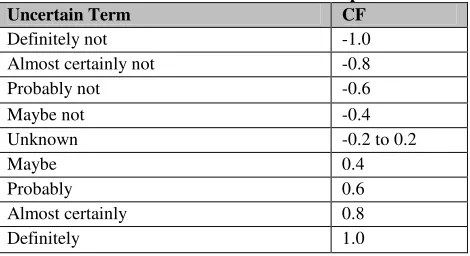
Certainty factor theory is a popular alternative to Bayesian reasoning. The basic principles of this theory were introduced by MYCIN, a diagnostic medical expert system [4, 11]. Certainty factors theory provides a judgmental approach to uncertainty management in expert system. An expert is required to provide a certainty factor, cf, to represent the level of belief in hypothesis H given that evidence E has been observed. The maximum value of the certainty factor was +1.0 (definitely true) and the minimum -1.0 (definitely false). Table 1 shows condition and the value of cf. The certainty factors method uses rules of the following form
IF E is true THEN H is true {cf}
Certainty factors are used if the probabilities are not known or cannot be easily obtained. Certainty theory can manage incrementally acquired evidence, the conjunction and disjunction of hypotheses, as well as evidences with different degrees of belief. Table 1 shows some basic uncertain terms.
Table 1. Uncertain terms and their interpretation
Uncertain Term CF
Definitely not -1.0
Almost certainly not -0.8
Probably not -0.6
Maybe not -0.4
Unknown -0.2 to 0.2
Maybe 0.4
Probably 0.6
Almost certainly 0.8
Definitely 1.0
2.4 Binary Tree Sort
Binary tree sort is a sort algorithm that builds a binary search tree from the keys to be sorted, and then traverses the tree (in-order) so that the keys come out in sorted order [7].
The algorithm of binary tree sort is as follows.
Algorithm Binary Tree Sort 1. tree = maketree(x[10]); 2. for (i = 1; i < n; i++) { 3. y = x[i]; 4. q = tree; 5. p = q;
6. while (p != null) { 7. q = p;
8. if (y < info(p)) 9. p = left(p); 10. else
12. }
13. if (y < info(q)) 14. setleft(q,y); 15. else
16. setright(q,y); 17. }
18. intrav (tree);
Figure 3. Algorithm of Binary Tree Sort
2.5 Balanced Binary Search Tree
The most efficient method of searching is the balanced binary searched tree [2, 9, 10]. Balanced binary search tree is a binary search tree (BST) that attempts to keep its height, or the number of levels of nodes beneath the root, as small as possible at all times, automatically [9, 10]. It is one of the most efficient ways of implementing ordered lists and can be used for other data structures such as associative arrays and sets.
Most operations on a binary search tree take time directly proportional to the height of the tree, so it is desirable to keep the height small. Ordinary binary search trees have the primary disadvantage that they can attain very large heights in rather ordinary situations, such as when the keys are inserted in sorted order.
Balanced binary trees solve this problem by performing transformations on the tree (such as tree rotations) at key times, in order to reduce the height.
3.
REAL TIME EXPERT SYSTEM SHELL
The combination of powerful searching and sorting algorithm in database, integrating two algorithms of knowledge acquisition in inference engine and supported by certainty factor calculation become a real time expert system shell (RTESS). The algorithm of RTESS can be seen in Figure 4.
Algorithm RTESS Input: Rules 1. Error checking; 2. While (error=0)
3. if (option method=forward) 4. forward_chaining; 5. if (option method=backward) 6. backward_chaining;
7. if (option method=forward & backward) 8. forward&backward_chaining; End
Figure 4. Algorithm of RTESS
In error checking procedure, this system checks the syntax of rule with cf and rule without cf. Syntax checking without cf is checking process that gets key string of rule which entered into system. There are 13 key string, namely: ACTIONS, FIND, RULE, IF, ‘=’, ASK, CHOICES, IMAGE, ‘;’, ‘:’, THEN, OR and AND. The combination of key strings in rule will be checked whether there is a syntax error or not. If there is a syntax error, then an informative error message will be displayed.
In RTESS, forward chaining is a method that take given set of rule then answer of given rule will be put into working memory. After that, each given rule will be checked, if rule premise produce true value then the result of the rule will be put into
working memory. Then, the rule status becomes true so it does not need to be checked again. The rule checking process will be started from the beginning. This process repeats until the goal value has been reached or set of rule already answered and there is no finding goal. The algorithm in Figure 5 show the algorithm of forward chaining.
Algorithm: Forward Chaining 1. Initialization.
Establish 3 empty tables, the Working Memory table, the Attribute-Queue table, and the Rule/Premise Status table. 2. Start inference.
Assign a value to a specific premise attribute, where this attribute must not appear in any conclusion clause.
3. Rule scan and check for convergence.
Examine the Rule/Premise Status table. If no rules are active, STOP. Otherwise, scan the active rule-set premise clauses for all occurrences of attribute on the top of the Attribute-Queue table, and record any changes in status of the premise clauses of active rule set.
a. If the premise of any rule is false then mark the associated rule as being discarded. Repeat this for all rules having a false premise. When complete, proceed to step 3b.
b. If the premise of any rule is true then mark the associated rule as being triggered and place its conclusion attribute and rule number at the bottom of the Attribute-Queue table. Repeat this for all rules having a true premise. When complete, proceed to step 3c.
c. If no rules are presently in the triggered state, go to step 5. Otherwise, go to step 4.
4. Rule firing.
Cross out the topmost attribute on the Attribute-Queue table. Change the status of the rule associated with the new topmost attribute from triggered to fired. Place the conclusion associated with the fired rule at the bottom of the Working Memory table. Return to step 3.
5. Queue status.
Cross out the topmost attribute on the Attribute-Queue table and proceed to step 6.
6. Convergence check and rule marking.
Scan the active rule set for any unmarked, active rule. If no such rules can be found, STOP. Otherwise, mark the first such rule found and go to step 7.
7. Query
For the most recently marked rule, query the user for the value of an attribute in any of the rule’s free premise clauses. If the user has a response then goes to step 8. Otherwise, continue this step for all remaining free premise clauses of the marked rule. If all such clauses have been examined without a user response, return to step 6.
8. Rule unmarking
Place the associated attribute and rule number on the top of the Attribute-Queue table. Unmark the most recently marked rule and return to step 3.
End
Figure 5. Forward Chaining Algorithm
Algorithm: Backward Chaining 1. Initialization.
Establish 3 empty tables, the Working Memory table, the Goal table, and the Rule/Premise Status table.
2. Start inference.
Specify a final goal. Place the associated goal attribute at the top of the Goal table.
3. Rule scan and check for convergence.
Scan the conclusion clause of the active rule to find any concurrence of the goal attribute presently on the top of the Goal table.
a. If the Goal table is empty, STOP.
b. If only one such rule may be found, go to step 6. If several such rules may be found, and any of these are triggered, select any one of the triggered rules and goal attribute in their conclusion clause set, then go to step 4.
4. Query.
For the goal attribute on top of the Goal table, find the associated query if one exists. If there is no query associated with this goal attribute, then STOP. Otherwise, query the the Rule/Premise Status table. Specifically, if the premise of any rule is false, discard that rule, and if the premise is true, trigger that rule. Return to step 3.
6. Rule evaluation.
a. If this rule is triggered, then remove the current topmost goal attribute from the Goal table and place it in the Working Memory table. Change the status of this rule from triggered to fired. Go to step 5. Otherwise proceed to step 6.
b. If this rule is not triggered, then select the first unknown premise attribute of the rule and place it at the top of the Goal table. Return to step 3.
End
Figure 6. Forward Chaining Algorithm
Mixed chaining method is a combination of forward chaining method backward chaining method. In this method, user will be given set of data that need to be answered. These will be done in forward chaining. Then, user can select the implementation of backward chaining if the data that need to be answered satisfies user needs and goal is still searching. Figure 7 shows the steps of mixed chaining method.
Step Rule (rule type) Facts (goals) Chaining (firing) performance of new RTESS using several thousand of rules. This system was built in Microsoft Visual C++ on a PC with 2.4 GHz Pentium ® 4 CPU and 1 GB of RAM under MS Windows XP Pro. Figure 8 is a screenshot for a simulation using tourism rule data.
Figure 8. Interface of RTESS
It shows a result of the process where the answer and its certainty factor is displayed. This system shows the result not only in text format, but in image as well.
Performance of RTESS
Figure 9. The Performance of RTESS
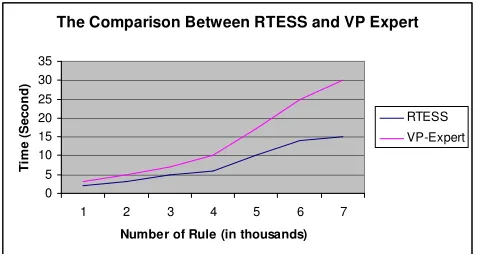
The Comparison Between RTESS and VP Expert
0 5 10 15 20 25 30 35
1 2 3 4 5 6 7
Number of Rule (in thousands)
T
im
e
(
S
e
c
o
n
d
)
RTESS
VP-Expert
Figure 10. The Comparison Performance between RTESS and VP Expert
Figure 10 shows the performance comparison between RTESS and VP Expert. It can be seen that RTESS outperforms the VP Expert.
5.
CONCLUSION
This paper deals with the implementation of balanced binary search tree and binary tree sort to support methods in inference engine – forward chaining, backward chaining and mixed chaining. The focus of this paper is to reduce running time and to display certainty factor of the result.
The emphasis of this paper was on feasibility – identification of possible approaches and development of methods to put them into practices.
We are currently working on the evaluation of performance and the reliability of methods proposed in this paper. Firstly, benchmarking for performance evaluation indicates for which method is the most efficient and effective from response time point of view. The next concern is the quality of the result.
6.
REFERENCES
[1] Angeli, C. 2000 Application of a real-time expert system for fault diagnosis. IEA/AIE 2000, LNAI 1821, pp 184-191. Springer-Verlag Berlin Heidelberg.
[2] Barnes, G. M., Noga, J., Smith, P. D. and Wiegley, J. 2005 Experiments with balanced-sample binary trees, ACM SIGCSE Bulletin, 37(1): 166-170.
[3] Dunning, B.B. and Switlik, J. 1988 A real-time expert system for computer network monitor and control. Database Summer pp 35-38.
[4] Giarratano, J.C. and Riley, G. 1994 Expert Systems: Principles and Programming, PWS Publishing Co., Boston, MA.
[5] Gunawan, F. 2008 Developing Expert System using Forward and Backward Chaining. Thesis. Petra Christian University
[6] Ignizio, J.P. 1991 Introduction to Expert Systems: The Development and Implementation of Rule-Based Expert Systems. Singapore:McGraw-Hill Book Co.
[7] Langsam, Y., Augenstein, M. J., and Tenenbaum, A. M. 1996 Data structure using C and C++, Prentice-Hall, New Jersey.
[8] Lee, K. C., Cho, H. R., and Kim, J. S. 2008 An expert system using an extended AND-OR graph. Knowledge-Based Systems, 21(1):38-51.
[9] Li, C. C. 2006 An immediate approach to balancing nodes in binary search trees, Journal of Computing Sciences in Colleges, 21(4): 238-245.
[10]Manthey, B. and Reischuk, R. 2007 Smoothed analysis of binary search trees, Theoretical Computer Science, 378(3):292-315.
[11]Negnevitsky, M. 2005 Artificial intelligence: a guide to intelligent systems, 2nd Ed., Addison Wesley, England. [12]Rybin, V.M., Rybina, G.V., Ochinsky, V.V., and Stepankov,
V.U. 1999 Real-time expert system for control of electrophysical complex. In Proc. of International conference on accelerator and large experimental physics control systems pp. 124-126.