All sources 76 Internet sources 64
Results of plagiarism analysis from 2018-02-19 09:34 UTC
Methane Fermentation Treatment Method.doc
[65]
123 matches from 79 sources, of which 79 are online sources.
TITLE OF THE INVENTION
METHANE FERMENTATION TREATMENT METHOD
BACKGROUND OF THE INVENTION
1. Field of the Invention
[0001] [17]The present invention relates to a methane fermentation treatment method for an
organic waste having a low nitrogen concentration.
2. Description of the Related Art
[0002] In the methane fermentation treatment, an organic waste is fermented with
methanogens under an anaerobic atmosphere and converted into methane gas. With this
treatment, the organic waste is decomposed to biogas and water, and hence, the organic waste
can be reduced remarkably. Further, the methane fermentation treatment has an advantage
of recovering methane gas to be generated as a by-product as energy.
[0003] Meanwhile, [35] the efficiency of the methane fermentation treatment is influenced by the
activity of bacteria which facilitate methane fermentation such as methanogen. One of the [35]
factors causing reduction of the activity of methanogen or the like is an increase in the
inhibiting material such as ammonia. Therefore, for example, as described in Japanese
Patent No. 3630165 (Claim 1), the fermentation state has been conventionally controlled so [48]
that the concentration of ammonia nitrogen in fermentation liquid falls within a predetermined
concentration.
[0004] Further, it is known that, due to the decrease in alkalinity of the fermentation liquid,
carbonate ions in the fermentation liquid in a methane fermentation tank cannot be buffered
any more, and the pH of the fermentation liquid decreases thereby lowering methane
fermentation performance. Therefore, there is employed a method of controlling the
value.
[0005] For [28] example, Japanese Patent Application Laid-open No. 2009-219960 (see Claim 3, [47]
paragraphs 0013 and 0020) discloses that, when the difference between the electrical
conductivity of fermentation liquid in a methane fermentation tank and the electrical
conductivity of an organic waste is at a predetermined value or less, methane fermentation is
performed while increasing alkalinity of the fermentation liquid. As one of the means for [27]
increasing alkalinity, there is a method involving adding another organic waste containing a
certain amount of nitrogen to an organic waste to be supplied to a methane fermentation tank
to increase the concentration of nitrogen, thereby increasing the amount of ammonia nitrogen
decomposed from the fermentation so as to increase the alkalinity.
[0006] Patent Publication 1: Japanese Patent No. 3630165 (Claim 1).
Patent Publication 2: [17]Japanese Patent Application Laid-open No. 2009-219960 (see
Claim 3, paragraphs 0013 and 0020).
[0007] In the case of subjecting an organic waste such as excreta and raw garbage to a
methane fermentation treatment, those containing a certain amount of nitrogen components
such as protein, the amount of nitrogen necessary for the activities of bacteria such as
methanogen can be ensured without adding a nitrogen component from outside.
[0008] However, in the case of subjecting an organic waste having a low nitrogen [58]
concentration in some of industrial liquid waste or the like to a methane fermentation
treatment with high-load operation, the amount of nitrogen necessary for the activities of
bacteria may not be ensured, and the activities of bacteria decrease due to the shortage of
nitrogen.
Therefore, in the case of subjecting an organic waste having a low nitrogen
concentration to a methane fermentation treatment with high-load operation, it is necessary to
[0009] Japanese Patent Application Laid-open No. 2009-219960 (see Claim 3, paragraphs [28]
0013 and 0020) discloses that another organic waste containing a certain amount of nitrogen
is added to an organic waste to be supplied to a methane fermentation tank in order to increase
the concentration of nitrogen, thereby increasing the amount of ammonia nitrogen
decomposed from the fermentation so as to increase alkalinity.
[0010] However, in the case of performing a methane fermentation treatment as described [25]
above, it is necessary to provide, in addition to a reservoir tank for an organic waste to be
treated, another reservoir tank for the organic waste containing a certain amount of nitrogen
separately, which enlarges the apparatus. Furthermore, [17] it is necessary separately to prepare
to bring another organic waste containing a certain amount of nitrogen, thus the shipping cost
or the like arises, resulting in an increased running cost.
[25]
SUMMARY OF THE INVENTION
[0011] [45]An object of the present invention is to provide a methane fermentation treatment
method which is capable of subjecting an organic waste having a low nitrogen concentration
to a methane fermentation treatment efficiently.
[0012] In order to achieve the above-mentioned [30] object, the present invention provides a
methane fermentation treatment method, including: supplying an organic waste [42] to a methane
fermentation tank to perform a methane fermentation treatment, the organic waste having a
ratio of a chemical oxygen demand concentration to a nitrogen concentration (COD/N ratio)
of 50 or more; taking out a fermentation liquid [12] from the methane fermentation tank by
predetermined amounts; separating [10] the fermentation liquid into a separated sludge and a
separated liquid; and returning at least a [42] part of the separated sludge to the methane
fermentation tank, characterized in that the method includes: measuring directly or indirectly [10]
tank; and controlling [10] an amount of the separated sludge returned to the methane fermentation
tank so that the concentration of the ammonia nitrogen exceeds a predetermined value.
[0013] In [14] the methane fermentation treatment method of the present invention, it is preferred
that the amount of the separated sludge returned to the methane fermentation tank be
controlled so that the concentration of the ammonia nitrogen in the methane fermentation tank
is 40 mg/L or more.
[0014] In [14] the methane fermentation treatment method of the present invention, it is preferred
that, when the amount of the ammonia nitrogen in the methane fermentation tank decreases to
a predetermined value or lower, the amount of the separated sludge returned to the methane
fermentation tank be increased, and in a case where the concentration of the ammonia
nitrogen does not exceed the predetermined value even when the amount of the separated
sludge returned to the methane fermentation tank reaches an upper limit, an ammonia nitrogen
contained in the separated liquid be supplied to the methane fermentation tank.
[0015] In the methane fermentation treatment [25] method of the present invention, it is preferred
that the organic waste be a palm oil mill effluent.
[0016] In a separated sludge obtained by subjecting a fermentation liquid taken out of a [21]
methane fermentation tank to a solid-liquid separation, nitrogen derived from cadaver of
bacteria such as methanogen flowing out of the methane fermentation tank, as well as
ammonia generated during the methane fermentation, and the like are contained to be
concentrated. An organic waste with a COD/N ratio of 50 or more has a very low nitrogen [10]
concentration, and hence, the activities of the bacteria are likely to be decreased due to the
shortage of nitrogen and the fermentation efficiency is likely to decrease with time. [32]
According to the present invention, the amount of the separated sludge to be returned to the
methane fermentation tank is controlled so that the concentration of ammonia nitrogen in the
Therefore, even when the methane fermentation treatment is performed with high-load
operation, nitrogen derived from cadaver of bacteria, ammonia, and the like contained in the
separated sludge are returned to the methane fermentation tank, which can suppress the
decrease in activities of the bacteria caused by the shortage of nitrogen, and enables the
methane fermentation treatment of the organic waste to be performed stably for a long period
of time.
[17]
BRIEF DESCRIPTION OF THE DRAWINGS
[0017] In [17] the accompanying drawings:
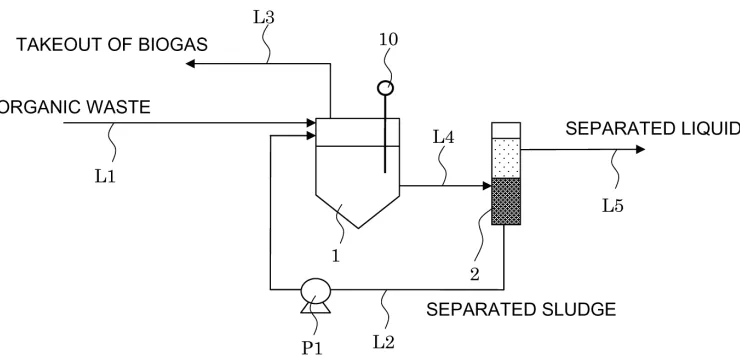
FIG. [10]1 is a schematic view of a treatment apparatus used in a methane fermentation
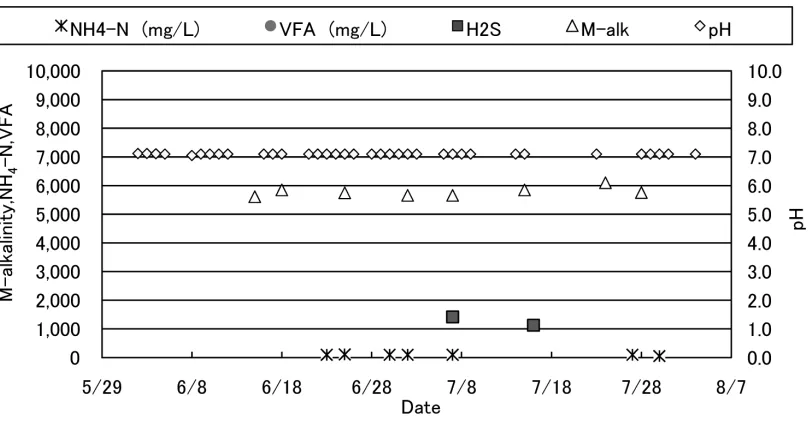
treatment of the present invention; and FIG. 2 is a diagram illustrating changes with time [34]
in pH, an alkalinity, an ammonia nitrogen concentration, a volatile aliphatic acid
concentration, and a hydrogen sulfide concentration of a fermentation liquid in a methane
fermentation tank in Example 1.
[34]
DETAILED DESCRIPTION OF THE PREFERRED EMBODIMENTS
[0018] One [28] embodiment of the methane fermentation apparatus used in the methane
fermentation treatment of the present invention isdescribed with reference to FIG. 1.
[0019] [10]As illustrated in FIG[36]. 1, the methane fermentation apparatus mainly includes a
methane fermentation tank 1 and a solid-liquid separation tank 2.
[0020] The [13] methane fermentation tank 1 is a treatment tank that subjects an organic liquid
waste supplied to the tank to an anaerobic treatment under the function of anaerobic bacteria,
such as methanogen, to decompose the liquid waste into biogas, such as methane gas. A [17]
pipe L1 extending from a supply source of an organic waste and a pipe L2 extending from a
portion of a side of the separation tank 2) are connected to the methane fermentation tank 1. [20]
Further, in the methane fermentation tank 1, a stirring device (not shown) for stirring
fermentation liquid in the tank and an ammonia meter 10 are disposed. Further, a pipe L3 [12]
for taking out biogas extends from an upper portion of the methane fermentation tank 1 and is
connected to a gas holder, a gas utilization facility, or the like.
[0021] There is no particular limit to the stirring device as long as the device is capable of
stirring the fermentation liquid in the tank. Examples of the stirring device include a stirrer
equipped with a stirring blade. Further, a mechanism in which a passage for circulating the
fermentation liquid in the tank is formed to generate an upward flow or a downward flow of
the fermentation liquid in the tank may be provided, and a gas stirring device for circulating
generated biogas to perform blow-bubbling may be provided.
[0022] There is no particular limit to the ammonia meter 10, and any meter capable of [61]
measuring the concentration of ammonia nitrogen in the fermentation liquid can be used.
Examples thereof include an electrode-type ammonia meter. Further, as [17] described in
Japanese Patent No. 3630165 and [17] Japanese Patent Application Laid-open No. 2009-219960, [27]
and the like, it is known that the electrical conductivity of the fermentation liquid has a
correlation with the concentration of ammonia nitrogen. Therefore, the ammonia meter 10 [27]
may be one that is capable of measuring the concentration of ammonia nitrogen in the
fermentation liquid indirectly by measuring the electrical conductivity of the fermentation
liquid.
[0023] In the latter stage [12] of the methane fermentation tank 1, the solid-liquid separation tank
2 is disposed. The [36] methane fermentation tank 1 and the solid-liquid separation tank 2 are
connected to each other via a pipe L4.
[0024] The solid-liquid separation tank 2 is not particularly limited as long as it has a
fermentation tank 1 into a separated liquid and a separated sludge by solid-liquid separation,
and solid-liquid separation tanks such as a gravity sedimentation tank, a centrifugal device,
and a membrane separation device can be used widely.
[0025] A pipe L5 for discharging a separated liquid extends from a side [17] of the solid-liquid
separation tank 2. Further, the pipe L2 extends from a lower portion (bottom portion in this [13]
embodiment) of the solid-liquid separation tank 2 to be connected to the methane
fermentation tank 1 via a liquid sending pump P1 so that at least a part of the separated sludge
can be returned to the methane fermentation tank 1.
[0026] Next, taking the case of using this methane fermentation apparatus as an example, [30]
the methane fermentation method of the present invention is described.
[0027] In [30] the methane fermentation treatment of the present invention, an organic waste
having a ratio of a chemical oxygen demand concentration to a nitrogen concentration
(COD/N ratio) of 50 or more, preferably about 65 to 80, is used as a material to be treated.
[0028] The organic waste has a very low nitrogen concentration, and hence, the shortage of [12]
nitrogen is likely to occur in the methane fermentation tank. In particular, the shortage of
nitrogen is likely to occur during high-load operation. [10]According to the present invention,
even in the case where an organic waste having a very low nitrogen concentration is subjected
to the methane fermentation treatment with high-load operation, methane fermentation occurs
at satisfactory efficiency for the reasons described below, and hence, such an organic waste
can be preferably used as a material to be treated. As such an organic waste, there is
exemplified an organic waste having a low protein content, and specific examples thereof
include palm oil mill effluent and alcohol liquid waste. The palm oil mill effluent refers to a [32]
cleaning effluent which is discharged as a result of cleaning of residues left after compressing
palm fruits and recovering palm oil. The palm oil mill effluent is an organic waste having a
[0029] [30]According to the present invention, an organic waste and a separated sludge are
supplied to the methane fermentation tank 1 through the pipes L1 and L2, respectively. Then, [63]
while stirring with the stirring means (not shown) continuously or intermittently so that the
concentration and temperature of the sludge of the fermentation liquid in the tank become
substantially uniform, the supplied organic liquid waste is retained for a predetermined period
of time to be subjected to methane fermentation under the function of anaerobic bacteria such
as methanogen.
[0030] The methane fermentation condition [10] is not particularly limited, and the methane
fermentation treatment is performed preferably under the conditions of an organic substance
load of 5 to 25 g/l/day and a residence time of 4 to 20 days, and particularly preferably under
the conditions of an organic substance load of 10 to 25 g/l/day and a residence time of 4 to 10
days. [10]In the present invention, even when an operation is performed at such a high speed
and a high load, the shortage of nitrogen does not occur in the methane fermentation tank, and
the methane fermentation treatment can be performed stably.
[0031] Then, [17] an equivalent amount of the fermentation liquid that of the organic liquid to
waste supplied to the methane fermentation tank 1 is pulled out through the pipe L4 and
supplied to the solid-liquid separation tank 2 in the latter stage. Further, biogas, such as [23]
methane gas generated when the organic waste is subjected to methane fermentation, is taken
out of the tank through the pipe L3 and reserved in a biogas holder (not shown) or the like.
[0032] In the [43] solid-liquid separation tank 2, the fermentation liquid taken out of the methane
fermentation tank 1 is separated into a separated liquid and a separated sludge by solid-liquid
separation. Then, at least a [13] part of the separated liquid is discharged outside the tank
through the pipe L5, and at least a part of the separated sludge is returned to the methane
fermentation tank 1 through the pipe L2.
fermentation tank, nitrogen derived from cadaver of bacteria, ammonia generated during
methane fermentation, and the like are concentrated. Therefore, when the separated [15] sludge
is returned to the methane fermentation tank 1, a nitrogen component contained in the
separated sludge is used as a nutrient and the like for the bacteria in the methane fermentation
tank.
[0034] [19]In the present invention, the amount of the separated sludge returned to the methane
fermentation tank 1 is controlled so that the concentration of ammonia nitrogen in the
methane fermentation tank 1 exceeds a previously set threshold value. In this embodiment, [15]
the amount of the separated sludge to be returned is controlled by regulating the drive of the
liquid sending pump P1 so that the measured value by the ammonia meter 10 exceeds an
threshold value.
[0035] It is preferred that [15] the amount of the separated sludge to be returned be controlled by
regulating the operation of the liquid sending pump P1 so that ammonia nitrogen in the
methane fermentation tank 1 exceeds the detectable limit. More preferably, the operation of [27]
the liquid sending pump P1 is regulated so that the concentration of ammonia nitrogen
reaches 40 mg/L or more, and particularly preferably, the operation of the liquid sending
pump P1 is regulated so that the concentration of ammonia nitrogen falls between 40 and 100
mg/L.
[0036] When ammonia nitrogen is detected [20] in the methane fermentation tank, it can be
conjectured that the shortage of nitrogen has not occurred in the tank and a nitrogen
component necessary for the activities of bacteria is present in the tank. If the concentration [19]
of ammonia nitrogen is 40 mg/L or more, the activity state of methanogen or the like can
become particularly favorable, and a higher methane fermentation efficiency can be expected. [38]
Further, in the case where an organic waste having a COD/N ratio of 50 or more is subjected
ammonia nitrogen increases too much. However, when the concentration of ammonia
nitrogen exceeds 2,500 mg/L, the activities of methanogen may be inhibited, and hence, the
upper limit of the concentration is preferably about 2,000 mg/L.
[0037] In the case where the concentration of ammonia nitrogen [14] in the methane
fermentation tank 1 does not exceed a threshold value even if the amount of the separated
sludge to be returned reaches the upper limit, it is preferred that the ammonia nitrogen
contained in the separated liquid be separated and recovered by a method, such as ammonia
stripping or an ion exchange membrane method, and returned to the methane fermentation
tank 1.
[0038] Thus, [11] according to the present invention, the amount of the separated sludge to be
returned to the methane fermentation tank is controlled so that the concentration of ammonia
nitrogen in the fermentation liquid in the methane fermentation tank 1 exceeds a threshold
value. Therefore, even when the methane fermentation [10] treatment is performed with
high-load operation, nitrogen derived from cadaver of bacteria, ammonia, and the like
contained in the separated sludge are returned to the methane fermentation tank so that the
amount of nitrogen necessary for the activities of the bacteria can be supplied. Therefore,
without setting a longer residence time; or without adding a nitrogen-containing compound [19]
such as ammonium carbonate, which may be converted into a nitrogen component, an organic
waste having high protein content such as raw garbage and excreta, or the like, an organic
waste can be subjected to the methane fermentation treatment at a high speed and a high load
over a long period of time while suppressing the decrease in the activities of bacteria caused
by the shortage of nitrogen. In addition, [23] there is no need separately to prepare to bring a
nitrogen-containing compound such as ammonium carbonate, which may be converted into a
nitrogen component, as well as an organic waste having high protein content such as raw
shipping cost; the cost for materials as they are; and the like can be avoided, and the [17]
operational cost can be reduced.
Example
[0039] (Example 1)
A methane fermentation treatment by an apparatus illustrated in FIG. 1 was
performed under the condition of a residence time of 10 days, with the use of palm oil mill a
effluent (COD/N ratio = 72) having a composition shown in the following Table 1. As the
methane fermentation tank 1, a tank with a capacity of 5 L was used. As the solid-liquid
separation tank 2, a gravity sedimentation tank 3 with a capacity of 0.5 L was used.
[0040] [Table 1]
TS mg/L 58,690
VS mg/L 48,250
BOD mg/L 54,000
CODcr mg/L 79,000
TOD mg/L 68,450
Kj-N mg/L 1,100
NH4-N mg/L 180
VFA mg/L 6,250
oil and Grease mg/L 6,700
C wt% 45.8
H wt% 6.42
N wt% 1.87
COD/N - 72
sewage test method-2.2.9. More specifically, [11] the TS concentration of the sample liquid was
obtained by dividing the amount of the remaining solid after drying at 110ºC by the original
volume of the sample liquid. Further, the VS [11] concentration of the sample was obtained by
subtracting the ash concentration, obtained by dividing the mass of the remaining solid (ash)
after heating at 600ºC±25ºC by the original volume of the sample, from the TS concentration
obtained above. Further, the COD/N ratio was calculated from CODcr/Kj-N (Kjeldahl
nitrogen) in Table 1.
[0042] To the methane fermentation tank 1,500 mL of palm oil mill effluent was charged per
day, and 125 mL of separated sludge (total solid (TS) concentration: 66,000 mg/L,
non-volatile organic substance (VS) concentration: 46,000 mg/L) was returned from the
solid-liquid separation tank 2. Further, the same amount (625 mL) [16] of the fermentation liquid
was pulled out of the methane fermentation tank 1 and introduced into the solid-liquid
separation tank 2. The pH, the alkalinity (M-alk), the concentration of ammonia nitrogen [14]
(NH4-N), the concentration of volatile fatty acid (VFA), and the concentration of hydrogen
sulfide (H S2 ) of the fermentation liquid in the methane fermentation tank 1 were measured.
FIG. 2 illustrates the results.
[0043] As illustrated in FIG. 2, during the methane fermentation treatment, the concentration [10]
of ammonia nitrogen of the fermentation liquid was 94 mg/L on average. There was no [49]
fluctuation in the pH, the alkalinity, the concentration of volatile aliphatic acid, and the
concentration of hydrogen sulfide, and thus, the fermentation state was stable.
Further, the VS concentration of the fermentation liquid in the methane fermentation [11]
tank, after the elapse of 31 days from reaching the condition of the residence time of 10 days
on the organic waste charged into the methane fermentation tank 1, was measured to be
17,000 mg/L, and the decomposition ratio of the VS was 69%.
An organic waste, in which 100 mg/L of ammonia nitrogen was added to a palm oil
mill effluent (COD/N ratio = 78) having a composition shown in Table 2, was subjected to a
methane fermentation treatment under the condition of a residence time of 8 days. It is
conjectured that the concentration of ammonia nitrogen of the organic waste was 144 mg/L.
[0045] [Table 2]
TS mg/L 46,400
VS mg/L 40,200
BOD mg/L 33,000
CODcr mg/L 56,000
TOD mg/L 62,540
Kj-N mg/L 720
NH4-N mg/L 44
oil and Grease mg/L 7,900
C wt% 49.2
H wt% 7.04
N wt% 1.71
COD/N - 78
[0046] After the elapse of 40 days of operation, the concentration of ammonia nitrogen [16] of
the fermentation liquid in the methane fermentation tank was measured to be 60 mg/L on
average.
It is conjectured from the above result that, if ammonia nitrogen was not added, [20]
ammonia nitrogen was not detected in the fermentation tank caused by the shortage of
WHAT IS CLAIMED IS:
1. A [53] methane fermentation treatment method, comprising:
supplying an organic waste to a methane fermentation tank to perform a methane [53]
fermentation treatment, the organic waste having a ratio of a chemical oxygen demand
concentration to a nitrogen concentration (COD/N ratio) of 50 or more;
taking out a fermentation liquid from the methane fermentation tank by
predetermined amounts;
separating e fermentation liquid into a separated sludge and a separated liquid; and th [25]
returning at least a part of the separated sludge to the methane fermentation tank,
characterized in thatthe method comprises[13]:
measuring directly or indirectly a concentration of ammonia nitrogen in the
fermentation liquid in the methane fermentation tank; and [11]
controlling an amount of the separated sludge returned to the methane fermentation
tank so that the concentration of the ammonia nitrogen exceeds a predetermined value.
2. A [13] methane fermentation treatment method according to claim 1, wherein the
amount of the separated sludge returned to the methane fermentation tank is controlled so that
the concentration of the ammonia nitrogen in the methane fermentation tank 40 mg/L or is
more.
3. A methane fermentation treatment method according to claim 1 or 2, wherein [14]
when the amount of the ammonia nitrogen in the methane fermentation tank decreases to a
predetermined value or lower, the amount of the separated sludge returned to the methane
fermentation tank is increased, and in a case where the concentration of the ammonia nitrogen
returned to the methane fermentation tank reaches an upper limit, an ammonia nitrogen
contained in the separated liquid is supplied to the methane fermentation tank.
4. A methane fermentation [17] treatment method according to any one of claims 1 to 3,
ABSTRACT OF THE DISCLOSURE
Provided is a methane fermentation treatment method which is capable of subjecting
an organic waste having a low nitrogen concentration to a methane fermentation treatment
efficiently. [35]The methane fermentation treatment method includes: supplying an organic [35]
waste to a methane fermentation tank to perform a methane fermentation treatment, the
organic waste having a ratio of a chemical oxygen demand concentration to a nitrogen
concentration (COD/N ratio) of 50 or more; taking out a fermentation liquid from [35] the methane
fermentation tank by predetermined amounts; separating the fermentation liquid into a
separated sludge and a separated liquid; and returning at least a part of the separated sludge to
the methane fermentation tank, characterized in that the method includes: measuring directly [35]
or indirectly a concentration of ammonia nitrogen in the fermentation liquid in the methane
fermentation tank; and controlling an amount of the separated sludge returned to the methane
fermentation tank so that the concentration of the ammonia nitrogen exceeds a predetermined