• Tidak ada hasil yang ditemukan

methane hydrates brief final

N/A
N/A
Protected

Academic year: 2017

Membagikan "methane hydrates brief final"

Copied!
4
0
0

Teks penuh

(1)

THE

A

C

ADEMIES

NATIONAL

IN BRIEF

REPORT

National Academy of Sciences • National Academy of Engineering • Institute of Medicine • National Research Council

Council evaluated the Program’s research projects and management processes since its congressional reautho-rization in 2005 and developed recommendations for its future research and development initiatives.

Producing Methane from

Methane Hydrate: Global

Research Challenges

Although several nations, including the United States, have extensive, ongoing methane hydrate research programs, consider-ably more information is needed about this “unconventional” energy resource before commercial production can be realized (Box 1). Some important research challenges related to eventual production of methane from methane hydrate include:

● Establishing proven engineering techniques for sustained production of methane gas from solid methane hydrate.

N

atural gas, composed mostly of methane, is the cleanest of all the fossil fuels, emitting 25-50% less carbon dioxide than either oil or coal for each unit of energy produced.1 In recent

years, natural gas supplied approximately 20-25% of all energy consumed in the United States. Methane hydrate is a potentially

enormous and as yet untapped source of methane. The Department of Energy’s Methane Hydrate Research

and Development Program has been tasked since 2000 to implement and coordinate a national methane hydrate research effort to stimulate the development of knowledge and technology necessary for commercial produc-tion of methane from methane hydrate in a safe and environmentally responsible way. At the request of Congress, the National Research

Realizing the Energy Potential of

Methane Hydrate for the United States

The U.S. Department of Energy (DOE) is leading the national effort to conduct research on the potential of augmenting U.S. energy supplies with methane from methane hydrate, a naturally occurring solid form of methane and water found in Arctic permafrost areas and under the sea along most of the world’s offshore continental margins. Studies sup-ported through the DOE have advanced understanding of how to identify, drill, and produce methane from methane hydrate and have generated optimism that producing the methane is technically feasible. However, critical questions remain in several areas, includ-ing the most appropriate production technologies, inadequate understandinclud-ing of the environmental consequences, and the expected volumes of recoverable methane resulting from production of methane from methane hydrate.

1 http://www.eia.doe.gov/bookshelf/brochures/greenhouse/ Chapter1.htm

Figure 1. Methane hydrate layered in a one-centimeter thick sample from the Southern Hydrate Ridge, below the sealoor off the U.S. northwest coast.

(2)

years has been guided by two general aims: (1) to conduct an initial assessment of the potential for commercial development of methane from methane hydrate resources, speciically on the Alaska North Slope (Figure 2), and (2) to demonstrate the recov-erability of methane from marine methane hydrate-bearing deposits, primarily through work in the Gulf of Mexico. Field, experimental, and modeling projects supported by the program have all contributed to addressing these aims, with more than 40 different research projects either completed or underway since 2000.

Field Research

Comprehensive ield projects in Arctic Alaska and the Gulf of Mexico have been coordinated through multi-disciplinary efforts. These projects have focused on identifying and assessing potential methane hydrate resources, drilling and sampling methane hydrate, and developing new equipment to measure the properties of natural methane hydrate samples. On the Alaska North Slope, an initial drill test to try to produce methane from methane hydrate was also initiated.

Experimental, Modeling, and Remote Sensing Research

Experimental and modeling research sup-ported by the Program has also added to the ability to evaluate methane hydrate resources and to help predict how methane hydrate will behave during production. Because extracting and preserving methane hydrate in nature for future laboratory ● Determining the best way to locate methane

hydrate and the volume and extent of potentially recoverable methane from a methane hydrate deposit.

● Understanding the response of methane hydrate to drilling and production and establishing safe and reliable production methods speciic to this resource.

The Department of Energy’s Methane

Hydrate Research and Development Program

In light of the scientiic challenges posed by methane hydrate for the international research community, the Program has supported and managed a high-quality research portfolio that has enabled signiicant progress toward the Program’s long-term goals. The Program’s research in recent

Methane hydrate is considered an “unconventional” natural gas resource because of the signiicant tech-nical challenges related to recovering the methane. Conventional natural gas ields trap gas in large pockets in the subsurface by solid rock layers, usually at considerable depths below the surface. Methane hydrate, however, occurs in fairly loose sediments nearer to the land surface or sealoor where the solid, ice-like hydrate structure serves as the trap for individual methane molecules. The extraction of methane as a gas from this solid “cage” requires changing the temperature, pressure, or chemistry of the methane hydrate and creates major technical challenges to sustain the low of methane gas once the process has been started. These challenges make it

especially important to identify the extent and poten-tial total volume of methane in a deposit as accurately as possible.

The production of methane from methane hydrate also involves potential drilling and production safety issues and environmental consequences. Production safety issues are sometimes called “ geohazards” because they refer to adverse geologic and environ-mental consequences that may result from human disturbance of the methane hydrate and surrounding sedimentary layers. Drilling and production safety requires more information and experience about how methane hydrate will react in the subsurface when its solid structure is physically or chemically altered to recover methane.

Box 1 How “Unconventional” Methane Hydrate Differs from Conventional” Natural Gas Figure 2. Methane hydrate dispersed through sand deposits

from the Alaska North Slope.

(3)

analysis is technically quite dificult, an ongoing challenge for these studies is to synthesize repeat-able samples in the laboratory that are similar to natural methane hydrate. New remote sensing methods (technologies used to “remotely” detect and characterize subsurface methane hydrate occurrences) and ways to analyze the data gener-ated by these methods have also been tested through the Program’s research.

Findings

The report found that the Program’s manage-ment has been consistent and effective during the past ive years: the program has worked to increase the success of the research it funds, has supported education and training of young researchers, and has enhanced collaborative efforts with other research entities, including other federal agencies, universities, industry, and national laboratories. The Program has also strengthened the transparency of its activities, notably through implementation of a peer-review process for ongoing research projects and increased communication with the public and the global research community through the Program Web site and other outlets. Important opportunities also exist for advancing research through interna-tional collaboration and, while

challenging to develop, the extent of the Program’s international engagement is expanding slowly.

The report also provides a posi-tive evaluation of the Program’s scientiic progress to date. A wide variety of domestic projects in collabo-ration with a range of external research groups have been successful overall, with particular advances made through the large ield projects. Although many scientiic, engineering, and environ-mental questions in methane hydrate research remain to be answered before methane from methane hydrate can be considered a proven energy source, the technical challenges identiied in the report were found not to be insur-mountable, as long as sustained, national commitment and support for the necessary research continue.

Recommendations

To better meet its goals of assessing the potential of the long-term production of methane from methane hydrate, DOE should aim to expand future research in several areas: (1) the designing and demonstrating of production technologies in the ield that can sustain the low of methane gas from methane hydrate deposits over long periods of time; (2) evaluating and predicting the environmen-tal and safety issues related to production of methane from methane hydrate; (3) reducing the uncertainty that remains in locating and identifying the size of methane hydrate deposits, including the potential volume of methane that might be

Box 2 Global Environmental Considerations Related to Methane Hydrate

At present, methane hydrate’s role in past or future climate change remains unclear. Methane itself is a potent greenhouse gas and is always present in the Earth’s atmosphere at varying concentrations. On the other hand, when methane is burned for energy, it produces less carbon dioxide—another key greenhouse gas—than most fossil fuels.

Natural seepage of methane from methane hydrate has always occurred, but understanding the impacts of methane on the global environment and natural methane leakage from methane hydrate reservoirs is an enormous scientiic challenge. A baseline measure-ment of methane’s natural luxes is one of many pieces still missing from our understanding of methane hydrate. At this point, even conirming that methane hydrate is a source of natural methane leakage in permafrost areas or on the sealoor is enormously dificult.

As compelling as these challenges are, however, the report empha-sizes the importance for the program to prioritize understanding of the potential environmental and safety issues related speciically to production of methane from methane hydrate. More general investiga-tions of the role of methane hydrate in the global carbon cycle should be pursued in collaboration with other agencies, as this issue, while of great scientiic interest, is not central to the Program’s goal.

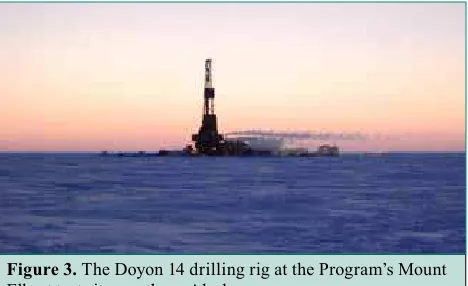
Figure 3. The Doyon 14 drilling rig at the Program’s Mount Elbert test site, northern Alaska.

(4)

extracted, and the way methane hydrate might behave or change during production.

To support the design of production technologies, the report recommends long-term ield production tests in different locations (Figure 4), as well as monitoring the behavior of methane hydrate deposits and surrounding sediments before, during, and after production.

Advances have been made in employing “remote sensing” techniques, conducting laboratory experiments, and computer modeling of methane hydrate to determine the location and quantity of methane hydrate deposits and how methane hydrate might behave when it is disturbed during produc-tion. However, substantial challenges remain to improve the accuracy and reliability of these assessments. Collecting new physical data both in the laboratory and in the ield and developing new tools and models to improve data quality and analysis were recommended as areas of future research focus for the Program.

Committee on Assessment of the Department of Energy’s Methane Hydrate Research and Development Program: Evaluating Methane Hydrates as a Future Energy Resource: Charles Paull (Chair), Monterey Bay Aquarium Research Institute (Chair from 8/7/09 to present); Scott R. Dallimore, Geological Survey of Canada;

Gonzalo Enciso, Shell Exploration and Production Company; Sidney Green, University of Utah, Salt Lake City;

Carolyn A. Koh, Colorado School of Mines, Golden; Keith A. Kvenvolden, U.S. Geological Survey (Retired);

Charles Mankin, Oklahoma Geological Survey (Retired); William S. Reeburgh, University of California, Irvine (Chair from 6/26/08 to 8/7/09; Retired); Michael Riedel, Geological Survey of Canada; Elizabeth A. Eide (Study Director), Deborah Glickson (Associate Program Oficer), Courtney R. Gibbs (Program Associate), Nicholas D. Rogers (Research Associate), National Research Council.

Committee on Earth Resources: Murray W. Hitzman (Chair), Colorado School of Mines, Golden;

James A. Brierley, Brierley Consultancy LLC; William S. Condit, Independent Consultant; Elaine T. Cullen, NIOSH Spokane Research Laboratory (Retired); Gonzalo Enciso, Shell Exploration and Production Company; Michelle Michot Foss, University of Texas at Austin; Donald Juckett,

American Association for Petroleum Geologists (Retired); Ann S. Maest, Stratus Consulting;

Leland L. Mink, U.S. Department of Energy Geothermal Program (Retired); Norman H. Sleep,

Stanford University; Samuel J. Traina, University of California, Merced; Elizabeth A. Eide (Senior Program Oficer), Nicholas D. Rogers (Research Associate), Eric J. Edkin (Senior Program Assistant), National Research Council.

The National Academies appointed the above committee of experts to address the speciic task requested by the Department of Energy. The members volunteered their time for this activity; their report is peer-reviewed and the inal product signed off by both the committee members and the National Academies. This report brief was prepared by the National Research Council based on the committee’s report. Copies of Realizing the Energy Potential of Methane

Hydrate for the United States are available from the National Academies Press, 500 Fifth Street, NW, Washington,

D.C. 20001; (800) 624-6242; www.nap.edu.

Figure 4. Worldwide locations of methane hydrate show the location of sampled and inferred deposits beneath the sealoor near coastlines and below the surface in permafrost regions. “Inferred” deposits have not been sampled, but testing in the location suggests that methane hydrate is present below the sealoor or permafrost.

Modiied from Keith Kvenvolden et al., U.S. Geological Survey

Recovered gas hydrate samples Inferred gas hydrate occurrences

Permission granted to reproduce this brief in its entirety with no additions or alterations. Permission for images/igures must be obtained from their original source.

Gambar

Figure 2. Methane hydrate dispersed through sand deposits from the Alaska North Slope.Photo from U.S
Figure 3. The Doyon 14 drilling rig at the Program’s Mount
Figure 4. Worldwide locations of methane hydrate show the location of sampled and inferred deposits beneath the sealoor near coastlines and below the surface in permafrost regions

Referensi

Dokumen terkait

The thermal conductivity methane sensor can detect methane concentration that measures the thermal conductivity coefficient of the measured methane different from the background

DMTM route (i): free-catalyst process of methane direct partial oxidation to methanol by oxygen (i.e. homogeneous process).. The use of other oxidants in catalyst-free process

This National Research Council report reviews current methods for assessing sea turtle populations and fi nds that although counts of sea turtles are essential, more

Scientists face the challenge of identifying trends in loods and droughts and predicting future shifts in hydrology as climate continues to change, but also need to communicate

Likewise, decades of methane sampling in Lake Stechlin in Germany had been restricted to the sediment and bottom water, and the methane peak in the oxic metalimnion was not discovered

The actual methane potential of the HHW household waste was calculated by subtracting the ultimate methane production accumulated in the headspace of the bottles with the samples from

One of the technologies to mitigate greenhouse gas emissions on agricultural land is through the use of natural materials as an inhibitor for the formation of methane and nitrous oxide

A calculation of methane CH4 emissions in the generation of paper waste is carried out in order to determine the methane emissions from the generation according to the characteristics