55
Assessment of Prescribing Indicators in Public and Private
Primary Healthcare Facilities in Java Island, Indonesia
Penilaian Indikator Peresepan di Fasilitas Kesehatan Primer Pemerintah dan Swasta di Pulau Jawa, Indonesia
Yuyun Yuniar*, Andi Leny Susyanty, Ida Diana Sari
Pusat Penelitian dan Pengembangan Sumber Daya dan Pelayanan Kesehatan, Badan Penelitian dan Pengembangan Kesehatan, Kementerian Kesehatan RI, Indonesia
*Email: [email protected]
Submitted: 26 September 2016 Revised: 14 February 2017 Accepted: 21 February 2017
Abstract
Prescribing indicator is an easy core indicator to evaluate drug utilization as stated in WHO guideline. Rational prescribing pattern is important to improve rational use of drugs whereas irrational prescribing pattern can lead to irrational drug use. This study aimed to assess the prescribing pattern in public and private primary healthcare facilities which were included in the National Health Insurance Program in Indonesia. This study has been conducted using the cross sectional research design, quantitative and retrospective method in four provinces in Java island (West Java, Banten, DIY and Central Java provinces) from May to July 2014. The method of retrospective data collection were collected 757 prescriptions from 26 PHCs and 900 prescriptions from 30 clinics or General Practitioners (GPs). All data in the prescribing form were analyzed manually using Microsoft Excel 2007. The average number of item in public and private facilities was 3.31 and 3.06 respectively. The percentage of generic prescribing was 93.3% and 62.0%, the percentage of drugs in accordance with the 2013 national formulary was 89.0% and 64.5%, the percentage of antibiotic per total number of encounter was 42.8% and 39.4%, while the percentage of injection per total encounter was only 0.7% and 2.2%. Paracetamol and dexamethasone were the most frequently prescribed drugs while for antibiotic group were amoxicillin, ciprofloxacin, cotrimoxazole and cefadroxil.The average number of items per encounter and antibiotic were not met the WHO standard(≤3 for average number and less than 30% for antibiotic percentage). Suitable interventions are needed to improve the prescribing practices in Indonesia.
Keywords: Prescribing indicator; Prescribing pattern; Rational drug use; Primary healthcare
Abstrak
Indikator peresepan merupakan salah satu indikator utama yang mudah digunakan untuk mengevaluasi penggunaan obat seperti yang dinyatakan dalam pedoman WHO. Pola peresepan yang rasional penting untuk meningkatkan penggunaan obat rasional, sedangkan pola peresepan yang tidak rasional dapat menyebabkan penggunaan obat yang tidak rasional. Penelitian ini bertujuan untuk menilai pola peresepan di fasilitas kesehatan primer pemerintah dan swasta yang ikut serta dalam progam Jaminan Kesehatan Nasional (JKN) di Indonesia. Desain penelitian adalah potong lintang, kuantitatif dan dilakukan secara retrospektif dilakukan di 4 provinsi di pulau Jawa ((Jawa Barat, Banten, Jawa Tengah dan DIY) pada bulan Mei-Juni 2014. Penelitian ini mengumpulkan 757 resep dari 26 puskesmas dan 900 resep dari 30 klinik dan praktek dokter. Rerata jumlah item obat di puskesmas dan fasilitas swasta berturut-turut 3,31 dan 3,06. Persentase peresepan obat generik 93,3% dan 62,0%, persentase peresepan obat sesuai formularium nasional 2013 sebesar 89,0% dan 64,5%, persentase peresepan antibiotik dari seluruh lembar resep 42,8% dan 39,4%, sedangkan persentase injeksi dari seluruh lembar resep hanya 0,7% dan 2,2%. Parasetamol dan deksametason merupakan obat yang paling sering diresepkan, sedangkan pada golongan antibiotik yaitu amoksisilin, siprofloksasin, kotrimoksazol dan sefadroksil. Jumlah rerata item obat per lembar resep dan persentase peresepan antibiotik masih belum memenuhi standar yang ditetapkan WHO (≤ 3 untuk rerata item dan kurang dari 30% untuk persentase antibiotik). Intervensi yang tepat diperlukan untuk memperbaiki praktek peresepan di Indonesia.
Kata kunci : Indikator peresepan; Pola peresepan; Penggunaan obat rasional; Fasilitas kesehatan primer
56
INTRODUCTION
The use of drugs either in the facility and the community are necessary to be evaluated regularly in order to define the improvement of drug utilization. The specific assessments of drug use in health facilities are listed in WHO guidelines. There are several useful indicators including prescribing indicators, patients care indicators and facility indicators. Prescribing indicators consist of average number of drugs per encounter, percentage of drugs prescribed by generic name, percentage of encounters with an antibiotic prescribed, percentage of encounters with an injection prescribed and percentage of drugs prescribed from an essential drugs list or formulary. Patient care indicators consist of average consultation time, average dispensing time, percentage of drugs actually dispensed, percentage of
drugs adequately labeled and patient’s
knowledge of correct dosage. Mean while, facility indicators only consist of availability of a copy of the essential drugs listor formulary and availability of key drugs.1
Prescribing indicator is an essential indicator to measure drug utilization in health facilities. The use of drugs in health
facilities depends mostly on the
prescription from physician. Prescriptions are the main source to measure the behavior of health provider especially in pharmaceutical practices. This indicator can be measured one time or across time, either using retrospective or prospective method1. Prescribing indicator becomes a valuable sign of rational drug use problems. Rational use of drug refers to the condition when patients get drugs according to required clinical condition, with proper dose, for a sufficient period and at affordable economic cost.2National Health Insurance (NHI) program has been implemented in Indonesia since 2014. One of its purposes is to control quality and cost in medication including drug use, which is also relevant to rational drug use program. The 2011 world medicine
situation report raised the issue on drug use
problems. The problems involved
suboptimal use of drugs which had been ongoing for more than 20 years without significant changes and showed worse situation in private than in public sectors.3
This study aimed to assess the prescribing indicatorsin some primary healthcare facilities in several provinces in Java. Java is the highest populated island in Indonesia where most facilities are also available. The result of this assessment reflected a great picture of prescribing pattern in Indonesia although it cannot be generalized directly as the sampling procedure did not follow a statistical calculation to represent Indonesia as a whole. By knowing the evidence based pattern of prescription in primary healthcare facilities, the issues in drug rational use including of polypharmacy, overprescribing of antibiotics and other related problems will be clearly depicted. As a result it is hoped to encourage the
government’s and community’s awareness
to overcome the problem by implementing proper interventions.
METHOD
Study setting
57
the recommendation from the health district authorities.
Study design
This study has been conducted from May to July 2014 using the cross sectional research design to describe the prescribing indicators at Primary Healthcare facilities.
Data collection and analysis
The method of retrospective data collection were collected 757 prescriptions from 26 PHCs and 900 prescriptions from 30 clinics or GPs. The prescriptions sample was selected from the day of survey retrospectively until reaching 30 encounters. Data, including name, age, and drugs prescribed were recorded for each patient encounter using the prepared prescribing indicator form. All data in the prescribing form were analyzed manually using Microsoft Excel 2007.
Prescribing indicators
The WHO prescribing indicators were used in this study. The prescribing indicators covered average number of drugs prescribed per encounter which is calculated by dividing the total number of drug items by the number of encounters in the survey; percentage of drugs prescribed by generic name which is calculated by dividing the number of drugs prescribed by generic name by total number of drugs prescribed and multiplied by 100; percentage of drugs prescribed from a National Essential Drug List (NEDL) which is calculated by dividing number of drugs prescribed (in generic name) which are listed in NEDL by the total number of drugs prescribed, multiplied by 100; percentage of encounters with antibiotic prescribed is calculated by dividing the number antibiotics prescribed by the total number of encounters surveyed, multiplied by 100; percentage of encounters with an injection prescribed calculated by dividing the number injections prescribed by the total number of encounters surveyed, multiplied by 100. used in this research was the 2013 National Formulary (NF). The reason was because the facilities selected were those which have signed contract with Healthcare and Social Security Agency as known as Badan Penyelenggara Jaminan Sosial Kesehatan (BPJSK). In this case the 2013 NF was used as the guideline to conform whether a drug in generic name or a generic name of branded one was listed or not. Therefore, the NF is used for selecting drugs procurement in health facilities.
Antibiotics are molecules that kill, orstop the growth of, microorganisms, including both bacteria and fungi. Antibiotics that kill bacteria are called "bactericidal". Antibiotics that stop the
growth of bacteria are called
"bacteriostatic". Drugs such as penicillin, antibacterial, anti-infective dermatological drugs, and anti-infective ophthalmological agents, antidiarrhea drugs with strepto-mycin, neostrepto-mycin, and metroni-dazole are considered antibiotics when used in the context of antibiotics.
Primary Healthcare facilities are healthcare facilities such as public health center, clinic, and general practitioner which had cooperation with BPJSK as a gate keeper in conducting health services.
Ethical approval
The data used for making this manuscript is a part of a research entitled
“The Implementation of Healthcare in the
Framework of A National Social Security
System”, conducted in 2014. Ethical
approval was obtained from the
Institutional Review Board at National
Institute of Health Research and
58
of Indonesia numbered LB.02.01/5.2/ KE.141/2014.
RESULTS AND DISCUSSION
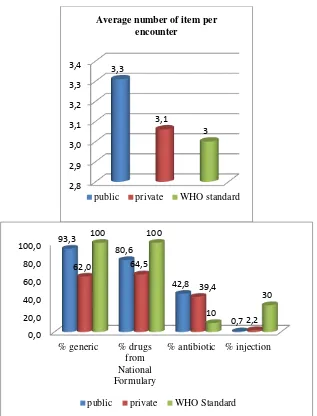
The calculation of prescribing indicator showed the range number of item per encounter in public sector was 2.77-4.13 and 1.67-4.07 in private sector. The average number of item in public facilities was 3.31 while in private facilities was
3.06. The percentage of generic
prescribing in public and private facilities was 93.3% and 62.0% respectively. The percentage of drugs listed in the national formulary in public and private facilities was 80.6% and 64.5% respectively. The
percentage of antibiotic prescribing was 42.8% of the total encounter in public facilities and 39.4% in private facilities while the percentage of injection prescribing in public and private facilities respectively was 0.7% and 2.2% of the total encounters. The result is shown in figure 1. Prescribing indicators were different in public and private facilities. The most significant differences were the name and listing of prescribed drugs, the generic and national formulary prescribing. Public facilities prescribed had higher percentage of generic drugs and drugs listed in the national formulary.
Figure 1. Prescribing indicators in public and private healthcare facilities
2,8 2,9 3,0 3,1 3,2 3,3
3,4 3,3
3,1
3 Average number of item per
encounter
public private WHO standard
0,0 20,0 40,0 60,0 80,0 100,0
% generic % drugs from National Formulary
% antibiotic % injection
93,3
80,6
42,8
0,7
62,0 64,5
39,4
2,2
100 100
10
30
59
Public facilities relied on drug supply from the government supplied through district health office. Therefore, the stock of drugs in every PHCs mainly consisted of generic preparation and conformed to regulations such as the national essential drug list or the national formulary. The ministry of health has introduced the national formulary 2013 as a guideline of drug items provided in both primary and referral health facilities.4 The national formulary has been revised continuously to meet the need of public health. The obligation of public health facilities to use generic drugs has been stated in the ministry decree.5 In contrast, private health facilities had more privilege whether or not to use generic drugs and the NEDL until the NHI program started. The NHI program demands every health facilities to use more generic drugs in accordance to the national formulary, regardless of their status.
The average number of item per encounter in public health facilities was higher than private health facilities. In many items in private facilities were branded combination drugs which were counted as one item. Meanwhile, in public facilities most items were single drugs written by generic name. In contrast, the variations of item in public health facilities were usually more limited than private facilities, because they emphasized more on generic drugs. The average number of items and the percentage of antibiotic in Indonesia have not changed much from 1993. The average number of item was 3.3 in 1993 and 3.79 in 2010 while the percentage of antibiotic was 43% in 1993 and 46.22% in 2010.6,7 In contrast, the percentages of generic prescribing and injection per encounter have changed significantly. The percentage of generic prescribing especially in public facilities
has risen far above the 1993’s number
which was close to the ideal standard of WHO (100%).7,8 The percentage of injection per encounter has changed
dramatically from 1993 and it has reached
the WHO standard (≤10).8
The WHO standard for average number
of item per encounter is ≤3 while the result
was still higher than it both for public and private facilities. Compared with other countries, the average number of item in Indonesia was still higher than Ethiopia, Sudan, Kalahari, India, Malaysia, Nepal and Egypt. The average number of items in Indonesia was similar to Iran, Bahrain and Nigeria.8,9 The percentage of drugs prescribed in generic name and the percentage of drugs prescribed in accordance with the national formulary in public health facilities almost met the WHO criteria (100%), yet the private facilities still unmet them.The percentage of generic prescribing in this research was quite similar with Egypt and Ethiopia.8, 9 Many countries had the percentage of essential drug list (EDL) prescribing that were close to WHO standard whereas Malaysia reached 100 percent of EDL prescribing.8-12 The percentages of antibiotic prescribing were 42.8% in public facilities and 39.2% in private ones, while the WHO standard was less than 30% and the world data was less than 40%.3,8,13-15 The data in some other countries also showed higher percentage compared with the standard. India and Ethiopia showed a
conforming percentage in primary
healthcare facilities but it was twofold higher in hospitals. The percentage of injection prescribing in public and private
facilities met the WHO standard
(<10%).8,16,17
60
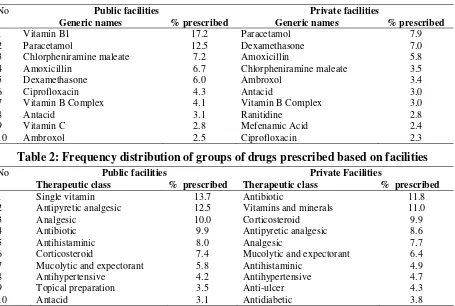
interesting part is that antibiotic ranked as the most frequent group prescribed in private sector, while in public sector was vitamin. Antipyretic analgesic, anti-histamine, mucolytic and expectorant, and corticosteroid were frequently prescribed.
The combination of these groups,
sometimes attributed with antibiotic and vitamin, is commonly used for acute respiratory infection cases as the most
common illness in Indonesia.
Antihypertensive as the only group for degenerative diseases, was listed as one of them. It inferred that prevalence of hypertension continuously rises across time.18-20
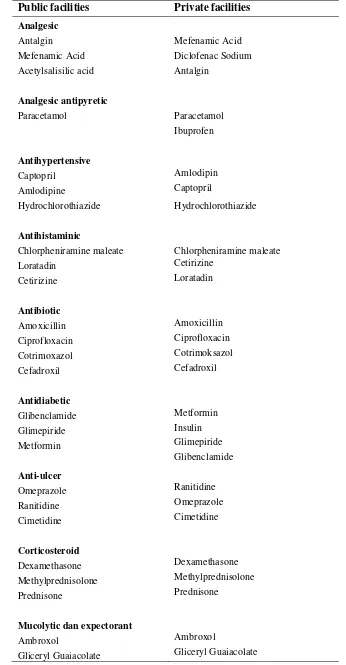
The most frequently prescribed drugs based on their classifications both in public and private sector were also similar which can be seen in table 3. Almost all items for each group are similar in two different types of facilities, for examples in antibiotic group; the most frequently items prescribed were amoxicillin, ciprofloxacin, cotrimoxazol, and cefadroxil. Other groups
also reflected the same items. In accordance with the common illnesses in Indonesia, it implied the pattern of the
most commonly prescribed drugs
regardless of the facility setting. Table 2 shows that a group of drugs most frequently prescribed in public and private facilities are analgesic, antipyretic analgesic, antihypertensive, antihistaminic, antibiotic, antidiabetic, anti-ulcer, corticosteroids, mucolytic and expectorant, topical preparations, and single vitamin.
The groups of drugs with generic names which were most frequently prescribed in both public and private facilities are described in table 3. The result showed the differences between public and private facilities were only in the prescribing indicator but when it broke down into the items in the prescription in generic names, the pattern of the prescription were relative similar.
The most frequently drugs prescribed in Indonesia were similar when compared
Table 1: Frequency distribution of prescribed drugs based on facilities
No Public facilities Private facilities
Generic names % prescribed Generic names % prescribed
1 Vitamin B1 17.2 Paracetamol 7.9
2 Paracetamol 12.5 Dexamethasone 7.0
3 Chlorpheniramine maleate 7.2 Amoxicillin 5.8 4 Amoxicillin 6.7 Chlorpheniramine maleate 3.5
5 Dexamethasone 6.0 Ambroxol 3.4
6 Ciprofloxacin 4.3 Antacid 3.0
7 Vitamin B Complex 4.1 Vitamin B Complex 3.0
8 Antacid 3.1 Ranitidine 2.8
9 Vitamin C 2.8 Mefenamic Acid 2.4
10 Ambroxol 2.5 Ciprofloxacin 2.3
Table 2: Frequency distribution of groups of drugs prescribed based on facilities
No Public facilities Private Facilities
Therapeutic class % prescribed Therapeutic class % prescribed
1 Single vitamin 13.7 Antibiotic 11.8
2 Antipyretic analgesic 12.5 Vitamins and minerals 11.0
3 Analgesic 10.0 Corticosteroid 9.9
4 Antibiotic 9.9 Antipyretic analgesic 8.6
5 Antihistaminic 8.0 Analgesic 7.7
6 Corticosteroid 7.4 Mucolytic and expectorant 6.4 7 Mucolytic and expectorant 5.8 Antihistaminic 4.9 8 Antihypertensive 4.2 Antihypertensive 4.7
9 Topical preparation 3.5 Anti-ulcer 4.3
61
with other research such as the research in health centers in Depok. It included paracetamol (54,6%), CTM (39,3%), and amoxicillin (28,4)7. In term of antibiotic, the result was also similar which included amoxicillin, cotrimoxazole, and cefadroxil. The most frequently non formulary drugs prescribed in public and private facilities were ambroxol and glyceryl guayacolate while for antibiotic group was cefadroxil. This finding was also similar with other countries such as Malaysia, Ethiopia, Bahrain, UK, and Iran where amoxicillin became the most frequent antibiotic prescribed.9,12,21-23 Cotrimoxazole and amoxicillin were the most frequently used drugs for treating under five years old children in Indonesia.24 The finding implied the probability of overuse antibiotic that lead to its resistance, especially amoxicillin. In Indonesia, although amoxicillin is categorized as prescription drug, it is available illegally in regular drug shops and sold widely without prescription in pharmacy.
Based on the results above, the most important indicators to be considered were the average number of item per encounter
drug related problems especially
antimicrobial resistance.Therefore, the awareness on combination of antibiotic prescribing is necessary.26High percentage of antibiotic use can be seen in many parts of the world and had become the growing concern. In Bahrain, the use of antibiotic for pediatric upper respiratory tract infection reached 51.6% and it was mainly for children under five years old.22 In India, 71% prescription for diarrheal children contained antibiotic which were broad spectrum and in irrational illogicall fix dose combinations.27 The same situation even happened in Netherland
where the use of antibiotic was considered low. In sinusitis case antibiotic use reached 67.2 percent while in children under 12 years old with asthma symptom the excessive use reached 6 percent.3
Several factors contribute to irrational prescribing including the physicians and their peer group, working condition, information received, and social cultural condition in the community.25 The availability of health insurance was also found to influence the number or item prescribed.28 Although this research cannot reflect the relationship of the physician factor with the prescribing pattern in detail, but the physicians in public sectors compared with the private sectors, are tied with more controlling regulation including guidance, monitoring and evaluation from the Ministry of Health via the local health office. A previously common existing assumption in the community was the PHCs served for the poor while the private clinics had better images and visited by people from higher economic status. In contrast, the patients in private facilities usually got branded drugs, had more choices on the prescription because they paid themselves. This assumption had been slowly reduced since the implementation of NHI program in which all involved facilities should provide the drugs according to the national formulary.
62
Table 3: The most frequent drugs prescribed based on therapeutic groups classification
Public facilities Private facilities
Analgesic
Antalgin Mefenamic Acid Mefenamic Acid Diclofenac Sodium Acetylsalisilic acid Antalgin
Analgesic antipyretic
Paracetamol Paracetamol Ibuprofen
Antihypertensive
Captopril Amlodipin
Amlodipine Captopril
Hydrochlorothiazide Hydrochlorothiazide
Antihistaminic
Chlorpheniramine maleate Chlorpheniramine maleate Loratadin Cetirizine
Cetirizine Loratadin
Antibiotic
Amoxicillin Amoxicillin Ciprofloxacin Ciprofloxacin Cotrimoxazol Cotrimoksazol Cefadroxil Cefadroxil
Antidiabetic
Glibenclamide Metformin Glimepiride Insulin Metformin Glimepiride
Glibenclamide
Anti-ulcer
Omeprazole Ranitidine Ranitidine Omeprazole Cimetidine Cimetidine
Corticosteroid
Dexamethasone Dexamethasone Methylprednisolone Methylprednisolone Prednisone Prednisone
Mucolytic dan expectorant
Ambroxol Ambroxol
Gliceryl Guaiacolate Gliceryl Guaiacolate
63
Black Cough Medicine syrup Bromhexine
Black Cough Medicine syrup
Topical preparations (eye drops, eye ointment, ear drops)
Gentamicin Chloramphenicol Chloramphenicol Gentamicin
Single Vitamin
Vitamin B1 Vitamin B Complex
Vitamin C Vitamin C
Vitamin B Complex Vitamin B1
The study in Gunung Kidul district, Indonesia in 1994 showed that self monitoring program in health centers had significantly reduced the average number of items per encounter from 4.2 to 3.1 and reduced dramatically the use of injection at almost one fourth and nearly a half of antibiotic prescribing almost a half. Another study in Indonesia showed that intensive training for health provider reduced the prescription of antibiotic for children with acute respiratory infection (ARI) and diarrhea symptom.31
There are twelve core interventions to promote more rational use of medicines including the availability of a mandated multi-disciplinary national body to coordinate medicine use policies; clinical guidelines; essential medicines list based on treatments of choice;drugs and therapeutics committees in districts and hospitals;problem-based pharmacotherapy training in undergraduate curricula; continuing medical education as a licensure requirement;supervision, audit and feedback; independent information on
medicines;public education about
medicines; avoidance of perverse financial incentives; appropriate and enforced regulation; and sufficient government expenditure to ensure availability of medicines and staff.2,31
Currently, the PHCs must report several indicator of prescribing pattern including: the percentage of antibiotic for non pneumonia respiratory infection, the percentage of antibiotic for non specific
diarrhea, the percentage of injection for myalgia, and average number of items per encounter. Not only from the PHCs report to the ministry of health, those prescribing indicators had also been evaluated through a national survey recently in 2016, named National Health Indicators Survey by Ministry of Health. Other efforts included the promotion of community awareness on antibiotic use through posters, social media, and creative programs. Despite the currently existing interventions in Indonesia, more efforts should be made. The promotion of rational prescribing pattern should be started from the formal college education for physician as prescriber and pharmacist as drug
reviewer. An ongoing problem in
Indonesia is a neglected role of pharmacists and lack of their presence in primary healthcare facilities. The pharmacists should be the partner of the physicians in conducting clinical role other than just a classical role as a drug dispenser. The result of this study cannot be generalized for Indonesia, because this study was conducted only in Java Island. This study used the WHO prescribing indicators, which only recorded exactly what was prescribed for the patients and not explained the underlying reasons of such prescribing pattern. Therefore, the possible implications of both physicians and patients to the pattern of prescription cannot be explored in detail.
64
CONCLUSION
The average number of item in public facilities was 3.31 and 3.06 in private
facilities, while WHO standard is ≤3. The
percentage of generic prescribing in public and private facilities was 93.3% and 62.0% respectively, while WHO standard is 100%. The percentage of drugs listed in the national formulary in public and private facilities was 80.6% and 64.5% respectively, while WHO standard is 100%. The percentage of antibiotic prescribing was 42.8% of the total encounter in public facilities and 39.4% in private facilities while WHO standard is less than 30%. The percentage of injection prescribing in public and private facilities respectively was 0.7% and 2.2% of the total encounters while WHO standard is
≤10%.
The result implied the obligation of the government to continuously monitor the prescribing pattern through prescribing indicators. Due to their impact on irrational drug use such as polypharmacy and antimicrobial resistance, the average number of items and the percentage of antibiotic prescription must be the greatest concern. These two prescribing indicators must be evaluated periodically to monitor their improvement. The implementation of NHI program is advantageous in a way that the government has the power to emphasize the use of the national formulary not only in public health facilities but also in private facilities which previously were difficult to be controlled. The intervention should be available for two sides either the health provider or the patients. Rational drug use awareness must be passed to physician and pharmacist started from the college, continuous promotion must be held for newly practicing physicians and widely spread to the community.
ACKNOWLEDGEMENT
We would like to deliver our gratefulness to the head of National
Institute of Health Research and
Development (NIHRD) for financial
support and all involved researchers at Center for Public Health Intervention Technology for their assistance in data collection.
REFERENCES
1. WHO. How to investigate drug use in health facilities. Selected drug use indicators. . Geneva: WHO/DAP/93.1.; 1993.
2. WHO. Promoting rational use of medicines: Core components. WHO policy perspectives on medicines. 2002 September 2002.
3. Holloway K, Dijk Lv. The World Medicines Situation 2011 Geneva: WHO, 2011.
4. Keputusan Menteri Kesehatan no. 328 tahun 2013 tentang Formularium Nasional, 328/Menkes/SK/VIII/2013 (2013).
5. Permenkes RI no 068 tahun 2010 tentang Kewajiban Menggunakan Obat Generik di Fasilitas Pelayanan Kesehatan Pemerintah, (2010).
6. Hogerzeil H, Ross-Degnan D, Laing R, Ofori-Adjei D, Santoso B, Chowdhury AA, et al. Field tests for rational drug use in twelve developing countries. The Lancet. 1993;342(8884):1408-10.
7. Sari KCDP. Evaluasi rasionalitas penggunaan obat ditinjau dari indikator peresepan menurut world health organization (WHO) di seluruh Puskesmas Kecamatan Kota Depok pada tahun 2010. Depok: Universitas Indonesia; 2011.
65 9. Desalegn AA. Assessment of drug use
pattern using WHO prescribing indicators at Hawassa University Teaching and Referral Hospital, South Ethiopia: a cross-sectional study. BMC health services research. 2013;13(1):170.
10. Cheraghali AM, Idries AM. Availability, affordability, and prescribing pattern of medicines in Sudan. Pharmacy world & science : PWS. 2009;31(2):209–15. 11. Gray A, Orrell C, Manong V, Wal Evd.
Collecting and using drug use indicators in districts. initiative for sub district supports.Kwik Skwiz. 1999;1(19). 12. Saleh K, Ibrahim MIM. How Rational are
drugs used in malaysian primary healthcare sector? Malaysian Journal of Pharmaceutical Sciences. 2006;4(1):1-12. 13. Bhartiy SS, Shinde M, Nandeshwar S,
Tiwari SC. Pattern of prescribing practices in the Madhya Pradesh, India. Kathmandu University medical journal. 2008;6(1):55-9.
14. Goel R, Bhati Y, Dutt H, Chopra V. Prescribing pattern of drugs in the outpatient department of a tertiary care teaching hospital in Ghaziabad, Uttar Pradesh. Journal of Applied Pharmaceutical Science. 2013;3(4):S48. 15. Dahal P, Bhattarai B, Adhikari D,
Shrestha R, Baral S, Shrestha N. Drug use pattern in primary healthcare facilities of Kaski district, Western Nepal. Sunsari Technical College Journal. 2013;1(1):1-8. 16. Angamo MT, Wabe NT, Raju NJ.
Assessment of patterns of drug use by
using world health organization’s
prescribing,patient care and health facility indicators in selected health facilities in Southwest Ethiopia. Journal of Applied Pharmaceutical Science. 2011;1(7):62-6. 17. Banerjee I, Bhadury T. Prescribing pattern
of interns in a primary health center in India. Journal of basic and clinical pharmacy. 2014;5(2):40-3.
18. Mustafa IEMA. The Pattern of Medicines use in Sudan: A cross sectional study at national health insurance fund setting, in 2012. Swiss: University of Basel; 2013. 19. Otoom S, Culligan K, Assoomi B,
Al-Ansari T. Analysis of drug prescriptions in primary healthcare centres in Bahrain. Eastern Mediterranean Health Journal EMHJ 2010;16(5):501-5
20. Enwere OO, Falade CO, Salako BL. Drug prescribing pattern at the medical outpatient clinic of a tertiary hospital in southwestern Nigeria. Pharmaco epidemiology and drug safety. 2007;16(11):1244–9.
21. Safaeian L, Mahdanian AR, Hashemi-Fesharaki M, Salami S, Kebriaee-Zadeh J, Sadeghian GH. General physicians and prescribing pattern in isfahan, iran. Oman medical journal. 2011;26(3):205-6. 22. Senok AC, Ismaeel AY, Al-Qashar FA,
Agab WA. Pattern of upper respiratory tract infections and physicians' antibiotic prescribing practices in Bahrain. Medical principles and practice : International Journal of the Kuwait University, Health Science Centre. 2009;18(3):170-4.
23. Drennan VM, Grant RL, Harris R. Trends over time in prescribing by English primary care nurses: a secondary analysis of a national prescription database. BMC health services research. 2014;14(1):54. 24. Nastiti F. Pola peresepan dan kerasionalan
penggunaan antimikroba pada pasien balita di Puskesmas Kecamatan Jatinegara. Depok: Universitas Indonesia; 2011.
25. Sadikin ZD. Penggunaan Obat yang Rasional. J Indon Med Assoc. 2011; 61(4 April ):4. guidelines for acute diarrhoea in children up to 12 years in Ujjain, India--a cross-sectional prescription analysis. BMC infectious diseases. 2011;11(1):32.
28. Al-Mohamadi A, Al-Harbi AM, Manshi AM, Rakkah MM. Medications prescribing pattern toward insured patients. Saudi pharmaceutical journal : SPJ : the official publication of the Saudi Pharmaceutical Society. 2014;22(1):27-31.
29. Gupta MC, Verma S. Drug Use at the Level of Primary Health Centres- A Critical Appraisal Health Administrator. 2006;XIX(1):8-12.
66
technologies [Internet]. Management Science for Health (MSH); [16]. Available from: http://apps.who.int/ medicinedocs/documents/s19604en/s1960 4en.pdf.
31. Chalker J. Chapter 29 Promoting Rational Prescribing. 2012. In: Managing access to