“Development of Science Curriculum in 21st Century”
Bandung, 30 October 2010
PROCEEDING ISBN: 978-979-99232-3-3
4
th
International Seminar of Science Education
Profile Material Difficulty Level Of Plant Physiology
According to Prospective Biology Teachers
Rahmi Susanti
1*, Nuryani Y.Rustaman
2**, and Sri Redjeki
3**
*Biology Education, University of Sriwijaya,
[email protected]
id
** Biology Education, Indonesia University of Education
Abstract
This descriptive study of student difficulties prospective teachers understand the physiology of plant material made to get a picture of the physiology of plant material profile that is difficult for prospective teachers of biology students. The study involved a number of biology students “LPTK” semester 4 in South Sumatra as research subjects (n = 36). Gathering data was used open and closed questionnaires by using Likert scale. The data were statistically processed simple. The results showed that the most difficult topics of each group of plant physiology topics according to prospective biology teachers as following photosynthesis (38.9%), fotoperiodisme and vernalization (33.3%), and nutrient absorption of minerals (30.11%). Physiology of plant material to be difficult according to the student because in studying the physiology of plants needed a lot of chemical formulas and phase chemical reactions, mathematical calculations and basic principles of physics in understanding it. Material for plant physiology easy to understand and interesting, it is suggested by the student learning associated with everyday life, using the method of discussion, equipped with a hand-out, practical activities and concludes with a quiz. The result showed that the learning meaningful to students of plant physiology teacher candidates, need to be prepared materials, learning and authentic assessment that provides challenges and skills provision that could apply to real situations, and should be continuous and periodic assessment
Keywords: meaningful learning, level of difficulty, plant physiology, prospective teachers of biology students.
Background
Based on the Indonesian Government
Regulation No. 19 Year 2005 on National Education Standards, as outlined in the Chapter VI stated that educators must have the academic qualifications and competence as agents of learning. Competencies as learning agents include: pedagogical competence, personality, professional, and social.
As agents of learning, the teacher should possess five professional competence. One of professional competence is to master the material, structure, concepts, and scientific mindset that supports amnestied subjects. Professional competence is explored in more detail for each subject teachers. One of 14 professional competencies to be possessed biology teacher, is to understand the concepts, laws, and theories of biology and its application in flexible (Ministry of Education, 2007).
Institute of Education Workforce Education (Lembaga Pendidikan Tenaga Kependidikan “LPTK”) as institutions that produce teachers prepare prospective teachers of students who have four competencies of pedagogy, personality,
professional, and social. Professional competence of teachers of biology subjects obtained through groups Course Expertise (Mata Kuliah Keahlian = MKK).
One of the courses are included into the group of MKK is plant physiology. Plant physiology course is a basic course to be taken by students and prospective teachers of biology in LPTK. Plant physiology lectures intended for students to understand the processes and activities of life that occurs in plants. Plant physiology discuss the structure and function of plants covering the entire development from seed to reproduce. The scope of study (teaching materials) in plant physiology courses are grouped into three groups, namely the biophysical, biochemical, and biodevelopment. Biophysics covers the relationship of plants with water, transpiration, nutrition in plants, mineral nutrient absorption. Biochemistry covers enzymes, cell respiration, photosynthesis, nitrogen and fat metabolism. Biodeveloment include the development of plants, hormones and growth regulators, reproduction and germination, fotoperiodisme
Profile Material Difficulty Level Of Plant Physiology According to Prospective Biology Teachers
and vernalization, and dormancy (Loeblich, 2003; Koning, 2004; Williamson, 2005; Dunford, 2006; Susanti, 2006; Redjeki, 2007, Smart, 2007 ; Harley, 2008).
According to Salisbury and Ross (1995) the entire plant function can be understood with the principles of physics and chemistry. Advances in plant physiology depends on the progress of science degree in physics and chemistry. In living organisms, such as machinery, structures very closely related to function.
The scope of studies and related disciplines in the study of plant physiology, causing material or studies in plant physiology is often difficult both expressed by teachers, prospective teachers, and students. The results Hamida, et al. (2008) and Hamida, et al (2009) conducted on the biology teachers in West Java and high school biology teachers from various regions in Indonesia shows that the most difficult concepts mastered by high school teachers in class XII is a matter of carbohydrate catabolism, anabolisme carbohydrates, catabolism and anabolisme relevance, and relevance of the metabolism of carbohydrates, fats, and proteins. Likewise, the material difficult to be taught by teachers to students, and materials that are difficult mastered by students is a matter of metabolism in class XII. The survey results about the biology teacher perceptions regarding the difficulty level concepts in biology, shows the result of difficult concepts in biology including cellular respiration, chemistry to biology, structure and enzyme function, and photosynthesis (Finley, et al, 1992). Further reported by Simpson & Arnold (1982) that almost all (99%) students aged 12-13 years or less understand the role of chlorophyll in photosynthesis and approaching half (46%) students aged 14-16 years or less understand the changes light energy into chemical energy. According to Michael (2007) there are four categories that make otherwise difficult subjects
of physiology, namely: First, the nature of
scientific disciplines of physiology itself, which requires a causal reasons, require chemistry, physics and mathematics, and is memorizing.
Second, how to teach physiology, related to the nature of pedagogical materials or subject matter
specific pedagogy. Third, how students learn
physiology, related to the readiness and reasoning abilities of students, as well as mastery
of the concepts of preconditions. Fourth, factors
outside the classroom. Learning the physiology of plants involve physical and chemical processes as
well as mathematics, this becomes a challenge in learning physiology. It should be more focus is on concepts and basic principles of chemistry and physics are relevant, its application model to understand the physiological phenomena, and provides the opportunity for students to use concepts and principles. Biodevelopment associated with gene expression in plant development.
Based on the categories that make difficult plant physiology, namely how professors teach and how students learn the physiology of plants. These two things are closely related to the learning methods used in lectures in the classroom. Although many ways to teach effectively, it requires three things: 1) material (matter) are taught, 2) learning the best strategies to teach the material, and 3) how students learn (Xiaoyan, 2003).
Based on the description above, then for the development of plant physiology lecture program data required how the profile of plant physiology courses according to students' biology prospective teacher of biology student in terms of characteristics and learning material.
METHODOLOGY
This research is descriptive material that reveals about the identification of plant physiology. Identification includes materials that are considered difficult by students and the things that makes the material difficult, and how the learning strategies that are expected by the student teacher prospective, so that the physiology of plant material into interesting and easily understood.
The study involved 36 people armed biology education students 2008/2009 academic year from a LPTK in South Sumatra Province as research subjects. Making tool in the form of questionnaire data open and closed questionnaire that uses Likert scale. Data results of the research is a qualitative and quantitative data are presented descriptively. The data obtained and presented in graphical form, analyzed and interpreted.
RESULTS AND DISCUSSION
1
.
Difficulty level of material in terms of
the concept of plant physiology
.
Rahmi Susanti, et al
Based on the results of analysis of questionnaires given to students who obtained results are presented in succession in Figure 1a, 1b, and 1c.
Figure 1a. The percentage of students who express difficult the topic in biophysics group
Based on the results presented in Figure 1a can be explained that the topics on the biophysics of the most difficult by students is the topic of mineral nutrient absorption, which is about 30.11%, and topics related plant and water the same level of difficulty with a topic that is 24.2% transpiration and the topic of nutrition is only 21.1% of students who stated the topic was difficult.
Based on the results of student responses to the topic of plants and water relations stated that the things that make it difficult for students is on this topic many uses mathematical calculations, and also involves the science of physics. On this topic the students must understand how the properties of liquids and gases associated with the pressure and temperature. Added again that the topic of many factors affecting transpiration both internal and external factors.
On the topic of the absorption of mineral nutrients needed a deeper understanding of how to process the entry of mineral nutrients into the plant. In addition, in order to understand how water and mineral nutrients enter the plants the students need to understand how the anatomical structure of plants, especially root anatomy. In addition, the type of mineral nutrients needed by plants too much, with the function and symptoms defisiensinya respectively.
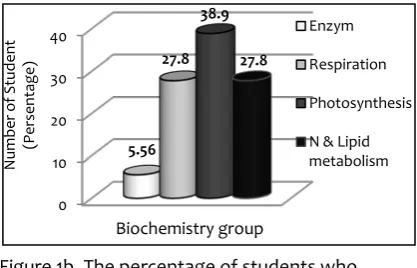
Figure 1b. The percentage of students who express difficult the topic in biochemistry group
Based on the results presented in Figure 1b can be stated that the topics on the biochemistry that are considered most difficult by students is the topic of photosynthesis 38.9%, followed by the topic of respiration, N and lipid metabolism by the same percentage of 27.8%. The topic of enzyme 5.56% of students stated the topic was difficult. The reason why the topic in a group of students is considered difficult biochemistry is the same for all four topics in which many use chemical formulas and the carbon chain. In this group are many stages of biochemical reactions that need to be understood by students, and also involves a long cycle of chemical reactions and many stages of reaction.
Figure 1c. The percentage of students who express difficult the topic in biodevelopment group
Based on the results presented in Figure 1c can be explained that the topics on biodevelopment groups that are considered difficult by students is the topic of fotoperiodisme and vernalization is 33.3%. Next topic of hormones and growth regulators or plant growth regulator 27.8%, then the topic of growth and development and the topic of movement in plants is answered by the student with the same percentage of 13.88%. The 0 plants with water Transpiration
Nutrition in plant
Profile Material Difficulty Level Of Plant Physiology According to Prospective Biology Teachers
topic of at least chosen students as a difficult topic is the topic of reproduction and germination of only 11.1%.
The reason given by students of the choices given is that the topic fotoperiodisme and vernalization is given on the last lecture schedule, so in learning about this topic a bit in a hurry and are not discussed in more depth. In addition, topics fotoperiodisme and vernalization, is a new topic is known by students at the college. This topic has not been recognized by students on previous education, in junior high and high school.
Topics hormones and growth regulators declared a difficult topic because of the wide variety of plant hormones and the function of each hormone are related to each other either inhibit or stimulate hormone each other. In addition, difficult to apply into everyday life. Response prospective teachers of biology to physiology of plant material that is expressed in percentages are presented in Table 1.
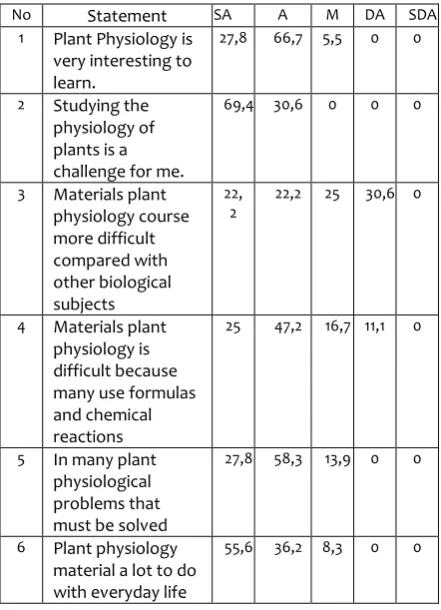
Table 1.
Response prospective teachers to plant physiology material (%)
No Statement SA A M DA SDA
1 Plant Physiology is very interesting to learn.
3 Materials plant physiology course
4 Materials plant physiology is difficult because many use formulas and chemical
6 Plant physiology material a lot to do with everyday life
55,6 36,2 8,3 0 0
Based on the results presented in Table 1 can be explained that the physiology of plant material is
very interesting to learn and a challenge to learn it. Students who declare that the physiology of plants is more difficult than the other biological materials (44.4%) was higher than students who did not agree and the student is in doubt. Most students agree that the physiology of plants is difficult due to the many uses of chemical formulas. Most students agree with the statement that in plant physiology that must be solved many problems and too many plants fisiiologi directly related to everyday life.
2. Plant Physiology Learning
Results of analysis questionnaire given to prospective teachers to find out how the learning of plant physiology are presented in Table 2, then the results of questionnaire analysis of how to learn plant physiology easier to understand and become more interesting are presented in Table 3.
Table 2.
Response prospective teachers about learning biology of plant physiology (%)
No Statement Number
of Students
Persentage
1 Related to everyday life and provided examples in the lives
22 61,11
2 Using drawings / sketches / props cause and effect
10 27,78
9 There should be a summary / handout
8 22,22
Rahmi Susanti, et al
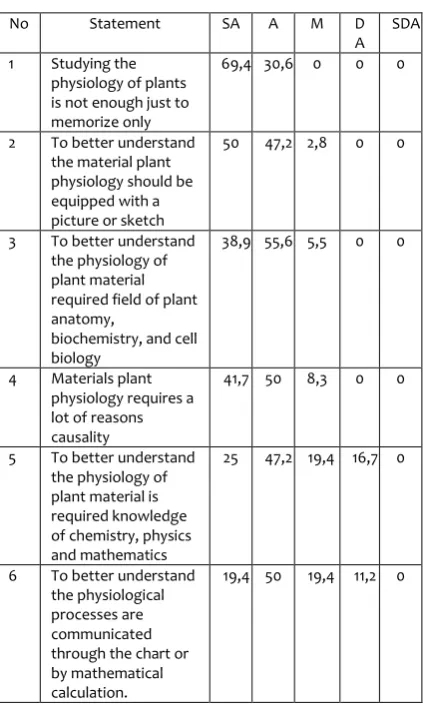
Table 3.
Response prospective biology on how to understand the physiology of plant material (%)
No Statement SA A M D
A SDA
1 Studying the physiology of plants is not enough just to memorize only
69,4 30,6 0 0 0
2 To better understand the material plant physiology should be equipped with a picture or sketch
50 47,2 2,8 0 0
3 To better understand the physiology of plant material required field of plant anatomy,
biochemistry, and cell biology
38,9 55,6 5,5 0 0
4 Materials plant physiology requires a lot of reasons causality
41,7 50 8,3 0 0
5 To better understand the physiology of plant material is required knowledge of chemistry, physics and mathematics
25 47,2 19,4 16,7 0
6 To better understand the physiological processes are communicated through the chart or by mathematical calculation.
19,4 50 19,4 11,2 0
Student responses to how they should be learning the implementation of plant physiology so that it becomes attractive and easy to understand, all students (100%) expressed a positive attitude that learning of plant physiology not only by memorizing it. Drawings, sketches, and props belonging to the students that are considered instrumental in the effort to understand the physiology of plants. Almost all students (97%) expressed a positive attitude about this. In studying the physiology of plants need further understanding as much related to physics, mathematics, and particularly chemistry.
CONCLUSION
Based on the above results, it can be concluded that the three groups of topics in plant physiology, a topic which, according to the most difficult student is the topic of each mineral nutrient absorption (30.11%), the topic of photosynthesis (38.9%), and topic fotoperiodisme and vernalization (33.11%).
Topics in plant physiology became difficult by students because it requires an understanding of physics, math, and in particular need of chemical reactions and phase in a chemical reaction.
To facilitate the understanding of plant physiology student materials, among others, are responding in learning must be linked and provided examples in everyday life, using the method of discussion and question and answer, discussion with a problem, equipped with a lab, and hand out, and ended with a quiz .
REFERENCES
Ministry of Education. (2005). Government Regulation Number 19 Year 2005 on National Education
Standards. Jakarta: Ministry of Education.
Ministry of Education. (2007). Government Regulation Number 16 Year 2007 on Academic Qualifications and
Standards Teacher. Jakarta: Ministry of National Education
Finley, F.N., Stewart, J. & Yarroch, W.L. (1992). Teachers' Perception of Important and Difficult Science Content. Science Education, 66 (4): 531-538.
Hamida, D., Rustaman, N.Y., Adi, D.S. & Mariane, I.M.A. (2009). "Profile Difficulty Level High School Biology Materials According to Teacher. "Papers. Presented at the National Seminar on Education at the University of Lampung (Unila) January 24, 2009: not published.
Hamida, D., & Rustaman, N.Y. (2008). Analysis Development Needs Professional high school biology teacher. Papers. Presented at the Seminar National Education at State University of Surabaya (Unesa) December 13, 2008: not published.
Harley, S. (2008). Botany 3204 - Plant Physiology Sillabus. Department of Botany, Weber State
University. [Online]. Available: http // faculty. weber edu/Sharley/3204/syllabus.htm.
[19 November 2008].
Koning, R. (2004). Plant Physiology Sillabus. Department of Biology, Eastern Connecticut State University. [Online]. Available: http //www. plantphy.into/plantphysiology/syllabus.SO4/html.
Profile Material Difficulty Level Of Plant Physiology According to Prospective Biology Teachers
Redjeki, S. et al. (2006). Plant Physiology course syllabus. Department Biology Education, FPMIPA UPI Bandung.
Salisbury, F.B. & C.W. Ross. (1995). Plant Physiology. (Translation Diah R.L and Sumaryono). Bandung: ITB.
Sefton, A.J. (2005). "Charting the Global Future for Education in Physiology". Advanced Physiology Education, 29, 189-193
Smart, L. (2007). EFB530-Plant Physiology Syllabus. Department of Biology, State University of New York. [Online]. Available: http // www.esf.edu/efb/Course/ ef530/ syllabus.htm. [19November 2008]
Susanti, R. (2006). Plant Physiology course syllabus. Study Program Biology Education, Teacher Training and Education Programs Sriwijaya University-Inderalaya Ogan Ilir.
Williamson, P.S. (2005). Biology-Plant Physiology Sillabus 3465. Department of Biology, Texas State University. [Online]. Available: http //www.bio. txtstate.edu/pwilliam/bio3465-syllabusF2005. [19 November 2008].
Xiaoyan, W. (2003). "Integration of Modern and Traditional Strategies in Plant Physiology "in M.
Peat (ed.) The China Papers: Tertiary Science and Mathematics Teaching for the 21st Century, 2, 53-57. [Online]. Available: science.uniserve. edu.au/pubs/china/vol2/wengxiaoyan. [January 2, 2009].