477
CONSTRUCTIVISM-BASED DEVELOPMENT WORKBOOK
LECTURES ON LINEAR PROGRAM IN THE DEPARTMENT OF
MATHEMATICS EDUCATION, FACULTY AND TEACHING TARBIYAH
UIN RIAU SUSKA
Zubaidah Amir M.Z.1, Risnawati2, Defi3
UIN Suska Riau1,2,3
[email protected], [email protected]2, [email protected]3
Abstract
This study aims to develop a workbook based constructivism valid, practical and effective on Linear Program lectures in the Department of Mathematics Education and teacher Training Faculty Tarbiyah UIN Riau Suska. This research method using Research Development Approach (Research Development). The study consisted of three stages: analysis stage front-rear (front-end analysis), prototype stage and stage assessment (assessment). Data collection techniques using learning tools validation sheet which includes lesson plan (RPP), the linear program workbook, sheet validation research instrument consisting of a guidance interview, questionnaire motivation and student learning activities.
The results show that the learning and research instruments and valid, practical and effective. Validity workbooks and lesson plans can be seen from the average score of recapitulation sheet validation of the experts is very valid RPP category (88.19%), the mean score results validation workbook validator is based constructivism by (3.35), according to the assessment criteria are very valid. Guidelines for instrument engineering researcher interviews a very valid (87.50%). Learning activities and instruments are very valid motivation questionnaire consecutive avg average score validation is (87.50%) and (89.58%), workbook-based constructivism can be used by students without significant obstacles, in a practical sense its use by rating students, and workbook-based constructivism has effectively shown from the learning activities and high motivation after participating in learning. This research can be further expanded by using a variety of active learning strategies are varied, the use of the workbook can be studied at home by students in order to save time lecture, and testing can be developed in a variety of different classes or universities.
Keywords:Development, Workbook, Constructivism.
INTRODUCTION
Background
478
Instructional materials intended course or teaching materials suitable for effective learning aid purposes.
In the lecture linear program especially in Mathematics Education Suska UIN Riau during this, the teaching materials used have not been effective because many reference number and heterogeneous nature. While no single practical teaching materials from professors as handle students in the lecture. Reality it is very difficult to achieve an effective learning process as expected.
The process of learning in college is not the same as learning process in schools. Because, "Students generally have to have the maturity to think and make choices. In terms of any age, students have been considered in comparison with the high school students "(Hisham, 20004, p. 4) further explained that the student as a person who is considered an adult, should be treated in a manner appropriate to their characteristics. According to Erman (2004) The adults are usually able to steer itself, has diverse experience, ready to learn due to the need and more like that is problem-centered learning (p.75). In addition, "Every student is an individual who has the potential for self-learning, both from written sources, mass media or environment. Lecturer is to facilitate and create a more conducive learning climate so that potential can develop optimally ". Therefore, teachers should try to create a situation that allows college students to learn from the knowledge and experience of each.
One of the tools that can accustom students to learn to be sustainable and effective use of a workbook. Workbook is a compilation of the guide books, and a collection of questions that have been packed in such a way that gradually made to train and improve the skills of students, and improve understanding of the stages in the completion of a matter. Workbook for courses linear program has not been published in general so that researchers have not been met. Book series of questions and solutions to the linear program already exists, namely Scaum series. But there are questions that have not been representative of the overall subject of the curriculum / syllabus of lectures dijurusan linear mathematics education program. In addition the book has not helped optimal student understanding because background levels of knowledge and skills of mathematics education students are different.
"The workbook is intended to help students to learn continuously and directionally. However, the workbook is structured not to replace or substitute for the role of college reference book "(Martono, 1991, pi)). It is also in accordance with the opinion of Strang (1991) which states that workbook created with the aim to teach mathematics in a more direct and active way. Through the workbook students are expected to learn in a more systematic.
479
Paul (1997) explains that "Constructivism is a philosophy that emphasizes the knowledge that our knowledge is the construction (formation) of our own" (p.18).) "Constructivist is a way of emphasizing the importance of meaningful, authentic activities that help the learner to construct understandings and develop skills relevant to solving problems ". (Wilson, 1996, p.3)
Thus, constructivism is an understanding that where students formed (construct) their own knowledge or actively concept based on knowledge and experience that already exists. Gega in Mulyardi (2002) stated "in view of constructivism students (students) do not simply accept or absorb the information he received from the delivery of teachers (lecturers) or textbook. But the students themselves are constructing a new knowledge "(p.92)
According to constructivism students construct knowledge by giving meaning to the knowledge of appropriate experiences. Students need to be taught to solve problems, discover and transform complex information into another situation and wrestle with ideas. According to Erman (2004) "Learning mathematics is a process where students actively construct mathematical knowledge. When students try to complete the tasks in the classroom, it is actively constructed mathematical knowledge (p.76). The characteristics of learning mathematics in constructivist view is as follows: (1) Students are actively involved in their learning. Muliyardi (2002) asserts that students learn mathematics significantly by working and thinking. Students learn how to learn it. (2) The new information must be linked with other information so that it blends with the schemata that students have an understanding of the information (materials) complexes can occur. (3) learning orientation is investigation and discovery that is basically problem solving (p.95).
Research Question and Aim
Based on the introduction above, the issue in this study is formulated as follows: "How is the development of a workbook based on the constructivist lectures linear program in Jur. Mathematics education FTK Suska UIN Riau? "To get the answer of the above questions, in particular can be broken down into the following research questions: How is the validity of a workbook based on the constructivist lectures linear program in Jur. Mathematics education FTK Suska UIN Riau?, How is the validity of the research instruments used? How practicalities of workbook-based constructivism?, How the effectiveness of the workbook based on the constructivist lectures linear program in Jur. Mathematics education FTK Suska UIN Riau? To obtain answers to questions the effectiveness of the workbook, detailed research into the following two questions: How are student activities during lectures by using a linear program workbook based constructivism?, And how motivated the students after the lecture following linear program using a workbook based constructivism in Jur. Mathematics education FTK Suska UIN Riau?
480
linear program workbook based constructivism in Jur. Mathematics education FTK Suska UIN Riau.
Research Method
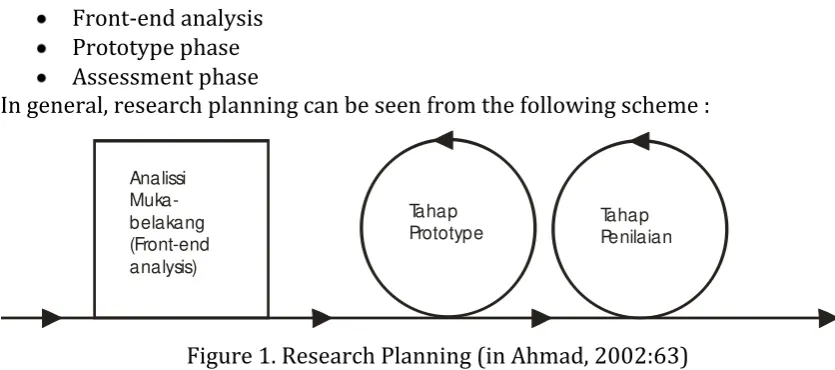
This research is Development research. This development research planning consisted of 3 phases, as follows:
Front-end analysis Prototype phase Assessment phase
In general, research planning can be seen from the following scheme :
Analissi Muka-belakang (Front-end analysis)
Tahap
Prototype TahapPenilaian
Figure 1. Research Planning (in Ahmad, 2002:63)
Research planning of the above Figure elaborated the procedure phase as follows:
Front-End Analysis
Front-end Analysis executed to get image of condition in field. At this phase, the stages done are as follows: Have interviews with colleague; Analyse course syllabus of Linear Program; Analyse the textbook of Linear Program; Review literature of book work.
Lecturing process designed shall involve student actively and self supporting. By the way of giving book work to student. This book work designed based on understanding of constructivist.
The basic of constructivism theory is that in process of study, student which must get emphasis. They must be active to develop their knowledge, not the lecturers or others. They which must have responsible to result of its learning. Creativity and activity of students will assist them to be independent in cognitive life of students.
Prototype phase
Result from front-end analysis is applied to design book work prototype based on construktivist in the course of Linear Program. The making of this prototype done through 2 phases, as below:
1. Validation phase
There are 2 kinds of validation applied at book work, that is: Content Validity is whether book work book based on constructivism was designed as according to course syllabus. And construct Validity that is concordance of book work components with indicators which has been specified.
2. Practicality phase
481
No. Aspect Metode in Data Collection Instrument 1. Implementation of Lecturing
with constructivist book work
Class Observation Observation Sheet
2. guidance Interviews with students Interview Handout 3. Content
4. Time
Tables 1. Practicality of Book work Based On Konstruktivism
Assessment phase
At assessment phase, activity focused to evaluate is prototype (trial version) can be applied as according to hope and effective to increase quality and achievement of student learning. Effectivity aspect observed in process of lecturing using book work based on constructivist in trial class is student activity and motivation of student learning.
Above research steps can be presented in diagram following:
Diagram 1. Path Diagram of Research Procedures
Book work based on Constructivism,
instrument of research
Frond-End Analysis
Interviews with colleage
Syllabus of Program Linear
Book of Program linear
Literature Review
Prototipe
Validation
Practicality Book work
Content s
Construct
Reading
Assesmen t
Efectivity
Students’ Activity
482 RESULT OF RESEARCH
Validity RPP, Research Instruments
Validity RPP seen from the average score of recapitulation sheet validation of the experts is very valid RPP category (88.19%), for which researchers interview guide instrument design is very valid (87.50%). Learning activities and instruments are very valid motivation questionnaire consecutive average score validation is (87.50%) and (89.58%).
Book work Validity Based On Constructivist Result of assessment of validator based on highest percentage from every aspect expressed as follows:
Purpose of lecturing formulated in interest indicator seen hardly explains. Rational of book work based on constructivist is that be of benefit to student. Contents of book work have been as according to theory used.
Book work characteristics based on constructivist is matter summary can be made as initial knowledge. Book work can give selftaught experience to student. Practice is guided to assists construction student of its knowledge. Book work gives opportunity to construction student to her/his own knowledge and can peep out good interaction between students with lecturer and also student with student.
Concordance seen between purpose of with matters.
Linguistic usage at job(activity book seen at sentence that is simple and explains. Form of physical of very attractive book work from the angle of packaging and covers it.
Book work based on this Constructivist gives possibility to be modified
Result of validation from the validator indicated that book work based on constructivist developed for lecturing of Linear Program have been valid. Mean that book work has assessed what which ought to assess as according to interest formulated at syllabus. Book work validity was evaluated from validity contents and construct. According to criterion result of assessment by expert it is obtained that book work based on constructivist is very valid.
Result of validation of book work based on constructivist at the table as follows:
Aspect
Score
Means 0 1 2 3 4
1 2 3 4 5 6 7
Formula of competence indicators
1 2 3,67
Requirements in competent indicators
2 1 3,33
Ability covered in competence indicators
2 1 3,33
1 2 3 4 5 6 7
Numbers of indicators related to time
2 1 3,33
Instruments characteristics 2 1 3,33
Ability to Motivate 2 1 3,33
483
Theory used 1 2 3,67
Testing Materials used 2 1 3,33 Divergent answers are
available
2 1 0,33
Variety of testing materials 3 3 The test Materials support
the students to think 2 1 3,33 Matter Summary as early
knowledge
1 2 3,67
Can give learning self experience to students
1 2 3,67
Guided exercises to help students construct his/her knowledge
1 2 3,67
Assignments can motivate thinking creativity
2 1 3,33
Give opportunity for students to construct his/her own knowledge
1 2 3,67
To arise Interaction 1 2 3,67
Objectives and Matter 3 4
Material and testing 1 2 3,67
Sentences 2 1 3,33
Level of difficulty 3 3
Packing 2 1 3,33
Cover 2 1 3,33
Possibility to modify 1 2 3,67
Average of all components 3,35
Tables 2. Result Of Validation Based Constructivist
Score average result of validation of book work based on constructivist by validator is 3,35. According to criterion result of assessment by expert it is obtained that book work based on constructivist is very valid.
Practicalities of Constructivism-Based Workbook
484
Effectiveness Workbook Based Constructivism
Constructivism based workbook for Linear Program that was created, tested with the type of cooperative learning strategies Think Pair Share. Based on the obtained activity data and student motivation. Total score on the answers the students' learning motivation questionnaire was 2282. According to the interpretation of the criteria table student motivation score is obtained that the level of student motivation to learn after attending lectures with workbook-based constructivism including very high category.
Student Activity
To determine the effectiveness of constructivism workbook based on student activities, observations made during the course Linear Program. Paul B. Diedrich in Sardiman (2007) suggested 8 kinds of activities that can occur in the study, namely: Visual activities, oral activities, Listening activities, Writing activities, Drawing activities, motor activities, activities Mental, Emotional activities, (p.101). Based on observation of student activity during the lectures indicates that the workbook based constructivism can bring positive activities of students and reduce the appearance of negative activity of students.
Positive activities that appear are filled with a complete workbook, asking, answering friends questions, express opinions, compare answers with the answers themselves friends, and students to discuss with their partner. Activity most often and very successfully implemented in the classroom is to compare their own answers with the answers friends. In this activity each student to match their work. In addition, activity was also very successful students discuss with their partner. This opportunity is exploited to discuss student issues that can not be resolved. Especially for students with low ability, they need an explanation about the completion of a highly capable partner. Negative activity is an activity that can be reduced ponder and chat. Activity seldom ponder students appearing in class. Because students are always busy with completing the workbook, ask her partner and listen to explanations from the group perform. If there are still doubts about the explanation of the group renderer, students can be asked to the group. While the activity of chatting students tend to arise when the group in charge of showing the results of their discussions was writing answers on the board. Students who chatted always the same people at each meeting. Students are low-ability students.
Student Learning Motivation
To determine the effectiveness of a workbook based on the constructivism learning motivation of students, they were asked to complete a questionnaire motivation to learn. Keller (1983) describes four categories of conditions that must be considered motivational lecturer in the business of making lectures interesting, meaningful and challenging for students, namely: (1) interest (interest), (2) relevance (relevance), (3) expectations (expectancy ), and (4) satisfaction (satisfaction) (p.389). Questionnaire was completed at the end of the semester.
485
giving advice. Almost all of the students said that they are eager to learn because of the problems given existing solution step. For smart students, with an answer key for the exercises to make them challenging to do. (2) Relevance workbook with lecture material, according to students, the problems that exist in the workbook always match those given in the theory class. Workbook is also in accordance with the needs and abilities of students, so it is rarely a matter of working on the book difficult to understand. (3) Expectations of students after filling the workbook, the general expectations of students filling the workbook is to obtain a good value. To achieve such good value they earnestly and concentration in learning. By filling out the workbook, they increasingly understand the lecture material. Because students understand the lecture material, they are able to make conclusions after filling the workbook, (4) Satisfaction, a person will be motivated if the work is done successfully. So also with the students, he was satisfied and more motivated if his book was completed. Good behavior of students whose motivation was that he was always present at all meetings and rarely idle when the lecture took place. In addition, student satisfaction after filling the workbook looks at whether or not understand the lecture material
CONCLUSION
Workbook based linear program generated constructivism valid, practical keterpakaiannya, as well as effectiveness. RPP is used, interview guides, questionnaires and observation sheets motivation Uncategorized valid student activities, to the effectiveness of the activity observed workbook and student motivation. The result is a workbook-based constructivism for Linear Programs have not been able to activate the students, especially those with low-ability. While the motivation of students after the lecture with constructivism based workbook for Linear Program is very high.
Finding
486
names of students who asked, express opinions and chat. So that data on the number of students groups, moderate and low activity above can not dikuantitatifkan. Workbook based constructivism not necessarily correspond with other universities as research students' ability to design it based Mathematics Education FTK Suska UIN Riau. RPP is a design researcher for 2 x 100 minutes or 2 times face to face, so the use of the overall strategy is not implemented
Suggestion
Workbook Constructivism-Based Linear Program can be developed further by using the application of a variety of active learning strategies varied, in the classroom. In addition, the use of the workbook should have begun learned at home by students in order to save more time lecturing. Because the tests carried out only in limited trials in one class, then pegujicobaan can be developed at various university classes or different characteristics.
REFERENCES
Ahmad Fauzan. 2002. Applying Realitistic Mathematics Education RME in Teaching
Geometry in )ndonesian Primary Schools . Tesis tidak diterbitkan. Enschede: University of Twente.
Crider, Andrew B. 1983. Psychology. USA: Scortt Foresman and Company.
Erman Suherman, dkk. 2004. Common Text Book Strategi Pembelajaran Matematika Kontemporer. Bandung: JICA-Universitas Pendidikan Indonesia (UPI).
Hisyam Zaini, dkk. 2002. Desain Pembelajaran di Perguruan Tinggi. Yogyakarta:
Center for Teaching Staff Development (CTSD) IAIN Sunan Kalijaga.
Keller, John M. 1983. Motivational Design of Instruction. Dalam Reigeluth, Charles M. (Ed.), Instructional Design Theories and Model: An Overview of their Current Status. London: Law Rence Erldaum Associates Publishers.
Koko Martono. 1991. Buku Kerja Kalkulus 7: Teknik Pengintegralan dan Integral Tak Wajar. Bandung: Jurusan Matematika FMIPA ITB.
Muliyardi. 2002. Strategi Pembelajaran Matematika. Padang: Jurusan Matematika FMIPA UNP.
Sardiman A. M. 2007. Interaksi dan Motivasi Belajar Mengajar. Jakarta: RajaGrafindo Persada.
Silberman, Melvin L. 1996. Active Learning: 101 Strategies to Teach Any Subject. Boston: Allyn and Bacon.
Strang, Gilbert. 1991. Study Guide to Calculus, (Online), (http://ocw.mit.edu/ans7870/resources/strang/strangtext.htm, diakses 16 Juli 2008).
Paul Suparno. 1997. Filsafat Konstruktivisme dalam Pendidikan. Yogyakarta: Kanisius.
Wilson, Brent G. 1996. What is a Constructivist Learning Environment? Dalam Wilson, Brent G. (Ed.), Constructivist Learning Environments: Case Studies in Instructional Design. New Jersey: Educational Technology Publications Englewood Cliffs.
Yusufhadi Miarso, dkk. 1986. Definisi Teknologi Pendidikan. Jakarta: CV. Rajawali.
This paper can be cited as Zulkardi(2013). Proceeding The First South East Asia Design/Development Research (SEA-DR) International