Bank CIMB Niaga
Merger Process and Achievement Report
Preface 1
Overview 3
Rationale 6
Merger Architecture 18
Key Challenges 28
Progress and Outcomes 29
Moving Forward 37 Synergy 43 Integration Cost 44 Information Technology 45 Human Resources 48 Financial 50 Branch 51 Branding 54 Key Strategy 56
Bank CIMB Niaga Fact Sheet 58
Appendices 59
Preface
On 1st November 2008, Bank CIMB Niaga (previously Bank Niaga) and Bank Lippo, two of the leading banking institutions in the country, have joined forces and merged to become Bank CIMB Niaga. The merger represents the best option chosen by the respective Shareholders of the two banks in the interest of all stakeholders in order to comply with the banking sector policies of the central bank, Bank Indonesia, and especially with regard to the Single Presence Policy (SPP).
Pursuant to the shareholders’ approval of the merger at the Extraordinary General Meeting of Shareholders of the respective banks on July 18, 2008, both Bank CIMB Niaga and Bank Lippo partook in an integration process, involving various legal, operational and organizational aspects. Among others, these include Products and Services, Business Unit, Sales and Distribution, Human Resources, IT and Operations, and Corporate Office.
I have only the highest of confidence that we can quickly step up to the next stage in implementing this merger in building a new banking entity – a more solid and progressive banking institution, and to be the preferred bank of customers.
As we enter the implementation stage, I would like to share with you here in this document some pertinent information concerning key and strategic achievements that we have realized to date in the successful execution of the integration planning phase.
Warm regards,
Pada 1 November 2008, Bank CIMB Niaga (dahulu Bank Niaga) dan Bank Lippo, dua entitas bank terkemuka di Indonesia, telah bergabung menjadi Bank CIMB Niaga. Penggabungan kedua bank tersebut merupakan opsi terbaik bagi seluruh pemangku kepentingan (stakeholder) yang diambil oleh Pemegang Saham dalam rangka mematuhi kebijakan Bank Indonesia (BI) khususnya mengenai Kebijakan Kepemilikan Tunggal atau Single Present Policy (SPP).
Setelah Pemegang Saham kedua bank menyetujui rencana penggabungan merger sesuai hasil Rapat Umum Pemegang Saham Luar Biasa tanggal 18 Juli 2008, Bank CIMB Niaga dan Bank Lippo memasuki tahap integrasi, yang meliputi berbagai aspek legal, operasional dan organisasi, diantaranya termasuk Produk dan Layanan, Business Unit, Sales and Distribution, Human Resources, IT and Operations, dan Corporate Office.
Saya sangat yakin, bahwa kita dapat segera melangkah ke tahapan implementasi berikutnya dengan lancar dalam membangun entitas bank baru hasil integrasi yang lebih kokoh dan maju, serta yang menjadi bank pilihan utama nasabah.
Setelah kita memasuki tahap implementasi berikutnya, saya ingin menyampaikan beberapa informasi penting mengenai berbagai pencapaian utama dan hasil-hasil strategis yang telah dicapai hingga saat ini dalam keberhasilan eksekusi dari tahap perencanaan integrasi ini.
Salam hangat,
Dato’ Sri Nazir Razak
CEO CIMB Group January 2009
Bank CIMB Niaga is here to continue in the finest traditions of its legacy banks, Bank Niaga and Bank Lippo, two of the leading banks in Indonesia. These banks have had a long and excellent history of providing quality service to their respective customers all over Indonesia, and this will stand in good stead in strengthening Bank CIMB Niaga’s position within the banking landscape in the country.
I am sure that all stakeholders concerned can trully appreciate the arrival of Bank CIMB Niaga, as it provides an opportunity to synergize the respective strengths of two of the most respected private commercial banks in Indonesia. Ultimately, this will benefit the national economy, facilitating the emergence of new entrepreneurs in the country, as well as improving the level of service to customers through better, more efficient, and more varied products and services. In terms of business and operations at Bank CIMB Niaga, the integration process is now approaching the next phase, known as the Single Platform Day 1 (SPD1). However, it is business as usual at the Bank. Our employees continue to provide the best of services, and customers continue to enjoy the convenience of our banking facilities.
That the merger process have gone smoothly up till now is the result of our consistent and dedicated efforts, with the full commitment and support of the shareholders. Also worthy of note is the full-hearted support from our employees, those of them who have elected to join the merged Bank, and this serves to bolster our shared confidence that Bank CIMB Niaga is poised for stronger growth in future years.
In presenting this Merger Process and Results Report, I am also confident that the merger of Bank CIMB Niaga will constitute a milestone in the history of the banking sector in Indonesia.
All our fine achievements to date should serve as a solid foundation towards more successes in the next phases of the merger process.
Warm regards,
Bank CIMB Niaga hadir untuk terus melanjutkan tradisi dan legacy terbaik dari dua bank besar dan terkemuka di Indonesia, Bank Niaga dan Bank Lippo. Kedua bank tersebut memiliki pengalaman yang panjang dalam memberikan layanan prima bagi para nasabahnya di seluruh tanah air, sehingga semakin memperkuat posisi Bank CIMB Niaga dalam lansekap industri perbankan di tanah air.
Fenomena lahirnya kekuatan baru Bank CIMB Niaga, patut disyukuri bersama oleh semua pihak, karena hal ini berarti telah lahir sebuah sinergi dari dua kekuatan bank swasta nasional yang memiliki reputasi yang baik, untuk turut mendukung perekonomian di Indonesia, mempercepat lahirnya wirausaha baru di tanah air, serta memperkuat layanan kepada nasabah, dengan lebih baik, lebih efisien, dan lebih beragam produk dan layanannya.
Secara bisnis dan operasional, Bank CIMB Niaga masih menunggu tahapan integrasi berikutnya, atau dikenal dengan istilah Single Platform Day 1 (SPD1). Namun kegiatan bisnis perbankan tetap berjalan seperti biasanya. Karyawan tetap memberikan layanan terbaik dan para nasabah akan terus memperoleh berbagai kemudahan dan fasilitas jasa perbankan. Proses merger yang telah berjalan baik ini, menjadi bukti sekaligus momentum bahwa apa yang telah menjadi komitmen dan dukungan Pemegang Saham telah dijalankan dengan secara baik dan konsisten. Dukungan karyawan yang besar untuk turut bergabung dalam bank hasil merger ini, tentunya semakin memperkuat keyakinan kita bahwa bank ini akan tumbuh lebih besar lagi di masa mendatang. Melalui Laporan Proses dan Pencapaian Merger ini, saya yakin bahwa keberhasilan merger Bank CIMB Niaga saat ini patut dicatat dalam sejarah perbankan nasional di Indonesia.
Semoga prestasi yang telah diraih selama ini dapat menjadi pijakan yang kokoh untuk meraih sukses di tahap selanjutnya.
Salam hangat,
Arwin Rasyid
CEO CIMB Niaga January 2009
The merger involves two of Indonesia’s leading banking institutions, Bank CIMB Niaga (herein after referred to as Bank Niaga) and Bank Lippo. The merged bank carries the name Bank CIMB Niaga. As a direct result of the Single Presence Policy of Bank Indonesia, the majority shareholders of Bank Niaga and Bank Lippo opted for the merger as the best course of action taking into account the best interest of all stakeholders.
The merger will form the sixth largest bank in Indonesia in terms of assets. By combining the strengths of both banks, the merger will result in a bank well-positioned to compete and grow in the increasingly competitive Indonesian banking environment. For CIMB Group, the merger will strengthen its position as a leading South East Asian franchise and enhance its earnings complexion and growth prospects.
During the planning phase of the merger, several notable events occurred in the Indonesian financial sector:
29 July 2008 Approval for Maybank acquisition of BII retracted
17 September 2008 Approval for Maybank acquisition of BII reinstated subject to
conditions
30 September 2008 Maybank acquired 56% of BII
6 to 8 (half day) October 2008 20% drop in the Stock Exchange of Indonesia
8 (half day) to 10 October 2008 Suspension of the Stock Exchange of Indonesia
9 October 2008 Minimum reserve requirement for banks decrease from 9.08% to 7.5%
(aimed to boost liquidity in the banking sector)
13 October 2008 Maximum guaranteed deposits at banks increased by 20-fold (aimed to
revive investor confidence in banks)
The CIMB Niaga Story
Overview
Proses merger melibatkan dua institusi perbankan terkemuka di Indonesia yaitu Bank CIMB Niaga (selanjutnya disebut Bank Niaga) dan Bank Lippo, menjadi Bank CIMB Niaga. Merger ini berawal dari kebijakan BI mengenai kepemilikan tunggal di Indonesia, dimana pemegang saham mayoritas dari Bank Niaga maupun Bank Lippo memilih merger sebagai opsi terbaik demi kepentingan seluruh stakeholder.
Merger ini membentuk bank keenam terbesar di Indonesia berdasarkan aset. Perpaduan keunggulan kedua bank menciptakan sebuah bank yang lebih baik dan bersaing serta tumbuh di tengah makin ketatnya persaingan sektor perbankan Indonesia. Bagi CIMB Group, merger ini akan memperkokoh posisi dan meningkatkan prospek pertumbuhannya sebagai kelompok bisnis terkemuka di Asia Tenggara. Selama tahap perencanaan merger, terjadi beberapa peristiwa penting di sektor industri keuangan di Indonesia:
Notwithstanding the above, Bank CIMB Niaga retains a firm footing in becoming a trusted bank alongside its peers in a very competitive Indonesian banking landscape. The immediate challenge is to operationally merge our businesses to realize the huge potential synergy values of our combined businesses, amongst Bank Niaga, Bank Lippo and CIMB Group. We remain committed to transforming Bank CIMB Niaga into an Indonesian universal bank.
Background of Bank Niaga
Bank Niaga was established on 26 September 1955. It is currently the seventh largest bank in Indonesia by assets, and has the second largest position in mortgage lending with around 9 - 10% market share. The majority of the Bank’s equity has been held by Bumiputra-Commerce Holdings Berhad (BCHB) since 25 November 2002 and on 16 August 2007 was transferred to CIMB Group, a wholly owned subsidiary of BCHB. As the first local bank to introduce ATM services in 1987 and also an on-line banking system in 1991, Bank Niaga is well regarded as one of the most innovative banks in Indonesia. It offers a comprehensive suite of conventional and Islamic banking products and services, from 256 branches in 48 cities in Indonesia. Bank Niaga has over 6,000 employees.
Over the years, Bank Niaga has been well regarded for its track record in customer service excellence and corporate governance, and also one of the sources of high quality bankers in Indonesia. Through the extensive branch offices and ATM network, as well as its wide range of sophisticated electronic channels, Bank Niaga offers a highly personalised banking experience to its customers. Amongst its accolades, in 2007 Bank Niaga was ranked 1st for Performance Management and Training and Development in The HR Excellence Award 2007 and also awarded Best Bank by the Investor Magazine. In 2006 it was awarded “The Most Consistent Bank in Service Excellence” by the Marketing Research Indonesia. For five consecutive years, since 2003 – 2007, Bank Niaga had been awarded The Best Annual Report in category Private Financial Listed Companies.
Sekalipun demikian, Bank CIMB Niaga tetap memiliki pijakan kokoh untuk menjadi sebuah bank terpercaya yang diperhitungkan di sektor perbankan Indonesia yang sangat kompetitif. Tantangan saat ini adalah bagaimana kami dapat melakukan integrasi operasional kedua bank untuk menggalang potensi sinergi di antara Bank Niaga, Bank Lippo dan CIMB Group. Kami telah bertekad untuk mewujudkan Bank CIMB Niaga sebagai bank universal di Indonesia. Sekilas Bank Niaga
Bank Niaga didirikan pada 26 September 1955, dan saat ini merupakan bank ke-7 terbesar di Indonesia berdasarkan aset serta ke-2 terbesar di segmen Kredit Kepemilikan Rumah dengan pangsa pasar sekitar 9-10%. Bumiputra-Commerce Holdings Berhad (BCHB) memegang kepemilikan mayoritas sejak 25 November 2002, kemudian dialihkan kepada CIMB Group, anak perusahaan yang dimiliki sepenuhnya oleh BCHB, pada 16 Agustus 2007. Sebagai salah satu bank paling inovatif di Indonesia, Bank Niaga memperkenalkan layanan ATM pada tahun 1987 dan menerapkan sistem perbankan on-line pada tahun 1991. Dengan lebih dari 6.000 karyawan, Bank Niaga menawarkan rangkaian lengkap produk dan jasa perbankan, baik konvensional maupun Syariah melalui 256 kantor cabang di 48 kota di Indonesia.
Bank Niaga memiliki reputasi yang sangat baik di bidang pelayanan nasabah dan tata kelola perusahaan, serta telah melahirkan banyak bankir handal di Indonesia. Melalui jaringan kantor cabang dan ATM yang luas serta keberagaman jalur distribusi perbankan elektronik, Bank Niaga menghadirkan layanan perbankan yang dikemas sesuai selera nasabahnya. Diantara berbagai penghargaan pernah diterima diantaranya peringkat pertama untuk Performance Management and Training and Development pada ajang HR Excellence Award 2007, dinobatkan sebagai Bank Terbaik oleh Majalah Investor, serta predikat ‘The Most Consistent Bank in Service Excellence’ oleh Marketing Research Indonesia pada tahun 2006. Selama lima tahun berturut-turut antara 2003-2007, Bank Niaga memperoleh penghargaan Laporan Tahunan Terbaik untuk kategori perusahaan swasta publik sektor keuangan dalam Annual Report Award.
Overview
Background of Bank Lippo
Bank Lippo’s journey started in March 1948. After a successful merger with PT Bank Umum Asia, Bank Lippo went public and was listed on the Stock Exchange in November 1989. The Government of Indonesia acquired a majority shareholding in Bank Lippo after the recapitalisation programme was executed on 28 May 1999. On 30 September 2005, having obtained approval from Bank Indonesia, Khazanah Nasional Berhad acquired majority ownership in the bank. Since then, Bank Lippo has moved quickly to design and implement a new road-map. The road-map provides Bank Lippo with the tools to meet the rigours of a world-class bank. Bank Lippo is now a leading private bank in Indonesia, providing quality services and products. Staffed by almost 5,000 employees, it has 401 branches and offices and 722 ATMs across Indonesia. It provides services in more than 120 cities in Indonesia. Bank Lippo pioneered E-Banking services in Indonesia.
Sekilas Bank Lippo
Bank Lippo didirikan pada bulan Maret 1948. Menyusul merger dengan PT Bank Umum Asia, Bank Lippo mencatatkan sahamnya di Bursa Efek pada November 1989. Pemerintah RI menjadi pemegang saham mayoritas di Bank Lippo melalui program rekapitalisasi yang dilaksanakan pada 28 Mei 1999. Pada tanggal 30 September 2005, setelah memperoleh persetujuan Bank Indonesia, Khazanah Nasional Berhad mengakuisisi kepemilikan mayoritas di Bank Lippo.
Sejak saat itu, Bank Lippo bergerak cepat menerapkan strategi pertumbuhan yang baru, yang dirancang untuk membawa Bank Lippo setara dengan bank kelas-dunia. Bank Lippo mempelopori layanan E-Banking di Indonesia. Saat ini, Bank Lippo merupakan salah satu bank terkemuka di Indonesia dengan hampir 5.000 karyawan, yang menghadirkan produk dan layanan perbankan berkualitas melalui 401 kantor cabang dan 722 ATM untuk melayani nasabah di lebih dari 120 kota di seluruh Indonesia.
There are over 126 banks in Indonesia. In order to attain a sound and strong Indonesian banking structure, it is necessary to consolidate. To expedite the consolidation process, Bank Indonesia (BI) believes that it is necessary to restructure bank ownership through the application of a single presence policy (SPP) for Indonesian Banks. Pursuant to the SPP Regulations, a party can only become the Controlling Shareholder in one bank.
Dengan 126 bank di sektor perbankan di Indonesia, maka dipandang perlu untuk melakukan langkah konsolidasi untuk mewujudkan struktur industri perbankan yang lebih kokoh dan sehat. Untuk memfasilitasi konsolidasi tersebut, Bank Indonesia (BI) melakukan restrukturisasi kepemilikan bank melalui apa yang disebut Kebijakan Kepemilikan Tunggal bagi Bank. Sesuai dengan kebijakan ini, sebuah entitas hanya diperbolehkan menjadi pemegang saham pengendali di satu bank saja.
Surveying the Indonesian banking landscape
Figure 1: Indonesia bank universe, ranked by assets
Assets
(US$bn) Branch/ATMsDistribution ROE1 (%) NPL2 (%) Comments
33.79 930/2,800 18.1 4.42 Largest bank in Indonesia; focused on corporate banking; two secondary share sell-downs in 2003
24.19 791/5,042 24.9 0.60 Most widely recognized Indonesian bank; strong franchise; controlled by Farallon Consortium
BRI 23.29 585/674 28.2 2.90 Indonesia’s leading micro-finance credit agency; industry’s highest margins; privatized in 2003
19.05 976/2,325 6.9 6.53
Oldest bank in Indonesia; extensive distribution platform; completed rights issue & secondary offering as part of Government’s privatization program in Aug 2007
10.97 419/754 21.6 2.08 Leading consumer/SME banking franchise in Indonesia; majority controlled by Temasek Holdings/Deutsche Bank
6.15 276/700 9.9 2.77 Strong credit card franchise; majority controlled by Temasek Holdings/Kookmin Bank
Panin 6.73 213/232 11.5 3.42 Acknowledged player in the consumer/SME market; strong capital position; ANZ a 30% strategic shareholder
6.42 240/395 14.5 2.99 Leading corporate lending bank in Indonesia; expanding into the consumer business; majority-controlled by CIMB Group
5.01 288/581 12.8 3.20
• Leading consumer franchise owing to its heritage Bank Bali platform
• Principal shareholders: Standard Chartered and Astra Int’l
4.14 398/687 13.1 0.84 • Strength in retail/trading SME segment• Majority-controlled by Khazanah
Note: Balance sheet data and ratios as of September 2008, distribution as of June 2008; exchange rate of Rp9,430/US$ as of September 30, 2008 1 ROE are based on International standards and defined as [Net Income/((Beginning equity + Ending equity)/2)]
2 Gross NPL
Rationale
Indonesian Banking Architecture & Single Presence Policy
Possessing the capacity and ability to operate on an international scale
Having a board scope of business and operating nationwide
Focused on particular business segments according to the capability and competence of each bank.
International Banks National Banks Corporate Regional Others Retail
Rural Banks limited scope of Banks with activities
Rural banks and banks with limited scope of business
Capital (Rp Trillion) 50 10 0.1 0
Envisaged Structure of Indonesian Banking System in IBA
IBA launched by Bank Indonesia on 9 January 2004
2 – 3 banks 3 – 5 banks 30 – 50 banks Others In the next 10 – 15 years Figure 2: Indonesian Banking Architecture
Khazanah is the Controlling Shareholder of Bank Niaga and Bank Lippo. As a long term strategic investor, Khazanah has continued to convey its intention and commitment to actively participate and contribute to the long-term economic development of the Republic of Indonesia, particularly in the financial and banking sector.
Furthermore both Bank Niaga, as a part of CIMB Group, and Bank Lippo have each resolved and stated on various occasions, the vision and mission to be one of the top 5 banks in Indonesia and to achieve various growth and profitability milestones by 2010. To achieve this goal, both banks have individually and aggressively focused on innovating new product lines and penetrating untapped customer segments for organic business expansion, while simultaneously seeking potential merger and acquisition opportunities as part of an inorganic growth strategy.
Consequently, the BOD and BOC of Bank Niaga and Bank Lippo after considering the welfare and interest of employees and all stakeholders have decided to merger as it is beneficial to all parties.
Khazanah saat ini merupakan pemegang saham pengendali baik di Bank Niaga maupun Bank Lippo. Sebagai investor strategis jangka-panjang, Khazanah memiliki komitmen untuk berpartisipasi aktif dan berkontribusi dalam pembangunan ekonomi Indonesia jangka panjang, khususnya di sektor keuangan dan perbankan.
Selanjutnya, Bank Niaga maupun Bank Lippo dalam berbagai kesempatan telah mencanangkan visi dan misi perusahaan untuk menjadi salah satu dari 5 bank peringkat teratas di Indonesia, lengkap dengan target pencapaian pertumbuhan maupun profitabilitas yang ingin dicapai sampai dengan tahun 2010. Untuk itu, kedua bank tersebut secara terpisah telah menjalankan strategi pertumbuhan organik yang agresif melalui inovasi produk perbankan dan penetrasi ke segmen pasar baru, sementara terus mencari peluang merger dan akuisisi sebagai strategi pertumbuhan inorganik. Dengan mempertimbangkan kesejahteraan dan kepentingan karyawan dan stakeholder, Direksi dan Dewan Komisaris Bank Niaga dan Bank Lippo mengambil langkah merger untuk memberikan manfaat bagi semua pihak yang terlibat.
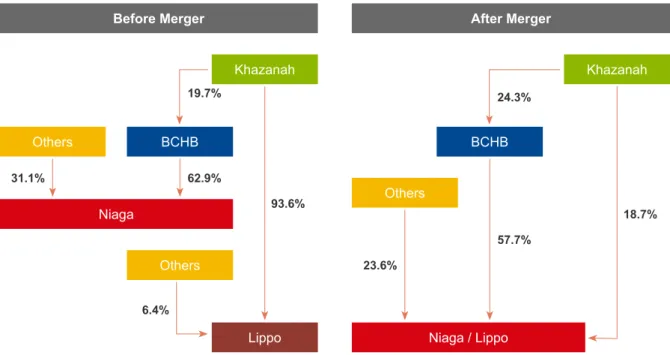
Before Merger Khazanah Others BCHB Niaga Others Lippo 19.7% 62.9% 31.1% 6.4% 93.6% After Merger Khazanah Others BCHB Niaga / Lippo 24.3% 57.7% 23.6% 18.7%
• The merger is in compliance with the Government’s preferred route and consistent with Khazanah’s investment track record and long-term commitment to Indonesia.
• Post merger, Khazanah will remain as the controling shareholder of Bank CIMB Niaga (the surviving entity of the Bank Niaga and Bank Lippo merger). • Khazanah’s shareholding in Bank CIMB Niaga will
be held directly and via its subsidiary BCHB/CIMB Group.
• This creates a complementary tri-partite merger for growth – scale, limited duplication and significant synergies.
• Bank CIMB Niaga combines the best of Bank Niaga and Bank Lippo, enhanced by scale synergies and CIMB Group’s regional platform.
The merger is driven by the single presence policy (SPP)
• Langkah merger merupakan opsi yang sesuai dengan preferensi Pemerintah Indonesia, serta konsisten dengan kebijakan maupun komitmen investasi jangka panjang Khazanah di indonesia. • Paska merger, Khazanah tetap menjadi pemegang
saham di Bank CIMB Niaga.
• Di Bank CIMB Niaga, Khazanah memiliki kepemilikan saham secara langsung dan tidak langsung melalui anak perusahaan BCHB/CIMB Group.
• Langkah merger menciptakan penggabungan tiga kekuatan yang komplementer untuk bertumbuh dalam skala usaha, dengan duplikasi minimal dan potensi sinergi yang signifikan.
• Bank CIMB Niaga menggabungkan keunggulan Bank Niaga dan Bank Lippo, didukung oleh sinergi dari skala bisnis yang lebih besar serta jaringan regional CIMB Group.
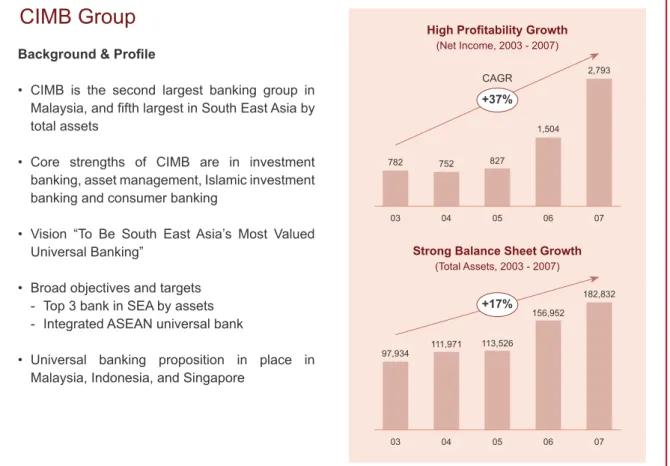
CIMB Group
03 04 05 06 07
High Profitability Growth
(Net Income, 2003 - 2007) 2,793 1,504 827 752 782 +37% CAGR 03 04 05 06 07
Strong Balance Sheet Growth
(Total Assets, 2003 - 2007) 182,832 +17% 156,952 113,526 111,971 97,934 Background & Profile
• CIMB is the second largest banking group in Malaysia, and fifth largest in South East Asia by total assets
• Core strengths of CIMB are in investment banking, asset management, Islamic investment banking and consumer banking
• Vision “To Be South East Asia’s Most Valued Universal Banking”
• Broad objectives and targets - Top 3 bank in SEA by assets - Integrated ASEAN universal bank
• Universal banking proposition in place in Malaysia, Indonesia, and Singapore
The merger presents a compelling value proposition for all shareholders, the management and employees, as well as the overall banking industry in Indonesia. Bank Niaga and Bank Lippo represent two unique franchises and when combined, represent one of the more exciting banking sector propositions for the country. The merger takes advantage of Bank Niaga’s strong corporate presence and mortgage niche together with Bank Lippo’s leadership in SME loan and payment processing system. By combining the strengths of both banks, the merger will result in a bank well positioned to compete and grow in the increasingly competitive Indonesian banking environment.
Merger ini memberikan peningkatan nilai yang menarik bagi seluruh pemegang saham, manajemen dan karyawan dari kedua bank, serta bagi industri perbankan Indonesia pada umumnya. Bank Niaga dan Bank Lippo merupakan dua bisnis yang unik dan penggabungan keduanya memberikan salah satu peluang pertumbuhan yang sangat menarik di sektor perbankan Indonesia, dengan memadukan kekuatan Bank Niaga di segmen perbankan korporasi, dan KPR, bersama keunggulan Bank Lippo di segmen kredit UKM dan infrastruktur transaksi pembayaran. Bank hasil merger akan memiliki posisi yang sangat baik untuk bersaing dan tumbuh dalam peta persaingan industri perbankan Indonesia yang semakin ketat.
“A Complementary Merger for Growth” “A New Beginning”
Figure 4: A Complementary Merger
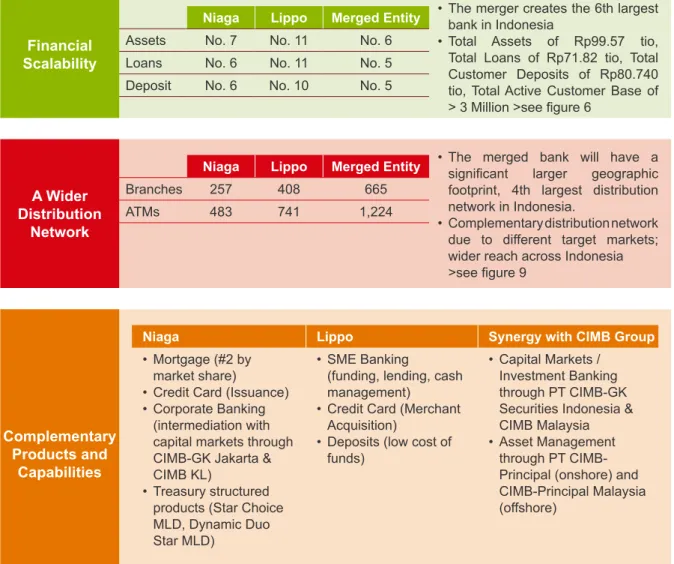
The Niaga-Lippo merger is grounded on a
strong strategic rationale
Niaga Lippo Merged Entity
Assets No. 7 No. 11 No. 6
Loans No. 6 No. 11 No. 5
Deposit No. 6 No. 10 No. 5
• The merger creates the 6th largest bank in Indonesia
• Total Assets of Rp99.57 tio, Total Loans of Rp71.82 tio, Total Customer Deposits of Rp80.740 tio, Total Active Customer Base of > 3 Million >see figure 6
Financial
Scalability
Niaga Lippo Merged Entity
Branches 257 408 665
ATMs 483 741 1,224
• The merged bank will have a
significant larger geographic
footprint, 4th largest distribution network in Indonesia.
• Complementary distribution network due to different target markets; wider reach across Indonesia >see figure 9
A Wider
Distribution
Network
Niaga Lippo Synergy with CIMB Group
• Mortgage (#2 by market share)
• Credit Card (Issuance) • Corporate Banking
(intermediation with capital markets through CIMB-GK Jakarta & CIMB KL)
• Treasury structured products (Star Choice MLD, Dynamic Duo Star MLD)
• SME Banking
(funding, lending, cash management)
• Credit Card (Merchant Acquisition)
• Deposits (low cost of funds)
• Capital Markets / Investment Banking through PT CIMB-GK Securities Indonesia & CIMB Malaysia • Asset Management
through PT CIMB-Principal (onshore) and CIMB-Principal Malaysia (offshore)
Complementary
Products and
Capabilities
CIMB Niaga
99.57
#6
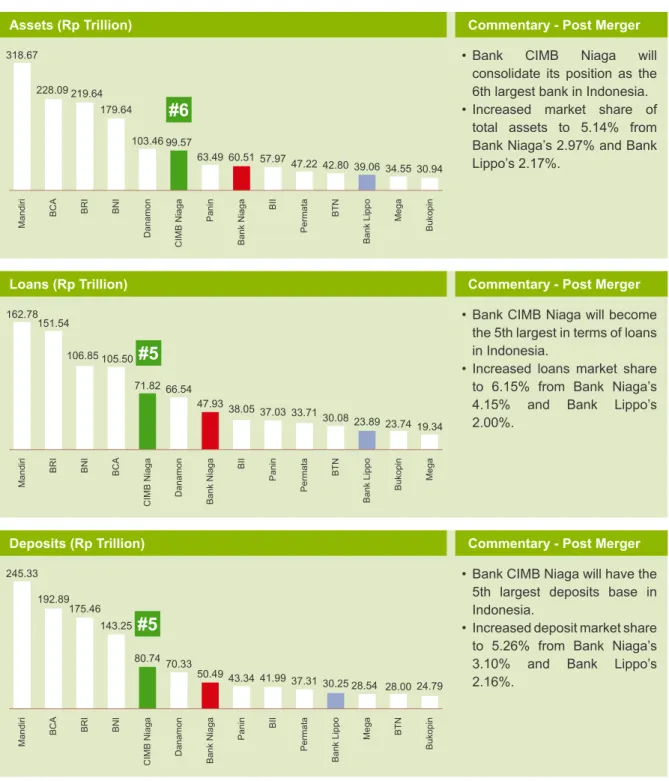
Bank CIMB Niaga will be bigger and stronger in total assets, loans, and customers’ deposits. The resulting economies of scale will enable us to serve our customers better with superior products, prices and service standards.
Bank CIMB Niaga akan menjadi bank yang lebih besar dan kokoh. Dengan skala ekonomi yang lebih besar, Bank CIMB Niaga akan mampu melayani nasabah dengan produk, harga dan kualitas layanan yang lebih baik.
Assets (Rp Trillion) Commentary - Post Merger
• Bank CIMB Niaga will
consolidate its position as the 6th largest bank in Indonesia. • Increased market share of
total assets to 5.14% from Bank Niaga’s 2.97% and Bank Lippo’s 2.17%.
Loans (Rp Trillion) Commentary - Post Merger
• Bank CIMB Niaga will become the 5th largest in terms of loans in Indonesia.
• Increased loans market share to 6.15% from Bank Niaga’s 4.15% and Bank Lippo’s 2.00%.
Deposits (Rp Trillion) Commentary - Post Merger
• Bank CIMB Niaga will have the 5th largest deposits base in Indonesia.
• Increased deposit market share to 5.26% from Bank Niaga’s 3.10% and Bank Lippo’s 2.16%.
Source: Company reports as at 30 September 2008. Total assets, total loans and total deposits for Indonesian Banking Industry: Rp2,125 trillion, Rp1,246 trillion and Rp1,609 trillion respectively. Rankings above are based on group level. (sourced from Bank of Indonesia website as at 30 September 2008 Bank only). Mandiri 318.67 BCA 228.09 BRI 219.64 BNI 179.64 Danamon 103.46 Panin 63.49 Bank Niaga 60.51 BII 57.97 Permata BTN 47.22 42.80 Bank Lippo 39.06 Mega 34.55 Mandiri 162.78 151.54 BRI 106.85 BNI 105.50 CIMB Niaga 71.82 Danamon 66.54 Bank Niaga 47.93 BII 38.05 Permata BTN 33.71 30.08 Bank Lippo 23.89 Bukopin 23.74 Mega 19.34 BCA Panin 37.03 Mandiri 245.33 143.25 BNI 192.89 CIMB Niaga 80.74 Danamon 70.33 Bank Niaga 50.49 Permata 37.31 BCA Panin 43.34 175.46 BRI Mega 28.54
#5
#5
Financial ScalabilityFigure 6: Financial Scalability
Rationale
BII 41.99 Bank Lippo 30.25 Bukopin 24.79 BTN 28.00 Bukopin 30.94We intend to take advantage of our larger size after the merger to improve our
performance gradually.
Sebagai bank yang lebih besar paska merger, Bank CIMB Niaga akan lebih mampu
meningkatkan performa secara bertahap.
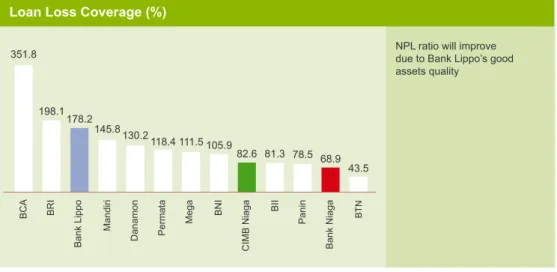
Figure 7: Banks’ performance ratios
351.8 54.7 0.6 198.1 62.1 0.8 178.2 67.4 1.2 145.8 73.2 2.1 130.2 79.1 2.3 118.4 80.6 2.8 111.5 83.8 2.9 105.9 86.4 3.0 82.6 87.8 3.2 81.3 90.4 3.4 78.5 90.7 4.4 4.0 43.5 68.9 107.4 93.8 6.5 NPL Ratio (%) (Gross) LDR (%)
Loan Loss Coverage (%)
NPL ratio will improve due to Bank Lippo’s good assets quality
• Bank Niaga’s LDR will reduce from 93.8% to 87.8% • Ability to grow its loans more
aggressively
NPL ratio will improve due to Bank Lippo’s good asset quality
Rationale
Source: Company reports (consolidated), websites and research reports (as at 30 September 2008)
10.8 43.5 8.7 45.5 6.5 45.7 6.4 49.5 6.2 50.6 5.8 54.4 5.7 55.6 5.6 59.0 5.5 5.5 61.3 5.4 64.3 5.2 70.6 5.0 71.9 71.1 NIM (%)
Cost/Income (%) - including Blanket guarantee
NIM of the enlarged entity will increase with lower COD and LDR
Further decrease in CI ratio expected from potential synergies
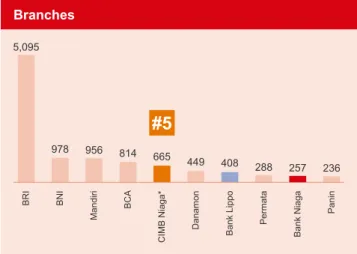
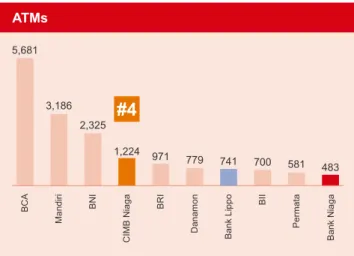
Bank CIMB Niaga will be the 5th largest bank in Indonesia in terms of its branch
network and ATM channels.
Branch Network
Our distribution network will
expand giving us access to more
customers.
Wider Distribution Network
Branches BRI 5,095 BNI 978 CIMB Niaga* 665 Danamon 449 Bank Lippo 408 Mandiri 956 BCA 814
#5
Figure 8: A wider Distribution Network in terms of branches and ATMs
(As of June 2008) * As at 30 September 2008 Permata 288 Panin 236 Bank Niaga 257
* As at 30 September 2008 (As of June 2008)
Figure 9: Branch Network Map
Sumatera Niaga 26 Lippo 39 Combined 65 Kalimantan Niaga 5 Lippo 11 Combined 16 Sulawesi Niaga 9 Lippo 8 Combined 17 Ambon Lippo 2 Papua Niaga 5 Jakarta Niaga 91 Lippo 169 Combined 260 Jawa Barat Niaga 40 Lippo 29 Combined 69 Jawa Tengah Niaga 30 Lippo 80 Combined 110 Jawa Timur Niaga 43 Lippo 54 Combined 97 Bali Niaga 6 Lippo 8 Combined 14 BNI 2,325 CIMB Niaga 1,224 BII 700 Bank Niaga 483 Mandiri 3,186 BCA 5,681 ATMs BRI Danamon 971 779
#4
Rationale
Bank Lippo 741 Permata 581 Branch NetworkThere is a positive correlation between number of
branches and deposit and loan shares. Ada korelasi positif antara jumlah kantor cabang dan penguasaan pangsa pasar untuk kredit dan simpanan nasabah.
We plan to leverage on our wider distribution network
to improve our market share. Jaringan distribusi yang lebih luas akan memungkinkan kami untuk memperbesar perolehan pangsa pasar.
Complementary Products and Capabilities Particulars Core strength Customer profile Consumer niche Funding Branches
Bank Lippo Bank Niaga
• Transaction banking, SME banking
and retail commercial loans • Corporate & Mortgage Loans • Mainly retail, general commerce,
consumer sectors • Corporate customers, retail mortgages
• Credit cards (issuer and merchants) • Housing mortgages (2 nd largest player with 9.64% market share), car financing
• Wide retail deposit base through the payments platform, high proportion of CASA
• Higher cost of funds–mainly from corporate, affluent and mass affluent customers
• Strong branch/ATM presence in
smaller cities • Smaller network focused mainly on major cities
Number of Branches and Market Share
BRI 0 2% 4% 6% 8% 10% 12% 0 2% 4% 6% 8% 10% 12% 14% 16% Danamon BNI BCA Mandiri Loans Branch
Figure 11: Loan Share Niaga Lippo 0 2% 4% 6% 8% 10% 12% 0 2% 4% 6% 8% 10% 12% 14% 16% Danamon BNI BRI BCA Mandiri Deposit Branch
Figure 10: Deposit Share Niaga
Lippo
The merger enables us to broaden and strengthen our product range. Bank CIMB Niaga will combine Bank Niaga’s strong corporate lending presence, and mortgage niche together with Bank Lippo’s leadership in SME loans and the payment processing system which offers attractive growth opportunities.
Bank CIMB Niaga akan memiliki portofolio produk yang lebih komprehensif, memadukan kekuatan Bank Niaga di segmen korporasi dan KPR yang memberikan margin menguntungkan, serta keunggulan Bank Lippo di bidang kredit UKM dan sistem transaksi pembayaran yang memberikan peluang pertumbuhan
Rationale
Over the years Consumer and SME segments have driven a strong growth in lending activities. After the merger, Bank CIMB Niaga will also leverage on its strength in these areas to grow its business.
Selama bertahun-tahun, segmen Konsumer dan UKM telah memacu pertumbuhan kredit. Setelah merger, Bank CIMB Niaga akan memberdayakan kekuatan pada area tersebut untuk pertumbuhan bisnis.
Total banking industry loans by segment (IDR Trillion)
2002 2003 2004 2005 2006 2007 Sep ‘08 371 441 559 696 792 1,002 1,247 22% 29% 22% 19% CAGR (‘02-’07) Consumer Commercial/SME Corporate
Figure 13: Total Banking Industry Loans
In the Indonesian banking sector where larger banks are generally valued at a premium to smaller banks, Bank CIMB Niaga by diversifying our income from multiple products, and spreading exposures across client-groups will create a more stable, safer and ultimately a more valuable institution for its stakeholders and consumers.
Di sektor perbankan Indonesia, bank-bank yang besar secara umum memiliki nilai lebih dibanding yang lebih kecil. Bank CIMB Niaga melalui diversifikasi pendapatan dari varian produk yang lebih lengkap serta sebaran paparan risiko pada lebih banyak segmen pasar, akan menjadi bank yang lebih kokoh, aman dan bernilai lebih bagi para stakeholder dan nasabah. 1.77 2.51 1.28 3.44 3.33 1.97
Mandiri BCA BRI BNI Average Mid-sized banks average* Large-sized Indonesian banks Price to Book 2007A (times)
Valuation of Banks
Figure 14: Price to Book Valuation Figure 15: Price to Earnings Valuation
* Source: Macquarie Research Report, 29 October 2008 ** Source: Mandiri Sekurities, November 2008
Mid-sized banks average* Weight Average* BNI** BRI BCA Mandiri
Large-sized Indonesian banks Price to Earnings 2008E (times)
9.62 12.2 7.1 5.6 9.7 4.7
New Product Introduction Operations Integration Strategy Integration Activities Production Support Service Levels Target Environment Selection Leadership Team Selection Sales Campaigns Revenue Targets Mobilising Resources High Expectations of Value Communication Corporate Objectives Stabilisation Customer Impact and Retention Systems Integration Financial Management
Business
as Usual
Merger
Quantitative ResultsSource: Accenture M&A survey of 150 deals over $500 million in the 1990s
Reasons for failure
Management structure unclear and fosters ambiguity in the merged entity
Lack of comprehensive communications strategy – lose hearts and minds of employees
Focus on the merger causes organisations to take their eye off the ball from day to day operations No proper up front planning and transition management – lack of a “Master Plan”
No prioritised ongoing focus on the levers and framework to realise savings
IT integration issues not adequately addressed Nothing changes operationally day to day – still two distinct entities post merger
Substantially Eroded Returns
30%
Eroded Some Returns20%
Created Substantial Returns17%
Created Marginal Returns33%
Merger adds complexity to existing
business operations
Figure 16: Business-As-Usual vis-à-vis Merger Priorities
We are further cognizant that most mergers fail to live up to expectations – we must not fall into this category. Understanding why many have failed is a good start.
Kebanyakan proses merger gagal untuk mencapai tujuan yang diharapkan. Memahami kasus-kasus mengenai gagalnya merger merupakan langkah awal untuk mencegah hal itu terjadi pada kami.
Merger Can Be Successful
Figure 17: Merger resultsHence exploiting every source of value in a merger is no easy task. It requires a robust merger architecture to be put in place – tools, merger execution milestone status reports and proven approaches.
We have adopted a merger integration approach that accelerates the speed at which we capture value. Early on we set about defining the management and merger governance process. The governance follows a structured approach, as we are implementing a complex and accelerated merger while at the same time ensuring we continue to run an efficient banking services for our customers. During the merger process we must avoid degradation in customer service – our customers are our raison d’etre.
Memaksimalkan setiap peluang peningkatan nilai pada sebuah merger bukanlah upaya yang mudah,. Hal ini membutuhkan suatu arsitektur merger yang handal – perangkat bantu (tools), laporan status proses merger, dan metoda pendekatan yang teruji. Kami memakai suatu metoda pendekatan yang dapat mempercepat tercapainya nilai atau tujuan yang diharapkan dari merger itu sendiri.
Kami mulai dengan merumuskan tata kelola proses merger dengan suatu pendekatan yang terstruktur. Hal ini diperlukan karena kompleksitas proses merger serta ketatnya jadwal waktu, sementara kami harus memastikan bahwa operasional perbankan terus berlangsung secara efisien. Kami harus mempertahankan kualitas layanan nasabah selama proses merger.
Merger Architecture
I. Plan Integration II. Execute Integration
“Established Framework and
Plan and Set Direction”
“Undertake Integration Activities”
Merger Kick Off IPO Office Setup Implementation of integration plans Business As Usual Transition Key Events Phases 6 months 12 months Estimated Timing
Responsibilities Program Management (e.g., IPO, ISC)
Value Creation (Dependent on Deal Value Drivers) Merger Enablement (Cross-Organisational Support)
Figure 18: Merger Integration Approach
The Merger adopts the following Integration
Governance Structure
Figure 19: Integration Governance Structure
Khazanah BOD CIMB Group BOD Niaga BOC & BOD Lippo BOC & BOD
Integration Governance Committee (IGC)
Integration Steering Committee (ISC)
Project Lead/ Deputy Project Lead
Integration Program Office (IPO)
Integration Taskforces
(ITF) Continuous interaction & consultation Deal Team
Chair: Tan Sri Md Nor Yusof
Chair: Dato’ Sri Nazir Razak
• Provides updates on progress • Escalates issues for resolution
• Updates on progress • Anticipates issues & seeks
direction
• Executes integration activities
ISC
ITF
CIMB Group
BOD Merged Bank BOC+BOD
After Legal Day 1
The Governance Structure is simplified
See Fig. 17 See Fig. 17
IPO
Integration Taskforces
IGC ISC Deal Team IPO Project Lead/ Deputy Project LeadSales &
Distribution Retail Banking
Corporate & Business
Banking
Syariah
Banking Treasury Risk Mgmt & Credit Recovery
• Retail Branch Sales • Preferred Circle • Branch Service • ATM/SSTs – Network Expansion • Call Centre – Inbound • Consumer Finance • Consumer Liability • Unsecured Lending • Alternate Channels • Tele-sales • Corporate Banking • Business Banking and Enterprise Banking (SMEs)
Syariah Banking • Treasury • Institutional Banking • Balance Sheet Management • Corporate Credit • Commercial Credit • Risk Management • Retail Recovery • Commercial Recovery Transactional
Banking Finance & Planning ComplianceHR & Operations IT
Co Sec, CA, Legal, Comm, IR Sub-Prime and Auto Loan • Transaction Banking (Payments) • Trade Finance • Cash Management • Finance – GL Reconciliation • Corporate Planning • HR • Training • Compliance • Branch Operations • Centralised Operations • IT Applications • IT Infrastructure • Corporate Secretary • Corporate Affairs • Legal, Corporate Communication • Investor Relations • Sub-Prime • Auto loan - KITA/ SGF ITF
^ Integration Taskforces consist of team leads from the banks and are facilitated by IPO representatives
Figure 20: Integration Taskforces
• Review overall deal and integration process • Review & recommend merger investments, budgets • Assess & recommend key appointments
• Set overall strategic directions. Committee is formalised once merger agreement is signed. Respective BOC / BOD to delegate relevant authority to this committee • Dissolve post Legal Day 1
Integration
Governance
Committee
(IGC)
Integration Committee and its Scope and Functions
ISC Members - pre LD1
• Chairman - Dato’ Sri Nazir Razak • Deputy Chair - Glenn Yusuf • CIMBG representative - Kenny Kim • Niaga representative - James Rompas
• Lippo representative - Hendrik Gezienus Mulder • Lippo representative - Lim Eng Khim
Figure 22: Integration Steering Committee (ISC) - Scope and Functions
IGC Members
• Chairman Exec Committee Khazanah
- Tan Sri Md Nor Yusof • Chairman Niaga - Dato’ Mohd Shukri Hussin • Chairman Lippo - Md Ali Md Dewal • Shareholder rep CIMBG - Dato’ Sri Nazir Razak • Shareholder rep Khazanah - Abdul Farid Alias • Indonesia rep - Roy Edu Tirtadji • Indonesia rep - Abdulgani • Deputy Chair of ISC - Glenn Yusuf
• Review decisions on business continuity and integration planning • Monitor base business, budget approval
• Monitor of integration progress and updates IGC • Dissolve post Single Platform Day 1 stabilisation
Integration
Steering
Committee
(ISC)
Figure 21: Integration Governance Committee (IGC) - Scope and Functions
ISC Members - post LD1
• Chairman - Dato’ Sri Nazir Razak • Deputy Chair - Glenn Yusuf • CIMBG representative - Kenny Kim • CIMB Niaga representative - Arwin Rasyid • CIMB Niaga representative - James Rompas
• Analyze both entities propositions and develop the TOM and synergy realization, guided by the integration principles and timeline
• Discuss proposed recommendations/options for the merged entity to Team Leads or other management members
Team Members
• Manage the respective team members (across Niaga and Lippo) in developing the TOM and synergy realisation, guided by the integration principles
• Agree and confirm recommendations in their respective areas based on the guiding principle and merger direction. Obtain management endorsement and sign-off • Define and obtain resolution for issues and where applicable, make decisions on
matters and issues related to the merger with discretion
• Provide bi-weekly status reporting to Project Leads/Deputy Project Leads and IPO
Team Leads
• Provide overall guidance and direction to Team Leads in defining the TOM and synergy realisation. Proactively lead and manage merger progress and manage resolution of issues to ensure that merger milestones are met, resources are provided and overall quality of work meets expectations
• Attends meetings with Integration Steering Committee (ISC) for updates or resolution of issues as and when necessary
• Liaises with IPO on merger-related issues (to be escalated to the ISC) during the merger integration process
• Agrees to the end-state operating model of the merged entity
Project Leads/
Deputy Project
Leads
• Sharing of methodology, approach and deliverable templates with Integration Teams • Work with Integration Workstream Teams to define Target Operating Model (TOM)
and synergy realisation
• Manage inter-dependencies and issue resolution across Integration Workstream Teams
• Responsible for tracking and ensuring that merger milestones are met and overall quality of work meets expectations
• Provide bi-weekly status reporting to ISC
Integration
Program
Office (IPO)
Figure 24: ITF - Scope and Functions
Figure 23: Integration Program Office (IPO) - Scope and Functions
Our new leaders who will chart the course of CIMB Niaga
Bank CIMB Niaga Board of Commissioners (BOC)
Presiden Komisaris
Dato’ Mohd Shukri Hussin
Deputy Presiden Komisaris
Roy Edu Tirtadji
Komisaris
Zulkifli M. Ali
Komisaris
Sri Hartina Urip Simeon
Komisaris
Ananda Barata
Key posts of Board of Commissioners and Board of Directors in Bank CIMB Niaga were determined early with roles in the new leadership structure clarified as much as realistically possible in order to minimize confusion and friction during the integration process. Target organization structure to be effective as at Legal Day 1 has been approved in the EGM on 18 July 2008 as per the requirements of the Indonesian merger regulations.
Personil di jajaran Dewan Komisaris dan Direksi di Bank CIMB Niaga telah ditetapkan diawal (sebelum pengumuman transaksi merger), dengan masing-masing fungsi dan tanggung jawab yang jelas dalam rangka meminimalkan friksi dan ketidakjelasan selamam proses merger.
Target struktur organisasi makro yang akan berlaku pada Legal Day 1 telah dimintakan persetujuan dalam RUPSLB pada 18 Juli 2008 sesuai ketentuan regulasi merger di Indonesia.
Credit & Enterprise Risk Management Director Thila Nadason **
Bank CIMB Niaga Board of Directors (BOD)
Board of Commissioners
Presiden Direktur
Arwin Rasyid
Deputy Presiden Direktur
Henk Mulder Retail Banking Director D. James Rompas Business Banking Director Handoyo Soebali Corporate Banking Director Catherine Hadiman Treasury & FI Director Gottfried Tampubolon Operations & IT Director Paul S. Hasjim Finance & Corporate Planning Director Thila Nadason TBA HR & Compliance Director ***
Risk Monitoring Committee Audit Committee Remuneration & Nomination Committee
Internal Audit
Suhardianto
Deputy Audit Executive
Indra Widjaja
CEO Office
Lydia Wulan Tumbelaka Figure 26: Bank CIMB Niaga BOD Structure
Notes:
** Thila Nadason serves temporarily as Acting Director in charge of Credit & Enterprise Risk Management
*** D. James Rompas serves temporarily as Acting Director in charge of Compliance, pending approval of Bank Indonesia
Merger Architecture
Detailed merger activities are championed by the business and support teams. These teams are responsible for the planning, execution and implementation of the integration plans. The IPO monitors team progress, assists in resolving cross business/ support team issues, and coordinates the overall merger program to ensure an orderly and optimal integration process. The IPO interacts periodically with the ISC by providing updates on the progress of the merger integration.
The IPO reports fortnightly to the ISC, which review decisions on business continuity and integration planning. The ISC is also responsible for resolving macro issues to ensure timely achievements of global objectives. The ISC updates the IGC monthly on the progress of the merger integration. The IGC sets the overall program direction and expected outcomes and makes key strategic decisions pertaining to the merger. The IGC was dissolved after LD1.
All merger plans have been drawn up to ensure minimal disruption within the core business. It is essential that business divisions at both Bank Niaga and Bank Lippo continue to focus on business-as-usual whilst undertaking merger activities. While dedicated and qualified staff are involved to ensure that the merger process is properly implemented, most staff continue to focus on running business as usual.
The internal communication process ensures that staff are regularly updated on all merger happenings. Communication media include the Neptune intranet portal, road shows, newsletter, emails and focus groups. Neptune portal serves as a key platform in disseminating merger-related information to all staff members. We actively update the Neptune portal with contests, FAQs etc.
Rincian aktivitas merger dilaksanakan oleh tim-tim ITF (Integration Task Force) bisnis dan pendukung, yang bertanggung jawab untuk perencanaan dan pelaksanaan rencana merger. IPO memonitor kemajuan tiap-tiap tim, membantu menyelesaikan permasalahan antar-tim yang timbul, dan mengkoordinir program merger keseluruhan untuk memastikan proses merger yang tertib dan optimal. Dari waktu ke waktu secara berkala, IPO melaporkan perkembangan kepada ISC (Integration Steering Committee) proses merger.
IGC menetapkan arah program merger dan tujuan yang ingin dicapai, serta membuat berbagai keputusan strategis terkait merger. ISC bertanggung jawab menyelesaikan masalah-masalah di tingkat makro yang terkait dengan pencapaian tujuan-tujuan di lingkup global. Secara berkala, ISC melaporkan kemajuan proses merger kepada IGC (Integration Governance Committee). IGC dibubarkan setelah LD1.
Seluruh rencana merger dibuat untuk meminimalkan gangguan terhadap bisnis inti, dimana seluruh divisi bisnis di Bank Niaga maupun Bank Lippo tetap berfokus kepada aktivitas normal sehari-hari sementara berlangsungnya aktivitas merger. Sebagian staf yang berkompeten ditunjuk untuk memastikan berlangsungnya proses merger, sementara staf lainnya tetap fokus pada aktivitas kerja normal. Seluruh staf secara berkala memperoleh informasi mengenai aktivitas merger melalui berbagai jalur komunikasi internal, termasuk portal intranet Neptune, road show, newsletter, e-mail dan diskusi kelompok. Portal intranet Neptune menjadi platform utama untuk penyebaran informasi merger kepada karyawan, dan senantiasa diperbarui isinya termasuk melalui berbagai kontes, kolom tanya-jawab, dan lain-lain.
Management team from both Bank Niaga and Bank Lippo have completed nationwide HR roadshows to explain the merger rationale to staff and encourage their continued participation and support for new bank.
Tim manajemen dari Bank Niaga dan Bank Lippo telah menyelesaikan roadshow SDM untuk menjelaskan alasan penggabungan kepada seluruh karyawan dan memberikan semangat atas partisipasi dan dukungan terhadap bank yang baru.
IGC Achievements
The following are the key achievements and decisions endorsed by IGC since 3rd March ‘08
Review overall deal and integration process
Review & recommend merger investments, budgets
Assess & recommend key appointments
Set overall strategic directions,
Integration Timeline
Integration Budget
Target Application Matrix
Key Appointments • HHP • JP Morgan • Accenture Notary A Pohan Morgan Stanley Earnst & Young Ujatek Watson Wyatt
3rd Party Appointments
Figure 27: IGC Key Achievements
Through the merger governance process, the IPO is cognizant of the following key challenges.
• Balancing the aggressive scope and pace of the project from impeding the ability of staff members to manage business as usual matters and the on-time completion of the merger.
To address this the IPO defined the viable implementation strategies as ciritical components and deferred non essential components
• Address the possibility of unknown or known dependencies adversely impacting the project
The IPO established a program management office to identify and monitor the critical path dependencies and escalated key issues that needed to be resolved
• Ensure that required knowledge transfer occurred within the desired timeframe
Developed a comprehensive training program
• Make timely decisions to avoid delays
Established a critical path project calendar to coordinate ISC meetings to ensure that key decisions were made at critical points
• Communicating effectively
Integrated communications channel for ITF teams and senior management sessions with business unit and branches and operate Neptune Portal.
• Pre-planning and team members
ITF teams and team members were identified from both organizations in putting the transaction together to work on issues related to each of the major functional and operational areas, and cross-entity ITF teams- work began as soon as the transaction had been announced.
• Integrating a large number of branches 665 spread over a wide geographical area as part of the merger process. The complexity involved is further compounded by the large disparity in branch system infrastructure between Bank Niaga and Bank Lippo.
We significantly increase our effort for planning and execution of branch integration
• Capacity requirements (systems, channels,
operations), for the merged bank will almost double as this involves the integration of 2 similarly sized banks.
Extensive planning, robust sizing and extensive
Terkait dengan proses tata kelola merger, IPO telah mengidentifikasi berbagai aspek yang menjadi tantangan utama sebagai berikut:
• Menjaga keseimbangan antara kompleksitas dan jadwal waktu proses merger yang ketat serta kemampuan para staf untuk melaksanakan aktivitas normal sehari-hari dan menyelesaikan proses merger secara tepat waktu. IPO telah merumuskan strategi implementasi merger
yang membedakan antara komponen vital yang perlu segera dilakukan dan komponen non-vital yang dapat ditunda kemudian.
• Menjaga terhadap kemungkinan terganggunya kelancaran proses akibat faktor ketergantungan (dependency).
IPO menerapkan fungsi manajemen program untuk mengidentifikasi dan memonitor faktor ketergantungan yang kritikal serta penyelesaian permasalahan yang diperlukan.
• Memastikan berlangsungnya proses alih-pengetahuan sesuai jadwal.
IPO telah mengembangkan program pelatihan yang komprehensif.
• Pengambilan keputusan tepat-waktu untuk menghindari penundaan.
IPO telah menyusun agenda proyek untuk proses-proses kritikal sehingga ISC dapat membuat keputusan yang diperlukan pada saat diperlukan.
• Komunikasi yang efektif.
Menggunakan jalur komunikasi terpadu untuk team-team ITF, komunikasi antara manajemen puncak dan unit bisnis serta cabang, dan portal intranet Neptune.
• Pra-perencanaan serta pembentukan team.
Team-team ITF beserta personilnya dibentuk di kedua
organisasi dalam pelaksanaan transaksi merger untuk menangani masalah-masalah terkait dengan masing-masing bidang fungsional maupun operasional yang utama. Team-team ITF antar-organisasi mulai bekerja segera setelah pengumuman transaksi merger.
• Integrasi sekitar 655 kantor cabang yang tersebar di wilayah geografis yang luas, yang semakin dipersulit karena adanya perbedaan besar dalam infrastruktur cabang antara Bank Niaga dan Bank Lippo.
IPO telah meningkatkan upaya yang dilakukan dalam perencanaan dan pelaksanaan integrasi jaringan kantor cabang.
• Peningkatan kapasitas (sistem, jalur distribusi, operasional) hampir dua kali lipat akibat penggabungan dua bank yang berukuran sama.
Description Major achievements Due Diligence and Deal Execution The financial as well as the legal
and regulatory aspects of the merger transaction
Signing of the S&P
Received all regulatory approvals required for the merger
Completion of the merger transaction
Business, Operation and IT
Integration Involving business and support units within the bank. Work-out methods, processes, requirements and products alignment for the merged bank
Defined TOMs for all business and support functions
Define merger integration cost and synergies
Integration Governance Drives the merger process and
ensures it is carried out in a highly disciplined way.
Also ensures that integrity is preserved in decision-making.
Conducted various meetings and made key decisions on the merger.
Endorsed TOMs proposed by business units.
We have had a good start to the merger! We have passed our planning phase and completed the merger transaction. In this short timeframe, we have achieved tremendous progress in the following areas:
Effective program management is critical to ensure that the merger integration effort is planned properly and that progress is effectively monitored. An Integration Program Office (IPO) was set up to undertake this role – issue management, tracking of key milestones, decision management, risk management and synergy management. The IPO also coordinates the activities of the 3 integration areas above.
Fungsi manajemen program yang efektif mutlak diperlukan untuk memastikan bahwa proses integrasi direncanakan dengan cermat dan kemajuannya dimonitor secara semestinya. Untuk itu, fungsi Integration Program Office (IPO) dibentuk untuk menangani aspek-aspek manajemen permasalahan, manajemen keputusan, manajemen risiko, manajemen sinergi, dan pemantauan kemajuan proses. IPO juga mengkoordinasikan berbagai kegiatan pada ketiga area integrasi di atas.
Figure 28: Merger Activities
Overview: Merger integration timeline
Unlike the traditional merger approach wherein the integration process commenced after the deal is consummated, we undertook the integration process concurrently with the deal execution. While aggressive, this approach allowed us to aviod delay and friction that might otherwise diminish the benefits of the merger.
Berbeda dengan pendekatan tradisional dimana proses penggabungan dimulai setelah transaksi merger ditandatangani, kami memulai proses integrasi sebelum dan seiring dengan berlangsungnya transaksi merger. Meskipun agresif, pendekatan ini mampu mengatasi adanya penundaan maupun friksi yang dapat mengurangi manfaat positif dari merger tersebut.
Figure 29: Merger Integration Timeline
Jan 08 Feb 08 Mar 08 Apr 08 May 08 Jun 08 Jul 08 Aug 08 Sep 08 Oct 08 Nov 08 Dec 08 3Q09
Due Diligence & Deal Execution
Conduct feasibility study (5 months)
Regulatory Approval (5 months)
Legal Day 1
Business, Operational & IT Integration
Develop merger plan (5 months)
Commence Integration Planning (~6 months) Execute integration (~12 months)
Q3 Single Platform Day 1 14/3 Commenced Due Diligence 5/2 IPO Office Setup 24/3 Merger Kick-Off: Integration Planning • Commence cross-selling • Redeploy resources based on
aligned functions • Implement aligned process,
procedures and policies • Develop and execute training
plan
• Continue to execute internal and external communication • IT enhancements, data conversion 27/1 Senior Management Briefing 19/2 Identified synergy areas Integration Governance
Merged Bank BOC, BOD and other mgmt / risk committees Integration Governance Committee (IGC)
Integration Steering Committee (ISC) June onwards
Senior management walkabout Finalize integration
masterplan Finalize TOM and Synergy
Assessment
See Fig. 27
See Fig. 29
See Fig. 30 30/5 BOD & BOC Approvals
11/7 EGM of BCHD
18/7 EGM of Bank Niaga & Bank Lippo
2/6 Signing of merger agreement
Legal Day 1
23/5 Joint ISC & IGC
1st 2nd 3rd 5th 6th 7th FINAL
1st 2nd 3rd 4th 5th 6th 7th 8th 9th 10th 11th1213th th14th15th 16th17th18th
The merger requires the approval of regulators from Indonesia and Malaysia
Indonesian approvals obtained:
• Bapepam-LK 30 June 2008
• Shareholders at EGM 18 July 2008
• Bank Indonesia 15 October 2008
• Minister of Law 22 October 2008
• Director General of Tax To be obtained
Deal Execution
Key milestonesJun Jul Aug Sep Oct
Figure 30: Deal Execution Timeline
Figure 31: Regulators’ Approval
Progress and Outcomes
3 July Niaga and LB EGMS notice and 1st amendment of MP 14 July 2nd amendment of Merger Plan 18 July Approval from Bank CIMB Niaga and LB EGMS 22 – 28 July Expiration of cash offer period to shareholders 23 July • Application to MoL to amend AoA of new bank • Application of merger permit to BI 7 Aug Approval from Bursa Malaysia 22 Oct MoL issues the
acceptance of Notification on Merger 24 Oct Announce merger timeline in 3 media 28 Nov Announce Opening Balance Sheet of merged bank in 2 newspapers 10 Dec
Submit the merger process report to BI Suspension of Bank Niaga/Lippo shares from 30 May to 2 June 26 June BCHB EGMS notice period; circular to be sent to shareholders of BCHB 30 May • Niaga/Lippo BOD & BOC approve the Merger Plan 2 June • Submission of registration statement to Indonesian regulators • Announcement of
Merger Plan in Biz Ind and Media Ind 3 June
• Regulatory submission to Malaysian regulators • Announce merger plan
30 June BAPEPAM endorsement of registration statement [Statement of Effective] 11 July Approval from BCHB EGMS 14 July Approvals from Securities Commission Malaysia 18 July Execute Deed of Merger and Amendment to AoA 21 July Report the result of Niaga and LB EGMS to BAPEPAM and published in Biz Ind and Media Ind 25 July Approvals from BNM 14 Oct BI issues Fit and Proper for BOD / BOC 15 Oct BI issues approval of the merger 16 Oct Execute amendment of Deed of merger 28 Oct Transfer of LB shares from Santubong to CIMB 1 Nov Effective Merger Date 7 Nov Cash Option Payment by CIMB G as standby buyer 13 Nov Odd Lot Shares Payment
Malaysian approvals obtained:
• Shareholders at EGM 11 July 2008
• Securities Commission 14 July 2008
• Bank Negara Malaysia 25 July 2008
• Bursa Malaysia Securities Berhad 7 October 2008 The Deal Team is represented by members from Bank Niaga, Bank Lippo and CIMB Group. The Deal Team is responsible for a broad range of tasks including managing the merger transaction, reviewing work done by taskforces, and rigourous progress tracking. In ensuring that the merger complies with the prevailing rules and regulations, the Deal Team is supported by our Financial Advisor, Public Accountant, Legal Consultant and the Independent Valuer.
Business, Operation and IT Integration
Key Business outcomes:
• Defined overall merger integration costs
• Defined value synergies and cost savings targets • Conducted joint marketing calls on valued
customers
• Defined TOM for 18 business and support functions – outlining the integration approach, product/ service mapping, key areas of alignment (people, organization, process, infrastructure), risks and mitigants;
• Identified and implemented quick-wins and cross selling
• Identified training and communication requirements • Developed detailed implementation workplan; and • Defined manpower plan
Key IT outcomes:
• Confirmed target systems
• Developed conversion and testing approach • Undertaken capacity planning
• Defined IT requirements – network, infrastructure, application enhancements; and
• Developed detailed implementation workplan.
Realisasi aspek Bisnis:
• Menentukan biaya keseluruhan proses integrasi • Menentukan sasaran sinergi nilai-nilai dan
penghematan biaya
• Melaksanakan pendekatan pemasaran bersama kepada nasabah utama
• Menentukan TOM untuk 18 fungsi bisnis dan pendukung, termasuk penjabaran pendekatan merger, pemetaan produk dan jasa, penyesuaian di aspek-aspek utama (SDM, organisasi, proses, infrastruktur), risiko dan upaya pengendaliannya • Melakukan identifikasi dan implementasi
program-program quick-win dan penjualan-silang
• Melakukan identifikasi kebutuhan untuk pelatihan dan komunikasi
• Menyusun detil rencana kerja, serta • Membuat perencanaan kepegawaian. Realisasi aspek Teknologi Informasi (TI): • Menentukan sistem sasaran
• Mengembangkan pendekatan untuk pengujian dan konversi sistem
• Melakukan perencanaan kapasitas
• Menentukan kebutuhan TI, termasuk jaringan, infrastruktur, peningkatan sistem aplikasi, serta • Menyusun detil rencana kerja.
Figure 32: Business, Operation and IT Integration Timeline
Merger Signing Ceremony Merger Approved by BI
Business & Support
Major activities
Major milestones
Identify and Implement (in phases) Quick-wins and Cross-selling Opportunities
Developed Manpower Plan & Identify Staff Shortage/ Excess Finalized Integration
Masterplan Merger
Kick Off
Assessed & Confirmed Target IT Systems Developed
Detailed Implementation Workplan Execute Integration Plan Finalized TOM
Developed High Level TOM
Defined Revenue Synergy, Cost Savings & Merger Budget Estimates IPO
Office Set Up
May Jun Jul Aug Sep
March April Oct