Erwin Setiawan, Rahmat Budiarto, Abdul Wadud Ismail | JSIFO STMIK Mikroskil 115
PERVASIVE COMPUTING FOR COLLABORATIVE
EDUCATION
Erwin Setiawan¹, Rahmat Budiarto², Abdul Wadud Ismail³ STMIK Mikroskil¹
Jl. Thamrin No. 112, 124, 140 Medan 20212 University Sains Malaysia²´³
[email protected]¹, [email protected]², [email protected]³
Abstract
Computing is becoming a part of our daily life and so is the Internet. Pervasive computing aims to make our lives simpler by using the tools which will allow us to serve the Internet and enable us to gain information easily. The tools as mentioned earlier are portable devices which allow any users to plug into powerful networks. These devices are no longer restricted to computers alone as understood previously This article is written based on research conducted concerning the advantages and disadvantages of pervasive computing to university students in Malaysia and the problems faced by students and their solutions. We propose that pervasive computing should be implemented and used in the high education. The younger generations should be exposed widely to the high technology in order to strive and succeed the challenges in progressive world. Through the Internet, the users will also be more familiar to the World Wide Web and thus gaining more benefits in their education line.
Keywords : pervasive computing, education, portable devices
1. Introduction
The tremendous growth of technology today is proven to have enhanced the activities in our daily lives. Pervasive computing and the use of Internet is quickly becoming a part of everyday life. This reality is specifically referring to mobile computing. On that note, pervasive computing is phenomenally growing to influence the current state of technology. It can be expected to expand and evolve into a form integrated into environments relevant to our daily lifestyle. This refers to the emerging trend of easily accessible computing devices connected to the increasingly ubiquitous network infrastructure everywhere in universities, home and social environments. The aim of pervasive computing is to make computing available wherever and whenever it is needed.
Pertaining to that, the availability offered by pervasive computing can significantly benefit the education process. Through my research and observations in primary and secondary schools, most of the students of present generation are computer literate. Instead of merely chalk and talk, education has resorted towards a more hands-on approach and this is where pervasive computing comes in handy. Pervasive computing devices allow the users to gain direct, simple and secure access to relevant information and services by plugging into powerful networks. Therefore, the widespread usage of computing devices helps students to access useful and relevant information from the World Wide Web, not only through personal computers but in the future, through very tiny or even invisible devices either mobile or embedded in any type of imaginable object.
2. Research Methodology
Erwin Setiawan, Rahmat Budiarto, Abdul Wadud Ismail | JSIFO STMIK Mikroskil 116 made by previous researchers to help us understand more about the case study. Then we will also study about the concept of pervasive computing that are suitable to be used in education, the pros and cons and the effect of using pervasive computing in education. We will study what are the problems and what are the solutions available. Thus, to get some solution, we decide to use the survey method. This survey method will be conduct by distributing some questionnaire by using paper tracking in some particular area or online survey. The main place that we have decided to choose in distributing the questionnaire is school of Computer Science (CS). In order to achieve the objective of this research paper, we will arrange a few suitable questions to the students. We are going to ask some related question about pervasive computing in education. All the question is all about asking them about the suitability of using pervasive game in education and its important for educational purpose.
3. Literature Review
3.1. Pervasive Computing in Education Environment
a. Definition
Pervasive computing for educational environment , also known as ubiquitous computing brings the meaning of connecting with computing devices in the environment to support learners and provide information to complete tasks successfully. Pervasive computing sets a computing environment through actual computing devices that can be very tiny and invisible to the common eye. The pervasive computing technology proves that computing is can be made available everywhere and anywhere it's needed. The concept of pervasive computing is more focused on spreading the network of connectivity to every aspect of life, especially in education. Technology of pervasive computing based transparent to the students to makes the actual computing and communication among them [2, 3]. Therefore, students will be gathering in groups or teams to solve a problem together via discussion or negotiation. Collaborative learning through the pervasive computing technology creates an environment that engages students in thinking about the things they are doing and reaches out to students that otherwise might not be engaged [4].
Erwin Setiawan, Rahmat Budiarto, Abdul Wadud Ismail | JSIFO STMIK Mikroskil 117
b. Benefits of Pervasive Computing
Among the benefits of pervasive computing in the context of collaborative education is cost reduction in course materials' productions. Through collaborative education, notes and assignments can be produced and shared electronically with learning mates and instructors without having to actually print them out, instead stored in mobile computing devices rendering the course materials accessible anywhere at any time. In addition to that, pervasive computing allows live voice and interactivity done across the Internet to enhance the human factor of the learning process. The simplicity of the technical aspects of pervasive computing also makes it easier for students and instructors to access the learning system with limited help from technical professionals. The ideal specs of pervasive computing make it more powerful for testing and evaluation. It is also able to fulfill the needs for compliance-based training to keep on track of the operations while maintaining the stability in gaining organizational momentum.
c. Problems and Solutions
The technology of pervasive computing can give benefits to all users in many kinds of ways. However there are still some problems we have to face in order to implement this pervasive game in education environment. These are some problems that had been identified as below:
• Costs to support the pervasive computing.
Pervasive computing is ubiquities computing that need some kind of devices or tools to allow its functionality .It also require the use of network technology [5]. This kind of requirement need high cost to support all the equipment needed. To reduce the cost of money that will be used, maybe we can try to use low cost of devices for network technologies instead of buying the expensive one.
• Reliability
Devices for ubiquitous computing must be reliable just as reliable as existing technologies like televisions and telephones 6]. Ubiquitous computing would be less successful and revolutionary if users are expected to constantly update and patch their systems for them to stay correctly operating. This kind of reliability need extra enhancement for next future work.
• No system administrator
Using the telephone system as an example, manufacturers need to administer the telephone system in order to connect the user and the receiver. The process works for a telephone system because it's considered simple enough for a user and a receiver to operate. However, with the complexity of ubiquitous computing, the users should not be expected to operate the system on their own. Thus needing a system capable of managing its own through remote administration, diagnostics, and upgrades.
3.2. Related Work
Erwin Setiawan, Rahmat Budiarto, Abdul Wadud Ismail | JSIFO STMIK Mikroskil 118 their learning system and this pervasive computing will make their student’s life easier and this technology will smooth the journey of students as a good student whether in academics or co-curriculum. The students will face a new challenge and this will encourage them to formulate strategies to cope with the opportunities of life [7]. For example, computing technology is very important where it can be used and implemented to enhance computer game design and computer-gaming experience [8]. In addition, mobile computing technology has a place in the world and all kinds of information can be obtained by using small-sized equipment as compared to the conventional ICT hardware and it helps the students in terms of technological learning sessions [9].
Pervasive computing more interesting when it have a several features such as mobile that contains gaming device and will be more enjoyable when it can be flexible in term of place and time where those can be used at anytime and anywhere. The interaction of environment and students can be the main factor in this pervasive computing where the people can create their own experience rather than pre-programmed, fix gaming sequences and scenarios. Integration occurs between the physical and virtual world in which the pervasive computing is different from the physical world as a medium to improve the physical world in terms of virtual features and add-ons [10]. Pervasive computing makes the real world as a field or surrounding area that requires physical movement and interaction relationships between students or users. In addition, it took advantage of the benefits and possibilities of mobile devices, wireless networks, sensor systems and the virtual world [11].
In the past, there is no option if a person wants to learn something, they must go to the person that has more experiences and they learn what they want from that person. This is called informal learning where there is no surrounding of learning environment such as school or teachers. This informal learning now changes to the formal educational systems and complementing the system learning in the future. In the time of advance technology now, pervasive computing in education more excellent with existed mobile learning or m-learning, that is the student can explores physical context which bring with them a personal mobile device. This personal device can accorded the learning activities and such other materials that can give benefit to students. So in this context, m-learning also known as informal learning for education students and these devices make student’s life easier. The main key of m-learning is we can learn experience at anytime and anywhere where it is able to share via any network connectivity surrounding us [12]. The increase of usability in m-learning, there are another product from special branches of m-learning such as pervasive learning [13] and ubiquitous learning [14].
4. Analysis, Finding and Proposed Work
4.1. Analysis and Finding
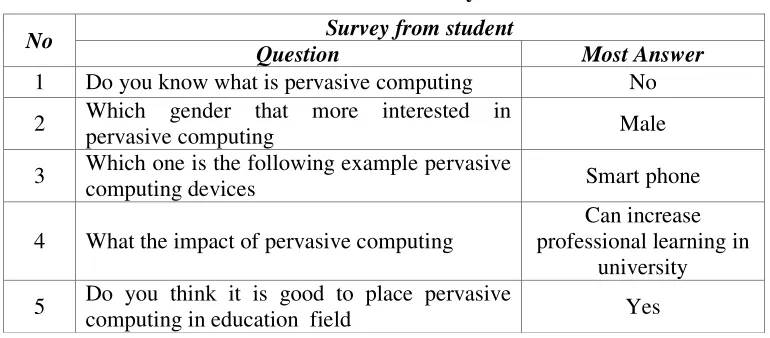
Erwin Setiawan, Rahmat Budiarto, Abdul Wadud Ismail | JSIFO STMIK Mikroskil 119 The statistic of the result shows that five questions that we survey are really encouraging us to support the pervasive computing for collaborative in education. We are using the type of gender, male and female to capture the overall of pervasive computing in surveys where it is male or female that are really excited in pervasive computing for education.
Table 1. Result of Survey Done
No Survey from student
Question Most Answer
1 Do you know what is pervasive computing No
2 Which gender that more interested in
pervasive computing Male
3 Which one is the following example pervasive
computing devices Smart phone
4 What the impact of pervasive computing
Can increase professional learning in
university
5 Do you think it is good to place pervasive
computing in education field Yes
Pertaining to question 1, through the survey, we can prove the hypothesis by concluding that most people do not understand the actual meaning of pervasive computing. We believe that many people are still oblivious to the existence of pervasive computing.
The hypothesis in question 2 is that males are more interested in pervasive computing compared to females. Males often have more advanced knowledge in handling pervasive computing compared to females
The hypothesis for the question 3 is without the aid of pervasive computing devices, the use of pervasive computing will be incomplete. Based on the result of the surveyed question, it is proved that our hypothesis is support the fact that the pervasive computing devices play a vital role in pervasive computing.
The result for the hypothesis in question 4 show that the impact of pervasive computing can increase professional learning at university because learning in education make them to download anything that related with their study more faster. Moreover they can access the website that related with their learning.
The last hypothesis in last question is the aim of pervasive computing is to make computing accessible wherever it is needed. Hence, we can say that this reason can support the fact that we want to implement the pervasive computing in education where it can increase the learning outcome and make it at ease of use for students to access whenever they want.
4.2. Proposed Work
4.2.1. Collaborative Pervasive Environment (CPE)
Erwin Setiawan, Rahmat Budiarto, Abdul Wadud Ismail | JSIFO STMIK Mikroskil 120 We had the opportunity to ask an interviewee from a rival local university about her opinions and reactions concerning the importance of pervasive computing in relevance to our proposed work. As a student of Biotechnology, she mentioned that pervasive computing played a significant role for her education in university, specifically when it comes to learning about protein structures. Single-dimensional textbook images did not significantly help learning about the chemical interactions within and by the protein structures that made them functional. A web-based learning system had been established by their instructors enabling them to enhance their understanding of the protein structures by working with their virtual 3D models. At the same time, learning mates can be interactive through the system and help each other with the learning. Among the tasks assigned to the interviewee through the system were constructions of hypothetical protein structures that can virtually interact with other proteins to synthesize a new hormone. Anyone with access to the learning system could view the hypothetical protein structures, makes comments, and test their virtual functionality against their own virtually-synthesized protein. This can actually be done anywhere as long as you can access to the learning system. Instructors were even capable of logging on the learning system during classes to host discussions about the protein structures.
Based on the discussion above, we can apply the CPE approach to ease the navigation and access of the 3D structures within the learning database. Students can use their mobile devices, PDAs or laptops to gain access in certain locations that have interconnections for them. When working in groups, they can discuss, exchange ideas and simultaneously work on each part and later on combine to get the results. The results will later be presented and discussed in class. Assignments become more interesting when submitted electronically because through the CPE approach, attaching a simulation clip to demonstrate your points in your assignments would be possible. Can you imagine what pervasive computing can do to the future of learning outcome?
Obtaining associating and twinning degrees with foreign universities has been the emerging trend in Malaysia in the past decade. In the future, with collaborative learning, travel and living costs in another country can be greatly reduced and/or abolished because all the learning can be done from within Malaysia. Every aspect of learning can be achieved and excelled through the use of the CPE approach utilizing pervasive computing.
4.2.2. Characteristic of Collaborative Pervasive Environment
Collaborative pervasive environment in education can be characterized based on capabilities that describe more details of its functionality. There are two main features of pervasive computing that can be used in this proposed environment; ad hoc group communications and situation awareness [15-18]. Ad hoc group communication capabilities can form networks dynamically to facilitate various methods of pervasive computing. Furthermore, situation-awareness is the ability of a device to make decisions based on the reality of the surrounding environments. [19].
Erwin Setiawan, Rahmat Budiarto, Abdul Wadud Ismail | JSIFO STMIK Mikroskil 121
5. Conclusion
This pervasive computing is kind of ubiquitous computing that can turn out the user’s life towards more meaningful, enjoyable and exciting. All this factors become the catalyst to the students to use this pervasive computing as their learning medium. All the problems that has been identified has meet their own solutions. The findings from this study showed that more efforts should be taken in future works in order to improve the usage of pervasive computing in education field.
This paper would benefit to following person:
a. USM students – This pervasive computing that going to be implementing in education
field will help USM student to faster their learning outcome and ease their works. Furthermore it provides opportunities to the students to collaborate their works with other student.
b. Other researcher – Useful for them to work deeply in future studies.
This paper’s approach is limited to the following ways:
a. The accuracy of data statistic - The survey is only limited to students because this paper
is about the collaborative works between students that using pervasive computing as one of the medium and it answered by 53 students. Furthermore, the most of the questionnaire are answered by School of CS while the CS students tend to know more about the new technology of pervasive computing. It is bias to conclude the data and represent the result to all USM students. But it is impossible to make all students to answer the questionnaire unless we change the method from paper tracking survey to online survey.
b. The sample of questionnaire is limited to 5 questions only. All the questions are created
base on our hypothesis about the idea we want to implement in this paper and this survey only involving some students, which may not be representative of the general population in USM, so it is unfair to conclude this issues on USM students.
For future work, we suggest to: Conduct a survey on every faculty in USM – For the future work, the survey need to be conduct in every faculty with the same number of student and not just focus to undergraduate student. It is to make sure that the answers are fair between all students so that the survey result will be more accurate.
References
[1] J.Hey, and S.Carter, “Pervasive Computing in Sports Training” IEEE Software, 4(3),
July-Sept. 2005, pp. 54.
[2] M. Weiser, “The Computer for the Twenty-First Century”, Scientific American,
September 1991. pp. 94-10.
[3] S.K.S. Gupta, W. Lee, A. Purukayastha, and P. Srimani. (editorial). IEEE Personal
Communications, Special Issue on Pervasive Computing, August 2001, Vol. 8, No. 4.
pp. 8-9.
[4] M.B. Tinzmann, B.F. Jones, T.F. Fennimore, J. Bakker,C. Fine, and J. Pierce, “What Is
the Collaborative Classroom?”, NCREL, Oak Brook, 1990.
URL:http://www.ncrel.org/sdrs/areas/rpl_esys/collab.htm
[5] J.Mencl, “Benefits and Drawbacks of Ubiquitous Computing,” May 2003, pp. 5-10.
[6] B.Ramadoss, and S.R.Balasundaram, “Aspects of Pervasive Computing for Web Based
Learning,” Springer-Verlag Berlin Heidelberg 2004, pp. 419-425.
[7] Klopfer, E., J. Perry, et al. (2005). “Collaborative learning through augmented reality
Erwin Setiawan, Rahmat Budiarto, Abdul Wadud Ismail | JSIFO STMIK Mikroskil 122 collaborative learning: learning 2005: the next 10 years! Taipei, Taiwan, International Society of the Learning Sciences.
[8] Jegers, K.., M. Wiberg (2006). “Pervasive Gaming in the Everyday World.” IEEE
Pervasive Computing, 6 (1): 77-85.
[9] K.Eileen, and J.Sieck (2010). “Location and Situation Based Services for Pervasive
Advanture Games”. In 12th International Conference on Computer Modelling and
Simulation, 2010.
[10] Jegers, K., “Investigating the Applicability of Usability and Playability Heuristic for
Evaluation of Pervasive Game”. IEEE Pervasive Computing, 2008.
[11] K.Eileen, and J.Sieck (2010). “Location and Situation Based Services for Pervasive
Advanture Games”. In 12th International Conference on Computer Modelling and
Simulation, 2010.
[12] T.H.Laine et al., “Critical Factors for Technology Integration in Game-Based Pervasive
Learning Spaces”, IEEE Transactions on Learning Technologies, Vol.X, No.
X,December.2010.
[13] J. Hundebol and N.H. Helms, ”Pervasive Learning Environments,” Proc. Society for
Information Technology & Teacher Education Intl. Conference 2006, pp. 2226-2231, Chesapeake, VA: AACE, 2006.
[14] H. Ogata, and Y. Yano, ”Context-aware support for computer-supported ubiquitous
learning,” Proc. IEEE Intl. Workshop on Wireless and Mobile Technologies in Education, IEEE Computer Society, pp. 27-34, 2004.
[15] G. Abowd and E. Mynatt, “Charting Past, Present, and Future Research in Ubiquitous
Computing”, ACM Trans. Computer Human Interaction, March 2000.Vol. 7, No.1, pp. 29-58.
[16] S. Yau, F. Karim, Yu Wang, Bin Wang, and Sandeep K. S. Gupta “Reconfigurable
context-sensitive middleware for pervasive computing”, IEEE Pervasive Computing,
1(3), July-September 2002, IEEE Computer Society Press, pp. 33-40.
[17] S. Yau, Y. Wang and F. Karim, “Development of situation-aware application software
for ubiquitous computing environment”, Proc. 26th Int’l Computer and Software Applications Conf. (COMPSAC 2002), August 2002, pp. 233-238.
[18] S. S. Yau and F. Karim, "Adaptive Middleware for Ubiquitous Computing
Environments", IFIP 17th WCC Proceedings, August 25-29, 2002, Montreal, Canada,
vol. 219, pp. 131-140.
[19] S.Y.Stephen et al., “Smart Classroom:Enhancing Collaborative Learning Using
Pervasive Computing Technology”, National Science Foundation. URL:
http://www.eas.asu.edu/~rcsm.
[20] A.Godesberger, “Pervasive Computing: Trends and Impacts”, Bibliographic