ISSN No.: 2456-2165
International Journal of Innovative Science and Research Technology
Address:-
sector-9,Rohini, Delhi.
EDITORIAL BOARD
Manish Gupta
(IJISRTREW100)
| Assistant professor | ECE Dept.| VIT jaipur | Rajasthan | India
HemantPurohit
(IJISRTREW77)
| Professor & HOD ECE dept.| JIET | Jodhpur | Rajasthan | India
Jai Prakash Mishra
(IJISRTREW13)
| Assistant Professor| ECE Dept.| VIT Jaipur | Rajasthan |India
Harsh Gupta
(IJISRTREW02)
| Micro Electronics Dept. | Manipal University | Jaipur | Rajasthan | India
DiwakarGautam
(IJISRTREW05)
| Assistant professor | ECE Dept. | Sharda University
TarunBadiwal
(IJISRTREW09)
| Assistant Professor | Electrical Dept. | Jaggannath University | Jaipur | Rajasthan | India
Virendra Swami
(IJISRTREW105)
| Assistant Professor | ECE Dept. | MaharshiArvind college| Jaipur |Rajasthan | India
Nishant Chauhan
(IJISRTREW79)
| Assistant Professor | Electrical Dept. | MahershiArvind College| Jaipur |
Rajasthan | India
Prince Ja.cob
(IJISRTREW91)
| Assistant Professor | Electrical Dept. | MahershiArvind College| Jaipur | Rajasthan | India
Dr.S.SairaBanu
(IJISRTREW10)
| Associate Professor | ECE Dept. | Karpagam University| Coimbatore | Tamil Nadu | India
BalajiVelusamy
(IJISRTREW500)
| Associate Professor | Info Institute of Engineering| Coimbatore | Tamil Nadu | India
Lalit Mohan Nainwal
(IJISRTREW501)
|School of Pharmaceutical Sciences and Research| JamiaHamdard| Delhi | India
BaisNiravKishorkumar
(IJISRTREW502)
|Assistant Professor|Ganpat University-Institute of Technology| Ahmedabad| Gujarat |
India
Raj Kumar Gupta
(IJISRTREW503)
|Assistant Professor|Amity University| Jaipur| Rajasthan | India
Dr. Neeta Saxena
(IJISRTREW504)
|Assistant Professor|Amity University| Gwalior| Madhya Pradesh | India
Dr.Nageswara Rao Moparthi
(IJISRTREW505)
|Associate Professor| Velgapudi Ramakrishna Siddhartha Engineering College|
Vijayawada | Andhra Pradesh | India
R. Narendran
(IJISRTREW506)
|Faculty of Marine Sciences| Annamalai University| Parangipettai | Tamil Nadu | India
Mahadeva.M
(IJISRTREW507)
Indexing
Volume 3, Issue 9
–
September 2018
The Importance of Value Education for Children Nation.
Author Name:
Zulaecha Ngiu | Volume 3, Issue 9, September- 2018
Entrepreneurial Effectiveness in Building Economic Independence Family in
Indonesia.
Author Name:
Jamaluddin, Andi Makassau, Hasanuddin | Volume 3, Issue 9,
September- 2018
Assessment of Drought Occurrences Over the Sahel Region of Nigeria using the
Standardized Precipitation Index (SPI).
Author Name:
Adigun Adepoju. Ibraheem, Adeyi Gabriel. Oyeleye, Otu John.
Emmanuel | Volume 3, Issue 9, September- 2018
Study of the Characteristics of a Mass of Sea Water in the Zone of the Estuary on the
Coast of Makassar.
Author Name:
Dr Muksan Putra Hatta | Volume 3, Issue 9, September- 2018
Proposed Topology for 7 Level Inverter: A Comparison.
Author Name:
Tanmay Shukla, Priyavand Bundela | Volume 3, Issue 9, September-
2018
Empowerment of Fishing Communities in the Management of the Results of the Sea
in Indonesia.
Author Name:
Andi Sulfatih, Patta Rapanna, Nurlaely Razak | Volume 3, Issue 9,
September- 2018
Chaos Management in Government and Mining Company Infrastructure Project in
South Sulawesi.
Relationship between Logical and Linguistic Categories in the Paradigm of Parts of
Speech.
Author Name:
Adibabotirova | Volume 3, Issue 9, September- 2018
Training of Making Corn Steak in Bonebolango District.
Author Name:
Fory Armin Naway | Volume 3, Issue 9, September- 2018
An Investigation into Teaching-
Learning Environment and Teacher’s Mental Health
in Single Teacher Lower Primary School of District Kokrajhar, Assam; India.
Author Name:
Swargiary, C. Talukdar, M.C. | Volume 3, Issue 9, September- 2018
How Brand Personality Excitement Affects Customer Purchase Decision of
Smartphone in Nairobi, Kenya.
Author Name:
John N. Mutinda, Hannah Bula, Peter P. Wambua | Volume 3, Issue 9,
September- 2018
An Assessment of Renewable Energy Potential for Electricity Generation and
Meeting Water Shortfall in Pakistan.
Author Name:
Dr Muhammad Mobin Siddiqi, Dr Rafia Azmat, Muhammad Nihal
Naseer | Volume 3, Issue 9, September- 2018
Private Label Effect on Customer Satisfaction of Consumer Private Label Sugar
Products.
Author Name:
Djoko Lesmana Radji, Abd Karim Hasym | Volume 3, Issue 9,
September- 2018
Transparency of Financing Management Education in High School.
Author Name:
Nina Lamatenggo, Ayu Anggraini Rosadi | Volume 3, Issue 9,
September- 2018
A Comparative Study on Heuristic and Meta Heuristic Approach in Solving a
Capacitated Vehicle Routing Problem.
Risk Factors for Sexually Transmitted Disease and HIV/AIDS Towards Males Sex
Males in Gorontalo City.
Author Name:
Irwan | Volume 3, Issue 9, September- 2018
Impact of Economic Education Student Field Experience Practices on Competency
Readiness to Become Professional Teachers in Indonesia.
Author Name:
Melizubaida Mahmud | Volume 3, Issue 9, September- 2018
Security Log Analysis.
Author Name:
Allenki Shiva Santosh | Volume 3, Issue 9, September- 2018
Partial Characterization of Red Oil from Three Varieties of Palm Oil Trees (Elaeis
Guineensis).
Author Name:
Ezenwaka, C. J.and Ezeonu, F. C. | Volume 3, Issue 9, September- 2018
Improved Medical Diagnosis using Wrapper and Filter Techniques of Feature
Selection.
Author Name:
Sonu Rani, Dharminder kumar, Sunita Beniwal | Volume 3, Issue 9,
September- 2018
A Study on Current Status of Municipal Solid Waste in Karur District, India.
Author Name:
Vigneshkumar.B, Amsaveni.M, Dr.Palanivel.M, Balakrishnan.M,
Ramesh.K | Volume 3, Issue 9, September- 2018
A Huge View of Life: Human Commitment in Bessie Head’s Maru.
Author Name:
Asma Semidaa | Volume 3, Issue 9, September- 2018
Financial Accessibility and Private Investment in Developing Countries.
Author Name:
Dr Sawadogo Tounwendé Alain, Nodji N. Mbatina, Dr Ronda
Zelezny-Green | Volume 3, Issue 9, September- 2018
Effectiveness of Training Programs of the Construction Sector in the Kingdom of
Bahrain.
Relationship of Personal Competence and Managerial Competency of Business
Organizers with the Quality of School Administration Services in Man Gorontalo
Graduates.
Author Name:
Novianty Djafri | Volume 3, Issue 9, September- 2018
Clinical Profile of Acute Poisoning in a Tertiary Care Hospital in Sub Himalayan
Region.
Author Name:
Pratibha Himral, Desh Raj Sharma | Volume 3, Issue 9, September- 2018
Assess the Knowledge among Steel Plant Workers Regarding Physical and Chemical
Hazards.
Author Name:
S.Vijaya Malar | Volume 3, Issue 9, September- 2018
Design and Construction of Wireless Power Transfer System Charging Multiple
Devices.
Author Name:
Adedayo Asaolu, Joshua Godwin Oshoname | Volume 3, Issue 9,
September- 2018
To Determine the Minimum Transportation Cost by Comparing the Initial Basic
Feasible Solution of a Transportation Problem by Various Methods.
Author Name:
V.T.Lakshmi, M.Usha | Volume 3, Issue 9, September- 2018
A Computerized Hospital Management System: Case Study “Gitwe Hospital”
Author Name:
Gatete Marcel, Uwizeyiman Faustin | Volume 3, Issue 9, September- 2018
Mental Wellness and Athletic Identities in High School Students.
Author Name:
Harsha Sisodia, Akhilesh Sharma | Volume 3, Issue 9, September- 2018
The Role of Perceived Trust on Consumer Intention Toward Mobile Banking in
Palestine.
Author Name:
Haitham M Jouda, Valliappan Raju | Volume 3, Issue 9, September- 2018
Turning Operation of AISI 304L Steel using Taguchi Technique.
A Survey About Women’s Personal Hygiene and Safety Measurements and its
Impact on Nature
Author Name:
S.Deepapriya, N. Manjula Devi | Volume 3, Issue 9, September- 2018
Employee Expectation Analysis using Quality Function Deployment Method.
Author Name:
Sonny Mochamad, Rano Ismoyo, Bramanto Agung W | Volume 3, Issue
9, September- 2018
Investigation of Phytochemicals, Total Phenols and Total Flavonoids Content of Two
Anti-Arthritic Plants.
Author Name:
Christy K. Jose, Francis Mathew, N. A. Aleykutty | Volume 3, Issue 9,
September- 2018
An Improvement of Performance in Virtual Local Area Network or Virtual LAN
using Software Defined Network.
Author Name:
Fatima Laassiri, Mohamed Moughit, Noureddine Idboufker | Volume 3,
Issue 9, September- 2018
Impact of Privatization on Higher Education with Special Reference to the Kamrup
Rural District- A Study.
Author Name:
Rajibloson Medhi, Rugung Boro | Volume 3, Issue 9, September- 2018
Implementation of Effective Quality Control to Improve Product Quality (Case
Study Pt Metiska Pharmaceutical, Jakarta).
Author Name:
Widya Noviyanti W, Apriliana Cendraleka, Dydi Purwanto, Erry
Rimawan
| Volume 3, Issue 9, September- 2018
The Empowerment of Traditional Market Collaboration towards the Economic
Independence of Small Traders in Indonesia
Implementation of Total Productive Maintenance (Tpm) in the Application of
Overall Equipment (Oee) in Pt.Xyz
Author Name:
Afriyuddin, Akmal Yudha Prawira Saputra, Diky Herdiawan , Erry
Rimawan.
| Volume 3, Issue 9, September- 2018
Evaluation of In-Vitro Antioxidant Activity of Two Anti-Arthritic Plants by DPPH°
Method
Author Name:
Christy K. Jose, Francis Mathew, N. A. Aleykutty
.
| Volume 3, Issue 9,
September- 2018
Determinants of Antepartum Mental Complication
Author Name:
Himali, L.P. and Shakila, L.
| Volume 3, Issue 9, September- 2018
Three-Way Regeneration of Spent V2O5 Catalyst from Sulfuric Acid Production
Author Name:
Boutheyna Belhaj Bettaieb, Hedi Ben Amor, Mohamed-Razak Jeday.
| Volume 3, Issue 9, September- 2018
Total Quality Management Factors in Bahrain Higher Education Institutions:
Influences on their Performance
Author Name:
Zahra Merza Moosa Ahmed.
| Volume 3, Issue 9, September- 2018
Effectiveness Analysis of Soehnel L1 Machine using Overall Equipment Effectiveness
(OEE) Method in PT PQR
Author Name:
Adik Ahmad Unggul Nugeroho, Gayuh Raditya Prabandanu, Rusmin
Nuryadin, Erry Rimawan
.
| Volume 3, Issue 9, September- 2018
Symbolic Interactionism at Public Spaces: A Review for Sociological Research on
Transformation the Architectural Public Spaces in Indonesian Cities
Performance and Feasibility of using both Stool Culture and Nested PCR for
Improved Detection of Typhoid Fever in Buea Health District, South West
Cameroon
Author Name:
Rita Ayuk Ndip, Richard Fopa Fomekong, Manfo Tsague Faustin Pascal,
Boris Kingue Gabin Azantsa, Moses Njutain Ngemenya.
| Volume 3, Issue 9, September-
2018
The Relationship of Family Burden with the Family Ability to Care for Post-
Restraint Skizofrenia Patients in Jambi Indonesia: Cross Sectional Study
Author Name:
Muhhammad Pauzi, Adnil Edwin Nurdin, Basmanelly.
| Volume 3, Issue
9, September- 2018
Strategies to Improve Phosphorus Availability in A Sustainable Agricultural System
Author Name:
Vijay Singh Kunwar, Janardan Lamichhane, Dhurva Prasad Gauchan.
| Volume 3, Issue 9, September- 2018
Impact of Front-
Line Demonstration (FLD’s) on Adoption Behaviour of Pi
geon Pea
Growers in Barwani District of M.P.
Author Name:
Akansha Sisodiya, Dr.Sandhya Choudhary, Dr. Deepak Kumar Verma, Dr.
K.S. Kumar.
| Volume 3, Issue 9, September- 2018
Health System in India : Opportunities and Challenges
Volume 3, Issue 9, September – 2018 International Journal of Innovative Science and Research Technology ISSN No:-2456-2165
IJISRT18SP53 www.ijisrt.com 106
Risk Factors for Sexually Transmitted Disease and
HIV/AIDS Towards Males Sex Males in Gorontalo City
Irwan
Department of Public Health, Universitas Negeri Gorontalo, Gorontalo, Indonesia
Abstract:- Sexually transmitted diseases (henceforth called STD) are infections that are passed through sexual contact, i.e., vaginal, anal, and oral intercourse. The purpose of this research is to analyze contributing factors of the transmission of HIV/AIDS in the behavior of males sex males. This observational analytic research employed the cross-sectional study approach. It involved 148 males who have sex with males; 30 of them were selected as the sample. The data were analyzed by using Kolmogorov Smirnov and Fisher Exact method. A number of studies focusing on males who have sex with males in areas with a low number of HIV case, i.e., in Gorontalo, are limited; most research examines the risk of STD or HIV/AIDS in a prostitution case. The result shows that maintaining reproductive organs by males sex males does not significantly influence the risk of being infected with STD and HIV/AIDS (P=0.586). This is different from the variable of sexual behavior and understanding of the risk of the transmission of the disease. Such factors significantly contribute to the risk of STD with the p-value p=0.005 and P=0.007 respectively.
Keywords:- Males Sex Males, Reproductive Health.
I. INTRODUCTION
There has been an increase in the transmission of STD and HIV/AIDS in some non-epidemic areas. Homosexual, shemale and lesbians are prone to STD. The data by the Office of Health Affairs of Gorontalo City reports that there are 350 people with such sexual orientation in the province of Gorontalo. Some of them do not hesitate to admit their sexual orientation (coming out) while the others prefer to hide their orientation (hidden).
People who have such sexual orientation, specifically males who have sex with males, are prone to STD and damages are inevitable during sexual or anal intercourse. The data by the ministry of health affairs, 2015, report that 73% of men practice anal intercourse in a year; they have sex once in a week. This also goes to men who also have sex with both men and women known as bisexual (10%). Furthermore, the data also show that prostitution case in one year is dominated by shemales (26%) and people addicted to
drugs (19%). The highest and lowest ratio of men who have sex with men is 19% and 6% respectively. The sexual
Furthermore, it is shown that STD and HIV/AIDS are common to men who have sex with men in productive ages, i.e., 20 - 24 years. It is concluded that homosexual behavior has been committed starting from age under 20. Men of
such ages are well-known as brondongmanisor young men.
Such a phenomenon has been the foremost concern of the prevention of STD and HIV/AIDS for people who are prone to such diseases in Gorontalo City. The purpose of this research is to analyze contributing factors of the transmission of HIV/AIDS in the behavior of males sex males.
II. RESEARCH METHODOLOGY
This quantitative research employed analytical observation and cross-sectional approach. This approach examines the dynamics between risk factors and its effects through observation, interview, and data collection; all of these processes were conducted at the same time.
The variable of research consists of two, i.e.,
independent (knowledge on health reproductive,
Volume 3, Issue 9, September – 2018 International Journal of Innovative Science and Research Technology ISSN No:-2456-2165
IJISRT18SP53 www.ijisrt.com 107
Table 1. Data of Respondents’ Duration of Being Gay in
Gorontalo City, From: Primary data, 2018.
Most of the respondents are entrepreneurs or working in private sectors (56.7%) while few of them are students (13.3%) as depicted..All the respondents are basically well-informed of their reproductive health (56.7%).
The above table shows that only 2 respondents that do not care about their reproductive system (6.70%). On the other hand, 7 respondents concern their reproductive system with the percentage 23.30% while the remaining 21 respondents are well-informed of the health of their reproductive system with the percentage 70.00%.
No. Reproductive
Table 2. Reproductive Health Care of Respondents. From: Primary data, 2018.
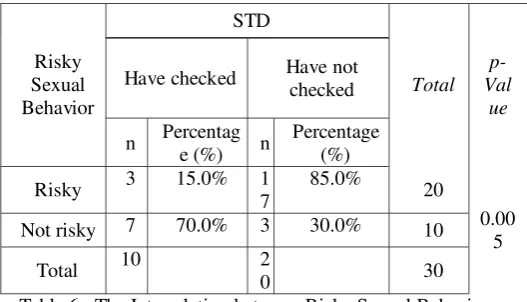
The data on risky sexual behavior of the respondents. shows that only 11 respondents practice safe sex (36.70%). However, the remaining 19 respondents do not concern with safe sex with the percentage 63.30%.The overall description of the STD examination of the respondents is explained shows that only 10 respondents who have performed medical check (33.30%). However, 20 respondents have not performed medical checkup (66.7%).
No. Risky Sexual Behavior n Percentage (%)
1 Not Risky 11 36.70
2 Risky 19 63.30
Total 30 100
Table 3. Risky Sexual Behavior, From: Primary data, 2018.
Bivariate Analysis
The result of Fisher Exact test in identifying
interrelation between the insight on the reproductive health of men who have sex with men and the transmission of STD is depicted in the following table; the test was performed by using SPSS 21.The table shows that 5 respondents (11.8%) do not perform medical checkup and they lack the insight of reproductive health. It is revealed that the probability value
is 0.007. This value is smaller than the alpha value (0.05)
indicating that H0 is rejected. It signifies that the degree of
significance reaches 95%, meaning that the insight on reproductive health significantly contributes to the transmission of STD.
Table 4. The Interrelation between the Insight on Reproductive Health of Men who have Sex with Men and
the Transmission of STD, From: Primary data, 2018.
The table shows that 9 respondents (42.9%) who perform medical checkup are well-informed of their reproductive health care. The result obtains that the
probability value is at 0.586. This value out numbers alpha
value (0.05) indicating that H0 is accepted. It signifies that
the degree of significance reaches 95%, meaning that the reproductive health care does not contribute to the transmission of STD.
Table 5. The Interrelation between Reproductive Health Care of Men who have Sex with Men and the Transmission
of STD, From: Primary data, 2018.
The table shows that 17 respondents (85%) do not perform medical checkup while the rest 3 respondents are the opposite. Furthermore, these respondents associate with risky sexual behavior. The result obtains that the probability value is at 0.005. The p-Value is smaller than the
alphavalue (0.05) indicating that H0 is accepted. It signifies
Volume 3, Issue 9, September – 2018 International Journal of Innovative Science and Research Technology
Have checked Have not checked
n Percentag
Table 6 . The Interrelation between Risky Sexual Behavior of Men who have Sex with Men and the Transmission of
STD, From: Primary data, 2018
IV. DISCUSSION
The result of the statistical analysis shows that the insight on reproductive health contributes to the transmission of STD. This is because experience functions
to enrich one’s knowledge on a particular matter. A person’s
age also influences the perspective and the way someone perceives. The older a person, the more developed his or her mindset by which enhances the way he or she gains knowledge. The result shows that the respondents whose age 24 - 24 years dominate the overall participant (10 people or 33.3%).
Knowledge aspect significantly contributes to one’s
behavior as it drives people to act positively or negatively. Having sufficient insight regarding raises the awareness to prevent the infection of such diseases. This is based on the result of research that knowledge plays a major factor in the transmission of STD. It resonates the result seen in Fatimah as well. This study assumes that having an adequate understanding of STD does not immediately raise the awareness of the respondents regarding the dangers of the disease and prevent transmission of STD. This blames two factors, i.e., internal (education and age) and external (environment and socio-culture). In addition, the knowledge of an individual can change and develop according to
people’s ability, needs, experience and the ease of accessing the information in their environment.
The level of education is in line with knowledge. In terms of the cognitive domain, knowledge comprises four stages, i.e., knowing, understanding, applying, analyzing, synthesizing, and evaluating (Notoatmodjo, 2003). This theory asserts that having a quality education does not ensure the way homosexual men understand and apply the insight they have learned. If the level of knowledge is limited to knowing, homosexual men will perform risky behavior despite understanding the impact it caused.
The application of good reproductive health knowledge will form the basis of healthy sexual behavior in order to reduce the prevalence of STD. It also provides information on reproductive health to homosexual men groups. Knowledge of reproductive and sexual health that is not maximal only leads to misperception, such as the fact that oral sex cannot transmit STD.
The result of statistical analysis shows that reproductive health care does not contribute to the transmission of STD to gay men (p=0.586). People with poor reproductive health care are 2.5 times more likely to be infected with STD.
This is echoing the results seen in Lestari (2006) that poor management of the reproductive health of street children contributes to the issue of STD. Reproductive health care plays a major role in preventing STD; this can be done by, for example, paying attention to the hygiene of reproduction organ.
The result of the statistical analysis shows that risky sexual behavior contributes to the transmission of STD (p=0.05). Sexual behavior of the respondents causes many STD, e.g., HIV, AIDS, syphilis, and many others. Men who have sex with men are the ones who are prone to such diseases.
The result shows that the respondents who perform medical check are only 33.3% of all participants. It is assumed that some of the respondents do not answer the questionnaire truthfully by which forgery is inevitable. With that being said, the lab check and other medical information should be performed for the respondents.
Research by Ratnawati (2002) and Hartono (2009) reports that oral and anal intercourse is among the examples of risky sexual behavior. Using condoms consistently is essential to prevent STD. However, homosexual men often ignore safe sex. According to Maurice Kwong-Lai et al. (2011), 43% of gay men do not use condom during sexual intercourse. It is because of the assumption of the men that they have performed safe sex.
Dailiet al. (2003 as cited in Hernawati, 2005) put risky sexual behavior on the top of the most common cause of 90% of STD patients do not realize that the symptoms of the diseases.
V. CONCLUSION AND RECOMMENDATIONS
The result shows that there is a significant correlation between 1) insight on reproductive health and the transmission of STD, and 2) risky sexual behavior and transmission of STD. On the other hand, reproductive health care does not affect the transmission of STD. With that being said, the government and health officials should perform monthly screening for men who have sex with men to check their condition.
Source of Funding:- This research was funded by
researcher.
Ethical clearance:- Taken from the Faculty of Medicine
Volume 3, Issue 9, September – 2018 International Journal of Innovative Science and Research Technology ISSN No:-2456-2165
IJISRT18SP53 www.ijisrt.com 109
Conflict of interest:-Author declare that there is no any conflict of interest within this publication.
REFERENCES
[1]. Ajzen I. Ishbein M. Attitudes, Personality and
Behaviour. Milton-Keynes, England: open University Press& Chicago, IL.Dorsey press. 1998.
[2]. Ajzen I. Attitudes, Personality Organizational
Behaviour and Human Decision Processes.
Behaviour,second Edition, New York: Milton Keynes OUP. 2006.
[3]. Albarracin D. et.al. Influences of social power and
normative support on condom use decisions: a research synthesis: J. AIDS Care. 2004; 16(6); 700-723.
[4]. Behrman. Labor Markets In Developing Countries,
Handbook of Labor Economics, in O. Ashenfelter&
[6]. Berrigan D. et.al. Patterns of Health Behaviours in US
Adults. Preventive Medicine. 2003; 36; 615-623.
[7]. Brown et.al. Sexi Media Matter, Exposure to Sexual
Content in Music, Movie, Television and
MagazinePredict Black and White Adolescend Sexual Behavior. J. Pediatrick. 2006; 117; 1018-1027.
[8]. Brown et.al. Sexual Tens, Sexual Media: Investigating
Media‘S Influence on Adolescend Sexuality. J.Lawrence Erlbaun. 2002; 1-24.
[9]. Fishbein M. Ajzen I. Belief, Attitude, Intention, and
Behaviour: And Introduction to Theory and Research.California: Addison-Wesley. 1991.
[10].Friedman S. HIV Prevalence, Risk Behaviours, and
High-Risk Sexual and Injection Networks Among.
[11].Young Women Injectors Who Have Sex With
Women. J. Public Health. 2003; 93(6); 902–906.
[12].Huebner A. &Garrod, A. Equilibration and the
Learning Paradox. Human Development. 1991; 34; 261-272.
[13].Gelles R.W. Adolescent Risk Behaviours and
Religion: Findings from a National Study University of Pennsylvania Scholarly Commons Published in J. Adolescence. 2001; 30; 2.
[14].Irwan et al. (2017), The Model of Risk Behavior at the
Rise of HIV and AIDS inAdolescent in Gorontalo
Province, International Journal of Pharmacy
&Pharmaceutical research.June 2017 Vol.:9, Issue:3.
[15].ISSN : 23497243 url :
http://ijppr.humanjournals.com/2017/06/.
[16].Irwan et al. (2018)Model of Hypertension
Transmission Risks to Communities in Gorontalo Province.Indian Journal of Public Health Research & Development.Volume 9 Nomor 1 Januari2018 ISSN :
0976-0245 {print} 0976-5506 (Electronic}
URL:http://www.indianjournals.com/IJOR .ASPX?
target=ijor:ijphrd & olume=9&issue=1&article=058
[17].Kalina, O. et.al.(2009). Psychological and Behavioural
Factors Associated with Sexual Risk Behaviour
Among Slovak Students. BMC Publich Health Journal. Vol. 9. No 15.
[18].Lin-Huei-Ling et.al. (2012). Effect of Matternal
Screening and Universal Immunization to Prevent Mother to Impant Transmission of HBV. Journal Gastroenterology (2012): Vol. 142, No. 4, pp. 773-781.
[19].Pranata, T.D. 2015. Behavior and Social Life of Gay
in Samarinda City ,e Journal Sosiatri- Sosiologi 2015, 3 (3): 135-150 ISSN 0000-0000, ejournal.sos.fisip-unmul.ac.id.
[20].Robert Mallow et.al. (2006) Intervention and Patterns
in Adolescend HIV/AIDS Prevention. Journal InstitudeOf Health NIH Public Access.publish 15 Desember 2008 (sitasi 26 Juni 2018).
[21].Stephenson, K.R. & Sullivan, K.T (2009) Social
Norms and General Sexual Satisfaction: The cost of Misperceived Descriptive Norms. The Canadian Journal of Human Sexuality. Vol 18, No. 3, 2009, pp.89-105.
[22].Triningsih, AH. 2006. Communication Network
Analysis about Gay Sexual Health in Yogyakarta: Fakultas IlmuS osialdan Politik UPN.
[23].WHO. 2013. Factsheet of Sexually Transmitted
Infections (STI’s).
http://www.who.int/reproductivehealth
/publications/rtis/rhr13_02/en/ (Akses 1 April 2018).
[24].Yuko Mizuno et. al. (2007) Beliefs that Condoms
Reduce Sexual Pleasure Gender Differences in
Correlates Among Heterosexual HIV-Positive
Injection Drug Users (IDUs). Journal Urban Health.