Material Confines
Conceptualizations of death through the materiality of burial structures
Leticia Inés Cortés
Submitted in partial fulfilment of the Requirements for the degree of
MSc in Human Osteology and Funerary Archaeology in the Department of Archaeology
The present research is aimed at the exploration of the possible meanings and significances associated to the materials and forms employed by ancient North-western Argentina’s societies in providing confinement for their dead. Ethnographical and etnohistorical accounts from the Andean region and adjacent lowland areas serve to this purpose in encouraging a locally-informed understanding of the perceptions of matter, life and death.
The social aspects of enclosure and confinement of the dead as well as the symbolic properties of earth, clay and stones used in the structures of burial are given thought. The various implications of burning and drying as meaningful processes of transformation of matter are revised in relation to indigenous conceptions of death and the afterlife. These insights are later discussed in light of several archaeological examples from North-western Argentina.
Abstract ….. 2
Table of Contents ….. 3 Acknowledgements ….. 4
Introduction: building death out of materiality ….. 5
I. From Structures to Structuring: archaeological accounts of burial practices ….. 9 Classification, Materiality and Structure: the archaeological perception of a burial ... 9
II. Materiality, Death and Burial ..…13
On enclosure and confinement: structures, gestures and social implications ..… 13
Structures and objects, among other material means of confinement …. 15 Bodies and gestures of confinement ….. 22
Meaningful Matters: earth, stones and clay ….. 24
Earth ….. 25 Stones ….. 30
Clay and Pottery ….. 33
Death and the Transformations of Matter: decomposing, drying and burning ….35
III. To Think Ahead: considerations on North-western Argentina’s burial record …. 41
Landscape, history and societies in North-western Argentina ….. 42
Death and Burial among North-western Argentina’s pre-Hispanic Societies: insights from materiality ….. 45
This research has been supported by the Programme Alβan, the European Union, Programme of High Level Scholarships for Latin America, scholarship No. E06M100529AR; the University of Sheffield International Scholarship for Latin America; and the National Council for Scientific and Technological Research (CONICET, Argentina).
I would like to express my most sincere thanks to all those who have made this possible: Andrew Chamberlain, for his constant support and guidance, for being so helpful before my arrival at Sheffield, throughout the course and after. To my professors at the Department of Archaeology Pia Nystrom, Mike Parker Pearson and Kevin Kuykendall, to Christie and Chris who have made of this course a most enjoyable and fruitful experience. To my family and friends who in the distance supported me in innumerable ways. To Alejandro, because this wouldn’t have been possible without you.
Introduction: building death out of materiality
In North-western (NW) Argentina, throughout centuries of archaeological investigation, every description of the funerary customs of ancient societies has been primarily made in terms of the structure that contained the remains of the deceased. Certainly, while other relevant features might have been overlooked, whether it was an ‘urn burial’ a ‘cist’ or a body placed directly on the ground has always been accounted for in the reports. Such varied ways of placing the dead later defined ‘types’ of burial and were even used to classify distinct cultural groups. However, the potentially diverse concepts of death implied by each particular way of confinement have rarely been discussed. In this place, I will begin to explore how the materiality of the burial structures and by implication, the ways of disposing the bodies of the dead might have denoted different concepts of death in NW Argentina’s prehistory.
worldview (Miller 1985:1). When it comes to the structures of burial then, why were certain materials chosen and no others? What particular conceptualizations of death are implied in the structures that provide confinement for the dead? And perhaps a more basic concern: to what extent are our own ways of understanding death and burial permeating the way we perceive, organize and classify the burial remains of past societies?
The first part of this research takes the form of a very brief acknowledgement on how particular perceptions might be biasing the archaeological classification of burial practices. While it might be unrealistic to think that the remains that we investigate can be totally freed from our own culturally shaped perceptions, this should not preclude the effort of discerning other possible ways of ordering reality. A critical consideration of the way we perceive, organize and interpret the material record of burial practices will hopefully be promoted by considering indigenous definitions of death and the afterlife.
structures -as problem to investigate itself- provide any different perspective in the interpretation of past funerary practices? If creating, building and shaping entails a “manipulation and recombination” of powerful substances into cultural forms (Saunders 2004:124), how then is a clay-urn, a stone-cist or a hole dug in the ground conceptually appropriate for the placing of the dead? A number of related issues are also given thought in this chapter. For example, why may be sometimes essential to provide the dead with a material structure of confinement? How are the bodily remains of the deceased purposively ‘affected’ by different types of confinement, or even by the absence of one? What meaningful considerations about the body and the afterlife can be drawn from different post-mortem treatments of the deceased’s body? Why might be particular qualities of the landscape, features or objects relevant to the realms of death?
The third part of this research is aimed at providing a first approximation to the material record of funerary rituals in pre-Hispanic NW Argentina hoping to develop some ideas with regards to the concept of death and their embodiment in diverse burial structures. I will consider various published and unedited records of funerary contexts ascribed to Formative (ca.600BC-900/1000AD) as well as Late period (ca.1000-1480 AD) societies settled around the Santa María Valley area and the eastern forest regions. The examples here discussed are not expected to provide any uncontested results but instead to unfold a framework of discussion to be deepened with further fieldwork and detailed contextual research.
I. FROM STRUCTRES TO STRUCTURING: ARCHAEOLOGICAL ACCOUNTS OF BURIAL PRACTICES
Classification, Materiality and Structure: the archaeological perception of a burial
In our Western tradition death occurs in an absolute moment of time. Life and death are axiomatic opposite realms: one, determined by the absence of the other. Nowadays, funerary rituals take in general a relative short time. Just the necessary involved in the preparation of the corpse and the paying of the final respects to the deceased and its’ relatives (Hertz 1960:28). After that time, the body is given final disposal.
visit and receive different kinds of offerings, and it is only by the end of the third year of cyclically repeating this ritual that the “ghost-souls can be safely ignored” (Carter 1968:246). For many societies around the world then, death is not an absolute state but a continued process that demands specific ritual actions and may even sometimes reverse (Barley 1995:47).
II. MATERIALITY, DEATH AND BURIAL
The aim of this chapter is twofold. In the first place I will focus on the social aspects of the enclosure and confinement of the dead, with particular concern to Andean societies. Without expecting this practice to be universal or even unavoidable, its unquestionable occurrence in the archaeological record gives reason for investigating the underlying beliefs as well as the material outcomes of such practice. In the second place, the symbolic meanings and cultural significances of diverse materials, elements and their changing physical and chemical states as perceived by past and present societies will be explored. Particular emphasis is given to Andean perceptions of materiality as well as to those recorded in the lowland eastern forests. The final objective is to elaborate a thoughtful body of knowledge on the symbolic implications associated to the use of particular materials and transforming processes (e.g. drying, burning) in the context of death and burial to later advance possible interpretations of pre-Hispanic NW Argentina’s funerary record.
On Enclosure and Confinement: structures, gestures and social implications
Harris 1982, Allen 1988, Gose 1994, Salomon 1995, 2002, Sillar 1996, DeLeonardis and Lau 2004). Consanguine relatives are said to be exposed to exceptional danger do to their “almost physical connection” to the corpse, a situation that does not end until the
alma (soul) has been definitively separated from the living (Tschopik 1951:214, Gose
1994:117). Before this time, the relatives and the community in general are in particular danger of being seized by the dead (Tschopik 1951:214).
Tschopik (1951:214) reports that among the Aymara of highland Peru, the funeral practices are explicitly designed to: “(1) prevent additional deaths; (2) protect the living against dangers incurred through contact with the dead; (3) discourage the ghost from lingering about the premises; and (4) speed the departed soul on its journey to the hereafter”. These four schematic aims are systematically repeated throughout the Andean region and the adjacent lowlands areas. A series of ritual actions thus take place to comply with this necessary separation of the realms of life and death, some of which may be considered transient and ephemeral but others indeed leaving distinct material outcomes. Indeed, building an enclosed structure for confinement constitutes one material means of effective separation. However, other more subtle forms might have had the same effects (see Parker Pearson 1999:25). Yet here I will not only think of confinement in terms of accomplishing a physical separation but also implying any
material and immaterial means of control and restrain from the potentially harmful
(Harris 1982:53). Certainly, although none of these ephemeral actions will be archaeologically recoverable, other gestures may have lasted as material embodiments of the imperative need of confinement, control and restrain. Indeed, while living among the Chaco groups of Argentina and Bolivia, Karsten realised that these peoples tried to avoid the spirits of the deceased by using “the same material means” as they would have employed against a human enemy, such as shutting the house where the corpse had laid, barricading the door with poles, and fencing the place with arrows. All these were perceived as “effective” protections against the dangerous spirits of the dead (Karsten 1932:194).
Here I would like to think of the various means and reasons for confining the dead while simultaneously protecting the living and to explore their material outcomes to build on possible archaeological indicators of such practices. In what follows, several questions will be explored: how and when is any burial structure to be understood as inherently confining? Could certain materials, landscape features or particular environs be founders of an effective separation of the harmful but indispensable dead? Could certain objects and their disposition in the grave be inhibiting noxious effects associated to the dead and thus ‘confining’ them in particular ways? Could burial postures -the ‘gestures’ of the dead- be considered an embodied means of restraint?
Structures and objects, among other material means of confinement
widespread practice (Parker Pearson 1999). From a general point of view, I would argue that any ‘enclosing’ structure for disposal can be considered inherently confining as its materiality establishes a separation -a distinct milieu- different from what surrounds. However, its variability can be said to be the result of a historically constructed worldview and perhaps only understandable in the specificity of each social context. Notwithstanding, some shared perceptions held by different communities in the Andean region speak of a more or less generalized understanding of the threats that lie beneath such need of confinement.
In the Andean thought, the ‘ghost’ of the dead -sometimes equated with its soul- has been said to represent the biggest threat to the living (Harris 1982:54); death rites are accomplished to dissolute the intimate link between the soul and the bodily remains of the dead (Gose 1994:116). On occasions, three or more ‘almas’ are distinguished, one of which is thought to remain with the buried cadaver (Valderrama and Escalante, cited in Gose 1994:116)1. The process by which the soul becomes effectively detached from the body of the dead begins with the simultaneous rituals of clothes washing and burial (Gose 1994:121) however it does not come to an end with the actual disposal of the body. Every year during the celebrations of All Saints and the Day of the Dead the recent dead are thought to come back to visit the living, an event that foresees the preparation of great quantities of food and drink to be offered to and ‘eaten’ by the visiting souls (e.g. Bastien 1978:171-187, 1995:368-372). Through this cyclical annual ritual, the separation of the living and the dead -initially accomplished during burial- is
1
In general, there seems to be a wide variety of interpretations concerning the number and quality of souls and their different paths alter death (Tschopik 1951:210-219). According to Allen (1988:62) “Andean worldview does not accommodate the Western dualism of body and soul”. Equally Harris (1982:61) warns about the ‘incompatibilities’ regarding the concept of soul, which might be simultaneously present -tied up to the body- and departing -to the afterlife.
ensured in time (e.g. Harris 1982:56). Although the division of the dead and the living seems to be reversed during these festivities (Gose 1994:114), this time could also be understood as a controlled, regulated way of contact and in this sense, as a culturally prescribed way of preserving their necessary separation.
However, both for contemporary and historic Andean and neighbouring lowland societies, the soul of the dead is thought to be particularly harmful during the time following death that is, when the arrangements for the disposal of the body are being made. During this critical time, several actions are performed to protect the ones in danger. Karsten has argued that among the lowland groups of the Argentinean and Bolivian Chaco the burial customs performed seemed to be aimed at “interring the soul with the body”, and only later is the soul thought to leave the grave and become some undefined entity (Karsten 1932:189). Providing the burial structure with a lid or cover seems to have been a clear indication of such need of confining the soul of the deceased:
“Before life was extinct, the body was thrust into a huge jar into which also ornaments, weapons, food and drink were put, the mouth of
the vessel then being carefully closed up with an earthenware platter. It
was important that the lid was put on before the dying person had drawn
his last breath. By doing this, it was thought that the soul of the dead
would for a time be held in confinement, so that it would not be able to
work any harm on the living. The jar was afterwards interred inside the
While the practice of interring adults in big vessels appears to have been more common in the eastern forests of the Andes (e.g. Berberián 1969), the fear of the soul escaping may have made of the practice of covering other types of tombs necessary and unavoidable. Yet, even these actions could sometimes be regarded as insufficient for which extra means of security could have been imperative. Huntington and Metcalf (1979:76) when discussing Berewan funerary rites have pointed out an occasion when extra bands of rattan needed to be tied to a coffin in order ‘to secure the lid more firmly’ as threatening sounds were heard coming from inside. Interestingly, several examples in the archaeological record of NW Argentina could be pointing towards this need of ‘reassuring’ the covers or lids (see Chapter III).
To cover up entails providing a close environment that neatly separates what remains inside and outside; in this sense, any ‘hole’ or ‘aperture’ (as in an opened urn) might be considered potentially dangerous. According to Hertz it is the need of avoiding the exit of the soul and preventing it causing other deaths what motivates the hermetic sealing of the coffins among Borneo peoples (Hertz 1960:32). In this same respect the account recorded by Pærregaard in highland Peru becomes revealing:
“Before the night of the wake, the relatives of the dead search for one or several holes in the ground which is said always to be found on a circle drawn around the corpse placed in the house of the family…Finally it is filled with a series of objects to obstruct it… I was told that the soul
of the deceased can escape through the hole if it is not properly
and the roof of the house cracking. Further, the lives of the bereaved would be in danger” (Pærregaard 1987:31, emphasis added).
Also:
“La Barre reports about the Aymara Indians he studied that when a person dies, in order that more in the family will not die also, a local doctor sound out all holes in the walls and floor of the house. If he strikes a place sounding hollow, he will dig it out pretending that he fights with something very strong… In the same area, Tschopik tells, people believe that the soul of the deceased digs a hole in the floor of the house to call the widow and convince her to join him. The only way to prevent this from happening is to identify and obstruct the hole…” (Pærregaard 1987:32-33, emphasis added).
And again:
“When a man died, his soul (qamasa) digs a little grave under the floor of the house. He is calling for his wife so that she will die too. The person who cleans the house discovers these ‘graves’ with a needle or awl and fills them with earth to prevent other deaths” (La Barre, cited in Tschopik 1951:214, emphasis added)
account remarks the importance of fully covering the dead as a means of protection against unwanted consequences. In this regard, it is pertinent to recall that in many parts of the Andean region people still refer to the ancient dead (the pre-Columbian dead) as ‘tapados’ (‘the covered-ones’) (also Salomon 2002:478). As it will be argued for NW Argentina, particular features in the very materiality of the burial structures might have been representative of such will of obstructing unwanted apertures or holes from where the soul of the dead could possibly escape (see Chapter III).
Not just the proper covering of the body seems to have been imperative but also interring the dead with certain urgency. For instance, some researchers have argued that it is the fear of someone being ‘seized’ by the soul of the deceased what makes the mourners fill in the grave hastily (Gose 1994:119, Bastien 1995:363) and “hurry” the corpse into the ground (Allen 1988:15). In this respect, Metraux (1930:143) has reported that among historic Chiriguano groups, just having the “slight perception of someone going to die” was sufficient enough “to grab the person and put him inside an urn”. Although perhaps overdramatized by the ethnographer, this perception is clearly evocative of the danger of the soul escaping just after death occurs.
The accomplishment of confinement however, needed not to be always dependent on a sealed structure since other less obvious means may have had the same outcomes. For example, in the Berewan case, the action of confinement was further ensured by placing magical plants on top of the coffins’ lid (Huntington and Metcalf op.
cit.). In contemporary Bolivia, Laymi people placed thorns and knifes in an upright
Andean region; Figure 1). Among some Bolivian groups stones are hurled with slings to avoid the souls of the living following the dead (La Barre, cited in Tschopik 1951:214). Similarly, as Gose has himself sensed “almost as if to make sure that the corpse stays down, heavy rocks and a cross are planted on top of the grave” (Gose 1994:119). In the same fashion, some of the relatives were in charged of “pounding the loose dirt on the grave with a heavy flat stone, which further emphasizes that the corpse/alma is being driven downwards” (Skar, cited in Gose 1994:275, emphasis added). Interestingly, several examples from NW Argentina could be evocative of such practices (see Chapter III).
Figure 1: Grave covered by thorny branches. Taken from Karsten (1932:194)
thought to be diametrically opposed to that of the living: one world experiences night while the other daytime; wet season in one, dryness in the other (Harris 1982:62). Also among contemporary Andean communities, the ritual of washing the clothes of the deceased is done by men in place of women who are usually in charged of that activity (e.g. Gose 1994). Similarly, and given the polluting nature of the clothes, the washing is done with the feet instead of the normal use of the hands. Moreover, the clothes of those who have participated in a funeral should be put inside out to avoid sickness and further bad luck (Tschopik 1951:215). Perhaps in this light, the frequent placing of upturned objects in the contexts of death could become relevant as another ritual means for taming the dead (see Chapter III).
Bodies and gestures of confinement
however and maybe because we tend to associate gesture with the living, this area of research remains mostly unexplored (Cortés 2007).
Meaningful Matters: earth, stones and clay
Materiality is sensuous in essence; textures, shapes, colours and smells may interact together to provide a unique experience of the material world (Meskell 2004:64, Tilley 2004:12). In the every day life of ancient communities, stone, clay, wood, earth, mud, metals, shell, bone were all constitutive of varied kinds of structures and objects. While according to traditional Andean thought, all materials are ultimately derived from the Mother Earth (Pachamama), the transformation of raw materials into objects may have entailed the conscious transfer and resignificance of their symbolic properties (Allen 1982:193). In this place, I will support the idea that the differential use of raw materials should be taken as inherently informative of a materially-expressed worldview (e.g. Boivin and Owoc 2004, Meskell 2004). Certainly, to create, to build and to shape entails a conscious reordering of substances into cultural forms, becoming the embodiment of fundamental powers or capacities (Saunders 2004:124). Today, many Andean communities experience the material world as “animate, powerful and responsive” to human intervention, influencing everyday activities, perceptions and beliefs (Allen 1988:37). The choices of particular materials and the techniques employed in their processing thus become necessarily entangled with the particular representations of the material world (Sillar 1996:259). How then, could stones, clay and the same Earth have imprinted particular statements and meaningful qualities to the structures they conformed? What immutable materials as well as transformative processes were considered necessary in the realms of death and burial?
extent these may inform our analysis of past funerary practices. Ethnographic as well as etnohistorical accounts contribute to this purpose although they do not provide any simple solution to interpreting what is in essence culturally and historically unique. Yet, these records may inspire us to observe reality from a different angle. In the following paragraphs, the evocative qualities of diverse materials will be explored. Special emphasis is given to stone, clay and earth as these are the main substances associated to the archaeological record of burial in NW Argentina and the southern Andes in general. In close relation to this, the various conceptual associations of death and the physical and chemical processes of burning, decomposing and drying are examined to further build on the past significances of burial structures, surroundings and contents.
Earth
The pervasive symbolic importance of the Mother Earth (Pachamama) in Andean cosmology, its fundamental position in thought and its omnipresence in ritual performances does not need to be emphasized. Certainly, since ancient times the ‘empowered earth’ has been the cause of many ritual practices, behaviours, gestures and offerings (Boivin 2004:5) but it is perhaps in the Andean region were ‘Pachamama’ becomes the defining element of ideology, the source from where all meaning ultimately derives (e.g. Mariscotti de Görlitz 1978).
symbolically neutral, surrounding matrix in which finds are buried and with which features are filled” (Parker Pearson 2004:85-86). Clearly, as one gets interiorized about the tremendous and all pervasive importance of Earth in the Andean thought, such an indifferent archaeological approach becomes unsustainable.
The every-day complex of ritual gestures towards the Pachamama that are today held in many parts of the Andean world could perhaps be taken as hints of the impressive importance and ubiquity that these rituals might have had in the pre-Hispanic past. While resignifications of such rituals have undoubtedly occurred, the long-standing omnipresence of such practices in the Andes speaks of the centrality of Earth in shaping the destiny of the people who live at expenses of ‘her’. In parallel with ancient sensitivities, digging the earth to extract its ‘treasures’ is not regarded as a harmless or innocuous practice by many contemporary Andean communities. Catherine Allen, among the many ethnographers that have worked and lived in Andean communities honestly confessed the impossibility of approaching their rationalities without taking into account the emotional basis of these peoples’ relation to nature and the material world. So she truthfully admitted having been able to describe the methods and techniques employed in hoeing the potatoes out of the fields and the teamwork involved in these tasks, yet regretting not being able to observe “the Earth’s resentment of the hoes cutting into her” (Allen 1988:37). In this phrase, Allen brilliantly summarizes our conceptual and perceptual distance to Andean present societies and leaves us archaeologists with a reflection of how far away are we to understanding past practices if we keep thinking them through our Western parameters and taxonomies.
inevitably and rightfully get engaged with traditional beliefs. In the Cajon Valley (NW Argentina) just like any professional archaeological digging entails a quantity of governmental and official permits, so too we have learned to request ‘permission’ to the Mother Earth by performing the offering ritual or ‘Pacha’. Before starting any archaeological dig, every participant in the excavation makes his/her ‘payment’ to the
Pachamama and requests her ‘treasures’ to be accessed. The main performer of the
ritual (usually a local collaborator) digs a small hole in the earth were all participants one by one will pour coca leaves, wine, aguardiente, cooked maize flour, sweets, chocolate and all that the Pacha enjoys ‘eating’. A cigarette is lighted and later placed standing in the hole for ‘the Earth to smoke’. Once the libations have finished, the hole is covered by a stone. Successive Pachas are preferably done in the same hole and a new stone is added each time (Figures 2, 3, 4).
Figures 3 and 4: Pacha ritual. Pouring of wine and toasted maize flour (Cajón Valley, Argentina). Photos by Lic. Marilin Calo.
Figures 5 and 6: ‘Señalada’ ritual (Cajón Valley, Argentina). Pouring of wine and detail of the flat stone used to cover the hole (arrow).
should be at least sentient of such associations; that is, to consider the act of digging the earth as no neutral activity but the result of “carefully considered acts” that not only implied the burial of things but also the “mixing of those things with soil” (Parker Pearson 2004:86).
Stones
To embark in the understanding of the meanings of stone becomes emblematic of the contradictory ways of perceiving reality between different systems of belief. Certainly, to us stones have become the paradigm of the ‘inanimate’, the ‘inert’, the ‘non-living’ thing. By contrast, many contemporary as well as ancient societies in different parts of the world share the perception of stones as animated beings (Boivin 2004). In the Andean region, the personified character of stones and stone formations (mountains, caves, outcrops, cliffs) has been determinant since ancient times (e.g. Arriaga 1621, Karsten 1926, Mariscotti de Görlitz 1978, Gose 1994, Bastien 1978, Saunders 2004). The sacredness of these formations stands in direct relation to their ritual-demanding nature, what in turn speaks of the powers that are embodied in them (Saunders 2004:126). According to the Andean worldview:
From a phenomenological framework, Tilley (2004) has extensively discussed how the different sensual proprieties of stones -textures, colours, sizes, even tastes and smells- become relevant in their perception and significance. Ethnographical and historical accounts have highlighted the importance that certain natural formations, stones and minerals had for Andean people, in particular those whose colours, shapes or textures stood out against their surroundings making them comparatively unique in their realm (Karsten 1926:363, Mariscotti de Görlitz 1978:57, Saunders 1999, Van de Guchte 1999:154). To some, the distinctiveness of certain formations is said to establish the limits of the sacred spaces (Mariscotti de Görlitz op. cit.), a point to which we will return when discussing specific landscape features related to the placing of the dead in NW Argentina.
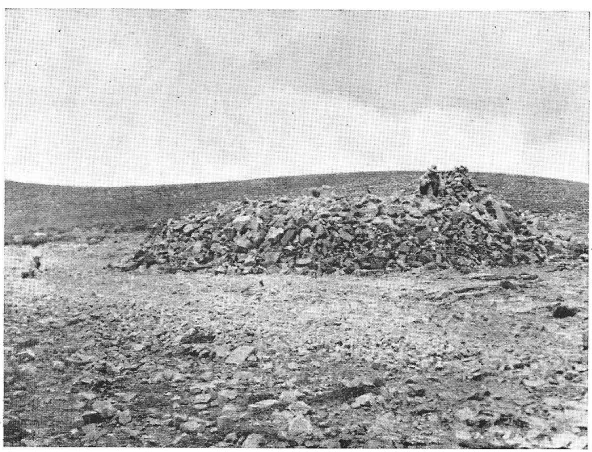
Figure 7: ‘Apacheta’. Taken from Von Rosen (1957)
Clay and Pottery
Throughout the world, the plasticity of clay has been exploited in innumerable ways (e.g. Barley 1994:69) making pottery a particularly good means of symbolic expression (Miller 1985:15, Hosler 1996:85). Both in domestic and the funerary contexts, earthenware is commonly associated with storage, serving and eating and in that capacity pottery is first and foremost a “container, transporter and framer” of substances (Miller 1985:204, see also Hendon 2000). But what is it that makes this kind of containers different from others?
“Clay is alive...it is sensitive, delicate, and gets upset easily; it responds to the mood of the potter. Clay knows when the potter is ill or inexperienced, and becomes impossible to work. Clay changes state, formed and shaped by the potter’s idea, but sometimes...clay has its own idea. Paja (straw) used to weave hats, on the other hand is neutral, it doesn’t feel anything, it isn’t alive.” (Hosler 1996:83).
Death and the Transformations of Matter: decomposing, drying and burning
It has been argued that in the context of Andean rituals, communication must be exerted through specific “mediating substances” -cooked food, alcohol and coca- offered in particular, pre-determined ways: by blowing, pouring, or sprinkling; by burning and by force-feeding (Allen 1982:191). In particular, according to traditional Andean knowledge, the transformation of substances through physical or chemical process such as burning or drying brings to front many interesting implications to the realms of death and burial. Among present day communities, dead bodies are argued to imply distinct risks to the living depending if they are in a mummified, dry-bone or rotting-flesh state (Allen 1982:192, Pærregaard 1987, Salomon 1995). Following Bastien’s proposal that solids are symbolically associated with males and liquids with females, Allen (1982:192) has argued that a ‘correct’ process of decomposition of a dead body entails the putrefying flesh (a fluid substance) to be absorbed by the Mother Earth (female) while the dry bones (a solid substance) shall remain as the materialization of the benevolent ancestors (male). A further distinction revolves around how and to what extent this process is attained:
flesh back, they act analogously to the earthbound Kukuchis” (Allen 1982:187, emphasis added).
The ‘proper’ separation of flesh from bones that assures the dead will turn into a benevolent (though ritual demanding) ancestor is thus accomplished by the Mother Earth’s absorption of the flesh and all rotting matter (Allen1988:63). By contrast, if the bones become desiccated by exposure to the sun -as it is argued to have happened in mythical times- the resulting bones are perceived as particularly polluting and harmful (e.g. Allen 1988:55, Salomon 2002). Salomon (2002:478) describes the perception of these ‘sun-dried’ ancient bones (or ‘gentiles’) as one of the most dangerous and charged archaeological remains as perceived by contemporary Andean communities, their casual encounter encompassing marked uneasiness and demanding diverse ritual gestures. But perhaps the worse situation is that of those who cannot free themselves from the ‘green, rotten, smelly’ flesh after death, an outcome frequently expected for sinners of various types (Allen 1982:187).
Tschopik 1951:216). Interestingly, among some Andean communities, those people who are approaching death as well as the recent dead (i.e. the decomposing dead) are conceptually analogous and different from the “immutable” nature of old, dried bones (Salomon 1995:328).
The numerous associations of rotting matter, flesh, fat and in general wet substances to the realms of death and souls is complex and multisided (e.g. Tschopik 1951, Bastien 1978, Gose 1986). What seems to be a shared Andean perception is that the different states of decomposing human matter and the process by which these states are attained are of primary importance in terms of their the influence effected upon the living: whether as mummies, dry bones or rotting flesh, the dead continue to exert an influence over the human welfare (Allen 1982:192). From an archaeological point of view, these distinctions have clear implications to the analysis of the structures of burial and their associated effects upon decomposing human matter. After death occurs, it follows a time were the process of structural separation of soul, flesh and bones needs to be properly accomplished through certain prescribed ritual acts (Pærregaard 1987:25, Salomon 1995:329). Indeed, some of these ritual gestures may have implied the building of particular structures. In this line of thought, chullpas have been argued to be ‘drying structures’ specifically designed to allow the preservation of the bodies in a mummified state (Sillar 1996). In other occasions, the expected outcome was that of obtaining bare bones “cleansed of flesh” (Allen 1988:62).
opposing but necessary connection to heat and burning (e.g. Bastien 1978, Harris 1982, Gose 1994). In this context, particularly interesting is the paradoxical association of burning and death in one side, and the almost inexistence of cremation practices, in the other. In relation to this, Peter Gose has argued that cremation has not been widely practiced in the Andes because “it violates the idea that the dead should be dried out in the underworld, to provide the living with water” (Gose 1994:130). Again, a particular mode of decomposition of the body ( to dry out in the ‘underworld’) has clear outcomes in terms of the necessary role of the dead in the lives of Andean communities, as it is only by these means that water will return to the living. According to Gose (1994:129), it is likely that the opposition of fire and water connotes as an implicit reference to the reduction process experienced by the soul of the deceased. So too Harris has sustained that water is antithetical to souls, for what their encounter might be particularly harmful during the rainy season (Harris 1982:59). Also, the exposed bones of the dead are thought to be the cause of draughts (Tschopik 1968:167) and as they are considered unable to cross water flows without help, water is seen as an effective means of separation between the living and the dead (Harris 1982:55). Interestingly, some places conceptually connected with dead coincide with naturally dried areas such as Mount Qoropuna, located in the arid western slope of the Peruvian Andes (Gose 1994:129). Without mediating any inconsistencies, desiccated human flesh is thought to be a good remedy for particular illnesses, alternatively the person might be cured by drinking the water in which the deceased’s clothes were washed (Tschopik 1951).
washing of the clothes of the dead as two of the main ritual performances during mourning (e.g. Tschopik 1951, Carter 1968, Gose 1994). Ambrosetti argues that the fire is the vehicle commonly used to establish a communication with the souls in the Andean regions (Ambrosetti 1967:140) and the burning of offerings is one particular manner through which this contact is accomplished (e.g. Bastien 1978:147, but see Allen 1988:164). Fire is the medium through which food as well as personal belongings are passed to the spiritual realms (Carter 1968:244, Gose 1994:143). The extirpators of idolatries recorded that if the fire sparkled, it was interpreted as a signal of the ancestors being hungry and different foods were thus thrown into it (Arriaga, cited in Fernández Juárez 2006:167). From other sources we learn that the food offered and eaten during these rituals has to be well-cooked and sometimes following specific rules (Bastien 1995:369). For example, maize may be cooked together with the cobs so that the grains remain “hard and dry inside” (Gose 1994:143-144). Furthermore, the soups eaten by the dead are said to be made of ashes (Arguedas, cited in Gose 1994:278). Pertaining to the inversion process of death, while the food offered to the dead must be baked and cooked (see Allen 1988:164) the living eat their food without salt or pepper (Guaman Poma de Ayala 1615: 292, 298, Salomon 1995:330) that is, without ‘metaphorical’ heat. Furthermore, the abstinence of eating chili pepper by the living is clearly opposed to the belief that the dead cultivate chili pepper in their fields making of this land of the dead a place of ‘heat’ (see Harris 1982:52, 62).
communities the dead are buried with a candle (a burning charcoal?) to illuminate the “nighttime trip” through the underground rivers of the mountains (Bastien 1978:174). Ashes, as one material outcome of fire, have too a principal role in the rituals associated with death as for example, they were commonly scattered at the doorway of the houses the night of the mourning to detect the footprints of the deceased’s ‘spirit’ which was expected to return (Bandelier 1910:8, Carter 1968:242, Salomon 1995:330). These were also frequently examined to determine the causes of sickness or future deaths (Tschopik 1951:202, 214). As it will be discussed, the various conceptual associations between death, heat and dryness and the material outcomes of the action of fire -ashes and charcoals- posit attractive implications in the analysis of various evidences registered in NW Argentina.
III. TO THINK AHEAD: CONSIDERATIONS ON NORTH-WESTERN ARGENTINA’S BURIAL RECORD
In this chapter I would like to think through particular features of the archaeological funerary record of NW Argentina that may be worthy of further reflection in light of the indigenous perceptions and thoughts discussed in the previous chapter. Special emphasis will be given to evidences ascribed to the Formative Period in the Santa Maria Valley and surroundings areas. However, some evidences from the Late Period and other regions esteemed relevant to the discussions will also be considered.
The archaeological information here presented comes from a wide variety of published and unedited records written in the first decades of the XX century through the present date. Undoubtedly, working with accounts produced by researchers and travellers whose aims, ideas and socio-historical contexts were markedly different imprints a great amount of heterogeneity to the available data. However, this singularity is also unavoidable and inherent to the particular nature of the archaeological record. In a sense, these records are double in value: not only they are evidences of past ways of thinking but they are also the material remains of our own ways of perceiving and classifying the material past. Certainly, while the experience of place is always desirable and irreplaceable (e.g. Tilley 2004:219), thinking from the experience of others does not entirely halt the possibilities of reinterpreting our past.
they may become meaningful with regards to the indigenous practices and beliefs previously outlined. Without trying to validate any direct analogy, the effort is focussed towards start thinking through these remains as expressions of a materially-expressed worldview. Needles to say, each of the contexts that will be presented below deserve to be studied in depth in terms of specific historical situations; however this must be understood as a first step towards a more minute and context-specific analysis to be accomplished with subsequent fieldwork and laboratory work.
Before delving into the material past, a very brief outline of the geographical and socio-historical development of NW Argentina is given.
Landscape, History and Societies in North-Western Argentina1
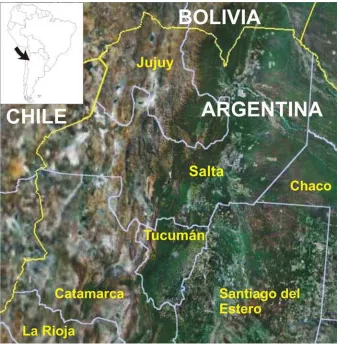
North-Western Argentina is a vast region that comprises the provinces of Jujuy, Salta, Catamarca, Tucumán and La Rioja. According to the presence of distinct ecological environments this region has been segmented in three major sub-areas: the
Puna (dry highlands), the Valles (temperate valleys and sierra) and the Yungas (the
humid slope on the eastern skirts of the Andes) (Figure 8). Such particular geographical configuration is thought to have been of fundamental importance during pre-Hispanic times as communities settled in different ecological environments were extensively involved in the circulation of people, objects and staples (e.g. Dillehay and Nuñez 1988, Albeck 1994, Lazzari 2006).
1
This schematic description does not accurately reflect the complexity of views and debates with respect to NW Argentina’s pre-Hispanic past. In favor of conciseness, I have preferred to refer to some of the authors who have dealt with these issues in depth for further reading.
Figure 8: North-Western Argentina (modified from Google Earth 2006)
In very schematic terms, the Formative (Neolithic) Period (ca. 600 BC-AD 900/1000)2 has been generally characterized as one where segmentary groups with little social hierarchy lived in small agricultural-herding sedentary or semi-sedentary communities that although mostly self-sufficient, were also involved in dynamic social interactions oriented towards the distribution and exchange of local products on a regional scale (e.g. Núñez Regueiro 1974, González 1979, Berberián and Nielsen 1988, Tarragó and Scattolin 1999, Olivera 2001, Scattolin 2007). The Formative Period is preceded by the Archaic -a period of experimental domestication (ca. 8000-1800 BC)-
2
I have adhered to a broad temporal definition of the Formative period following Scattolin (2003).
and followed by the Regional Developments or Late Period (ca. 1000-1436 AD). The Late Period is usually described as a time of highly hierarchical chiefdoms with clear-cut territorial boundaries maintained through the political control of other ecological areas, agglomerated settlements and warfare (e.g. Tarragó 1992, 2000, Nielsen 1996). Afterwards, the Incas conquered the area affecting differentially the local developments (e.g. Williams 2000) a process that was to be later drastically changed by the arrival of the Spanish conquerors.
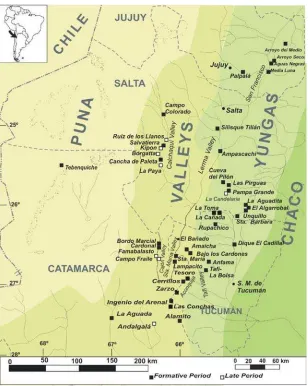
Following, evidences from both Formative and Late Period will be cited (see Figure 9 for geographical location of the contexts mentioned in the text).
I am aware that -not just because of their chronological separation- but for being part of specific social systems and rationalities, the funerary remains here discussed are likely to have entailed particular meanings and symbolic associations that demand specific historical and contextual consideration. In this place, however, I have favoured a preliminary analysis of their materiality within a framework that contemplates the great temporal depth of an ‘Andean’ worldview towards nature, life and death.
Death and Burial among North-Western Argentina’s pre-Hispanic Societies: insights from materiality
Dead. The canes used to build the structure are equated to the walking stick used by the dead and the decorative onions represent their water bottle (Fernández Juárez 2006:175). As he travelled through La Ciénega, Adán Quiroga noticed the formal resemblance of some burial structures to “a big and extended ‘apacheta’” (Quiroga 1921:23; Figure 10). This idea was also earlier evoked by another group of funerary structures near Amaicha. The cemetery consequently named “The Apacheta” was formed by a series of artificial ‘mounds’ shaped by the superposition of several layers of earth and stones surrounding the interred bodies (Quiroga 1912:155-6). In the same line of thought but with reference to a series of small cairn structures found next to an excavated cist at Bajo Los Cardones site it was suggested that these -as present day
apachetas- could have been placed “to protect the journey of the deceased” (Navarro,
cited in Chiappe Sánchez 2007:100). Not just in terms of their formal resemblance, but because of the qualities embodied in the materiality of stones, it would not be a banal exercise to start thinking of the intentional arrangement or accumulation of stones as an effective means of confining the harmful dead as well as a material metaphor of the journey to be achieved.
The ‘suitability’ of stones as materials for guarding off the dead could also be indicated by its use in other defined ways. Certainly, if the very materiality of stones was deemed effective to this purpose, its use may not have be dependent on building an ‘enclosed’ structure, as other particular uses might have had the same outcomes. For example, the recurrent use of single flat stones placed over the sepulchres of the dead seems to have been especially recurrent. As Boman (1908:328) early noticed:
“…in many South American villages, both ancient and modern, we found the custom of placing a stone or another more or less flat object over the sepulchres, on top of the head of the cadavers…” (Boman 1908:328, my translation).
Figures 11 and 12: Adult burial and Santamariana funerary urn from Pampa Grande. Taken from Ambrosetti (1906:33, 76)
In the Cajon Valley, at the Campo del Fraile cemetery (Late Period) there are several examples of the use of flat stones as covers for the different types of graves (Arena 1975; Figure13).
Figure 13: Tombs from Campo del Fraile cemetery. Taken from Arena (1975:70,72 according to Weiser).
Figure 14). Similar findings are mentioned at Dique el Cadillal (Berberian et al. 1977:36).
Figure 14: Urns from Santa Barbara and Unquillo (La Candelaria). Taken from Rydén (1936:64,130)
Also near this area, at Tafí del Valle-La Bolsa site, the several Formative tombs excavated comply with a characteristic ‘vaulted roof’ shape and they also exhibit various flat stones horizontally placed in the filling of the grave -from the skeleton up to the roof- “in the manner of successive lids” (Berberián and Nielsen 1988:95). At El Bañado in the Santa Maria Valley as well in other sites of the region the burial of infants was made inside big vessels placed between two flat stones, one as base and one as lid (Pelissero and Difrieri 1981:61).
surfaces and the reiterative association to the realm of death and burial could be pointing towards specific conceptualizations that deserve further thought and research. The fact that still today among some Andean communities flat stones are chosen for covering the graves (Harris 1988:15) must perhaps be taken as further evidence of their specific uses in the past. Perhaps, the use of “heavy flat stones” could be understood as a material metaphor of the body and the soul being “driven downwards” to the realms of death (see Skar, cited in Gose 1994:275). Further relevant is the formal resemblance of some of these internment structures -pits dug in the ground, covered by flat stones- to the ones built for performing the Pachamama ritual in current Andean communities (see Figures 5, 6). Interestingly, in other parts of the Bolivian Andes offering rituals make use of the so called “earth shrines” described as
“natural openings or small holes dug into the ground. They are covered with rocks, except during ritual feedings. Alongside the hole is usually a rock pile, where Indians place their coca quids before fresh leaves are put inside the hole. Earth shrines are found near passes, waterholes, knobs and rocks” (Bastien 1978:57)
illness away (Tschopik 1951:2215) transmits the idea of these sepulchers as ‘powerful apertures’, as places from and through which diverse influences and forces can flow. Perhaps we should as well start thinking of caves as ‘natural openings of the earth’ and their meaningful role as places for the dead. To start perceiving the importance that these ‘openings’ of the Earth had for ancient Andean societies must be a necessary start in the appreciation of past structures of disposal.
Figure 15: Urns from Campo del Fraile cemetery (Cajón Valley). Taken from Arena (1975:71 according to Weiser)
A particularly striking case is that of an anthropomorphic urn recovered at Villavil which was found accompanying the burial of two adults and an infant. The urn contained various implements and objects and was covered with two ceramic lids (Figure 16). Interestingly, a feather collar was placed in-between to “cover the hole left between the urn and the lids”; according to the original report, this was intended to provide “a more effective closure” to the vessel (Schreiter 1936:7).
Mud or clay sealing are also frequently reported throughout NW Argentina. For example, at Cueva del Pilón, all the urns were covered with a layer of fine mud which was placed with so much care that the interior of the urn was completely free of soil or dirt (Aparicio 1941). Also, a layer of fine mud kneaded with straw was placed upon several individuals that were lying on the natural rocky floor of the cave (Aparicio op.
cit.). At Las Pirguas, urns were found closed by stone lids, big pottery fragments, mud
and even moss (Baldini and Baffi 1996:10). Not very far from this site, at Dique El Cadillal the urn of an adult was sealed with an “mud ring of 12 cm thick and surrounded by some flat stones and milling hands stuck in a vertical position” (Berberián et
al.1977:33). In the valley area as well, the practice of clay sealing is recorded at the
Campo Colorado (Tarragó 1980:39). The urn dated to the Late Period recovered at Rio Chaquiago (Andalgalá) deserves a special mention: here, the lid was secured with a mud ring of 12 cm thick and some phalanges of the buried individual were imprinted in the mud, indicating that this was still soft when the lid was pressed over the hand of the buried man (Berberián 1969:15; Figure 17).
Significantly, the vessels had small clay balls inside their hollow borders that acted as a “rattle” perhaps to alert if they were lifted from their place? (Nordenskiöld 1915:40; Figure 18).
Figure18: Burial from south-eastern Bolivia. Taken from Nordenskiöld (1915:40)
pieces: a container and an inverted bowl as lid. In this sense, the lid actually covers the aperture of the urn but also does it in an inverted position.
Urn burials clearly constitute a big proportion of the funerary remains found in NW Argentina. In very general terms we may say that during Formative times, ceramic vessels seem to have been restricted to subadult burials throughout Valleys, acquiring great standardization especially during the Late Period. In the eastern Yungas however, the practice of burying adults in urns is recorded along the Formative and Late periods, and it is only during this last chronological moment that such practice appears -although rarely- in some valley areas (e.g. Berberian 1969). To delve into the meanings of the ceramic vessels as graves is a complex and multisided issue that demands detailed knowledge of the associations of styles, technologies and socio-historical processes. Yet, here I would like to call the attention over certain features of the materiality of the urns themselves as repositories for the dead.
culturally defined concept (Barley 1994) so too, the perception of the urn as a suitable way of confinement for the harmful dead probably responded to cultural assessment on the intrinsic proprieties and qualities of pottery. Perhaps it is the ‘animated’ essence of clay (Hosler 1996) what makes these vessels appropriate repositories of the dead.
Figure 19: Funerary urn from the Santa María Valley. Taken from Schreiter (1919:5)
the earth. The urn, being the result of several processes involving drying and firing may have acted as a ‘buffer’ against the rawness of an infant. In this regard, further significant is the fact that many of these vessels show clear signs of having had frequent and direct contact with fire probably because of their use as cooking vessels (Baldini and Baffi 2007:8-9).
that these were still ignited when placed near the deceased (Baldini and Baffi 2003, 2007:9). This appears to be the case in Salvatierra and Cancha de Paleta where layers of ashes found beneath the buried individuals have been reported (Baldini and Baffi 2003:58). Related findings are mentioned for the San Francisco river area: one individual placed on top of a concentration of ashes at Aguas Negras, another found inside an ancient ‘oven’ structure at Media Luna (Ortiz 2003:43) and burnt soil surrounding the individual buried at Palpalá (Dogherty, cited in Ortiz op. cit.). Findings of human remains in fire pits also occur in the valleys of Catamarca (Kriscautzky, cited in Sempé and Salceda 2005:55), and in the Late Period sites of Borgatta and Kipón adult individuals were placed over a thick layer of ashes (Baldini and Baffi 2003:58).
At Cueva del Pilón the first levels of the cave were purposefully filled with two layers of sand and ashes alternated, beneath which several burials where found lying on the natural rocky floor of the cave (Aparicio 1941). One of the excavated urns further contained an adult mommy sitting on a bed of ashes. A similarly interesting context was described at the site of Bajo Los Cardones: the careful study of a cist structure revealed several consecutive events of deposition of ashes placed both beneath and over two buried bodies as well as in a small circular stone structure found adjacent to the cist (Chiappe Sánchez 2007:95-97). Interestingly, the placing of each body is chronologically separated and a new layer of ashes was deposited each time. According to the report, the cist was filled with the results of a combustion process that took place in a different location. Further significant is the fact that the cist was built on top of a fine layer of sand (Chiappe Sánchez 2007:95, see below).
mixed with flour to ease the hunger of the soul (Boman 1908:265). Recalling that is through fire and burning that ritual communication with the realms of death is attained, the ashes found in these deposits could be the result of a ritual burning of the possessions that the deceased was supposed to take to the other life; similarly, the charcoals could be remains of ritual burning of food of other substances that were required by the soul.
Also, twenty graves were located in a sand dune at Las Conchas and other four placed in the sand dunes located further south (Weiser 1920-1929, Scattolin Ms). In the adjacent Santa Maria Valley, according to Weiser’s neat field notes the stratified deposit of one burial appears to have included a thick layer of “fine sand” (arena fina) (Figure 20, arrow).
Figure 20: Formative burial in the Santa María Valley. Taken from Scattolin et al. (2005:37, redrawn from Weiser 1920-29)
For the Late Period in the same Cajón Valley, Schreiter (1919:5) has reported the presence of two Santa Maria infant cemeteries located in the sandy soils at the bottom of the Famabalasto mountains.
Figure 21: Vazquez cemetery (Cajón Valley, Argentina)
Van de Guchte (1999:154) translates an original account from the Jesuit Bernabé Cobo who describes that ancient Peruvians displayed ritual gestures
or sand, where the rest were rocky, or vice versa” (Cobo, cited in Van de
Guchte1999:154, emphasis added).
As in this account, the placement of the cemetery areas within the Formative villages of Cardonal and Bordo Marcial not only sized natural discontinuities in the perceived landscape but also made use of sandy soils. Cobo also made explicit reference to the ancient Peruvians building the sepulchers of their dead “in the fields or in the sand
dunes” (Cobo, cited in Balducci 1984). Significantly, like in the aforementioned cases,
sand appears to have been particularly meaningful for the placing of the dead even to the extent to have been ‘transported’ or ‘built into’ specific sites of internment. In relation to what has been already discussed, we may advance that the significance of sand dunes as appropriate locations for the dead resides in this being a ‘dried’ and ‘heat’ landscapes par excellence. This would be further concordant to the antithetical nature of souls and water (Harris 1982:59) as well as to the many accounts describing the land of the dead as places of ‘imagined’ heat (Harris 1982:62) and actual dryness (Gose 1994:129).
prescribed processes on the decomposition of the bodies are likely to have been pursued in the past. In this regard, particularly appropriate are the descriptions of Guaman Poma de Ayala, who clearly specified that the punishment suffered by different kinds of sinners and criminals during Inca rule was that their bodies were left without internment, in the open fields for the animals and birds to eat their flesh and disperse their bones (Guaman Poma de Ayala 1615:309, 313). By contrast, the propper practice of burial in the ‘Ande suyos’ region of the Inca kingdom included the removal and eating the deceased’s flesh “leaving just the bones”, and among the “Yungas” (lowland groups) after the removal of the flesh, the bones were wrapped in textiles for burial (Guaman Poma de Ayala 1615:294, 299). Although we cannot today observe these processes of prescribed decomposition -which could certainly have implied the use of perishable structures (e.g. Figure 21) or the actual obliteration of the remains- the material record of past funerary practices does allow the recognition of the frequent will of preserving the deceased’s remains -bones and flesh- in various specific ways.
Figure 21: ‘Aerial sepulcher’ placed in a tree from the Chaco salteño in NW Argentina. Taken from Palavecino (1944: lámina I). Once the body decomposed, the bones were usually taken to be
interred in other location (Palavecino op. cit:88)
Figure 23 and 24: mummy from the north-central coast of Peru. Taken from Pérez Gollán (2000:29, photo by J.M.Vreeland Jr.) and stone ‘supplicant’. Taken from Pérez Gollán (2000:25). Both pictures are
published by Pérez Gollán (2000) in his discussion of the humanlike qualities of the Supplicants.
Conclusion
“When my grandfather died, we dug a deep hole in the cemetery and lowered the coffin
with some ropes. We interred him with all his clothes -the best he had- placed in a small
box next to his body and then we added some coca -because he was an habitual
‘coqueador’- and toasted maize, because this was what he enjoyed eating the most. We
also added wine, and cooked maize flour, such as we do in the Pacha, and poured some
Holy water… From time to time, we put flowers in his grave, especially during the Day
of the Dead” (April 2006, La Quebrada, Cajón Valley, Argentina).
The above account was recorded last year during a field trip to La Quebrada locality, in the Cajon Valley. It is perhaps a hint to the strength of those rationalities and worldviews that have prevailed through centuries of incessant change and that today coexist in no apparent contradiction with Christian beliefs.
have introduced many subjects of enquire to be pursued in depth with more detailed contextual information and fieldwork. In highlighting the many fundamental associations and material outcomes forwarded by death and burial among present and past Andean societies, the aim of this work has been fulfilled.
One fundamental axis around which the study of funerary practices in Andean societies revolves is the quality of animation that all mater is thought to posses. In effect, this perception attains not only the remains of the dead but everything that has material existence (Allen 1988:50). Such as everyday practices and rituals are aimed at holding, controlling and redirecting the flow of energy that is thought to habit within every entity or thing (Allen op. cit.), so too Andean funeral rituals seemed to be oriented towards manipulating the dead to achieving four basic purposes: (1) preventing additional deaths; (2) protecting the living against the polluting nature of the dead; (3) discouraging the ghost or its soul from wandering in the realms of life and (4) guaranteeing the departure of the soul and the successful completion of its trip to the afterlife (modified from Tschopik 1951:214). Reconsidering these premises in light of the data here presented, it is possible to suggest that these could have been relevant to past Andean societies settled in NW Argentina. Although their specific meanings are likely to have changed and be resignified along with the changing historical moments, some basic concepts appear to have experienced certain continuity through time.
materiality of the graves, whose appropriateness varies from regions and times, can be thought of possessing the inherent qualities of restraining the potentially harmful and contaminating nature of the dead. Various material means -from structures and objects, to bodily gestures- could have effected the desired outcomes. Tombs have been argued to be conceptually associated to powerful ‘apertures’ from and to where diverse forces transit, as well as material metaphors of the journey to the afterlife, although further contrasting evidence becomes indispensable. Along with earlier proposals, this work has emphasized the necessary consideration of the powerful associations and ritual reciprocities set forward by the act of digging the Earth to place a body. Perhaps, as Bastien has recognized, it is the act of mixing particular materials and their placing inside the earth what entailed meaningful outcomes (Bastien 1978:55, also Parker Pearson 2004:86). Such principle of significant combinations could also have been embodied in pottery (i.e. involving the mixing of clay, tempers, water, fire and heat) making vessels suitable containers for the dead.
The various and complex associations entailed by the stages of decomposing human matter as well as the necessary process of attaining a ‘desiccated state’ have been argued to posit clear implications to the study of funerary rituals and in particular, to the analysis of the structures of burial. The structure as well as the rituals performed in occasion of death will condition the way the body is preserved (or destroyed). Solid, non perishable structures are not only likely to defy the passage of time but also to generate a particularly prosperous environment for the conservation of bone tissue. Confining while preserving the material remains of the dead can be argued to have constituted a desired outcome among past communities in NW Argentina.
traveled through vast regions in NW Argentina did not perceive this harmful powers embedded in the bones or the structures of the dead (Figures 26, 27).
As archeologists, we have the privilege and the obliged task of moving back and forward through these opposing views, scientifically and ‘skeptically’ examining the changes and resignified perceptions towards those structures that once imbued with magical powers capable of taming the dead, later became the most mundane ‘cane honey’ storage (Boman 1903:9, with regards to the one of the funerary urns of Arroyo del Medio). To trace the modern uses and perceptions of ancient repositories of the dead should be the necessary following step to keep reconstructing the biographies of those structures that have kept an ancestral history confined.
Bibliography
Ambrosetti, J.B. 1906. Exploraciones arqueológicas en La Pampa Grande (Provincia de Salta). Publicaciones de la Sección Antropología 1:1-199. Buenos Aires, Facultad de Filosofía y Letras.
Ambrosetti, J.B. 1967. Supersiticiones y Leyendas. Santa Fe, Editorial Castellvi.
Aparicio, F. 1941. Nuevas investigaciones en la Pampa Grande. La Prensa Newspaper, September, Sunday 21st, 1941. Second Section.
Albeck, M.E. (ed) 1994. Taller “De Costa a Selva”. Producción e Intercambio entre los
Pueblos Agroalfareros de los Andes Centro Sur. Instituto Interdisciplinario de Tilcara,
Facultad de Filosofía y Letras, Universidad de Buenos Aires.
Allen, C. 1982. Body and Soul in Quechua Thought. Journal of Latin American Lore 8(2):179-195.
Allen, C. 1988. The Hold Life Has. Coca and cultural identity in an Andean community. Washington, Smithsonian Institution Press.
Arena, M.D. 1975. Arqueología del Campo del Fraile y Aledaños (Valle del Cajón, Dpto. de Santa María, Catamarca). Actas del I Congreso Nacional de Arqueología
Argentina, Rosario, pp. 43-83.
Arriaga, Padre Pablo Iosep de 1621. Extirpación de Idolatría del Piru. Edition and Notes by Lic. M.I. Balducci. Consejo Nacional de Investigaciones Científicas y Técnicas,
Documenta Laboris, Año IV, no.61.
Baffi, E.I., L. Baldini and Pappalardo R. 2001. Entierro de un párvulo en urna. Ruiz de los Llanos (Valle Calchaquí, Salta, Argentina). Boletín del Museo de Arqueología y
Antropología 4 (3): 69-75.
Baldini, L. and Baffi, E.I. 1996. Comportamiento Mortuorio en la Población Prehispánica de Las Pirguas (Pampa Grande, Salta). In Actas y Memorias del XI
Congreso Nacional de Arqueología Argentina (Segunda Parte). Revista del Museo de Historia Natural de San Rafael (Mendoza). Tomo XXIII (1/4):7-16.
Baldini, L. and Baffi, E.I. 2003. Niños en vasijas. Entierros tardíos del Valle Calchaquí (Salta). Runa 24:43-62.