Green Materials Comparation of Sawdust and Coconut Fibre Acoustical
Waffle Panel
Erni Setyowati
1, a*, Gagoek Hardiman
2,band Sugeng Tirta Atmaja
3,c1 Department of Architecture, Engineering Faculty, University of Diponegoro, 50275 Tembalang,
Semarang, Indonesia
2Doctorate Program of Architecture and Urban Planning, University of Diponegoro, Semarang,
Indonesia
3 Department of Mechanical Engineering, Engineering Faculty, University of Diponegoro, 50275,
Tembalang, Semarang, Indonesia
a[email protected], b[email protected], c[email protected]
Keywords: waffle textured panel, wooden waste, coconut waste, phisics and acoustics
Abstract. The natural wealth of Indonesia produces a wide range of natural resources. This research will discuss sawdust and coconut fibre for example from natural resources which can be processed into building materials. The use of the absorber as a facade is needed, especially for buildings located in noisy urban areas. Various research has studied the absorber made from sawdust and coconut fibre, but only a few studies that study the absorber material that has the texture of waffle on its surface. The research method used is the method comparisons of the value of the absorption coefficient, density and Sound Transmission Loss (STL) impedance tube with 1/3 octave filter. The result is that the waffle the panel from the sawdust has a higher density than waffle the panel from coconut fibre. The value of the coconut fibre panel STL ranged 46,134 – 51,312 dB. This value is lower than the STL material from sawdust that has a value between 47,301 – 62,688 STL. Absorption coefficient, coconut fibre panels between 0,432 – 0,511, while the value of the coefficient of absorption sawdust panel range 0,469 – 0,529. (max 200 words).
Introduction
Material industry becomes very important in the economic development of Indonesia. Forests and plantations resources of Indonesia can produce a variety of materials, for example acoustical material made from sawdust and coconut fibre [1]. While in the previous research on sustainable housing, that prototype of housing in Indonesia is an economic class housing with lower to middle income community. The number of houses in Indonesia increases from year to year, even noisy urban areas such as the airport area is surrounded by a densely populated residential area [2]. According to Leslie Doelle, that material with bigger absorption coefficient than 0.2 is arguably as absorber [3]. Sawdust generated by certain Woods will have different properties. Meanwhile, according to Bucur (2006) acoustic properties of wood that will be affected by noise emission characteristics of the specific wood material, the influence of the growth, humidity, elastic modulus, and chemical substances [4]. This research will discuss about how the design of hot press machine with waffle profile is planned, created and several material tests are done including density, absorbtion coefficient and Sound Transmission Loss (STL).
Methodology
As mentioned in the Introduction, that this research begins with the planning of machine press to make the Acoustical waffle panel. Planning of machines was performed using the method and FEM solidwork software. After the planning of machine finished, then researchers conducted machines assembly in the workshop. Physical properties of the material consists of the acoustic test, whereas density material consists Sound absorption coefficient Test and Transmission Loss (STL). In the acoustic tests, researchers using the method of impedance tube with 1/3 octave filter.
This research was preliminary research which used samples of material that should be observed. Creation of sample done after particles and adhesive were mixed evenly then the dough
Applied Mechanics and Materials Vol. 747 (2015) pp 221-225 Submitted: 08.10.2014
© (2015) Trans Tech Publications, Switzerland Revised: 06.11.2014
doi:10.4028/www.scientific.net/AMM.747.221 Accepted: 06.11.2014
was inserted into the mold waffle maker. Researchers used waffle maker waffle maker because the system of work was almost the same with a real hot press. The adhesive used is PVAC adhesive that methylene diphenyl diisocyanate is mixed with (MDI) as a hardener with a ratio of 15: 1. The use of isocyanate pioneered by Deppe and Ernst in 1951, while the manufacture of particle board for commercial use adhesive diisocyanate started in Germany in 1975 [5]. Isocyanate adhesive was brown liquid containing methylene diphenyl diisocyanate (MDI). To generate a good strength adhesive, then this adhesive requires high temperatures and pressures [6]. Comparison of weight between material and adhesive is 1: 2. During the process of formation of particle distribution on sheet printers laboured spread evenly so the product sample composite boards are produced has a uniform density [7]. The temperature at the time of pressing was about 120 ºc with pressure 25 kg/sq cm for 10-15 minutes. After the pressing is complete, the board was removed from the machine and allowed to waffle maker for 30 minutes so that the sheet of particle board to harden. This condition was done for the purpose of uniform moisture content particle board and releasing the remaining voltage that was formed on the surface of the sheet during the hot pressing process. After the sample was cold then the samples were formed as circles with a diameter of 3 cm so they could be inserted into the impedance tube.
Results and Discussion
After done measurement, observation and testing, then the next stage is the reporting of the results and analysis.
Method of FEM in the Solid work design of Hot Press Machine with waffle profile
Remarks on Data below describes the object on both sides of the surface material the most dominant get pressure and also describes the stress on the drive shaft with a force of 1000 N/M on a plate with a suppressor.
Fixture name Fixture Image Fixture Details Hot press Machine
Fixed-1
Figure 1, The solid work Design of Hot press Machine and image of machine
Pressure/pressure must be greater than the pressure/pressure down, because the style was at the point of maximum thrust. While bottom element is the most dominant exposed point of thrust.The smaller displacement and power structure of the material is getting a good deal.A good structure on
a material is when Von misses did not exceed the limit of material so as not to melt occurring fractures (related to Safety factor)
Material Density Test
The density is the comparison between the weight and the volume of dry air composite boards. Its value depends on the density of origin timber used and the amount of pressure exerted during the making of continuous slabs [10]. Test results obtained by density of the output as
3 Two sides waffled sawdust panel, thickness 12 mm
mm 8,370 2,680 0,320
4 Two sides waffled Coconut fibers panel thickness 10 mm 7,065 1,960 0,277 5 One side waffled sawdust panel: thickness 10 mm 7,065 2,320 0,328
6 One side waffled Coconut fibers panel, 15 mm 10,598 2,440 0,230
According to the theory that low density can increase the speed of sound, sound damping and sound absorption coefficient the absorption, low-frequency sounds especially [11]. From the table above it can be concluded that the highest density is a material made from sawdust to the value density of 0,320 – 0,351 g/cm3. Meanwhile, a material made from coconut fibers have a density range between 0,277- 0,192 g/cm3. The density value of the material is affected by the dimensions of the components forming the material. Grains of sawdust is better than grains of coconut fibre. Based on the density of the test results, it can be concluded that both materials were classified as low density particle board because they had a density < 0.59 g/cm3[12].
The absorption Coefficient test (α) with Impedance tube
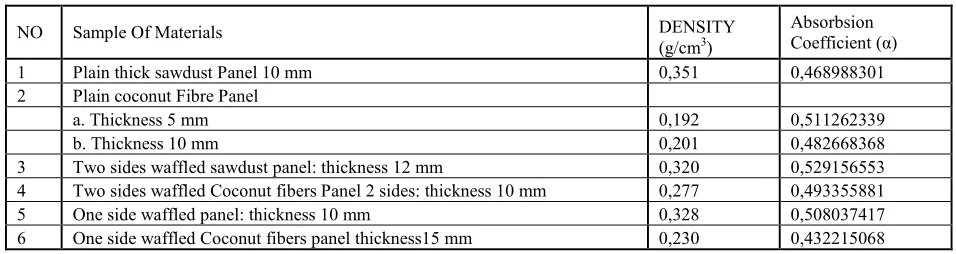
A good absorber materials can absorb sound for a minimum of 0.2 [13]. Meanwhile, according to Callender, 1974 that the value 0 stated the absence of a sound energy absorbed and the number 1 indicates perfect absorption [14]. The average value of the absorption coefficient of a material sample can be seen in the table below:
Table 2, The average Absorption coefficient of specimen material
NO Sample Of Materials DENSITY
(g/cm3) Absorbsion Coefficient (α)
1 Plain thick sawdust Panel 10 mm 0,351 0,468988301
2 Plain coconut Fibre Panel
a. Thickness 5 mm 0,192 0,511262339
b. Thickness 10 mm 0,201 0,482668368
3 Two sides waffled sawdust panel: thickness 12 mm 0,320 0,529156553
4 Two sides waffled Coconut fibers Panel 2 sides: thickness 10 mm 0,277 0,493355881
5 One side waffled panel: thickness 10 mm 0,328 0,508037417
6 One side waffled Coconut fibers panel thickness15 mm 0,230 0,432215068
From the table it can be concluded that the absorption coefficient of a material made from coconut fibers have a low density (0,192-0,277 grams/cm3), but have a high absorption coefficient (0,432-0,511). Meanwhile, material from the sawdust has a high density (0,328-0, 351gram/cm3), and high absorbsinya coefficient (0,469-0,529).
Sound Transmission Loss (STL) Test
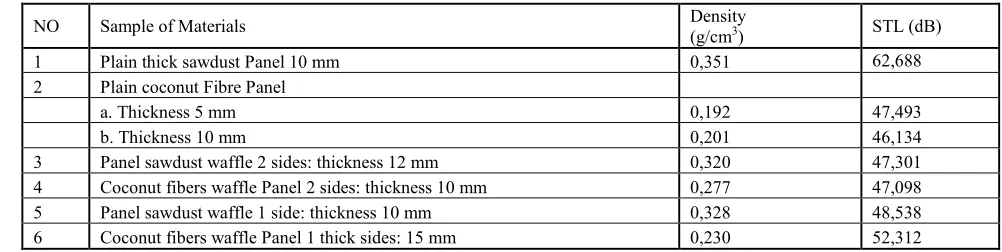
To perform measurements of Sound Transmission Loss (STL) then the sample is inserted into the tube impedance which is equipped with 4 microphone. The results obtained after the STL voice-frequency sound low to get into high impedance tube. Following are the results of the value of STL on sample material:
Table 3, The average Sound Transmission Loss of material specimen
NO Sample of Materials Density (g/cm3) STL (dB)
1 Plain thick sawdust Panel 10 mm 0,351 62,688
2 Plain coconut Fibre Panel
a. Thickness 5 mm 0,192 47,493
b. Thickness 10 mm 0,201 46,134
3 Panel sawdust waffle 2 sides: thickness 12 mm 0,320 47,301
4 Coconut fibers waffle Panel 2 sides: thickness 10 mm 0,277 47,098
5 Panel sawdust waffle 1 side: thickness 10 mm 0,328 48,538
6 Coconut fibers waffle Panel 1 thick sides: 15 mm 0,230 52,312
From the table it can be concluded that the absorption coefficient of a material made from coconut fibers have a low density (0,192-0,277 grams/cm3), but have a high absorption coefficient (0,432-0,511). Meanwhile, material from the sawdust has a high density (0,328-0,351 g/cm3) and high absorption coefficient (0,469-0,529).
Summary
The results showed the value of average density acoustic panels range between – 0,511 0,192 g/cm3. The value of the average moisture content of acoustic panel research results ranged from 7.8 – 10.2%. The average value of a thick development 24 hours range from 3.93 – 17.14%. The average value of water absorption of acoustic panels 2 hours ranged from 27.35 – 79,84% while for the average value water absorption 24 hours ranged from 101,09% – 43,88. The entire panel acoustic particle board that has the distinction of the particle size has the ability to absorb sound well in the high frequency range is located at 1000 Hz – 4000 Hz the absorption value ranges between 0,432 – 0,529. The value of sound Transmission Loss (STC) the average acoustic particle board panel ranges between 47,301 – 62,688 dB
References:
[1] Progress Report the acceleration and expansion of the Masterplan economic development of Indonesia 2011-2025: 4-8.
[2] Erni Setyowati & Anggana Fitri Sadwikasari, 2013, Building Material Composition Influence to Sound Transmission Loss (STL) Reduction, International Journal of Advances in Materials, Processing and Manufacturing, Scopus indexed, Trans Tech Publications, 242-247.
[3] P. Lea, Akustik Lingkungan (translate edition) of Doelle,L, Environmental Acoustics, Erlangga Publisher, 1993, 56-75.
[4] Bucur V. 2006. Acoustic of Wood. 2nd Edition. Springer : CRC Press.
[5] Pizzi A. 1983. Wood Adhesive, Chemistry and Technology. National Timber Research InstituteCouncil for Science and Industrial Research. Pretoria South Africa.
[6] Vick CB. 1999. Wood Handbook, Wood as an Engineering Material. Chapter 9. Adhesive Bonding of Wood Materials. Forest Products Society. USA.
[7] Blomquist, R. F. 1983. Fundamentals of Adhesion. In : Blomquist, R.F., Christiansen, A.W., Gillespie, R.H. dan Myers, G.E. (Eds) ; Adhesive Bonding of Wood and Other Structural Materials. Forest Product Technology USDA Forest Service and The University of Winconsin. Chap.1
[8] JSA] Japanese Standard Association. 1963. JIS A 1405. Methods of Test for Sound Absorption of Acoustical Material by the Tube Method. Jepang: Japanese Standard Association
[9] [ASTM] American Society for Testing and Materials. 2004. ASTM E 413.
Classification for Rating Sound Insulation. USA : American Society forTesting and Materials. [10] Bowyer JL, Haygreen JG, dan Shmulsky R. 2003. Forest Product and Wood Science. Iowa:
The Iowa State University Press.
[11] Callender. 1974. Time Server Standars for Arcitectural Design Data. Fifth Edition. Kingsports Press.
[12] Maloney, TM, 1998, Modern Particleboard and Dry Process Fibreboard Manufacturing, San Fransisco.
[13] Sarwono J, 2008, Five Basic Principal of Suara (Soundproofing).
[14] Callender, 1974, Time Saver Standars for Architectural Design Data, Fifth Edition, Mc. Graw-Hill Book Company, Kingsports Press, USA.