ISO 9000 maintenance in service
organisations: tales from two
companies
Roslina Ab Wahid
Department of Management Systems, Waikato Management School,
University of Waikato, Waikato, New Zealand, and
Universiti Teknologi MARA, Shah Alam, Malaysia
James Corner
Department of Management Systems, Waikato Management School,
University of Waikato, Waikato, New Zealand, and
Peck-Leong Tan
Department of Economics, Waikato Management School,
University of Waikato, Waikato, New Zealand, and
Universiti Teknologi MARA, Shah Alam, Malaysia
Abstract
Purpose– This paper aims to investigate and to highlight the way the quality system is being managed and the outcomes in terms of changes and improvements obtained by the two companies as a result of its maintenance approach. By studying how ISO 9000 is being maintained in the service organisations, it provides useful insights into the unique ways quality systems are managed and the aspects that are important to successful and effective maintenance of ISO 9000 quality system. Design/methodology/approach– A case study approach as described by Eisenhardt and Yin, is used for this study. A total of 30 face-to-face interviews were conducted over a period of 13 weeks with top management, middle management, lower management in charge of operations and quality, and the management representative responsible for the implementation of ISO 9000 in the organisation. To support the findings of the interviews, 300 questionnaires were distributed to employees of both companies. ISO 9000 and quality documents were also reviewed as part of the data gathering process for the study.
Findings– Based on the interview results, there are similarities and differences in how the two case companies maintain their ISO 9000 in terms of how they view and manage the aspects that are closely associated with ISO 9000 maintenance. It was found that the company with higher top management commitment and better internal communication has better-motivated employees. Regardless of the length of time being certified to ISO 9000, the firm which incorporates a higher level of human resource aspects such as reward, recognition and empowerment into its quality system experiences higher employee enthusiasm and commitment to the maintenance of the quality system which resulted in better employee participation and involvement compared to the one that did not.
Originality/value– This paper makes a contribution to the body of knowledge in the field of quality management systems during the maintenance phase where such work is still limited, especially in the service sector.
KeywordsISO 9000 series, Maintenance, Quality systems, Quality management practices, Service sector, Malaysia
Paper typeCase study
The current issue and full text archive of this journal is available at
www.emeraldinsight.com/0265-671X.htm
ISO 9000
maintenance
735
Received September 2010 Revised January 2011 Accepted February 2011
International Journal of Quality & Reliability Management Vol. 28 No. 7, 2011 pp. 735-757
Introduction
The ISO 9000 has been introduced in Malaysia since the late 1980s. In mid 1996, the government issued circulars encouraging its departments and agencies to seek ISO 9000 certification in its effort to increase the efficiency and effectiveness of the public services and government bodies. Until today, ISO 9000 is still popular in Malaysia as the government and the business organisations view it as one of the tools that can improve efficiency and effectiveness of both the public and private sectors. Further, with market globalisation and the growing interdependence of economies, many developing countries have embraced quality management concepts in order to improve their productivity and competitiveness in international markets (Adamet al., 1996). According to statistics provided by the ten top certification bodies in Malaysia, there are about 6800 ISO 9001:2000 registered companies in Malaysia as at 31 December 2007. Out of this figure, about 20 per cent are service companies. The Standards Industrial and Research Institute of Malaysia (SIRIM) have the largest number of companies certified to the standards.
Compared to the literature on the implementation of ISO 9000, very few are written on the maintenance or the post-certification phase of the quality management system (QMS). Further, although there are many service organisations certified to ISO 9001:2000 in Malaysia, researchers have not studied how these organisations maintain their certificate. Therefore, through a case study this paper investigates the maintenance of ISO 9000 in two service organisations. This paper highlights and describes the way the quality system is being managed and the outcomes in terms of changes and improvements obtained by the two companies as a result of its maintenance approach adopted. By studying how ISO 9000 is being maintained in the service organisations, it provides useful insights into the unique ways quality systems are managed and the aspects that are important to successful and effective maintenance of ISO 9000 quality system.
ISO 9001:2000
The ISO 9000:2000 series of quality management standards was launched on 15 December 2000 and the standards were adopted as Malaysian standards MS ISO 9000:2000. In November 2008, ISO 9001:2008 was launched to replace the ISO 9001:2000. Compared to the 2000 version on which the study is being based on, the ISO 9001:2008 represents fine-tuning, rather than a thorough overhaul (Leeet al., 2009). The new standard does not contain any new requirements. Further, the structure and outline of ISO 9001:2008 is identical to that of ISO 9001:2000. However, the changes to the wording are made for easier use, clearer language, easier to translate into other languages and better compatibility with the environmental management standard ISO 14001:2004 (www.isosimplified.com). The ISO 9001:2000 contains five main clauses such as quality management system, management responsibility, resource management, product realisation, and measurement, analysis and improvement.
The principles that guide the standard are customer-focused organisation, leadership, involvement of people, process approach, system approach by management, continual improvement, factual approach to decision-making, and mutually beneficial supplier relationships. These are enablers that top management can use as a framework for introducing good management practice to underpin the organisation’s management systems.
IJQRM
28,7
Reasons for ISO 9000 maintenance
Companies maintain their ISO 9000 certification for various reasons. Van de Water (2000) argued that the maintenance of the total quality management system of an organisation is a necessary activity as it prevents stagnation of the process of quality management and its translation into concrete activities on all levels of the organisation. The quality management system (QMS) must be constantly dynamic in order to improve the quality of both the company’s internal and external services. For this to be so would require proper maintenance of the QMS which includes constant monitoring,
controlling, assessing and improving through both the technical and
non-technical/socio-cultural approaches (Stewart, 1995). The QMS should be continually maintained mainly because it provides the possibility of quick and flexible anticipation of the ever-changing requirements of the environment. Furthermore, it is a necessary condition to keep the quality initiative within an organisation alive (Van de Water, 2000). Other reasons for maintaining the QMS are demand for quality and value for money, change and innovation, to maintain benefits of ISO 9000, and to avoid withdrawal of ISO 9000 certification (Low and Omar, 1997). Further, to maintain the certificate, an organisation has to be proactive in anticipating future problems and show its continual improvement efforts. Continual improvement efforts are required in order to be proactive to the QMS development and should not be strictly related to non-conformances identified within the system. Continuous maintenance is essential to satisfy the surveillance visits by registrars and to monitor and improve the system (Chinet al., 2000).
For this study, maintaining ISO 9000 would mean not only keeping the certification by complying with the requirements of the standard but also embracing the principles and values that are embedded within. Therefore, the meaning of maintenance in relation to ISO 9000 can be divided into two levels. First, “maintenance” refers to strictly following the requirements of the standard. Second, on the deeper level, it relates to the embedding of principles that underpin the ISO 9000 standard.
Quality management systems maintenance framework
Van de Water (2000) cites Fisscher (1994) as saying that a well based quality system comprises both the system structural aspects and the social-dynamical aspects. Structural aspects, consists of the ISO requirements, guidelines, and control procedures while social-dynamical aspects include paying attention to employees’ thoughts, feelings, interests and to the existence of potential human qualities. Sufficient attention to these aspects does result in an easier and deeper acceptance of the system structural aspects by the organisation members.
Low and Omar (1997) quoting the theoretical approach (Spekknink, 1995), asserts that an effective maintenance system requires the application of an integrative approach in an organisation rather than the segmentalist approach. The result of their study suggests that the quality management systems in the Singaporean construction industry were maintained based on the technical requirements set out in the ISO 9000 standard while the non-technical or socio-cultural aspects which help to promote an integrative environment were not emphasised. A technical approach is based on the requirement of ISO 9000 and the study found that documentation, corrective and preventive actions, internal quality audits, training and management reviews are the most popular methods for maintaining the QMS in Singapore’s construction industry.
ISO 9000
maintenance
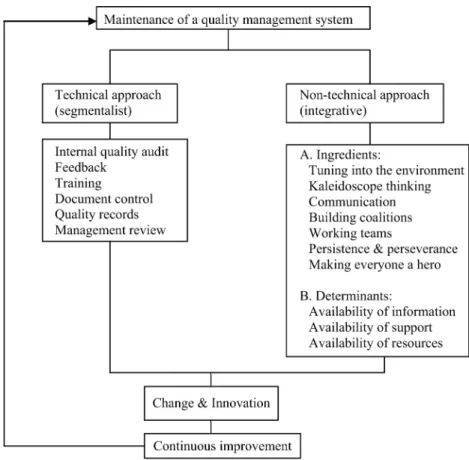
According to Low and Omar (1997), in order to achieve greater effectiveness, the non-technical approach should be used, as it will help to promote an integrative environment for the development of change and innovation with the primary objective of quality improvement. Moreover, an organisation should adopt the integrative or innovative-stimulating approach, as it will have the ability to change and innovate its structure, culture, policies, management, and seek new ideas to contribute to new way of doing things. Therefore, they propose Kanter’s (1994) model of an integrative organisation for maintaining a QMS to help improve the system. Figure 1 shows the model.
Quality culture and ISO 9000
A quality culture is an organisational value system that results in an environment that is conducive to the establishment and continual improvement of quality (Evans and Lindsay, 2005). It consists of values, traditions, procedures, and expectations that promote quality. Hence, Evans and Lindsay (2005) stress that total quality culture involves change and improvement for the organisation and its people. While there are many definitions of culture, Schein (1985) and Kotter and Heskett (1992) have indicated
Figure 1. Kanter’s model for effective maintenance of quality management systems
IJQRM
28,7
that quality culture should focus on having a collective or shared learning of quality-related values as the organisation develops its capacity to survive in the external environment. Quality culture formation occurs through integrated changes in the organisational system; an organisational quality-based vision, mission and goals, consistent formal and informal organisational structures, compatible reward systems, appropriate technology and job design, and attention to important personnel issues.
According to Goetsch and Davis (2000), quality culture is embedded in organisations when:
. the behaviour of its people matches slogans;
. customer input is actively sought and used to continually improve quality;
. employees are both involved and empowered;
. work is done in teams;
. top management are committed and involved;
. sufficient resources are made available for continual improvement of quality;
. education and training are provided to ensure that employees at all levels have the knowledge and skills needed to continuously improve quality;
. reward and promotion system are based on contributions to quality continual improvement;
. employees are viewed as internal customers; and
. suppliers are treated as partners.
To create a quality culture, managing a change process like ISO 9000 would include managing employee attitudes towards change. If the reactions to change are not anticipated and managed, the change process will be needlessly painful and perhaps be unsuccessful ( Jick, 1993). It is vital for an organisation to be change ready before attempting to implement and manage any kind of change (Armenakis and Harris, 2002; Kotter, 1996; Luecke, 2003) as research has shown that about 70 percent of all change programs fail (Balogun and Hailey, 2004). So, in order for an organisation to be change-ready, By (2007) suggests factors such as creating a vision and a sense of urgency, empowering broad based action, communicating the change vision, and mobilising energy and commitment are essential to change readiness. In order to increase the level of change readiness, Vakola and Nikolaou (2005) implied that effective communication, top management commitment, allocation of resources, good and effective work relationships, rewards, training, and participation in the planning, and implementation are crucial.
By not placing importance on the maintenance phase, the current literature is clearly lacking, as it is not providing a solid foundation for sustainable success of the quality system. Therefore, two research questions arise as follows:
RQ1.How do service companies maintain their ISO 9000? Are there any differences or similarities in the approach adopted?
RQ2.What are the outcomes obtained by the two companies as a result of maintaining the ISO 9000 quality management system?
ISO 9000
maintenance
Research methodology
The purpose of this study is to gain a deep understanding of how the two Malaysian service companies maintain their ISO 9000. This means that the researcher has to gain information on the factors associated with ISO 9000 maintenance, which include the views on quality and ISO 9000, the real motivation for certification, top management commitment, and approaches used by the case organisations to maintain the quality system. The previous types of questions require the researcher to adopt an in-depth approach to obtain information in order to gain a better understanding on the area studied. By using the case study method will address the desire of the researcher to understand complex social phenomena (Yin, 2003). Due to the nature of the research questions, the case study method is selected over other methods because it is the most appropriate. It is also the preferred and ideal strategy when “what”, “how” and “why” questions are being posed (Robson, 1994). This will allow the researcher to determine not only what happened but also why it happened (Yin, 2003). Moreover, Jankowic (1993) believes that the advantage of case study research is that it will enable comprehensive and informative data to be generated. Evidence collected may be qualitative (e.g. words) or quantitative (e.g. numbers) or a combination of both (Eisenhardt, 1989). Further, Creswell (1998) explains that case study is ideal when the researcher is trying to develop an in-depth analysis of a single or multiple cases, as is the purpose of this study.
The two companies were chosen for this study based on several criteria. First they were ISO 9000-certified companies. Second, they have been certified for more than three years and thirdly, they were service companies. According to Merriam (1998), the sample in case studies will depend on the questions being asked, the data being gathered, the analysis in progress and the resources one has to support the study. Furthermore, a sample within the case needs to be chosen either before the data collection (purposive sampling) or while the data are being gathered (theoretical sampling). For this study, purposive sampling was applied when choosing the sample within the case as criteria are established to purposely select who to interview and what documents to analyse.
This research is exploratory in nature and triangulation is used to support the interview findings. A total of 30 interviews were conducted over a period of 13 weeks with the top management, middle management, operations managers, quality executives and the management representatives of the quality system. To support the findings of the interviews, 300 questionnaires survey were distributed to employees of the two case companies. To reduce the probability of sampling error occurring, stratified random sampling was used to choose the sample. Two criteria were used for the sample stratification, department and job level of employees. This strategy seems most appropriate as employees belong to different departments and job levels in each organisation and therefore the issue of representation of the sample to the population can be addressed that could not be done by other sampling designs. Having chosen the basis for the strata, the frame was used to calculate the population proportions per stratum. This determines the number of employees to be chosen per stratum, so each stratum has the same proportion in the sample as in the population. Random digit table was used to generate the different labels in the range chosen. The employees with those labels in the frame list were those chosen. The process was repeated for each stratum. At the same time, internal and external audit reports and other quality documents were also reviewed.
IJQRM
28,7
For the purpose of analysing the data collected, this study adopts the “thematic” analysis method described by Braun and Clarke (2006) which involves data familiarisation, data coding, searching for themes, and defining and naming the themes prior to report production. SPSS version 16 was used to analyse the data from the questionnaire survey. Cronbach’s Alpha was carried out to measure these items’ reliability and consistency. In general, reliabilities less than 0.60 are considered poor, those in the 0.70 range, acceptable, and those over 0.80, good. For this research, only reliabilities of 0.70 and above are taken to ensure reliability and consistency.
Case organisations MK Private Limited
MK Private Limited (MK) is a subsidiary of a major airlines company set up to handle the delivery of cargo around the world via the parent company’s global network of routes. Currently, the company has about 900 employees. The core businesses or services of MK are sales of cargo space on the parent company flights, handling of normal cargo, express cargo, perishable, animal, and transhipment cargo on behalf of the parent airlines and customer airlines, i-port transhipment service and charter services. Customers of MK consist of freight forwarders, agents, customer airlines, both local and overseas. The scope of the quality system for MK is planning of chartering of its parent airline’s aircraft for transportation of cargo and provision of cargo ground handling services and warehouse operations on behalf of its parent company and customer airlines.
Cargo operations are divided into three sections namely; operations commercial, operations line stations, and operations support. Operations Commercial’s core processes are export and import operations, ramp, documentation office and physical charter. The core functions of Operation Line Stations are quality assurance and Line Station, transhipment, customer care and cargo safety. Meanwhile, Operations Support consists of core processes such as management and maintenance of cargo equipment, budget, tender and procurement of cargo equipment, animal hotel, express handling unit, and property administration and maintenance.
The preparation for MS ISO 9001:2000 at MK started in June 2003 with the appointment of a consultant. Six months later, MK was awarded the MS ISO 9001:2000 Quality Management System for the previous scope. Other prestigious awards received by MK are the ISO 14001:2004 and OHSAS 18001:1999, Best Global Ground Handler (2007) and Excellence in Logistics – Air Cargo Services (2007).
Prior to ISO 9000 certification, MK was making losses. The company wanted to improve efficiency in its operations and the ISO 9000 certification was seen by its management as a way to achieve this goal.
XY Limited
XY limited (XY) is a subsidiary of a company, which manages and operates an expressway under concession from the Malaysian government. It was formed in 1988 to undertake all maintenance works, which include highway routine maintenance, pavement, landscaping, traffic management, logistic and machinery, and building maintenance of an expressway. Since then XY has grown and offers a comprehensive range of services for every aspect of infrastructure maintenance and in particular, a road and highway maintenance.
ISO 9000
maintenance
XY begun preparing for ISO 9001:2000 certification, since 1998, on its own with no consultant engaged. The company was confident it had the necessary expertise in its own people. A year later in 1999, XY was awarded both the MS ISO9001:2000 Quality Management System. Three years on it received the OHSAS 18001:1999 Occupational Health and Safety Management System accreditations.
XY is divided into three regions: northern, central, and southern region offices. Currently the company has over 900 staff and a fleet of more than 350 units to support its maintenance operations. Apart from its main client PB Limited, XY’s other clients include other expressway/highway owners. As its current scope of business is limited to maintenance activities, the company is therefore looking forward to varying its business activities and expanding its business to other areas both locally and abroad. Thus, for XY, the ISO 9000 certification is a useful tool to market the company and concurrently enhances its image to its existing and potential customers.
Interview and document review findings
Based on the interview results and documents review, there are similarities and differences in how the two case companies maintain their ISO 9000 in terms of how they view and manage the aspects that are closely associated with ISO 9000 maintenance. Table I displays the aspects in which the two companies are similar and different.
Based Table I, the aspects in which they are similar are with regards to views on quality and ISO 9000 where both companies seemed to have positive views; the importance of top management’s role in maintaining the quality system; the process of setting and reviewing of quality policy and objectives, training needs identification, measurement of performance, and improvement initiatives.
Meanwhile, the aspects in which they differ are on the motivation for certification, documentation structure and number of procedures, handling of management review meeting, appointment of management representative, resource planning and management, service realisation process, relationship with subcontractors/suppliers, customer satisfaction and feedback, employee empowerment, feedback and satisfaction, recognition and reward system, employee involvement, and continual improvement.
Survey findings
The scale of 1-4 was used to measure the level of agreement by respondents on the quality management practices of the organisations (1¼strongly disagree, 2¼disagree,
3¼agree, and 4¼strongly agree). Table II shows the average scores of both companies
indicated that MK’s average scores are higher than XY’s on all the statements. The scores of 3.0 and above reflect that employees at MK agree positively on their top management commitment and involvement in the ISO 9000 maintenance, that communication within the company is effective, employees are empowered and suitably rewarded for their efforts, employee training is continuously provided, processes and system are continuously improved, relationship with suppliers is close, the organisation is customer-focused, people in the company works as a team, performance is measured and data are analysed, and statistical tools and techniques are used for quality improvement. However, score of less than 3 (3¼agree, 2¼disagree) were obtained on
matters regarding employees’ feedback, and employee satisfaction. Although employees agree that they are rewarded for their efforts, the degree of agreement is less when it comes to whether reward is linked to their performance.
IJQRM
28,7
No. Aspect Similar Different Remarks
1. Motivation for certification p For MK, the real motive was to improve its operation’s
efficiency as it was making losses. For XY, the motive was as a tool for market expansion. XY does not include improvement on people aspect as a motive for certification
2. Views on quality p Similar
3. Views on ISO 9000 p Similar
4. View of the top management’s role p Similar
5. Documentation structure p MK has four levels, XY has three
6. Number of procedures p MK outnumbered XY by 20 procedures
7. Setting and reviewing of quality policy and objectives p Similar
8. Handling of management review meeting p The meeting at XY is chaired by HOD, at MK by the MD
9. Appointment of management representative (MR) p At MK, from within the company. XY’s MR is from its
parent company
10. Resource planning and management p MK applies multi-tasking of its employees
11. Training needs identification p Similar
12. Service realisation process p XY’s more complex than MK’s due to its nature of
business
13. Relationship with contractors/suppliers p XY has an adversarial relationship with its contractors.
MK has better relation with its subcontractors/suppliers 14. Measurement of performance p Similar
15. Customer satisfaction and feedback p MK has better customer satisfaction survey and
complaints handling system 16. Improvement initiatives p Similar
17. Employee empowerment and feedback p Employees at MK are empowered to do their job and their
feedback sought
18. Employee satisfaction p Employees at XY are less happy and less satisfied
19. Recognition and reward system p
MK has a clear recognition and reward system 20. Employee involvement p Employees at MK are more involved in quality activities
such as in procedure development 21. Continual improvement (CI) p MK has a more structured plan for CI
Table
I.
Similarities
and
differences
of
approaches
between
MK
and
XY
ISO
9000
maintenance
Statement MK XY
t-test p-value
Top management commitment
Top management is involved in quality improvement 3.12 3.09 Top management is committed to ISO 9000 maintenance 3.30 3.11 Top management provides necessary resources to carry out
activities effectively 3.16 3.07
Resources are adequate to carry out business and quality system
activities 3.14 3.01
Management actively displays an ongoing commitment to quality
improvement 3.08 2.96
Average per category 3.16 3.05 0.042
Internal communication
Quality policy and objectives are communicated/disseminated to all
employees 3.16 2.98
I know and understand the quality policy and objectives of my
organization 3.15 2.93
Communication in the organisation is effective 3.06 2.88 It is easy to communicate about work with my superior 3.11 2.86 Important information is presented/transmitted to staff 3.11 2.99
Average per category 3.12 2.93 0.001
Teamwork
In this organisation, we work as a team 3.27 3.01 Work groups are common in this organisation 3.23 2.95
Average per category 3.25 2.98 0.001
Process approach
The organisation adopts a process management approach 3.06 2.91
Average per category 3.06 2.91 0.022
Continuous improvement
Processes are continuously improved 3.13 2.91
The quality system is improved continuously 3.17 3.01
Average per category 3.15 2.96 0.002
QM practices and tools
The organisation uses quality circles/improvement teams 3.13 2.95 Multi-tasking is practised by the organization 3.04 2.79 The company uses quality programmes to improve its quality 3.11 3.01 The company uses statistical tools and techniques to measure and
control quality 3.16 3.00
Average per category 3.10 2.94 0.003
Organisational structure
There is a little bureaucracy (formal hierarchy, procedures and
detailed rules) in the organisation 2.93 2.79
Average per category 2.93 2.78 0.120
Customer needs and satisfaction (customer focus)
Top management encourages employees to consider customer needs
and expectations 3.12 2.91
Customer needs and feedback are integrated into the service
development design and process 3.07 2.95
(continued) Table II.
Employees’ perception of quality management practices at MK and XY
IJQRM
28,7
Statement MK XY
t-test p-value
The company carries out market studies to determine its customer
needs and wants 3.14 2.93
The company carries out studies to measure customer satisfaction 3.14 3.00 The company has a system to collect and manage customer’s
complaints 3.08 2.98
Average per category 3.11 2.95 0.003
Supplier relations
The company works in close collaboration with its suppliers 3.08 2.95 The company treats its suppliers as partners 3.09 2.64
Average per category 3.08 2.83 0.000
Documentation
The company has a clear documentation procedure 3.19 3.04 The company has a clear set of work instructions 3.08 3.01
Average per category 3.13 3.03 0.084
Measurement, information and data analysis
The company collects/analyses data related to its activities 3.06 2.99 The company harnesses information to improve its key processes
and services 3.07 2.99
The company measures and control quality 3.16 2.99
Average per category 3.09 2.99 0.067
Employee training
The company provides continuous training for its staff 3.16 2.81 Training needs and training are always evaluated 3.14 2.75 Employees are trained in the use of statistical tools and techniques 3.01 2.93
Average per category 3.11 2.83 0.000
Employee empowerment and participation
Employee feedback is always sought 2.95 2.60
Employees are encouraged to participate and be involved in the
company’s activities 3.10 2.80
Employees are encouraged to make decision with regards to their job 3.01 2.58 Management lets employees participate in achieving organizational
objectives 3.06 2.68
Employees are responsible for tasks they perform, and inspect their
own work 3.25 2.61
Average per category 3.07 2.66 0.000
Employee satisfaction
Employee satisfaction is measured 2.83 2.60
Average per category 2.83 2.61 0.021
Employee performance, recognition and reward
Employee performance is measured 3.10 2.70
There is a performance measurement system in this company 3.13 2.93
Reward is linked to performance 2.95 2.70
There is a reward system to encourage new ideas from employees 3.23 2.63 Recognition is given to high achievers 3.13 2.83 Skills and knowledge acquired from multi-tasking increase
employee’s opportunity for promotion 3.09 2.84
Average per category 3.11 2.77 0.000 Table II.
ISO 9000
maintenance
For XY, the areas that were perceived less by the employees in terms of agreement (score of 2.80 and lower) are with regards to encouragement for employee participation and involvement in the company’s activities, employee participation in achieving organisational objectives, employee decision making with regards to their job, evaluation of training needs and training, employee feedback, measurement of employee satisfaction and performance, the link of reward to performance, practice of multi-tasking, and relationship with suppliers.
When aggregation or averaging of responses are done on items with similar themes, thet-tests revealed that there are statistically significantly differences between the two case companies on top management commitment (p¼0:042), internal communication
(p¼0:001), teamwork (p¼0:001), process approach (p¼0:022), continuous
improvement (p¼0:002), quality management practices and tools (p¼0:003),
customer focus (p¼0:003), supplier relations (p¼0:000), employee training
(p¼0:000), employee empowerment and participation (p¼0:000), employee
satisfaction (p¼0:021), and employee performance and recognition (p¼0:000)
Overall, the interview and document review results are consistent with the results of the survey. Survey results also supported the interview outcomes that there is a difference between the two companies on aspects such as customer satisfaction, employee empowerment, feedback and satisfaction, employee recognition and reward, employee involvement/participation, continual improvement, and subcontractor/supplier relations. These differences explain the effectiveness of ISO 9000 maintenance and the outcomes experienced by the two case companies.
Changes and improvements
Based on the interview results, since implementing and maintaining the ISO 9000 quality system, several changes and improvements have been experienced by both companies as shown by Tables III and IV.
Looking at the tables, it could be said that some positive changes have resulted due to the improvements carried out on the processes, documentation, and system of both companies in maintaining the ISO 9000. However, MK obtained an extra benefit in terms of its people whereby they want to contribute and become proactive; they are committed and involved; they are more positive about the quality system and their morale has also improved resulting in higher involvement and participation in maintaining the ISO 9000. Both companies’ people however gained awareness of and become more knowledgeable on ISO 9000. They become more aware and knowledgeable about the processes and their roles in delivering the service. In terms of technology, they also become more sophisticated.
Managerial Implications
The results of the study therefore present several important implications to managers as outlined in the following.
Top management commitment must be visible and supported by action
Top management commitment is critical to ISO 9000 maintenance as it determines the smooth deployment of quality philosophy and policy of an organisation, which is core to the quality system. The quality improvement process associated with maintaining the quality system must begin with the top management’s own commitment to quality
IJQRM
28,7
since it is the leadership who create the organisational systems that determine how services are designed and produced. Moreover, the extent of top management commitment will determine the organisation quality culture. Due to these reasons, top management commitment needs to be highly visible. For examples, top management should increase their involvement in activities associated with the quality system such
Improvement
Area Result
Processes
Simplify the process by reducing the number of activities in the process
Easier tracing of work errors
Processes are documented Shorter time taken to trace a process Processes are changed to suit the market Immediate recording and detection of
discrepancies and damages at cargo warehouse Simplify import delivery performance by asking
key agents to pre-alert shipment
Shorter delivery and release time for shipment
Processes are standardised Smoother process flow Improved process time Decreased maintenance cost Reduced cargo mishandling rate Reduced number of customer complaints Increased in service standard
Reduced standard time to process transhipment cargo
Lower claim compensation
Increased awareness in people about the process and service standard
Increased transparency on process and service standard
Improved service standard Documentation
Standard operating procedures are constantly updated
Improved customers’ trust and confidence in the company
Online document control system to control documents
People are more responsible and accountable for their work
Help to track and monitor performance Trigger corrective and preventive action Staff are more aware of policy and procedures Change of staff attitude
Transparency in doing business
People work in accordance with the procedures Improved work organisation
System
Daily meeting and post-mortem People become more proactive in tackling problems Online document system Easier to control document
Online booking Wider access to trace and track processes Internal training Reduced cycle time for change of document
Better housekeeping
Customer services department has been closed Checking of booking through online electronic computer bookings
Table III. Changes and improvements resulted from ISO 9000 maintenance for MK
ISO 9000
maintenance
as by joining employees in the internal audit course, being the trainer for documentation course, being a member of improvement team, and being more active in deciding the corrective and preventive action that needs to be taken and its follow-ups during the management review meeting.
Apart from those activities, top management should also be involved in more open discussions, dialogues and meetings with employees especially at the lower level so as to get their views and feedback and to show them that top management are serious and committed to this quality effort. This will foster a closer relationship between top management and employees, which at present employees feel is lacking. It will also improve communication between management and employees and this will create a better relationship for both parties.
To further enhance the effectiveness of communication and enhance quality commitment, there should be adequate communication devices provided to employees who worked at scattered locations and the communication language used must be understood by employees at all levels. Employees also need to be informed of audit results so that they will know what actions need to be done on their part to contribute to the achievement of quality objectives. Also, top management must also provide adequate resources such as manpower and budget for employee training to show their commitment to maintaining the quality system.
Recognising and rewarding performance
“What gets rewarded gets done”. Implementing and maintaining the ISO 9000 quality system involved a lot of hard work on the part of everybody in the organisation. To
Improvement
Area Result
Processes
Standardised operation Work becomes more systematic Processes are documented Improved record and tracing of work Processes are monitored through reports Analysis could be done
Documentation
Developed and refined Better acquaintance with quality policy, procedures and job scope.
Recorded Reduce overlapping of functions and roles Standardised procedures Easier to settle dispute
Simplified checklists from more than 100 to 20 Easy to follow More systematic Easier to do jobs
Easier for newcomers to do jobs System
Semi-automated system Improved record and tracking purposes Report generation Improved traffic management and control Proper filing Improved monitoring and reward for staff,
suppliers and subcontractors
Online document and updating of document Improved in revenue and profit before tax Mechanical robots Improved service quality
Performance measurement unit Decrease in operating cost Statistical data collection Performance measurement possible Table IV.
Changes and
improvements resulted from ISO 9000 maintenance for XY
IJQRM
28,7
motivate people to work and to encourage continuous improvement, people need to be trained, recognised, and rewarded for their efforts. This will spur the amount and speed of execution of continuous improvement activities and progress. To keep motivation going, some forms of recognition and reward should be introduced. Recognition and reward should commensurate with the effort and performance shown by the employees in keeping the quality system running. Recognition can be in the form of appreciation letter, commendation letter and certificate while reward can be in the form of salary increment, bonus, incentive, paid holiday package, share certificates and extra leave for examples. For internal auditors, which are from the employees, incentive such as hourly and travelling allowance should be given when they carry out an audit. Although they are employees of the company, still the effort and training that they have to undergo before being qualified as an auditor requires something extra and this shows their commitment to the company. This sort of commitment should be rewarded. If incentives for change are absent within the organisation, the rate of change will be slower as employees will feel they are being taken for a ride by management.
To better maintain ISO 9000, people must be prepared and ready
People, which include both management, and employees, need to understand the requirements of ISO 9000 in order to maintain it effectively. Most of the problems in maintaining the quality system discussed earlier in this chapter are due to lack of awareness and training. This is actually the root cause of problems associated with procedures, documentation, people and system. To change attitude, which is underpinned by behaviour, the people of the organisation need to be educated and trained on ISO 9000 to increase their understanding on the standards and its requirements. Top management has to understand the requirements of the standards and knows what they mean in order to be able to digest the importance of their commitment and involvement. This would mean, that training needs to be of priority as it reflects the top management commitment and at the same time arming both the management and employees with skills, knowledge and tools to face the change. An assessment needs to be made on the required skills and compared to the existing skills to identify training and development needs of the organisation. Generally, employees should be educated and trained on core knowledge of their job, skills and competency. In addition, they also have to be educated on the ISO 9000 especially on the awareness of the ISO 9000, documentation, corrective and preventive action, data analysis, and internal audit. The corrective action system and internal auditing process system are partners in the development and improvement of the overall quality system (Chinet al., 2000).
Also, by analysing data, it can pinpoint areas for corrective and preventive actions, which are important for continuous improvement. Tools and techniques for measurement of process and improvement of the system should also be taught to relevant employees so that they can apply them in their jobs. By educating and training people will contribute to the fulfilment of their job requirement, which also lead to an efficient and effective process, one of the main objectives of obtaining ISO 9000 certification.
Apart from document control, operational control is also found to be one of the problems identified by the internal and external audits of the companies. Some of the non-conformances that have been found indicating the lack of operational control were
ISO 9000
maintenance
seen in the control of nonconforming product, control of production and service provision, monitoring and supervision, and ineffectiveness of measurement on some processes. The training on skills, competency, ISO 9000 and job specific knowledge would to certain extent help towards reducing the non-conformances associated with operational control. This would increase the effectiveness and efficiency of the quality management system. In addition, subcontractors/suppliers should be trained regularly especially when there are changes to the company’s processes or a new process is introduced. This way, subcontractors/suppliers will be included in the production process of the service by the company. This will certainly improve communication and trust between the company and their subcontractors/suppliers that would lead to a mutually beneficial relationship as stated in the eight guiding principles of ISO 9000.
Integrating the technical and human resource aspects
To maintain ISO 9000 effectively and to go beyond maintenance, the human resource aspects of quality management must be given the same priority as the technical requirements of ISO 9000. Therefore, employee involvement and customer-focused organisation are principles of ISO 9000 that need to be adopted if a firm wants to strive for excellence.
Employees need to be empowered so that they can make decisions pertaining to their jobs, unleash their creativity and realise their potential. This is very important for service firms, as they need to interact with their customers. Real-time response and action requires employees of service firms to think on their feet, which can only happen if they are empowered.
Although the case companies employ both the technical requirements and human resource aspect to quality management when maintaining their quality management system, the human resource aspect of quality management was treated as secondary to the technical requirements of ISO 9000. This finding is similar to Low and Omar (1997) study on the Singaporean construction industry and Tari (2005) study on TQM in ISO 9000 certified firms in Spain.
Clearly, the change in the standard from the 1994 version to the 2000 version does not seem to improve this matter despite the 2000 version being closer to TQM. Thus, the later standard did not really change the way top management of these organisations view the human resource aspect. Management failed to realise that people are the ones who perform these operations. As a result, continued weaknesses are found in control of document, corrective and preventive action, and data analysis. Although providing training is important to equip employees with skill, knowledge and tools to do the job, training alone is not enough. Employees need both the intrinsic and extrinsic motivation to work. They need to be able to feel the sense of belonging to their work and workplace. In this sense, management must empower and encourage their participation by involving them in decision-making, processes and procedure development for example. There must be a proper recognition and reward system for performance, that support the maintenance of the quality system and continuous improvement by employees. Otherwise, employees would not be motivated to maintain certification and to go beyond ISO maintenance. As ISO 9000 standard does not place a strong emphasis on this aspect, companies should take their own initiatives to improve the human resource aspect of quality management in order to improve ISO 9000 maintenance and its outcomes.
IJQRM
28,7
Resource and infrastructure to maintain ISO 9000
It is pointless to ask employees to maintain the ISO 9000 if resources needed are not adequately provided as the allocation of resources be it manpower or infrastructure, is usually a good indicator of top management’s commitment to ISO. Therefore, necessary resources must be provided adequately to show that management are committed to maintain the quality system.
In situation where there is a shortage of human resource in certain unit/department within the company, and an excess in another, human resource or employees can be trained to do multiple jobs to manage the problem. Multi-tasking will help employees be multi-skilled. Apart from being flexible, employees are developed so that they can do multiple jobs. This is crucial for a service factory like MK especially during peak seasons when it is busiest. At these times, manpower and scheduling service delivery become a challenge for managers at the company. By multi-tasking, employees also are highly involved and this will indirectly increase their understanding of processes and their interactions. As a result, employees can see a more holistic picture of their company’s operations, thus enabling them to be better at identifying and solving work related problems. Moreover, as employees are developed to their full potential, this indirectly will help management to identify candidates for promotion and succession plan. However, care should be taken not to “overstretch” the human resource as this might create fatigue and resentment that would produce a negative impact on productivity. In addition, computers, soft wares, machines, tools, equipment and space that are required by the process and to run the quality system need to be provided adequately by management.
Relationships with subcontractors
A good relationship with subcontractors/suppliers is important if high quality of service is to be achieved. Implementing the performance measurement and monitoring system is only one of the ways of monitoring and evaluating subcontractors or suppliers performance.
In order to improve the relationship with subcontractors/suppliers, the purchaser
has to move away from the “upper hand” mentality, and treats
subcontractors/suppliers as partners rather than as adversaries. Further, too many suppliers/subcontractors will burden the purchaser, as it will be time-consuming to assess and monitor them. XY should consider reducing the number of subcontractors under each category of work it subcontracts out and concentrates on developing a more collaborative relationship with them.
Quality culture
A strong quality culture is critical to maintain the ISO 9000 quality system. Without a strong quality culture, people will not be ready to commit and involve themselves fully in ISO maintenance. As a result, continued weaknesses are observed in document control, corrective and preventive action, analysis of data, communication, and the human resource aspects of quality management of both companies.
To better maintain the ISO 9000, companies need to develop a strong quality culture, as this would increase the commitment and involvement of people. Management needs to determine a match between organisational culture and espoused ISO 9000 values and strategy. During the course of implementation and maintenance of ISO 9000,
ISO 9000
maintenance
managements’ behaviour and emergent culture must become consistent over time with the quality system philosophy or employees will become cynical. This would undermine commitment and results in the collapse of the ISO 9000 quality system. A strong quality culture also would greatly aid the initiatives for continuous improvement, as the people of the organisation will have a strong quality orientation.
Other implications
Implications for other researchers
The results of the study provide useful guidelines for future action. While the two case studies provide useful insights into the maintenance of ISO 9000 in the service sector, they may not be fully applicable to other service sectors. Other researchers should use this study as a platform to conduct similar studies in other service sectors such as banks, hotels, and other public utilities service or by the nature of service such as service shop, service factory, mass service and professional service to determine whether these findings have a more general application (see – recommendation for further work).
Implications to research design
Previously, survey questionnaires were used to conduct research in operations management. However, the need for in-depth investigation of phenomenon has led to a more flexible approach as applied in this research. The leading philosophy of this research is qualitative, but to enhance the validity of the research and to avoid superficial treatment of phenomena, quantitative data were also used to support the finding of qualitative data. In short, this study offers new insights into the use of mixed methods and of adopting a holistic approach to investigate service organisations especially those engaging complex and contradicting change like ISO 9000.
Implications for ISO 9000 technical committee
Although the ISO 9000 principles are closer to TQM, the ISO 9001:2000 and the ISO 9001:2008 requirements are tailored to the manufacturing and do not incorporate the human resource aspects of quality management into it. This does not work well with service firms, as their nature requires higher level of customer contact and interaction that make decision-making and fast response crucial to their service quality. Therefore, apart from training for competency, the ISO 9001:2008 requirements need to incorporate more of its principles especially employee involvement and be more customer focused. To motivate employees to be involved and participate, facets of human resource aspects such as employee empowerment, recognition and reward, and internal customer satisfaction must be integrated into the standard.
Limitations
This research is not free of limitations. The limitations of this research are as follows: (1) The cases being researched are service organisations, which are involved in the transportation industry. Therefore, the result of this research may be less applicable to service organisations in other industries.
(2) The study focused on the factors in ISO 9000 maintenance of two service companies in Malaysia. The results of this research emerged from the analysis of data collection in this area and may not be generalisable beyond this as it is very specific.
IJQRM
28,7
(3) The results of the study might not be applicable or less applicable to other countries due to the difference in culture.
(4) Both cases have sustained their ISO 9000 quality management system and therefore their certification. Due to this, only literal replication will result as the lack of instances of failure to sustain will mitigate against theoretical replication being possible.
Recommendations for further work
This study is conducted based on the ISO 9001:2000 not the current ISO 9001:2008 version. However, since there is no new requirement to the new version, the difference between them is minimal. The study acts as a basis for future research in ISO 9000 maintenance and beyond especially in the service sector as very few has been specifically conducted so far. This study has been conducted on two service organisations in Malaysia, which can be classified as in the transportation industry. Therefore, further studies are required to extend this research to other service sectors/industries and to other countries. Further research work is recommended on areas as follows:
(1) The difference between ISO 9000 implementation and maintenance in service organisations. This is important because the current literature does not really differentiate and define the difference(s) between the two phases.
(2) The maintenance of ISO 9000 in professional service, mass service, service factory, and service shop. It might be interesting to investigate more on the similarities and differences that might exist among the service classification in terms of how each type of service sustain their QMS.
(3) The maintenance of ISO 9000 in other countries across the world. The outcome of the study might be moderated by the culture of each country.
(4) Critical success factors in ISO 9000 maintenance in different service sectors. This is needed to examine the differences and similarities of factors that are critical to ISO 9000 maintenance in different service sectors to enrich the literature on maintenance.
(5) Problems and challenges in ISO 9000 maintenance in different service sectors. The need for this research is the same as previously.
(6) Improvement obtained by maintaining the ISO 9000 in service companies. There is a need to find out the improvement that can result by maintaining the ISO 9000 quality system by other service companies.
(7) The impact of human resource aspects on ISO 9000 maintenance. Previous literature has found that human resource aspects have been treated as secondary when it comes to maintaining the ISO 9000. The current study has found that they are important to the success of ISO 9000 maintenance in the two case organisations.
(8) The reasons why companies failed to maintain ISO 9000 certification. It is interesting to examine the reasons why companies failed to maintain their ISO 9000 certification to see whether the reasons are similar based on the various version of ISO 9000 standards.
ISO 9000
maintenance
(9) Beyond ISO 9000 maintenance in other sectors. This is more to do with “What’s next?” once certification and maintenance are achieved and efforts by companies towards excellence.
Conclusion
The study has shown that the approaches adopted by the organisations to maintain ISO 9000 can be different. These differences determine the effectiveness of ISO 9000 maintenance and the outcomes obtained by the companies. It was found that the company with higher top management commitment and better internal communication has better-motivated employees. Regardless of the length of time being certified to ISO 9000, the firm which incorporates a higher level of human resource aspects such as reward, recognition and empowerment into its quality system experiences higher employee enthusiasm and commitment to the maintenance of the quality system which resulted in better employee participation and involvement compared to the one that did not. Employees are found to be more satisfied.
The study concludes that the implementation and continued maintenance of ISO 9000 have brought a lot of positive changes and improvements to the service organisations and if it is maintained effectively, ISO 9000 can bring much more benefits to the organisations. However, to maintain the quality system more effectively, ISO-certified firms have to integrate its people and human resource aspects into its quality management system.
References
Adam, E.E. Jr, Corbett, L.M., Harrison, N.J., Lee, T.S., Ho, R.B. and Samson, D. (1996), “A study of quality management practices and performance in Asia and South Pacific”,Proceedings of the First International Research Conference on Quality Management, pp. 1-12.
Armenakis, A.A. and Harris, S.G. (2002), “Crafting a change message to create transformational readiness”,Journal of Organizational Change Management, Vol. 15 No. 2, pp. 169-83. Balogun, J. and Hailey, V.H. (2004),Exploring Strategic Change, 2nd ed., Prentice Hall, London. Braun, V. and Clarke, V. (2006), “Using thematic analysis in psychology”,Qualitative Research in
Psychology, Vol. 3, pp. 77-101.
By, T. (2007), “Ready or not”,Journal of Change Management, Vol. 7 No. 1, pp. 3-11.
Chin, K., Poon, G.K. and Pun, K. (2000), “The critical maintenance issues of the ISO 9000 system: Hong Kong manufacturing industries perspective”,Work Study, Vol. 49 No. 3, pp. 89-96. Creswell, J.W. (1998),Qualitative Inquiry and Research Design: Choosing among Five Traditions,
Sage Publications, Thousand Oaks, CA.
Eisenhardt, K.M. (1989), “Building theories from case study research”,Academy of Management Review, Vol. 14 No. 4, pp. 532-50.
Evans, J.R. and Lindsay, W.M. (2005), The Management and Control of Quality, 5th ed., International Thomson Publishing, Andover.
Goetsch, D. and Davis, S. (2000), Quality Management: Introduction to Total Quality
Management for Production, Processing and Services, 3rd ed., Prentice Hall, Englewood Cliffs, NJ.
Jankowic, A.D. (1993),Business Research Projects for Students, Chapman and Hall, London. Jick, T.D. (1993),Managing Change: Cases and Concept, Irwin, Boston, MA.
IJQRM
28,7
Kanter, R.M. (1994), “Collaborative advantage: the art of alliances”,Harvard Business Review, July-August.
Kotter, J.P. (1996),Leading Change, Harvard Business School Press, Boston, MA.
Kotter, J.P. and Heskett, J.L. (1992),Corporate Culture and Performance, The Free Press, New York, NY.
Lee, P.K.C., To, W.M. and Yu, B.T.W. (2009), “The implementation and performance outcomes of ISO 9000 in service organisations: an empirical taxonomy”, International Journal of Quality & Reliability Management, Vol. 26 No. 7, pp. 646-62.
Low, S.P. and Omar, H.F. (1997), “The effective maintenance of quality management systems in the construction industry”,International Journal of Quality & Reliability Management, Vol. 14 No. 8, p. 768.
Luecke, R. (2003),Managing Change and Transition, Harvard Business School Press, Boston, MA.
Merriam, S.B. (1998), Qualitative Research and Case Study Applications in Education, Jossey-Bass, San Francisco, CA.
Robson, C. (1994),Real World Research, Blackwell, Oxford.
Schein, E.H. (1985),Organisational Culture and Leadership: A Dynamic View, Jossey-Bass, San Francisco, CA.
Spekknink, D. (1995), “Architect’s and consultant’s quality management system”, Building Research and Information, Vol. 23 No. 2, pp. 97-105.
Stewart, R. (1995), “Alive and kicking – quality assured: getting it was hard work, but keeping it means constant improvement”,The Chartered Builder, The Chartered Institute of Building, April, pp. 12-13.
Tari, J.J. (2005), “Components of successful total quality management”,The TQM Magazine, Vol. 17 No. 2, pp. 182-94.
Vakola, M. and Nikolaou, I. (2005), “Attitudes towards organizational change: what is the role of employees’ stress and commitment?”,Employee Relations, Vol. 27 No. 2, pp. 160-74. Van de Water, H. (2000), “A maintenance model for quality management”,International Journal
of Quality & Reliability Management, Vol. 17 No. 7, p. 756.
Yin, R.K. (2003),Case Study Research: Design and Methods, Sage Publications, London.
Further reading
Anderson, S.W., Daly, J.D. and Johnson, M.F. (1999), “Why firms seek ISO 9000 certification: regulatory compliance or competitive advantage?”,Production Operations Management, Vol. 8, pp. 28-43.
Ashire, S. and O’Shaughnessy, K. (1998), “The role of top management commitment in quality management: an empirical analysis of the auto parts industry”,International Journal of Quality Science, Vol. 3 No. 1, pp. 5-37.
Bou, J.C. and Beltran, I. (2005), “Total quality management, high commitment human resource strategy and firm performance: an empirical study”,Total Quality Management & Business Excellence, Vol. 16 No. 1, pp. 71-86.
Chang, D.S. and Lo, L.K. (2005), “Measuring the relative efficiency of a firm’s ability to achieve organizational benefits after ISO certification”,Total Quality Management, Vol. 16 No. 1, pp. 57-69.
Cheng, S.P. and Tummala, V.M. (1998), “An employee involvement strategy for ISO 9000 registration and maintenance: a case study for Hong Kong and China companies”, International Journal of Quality & Reliability Management, Vol. 15 Nos 8/9, p. 860.
ISO 9000
maintenance
Chow-Chua, C.M., Goh, M. and Wan, T.B. (2003), “Does ISO 9000 certification improve business performance?”,International Journal of Quality & Reliability Management, Vol. 20 No. 8, pp. 936-53.
Claver, E., Tari, J.J. and Molina, J.F. (2003), “Critical factors and results of quality management: an empirical study”,Total Quality Management, Vol. 14 No. 1, pp. 91-118.
Demirbag, M. and Sahadev, S. (2008), “Exploring the antecedents of quality commitment among employees: an empirical study”,International Journal of Quality & Reliability Management, Vol. 25 No. 5, pp. 494-507.
Eisenhardt, K.M. and Graebner, M.E. (2007), “Theory building from cases: opportunities and challenges”,Academy of Management Journal, Vol. 50 No. 1, pp. 25-32.
Glover, L. and Siu, N. (2000), “The human resource barriers to managing quality in China”, International Journal of Human Resource Management, October, pp. 867-82.
Gosen, J., Babbar, S. and Prasad, S. (2005), “Quality and developing countries: the role of international and organisational factors”, International Journal of Quality & Reliability Management, Vol. 22 No. 5, pp. 452-64.
Han, S.B. and Chen, S. (2007), “Effects of ISO 9000 on customer satisfaction”,International Journal of Productivity & Quality Management, Vol. 2 No. 2, pp. 208-20.
Harnesk, R. (2004), “Partnership with internal customers – a way to achieve increased commitment”,The TQM Magazine, Vol. 16 No. 1, pp. 26-32.
Hazman, S.A. and Jasmine, A. (2009), “The fit between organisational structure, management orientation, knowledge orientation, and the values of ISO 9000 standard: a conceptual analysis”, International Journal of Quality & Reliability Management, Vol. 26 No. 8, pp. 744-60.
Hughes, T., Williams, T. and Ryall, P. (2000), “It is not what you achieve it is the way you achieve it”,Total Quality Management, Vol. 11 No. 3, pp. 329-40.
Huq, Z. (2005), “Managing change: a barrier to TQM implementation in service industries”, Managing Service Quality, Vol. 15 No. 5, p. 452.
International Organisation for Standardisation (2009),The ISO Survey of Certifications-2008, available at: www.iso.org/iso/pressrelease.htm?refid (accessed 2 November).
ISO (2009),Simplified: Electronic References, available at: www.isosimplified.com/ (accessed July 31, 2009).
ISO 9001 Standard (2000), Quality Management Systems – Requirements, International
Organization for Standardization, Geneva.
ISO 9004 Standard (2000), Quality Management Systems – Guidelines for Performance
Improvements, International Organization for Standardization, Geneva.
Lambert, G. and Ouedraogo, N. (2008), “Empirical investigation of ISO 9000 quality management systems’ impact on organizational learning and process performances”, Total Quality Management & Business Excellence, Vol. 19 No. 10, pp. 1071-85.
Lo, L.K. and Chang, D.S. (2003), “An examination of the cause-and-effect relationship between ongoing operations after ISO certification and the benefits to the organization”,Journal of Management and Systems, Vol. 10 No. 3, pp. 285-302.
Low, S.P. and Chia, W.H. (2008), “Middle management’s influence on the effectiveness of ISO 9000 quality management systems in architectural firms”, Architectural Engineering and Design Management, Vol. 4, pp. 189-205.
McCullogh, L. and Laurie, A. (1995), “ISO 9001: after registration, then what?”,Proceedings of the ANTEC Annual Technical Conference, Vol. 3.
IJQRM
28,7
Mann, R. and Kehoe, D. (1994), “An evaluation of the effects of quality improvement activities on business performance”,International Journal of Quality & Reliability Management, Vol. 11 No. 4, pp. 29-44.
Najmi, M. and Kehoe, D.F. (2000), “An integrated framework for post-ISO 9000 quality development”,International Journal of Quality & Reliability Management, Vol. 17 No. 3, p. 226. Poksinska, B., Eklund, J.A.E. and Dahlgaard, J.J. (2006), “ISO 9001:2000 in small organizations: lost opportunities, benefits and influencing factors”, International Journal of Quality & Reliability Management, Vol. 23 No. 5, p. 490.
Quazi, H., Hong, C. and Meng, T. (2002), “Impact of ISO 9000 certification on quality management practices: a comparative study”,TQM Magazine, Vol. 13 No. 1, pp. 53-7.
Singh, P.J., Feng, M. and Smith, A. (2006), “ISO 9000 series of standards: comparison of manufacturing and service organizations”,International Journal of Quality & Reliability Management, Vol. 23 Nos 2/3, p. 122.
Taylor, W.A. (1995), “Organizational differences in ISO 9000 implementation practices”, International Journal of Quality & Reliability Management, Vol. 12, pp. 10-27.
Van Iwaarden, J., Van der Wiele, T., Williams, R. and Dale, B. (2006), “A management control perspective of quality management: an example in the automotive sector”,International Journal of Quality & Reliability Management, Vol. 23 No. 1, p. 102.
Wilkinson, A. (1992), “The other side of quality: ‘soft’ issues and the human resource dimension”, Total Quality Management, Vol. 3, pp. 323-9.
Yang, C. (2006), “Establishment of a quality-management system for service industries”,Total Quality Management, Vol. 17 No. 9, pp. 1129-54.
Yeung, A.C.L., Lee, T.S. and Chan, L.Y. (2003), “Senior management perspectives and ISO 9000 effectiveness: an empirical research”,International Journal of Production Research, Vol. 41, pp. 545-69.
Yin, R.K (2002),Applications of Case Study Research, 2nd ed., Sage Publications, London.
About the authors
Roslina Ab Wahid is Senior Lecturer of Operations Management at the Universiti Teknologi MARA, Shah Alam, Malaysia. Her research areas include quality management, ISO 9000 quality management systems and service quality. She has published articles and a book on quality management and her article on critical success factors and problems in ISO 9000 maintenance has been published by theIJQRM. Roslina Ab Wahid is the corresponding author and can be contacted at: [email protected] or [email protected]
James Corner is Full Professor in the Management Systems Department, Waikato Management School, University of Waikato. He received his PhD in Operations Research in 1991 from Arizona State University, USA. His current research interests include descriptive and prescriptive decision processes, aspects of supply chain management, and the new field of Systems Intelligence.
Peck-Leong Tan is Senior Lecture of Economics and Management at the Univesiti Teknologi MARA, Shah Alam, Malaysia. He is currently in his final year of his PhD studies at the Waikato Management School, University of Waikato, New Zealand. His research areas include economics impacts of lower skilled migrants, ageing population, maternal employment and female labour force participation.
ISO 9000
maintenance
757
To purchase reprints of this article please e-mail:[email protected]