II
CONTENTS
Editors‟ Note
PRESCRIPTIVE VERSUS DESCRIPTIVE LINGUISTICS FOR LANGUAGE MAINTENANCE: WHICH INDONESIAN SHOULD NON-NATIVE SPEAKERS
LEARN? 1 - 7
Peter Suwarno
PEMBINAAN DAN PENGEMBANGAN BAHASA DAERAH? 8 - 11
Agus Dharma
REDISCOVER AND REVITALIZE LANGUAGE DIVERSITY 12 - 21
Stephanus Djawanai
IF JAVANESE IS ENDANGERED, HOW SHOULD WE MAINTAIN IT? 22 - 30
Herudjati Purwoko
LANGUAGE VITALITY: A CASE ON SUNDANESE LANGUAGE AS A
SURVIVING INDIGENOUS LANGUAGE 31 - 35
Lia Maulia Indrayani
MAINTAINING VERNACULARS TO PROMOTE PEACE AND TOLERANCE IN
MULTILINGUAL COMMUNITY IN INDONESIA 36 - 40
Katharina Rustipa
FAMILY VALUES ON THE MAINTENANCE OF LOCAL/HOME LANGUAGE 41 - 45
Layli Hamida
LANGUAGE MAINTENANCE AND STABLE BILINGUALISM AMONG
SASAK-SUMBAWAN ETHNIC GROUP IN LOMBOK 46 - 50
Sudirman Wilian
NO WORRIES ABOUT JAVANESE: A STUDY OF PREVELANCE IN THE USE
OF JAVANESE IN TRADITIONAL MARKETS 51 - 54
Sugeng Purwanto
KEARIFAN LOKAL SEBAGAI BAHAN AJAR BAHASA INDONESIA BAGI
PENUTUR ASING 55 - 59
Susi Yuliawati dan Eva Tuckyta Sari Sujatna
MANDARIN AS OVERSEAS CHINESE‟S INDIGENOUS LANGUAGE 60 - 64
Swany Chiakrawati
BAHASA DAERAH DALAM PERSPEKTIF KEBUDAYAAN DAN
SOSIOLINGUISTIK: PERAN DAN PENGARUHNYA DALAM PERGESERAN DAN
PEMERTAHANAN BAHASA 65 - 69
Aan Setyawan
MENILIK NASIB BAHASA MELAYU PONTIANAK 70 - 74
III
PERGESERAN DAN PEMERTAHANAN BAHASA SERAWAI DI TENGAH HEGEMONI BAHASA MELAYU BENGKULU DI KOTA BENGKULU SERAWAI LANGUAGE SHIFT AND MAINTENANCE IN THE BENGKULU MALAY
HEGEMONY IN THE CITY OF BENGKULU 75 - 80
Irma Diani
KEPUNAHAN LEKSIKON PERTANIAN MASYARAKAT BIMA NTB DALAM
PERSPEKTIF EKOLINGUISTIK KRITIS 81 - 85
Mirsa Umiyati
PERAN MEDIA CETAK DAN ELEKTRONIK DALAM RANGKA MEREVITALISASI DAN MEMELIHARA EKSISTENSI BAHASA INDONESIA DI NEGARA
MULTIKULTURAL 86 - 90
Muhammad Rohmadi
BAHASA IBU DI TENGAH ANCAMAN KEHIDUPAN MONDIAL YANG
KAPITALISTIK 91 - 95
Riko
TEKS LITURGI: MEDIA KONSERVASI BAHASA JAWA 96 - 101
Sudartomo Macaryus
PEMILIHAN BAHASA PADA SEJUMLAH RANAH OLEH MASYARAKAT TUTUR
JAWA DAN IMPLIKASINYA TERHADAP PEMERTAHANAN BAHASA JAWA 102 - 107
Suharyo
BAHASA IMPRESI SEBAGAI BASIS PENGUATAN BUDAYA DALAM
PEMERTAHANAN BAHASA 108 - 112
Zurmailis
THE SHRINKAGE OF JAVANESE VOCABULARY 113 - 117
Ari Nurweni
LANGUAGE CHANGE: UNDERSTANDING ITS NATURE AND MAINTENANCE
EFFORTS 118 - 123
Condro Nur Alim
A PORTRAIT OF LANGUAGE SHIFT IN A JAVANESE FAMILY 124 - 128
Dian Rivia Himmawati
LANGUAGE SHIFT IN SURABAYA AND STRATEGIES FOR INDIGENOUS
LANGUAGE MAINTENANCE 129 - 133
Erlita Rusnaningtias
LANGUAGE VARIETIES MAINTAINED IN SEVERAL SOCIAL CONTEXTS IN
SEMARANG CITY 134 - 138
Sri Mulatsih
FACTORS DETERMINING THE DOMINANT LANGUAGE OF JAVANESE-INDONESIAN CHILDREN IN THE VILLAGES OF BANCARKEMBAR
(BANYUMAS REGENCY) AND SIDANEGARA (CILACAP REGENCY) 139 - 143
Syaifur Rochman
PERSONAL NAMES AND LANGUAGE SHIFT IN EAST JAVA 144 - 146
IV
REGISTER BAHASA LISAN PARA KOKI PADA ACARA MEMASAK DI STASIUN
TV: SEBUAH STUDI MENGENAI PERGESERAN BAHASA 147 - 151
Andi Indah Yulianti
PERUBAHAN BAHASA SUMBAWA DI PULAU LOMBOK: KAJIAN ASPEK LINGUISTIK DIAKRONIS (CHANGE OF SUMBAWA LANGUAGE IN LOMBOK
ISLAND: STUDY OF THE ASPEK OF DIACRONIC LINGUISTICS) 152 - 156
Burhanuddin dan Nur Ahmadi
PERGESERAN PENGGUNAAN BAHASA INDONESIA AKIBAT PENGARUH SHUUJOSHI (PARTIKEL DI AKHIR KALIMAT) DALAM BAHASA JEPANG, SEBUAH PENGAMATAN TERHADAP PENGGUNAAN BAHASA INDONESIA OLEH KARYAWAN LOKAL DAN KARYAWAN ASING(JEPANG) DI PT. KDS
INDONESIA 157 - 162
Elisa Carolina Marion
PENGGUNAAN BAHASA DALAM SITUASI KEANEKABAHASAAN 163 - 167
Fatchul Mu’in
PENGEKALAN BAHASA DALAM KALANGAN PENUTUR DIALEK NEGEI
SEMBILAN BERDASARKAN PENDEKATAN DIALEKTOLOGI SOSIAL BANDAR 168 - 172 Mohammad Fadzeli Jaafar, Norsimah Mat Awal, dan Idris Aman
KONSEP DASAR STANDARISASI BAHASA SASAK: KE ARAH KEBIJAKAN
PEMBELAJARAN DAN PEMERTAHANAN BAHASA SASAK DI LOMBOK 173 - 177
Ahmad Sirulhaq
PEMBELAJARAN BAHASA INDONESIA TERPADU (KOHERENS) 178 - 182
Marida Gahara Siregar
HARI BERBAHASA JAWA DI LINGKUNGAN PENDIDIKAN 183 - 185
Yasmina Septiani
JAVANESE-INDONESIAN RIVALRY IN AKAD NIKAH AMONG YOGYAKARTA
JAVANESE SPEECH COMMUNITY 186 - 191
Aris Munandar
PENGKAJIAN BAHASA MADURA DAHULU, KINI DAN DI MASA YANG AKAN
DATANG 192 - 197
Iqbal Nurul Azhar
BAHASA INDONESIA ATAU BAHASA JAWA PILIHAN ORANG TUA DALAM
BERINTERAKSI DENGAN ANAK DI RUMAH 198 - 202
Miftah Nugroho
PILIHAN BAHASA DALAM MASYARAKAT MULTIBAHASA DI KAMPUNG
DURIAN KOTA PONTIANAK (PENDEKATAN SOSIOLINGUISTIK) 203 - 207
Nindwihapsari
PEMAKAIAN BAHASA JAWA OLEH PENUTUR BAHASA JAWA DI KOTA
BONTANG KALIMANTAN TIMUR 208 - 212
Yulia Mutmainnah
INSERTING JAVANESE ACRONYMS FOR TEACHING GRAMMAR RULES: A
THEORETICAL ASSUMPTION 213 - 217
V
THE JUNIOR SCHOOL STUDENTS‟ ATTITUDES TOWARDS SUNDANESE LANGUAGE LEARNING (A CASE STUDY AT 2 JUNIOR SCHOOLS AT
BANDUNG, WEST JAVA, INDONESIA) 218 - 221
Maria Yosephin Widarti Lestari
THE JUNIOR SCHOOL STUDENTS‟ ATTITUDES TOWARDS SUNDANESE
LANGUAGE LEARNING (A CASE STUDY AT 2 JUNIOR SCHOOLS AT
BANDUNG, WEST JAVA, INDONESIA) 222 - 225
Tri Pramesti dan Susie C. Garnida
KEARIFAN LOKAL SEBAGAI BAHAN AJAR BAHASA INDONESIA BAGI
PENUTUR ASING 226 - 230
Hidayat Widiyanto
BAHASA, SASTRA, DAN PERANANNYA DALAM PEMBENTUKAN
KECERDASAN EMOSI PADA ANAK (SEBUAH STUDI KASUS PELAKSANAAN PEMBELAJARAN BAHASA DAN SASTRA PADA KELAS SASTRA ANAK DAN
SASTRA MADYA DI LEMBAGA PENDIDIKAN “BINTANG INDONESIA”
KABUPATEN PACITAN) 231 - 236
Sri Pamungkas
COMMUNICATION MODEL ON LEARNING INDONESIAN
FOR FOREIGNER THROUGH LOCAL CULTURE 237 - 239
Rendra Widyatama
VARIASI BAHASA RAGAM BAHASA HUMOR DENGAN MENGGUNAKAN UNSUR PERILAKU SEIKSIS DI DESA LETEH, REMBANG KAJIAN BAHASA
DAN JENDER 240 - 245
Evi Rusriana Herlianti
EKSPRESI KEBAHASAAN PEREMPUAN KLOPO DUWUR TERHADAP PERANNYA DALAM KELUARGA DAN MASYARAKAT (SEBUAH ANALISIS
BAHASA DAN JENDER) 246 - 250
Yesika Maya Oktarani
BELETER FOR TRANFERING MALAY LANGUAGE AND CULTURAL MORAL
VALUES TO YOUNG MALAYS AT PONTIANAK, KALIMANTAN BARAT 251 - 255
Syarifah Lubna
METAPHORS AS A DYNAMIC ARTEFACT OF SOCIAL VALUES EXPRESSED
IN LETTERS TO EDITORS 256 - 260
Deli Nirmala
THE EXPRESSION OF THE CONCEPTUAL METAPHORS “FRONT IS GOOD;
BACK IS BAD” IN THE INDONESIAN LANGUAGE 261 - 266
Nurhayati
PEMERTAHANAN BAHASA: PERSPEKTIF LINGUISTIK KOGNITIF 267 - 270
Luita Aribowo
KAJIAN LEKSIKAL KHAS KOMUNITAS SAMIN SEBUAH TELISIK BUDAYA
SAMIN DESA KLOPO DUWUR, BANJAREJO, BLORA, JAWA TENGAH 271 - 276
VI
MANIPULATING SUNDANESES‟ PERCEPTIONS AND THOUGHTS IN
POLITICAL DISCOURSE THROUGH INDIGENIOUS LANGUAGE 277 - 280
Retno Purwani Sari dan Nenden Rikma Dewi
THE POSITIONING OF BANYUMASAN AND ITS IDEOLOGY „CABLAKA‟ AS
REFLECTED IN LINGUISTIC FEATURES 281 - 284
Chusni Hadiati
WHAT PEOPLE REVEALED THROUGH GREETINGS 285 - 289
Dwi Wulandari
THE ROLE OF INDIGENOUS LANGUAGES IN CONSTRUCTING IDENTITY IN
MULTICULTURAL INTERACTIONS 290 - 292
Eliana Candrawati
THE LOGICAL INTERPRETATION AND MORAL VALUES OF CULTURE-BOUND
JAVANESE UTTERANCES USING THE WORD “OJO” SEEN FROM
ANTHROPOLOGICAL LINGUISTIC POINT OF VIEW 293 - 297
Muhamad Ahsanu
PENGUNGKAPAN IDEOLOGI PATRIARKI PADA TEKS TATA WICARA
PERNIKAHAN DALAM BUDAYA JAWA 298 - 302
Indah Arvianti
PEPINDHAN: BENTUK UNGKAPAN ETIKA MASYARAKAT JAWA 303 - 310
Mas Sukardi
BAGAIMANA BAGIAN PENDAHULUAN ARTIKEL PENELITIAN DISUSUN? 311 - 316 Jurianto
STYLISTIC IN JAVANESE URBAN LEGEND STORIES: A CASE STUDY IN
RUBRIC ALAMING LELEMBUT IN PANJEBAR SEMANGAT MAGAZINE 317 - 320
Valentina Widya Suryaningtyas
MAINTAINING SOURCE LANGUAGE IN TRANSLATING HOLY BOOK: A CASE
OF TRANLSTAING AL-QUR‟AN INTO INDONESIAN 321 - 325
Baharuddin
TRANSLATING A MOTHER TONGUE 326 - 329
Nurenzia Yannuar
TRANSLATION IGNORANCE: A CASE STUDY OF BILINGUAL SIGNS 330 - 334
Retno Wulandari Setyaningsih
TERJEMAHAN UNGKAPAN IDIOMATIS DALAM PERGESERAN KOHESIF DAN
KOHERENSI 335 - 338
Frans I Made Brata
VARIASI FONOLOGIS DAN MORFOLOGIS BAHASA JAWA DI KABUPATEN
PATI 339 - 342
Ahdi Riyono
VARIASI FONOLOGIS DAN MORFOLOGIS BAHASA JAWA DI KABUPATEN
PATI 343 - 347
VII
PROSES FONOLOGIS BAHASA KAUR YANG DIPICU FAKTOR EKSTERNAL
LINGUISTIK 348 - 352
Wisman Hadi
WORLD PLAY IN CALAOUMN OF CATATAN PLESETAN KELIK (CAPEK) 353 - 357 Oktiva Herry Chandra
ANALYTIC CAUSATIVE IN JAVANESE : A LEXICAL-FUNCTIONAL APPROACH 358 - 362 Agus Subiyanto
A SYSTEMIC FUNCTIONAL ANALYSIS ON JAVANESE POLITENESS: TAKING
SPEECH LEVEL INTO MOOD STRUCTURE 363 - 367
Hero Patrianto
PERGESERAN PENEMPATAN LEKSIKAL DASAR DALAM DERET
SINTAGMATIK PADA TUTURAN JAWA PESISIR 368 - 372
M. Suryadi
JAVANESE LANGUAGE MODALITY IN BLENCONG ARTICLES OF SUARA
MERDEKA NEWSPAPER 373 - 377
Nina Setyaningsih
POLISEMI DALAM TERMINOLOGI KOMPUTER (SEBUAH UPAYA APLIKASI
PENGEMBANGAN DAN PEMELIHARAAN BAHASA) 378 - 384
Juanda Nungki Heriyati
STRUKTUR FRASE NAMA-NAMA MENU MAKANAN BERBAHASA INGGRIS DI
TABLOID CEMPAKA MINGGU INI (CMI) 385 - 389
218
THE JUNIOR SCHOOL STUDENTS‟ ATTITUDES TOWARDS
SUNDANESE LANGUAGE LEARNING
(A Case Study at 2 Junior Schools at Bandung, West Java, Indonesia)
Maria Yosephin Widarti Lestari
Widyatama University [email protected]
Abstract
In Indonesia, based on the 2003 Curriculum for Junior school, there are three languages, e.g. English, Bahasa Indonesia and indigenous languages in the group of language. It means that all three languages are taught though in fact the indigenous language is not the subject examined nationally. The government policy to place indigenous languages in education system is meant to be one of the ways to avoid it from extinction. Unfortunately, many problems arose in the teaching and learning process because of the status of the language. The research was carried out in 2 junior schools in Bandung, West Jawa, Indonesia. The schools chosen are based on the location and status in which one is a private school in town (77 students) and the other school is public/state one located in outside the city (74 students). Findings suggested that the students from public school have higher attitudes toward the use of Sundanese language and the Sundanese language learning than students from private school. It is influenced by social and educational factors internally and externally.
Keywords: Indigenous language, language learning, extinction
1. Introduction
Based on the 2003 Curriculum for Junior High School, there are three languages, e.g. English, Indonesia and an indigenous language in the group of language. It means that all three languages are taught in those schools. However, the first two languages are examined nationally, and the last is not the subject examined nationally. The different levels of the languages tend to make students underestimate the language, of course, the local one. The condition is worsened by unqualified teachers and uninteresting materials of teaching. As a result, indigenous languages are not considered to be important subject to learn and the languages will become extinct. Whose responsibility is the problem? The government policy to place indigenous languages in education system is meant to be one of the ways to avoid it from extinction. The effort to maintain the existence of the indigenous languages is also proclaimed by UNESCO which established 21 February as International Mother Language Day and recommended the languages taught at schools.
In West Java, Sundanese language is one of languages taught at schools especially at Elementary Schools – Senior High Schools. Unfortunately, many problems arose in the teaching and learning process because of many factors. Dudy Herlianto (2010) indicates that the materials of Sundanese language were very poor, boring and scary to explain how unattractive the subject was. Juanda (2011) cited Saragih explains that the factors causing the extinction of a language are the influence of globalization, the policy of language and education, government policy, the attitudes of the speakers, human resource, religion, script and financial support. Ayatrohaedi (1990) asserts that Sundanese language will become extinct if there is no effort from the speakers. He refers to the speakers‘ attitudes in which they position English or Bahasa Indonesia as their language in order to make their communication easy. The above facts interested the writer to conduct a research to know the students‘ attitudes towards language learning and the language itself, specially Sundanese language.
2. Language Attitudes and Language Learning
219
attitudes as the feelings people have about their own language or the languages of others. Gardner and Lambert (1972) in their study of language attitude state that language attitude is as systematic attempts in the field of language teaching and learning, propose motivation as a construct made up of specific attitudes to language. Fishman and Agheyisi (1970) in their survey have explained that language attitudes is related a mentalist and behaviourist viewpoint.
Karahan (2007) cited that in the mentalist view, attitudes are a "mental and neutral state of readiness which cannot be observed directly, but must be inferred from the subject's introspection". Difficulties arising from this viewpoint include the question that from what data can attitudes be derived, and in what way are they quantifiable. According to behaviourism, attitudes are a dependent variable that can be statistically determined by observing actual behaviour in social situations. This also causes problems; it can be questioned whether attitudes can be defined entirely in terms of the observable data. Labov (1966), on the other hand, argues that language attitude appears as a defining characteristic of speech community. Seligman, Lambert and Tucker (1972) see the language attitude from the side of teaching and learning process as a determinant of teacher‘s perception of their pupil‘s ability.
Adegbija (1994) in his research focuses on the attitudes of indigenous language in Africa. He tried to reveal the existence of the language which is in many Africans‘point of view, their own ethnic languages are unsuitable for use officially for the lack of the capacity for expressing ideas in a various situation. As a result, indigenous languages were excluded from all aspects of communication in official situations. Furthermore, he offers a view to counter the situation. He states standardization and graphitization which could be used to develop positive attitudes towards indigenous languages. To meet the goal, it requires an active involvement of the government in formal or non-formal situations. It happened in Sudan in which the government in 2004 signed a protocol stating that all Sudanese languages are national languages. It means that the indigenous languages in Sudan are used in daily interactions, all situations, at home and at schools. The event plays an important role to change people‘s attitude towards their indigenous languages.
The government of Indonesia through the 22/1999 Law gives local autonomy to the institutions and people to develop the usage of the indigenous languages. Responding to the government‘s law, the province of Jawa Barat (West Java) enforces rules of using Sundanese language in all situation formally and informally as stated in Perda 5/2003 regulating the development and the enhancement of Sundanese language and literature. In fact, the speakers of the Sundanese language often show negative attitudes towards the language. Rosmana, a Sundanese lecturer of UPI, in his blog, writes his concerns about the use of the language. In his research about the preservation of Sundanese language conducted to his undergraduates students, he argues that his students show negative attitudes towards the Sundanese language. One of the facts shows that they will use Sundanese in a certain homogenous environment using Sundanese language. On the contrary, when they are in an environment in which one of the speakers doesn‘t use the language, they will leave the language and switch into Bahasa Indonesia. It‘s a reality in the formal situation where the Sundanese language is their field study. Even Holmes (1993) in his article about Language Maintenance and Shift in Three New Zealand Speech Community explicitly states that school (formal education institution) is one of factors to support indigenous language preservation.
3. Purpose of the study and the methods
The extinction of Sundanese language can be avoided through its use in family and school. For these reasons, the purposes of this study is to cope with the following two research questions: (1) Is there any differenT level on the students‘ attitude from the two schools? (Ň) →hat are the students‘ attitudes toward the use of Sundanese language and toward the Sundanese language teaching in each school?
220
Table 1 gives the descriptive statistics for each of the two groups (as defined by the grouping variable: Group A from a private school in city and Group B from a public school outside town). There are 77 students in group A and they have, on average, 66.2800 response of attitude, with a standard deviation of 10.1016. On the other hand, group B with 74 students has 77.9482 response of attitude, with standard deviation of 10.098ň. It means that on average, the public school students‘ attitude towards the use of Sundanese language and Sundanese Language Learning is higher than those from private school.
4. Findings and Discussions
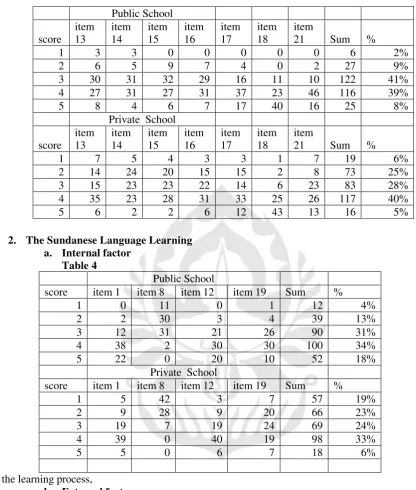
The two table above tell us that the two schools have different attitudes towards the use of Sundanese language and the Sundanese language learning. The following are the result of analysis based on the two attitudes.
1. The use of Sundanese Language.
a. Social Factors – table 2
221
From the frequency of the use of Sundanese language at school, the students of public school have better attitudes toward the use of Sundanese Language at school, They like to talk to their teacher by using that language.
2. The Sundanese Language Learning
a. Internal factor
In the learning process,
b. External factor
Conclusion References
Fishman, J. (1970): ―Language Attitudes: A Brief Survey of Methodological Approaches‖, Anthropological Linguistics, 12.
Crystal, David. 1992. An encyclopedic dictionary of language and languages. Cambridge, MA: Blackwell.
Davies, A & Elder, C. 2004, The Handbook of Applied Linguistics, Blackwell Publishing, UK.
Gardner, R. G.; Lambert, W. (1972): Attitudes and motivation in a second-language learning. Rowley Massachusetts: Newbury House Publishers.
Holmes (1993). Maintenance and Shift in Three New Zealand Speech Community. Applied Linguistics. Vol 14.