THE IMPACT OF ELECTRONIC WORD-OF-MOUTH ON BRAND IMAGE,
ATTITUDE TOWARD PRODUCT, PERCEIVED QUALITY AND VISIT
INTENTION: AN EMPIRICAL STUDY OF THE FOOD AND BEVERAGE
INDUSTRY IN JAKARTA
Adilla Anggraeni and Arvin Luthfi
Business Management and Marketing, Binus Business School, Bina Nusantara University ([email protected])
Abstract
This research is a synthesized study of two previous studies conducted by Jalilvand and Samiei (2012) and Jalilvand, Samiei and Ebrahimi (2012). The context of the research has been adapted to the food and beverage industry in Jakarta. The respondents of this study are individuals who have experience in visiting restaurants located in Jakarta. In total, there were 163 usable responses. The findings of the study show that electronic word-of-mouth (eWOM) influences brand image and visit intention to a restaurant. The findings suggest that restaurant managers should pay attention to the kind of eWOM that can be found in a variety of social media and internet platforms.
Keywords: brand image; food industry; electronic word-of-mouth; perceived quality; restaurant; intention to visit
1 INTRODUCTION
This research is a synthesized research of two previous studies. The first study was conducted by Mohammad Reza Jalilvand and Neda Samiei with the title “The effect of electronic word of mouth on brand image and purchase intention: an empirical study in the automobile industry in Iran” (2012). The second study was conducted by Mohammad Reza Jalilvand, Neda Samiei, and Abolghasem Ebrahimi titled: “Electronic word-of-mouth effects on tourists’ attitudes toward Islamic destinations and travel intention: an empirical study in Iran” (2012).
The food and beverage (F&B) industry has become one of the biggest industries in Indonesia. As stated in the Indonesian Ministry of Industry’s website (2015), the F&B industry contributed 20% to the country’s income. The industry’s growth is about 9.54%, higher than
the manufacturing industry which grew by 5.02% in 2015. Due to the F&B industry’s significant growth, the Indonesian government classified it as one of the nation’s prioritized industries (Ministry of Industry, 2015). In addition to that, most Indonesians favor creating a business in the F&B industry over other industries to start their entrepreneurship attempt (Hartono & Halim, 2014).
products or to criticize competitors’ offerings (Bao and Chang, 2014). Moreover, the advancement of technology and the growth of online social networks and social media platforms have further helped the spread of eWOM (Bao and Chang, 2014). In this research, the authors investigated about how e-WOM could have had a significant impact on visit intention, brand image, attitude toward the brand and perceived quality for restaurants in Jakarta.
The focus group discussion conducted by the author reveals that for the past few years, Pantai Indah Kapuk (a region in north Jakarta) has been one of the main areas of attraction for food enthusiasts in Jakarta, followed by Senopati (south Jakarta) and Kelapa Gading (north Jakarta). However, Pantai Indah Kapuk is seen as having more potential for new restaurants because the availability of shop-houses waiting to be rented. It can also be seen by the number of hashtags for each location. Pantai Indah Kapuk for example, has been talked about by customers more than 250,000 times on Instagram, while Senopati and Kelapa Gading were discussed over 20,000 and 160,000 times respectively as per January 11, 2016.
With the fast-paced growth of the F&B industry in Jakarta, it becomes more difficult for customers to decide which place to eat. Hence, customers are increasingly reliant on e-WOM to decide which restaurant to visit. People who dared to visit a restaurant before looking for e-WOM may become the pivot for other newcomers, which is why the restaurant owners are willing to invite influential people to visit their restaurants. Electronic word-of-mouth has become more effective today because those belonging to the Generation Y cohort spend quite a large amount of time
looking at their smartphones, which is why available information can be obtained quickly (Litvin, Goldsmith, & Pan, 2008). Generation Y has the most impactful voice in spreading e-WOM (Sweeney, Soutar, & Mazzarol, 2008). The advancement of technology has enabled the consumers to express their opinions using variety of media that goes beyond direct communication (Gheorghe and Liao, 2012).
Interestingly, a focus group discussion (FGD) conducted by the author revealed that customers do not pay attention regarding the source of information. There is paid content that means content made by a writer who was paid by a certain party to write good reviews regarding the restaurant. Consumers also tend to believe in one source without comparing the score from other similar platforms. Average score numbers and written reviews easily become references for their visit; sometimes just a nice picture of food is enough to create their intention to visit a restaurant. This could mean that the business owners can make their own reviews or ask friends and relatives to write reviews for them.
Word-of-mouth on the internet can be in various forms; the FGD also revealed that some people may crave a product after reading reviews from other customers, but to some, amateur photographs may be enough to convince them to visit the restaurants. Hence, generating positive e-WOM should be in the minds of restaurant managers.
In addition to that, there are limited studies regarding the impact of e-WOM toward perceived quality of restaurants. The relation of perceived quality and visit intention also varies in the context of the studies, which indicates that there is a strong need to investigate the relationship between these
2 LITERATURE REVIEW
2.1 Electronic Word-of-Mouth
Traditional word-of-mouth is a form of non-commercial communication shared between acquaintances and it has evolved into modern form due to the advancement of technology, known as electronic word-of-mouth (Cheung & Thadani, 2010). Like its predecessor, eWOM can be defined as any comments, positive or negative, made by past, present or future customers regarding a product or a company via the internet (Hennig-Thurau, Gwinner, Walsh & Gremler, 2004).
According to Cheung and Thadani (2010), there are exclusive attributes that differentiate traditional WOM and eWOM; one is that eWOM possesses a revolutionary scale and diffusing speed while traditional WOM is only shared to smaller individual groups and the spread is not as fast as eWOM. eWOM can be found in many platforms on the internet; it can be on customers own websites (such as blogs), discussion forums, review websites, news articles, e-bulletins, and social media websites. Another attribute of eWOM is that it is more persistent and easier to access since eWOM information is mostly in the form of text and available for an unrestricted time period (Hennig-Thurau, Gwinner, Walsh & Gremler, 2004). The third exclusive attribute is measurable (Park & Lee, 2009); with this attribute, people can observe the longevity, persistency, and viral rate of the information. Finally, eWOM does not share equal credibility with traditional WOM, as generally the traditional WOM is received from people who are known by the recipients, such as friends, family, or acquaintance while eWOM can be from anonymous sources.
There are several reasons why customers read e-WOM, First, customers use e-WOM as a means of obtaining information, to achieve social orientation, to have a sense of belonging and to learn ways to consume
products (Bao & Chang, 2014). Through e-WOM, customers can get the illustration of a product and begin to perceive its quality (Lecinsky, 2011).
Jalilvand and Samiei (2012) have stated that eWOM is a significant element for customers in gathering pre-purchase information. It has become a common activity for future customers to search information on the internet and this creates purchase intention. Due to this behavior, a strong term has been created for marketers, which is the ‘zero moment of truth’ (ZMOT). ZMOT means that customers already have information or can predict the quality of products or services before they actually see and experience them (Lecinsky, 2011). Lecinsky (2011) pointed out that current customers shopping behavior urges them to have their questions answered before they actually go shopping, and the easiest way to achieve the answers is from eWOM.
Through e-WOM, customers can get the illustration of a product and begin to perceive its quality (Lecinsky, 2011). The internet gives customers the ability to learn about a company’s products, price, place and promotion, and then define the quality of such a company.
There are several reasons why customers read e-WOM, First, customers use e-WOM as a means to obtain information, to achieve social orientation, to have a sense of belonging and to learn ways to consume products (Bao & Chang, 2014).
2.2 Brand Image
one brand and another may be “functional, rational, or tangible – related to the product performance of the brand” and can also be “symbolic, emotional, or intangible – related to what the brand represents”. Saeed (2013) states that brand image is an important part of brand strength and it is evaluated by fame and market share; thus whichever brands are more spoken about are superior to other brands in for customers to make their purchase decision, and reduce the risk of being disappointed after making their decision.
Jalilvand and Samiei (2012), found that customers will become seriously aggravated when the purchased products or services given by providers did not match their expectations. Customers tend to trust and rely on a small number of providers that deliver products or services with quality that consistently meet their standards. In addition, Su and Yang (2015) also mentioned that every interaction between sellers and buyers is critical and becomes the input for both party’s next action, inclined toward the buyers. Therefore, it is crucial for everyone in an organization to always provide and deliver consistent, predictable, and high quality performance to the customers.
In the restaurant industry, Wu et al. (2011) found that both store image and service quality have a direct and positive effect on brand image and visit intention. Brand image in the restaurant business is one of the competitive tools to win the market as it can be a determinant aspect for customers to visit, revisit and become loyal (Yohn, 2012). According to Yohn (2012), the brand image of
a restaurant should always be rejuvenated to keep the brand relevant with the market conditions and to do this, managers can simply add new menu items or change the design of
Zeithaml (2000) defined perceived quality as customers’ subjective appraisal of a product as a whole regarding its value, benefit and excellence. Personal experience, unique needs and situation while using the product can influence customers’ subjective appraisal of the quality.
In service industry, service quality performance is an indicator of customer satisfaction and eventually behavioral intentions (Brady and Cronin, 2001). This suggests that measurement of service quality has been discussed widely by industry practitioners and researchers over the years (Hwang and Ok, 2013).
According to Dodds (2002), perceived quality is the customers’ trust and belief of the benefit(s) they will get from a product or a brand. Thus, we can summarize that perceived quality is the customers’ assumption of a product’s benefit(s) and theirs hopes that it will match their expectation.
become customers’ starting line to perceive a product or service quality, whether the brand is at a premium or an economical level as well as whether the brand is the best in class or is competitive in the market.
In the restaurant context, Jang and Namkung (2008), conceptualized that perceived quality is supported by different sets of stimuli, such as service stimuli, environmental stimuli, and product stimuli. Product stimuli consist of food taste, freshness and presentation; this stimulus as well as the other two play a very crucial role to predict the customers’ response and behavior.
Durianto et al. (2004) stated that perceived quality has 7 dimensions which are performance, service, durability, reliability, product characteristic, compliance with specification and result. Each dimension affects customers’ perceived quality toward a product; for instance, restaurants with great food but with lackluster service would create varied perceived quality in every customer; some may only care for the food while some care for both product and service.
Products perceived quality dimensions are as follows (Umar, 2005):
• Performance, related to the functional aspects of a product and the main characteristics to be considered by customers to purchase such a product; • Features, a performance aspect that
can enhance the basic function. This is generally related with available product options and customization; • Reliability, related to the products
performance probability when operating its function;
• Conformance, it confirms the accuracy of product characteristic with its standard specifications;
• Durability, reflects the endurance and/or age of a product;
• Serviceability, a characteristic that is related to the speed, competitiveness, simplicity and accuracy in providing service to repair products;
• Aesthetics, a characteristic with subjective nature regarding the aesthetic values related with personal opinion and reflected from individual preference;
• Fit and finish, this refers to the subjective nature related with customers’ feeling about the product’s position as a quality product.
According to Zeithaml (2000), there are several dimensions of perceived quality, including tangibility, reliability, responsiveness, assurance, and empathy. Tangibility covers the physical appearance such as the building design, parking availability, cleanliness, facilities and employees’ appearance. Reliability, is the ability to provide services as promised; Responsiveness is the employees’ response to help customers and give fast and perceptive service. Assurance, covers the capability of employees with accurate product knowledge, friendliness, attentiveness and courteousness in providing service, security, skills and information. More importantly, it is the ability to embed customers’ trust in a firm. Empathy, which is the individual attention given by a firm to the customers.
Gatti (2012) has noted that perceived quality will spark customers’ curiosity to act. Curiosity makes customers want to materialize their expectation into reality. Thus, visit intention is possibly related to perceived quality.
2.4 Attitude Toward the Brand
reaction in either favorable or unfavorable gestures to a particular matter (Shahrokh, 2012). According to Shimp (1981), attitude has two components; the first is the affective components that generate emotion that caused are by the matter and cognitive components that shows how good and useful the matter is. Lefton & Brannon (2008) defined attitude as a pattern of feeling, trust and behavioral tendency toward a person, idea, or object over a long period of time. Thus, it can be summarized that attitude is the expression or pattern of feeling, trust and behavioral tendency to respond to a matter consistently, either favorably or unfavorably. Hanna and Wozniak (2001) found that attitude is the result from experience of a product or from information give from other individuals.
Abzari and Ghassemi (2014) stated that customers’ attitude formation often depicts the relationship of trust, attitude and behavior. Belief, trust and customers’ evaluation of a product forms customers’ attitude. Attitude holds a significant role in forming behavior (Aminu and Hartini, 2008)
In the context of customer attitude toward an object, objects can be defined in a category of product, brand, service, advertisements, etc. (Ristiyanti et al., 2005). Ristiyanti et al. (2005) also add that attitude is directional and has its own intensity; it is directional because attitude causes people to have positive and negative views toward an object. How substantial the pleasure or displeasure is will depend on the attitude intensity.
In the F&B industry, attitudes toward food and beverages are determined by a variety of personal factors, such as the individual’s economic conditions, socio-demographic and cultural environment (Sparke & Horska, 2007). Mohan (2013) noted, customers’ attitudes toward food are elastic; although every customer has their own taste such as avoiding spicy or sour tastes, but they are open to new kinds of food if it matches their criteria.
Thus, it can be hypothesized that: The more positive the attitude towards the restaurant brand, the higher the intention to
revisit the restaurant.
3 3. RESEARCH METHODOLOGY
The study utilizes a survey as its main data collection method. The questionnaires were distributed online and offline. The offline method was conducted by distributing the printed questionnaires to potential respondents in Jakarta, especially in several universities in the city. The online method was distributed through social media, chatting platforms, and e-mail.
The objective of the study and the author’s declaration to keep the gathered information anonymous and solely used for academic purposes was provided in the cover page. The questionnaire was divided into 3 sections. The first section gathered the respondents’ demographic information: gender, age, occupation and monthly expenses.
The second section determined whether the respondents are eligible to participate in the survey with a filter question. The third section of the questionnaire contained questions related to the main variables of the study. The hypotheses were determined by analyzing the relationship of variables in the third section.
Prior to the distribution of the actual questionnaires, the measurements were
pre-tested to ensure their validity and reliability.
Table 3.1 Measurement Reliability
Variable
Cronbach's
Alpha
Acceptable
Value
Number
of Items
Remarks
eWOM
0.881
>0.6
6
Reliable
Brand Image
0.855
>0.6
5
Reliable
Attitude
toward
the
Brand
0.812
>0.6
3
Reliable
Perceived
Quality
0.941
>0.6
10
Reliable
Visit
Intention
0.912
>0.6
3
Reliable
The reliability test was conducted to measure the internal consistency and stability of the questionnaire. In other words, to see whether the questionnaire would produce consistent results when it was tested repeatedly (Malhotra, 2012). The reliability is measured by the value of each variable’s Cronbach’s Alpha; if the result is above 0.6, then the measurement is considered to be reliable.
As shown in Table 3.1, every variable in the study was reliable since it passed the minimum requirement of 0.6 for the Cronbach’s Alpha. Thus, it can be concluded that the measurements were reliable.
The value from KMO determines the adequacy of the degree of the analysis. To be
adequate, the value needed to be equal greater than 0.5 and if the result was below 0.5, the author needed to increase the sample size. (Kaiser,1970). According to Malhotra (2010), cumulative variance is expressed as a percentage which refers to the sum of variance of a construct’s variables and it is proper if for each construct when the variance’s percentage is greater than 60%. The component matrix indicator tests the validity of the measurement. According to Malhotra (2010), this indicator shows the relationship between every variable and the component; it is considered good when the value of every variable is greater than 0.7.
Variable Communalities Value (>0.5)
KMO
Value
Remark
e-WOM
EWOM1: 0.637 EWOM2: 0.622 EWOM3: 0.624 EWOM4: 0.650 EWOM5: 0.636 EWOM6: 0.685
0.806 Acceptable
Brand Image
IMAGE1: 0.607 IMAGE2: 0.791 IMAGE3: 0.640 IMAGE4: 0.581 IMAGE5: 0.549
0.787 Acceptable
Attitude toward the Brand
ATTITUDE1: 0.759 ATTITUDE2: 0.749 ATTITUDE3: 0.681
0.709 Acceptable
Perceived Quality
QUALITY1: 0.574 QUALITY2: 0.745 QUALITY3: 0.749 QUALITY4: 0.604 QUALITY5: 0.575 QUALITY6: 0.609 QUALITY7: 0.596 QUALITY8: 0.679 QUALITY9: 0.692 QUALITY10: 0.733
0.8 Acceptable
Visit Intention
INTENTION1: 0.912 INTENTION2: 0.753 INTENTION3: 0.891
0.702 Acceptable
4 4. FINDINGS AND DISCUSSION
All 211 respondents had experience of using food review platforms, indicating that none of the responses received were excluded from the analysis. However, among the respondents, there were 48 people who were not part of Generation Y, thus there were only 163 valid responses for this study. There were 96 male respondents (58.9%) and 67 female respondents (41.1%), with ages ranging from 17 to 35 years old. The majority of the respondents (38.7%) spent Rp 1,000,001 to Rp
2,000,000 (approximately USD 80-150) in a month to dine out. In addition to that, 61 respondents (37.4%) spent around Rp 2,000,001 to Rp 3,000,000 (approximately USD 150-250) a month. The rest of the respondents (9.8%) spen less than Rp 1.000.000 a month to eat out and 19 (11.7%) spent Rp 3,000,001 to Rp 4,000,000. Lastly, only 4 respondents ((2.5%) spent more than Rp 4,000,000 to dine out.
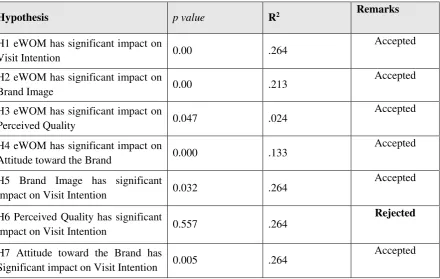
Table 4.1 Findings of the study
Hypothesis p value R2 Remarks
H1 eWOM has significant impact on
Visit Intention 0.00 .264
Accepted
H2 eWOM has significant impact on
Brand Image 0.00 .213
Accepted
H3 eWOM has significant impact on
Perceived Quality 0.047 .024
Accepted
H4 eWOM has significant impact on
Attitude toward the Brand 0.000 .133
Accepted
H5 Brand Image has significant
impact on Visit Intention 0.032 .264
Accepted
H6 Perceived Quality has significant
impact on Visit Intention 0.557 .264
Rejected
H7 Attitude toward the Brand has
Significant impact on Visit Intention 0.005 .264
Accepted
1. RQ1: Does e-WOM have significant impact on the visit intention to restaurants
The study reveals that e-WOM has a significant impact on visit intention to restaurants. It is proven by the existence of a direct linear relationship between e-WOM and visit intention. Thus, it can be concluded that the more and better reviews of a restaurant, the higher the likelihood of potential customers wanting to visit that restaurant. The finding is aligned with the study conducted by Jalilvand and Samiei (2012) that e-WOM has an impact on customers’ intention.
Food review platforms such as Zomato.com and Qraved.com have rating systems so the customers can draw a conclusion from the average rating of a restaurant before reading what the reviewers have written. Pictures in Instagram can also be edited to look very appetizing so customers may not have the need to read further details.
Another explanation of this finding is that the individuals’ behaviors tend to follow trends, especially what they have learned from
the internet, including trends in the F&B industry. A higher number of strong reviews for a restaurant could create hype among food enthusiasts. The word spreads through the Internet and by word of mouth, creating a new trend and curiosity and urging potential customers to plan a visit to the restaurant. Hence, it is important for a restaurant to stimulate its customers to write reviews about it.
2. RQ2: Does e-WOM have significant a impact on restaurant’s brand image that will influence them to visit the restaurant?
customer reviews’ influence is particularly pertienent in the domain of hospitality and tourism.
Zero Moment of Truth theory suggests that customers learn about a product or a brand before they have even gone and experienced such a product or brand (Lecinsky, 2011). That is the function of e-WOM. Potential customers learn about the restaurant from the food review platform and/or social media. Then they relate with the brand image impression from the reviews.
The more positive reviews of a brand on the internet could create the customers’ mindset that the brand is trustworthy and reliable. Customers must trust that the brand will not disappoint them. Reliable brand image induces the intention of customers to experience its products or service. A study by Lien (2014) stated that customers must be attracted to the brand image first, before they have the intention to purchase. Such a brand also should not hurt the customers’ social status since brand image represents a social status symbol of its customers.
3. RQ3: Does e-WOM have a
significant impact on perceived quality toward certain restaurants that will influence customers to visit the restaurant?
The most interesting finding in this study is that perceived quality does not have significant impact toward visit intention. It may be due to the customers’ experience of similar kinds of restaurant (similar food offered, style, location, price) so they do not have the urge to visit another one. Food reviews often include the pictures of the food. Some platforms occasionally show the complete menu and price. Customers who write reviews give detailed information of the restaurant they went to, complete with the parking conditions, restaurant ambience, and the service. Such information gives potential customers the idea to perceive the quality of a restaurant, especially since the intangibility of
the service may cause difficulties in assessing the service quality (Kushwaha & Agrawal, 2015).
According to Khajittanakorncharoen and Chirapanda (2010), when the customers already have a set of quality standards for a certain product, the quality of other similar products would not affect their intention to try, unless it has distinguished differentiation from what they have experienced. In other words, customers compare quality among products. If they perceive that they can get the same quality from the product they have trusted, they will have little intention to try the new one.
Moreover, it has been suggested that the interaction between customer and service provider can have a significant influence on
how customers evaluate a restaurant’s service
quality (Jang & Namkung, 2009).
RQ4: Does e-WOM have a significant impact on attitude toward the brand on certain restaurants that will influence customers to visit the restaurant?
The results of this study have shown that e-WOM has a significant impact on attitude toward the brand for certain restaurants and such an attitude will influence them to visit the restaurant. These findings confirm the study in a different context and time conducted by Jalilvand, Samiei and Ebrahimi (2013).
affect customers intention to visit the restaurant.
5 5. CONCLUSION AND
RECOMMENDATIONS
This study has shown that e-WOM affects the brand image, attitude toward the brand, perceived quality and the customers’ intention to visit restaurants, indicating the importance of generating positive e-WOM. To start generating e-WOM, restaurant managers have to register their restaurants on social media and food review platforms. Social media such as Twitter, Instagram, and Facebook have a “hashtag” system where a restaurant can create the trend and follow the trend. The hashtag system is similar to keyword system whereas the user can categorize what topic their product or service is.
In order to increase customer awareness towards their restaurants, managers might need to create a buzz through enlisting the assistance of endorsers. This is where food bloggers are needed as endorsers. However, managers need to carefully choose which bloggers to endorse, since the bloggers are segmented as well.
Reviews from natural customers are earned either when they are satisfied or disappointed. To stimulate customer satisfaction and willingness to review, managers may want to lure the customers with rewards. For example, a steak restaurant in Indonesia called HolyCow rewards customers with a free slice of tiramisu and another restaurant called Suntiang rewards a cup of ice cream to those who proved that they have posted a picture or written a review regarding the restaurant on an internet platform.
Managers should also carefully choose which platforms that they use to invest their marketing budget. According to the findings in this study, most people use Zomato.com and
Instagram to find food references and read reviews; thus to learn how those platforms work is crucial to make an efficient and effective strategy.
Brand image is proven to be a significant factor to create visit intention. Thus, there are several notes addressed toward F&B entrepreneurs and managers in managing a restaurant’s brand image. Prior to starting a business, the brand name, logo, and theme should be carefully designed. These restaurant owners and managers need to know their target customers first before formulating the brand image, as strong brand image is expected to attract customers that feel the connection with the brand.
Brand image symbolizes the restaurant’s integrity and reputation. The workers in the restaurants must be trained to never disappoint the customer and if the customers ever get disappointed, it is better to fix the problem right away. For example, Pizza Hut Delivery (PHD) holds its promise that if the food was delivered later than 30 minutes, then the customers would get a voucher for free pizza for their next purchase. Brand image should never get sullied; if the brand does not have promises such as PHD, the manager must be quick to handle customers’ complaints. Handling customers complaints can be done by apologizing and giving discount or free products for compensation. Disappointed customers can hurt the brand image, make the brand less trustworthy if the word gets out and spreads as negative word-of-mouth. It is harder to rebuild the brand image than to protect it.
Based on the findings, positive attitude toward the brand increases the probability of customers’ visit intention. Positive attitude is formed either by direct positive experience or positive information gained from other people (Hannah & Wozniak, 2001). Then, it is important to have positive e-WOM.
customers see is the restaurant rating. In addition, customers can quickly create their attitude just by looking the rating.
The author suggests that managers should have someone dedicated to handle the social media and digital marketing of the brand. That person needs to find the reasons of why the rating is dropping or increasing and report to managers once he or she found the reasons. If the brand condition is acute, rebranding might be needed by creating promotions such as discounts or introducing new products.
This study has shown that perceived quality does not have a significant impact on visit intention. However, it does not mean that restaurants should not pay attention to its products and service quality. Tsiotsou (2005) suggests that quality is the base of brand image. If a brand sells products or service with low quality, it means that brand is relating itself toward segments that accept low quality product or service. Since quality is related to brand image, and brand image has significant impact toward visit intention, then the restaurant managers must firmly decide their segments and the level of quality that is desired by those chosen segments.
The findings of this study may face several limitations due to factors such as respondents’ profile limitation. The younger generation (for example Generation Z) and purchasing and decision-making power over the younger generations. parents and their financial power is still limited compared to previous generations while Generation X are not heavy social media users and therefore are less active in community forums compared to the generation Y (Allaway, 2015). In addition to that, the choices of restaurants provided in the questionnaire consisted of restaurants which were popular during the period of September 2015; however, there is a possibility that the trends of the restaurants in Jakarta can change from time to time which may influence the findings.
The study does not incorporate possible reasons why respondents were interested in reading e-WOM at the first place. Different types of platforms that the respondents utilized to read the reviews may also have an impact on the strength of the influence of e-WOM.
There are several recommendations for further research. First, a study on generation X within a similar context is encouraged. exposure to social media. Interestingly, from 48 gen X respondents that were excluded in this study, all of them had experience of using social media and food review platforms to find food references.
The study could also be conducted in other big cities in Indonesia and could be specified to a certain type of restaurant. For example, a study strictly on high-end restaurants to investigate further about perceived quality of similar type of restaurants.
6
7 REFERENCES
and purchase intention: The case of Iran Khodro company”. Social and Behavioral Science, 143, 822-826.
Allaway, T., 2015. Infographic: The mobile technology habits of gen X vs millenials. Retrieved from
https://www.digitalpulse.pwc.com.au/gen-x-mobile-technology-infographic/
Aminu, A and Hartini, A., 2008., Marketing Mix Drivers of Client Satisfaction in Technology
Enabled Service: A Study of Nigerian GSM subscribers, Communication of the IBIMA. 1,
Bao, T. & T-L. S. Chang, 2014., “Finding disseminators via electronic word of mouth message for effective marketing communications”, Decision Support Systems 67, pp.21–29
Cheung, C. M. & Thadani, D. R., 2010. “The effectiveness of electronic word-of-mouth communication: A literature analysis”. BLED 2010 Proceedings, 18. Retrieved from
http://asisel.asinet.org/bled2010/18
Gheorghe, Iuliana-Raluca and M-N. Liao, 2012. “Investigating Romanian healthcare consumer behaviour in online communities: Qualitative research on negative eWOM”, Procedia – Social communities: Social capital, consumer learning, and behavioral outcomes. Advertising Research, 47(4), 485-495.
Hennig-Thurau, T., Gwinner, K. P., Walsh, G. & Gremler, D. D., 2004. “Electronic word-of
mouth via consumer-opinion platforms: What motivates consumers to articulate themselves
on the Internet.”Journal of Interactive Marketing, 18(1), pp. 38-52.
Hwang, Jinsoon and C. Ok, 2013. “The antecedents and consequence of consumer attitudes toward restaurant brands: A comparative study between casual and fine dining restaurants”
Jalilvand, M. Reza, A. Ebrahimi and N. Samiei, 2012. “Electronic word of mouth effects on tourists’ attitudes toward Islamic destinations and travel intention: An empirical study in Iran”, Procedia Social and Behavioural Science, 81, pp. 484-489
Jang, SooCheong & Y. Namkung, 2009. “Perceived quality, emotions, and behavioral intentions: Application of an extended Mehrabian–Russell model to restaurants”, Journal of
Business Research, 62, pp. 451-460
Khajittanakorncharoen, Anchalee & S. Chirapanda, 2010. “Factors influencing golfers’ revisit intentions of golf courses in Bangkok metropolitan region”, International Journal of Business
and Economics
Kushwaha, Gyaneshwar Singh & Agrawal, S. R., 2015. “An Indian customer surrounding 7Psof
service marketing,” Journal of Retailing and Consumer Services, 22, pp. 85–95
Ladhari, R. & Michaud, M., 2015. “eWOM effects on hotel booking intentions, attitudes, trust
and website perception”. International Journal of Hospitality Management. 46, 36-45.
Lecinski, J. 2011. Zero moment of truth – Think with Google. Retrieved from
https://www.thinkwithgoogle.com/collections/ zero-moment-truth.html
Majid, Mohd. Aliff A., M.A. M. Alias, A. Samsudin & C.T. Chik, 2016. “Assessing customer based brand equity ratings in family restaurant”, Procedia Economics and Finance 37, pp. 183-189
Onigbinde, I. O.& Odunlami, S. A., 2015. “Influence of brand image and promotional mix on consumer buying decision - a study of beverage consumers in Lagos state, Nigeria.”
Tsiotsou, R., 2005. “Perceived quality levels and their relation to involvement, satisfaction, and purchase intention”, Marketing Bulletin, 16 (4), pp. 1-10