ONLINE RELIGIOUS INFORMATION SEEKING
BEHAVIOR AMONG MEXICAN FEMALE MUSLIM
CONVERTS
BY
GABRIELA AURORA MONDRAGÓN MEZA
A thesis submitted in fulfilment of the requirement for the
degree of Master of Human Sciences in Communication
Kulliyyah of Islamic Revealed Knowledge and Human
Sciences
International Islamic University Malaysia
ii
ABSTRACT
This study is about online religious information seeking behavior among Mexican female Muslim converts using theoretical concepts of information seeking behavior and the Sense-Making Theory developed by Dervin (1983). The respondents of this study were fourteen Mexican female Muslim converts living in a non-Muslim country, Mexico, where they face the day-to-day challenge of how to be a Muslim in a non-Islamic environment and belonging to Catholic families. These are further compounded by the misconception and hysteria created by the mass media about Islam and its followers. The research objectives of the study are: (1) To investigate the experience of Mexican female Muslim converts in their process of online religious information seeking; (2) to identify the information needs among them; and (3) to explore their information use. A qualitative methodology was used, utilising online narrative interviews through WhatsApp. The ATLAS.ti software was used for data management and analysis. The researcher found that there are two different processes of information seeking behavior: before and after conversion. Information needs and information use are different in each step for the respondents. The researcher found why the respondents look for online religious information, what are their needs, and how they use the information. It was also found that the society was not prepared for the changes undertaken by a Muslim convert in practising the discipline and religion of Islam. The present research has several contributions. It adds to the existing body of knowledge in four areas: namely communication, information seeking behavior, Internet studies and in the context of minority Muslims. This work can serve as a future reference in research on communication looking for literature on Muslim converts, particularly involving Mexican convers, as well information on male converts.
iii
ﺚﺤﺒﻟا
ﺔﺻﻼﺧ
ABSTRACT IN ARABIC
ﺚﺤﺒﻟا
اﺬھ
لوﺎﻨﺘﯾ
ﺮﺒﻋ
ﺔﯿﻨﯾﺪﻟا
تﺎﻣﻮﻠﻌﻤﻟا
ﻦﻋ
ﺚﺤﺒﻟا
كﻮﻠﺳ
)
ﺔﻜﺑﺎﺸﻟا
ﺖﻧﺮﺘﻧﻹا
(
تﺎﻤﻠﺴﻤﻟا
ﻦﯿﺑ
مﻼﺳﻹا
ﻦﻘﻨﺘﻋا
ﻲﺗﻼﻟا
تﺎﯿﻜﯿﺴﻜﻤﻟا
؛
ماﺪﺨﺘﺳﺎﺑ
ﻟا
تﺎﻣﻮﻠﻌﻤﻟا
ﻦﻋ
ﺚﺤﺒﻟا
كﻮﻠﺴﻟ
ﺔﯾﺮﻈﻨﻟا
ﻢﯿھﺎﻔﻤ
) "ﻰﻨﻌﻤﻟا ﻦﯾﻮﻜﺗ" ﺔﯾﺮﻈﻧو
Sense-Making theory
ﺎھرﻮط ﻲﺘﻟا (
ﻦﻓﺮﯾد
Dervin
)
1983
(
،
ﺖﻛرﺎﺷ
ﺪﻗو
ﺚﺤﺒﻟا
ﻲﻓ
14
ﺔﻟود
ﻲﻓ
ﻦﺸﻌﯾ
ﺔﻤﻠﺴﻣ
ﺔﯿﻜﯿﺴﻜﻣ
ةأﺮﻣا
ﻚﯿﺴﻜﻤﻟا
،
و
ﺸﻣ
ﻦﮭﺟاﻮﯾ
ﺎ
ﻞﻛ
ﺔﯿﻣﻮﯾ
ﻞﺜﻤﺘﺗ
ﻔﯿﻛ
ﻲﻓ
ﺔﯿ
ﺶﯿﻋ
ﻟا
،ﺔﯿﻣﻼﺳإ
ﺮﯿﻏ
ﺔﺌﯿﺑ
ﻲﻓ
ﻢﻠﺴﻤ
ﺮﺸﻨﯾ
ﻦﯿﺣ
ﺎﻤﯿﺳ
ﻻو
ةرﻮﺻ
مﻼﻋﻹا
مﻼﺳﻹا ﻢﯿھﺎﻔﻣ ﻦﻋ ﺔﺌطﺎﺧ
و
،ﮫﻋﺎﺒﺗأ
ﺎًﻤﻠﻋ
نأ
ﯿﻜﯿﺴﻜﻤﻟا
ﯿ
ﻟﻮﺤﺘﻤﻟا ﻦ
ﯿ
ًﺒﻟﺎﻏ نﻮﻤﺘﻨﯾ مﻼﺳﻹا
ﻰﻟإ ﻦ
ﺎ
ﻰﻟإ
ﺔﯿﻜﯿﻟﻮﺛﺎﻛ
ﺮﺳأ
أ
دﺪﺤﺘﺗ
؛ﻢﺛ
ﻦﻣو
،
ﺚﺤﺒﻟا
فاﺪھ
ﻲﻓ
تﺎﯿﻜﯿﺴﻜﻤﻟا
تﺎﻤﻠﺴﻤﻟا
ﺔﺑﺮﺠﺗ
فﺎﺸﻜﺘﺳا :
ﺮﺒﻋ
ﺔﯿﻨﯾﺪﻟا
تﺎﻣﻮﻠﻌﻤﻟا
ﻦﻋ
ﺚﺤﺒﻟا
ﺔﯿﻠﻤﻋ
ﻲﻓ
تﻻﻮﺤﺘﻤﻟا
و
،ﺔﻜﺑﺎﺸﻟا
ﻦﻣ
ﻦﮭﺗﺎﺟﺎﯿﺘﺣا
ﺪﯾﺪﺤﺗ
ﻦﮭﻨﯿﺑ
ﺎﻤﯿﻓ
تﺎﻣﻮﻠﻌﻤﻟا
،
و
تﺎﻣﻮﻠﻌﻤﻟا
ﻚﻠﺗ
ﻦﮭﻣاﺪﺨﺘﺳا
ﺔﻘﯾﺮط
فﺎﺸﻜﺘﺳا
،
ﺚﺤﺒﻟا
ﻊﺒﺗا
ﺪﻗو
ﺞﮭﻨﻤﻟا
ﻲﻋﻮﻨﻟا
ﻣ
لﻼﺧ ﻦ
ﻖﯿﺒﻄﺗ ﺮﺒﻋ تﻼﺑﺎﻘﻤﻟا
بﺎﺴﺗاو
،
و
ﺞﻣﺎﻧﺮﺑ ماﺪﺨﺘﺳا
ATLAS.ti
ﺎﮭﻠﯿﻠﺤﺗو
تﺎﻧﺎﯿﺒﻟا
ةرادﻹ
ﻦﱠﯿﺒﺗ
ﺪﻗو
،
ًّﺪﻌﺘﺴﻣ
ﺲﯿﻟ
ﻊﻤﺘﺠﻤﻟا
نأ
نﻮﻤﻠﺴﻤﻟا
ﺎﮭﺑ
مﻮﻘﯾ
ﻲﺘﻟا
تاﺮﯿﯿﻐﺘﻠﻟ
ا
نﻮﻟﻮﺤﺘﻤﻟا
ﻻ
ﻲﻣﻼﺳﻹا ﻦﯾﺪﻟا مﺎﻈﻧ عﺎﺒﺗ
،
ﺐﺒﺳ ﻦﻋ لؤﺎﺴﺗ كﺎﻨھو
ﺚﺤﺑ
تﺎﻛِرﺎﺸﻤﻟا
تﺎﻣﻮﻠﻌﻤﻟا ﻦﻋ
ﺔﯿﻨﯾﺪﻟا
،
ﻨﺠﺘﺤﯾ
ﺎﻣو
،ﮫ
ﻔﯿﻛو
ﺔﯿ
ا
ﺪﺨﺘﺳ
ا
ﻣ
ﻦﮭ
تﺎﻣﻮﻠﻌﻤﻟا
ﻚﻠﺗ
،
ﺪﻗو
كﺎﻨھ
نأ
تﺎﻧﺎﯿﺒﻟا
ﻞﯿﻠﺤﺗ
ﺮﮭظأ
تﺎﻣﻮﻠﻌﻤﻟا ﻦﻋ ﺚﺤﺒﻟا كﻮﻠﺴﻟ ﻦﯿﺘﻔﻠﺘﺨﻣ ﻦﯿﺘﯿﻠﻤﻋ
ﺎﻤھاﺪﺣإ ؛
مﻼﺳﻹا قﺎﻨﺘﻋا ﻞﺒﻗ
،
ﺪﻌﺑ ىﺮﺧﻷاو
ذإ ؛ه
جﺎﯿﺘﺣﻻا ﻒﻠﺘﺨﯾ
ا ﻰﻟإ
ﺔﺒﺴﻨﻟﺎﺑ
ةﻮﻄﺧ ﻞﻛ
ﻲﻓ ﺎﮭﻣاﺪﺨﺘﺳاو تﺎﻣﻮﻠﻌﻤﻟ
ا ﻰﻟإ
ﻛرﺎﺸﻤﻟ
،تﺎ
ﻟو
ﺚﺤﺒﻟا اﺬﮭ
إ
ﮭﺳ
ﺎ
تﺎﻣ
؛ةﺪﻋ
ذإ
ﯾ
إ
ﻞﺜﻤ
ﺿ
ﺎ
ﻓ
ﺔ
تﻻﺎﺠﻣ
ﺔﻌﺑرأ
ﻲﻓ
ﺔﻓﺮﻌﻤﻟا
قﺎﻄﻧ
ﻰﻟإ
؛
،ﻞﺻاﻮﺘﻟا :ﻲھ
و
كﻮﻠﺳ
،تﺎﻣﻮﻠﻌﻤﻟا ﻦﻋ ﺚﺤﺒﻟا
ﻟاو
تﺎﺳارﺪ
ﺔﯿﻜﺑﺎﺸﻟا
،
و
ﺔﻤﻠﺴﻤﻟا ﺔﯿﻠﻗﻷا قﺎﯿﺳ
،
و
اﺬھ نﻮﻜﯾ نأ ﻦﻜﻤﯾ
ﺔﻟﺰﻨﻤﺑ
ﻲﻠﺒﻘﺘﺴﻣ
ﻊﺟﺮﻣ
ﻟ
مﻼﺳﻹا
ﻰﻟإ
ﻦﯿﻟﻮﺤﺘﻤﻟا
ﻦﯿﻤﻠﺴﻤﻟا
ﻦﻣ
تﺎﻣﻮﻠﻌﻤﻟا
ﻦﻋ
ﺚﺤﺒﻠ
ﻲﻓ
ﻚﯿﺴﻜﻤﻟا
،
ﻦﻣو
ا
تﺎﯿﻠﻗﻷا
ىﺮﺧﻷا
ﺔﻤﻠﺴﻤﻟ
ﺔﻓﺎﺿإ
ﺚﺤﺒﻟا
نﻮﻜﯾ
ﺪﻗ
اﺬﻛو
،
ﻲﻓ
ردﺎﺼﻤﻟا
عاﻮﻧﺄﺑ
ﻖﻠﻌﺘﯾ
ﺎﻤﯿﻓ
ﻟا
ﺸ
ﺎ
ﺔﻜﺑ
.ﺎﮭﺼﺋﺎﺼﺧو
iv
ABSTRACT IN MALAY
Kajian ini adalah mengenai sikap pencarian maklumat berkaitan agama dalam talian di kalangan wanita mualaf warganegara Mexico, dengan menggunakan konsep teori sikap pencarian maklumat dan Teori Sense-Making yang dikembangkan oleh Dervin (1983). Responden kajian ini terdiri daripada empat belas wanita mualaf warganegara Mexico yang tinggal di negara bukan Islam seperti Mexico. Mereka menghadapi masalah harian seperti cara mengamalkan gaya hidup Muslim di dalam persekitaran bukan Islam, terutamanya media massa mewujudkan salah faham mengenai Islam dan penganutnya. Walhal, majoriti mualaf warganegara Mexico adalah dari kalangan keluarga beragama Katolik. Objektif kajian adalah seperti berikut: (1) Untuk menyelidik pengalaman wanita mualaf Mexico dalam proses pencarian maklumat berkaitan agama dalam talian. (2) Untuk mengenal pasti maklumat yang mereka perlukan. (3) Untuk mengkaji penggunaan maklumat mereka. Metodologi kualitatif digunakan dan temu ramah naratif dalam talian menerusi WhatsApp. Perisian ATLAS.ti digunakan untuk analisis dan pengurusan data. Pengkaji mendapati bahawa terdapat dua proses di dalam sikap pencarian maklumat: yang pertama adalah sebelum, manakala yang kedua adalah selepas memeluk Islam. Kegunaan keperluan maklumat dan maklumat di dalam setiap langkah adalah berbeza bagi setiap responden. Pengkaji mendapat maklum balas tentang mengapa responden mencari maklumat keagamaan di dalam talian, apa yang diperlukan dan cara penggunaan maklumat diperolehi. Pengkaji juga mendapati alasan responden mencari maklumat keagamaan di dalam talian, keperluan mereka dan bagaimana mereka memanfaatkan maklumat yang didapati. Selain itu, pengkaji menyedari bahawa masyarakat sekeliling belum bersedia dengan perubahan yang dilakukan oleh para mualaf kerana mengikuti aturan agama Islam. Kajian ini mempunyai beberapa kepentingan. Di antaranya, ia menambahkan pengetahuan di dalam empat bidang, iaitu di dalam bidang komunikasi, sikap mencari maklumat, pengajian Internet dan konteks Muslim minoriti. Kajian ini juga boleh digunakan sebagai rujukan di masa depan dalam kajian pencarian maklumat dari mualaf lelaki dan komuniti Muslim minoriti yang lain. Selain itu, ia boleh digunakan di dalam bidang sains maklumat. Contohnya, ciri-ciri dan jenis sumber di dalam talian.
v
APPROVAL PAGE
I certify that I have supervised and read this study and that in my opinion, it conforms to acceptable standards of scholarly presentation and is fully adequate, in scope and quality, as a thesis for the degree of Master of Human Sciences (Communication).
……….. Nerawi Sedu
Supervisor
……….. Aini Maznina A. Manaf
Co-Supervisor
I certify that I have read this study and that in my opinion it conforms to acceptable standards of scholarly presentation and is fully adequate, in scope and quality, as a thesis for the degree of Master of Human Sciences (Communication).
……….. Che Mahzan Ahmad
Examiner
……….. Zeti Azreen Ahmad
Examiner
This thesis was submitted to the Department of Communication and is accepted as a fulfilment of the requirement for the degree of Master of Human Sciences (Communication).
……….. Zeti Azreen Ahmad
Head, Department of Communication
This thesis was submitted to the Kulliyyah of Islamic Revealed Knowledge and Human Sciences and is accepted as a fulfilment of the requirement for the degree of Master of Human Sciences (Communication).
……….. Shukran Abdul Rahman
Dean, Kulliyyah of Islamic Revealed Knowledge and Human Sciences
vi
DECLARATION
I hereby declare that this thesis is the result of my own investigations, except where otherwise stated. I also declare that it has not been previously or concurrently submitted as a whole for any other degrees at IIUM or other institutions.
Gabriela Aurora Mondragon Meza
vii
INTERNATIONAL ISLAMIC UNIVERSITY MALAYSIA
DECLARATION OF COPYRIGHT AND AFFIRMATION OF
FAIR USE OF UNPUBLISHED RESEARCH
ONLINE RELIGIOUS INFORMATION SEEKING BEHAVIOR
AMONG MEXICAN FEMALE MUSLIM CONVERTS
I declare that the copyright holders of this thesis are jointly owned by the student and IIUM.
Copyright © 2020 Gabriela Aurora Mondragon Meza and International Islamic University Malaysia. All rights reserved.
No part of this unpublished research may be reproduced, stored in a retrieval system, or transmitted, in any form or by any means, electronic, mechanical, photocopying, recording or otherwise without prior written permission of the copyright holder except as provided below
1. Any material contained in or derived from this unpublished research may be used by others in their writing with due acknowledgement.
2. IIUM or its library will have the right to make and transmit copies (print or electronic) for institutional and academic purposes.
3. The IIUM library will have the right to make, store in a retrieved system and supply copies of this unpublished research if requested by other universities and research libraries.
By signing this form, I acknowledged that I have read and understand the IIUM Intellectual Property Right and Commercialization policy.
Affirmed by Gabriela Aurora Mondragon Meza
……..……….. ……….. Signature Date
viii
ACKNOWLEDGEMENTS
Alhamdulillah, all the praise belongs to Allah, The Great. Thanks to Allah for taking me from ignorance to the light of Islam. For the opportunities in life, for the mistakes and wrong choices that have led me to the right place with the right people. Thanks to Allah for the countless blessings before and after becoming a Muslim.
I would like to express my sincere appreciation to my Main Supervisor, Dr. Nerawi Sedu and Co-Supervisor, Dr. Aini Maznina A. Manaf for their guidance and encouragement in writing this thesis. Without their advice, I could not have achieved this result. I will always remember and be grateful to them. I must also offer my gratitude to Prof. Dr. Che Mahzan Ahmad and Dr. Zeti Azreen who gave me valuable advice as my examiners. I would also like to record my respect and appreciation to Dr. Arely Medina, who has wide experience of the phenomenon of Mexican Muslim converts and kindly performed a peer examination of this academic work.
My thanks and gratitude also goes to all the lecturers who have taught, helped and motivated me throughout my study during my coursework, Prof. Dr. Syed Arabi, Prof. Dr. Saodah, Dr. Rizalawati. My thanks also go to Sr. Norlia, Department of Communication’s administrative staff who helped me several times during my studies in IIUM.
I feel grateful to the Turkiye Diyanet Foundation and IIUM for sponsoring my master’s studies. Thanks to the Office of the Deputy Rector, Internationalisation and Global Network, to Prof. Dr. Abdelaziz Berghout, Prof. Dr. Dawood Al Hidabi, Mr. Shawgi Younis Ahmed Mounis, Miss Sabirah Abdullah, my good friends and sisters in Islam Ingrid Margarita Florez Fortich and Heba Zakariya and everyone who was involved directly or indirectly in helping and supporting me from the beginning of my IIUM journey until the end.
Getting through my coursework and writing the thesis required more than academic support, and I have to thank these people for listening to me with patience for more than two years. My friends and colleagues Hasnah, Tan, Elizz, Souhaila, Haffifa, Ayan, Hani, Nada, Syahira, Habib, Rukayat, Murakeen, Ola, Mahfuza and Aminah. Thank you to my friends for their encouragement and moral support which made my stay and studies in IIUM more enjoyable.
Most importantly, I wish to express my gratitude to my family, my mother Gabriela Meza Fajardo and my brothers Gustavo, Pedro, and Rodrigo, my father Gustavo Mondragón and my stepfather Pedro Cordero, who trust and encourage me, even when they do not understand completely why I choose Islam as my religion. Thanks to Allah because my husband Mohamed and my baby boy Yusuf came to my life during my research. Thanks to all the respondents in the study, some of whom are also my friends. This study is dedicated to the Mexican women who decided to embrace Islam. Thanks a lot for the support. May Allah SWT bless you all.
ix
TABLE OF CONTENTS
Abstract ... ii
Abstract in Arabic ... iii
Approval Page ... v
Declaration ... vi
INTERNATIONAL ISLAMIC UNIVERSITY MALAYSIA ... vii
Acknowledgements ... viii
Table of Contents ... ix
List of Tables ... xi
List of Figures ... xii
CHAPTER ONE ... 1
INTRODUCTION ... 1
1.1 Background of The Study ... 1
1.2 Problem Statement ... 7
1.3 Significance of The Study ... 9
1.4 Research Objectives ... 10 1.5 Research Questions ... 11 CHAPTER TWO ... 12 LITERATURE REVIEW ... 12 2.1 Introduction ... 12 2.2 Islam in Mexico ... 12
2.3 Online Religious Information ... 19
2.4 Information Seeking Behavior ... 24
2.5 Theoretical Framework ... 28 CHAPTER THREE ... 32 METHODOLOGY ... 32 3.1 Introduction ... 32 3.2 Research Design ... 32 3.3 Population ... 33 3.4 Sampling ... 33 3.5 Unit of Analysis ... 39 3.6 Research Procedure ... 39 3.7 Research Instrumentation ... 42
3.7.1 The Narrative Interview ... 43
3.8 Trustworthiness ... 46
3.8.1 Peer Examination ... 51
3.8.2 Reflexivity ... 55
3.9 Data Analysis ... 60
CHAPTER FOUR ... 63
FINDINGS AND DISCUSSION ... 63
4.1 Findings ... 63 4.1.1 Introduction ... 63 4.1.1.1 Demographic Information ... 64 4.1.1.2 Information Seeking ... 68 4.1.1.3 Information Needs ... 78 4.1.1.4 Information Use ... 87
x
4.2 Discussion ... 98
4.2.1 Introduction ... 98
4.2.2 Islam In Mexico ... 99
4.2.3 Online Religious Information ... 100
4.2.4 Information Seeking Behavior and Sense-Making ... 104
CHAPTER FIVE ... 116
CONCLUSION ... 116
5.1 Introduction ... 116
5.2 Information Seeking Behavior ... 117
5.3 Contributions of The Study ... 122
5.4 Recommendations for Future Research ... 123
5.5 Limitations of The Study ... 124
REFERENCES ... 126
APPENDIX A ... 137
EVIDENCE OF RESULTS ON GOOGLE SEARCH BY KEYWORDS ... 137
APPENDIX B ... 139
OPEN INVITATION TO PARTICIPATE IN THE STUDY ... 139
APPENDIX C ... 140
THE INTERVIEW ... 140
APPENDIX D ... 142
xi
LIST OF TABLES
Table 1.1 Results of keyword search on Google 4 Table 2.1Types of information sources (Arora, 2017) 21 Table 3.1 Respondents of the study 38 Table 3.2 Pre-coding and sub-coding 49 Table 3.3 Example of analysis using the table code-document 61 Table 4.1 Internet usage among the respondents 70 Table 4.2 Type of sources and its characteristics where respondents found
out about Islam for the first time 71 Table 4.3 Information use – examples of change of concepts 89 Table 4.4 Type of sources and online religious activities 103 Table 4.5 Ways of expressing information needs before conversion to Islam 110
xii
LIST OF FIGURES
Figure 2.1 Time-line of the establishment of Muslims in Mexico 15 Figure 2.2 Elements of Sense-Making Theory (Dervin, 1983) 31 Figure 3.1 Recruitment and selection of the respondents 34 Figure 3.2 Screen-based and user-based data in CMC research 41 Figure 3.3 Map of codes, sub-codes and themes 50 Figure 3.4 Process of peer examination 54 Figure 4.1 The geographical location of the respondents 64 Figure 4.2 Years as practicing Muslims 66 Figure 4.3 Marital status among the respondents 67 Figure 4.4 Level of education among the respondents 67 Figure 4.5 First contact with Islam 69 Figure 5.1 Religious information-seeking behavior process among the
respondents before conversion to Islam 121 Figure 5.2 Religious information-seeking behavior process among the
1
CHAPTER ONE
INTRODUCTION
1.1 BACKGROUND OF THE STUDY
The Internet and ICT have made local culture, traditions, and religion accessible to everyone around the globe who has Internet access. Many people look at the Internet as a space or place where the spiritual dimension of the self can be developed (Bakardjieva, 2003; Bunt, 2000, 2003, 2009; Zijderveld, 2008). The use of the Internet and ICT for religious purposes can be traced to the early 1980s, and studies about the Internet and religion started one decade later, around the 1990s (Campbell, 2005). According to Campbell (2005, 2006), this research area is supported by computer-mediated communication under the field of “Internet studies”, because the Internet has been confirmed as a phenomenon tool and a space that since its creation has been shaping many areas of culture. In social science, religion is considered as part of the culture of human being, so it takes place as a phenomenon. However, what happened if a person chooses a different religion from its cultural background?
The number of studies about the Internet and religion have been rising in the last decade (e.g., Abdul Rahman & Othman, 2011; Almenayes, 2014; Campbell, 2011; Cheong, 2014; Guerrero, 2012; Hasan & Haron, 2013; Helland, 2015; Karimi, 2015; Lev-On & Shahar, 2011; Lindley-Highfield & Ballumbie, 2014; Piraino, 2016; Shafti, 2013; Teusner, 2010). The same pattern is occurring for the studies about the Internet and religion in Mexico (Barzilai-Nahon & Barzilai, 2004; Medina, 2014; Papenfuss, 2019). Research about Islam in México and its relationship with the Internet is also increasing (Castro, 2012; García, 2014; Medina, 2014, 2019), and it is considered a phenomenon by the researchers because Mexico is Christian-majority
2
country and other religions including Islam have just a few followers, and a really minority Mexicans choose Islam as their religion in both dimension, as a spiritual belief and as a practical way of life, in an non-Islamic environment.
The statistics from the Mexican Association of the Internet show that there were 79 million Internet users in Mexico in 2017. The number of users rose by 4.3 per cent in 2018, reaching almost 83 million which represents 71 per cent of the Mexican population older than six years old (Asociación Mexicana de Internet, 2019). The same association reported in 2017 that 51 per cent of Mexican Internet users were women and 49 per cent were men; 50 per cent of the users were between 24 and 54 years old. Another statistics by the Mexican Association of the Internet show the online activities of the users, and the top five are: (1) access to social media (83%), (2) send and receive emails (78%), (3) send and receive instant messages or calls (77%), (4) search for information (74%), and (5) read, watch or listen to relevant content (58%). One-third of Mexican Internet users interact with the advertisements they see (30%), but 70 per cent prefer content consumption (Asociación Mexicana de Internet, 2017).
As portrayed by the above statistics, content consumption gains greater relevance among the Internet users regardless of the topic they prefer to search, with the purpose of reading, watching or listening. The consumption of online religious information was not included in the report of the Mexican Association of the Internet (2017, 2019), perhaps because it is too specific or it is not considered relevant for the society, as noted by Campbell (2005) who wrote that religion is often not taken into consideration as an important factor for the development of the society. However, the report mentioned “relevant content”, and it can be inferred that users have the freedom to choose which content is relevant and important to them, and which one is not. Thus,
3
online religious information can be included in the 70 per cent of content consumption mentioned above.
Mexico is a Christian-majority country, with minority religious groups like Jewish, Buddhism, and Islam, among others. The national statistics institution of Mexico reported that the population of Mexico was 112.3 million in 2010. The official numbers show that 92.4 per cent of the population belong to mostly Catholicism and some other sects of Christianism, and the remaining 7.6 per cent belong to other religions, such as Jewish, ethnic religions, spiritism, no religion, and Islam is the religion with the least followers in the territory that do not reach even one per cent of the population (Instituto Nacional de Estadística y Geografía [INEGI], 2011).
Official numbers from the Federal Government of Mexico show that by August 2019, the country had registered about 88,000 Christian associations and only 26 Islamic associations (Dirección General de Asuntos Religiosos, 2019). The Islamic associations do not always have a physical location, and sometimes they use the Internet and ICT as a place of socialisation or for religious proselytism or simply to have visibility as a Muslim community in the virtual world (Medina, 2014).
De la Torre and Gutiérrez Zúñiga (2008) found that a Mexican recognises himself as a follower of the Catholic religion. However this recognition does not imply that he creates, thinks, and acts within the normative frameworks of the Catholicism where he belongs and was raised. Based on the results of the World Values Survey 2006, there is an international tendency for practising a religion is to do it more individually, leaving the rituals in groups and trying to do prayers and supplications privately. This information is important in this study because it shows that the Mexican population is a product of hybridism in their spiritual beliefs and religious practices, and the people are open to know new ways of developing their
4
spirituality. Islam can be considered as new in Mexico because not many people know about it and even when they know something, the information is often a misconception created by the mass media about Islam and its followers (García, 2014; Medina, 2014, 2019), such as Muslims are terrorists or Islam oppresses women. On the other hand, the conversion to Islam is a lonely journey and encourages its followers to do the prayers and practise the religion in their daily life more individually rather than in a group.
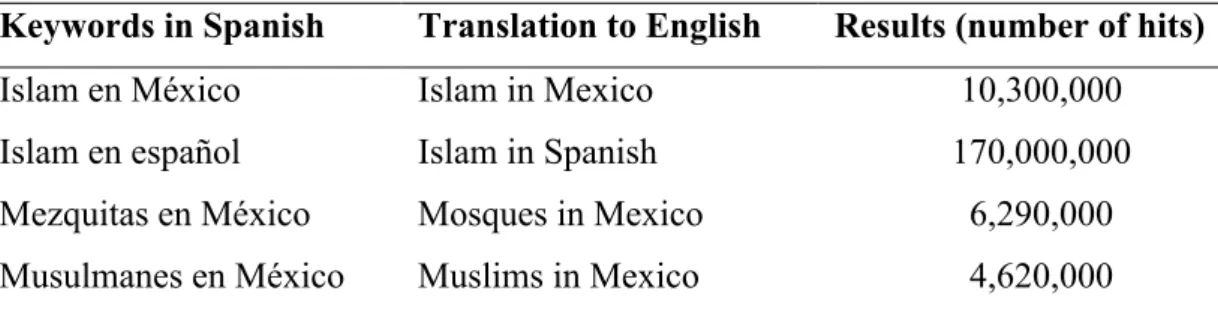
Information about Islam is accessible to everyone through the Internet and ICT. When a person is interested to know about Islam, it is easy to make a search on the Internet and this is when the process of online religious information seeking behavior starts. For example, a quick research on Google made on 30 August 2019 with the keywords of (1) Islam en México, (2) Islam en español, (3) Mezquitas en México, and (4) Musulmanes en México, generated the following results (Table 1.1) in Spanish, which is the official language of Mexico (see Appendix A to see the screenshots of the evidence):
Table 1.1 Results of keyword search on Google
Keywords in Spanish Translation to English Results (number of hits)
Islam en México Islam in Mexico 10,300,000 Islam en español Islam in Spanish 170,000,000 Mezquitas en México Mosques in Mexico 6,290,000 Musulmanes en México Muslims in Mexico 4,620,000
The phenomenon of seeking online religious information about Islam is occurring nowadays among a few Mexicans, and it is evidenced by the increase of the Muslim population by 39.8 per cent between 2010 and 2015. However, the Muslim
5
population in Mexico still much less than one per cent of the total Mexican population. See the graph for better understanding.
The questions that arise are how this phenomenon occurs and what is the experience of the information seekers. One of the most relevant findings among the studies conducted in this area is that the Internet is one of the sources where many Mexican converts encounter Islam for the first time (Castro, 2012; García, 2014, 2018; Pastor, 2011, 2015; Medina, 2014, 2019). This study focuses on online religious information seeking behavior process among the Mexican female Muslim converts. The researcher chose the female gender for two reasons: (1) to generate an easy connection with the respondents and to establish rapport easily and (2) because the conversion to Islam for women is much more visible to society, family and friends, due to the change in dressing.
Religion and culture have a close relationship (Beyers, 2017). In sociology, religion is considered as part of a culture (McGivern, 2014). However the phenomena of the conversion to Islam in countries where Muslims are minority, is interesting, because Islam is not part of the culture of the society, so, how and why few people choose Islam as their religion. Medina (2019), in her study, addressed the problem of how to be a Muslim in a non-Muslim environment, far away from the territory of origin of Islam. Conversion to Islam leads a person to make many changes in the spiritual belief and lifestyle, and sometimes these changes are very different from the original culture of the converts where they grew up and were raised. Nowadays, already started the academic discussion about why some people choose Islam as a religion and how the converts do their transformation to be Muslims and practise Islam (Castro, 2012; García, 2014, 2018; Pastor, 2011, 2015; Medina, 2014, 2018, 2019).
6
The present research studied the experience of Mexican female Muslim converts in searching for religious information on the Internet and tries to answer the general question of whether the religion of Islam can answer their questions and fill the uncertainties that they feel. Thus, this study started with two assumptions: (1) the Mexican female Muslim converts have questions and they need to find the answers both, before and after their conversion to Islam, and (2) the Mexican female Muslim converts feel uncertainties that need to be filled with religious information with the purpose of making sense of their lives.
The researcher used the basic theoretical concepts of information seeking behavior and the Sense-Making Theory developed by Dervin (1983) that includes some concepts as part of a process. These concepts are information need, information seeking, and information use. This theoretical framework helped the researcher to achieve the objectives of the study and answer the research questions. This study agrees with the idea of the construction of sense through a process called information seeking, and tries to identify the information needs of the respondents, the pattern of seeking the information, and how they use the information. The respondents are seen as actors because the actor makes the action to seek and use the information.
This study is divided into five chapters. The first chapter is the introduction that provides an overview of the thesis encompassing the background of the study, problem statement, and the significance of the study that clarifies why the researcher chose this topic. It is followed by the research objectives and research questions. In the second chapter, the researcher discusses the literature review, which provides the relevant literature on Islam in Mexico, online religious information, and information seeking behavior. The theoretical framework is also discussed in the second chapter.
7
The third chapter clarifies the methodology and covers the design, population, and sampling criteria. The unit of analysis, research procedure, data collection, research instrumentation, trustworthiness, and data analysis are also presented in this chapter. Next, the fourth chapter provides the findings and discussion of the study, where the findings answer the research questions with evidence collected from the respondents, focusing on the information seeking behavior process. The discussion covers the analysis of the findings based on the literature review and theoretical framework. Finally, the fifth chapter presents the conclusion, where the researcher summarises the study, discusses the implications of the study, and provides recommendations for future research.
1.2 PROBLEM STATEMENT
The respondents of this study are Mexican female Muslim converts living in a non-Muslim country, Mexico, where they face the day-to-day problem of how to be a Muslim in a non-Islamic environment (Medina, 2014, 2019), especially when the Mexican Muslim converts mostly belong to Catholic families and do not know much about Islam, only the misconceptions created by the mass media. What is their motivation, prior to the conversion to start the process of seeking online information about religions and more specifically about the religion of Islam. How they use the information to become a practising Muslim in a Christian-majority country.
In relation to the above, the identity of Mexican Muslims is in the process of being built (García, 2014; Medina, 2014). According to Medina (2014), the main problem is the identity reconfiguration as a Muslim. Mexican female Muslim converts are seeking information to find ways to rebuild their identities, and they start a process of de-legitimisation of their previous beliefs and lifestyle to be able to legitimise their
8
new religious beliefs. Something is no longer working for them, so they need to find answers to their questions and a way to legitimise their new spiritual beliefs and religious practices. The virtual world provides an avenue to seek the information that they need to support their new beliefs and to practise the religion (Bunt, 2009; Munassar, 2015; Medina, 2014; Roy, 2004).
The process of information seeking behavior starts with a need or several needs for information, so, how the respondents use the Internet to seek the information which they feel can answer their questions, and how they use the information. The end of the process is when the respondents can assess the outcome of whether the information obtained helps them to solve their questions or not.
Some researchers highlighted that religion is one of the sources where people can find the purpose of life and it brings inner peace and well-being while helping them to be better in their actions and be stable psychologically (Baljani, Kazemi, Amanpour, & Tizfahm, 2011; Graham & Crown, 2014; Lomas, Cartwright, Edginton, & Ridge, 2014; Newman & Graham, 2018; Salgado, 2014; Steedman, Atherton, & Graham, 2010). People need to find the purpose of their existence and finding it helps the person in psychological and physical dimensions (Rainey, 2014). To be able to do that, people need to go through a process of information seeking behavior to find the answers to their questions and make sense of their lives.
Abdul Rahman and Othman (2011) said that not much has been researched and discussed on the information need and information use from the perspective of Muslim converts. Although previous researchers have studied the minority Muslims in Mexico and its relationship with information on the Internet from historical perspective (Kusumo, 2013; Lindley-Highfield & Ballumbie, 2014; Pastor, 2015; Medina, 2018), anthropological perspective (García, 2014), and sociological
9
perspective (Medina, 2014, 2019), there is a gap in the research on religious information seeking behavior among Mexican female Muslim converts, and this topic has received scarce attention from the researchers.
In sum, the problem states as follows: the Mexican female Muslim converts living in a non-Muslim environment, face the day-to-day challenge of how to be a Muslim, when they belong to Catholic families and have a lot of misconceptions of Islam created by the mass media. What is their experience in their process of information seeking behavior? What are their information needs? How they use the information? Does the information help them or not?
1.3 SIGNIFICANCE OF THE STUDY
The present research makes a significant contribution in three main aspects. First, it adds knowledge to the existing four areas of study: communication, information seeking behavior, Internet studies and Islam in Mexico; second, in the research method doing online interviews; and third, it can be useful for society in general and the Muslim community in particular. This study is useful in the communication field because it attempts to explore how information is transmitted through the Internet as a channel and the seeker as a receiver, which is one of the actors in the communication model in one particular context that might have an impact on how the respondents receive the information (Savolainen, 1993).
This research is useful in the information seeking behavior field as it examines how users search for information from different sources, taking the theoretical framework from the Sense-Making Theory of Dervin (1983) and the basic elements of the field (information need, seeking, use). The research contribution in the field of Internet studies is concerned with the relationship between the Internet and religion
10
(Campbell, 2005). It also contributes to the area of study about Islam in Mexico and Latin America in the context of minority Muslims in non-Muslim countries, because recently, researchers have been making efforts to study the phenomenon (Castro, 2012; García, 2014, 2018; Pastor, 2015; Medina, 2014, 2019).
Regarding the methodology, this study is significant because the data collection was done through online digital media using WhatsApp. Data collection was done using ICT by conducting one-to-one interviews in an asynchronous mode with a smartphone, through instant messages using the WhatsApp tool for communication. Online data collection is one of many ways to do research when the researcher and respondents are in different locations, and it is an option that more researchers are exploring and documenting as a new way to do research (Androutsopoulos, 2013; Flick, 2009; Patton, 2002).
Based on the small sample, the findings of this research are not necessarily representative of the Mexican female Muslim converts. However it provides evidence and sheds some light on the phenomenon of Mexican female Muslim converts living in non-Islamic environment, why they choose this religion as a lifestyle, and how they do it to be Muslims in Mexico (Medina, 2014) through a process of information seeking behavior. Therefore, this research is significant for society in general because it sheds some light on understanding the phenomenon, and it is also useful for the Muslim community to clearly see the information needs of the respondents (Abdul Rahman & Othman, 2011).
1.4 RESEARCH OBJECTIVES
1. To investigate the experience of Mexican female Muslim converts in their process of online religious information seeking.
11
2. To identify the information needs among Mexican female Muslim converts. 3. To explore the information use among Mexican female Muslim converts.
1.5 RESEARCH QUESTIONS
1. Which is the experience of the Mexican female Muslim converts seeking online religious information?
2. What are the religious information needs of Mexican female Muslim converts? 3. How do the Mexican female Muslim converts use religious information?
12
CHAPTER TWO
LITERATURE REVIEW
2.1 INTRODUCTION
In this section, the researcher discusses the literature review in three aspects. The first is regarding Islam in Mexico, the history of how Islam arrived in the country, and some recent studies. The second part is related to online religious information and how it is an alternative for many people to keep learning about religions and how they can find a place (or a space) on the Internet to develop their spirituality. The third section focuses on some concepts and fundamental theories of information seeking behavior. The theoretical framework is part of this chapter where is explained the Sense-Making Theory of Dervin (1983).
2.2 ISLAM IN MEXICO
In this section, the researcher discusses a brief history of how Islam came into Mexico. Some statistical data are presented to demonstrate the people that uses the Internet and ICT in Mexico. At the end of the section, the researcher will present some studies about Islam in Mexico and the Internet.
The history of when and how Islam arrived in Mexico is difficult to trace, and the presence of Muslims in the country is hard to count (García, 2014; Medina, 2018). Different historical records show that first Muslims came with the immigrants, mainly from Turkey, Lebanon, Syria, Algeria, and Egypt (García, 2014; Kusumo, 2013; Lindley-Highfield & Ballumbie, 2014; Pastor, 2009, 2015; Medina, 2018). Some evidence shows that Islam arrived in Mexico with Christianity, together with the Spanish Conquest with Christopher Colombus (Pastor, 2015; Medina, 2018). Some