Synthesis and Kinetic Study of the Urea Controlled Release Composite Material:
Sodium Lignosulfonate from Isolation of Wood Sawdust-Sodium Alginate-Tapioca
Arif Cahyo Imawan
*, Yehezkiel Steven Kurniawan, Muhammad Fernadi Lukman,
Jumina, Triyono, and Dwi Siswanta
Department of Chemistry, Faculty of Mathematics and Natural Sciences, Universitas Gadjah Mada, Sekip Utara, Yogyakarta 55281, Indonesia
Received July 16, 2017; Accepted November 1, 2017
ABSTRACT
A synthesis and kinetic study of the urea controlled-release composite material based on isolated Na-lignosulfonate, Na-alginate and tapioca was carried out. This experiment’s aims were to isolate Na-lignosulfonate from wood sawdust and to applicate this isolated Na-lignosulfonate, along with tapioca and Na-alginate as urea control release composite material. A kinetic study of urea released from the composite materials was also conducted. Na-lignosulfonate was isolated by Kraft lignin method to give a brown solid yield of 16.92% and was characterized by FT-IR spectrophotometer and SEM-EDX. The composite materials were synthesized by blending urea as the active compound with composite material as the carrier compound. Three types of material were prepared: complete material (A), low-concentration Na-lignosulfonate material (B) and material without tapioca (C). The composite material had a spherical form with 0.79 mm radius and 2.16 mm swollen radius. Urea content inside material was 40.425 mg urea/g material. The urea diffusivity coefficient for material A, B, and C were 7.27 x 10⁻⁶; 15.50 x 10⁻⁶and 0.94 x 10⁻⁶m2h–1, respectively. Modelling analysis showed the experiment obeyed around only 15% of the Korsmeyer–Peppas model, but there was good correlation (80%) with the unsteady-state diffusion model.
Keywords:Na-lignosulfonate; urea; control release material; wood sawdust
ABSTRAK
Sintesis dan studi kinetika dari material komposit pengontrol pelepasan urea telah dilakukan. Tujuan dari penelitian ini adalah untuk mengisolasi Na-lignosulfonate dari limbah gergaji kayu dan pengaplikasiannya dengan tapioka dan Na-alginat sebagai komposit material pengontrol pelepasan urea serta studi kinetika pelepasan urea dari material komposit ini. Na-lignosulfonat diisolasi menggunakan metode Kraft lignin menghasilkan padatan coklat dengan rendemen 16,92% kemudian dikarakterisasi dengan FT-IR dan SEM-EDX. Material komposit pengontrol pelepasan urea disintesis melalui pencampuran urea sebagai komponen aktif dengan material komposit sebagai komponen pembawa. Terdapat tiga jenis material komposit yang telah disintesis yaitu material lengkap (A), material rendah konsentrasi lignosulfonat (B) dan material tanpa tapioca (C). Material komposit memiliki bentuk sferis dengan jejari 0,79 mm yang mampu mengembang hingga 2,16 mm. Kandungan urea di dalam material sebesar 40,425 mg urea/g material. Konstanta difusivitas urea untuk material A, B dan C masing-masing sebesar 7,27 x 10⁻⁶; 15,50 x 10⁻⁶dan 0,94 x 10⁻⁶m2jam–1. Model pelepasan urea dari material A, B dan C hanya memiliki korelasi sebesar 15% dengan model Korsmeyer-Peppas, namun memiliki korelasi yang baik (80%) dengan model difusi unsteady state.
Kata Kunci:Na-lignosulfonat; urea; material pengontrol pelepasan; limbah gergaji kayu
INTRODUCTION
Nitrogen, as a plant macronutrient, constructs chlorophyll for plant photosynthesis. One of the most widely used sources of nitrogen is urea, which has a nitrogen content of 46% [1]. Urea is capable of undergoing nitrification reaction and generating nitrate which can be adsorbed biologically by the plant [2]. Unfortunately, because of this reaction and also the high solubility of urea, the application effectiveness of urea means that only 30% of the urea applied is absorbed by
the plant, with the remainder lost to the environment as urea waste [3].
to their hydrophilicity. Some researcher have sought to improve the effectiveness of urea controlled-released material. Shen et al. [14] reported on urea controlled released material based on Fe(III)–Tannic acid; however, its Fe(III) and acid content led to a reduction in the soil pH, which is detrimental to plant growth and the environment. The use of eco-friendly materials such as montmorillonite [15], nano starch matrix [16] and hydroxyapatite [17] has also been reported. However, these three controlled-released materials are expensive and are only capable of decreasing urea released in second-order kinetic. As such, these three materials have poor ability to control urea released.
Na-lignosulfonate is derivative of phenylpropane compound. It can be obtained by extraction from wood as well as wood sawdust. It is well known that the wood sawdust is rarely used and is commonly discarded as a waste. It is also usually burned due to the amount of space it takes up, thereby causing air pollution. Li and Wang [18] reported that Na-lignosulfonate can interact
with urea via the π – π conjugated interaction between
the double bond of the urea carbonyl group and delocalized electron of the Na-lignosulfonate phenyl group. This interaction allows for the use of Na-lignosulfonate as a urea controlled-release material. However, Na-lignosulfonate cannot be directly used as a urea controlled-release material because of its weak interaction with urea. The addition of the Na-alginate, which forms a porous gel material with divalent cation such as Ca2+ and Fe2+, keeps urea and
Na-lignosulfonate interaction inside the material [19]. However, the concentration of Na-alginate should be fixed at around 2% [20]. Due to the limiting of Na-alginate concentration on composite material, in order to improve the water loading ability that is very important parameter on desorption of urea, another hydrophilic material such as tapioca needs to be added.
Mathematical modelling of the releasing material can indicate the process that occurs inside material based on active-compound mass transfer [21]. There are many types of mathematical modelling with each respective approximation, e.g. the unsteady state diffusion model and the Korsmeyer-Peppas model. The unsteady state model incorporates a type of the mathematical modelling that considers the active-compound is released from a spherical shape material with the flux changing as a time function [22]. Whereas, the Korsmeyer-Peppas model considers that the active-compound is released from sheet shape material with flux changing as a time function [23]. However, the Korsmeyer-Peppas is used not only for sheet shape material but also spherical shape material. Furthermore,
Korsmeyer-Peppas is widely used in mathematical modelling due to its simple linear equation form.
This paper reports the isolation of Na-lignosulfonate from wood sawdust using the Kraft lignin method. The isolated Na-lignosulfonate was combined with tapioca and Na-alginate to form a composite of urea controlled-released material. The urea can interacts with the non-polar part of Na-lignosulfonate
via π – π conjugated interaction inside the composite
material. In addition, the tapioca can adsorb water; the composite material therefore has high efficiency and also good water loading ability. To examine the effect of the Na-lignosulfonate and tapioca on the urea released rate, three materials were analyzed, i.e. a complete material (A), a low concentration Na-lignosulfonate material (B), and a material without tapioca (C). The modelling of urea released from the materials was performed using the Korsmeyer-Peppas model [23] and the unsteady-state model of spherical material [22] to evaluate the mechanism of the urea released process.
EXPERIMENTAL SECTION
Materials
The industrial urea (46% w/w Nitrogen) was obtained from PT. Kujang Indonesia. Tapioca starch food grade was obtained from PT. Budi Starch & Sweetener Tbk (Jakarta). The Na-alginate technical grade was received from Sigma Aldrich, and the wood sawdust was obtained from wood craftsmen at Pogung Dalangan, Yogyakarta. The other chemicals, such as sodium nitrite, sodium chloride, nitric acid, sodium hydroxide, sulphuric acid, calcium chloride dihydrate,
glutaraldehyde, ethanol 96%,
4-dimethylaminobenzaldehyde (DMAB) and hydrochloric acid were purchased as an analytical grade from Merck Millipore.
Instrumentation
Procedure
Isolation and synthesis of Na-lignosulfonate from wood sawdust
Wood sawdust (25.0 g) was added to the mixture solution of NaNO2 (10.0 mg) in 330 mL of 3.5% w/w
HNO3and then heated at 60 °C for 1 h. The mixture was
filtered and refluxed with a solution of 125 mL of 2.4% w/v of Na2SO3 and 125 mL of 2.0% w/v of NaOH at 90
°C for 1 h. The filtrate was acidified with conc. H2SO4
until pH 2. The solution was kept for overnight to stabilize the precipitation and then heated at 60 °C for 3 h. The precipitate was then washed with 20 mL of aquadest and heated again at 60 °C for 30 min. The Na-lignosulfonate product was characterised by FT-IR and SEM-EDX.
Synthesis of urea controlled released composite material
To prepare material the controlled-released material; an amount of tapioca and isolated lignosulfonate (Table 1) was mixed with 3.0 g of Na-alginate and 3.0 g of urea in 100 mL bidistilled water as mixing media, prior to 2.0 mL of glutaraldehyde added into this mixture solution. The mixture solution was dropped slowly into 100 mL of 2% w/v of CaCl2. The
composition of the different materials are given in Table 1. The diameter of urea controlled-release material was measured using a method similar to that reported by Lukman et al. [24]. The synthesised materials were analysed by FT-IR. To determine the urea content inside of the material, 1.0 g of controlled-released material was added to 25 mL of saturated NaCl solution (brine) and then urea concentration in the supernatant was then determined. The amount of urea released from materials A, B and C was determined by soaking the materials in 2.0 L of bidistilled water. The amount of urea released was determined by periodically analysing 2.0 mL of urea-released solution every 24 h for 5 d. The urea concentrations in the supernatant (2.0 mL) and urea-released solution (2.0 mL) from materials A, B and C were analysed respectively by UV-Vis (425 nm), using DMAB as a complexing agent. The DMAB solution was prepared by dissolving 1.0 g of DMAB in a solution mixture of 50.0 mL ethanol 96% and 10.0 mL of 1.0 M HCl.
Analysis of urea diffusion model
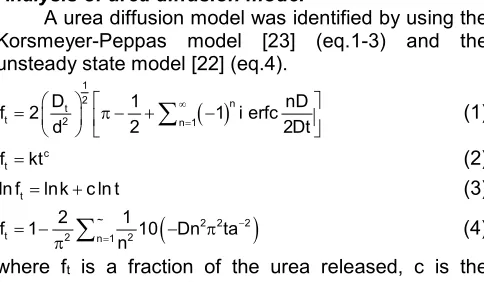
A urea diffusion model was identified by using the Korsmeyer-Peppas model [23] (eq.1-3) and the unsteady state model [22] (eq.4).
where ft is a fraction of the urea released, c is the
released exponent, k is the released rate constant, n is a natural number, t is time, a is the diameter of the material and D is the urea diffusivity coefficient.
RESULT AND DISCUSSION
Isolation and Synthesis of Na-lignosulfonate from Wood Sawdust
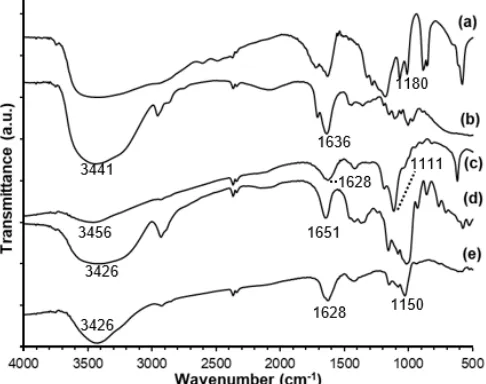
The brown solid of Na-lignosulfonate was obtained in 16.92% yield from the wood sawdust extraction process (Fig. 1b). The extracted product was characterised by FT-IR (Fig. 1c). The FT-IR spectra of Na-lignosulfonate were difference from the wood sawdust as its raw material. The S-O and S=O stretching peaks at 1064 and 1180 cm–1were not found
in the wood sawdust FT-IR spectra [25]. It indicates that the sulfonate functional group was successfully introduced to the lignin material.
Based on the SEM image of synthesized lignosulfonate (Fig. 2a), the surface contour of Na-lignosulfonate is not uniform as there were three kinds of hypothetically monomer with many possible interactions among those monomers [26]. The EDX result (Fig. 2b) showed that the synthesized Na-lignosulfonate product contained a sulphur atom, thus confirming a successful sulfonation reaction. Thus, the FT-IR and SEM-EDX results strongly indicated that Na-lignosulfonate had been obtained.
Synthesis of Urea Controlled Released Composite Material
The synthesized controlled-release materials A, B and C have a similar spherical form of a 0.79 mm radius
Table 1.Concentrations variation of Na-lignosulfonate and tapioca inside materials A, B and C
No. Material Na-lignosulfonate (g) Tapioca (g)
1 Complete material (A) 1.0 2.0
2 Low concentration lignosulfonate material (B) 0.5 2.0
Fig 1. Images of wood sawdust as a Na-lignosulfonate resource (a) and extracted Na-lignosulfonate from wood sawdust (b), as well as both FT-IR spectra (c)
which could be swollen up to a 2.16 mm radius (Fig. 3); hence, the materials have a good loading water ability. In line with Miller and Miller (2005), a t-test was carried out for the radius of each material. Table 2 shows that tcalculated < t0.05, so there was no significant difference
between the radii of materials with and without tapioca, probably due to glutaraldehyde as a cross-linking agent. Moreover, the addition of glutaraldehyde could increase the rigidity and prevent further swelling of the material. The further swelling phenomenon was led to the uncontrolled release of urea. The urea concentration inside the materials A, B and C was 40.425 mg urea/g material and this was used as an initial concentration of urea for the study of slow release.
Characteristics of Urea Controlled Released Composite Material
Table 2.The t-test (significance test) for radius of composite material with, and without tapioca
material with tapioca material without tapioca
Mean of radius 2.22 2.16
Deviation standard 0.31 0.23
Mount of sample 56 20
df(Degree of Freedom) 45
0.94 1.3 tcalculated
t0.05
Conclusion: because tcalculated< t0.05, the null hypothesis (Ho) is rejected, so there is no difference in radius between
the materials with and without tapioca
Fig 3. Representative image of (a) non-swollen controlled-released material and (b) swollen controlled-released material. Diameter of black circle (standard) in both images are 3.90 mm
Fig 4. FT-IR spectra of isolated Na-lignosulfonate (a), glutaraldehyde (b), Na-alginate (c), tapioca (d) and composite urea controlled release material A (e)
3426 cm–1 of tapioca was greater than in the urea
controlled-release material, thus indicating that there was some interaction between tapioca and other compounds inside the urea controlled-release material, such as an interaction between the O-H group of tapioca and the carbonyl group of the glutaraldehyde. In the FT-IR spectra of the urea controlled-release material, the C=O and O-H peaks of the glutaraldehyde at 1636 and 3441 cm–1disappeared due to the role of glutaraldehyde
as the cross-linking agent. The S=O peak of Na-lignosulfonate was shifted from 1180 to 1150 cm–1due
to the cation replacement of Na+by Ca2+. This confirms
that the composite material was successfully synthesised.
Korsmeyer-Peppas Model of Urea Controlled Released Composite Material
The results of the urea diffusion model for materials A, B and C are shown in Fig. 5. The three materials, A, B and C have linear equations based on eq. 3,i.e. y = 0.317x – 1.326 (R2 = 0.69); y = 1.54x –
0.78 (R2 = 0.79) and y = 0.32x + 3.94 (R2 = 0.80),
respectively. The rate constant, k were 0.27, 0.46 and 0.27 h–1, respectively. while the constant c for materials
A, B and C were 0.32, 1.54 and 0.31, respectively. The c constant values for A and C were less than 0.5, so the diffusivity models of those materials followed Fick’s model, while the values for material B were greater than 0.5, indicating that the diffusivity model of this material followed non-Fickian model. This model was not a match for the entire time of urea released from the 3 urea controlled-released materials, matching with only around 15% of the first-time data. This reflects the Korsmeyer-Peppas equation derivation, which considers only data with a very small time (t) value,
meaning that 1 n 1
1 i erfcn nD2 2Dt
in eq. 1 is equalFig 5.Korsmeyer-Peppas models of materials A, B and C
Fig 6.Unsteady state models of materials A, B and C
Unsteady State Model of Urea Controlled Released Composite Material
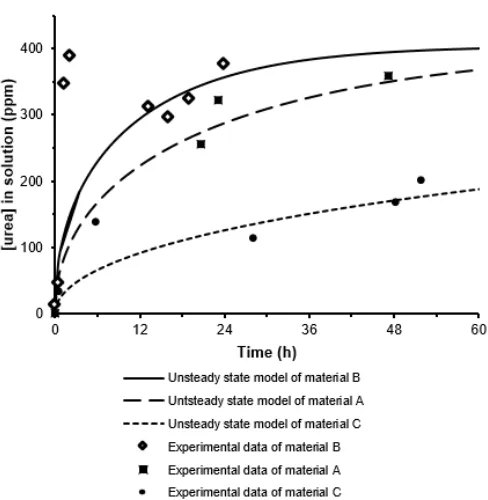
The unsteady model (Fig. 6) was more suited to the urea released experimental data (Fig. 5) than the
Korsmeyer-Peppas model. This model was able to describe almost entirely experimental data. The urea released models for materials A, B and C obeyed this model with diffusivity coefficient of 7.27 x 10⁻⁶; 15.50 x
10–6and 0.94 x 10⁻⁶m2h–1, respectively. The diffusivity
coefficients of those materials were lower than the diffusivity of urea in the water (539 x 10–6 m2 h–1). A
smaller urea diffusivity coefficient of a material indicates a limit to urea distribution due to intermolecular interactions with the composite material, yet the low diffusifity coefficient were still sufficient for the release of urea. Thus, the unsteady-state model for composite materials is reliable to explain urea release data.
Material A had a lower of urea diffusivity constant but a higher Na-lignosulfonate concentration than material B, thus indicating that Na-lignosulfonate is
able to interact effectively with the urea by the π – π
conjugated interaction between double bonds of the urea carbonyl group and the delocalized electrons of the Na-lignosulfonate phenyl group [18]. On the other hand, the tapioca was not able to retain the urea by hydrogen bond, as indicated by the decreasing urea diffusivity value of tapioca-rich material A compared with material C, which had no tapioca content.
Based on the equilibrium state values, the releases of urea from material A reached equilibrium state with a greater time value than material B, thus showing that Na-lignosulfonate is able to increase the release effectiveness of urea controlled-release material. On the other hand, the presence of a hydrophilic group of tapioca could decrease the effectivity of the controlled-release of urea process. This can be seen in the fact that material C had a shorter time span to reach the equilibrium state than material A. Furthermore, it took in excess of 20 h to reach the equilibrium state of the three materials. The time span of this material is higher than the equilibrium state of urea controlled-release material based on the hydrophilic matrix only [10]. In addition, urea was mostly found near the Na-lignosulfonate moiety inside
the material because the urea was retained by the π – π conjugated interaction [18]. While the water loaded in
the material interact with hydrophilic group of tapioca and Na-alginate polymer.
CONCLUSION
The Na-lignosulfonate was isolated and synthesized from wood sawdust waste by using the Kraft lignin method, with this being confirmed by the presence of the S=O group of Na-lignosulfonate in the FT-IR spectra. In addition, the elemental components of Na-lignosulfonate were detected by using SEM-EDX. Furthermore, Na-lignosulfonate can be used as the composer of urea controlled-release material along with tapioca and Na-alginate. It is possible to use the synthesized urea controlled-release to conveniently control urea released by optimizing its tapioca and Na-lignosulfonate content. While tapioca can increase the urea releases rate, Na-lignosulfonate decreases this rate.
These composite materials have better urea controlled-release ability than some of the commonly reported synthesized urea controlled-release materials. This is especially true of material C, which was the best urea controlled-release material since it needed a longer time to reach an equilibrium state. The composite materials tested therefore have good performance as a urea controlled-release materials. Furthermore, they also have good water loading ability as shown by the swelling phenomenon. Mathematical modelling of these three synthesised materials has good correlation with the unsteady-state diffusion model and indicates that urea
was retained by Na-lignosulfonate through the π – π
conjugated interaction.
ACKNOWLEDGEMENT
The authors express their gratitude for the financial support from the AKUGAMA scholarship, and to the Directorate General of Higher Education, Ministry of Research, Technology and Higher Education of the Republic Indonesia (MENRISTEK-DIKTI) through the Student Creativity Program in Science Research, PKM-PE 2016 (No: 117/B3.1/KM/2016).
REFERENCES
[1] Krishnamurthy, V.N., Gowariker, S., Dhanorkar, M., Paranjape, K., and Gowariker, V., 2009, The Fertilizer Encyclopedia, John Wiley and Sons., Canada, 872.
[2] Trenkel, M.E., 2010, Slow and controlled release and stabilized fertilizers: an option for enhancing nutrient use efficiency in agriculture, International Fertilizer Industry Association, Paris, 160.
[3] Davidson, D., and Gu, F.X., 2012, Materials for sustained and controlled release of nutrients and molecules to support plant growth, J. Agric. Food Chem., 60 (4), 870–876.
[4] Yang, X., Geng, J., Li, C., Zhang, M., and Tian, X., 2016, Cumulative release characteristics of controlled-release nitrogen and potassium fertilizers and their effects on soil fertility, and cotton growth,Sci. Rep.,6, 39030.
[5] Wang, S., Li, X., Lu, J., Hong, J., Chen, G., Xue, X., Li, J., Wei, Y., Zou, J., and Liu, G., 2013, Effects of controlled-release urea application on the growth, yield and nitrogen recovery efficiency of cotton,Agric. Sci., 4 (12), 33–38.
[6] Carson, L.C., Ozores-Hampton, M., Morgan, K.T., and Sargent, S.A., 2014, Effects of controlled-release fertilizer nitrogen rate, placement, source, and release duration on tomato is grown with seepage irrigation in Florida,HortSci., 49 (6), 798– 806.
[7] Guo, C., Li, P., Lu, J., Ren, T., Cong, R., and Li, X., 2016, Application of controlled-released urea in rice: reducing environmental risk while increasing grain yield and improving nitrogen use efficiency, Commun. Soil Sci. Plant. Anal., 47 (9), 1176– 1183.
[8] Ziadi, N., Cambouris, A.N., and Zebarth, B.J., 2016, Controlled release nitrogen fertilizer use in potato production systems of eastern Canada, Proceedings of the 2016 International Nitrogen Initiative Conference, Melbourne, Australia, 4-8 December 2016, 1–4.
[9] Gagnon, B., Ziadi, N., and Grant, C., 2012, Urea fertilizer forms affect grain corn yield and nitrogen use efficiency,Can. J. Soil Sci., 92 (2), 341–351. [10] Niu, Y., and Li, H., 2012, Controlled release of
urea encapsulated by starch-g-poly(vinyl acetate), Ind. Eng. Chem, Res., 51 (38), 12173–12177. [11] Bortoletto-Santos, R., Ribeiro, C., and Polito, W.L.,
2016, Controlled release of nitrogen-source fertilizers by natural-oil-based poly(urethane) coatings: The kinetic aspects of urea release, J. Appl. Polym. Sci., 133 (33), 43790.
[12] Yang, Y., Tong, Z., Geng, Y., Li, Y., and Zhang, M., 2013, Biobased polymer composites derived from corn stover and feather meals as double-coating materials for controlled-release and water-retention urea fertilizers,J. Agric. Food Chem., 61 (34), 8166–8174.
[13] Zhang, S., Yang, Y., Gao, B., Wan, Y., Li, Y.C., and Zhao, C., 2016, Bio-based interpenetrating network polymer composites from locust sawdust as coating material for environmentally-friendly controlled-release urea fertilizers, J. Agric. Food Chem., 64 (28), 5692–5700.
[14] Shen, Y., Du, C., Zhou, J., and Ma, F., 2017, Application of nano FeIII-tannic acid complexes in
1030-1036.
[15] Pereira, E.I., Minussi, F.B., da Cruz, C.C.T., Bernardi, A.C.C., and Ribeiro, C., 2012, Urea-montmorillonite-extruded nanocomposites: A novel slow-release material, J. Agric. Food Chem., 60 (21), 5267–5272.
[16] Giroto, A.S., Guimarães, G.G.F., Foschini, M., and Ribeiro, C., 2017, Role of slow-release nanocomposite fertilizers on nitrogen and phosphate availability in soil,Sci. Rep., 7, 46032. [17] Kottegoda, N., Sandaruwan, C., Priyadarshana, G.,
Siriwardhana, A., Rathnayake, U.A., Arachchige, D.M.B., Kumarasinghe, A.R., Dahanayake, D., Karunaratne, V., and Amaratunga, G.A.J., 2017, Urea-hydroxyapatite nanohybrids for slow release of nitrogen,ACS Nano, 11 (2), 1214–1221.
[18] Li, W., and Wang, J., 2012, Interactions between lignin and urea researched by molecular simulation, Mol. Simul., 38 (13), 1048–1054.
[19] Gombotz, W.R., and Wee, S.F., 1998, Protein release from alginate matrices, Adv. Drug Delivery Rev., 31 (3), 267–285.
[20] Lowalekar, R., and Chauhan, L.S., 2016, In-vitro release kinetics, vitro buoyancy studies and in-vivo floating behaviour of gastro-retentive tablets of ciprofloxacin and metronidazole, JIPBS, 3 (4), 67–
72.
[21] Shaikh, H.K., Kshirsagar, R.V., and Patil, S.G., 2015, Mathematical models for drug release characterization: A review, World J. Pharm. Pharm. Sci., 4 (4), 324–338.
[22] Crank, J., 1975, The Mathematics Diffusion, 2nd
ed., Clarendon Press Oxford, J.W. Arrowsmith Ltd., Bristol, England, 414.
[23] Peppas, N.A., 1985, Analysis of Fickian and non-Fickian drug release from polymers, Pharm. Acta Helv., 60 (4), 110–111.
[24] Hakim, L.N., Rochmadi, and Sutijan, 2017, Phenol biodegradation by immobilized Pseudomonas putida FNCC-0071 cells in alginate beads, AIP Conf. Proc., 1855 (1), 50004.
[25] Silverstein, R.M., Webster, F.X., Kiemle, D.J., and Bryce, D.L., 2005, Spectrometric Identification of Organic Compounds, 8thed., John Wiley and Sons
Inc., New York, 464, 1–30.
[26] Heitner, C., Dimmel, D.R., and Schmidt, J.A., 2010, Lignin and lignans: Advances in chemistry, CRC Press, New York.
[27] Miller, J.N., and Miller, J.C., 2005, Statistics and Chemometrics for Analytical Chemistry, 5th ed.,