Ozonation Pre-treatment Evaluation for Xylanase Crude
Extract Production from Corncob under Solid-State
Fermentation
Efri Mardawati
1*, Surya Martha Pratiwi
1, Robi Andoyo
1, Tita Rialita
1, M Djali
1,
Yana Cahyana
1, Een Sukarminah
1, In-In Hanidah
1, Imas Siti Setiasih
11Faculty of Agro- Industrial Technology
Universitas Padjadjaran Jl. Raya Bandung Sumedang KM.21, Sumedang, 45363, Indonesia
Email: [email protected]*
Abstract
Xylanases are a highly exploited enzyme in industries, including food and chemical industry. Xylanases can be utilized in catalyzing the endohydrolysis of 1,4-β-xylosidic linkages in xylan, lignocellulosic component to produce xylose-monomer. This research aims to optimize xylanase production from an alternative substrate, corncob. Corncob contains 41.17% of hemicellulose, the polymer of xylan. Xylanases are produced through solid state fermentation by Trichoderma viride. The ratio between substrate and moistening solution was 0.63 g/mL with fermentation temperature 32,8OC. Variables varied include incubation time and pre-treatment (using autoclave, ozonation, a combination of ozonation and autoclave, also without pre-treatment). Xylanase activity was measured by DNS method using 1% of xylan as substrate standard. The result showed that the best incubation time is 36 h with 14403.8707 U/mg protein for specific xylanase activity by using autoclave as pre-treatment. Ozonation pre-treatment process can in-crease the enzyme activity of xylanase.
Keywords: Corncob, Pre-treatment, Solid-state fermentation, Xylanase.
. INTRODUCTION
The use of enzymes in )ndonesia reached
tons with the import value of .
billion in . Almost all enzymes for
industrial needs in )ndonesia are imported from other countries. One of the enzymes needed is xylanase. Xylanase in the food industry is used to hydrolyze xylan into xylose. Xylanase is often used in bread indus-try to make a soft dough and to increase the volume. Juice and wine industry also need xylanase on the process of extraction, purification, and stabilization . Therefore, there must be an independent production of xylanase using a widely available raw materials such as agricultural waste.
Waster is a major source of environmental pollution and has a negative impact on society. Corncobs are usually used only for animal feed or fertilizer. Chemical analysis of the corncobs indicates that there
are cellulose, hemicellulose, and lignin. (emicellulose main chain can consist one polymer, for example, xylan, that is useful in the production of xylanase .
Maize Zea mays L. is the second staple
food after rice in )ndonesia. )ndonesia’s
maize production in reached .
million tonnes spread over . million hectares of plantation area. The corn production wasted corncob as much as ton per hectare or approximately . million tonnes.
with the help of fungi because bacteria and yeast are not resistant to low humidity levels. Affecting factors of solid-state fermentation
include incubation time, inoculum
concentration, as well as physiological and nutritional parameters.
Results of xylanase production by using solid-state fermentation method can be maximized by pre-treatment. Pre-treatment in the production of xylanase aims to eliminate lignin that can inhibit lignin xylan
extraction . )f the lignin is not degraded,
the accessibility of fungi on the xylan cannot be maximized and affect the final result. Pre-treatment is usually done physically by autoclave. Ozone pre-treatment is able to do the same. Lignin is specifically degraded by ozone up % , leaving a solid fraction rich in sugar .
Ozonation has various advantages. )t is simple and relatively fast in high dry
concentration - % , low temperature
less than °C , and without the production of fermentation inhibitors such as furfural or -(MF. Most of the carboxylic acid and phenolic compounds arising from the degradation of lignin can be removed only with distilled water at room temperature . All of cellulose and hemicellulose are basically found in the fibers after plasma pre-treatment without any degradation .
Further investigation is required for the influence of many pre-treatments on the xylanase production from the corncob under a solid-state fermentation process by using fungi. The production of the xylanase by us-ing pre-treatment also needs to be compared with those which is not given. These things need to be done because the pre-treatment of the lignocellulosic material has a different effect on the xylanase.
. MATERIALS AND METHODS . Material
Raw materials used in the experiment were corncobs from Universitas Padjadjaran. Before used, the materials were sun dried,
cleaned, oven dried at ◦C overnight and
ground. The particle size of materials - mesh were used Other materials used in the
production of xylanase were a microbial
cul-ture Trichoderma viride , PDA, CaCO ,
MgSO , distilled water, N( SO , K( PO , urea, CaCl , MgSO . ( O, . μm porous fil-ter paper, ( SO , bovine serum albumin, eth-anol, xylose, xylan, acetate buffer at p( , di-nitrosalicylic acid, and oxygen.
. . Ozonation process
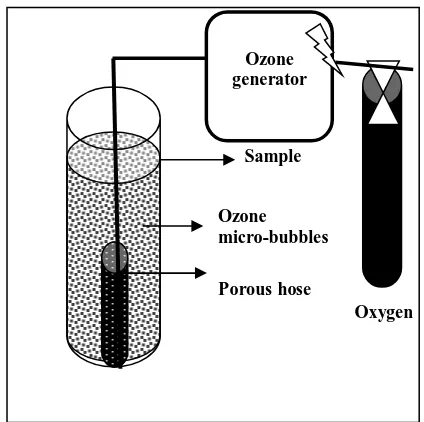
The ozone was produced from pure ox-ygen using an ozone generator (LUSO, OZ-5G). Ozone is formed by a high energy input splitting the O2 (oxygen) molecule. Single O
rapidly combines with available O2 to form
the very reactive O3. At the equipment outlet,
a hose with a porous surface made of sand was connected with oxygen flow rate of 0.25 L/min(Fig. 1). This system was used to dis-tribute the generated ozone as micro-bub-bles in the water, improving the ozone mass transfer and homogeneity. The ozonation was carried out in a stainless steel rectangu-lar tank of 0.10 m diameter and 0.3 m height. The 0.8 L of water/sample was placed in the tank, the ozone generation system was turned on and applied to the sample for 10 min. These processes were carried out in du-plicate. Ozone concentration at exposing time of 10 min is approximately 4.195 ppm.
Figure .Schematic diagram of ozona-tion system
Sample Ozone generator
Oxygen
Porous hose
. . Production of crude xylanase
Crude xylanase was produced from solid state cultivation of T.viride ITBCC L67 on Corn Cob. The cultivations of T.viride ITB CCL.67 was carried out in 300 mL shake flasks on the media that composed of corncob and mineral solution. The inoculum was prepared by suspending the spores in sterile physiological solution to give a final spore count of 1×10⁶ spores/mL. Enzymes
were extracted from the fungal cultivation by adding distilled water (four-time volume of liquid medium) to the cultivation solution. Subsequently, the solution was stirred with a sterile glass stick and then shook at 100 rpm for 1 h at room temperature. The crude en-zyme was obtained by separating the solid (leftover corncob and fungal) from the solution by centrifugation. The supernatant was then analyzed for enzymatic activity following the DNS method using Larchwood xylan (Sigma Co., USA) as substrate.
. Analysis
The xylanase activity was deter-mined using Oat spelts xylan (Sigma Co., USA) as the substrate. The reducing sugars produced were quantified by the dinitrosali-cylic acid method using D-xylose as standard.
. Research Method
The method used was experimental descriptive which described the effects of various types of pre-treatment using an autoclave, ozonation, ozonation combined with an autoclave, and without pre-treatment of the xylanase production on corncobs. The hypothesis test was using two parties. The independent variable X in this study was the type of pre-treatment given. The dependent variable Y was the value of enzyme activity and specific activity of the enzyme produced due to the provision of various pre-treatments. The study consisted of treatments using an autoclave, ozonation, ozonation combined with the autoclave, and without pre-treatment with two replicates.
3. RESULTS AND DISCUSSIONS . Raw Material Analysis
Proximate analysis of corncobs consists of content analysis such as hemicellulose, cellu-lose, lignin, water, and ash. Results of the compound biomass analysis of corncobs can be seen in Table .
Table 1. Corncobs Proximate Analysis.
No Component Content (%)
1 Hemicellulose 41,17
2 Cellulose 20,89
3 Lignin 15,90
4 Water 5,96
5 Ash 7,40
Hemicellulose content needs to be ana-lyzed to determine how potential the corn-cobs are to be used as raw materials for xy-lanase production. The required main com-ponent, xylan, is contained in the hemicellu-lose. Hemicellulose content of the corncob was 41.17%, which is higher compared with other agricultural waste.
Lignin content needs to be analyzed to de-termine how many components can inhibit the enzymatic hydrolysis process. Lignin prevents the entry of enzymes from breaking down polysaccharides into monosaccha-rides. Hemicellulose and cellulose are united by lignin and form a layer as an inhibitor of the solution penetration. The lignin content in corncob was 15.90%. This suggests that the corncob was potential to be used because
it contained % lignin (4).
place could be made to avoid mechanical damage and absorption of moisture from the surrounding environment. The corncob was potential because it had % amount of dry matter (4).
The ash content indicates the content of organic substances or mineral elements of a material. The ash content is influenced by the type, age, and others. Based on the analysis, the corncob had the ash content of . %. The ash content of corncobs ranged from . to . %. The differences could be caused by the difference on the addition of fertilizer and soil conditions where the corn grows.
. Enzyme Activity of Xylanase Crude Ex-tract
The incubation time search was per-formed to determine the best time for the growth of microorganisms in the production of xylanase. The incubation time search
pro-cess applied to Trichoderma viride with
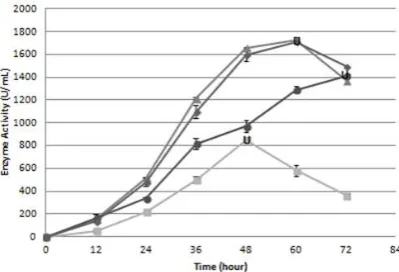
. °C temperature and . ratios of corn-cobs substrate with moistening solution. Sampling was done every hours for hours and enzyme activity test performed on each sample. Results of the enzyme activity test are shown in Figure . The testing pro-cess was done in duplicate enzyme activity.
Figure . Effect the pre-treatment method on Enzyme Activity during incubation time.
= without pre-treatment; = autoclave;
= ozonation; = ozonation combined wi
th autoclave; U = maximum enzyme activity
The relationship between the enzyme activities was almost equal to the growth curve of microorganisms. The growth curve of microorganisms consists of four phases:
adaptation, logarithmic phase, stationary phase, and death phase .
Trichoderma viride grown on corncobs will have a process of adaptation. The adap-tation process includes the synthesis of new enzymes in accordance with the medium and the recovery of the metabolites that are toxic to the previous media.
Xylanase was formed because of the
growth of Trichoderma viride assisted with
the number of substrates in the form of xylan on corncobs. There was no increase in the number of cells in the adaptation phase so the enzyme activity did not increase signifi-cantly. This was shown on to h in all treatments. )t only increases the volume be-cause cells in static phase usually do down-sizing.
The cell divides after obtaining ideal con-ditions. )deal conditions had been achieved by Trichoderma viride with the nutrients con-tained in the mixture of corncobs and mois-tening solution. Microorganisms performed nutrient consumption and other physiologi-cal processes in this phase. Compound prod-ucts desired by human are formed.
The number of microorganisms rapidly increased and was comparable with the high activity of the xylanase produced. The value of enzyme activity produced by using auto-clave as pre-treatment, as well as the combi-nation of ozocombi-nation and the autoclave, were at a logarithmic phase in to hours. The xylanase produced without pre-treatment was also the same. The only anomaly of the result was xylanase produced using ozona-tion pre-treatment which continued to rise during the observation. This occurred be-cause ozonation as a significator splitting strong carbon-carbon bonds of aromatic ring was slower than the weak carbon-carbon bonds of chain aliphatic . This slower pro-cess caused the logarithmic phase to last longer. )t was not certain whether the fer-mentation time was longer, the value of en-zyme activity by using ozonation as ptreatment would be higher or not. Further re-search is needed to look into that matter. The multiplication of the number of cells oc-curred to a certain extent, then entered the stationary phase.
phase while others grow and divide so that the number of alive cells is fixed. Enzyme ac-tivity value tended to be static at - h on corncob with pre-treatment using an auto-clave as well as a combination of ozonation and autoclave. Corncobs with ozonation pre-treatment did not reach stationary phase yet.
This study showed that Trichoderma
viride died within few days, making the value of the enzyme activity decrease. The value of enzyme activity began to decline from the th hour on the cob corn by thermal pre-treatments, such as using the autoclave as well as a combination of ozonation and auto-clave. Ozonation pre-treatment had not shown any activity since continued to rise. The value of enzyme activity from corncob without pre-treatment decreased from h.
Based on Figure , the activity of the en-zyme at each pre-treatment reached a maxi-mum at different times. Corncob without pre-treatment reached maximum enzyme ac-tivity after incubation for hours, the fast-est of the others. This happened because the delignification process did not happen. Lig-nin delignification is an acquisition process of a complex compound. The delignification process is important because lignin may in-hibit penetration. Without pre-treatment,
the penetration of Trichoderma viride was
in-hibited.
The xylanase produced by pre-treatment reached maximum activity with longer incu-bation than without pre-treatment. This hap-pened because of the delignification process. Lignin could be free and penetration of Trichoderma viride was going well. Autoclave pre-treatment as well as a combination of ozonation and autoclave had a maximum
en-zyme activity by incubation for hours.
Trichoderma viride could produce xylanase with longer maximum value because lignin had been damaged so that the fungi could op-timally use xylan.
The value of enzyme activity by using ozonation as pre-treatment continued to rise for h. The dynamics of the early stages of fermentation were due to the corncob treated by ozonation contained more dis-solved oxygen. Oxygen is required for the
propagation of cells, Trichoderma viride, in
this study. The results showed that with ozo-nation process for min, the concentration of dissolved oxygen in the wort had doubled . Oxygen dissolved in corncobs created suita-ble conditions for the early stages of fermen-tation so that the number of microorganisms continued to rise, and so did the value of the enzyme activity.
Corncob without pre-treatment had a maximum value of enzyme activity to
. U/mL. The value was the lowest of
other treatments because of the absence of delignification process. Maximum enzyme activity was obtained by autoclave
pre-treat-ment with a value of . U/mL. The
combination of ozonation and autoclave pro-cesses also had high maximum enzyme
activ-ity, . U/mL. Xylan is soluble in hot
water. This led xylan easier to be
enzymati-cally synthesized . (igher temperature
°C facilitates the release process of hem-icellulose and lignin .
Ozonation process produced maximum
enzyme activity to . U/mL, lower
than the autoclave pre-treatment. There are two phases in the delignification process us-ing ozonation as a pre-treatment. As ex-plained previously, ozone splits carbon-car-bon carbon-car-bonds of aromatic ring slower than the weak carbon-carbon bonds of chain aliphatic . Lignin as an aromatic polymer subunits
is usually derived from phenylalanine .
Therefore, the value of enzyme activity with ozonation pre-treatment was lower than au-toclave. Aromatic rings in lignin were possi-bly splitting less than by using a thermal treatment.
. Specific Activity of Xylanase Crude Ex-tract
The specific activity of xylanase crude extract states a number of μmol substrates which can be converted into products within a minute by milligram of the enzyme under optimum conditions. The higher the value of the specific activity means a better ability of xylanase to utilize the substrate, i.e. corncob. The calculation of specific activity was done by comparing the value of enzyme activity with protein content.
function such as catalysts of biochemical re-actions that collectively form metabolisms-intermediates from cells. The protein content was used as one of the tests because the solid-state fermentation caused the cells to mix with the substrate, making it difficult to calculate the number of dry weight cells. The protein testing process, similar to enzyme
ac-tivity, was applied to Trichoderma viride with
a temperature of . °C and a corncob sub-strate ratio with moistening solution of . . Samplings were performed every hours for hours and protein testings were per-formed on each sample.
Figure . Effect the pre-treatment method on Enzyme Activity and protein content during incubation time.
= enzyme activity without pre-treatment ;
= enzyme activity autoclave ; =
en-zyme activity ozonation ; = enzyme activity
ozonation-autoclave ; = protein without
pre-treatment ; = protein autoclave ;
= protein ozonation ; = protein
ozonation-autoclave
The relationship between time and protein, as well as the relationship between time and enzyme activity, were almost the same as the growth curve of microorganisms. This was in line with the literature which states that: The higher the protein content, the higher the growth of microorganisms during the fermentation process. Protein at each pre-treatment reached a maximum at different times. Maximum protein was reached after fermentation process for hours without pre-treatment. The protein produced by pre-treatment reached the opti-mum point longer than without pre-treat-ment. Ozonation caused the protein content to get higher and higher for hours.
Auto-clave produced maximum protein at the th
hour, as well as the combination of ozonation and autoclave.
The protein produced in the absence of pre-treatment had a value of . mg/mL, the highest of other treatments. This happened because there was still protein content in the corncob that was not damaged in the absence of additional pre-treatment. The protein contained in the crude extract of xylanase was not the only enzyme, but there were also sources of protein from the growth medium.
Ozonation produced . mg/mL
of protein, which was not much difference with protein without pre-treatment. There is a study with wheat grain material, which also
contained many hemicelluloses . The
study showed that there is no change in wa-ter content, ash, protein, and color afwa-ter grinding wheat grains with those extracted
using water with ozone content in it .
Peptide nitrogen is relatively inert for
reac-tion with ozone . The side carbon chains
found in peptides are still available for oxida-tion reacoxida-tions. Oxidaoxida-tion of the side chain without breaking the amide bond will result in complex, partial oxidation formation, with a high molecular weight of the compound.
The combination of ozonation and autoclave, especially autoclave alone, has a low protein. The combined pre-treatment
produced . mg/mL of protein. The
pro-tein produced by autoclave was .
mg/mL. Zhao, et al. conducted a study
on wheat seeds that also contained lots of
hemicellulose such as corncobs . The
study stated that high temperature is a major determinant of seed growth and yield for-mation in wheat. (igh temperatures will re-duce the levels of protein in whole grains
.
Protein is very sensitive to the physi-cal effects of chemiphysi-cals and is easy to change shape. Changes or modifications to the struc-ture of a protein molecule are called denatur-ation. The causes of denaturation are heat, p(, pressure, electric current, and the pres-ence of chemicals such as urea, alcohol, and soap. Temperature is the midpoint of the de-naturation process, which is called melting temperature Tm . )n general, protein has a
is above Tm, then the protein will experience denaturation.
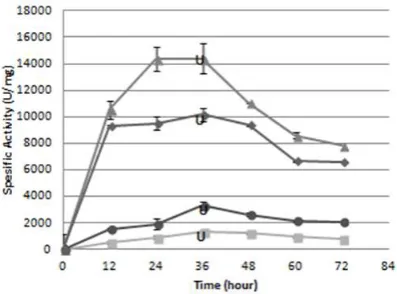
Figure . Effect the pre-treatment method o n Enzyme Specific Activity during incubatio
n time.
= without pre-treatment; = autoclave;
= ozonation; = ozonation combined
with autoclave; U = maximum specific activity
The specific activity of the enzyme raised over a period of time, then decreased, almost the same as the relationship between time and enzyme activity. The value of the specific activity of the enzyme at all pre-treatments is
maximum at hours. )t showed that
Tricho-derma viride is most active to produce xy-lanase crude extract by using corncob within
one minute after a -hour fermentation
process.
The specific enzyme activity from the lowest to the highest was the same as the value of enzyme activity, i.e. without pre-treatment, ozonation, ozonation combined with the autoclave, and autoclave. The maxi-mum specific activity of xylanase was ob-tained by pre-treatment of the autoclave. The
value of the specific activity was .
U/mg. The combination of ozonation and au-toclave had the highest specific activity value
of . U/mg. The ozonation
treat-ment produced xylanase with a specific
activ-ity value of . U/mg after hours.
The lowest specific activity value was corn-cob without pre-treatment with a value of
. U/mg. There should be a t-test to
know whether pre-treatment on corncob is significant or not.
The result of the t-test between pre-treat-ment and without pre-treatpre-treat-ment showed
that the specific activity of the enzyme with-out and with pre-treatment such as an auto-clave, ozonation, and combination between ozonation and autoclave was significantly different. Pre-treatment in xylanase produc-tion could significantly increase the value of the specific activity.
The t-test was also performed between ozonation and autoclave. This suggested that the specific activity of the enzyme in the ozo-nation and autoclave treatment was signifi-cantly different. The real difference occurred because the ozone molecules that divide the strong carbon bonds of lignin were slower than the autoclave.
CONCLUSIONS
The pre-treatment process can increase the enzyme activity and the specific activity enzyme produced when compared with no pre-treatment. Pre-treatment using auto-clave produced the highest enzyme activity and specific activity. Ozonation and a combi-nation of ozocombi-nation and autoclave also in-crease the value of enzyme activity and the specific activity, but still lower than using the autoclave.
REFERENCES
[1]. Polizeli, M L T M, et al., et al. 2005
Xylanases from Fungi: Properties and
Industrial Applications. Appl.
Microbiol. Biotechnol, pp. 577-591 [2]. Bajaj, B K and Singh, N P. 2010.
Production Xylanase from an Alkali Tolerant Streptomycess sp. 7b under
Solid-State Fermentation, Its
Purification, and Characterization, Appl. Biochem. Biotechnol., pp. 1804-1818
[3]. Vazquez, M J, et al. 2000.
Xylooligosaccharides: Manufacture and Applications.. Trends in Food Science and Technology
[4]. Schultz-Jensen, N, et al., et al. 2011.
Plasma-Assisted Pre-treatment of
[5]. Cirakovic, J and Diner, B A. 2010. Ozone Treatment of Biomass to Enhance
Enzymatic Saccharification.
US20100159521 A1.
[6]. Willey, J M, Sherwood, L and Woolverton, C J. 2008. Prescott, Harley, and Klein’s Microbiology, McGraw-Hill Higher Education.
[7]. Souza-Corrêa, J A, et al., et al. 2013,
Atmospheric Pressure Plasma Pre-treatment of Sugarcane Bagasse: The Influence of Moisture in the Ozonation Process. Appl. Biochem. Biotechnol, pp. 104-116.
[8]. Dziugan, P, et al., et al. 2016. Ozonation as an Effective Way to Stabilize New Kinds of Fermentation Media Used in Biotechnological Production of Liquid Fuel Additives, Biotechnol. Biofuels. [9]. Whistler, R L. 1950. Xylan, in: Cantor,
C.S.H. and S.M. (Ed.), Advances in Carbohydrate Chemistry, Academic Press, pp. 269-290.
[10]. Wu, L, et al., et al. 2011. Low Temperature Alkali Pre-treatment for Improving Enzymatic Digestibility of Sweet Sorghum Bagasse for Ethanol Production, Bioresour. Technol., pp. 4793-4799.
[11]. Whetten, R and Sederoff, R. 1995.
Lignin Biosynthesis, Plant Cell, pp. 1001–1013.
[12]. İbanoǧlu, S. 2001. Influence of Tempering with Ozonated Water on The Selected Properties of Wheat Flour, Research Gate, pp. 345-350.
[13]. O’Donnell, C, et al., et al. 2012. Ozone in Food Processing.
[14]. Lacheur, R M Le and Glaze, W H. 1996.
Reactions of Ozone and Hydroxyl Radicals with Serine, Env. Sci Technol, pp. 1072-1080.
[15]. Zhao, H, et al., et al. 2007. Leaf Senescence and Grain Filling Affected by Post-anthesis High Temperatures in
Two Different Wheat Cultivars,
Research Gate, pp. 149-158.
[16]. Lakshmi, G S, Bhargavi, P L and Prakasham, R S. 2011. Sustainable Bioprocess Evaluation for Xylanase Production by Isolated Aspergillus terreus and Aspergillus fumigatus
under Solid-State Fermentation using Oil Palm Empty Fruit Bunch Fiber, Curr. Trends Biotechnol. Pharm, pp. 1434-1444.
[17]. Wolfrom, M L and Tipson, R S. 2014.