Recent research shows partially overlapping signal transduction pathways controlling responses to wounding, insects, and pathogens. Chemical and behavioral assays show that plants release herbivore-specific volatiles, and that parasitic wasps can distinguish between these emission patterns. QTL mapping and candidate gene studies are beginning to identify polymorphic resistance genes, and ecological analyses provide information on the physiological and fitness costs of resistance. Such multidisciplinary approaches can elucidate the physiological causes and ecological consequences of plant–herbivore interactions.
Addresses
Max-Planck-Institut für Chemische Ökologie, Tatzendpromenade 1a, 07745 Jena, Germany
*e-mail: [email protected]
Current Opinion in Plant Biology1999, 2:268–272 http://biomednet.com/elecref/1369526600200268 © Elsevier Science Ltd ISSN 1369-5266
Abbreviations
HR hypersensitive response
LRR leucine rich repeat
MAPK mitogen-activated protein kinase
NBS nucleotide binding site
PI proteinase inhibitor
QTL quantitative trait loci
WIPK wound-induced protein kinase
Introduction
Plants and insects have coexisted for at least 100 million years, and have evolved a variety of beneficial and delete-rious interactions. Pollination benefits both partners, with insects cross-fertilizing plants in the process of collecting nectar. Carnivorous plants trap insects in specialized organs, obtaining additional nitrogen and phosphorus in nutrient-poor environments. More often, however, plants are damaged by herbivorous insects. Mechanisms of defense against herbivores and microbial pathogens have been evolving for millions of years, and are, therefore, shared across many plant families [1]. This review focuses on recent progress in understanding plant defenses against insect attack.
Analysis of quantitative variation
Unlike the dichotomous patterns of resistance versus sus-ceptibility that have been the foundation of recent advances in plant–pathogen interactions [2], resistance to insects is often continuously variable and controlled by segregation of quantitative trait loci (QTLs). Lee et al.[3•] mapped QTL controlling resistance to corn earworm (Helicoverpa zea) in maize, as well as levels of maysin and apimaysin, two flavonoid compounds that are implicated in antibiosis to corn earworm. They identified one QTL influencing insect antibiosis that was unrelated to flavonoid levels, as well as
maysin and apimaysin QTLs tightly linked to insect resis-tance. However, they conclude that other compounds not measured in their study may actually be responsible for resistance to corn earworm. Clearly, greater understanding of secondary metabolism is required. This combined approach to mapping insect resistance QTLs and their physiological components is one of the fundamental tools that can elucidate the genetic basis of resistance to insects.
Glucosinolates are biologically active secondary metabolites that influence insect egg laying (oviposition) and feeding [4]. When plant tissue is damaged, they are hydrolyzed by myrosinase enzymes to nitriles, thiocyanates, and isothio-cyanates. Glucosinolate and myrosinase levels are genetically variable in Brassica and Arabidopsis. Genetic manipulation of glucosinolate levels in Brassica cause changes in flea beetle herbivory in accordance with a priori predictions based on insect physiology [5]. QTLs control-ling glucosinolates and myrosinase activity have been mapped in Arabidopsis[6,7•], and this will permit analysis of genetic causes and ecological consequences of this defense-related trait in a genetically tractable plant species.
Resistance genes
Hypersensitive cell death is a common resistance mecha-nism against microbial pathogens. Plants express resistance genes that trigger hypersensitive responses (HR) through their specific interactions with pathogen avirulence genes. In plant–insect interactions, this form of resistance has received less attention. However, there are reports of HR in Brassicafollowing oviposition by Pierisbutterflies [8] and of HR-based resistance against galling insects on a legume species [9]. Identification of HR against insects in several plant families suggests that such insect resistance mecha-nisms might be taxonomically widespread.
The first identification of a resistance/recognition gene that affects insects was fortuitous. The Migene of tomato was iso-lated due to its effect on root knot nematodes [10], but also confers resistance against the potato aphid, Macrosiphum euphorbiae. Both organisms penetrate plant tissue intercellu-larly and establish a feeding site in vascular tissue [11••]. The Mi protein belongs to the nucleotide binding site – leucine rich repeat (NBS–LRR) family of resistance genes and is located in the cytoplasm. The Mi protein could come into contact with signal molecules from aphids or nematodes upon cellular penetration. As aphids transmit viruses and also contain symbiotic bacteria, it is possible that this signal could be of microbial origin. It remains to be seen whether plants are able to specifically recognize chewing insects.
Proteinase inhibitors
Plant proteinase inhibitors (PIs) are small proteins that con-tribute to defense against insects. They inhibit digestive
Plant–insect interactions
this defense by increasing proteolytic activity [12], by inducing different proteolytic enzymes that are insensitive to the corresponding plant PIs [13], or by expressing pro-teinases that degrade PIs [14].
In addition, some insect populations are genetically vari-able for tolerance to plant PIs. For instance, when populations of the weevil Ceutorynchus assimilis were col-lected from two oilseed rape fields in France and reared on transgenic oilseed rape expressing a rice cysteine PI, one insect strain showed an increased growth rate whereas the other remained unaffected [15]. Thus, insects may rapidly evolve tolerance to transgenic PIs, even from novel sources that they have not previously encountered.
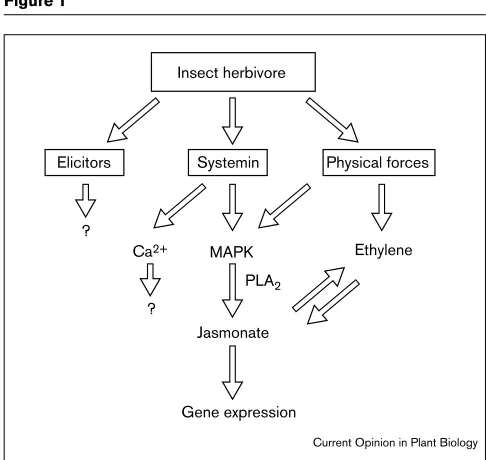
Can plants discriminate between a wound and a bite? Systemin is a chemical messenger implicated in wound-signal transduction in tomato and related species [16]. It elicits a lipid-based signaling cascade involving jasmonate production via the octadecanoid pathway, leading to sys-temic defense against insect herbivores [17]. Early responses to systemin in tomato cells involve ion fluxes across the plasma membrane, a transient increase in cyto-plasmic free calcium [18], and induction of mitogen-activated protein kinase (MAPK) activity [19]. It has recently been shown in tobacco that a wound-induced protein kinase (WIPK) is activated in response to wound-ing, leading to jasmonate-dependent expression of proteinase inhibitor II [20•]. It is possible that wound-related MAPKs activate the octadecanoid pathway via phospholipase A2 (PLA2), as in animal cells [19]. Indomethacin, an inhibitor of PLA2, reduces expression of several jasmonate-induced genes upon wounding, but not their induction by jasmonate. Other wound-responsive genes are not repressed, providing further evidence for the existence of separate jasmonate-dependent and indepen-dent wound signal transduction pathways [21]. Apparently, protein phosphatases are also involved in these pathways [22]. Additional phytohormones also mediate wound responses: salicylic acid acts antagonistically to jasmonates [23,24], whereas ethylene has synergistic effects [25,26].
Insect herbivory inevitably involves wounding of the host plant. It is not surprising, therefore, that plants initiate wound-response pathways when challenged with insects. For instance, feeding of the tobacco hornworm, Manduca sexta, stimulates MAPK systemically within three minutes in tomato [19]. In addition, certain mutants in the octade-canoid pathway are more susceptible to insect herbivores and fungal pathogens than wild-type [27,28,29•]. Jasmonate, however, has multiple pleiotropic effects on plants [30], and is unlikely to provide general resistance against all insects. Also, some results suggest that plant sig-nal transduction pathways respond differently to insects
than to mechanical stresses. Volatile patterns released upon herbivory and mechanical wounding exhibit signifi-cant differences, both quantitatively and qualitatively [31,32,33••]. In addition, wound-related gene expression in potato is activated more rapidly by insect herbivores than by mechanical stimuli, and this acceleration is also evoked by heat-stable regurgitant fluids from Manduca sexta[34]. Further work is required to dissect the signaling pathways controlling responses to wounding, insects, and pathogens.
Tritrophic interactions: plants, herbivores, and parasitoids In response to insect damage, plants emit a blend of volatile compounds, which are released from storage or synthesized de novo[32,35]. These compounds attract insect parasitoids, which attack herbivorous insects. As this reduces feeding on the plant, volatiles may be regarded as a component of an indirect defense system in plants. An elicitor of volatile pro-duction, volicitin or N-(17-hydroxylinolenoyl)-L-glutamine, has been isolated from oral secretions of beet armyworm [31]. When volicitin is applied to damaged maize leaves, it triggers plant emission of parasitoid-attracting volatiles. The fatty acid portion of this insect ‘spit factor’ is plant derived, and is subsequently modified in the insect gut, leading to induced volatile emission and attraction of insect parasitoids which may defend the plant [36•].
Recent research demonstrates that damaged plants emit dif-ferent blends of volatile compounds in an herbivore-specific manner, and that parasitic wasps can distinguish between these volatile blends [33••]. Females of the parasitic wasp
Insect-related signal transduction in plants. Chemical and physical cues relay information to the plant. Physical signals, such as hydraulic forces, may be primary in nature and endogenous chemical signals of plants, such as systemin, may be secondary. PLA2is assumed to
mediate MAPK signaling leading to jasmonate synthesis. Besides jasmonate, insect elicitors and Ca2+affect plant gene expression.
Elicitors Systemin Physical forces
MAPK PLA2
Jasmonate
Gene expression
Ethylene ?
Ca2+
?
Cardiochiles nigriceps significantly prefer tobacco or cotton plants infested by their host, Heliothis virescens, over those attacked by the closely related species Helicoverpa zea or over control plants, even when all damaged leaves were removed to exclude possible cues associated with the larvae themselves [33••]. Volatile signaling in these plant–herbi-vore–parasitoid interactions will yield exciting functional information on physiology and molecular biology, as well as ecological understanding of interactions among three troph-ic levels. Exploiting indirect defenses for agrtroph-icultural purposes has a potential role in integrated pest manage-ment, but will require greater understanding of complex agroecosystems.
Ecology
Studies of resistance to insects in natural plant populations often reveal genetic variation for resistance [37]. What evo-lutionary factors can maintain widespread genetic variation for a presumably advantageous trait? Fitness costs of phys-iological investments in plant defense could maintain this heritable variation. In addition, inducible defenses may protect against attack by insect herbivores while avoiding physiological costs of defense when herbivores are absent. To test these hypotheses, Baldwin [38•] compared fitness of Nicotiana attenuata when herbivores were present or absent, and with defensive secondary compounds at basal or elevated levels. The wound-related plant hormone methyl jasmonate was used to induce plant defenses. Nicotine, an energetically expensive secondary compound with insect toxicity, was used to monitor the plant response. In populations with intermediate levels of herbivory, induced plants experienced less insect damage and had higher fitness than uninduced controls. In low herbivory treatments, however, induced plants had lower fitness than their uninduced counterparts. These results indicate that jasmonate-induced responses are favored when herbivory is
high. Induced responses to jasmonates are costly, however, and reduce plant fitness when herbivory is low. Similarly, Mauricio [39] examined quantitative genetic variation in Arabidopsispopulations growing in the field, and found that high trichome density is associated with greater resistance when herbivory levels are high, but low trichome density is favored when herbivores are excluded. This suggests that trichome production is expensive, and the benefit of this mechanical defense depends upon levels of herbivory.
Although physiological [38•] and quantitative genetic [39,40] approaches can offer suggestive evidence regarding costs of plant defense, they cannot prove that fitness costs actually arise from defense mechanisms. Jasmonates have extensive pleiotropic effects on growth and metabolism [41], so it is possible that defense against herbivores is cost-free, and costs result from other, pleiotropically induced aspects of plant growth and development. Likewise, genet-ically correlated traits may arise from spurious effects of linkage disequilibrium, especially when inbred Arabidopsis genotypes are combined from several populations [39]. Manipulative experiments with mutants [28], transgenic plants [42], or fine-scale mapping [7•] are required to assess costs and fitness consequences of plant defense.
Conclusions
To understand plant–insect interactions in natural and agri-cultural ecosystems, we need more information on insect physiology, genomics, and population genetics. This infor-mation will be especially important for efforts to reduce the rate at which herbivorous insects evolve tolerance to natural and transgenic mechanisms of plant defenses. Studies of digestive [43,44] and sensory physiology can suggest candi-date genes that influence levels of insect damage. Entomologists should take advantage of genetic tools avail-able in Drosophila (e.g., [45•,46•,47,48]), where odorant Figure 2
may help promote dipteran pests as model genetic systems for understanding oviposition and feeding preferences.
In the past decade our understanding of the functional basis of plant defense against microbial pathogens has increased dramatically. These advances have benefited from progress in molecular biology and genetics, and from widespread use of model plant and pathogen species. In contrast, systematic molecular genetic analy-ses of plant defense against insect herbivores have lagged behind. Studies of plant–insect interactions are hindered by the inherent complexity of interactions between insects and plants. For example, in addition to plant chemical defenses that influence insect feeding, plant resistance is also determined by insect host choice and by predators and parasites that attack herbivorous insects. Furthermore, few studies of insect resistance have employed genetically tractable plant species, which allow identification of any mutant gene causing measurable phenotypic effects. Many aspects of pest recognition and signal transduction are conserved in a broad range of plant species, so results from model systems may be extended to plants of agricultural and ecological impor-tance [1]. Genomics in model plant species should greatly increase understanding of the functional basis of insect resistance in the near future.
Genome-wide expression studies with model plant species will identify candidate genes potentially responsible for induced plant defences against insects. Putative resistance genes can be characterized by analyzing the phenotypic effect of knock-outs in T-DNA and transposon insertion lines. Comparative genomics with related plant species will help understand naturally occuring genetic variation for defense physiology and insect resistance.
Acknowledgements
This work was supported by the Max-Planck-Gesellschaft, and by grants to T Mitchell-Olds from the United States National Science Foundation (DEB-9527725) and the European Science Foundation. We thank J Gershenzon, J McKay and B Stranger for helpful comments on the manuscript, and S Dix for expert secretarial assistance. All authors contributed equally to this work.
References and recommended reading
Papers of particular interest, published within the annual period of review, have been highlighted as:
• of special interest ••of outstanding interest
1. Mitchell-Olds T: Genetics and evolution of insect resistance in Arabidopsis. In Insect-Plant Interactions and Induced Plant Defense, Novartis Foundation Symposium 223.Edited by Goode J, Chadwick D. London: Wiley; 1999: in press.
2. Hammond-Kosack K, Jones J: Plant disease resistance genes. Annu Rev Plant Physiol Plant Mol Biol1997, 48:575-607.
secondary metabolism.
4. Halkier BA, Du L: The biosynthesis of glucosinolates. Trends Plant Sci1997, 2:425-431.
5. Siemens D, Mitchell-Olds T: Evolution of pest induced defenses in Brassicaplants: tests of theory. Ecology1998, 79:632-646.
6. Mithen R, Clarke J, Lister C, Dean C: Genetics of aliphatic glucosinolates. III sidechain structure of aliphatic glucosinolates in Arabidopsis thaliana. Heredity 1995, 74:210-215.
7. Mitchell-Olds T, Pedersen D: The molecular basis of quantitative
• genetic variation in central and secondary metabolism in Arabidopsis. Genetics1998, 149:739-747.
An example of QTL mapping of physiological traits with known candidate genes in Arabidopsis.
8. Shapiro AM, Devay JE: Hypersensitivity reaction of Brassica nigra L. Cruciferae kills eggs of Pieris butterflies (Lepidoptera: Pieridae). Oecologia 1987, 71:631-632.
9. Fernandes GW: Hypersensitivity as a phenotypic basis of plant induced resistance against a galling insect (Diptera,
Cecidomyiidae). Environmental Entomology 1998, 27:260-267.
10. Milligan S, Bodeau J, Yaghoobi J, Kaloshian I, Zabel P, Williamson V: The root knot nematode resistance gene Mi from tomato is a member of the leucine zipper, nucleotide binding, leucine-rich repeat family of plant genes. Plant Cell 1998, 10:1307-1320.
11. Rossi M, Goggin F, Milligan S, Kaloshian I, Ullman D, Williamson V:
•• The nematode resistance gene Miof tomato confers resistance against the potato aphid. Proc Natl Acad Sci USA1998, 95:9750-9754.
Demonstrates that Meu-1, contributing to resistance against the aphid Macrosiphum euphorbiaein tomato, and Mi, conferring resistance to root knot nematodes, are the same gene. This is one of a few studies indicating ‘crosstalk’ between plant defenses against insects and other pests.
12. Girard C, Le Métayer M, Bonadé-Bottino M, Pham-Delegue MH, Jouanin L: High level of resistance to proteinase inhibitors may be conferred by proteolytic cleavage in beetle larvae. Insect Biochem Mol Biol 1998, 28:229-237.
13. Gruden K, Strukelj B, Popovic T, Lenarcic B, Bevec T, Brzin J, Kregar I, Herzog Velikonja J, Stiekema WJ, Bosch D, Jongsma MA: The cysteine protease activity of Colorado potato beetle (Leptinotarsa decemlineata Say) guts, which is insensitive to potato protease inhibitors, is inhibited by thyroglobulin type-1 domain inhibitors.
Insect Biochem Mol Biol 1998, 28:549-560.
14. Giri AP, Harsulkar AM, Deshpande VV, Sainani MN, Gupta VS, Ranjekar PK: Chickpea defensive proteinase inhibitors can be inactivated by podborer gut proteinases. Plant Physiol 1998, 116:393-401.
15. Girard C, Bonadé-Bottino M, Pham-Delegue MH, Jouanin L: Two strains of cabbage seed weevil (Coleoptera: Curculionidae) exhibit differential susceptibility to a transgenic oilseed rape expressing oryzacystatin I. J Insect Physiol 1998, 44:569-577.
16. Constabel CP, Yip L, Ryan CA: Prosystemin from potato, black nightshade, and bell pepper: primary structure and biological activity of predicted systemin polypeptides. Plant Mol Biol 1998, 36:55-62.
17. Bergey DR, Howe GA, Ryan CA: Polypeptide signaling for plant defensive genes exhibits analogies to defense signaling in animals. Proc Natl Acad Sci USA 1996, 93:12053-12058.
18. Moyen C, Hammond-Kosack KE, Jones J: Systemin triggers an increase of cytoplasmic calcium in tomato mesophyll. Plant,Cell and Environment 1998, 21:1101-1111.
20. Seo S, Sano H, Ohashi Y: Jasmonate-based wound signal
• transduction requires activation of WIPK, a tobacco mitogen-activated protein kinase. Plant Cell1999, 11:289-298.
Recent progress in a controversial area. Provides evidence for the function-al importance of WIPK in wound-related signfunction-aling.
21. León J, Rojo E, Titarenko E, Sánchez-Serrano JJ: Jasmonic acid-dependent and -inacid-dependent wound signal transduction pathways are differentially regulated by Ca2+/calmodulin in Arabidopsis thaliana. Mol Gen Genet 1998, 258:412-419.
22. Rojo E, Titarenko E, León J, Berger S, Vancanneyt G, Sánchez-Serrano JJ: Reversible protein phosphorylation regulates jasmonic acid-dependent and -inacid-dependent wound signal transduction pathways in Arabidopsis thaliana. Plant J 1998, 13:153-165.
23. Peña-Cortes H, Albrecht T, Prat S, Weiler EW, Willmitzer L: Aspirin prevents wound-induced gene expression in tomato leaves by blocking jasmonic acid biosynthesis. Planta 1993, 191:123-128.
24. Pieterse CMJ, van Loon LC: Salicylic acid-independent plant defence pathways. Trends Plant Sci 1999, 4:52-58.
25. O’Donnell PJ, Calvert C, Atzorn R, Wasternack C, Leyser HMO, Bowles DJ: Ethylene as a signal mediating the wound response of tomato plants. Science 1996, 274:1914-1917.
26. Hirt H: Multiple roles of MAP kinases in plant signal transduction.
Trends Plant Sci 1997, 2:11-15.
27. Howe GA, Lightner J, Browse J, Ryan CA: An octadecanoid pathway mutant (JL5) of tomato is compromised in signaling for defense against insect attack. Plant Cell 1996, 8:2067-2077.
28. McConn M, Creelman RA, Bell E, Mullet E, Browse J: Jasmonate is essential for insect defense in Arabidopsis. Proc Natl Acad Sci USA 1997, 94:5473-5477.
29. Vijayan P, Shockey J, Levesque CA, Cook RJ, Browse J: A role for
• jasmonate in pathogen defense of Arabidopsis. Proc Natl Acad Sci USA1998, 95:7209-7214.
Arabidopsismutants deficient in jasmonate signaling are susceptible both to insects and to some pathogens.
30. Wasternack C, Parthier B: Jasmonate-signalled plant gene expression. Trends Plant Sci 1997, 2:302-307.
31. Alborn HT, Turlings TCJ, Jones TH, Stenhagen G, Loughrin JH, Tumlinson JH: An elicitor of plant volatiles from beet armyworm oral secretions. Science 1997, 276:945-949.
32. Paré PW, Tumlinson JH: De novo biosynthesis of volatiles induced by insect herbivory in cotton plants. Plant Physiol 1997, 114:1161-1167.
33. De Moraes CM, Lewis WJ, Paré PW, Alborn HT, Tumlinson JH:
•• Herbivore-infested plants selectively attract parasitoids. Nature 1998, 393:570-573.
Chemical and behavioral assays show that plants release herbivore-specific volatiles, and that parasitic wasps can distinguish between these emission patterns.
34. Korth KL, Dixon RA: Evidence for chewing insect-specific molecular events distinct from a general wound response in leaves. Plant Physiol 1997, 115:1299-1305.
35. Boland W, Hopke J, Piel J: Induction of plant volatile biosynthesis by jasmonates. In Natural Product Analysis, Chromatography, Spectroscopy, Biological Testing. Edited by Schreier P, Herderich M, Humpf H-U, Schwab W. Braunschweig/Wiesbaden: Viehweg Verlag; 1998:255-269.
36. Paré PW, Alborn HT, Tumlinson JH: Concerted biosynthesis of an
• insect elicitor of plant volatiles. Proc Natl Acad Sci USA1998, 95:13971-13975.
Documents biosynthesis of volicitin, the first low molecular weight insect-specific elicitor. A nice example of chemical analysis clarifying the functional basis of ecological interactions.
37. Rausher M: Genetic analysis of coevolution between plants and their natural enemies. Trends Genet 1996, 12:212-217.
38. Baldwin IT: Jasmonate-induced responses are costly but benefit
• plants under attack in native populations. Proc Natl Acad Sci USA 1998, 95:8113-8118.
As plant defense mechanisms become better understood, ecologists are examining the ecological causes and consequences of variation in resis-tance to insects. This field study of wild tobacco shows that jasmonate-induced responses are costly, but are favored by high herbivory.
39. Mauricio R: Costs of resistance to natural enemies in field populations of the annual plant Arabidopsis thaliana. Am Nat 1998, 151:20-28.
40. Mitchell-Olds T, Bradley D: Genetics of Brassica rapa. 3. Costs of disease resistance to three fungal pathogens. Evolution 1996, 50:1859-1865.
41. Creelman R, Mullet J: Biosynthesis and action of jasmonates in plants. Annu Rev Plant Physiol Plant Mol Biol 1997, 48:355-381.
42. Purrington C, Bergelson J: Fitness consequences of genetically engineered herbicide and antibiotic resistance in Arabidopsis thaliana. Genetics 1997, 145:807-814.
43. Michaud D: Avoiding protease-mediated resistance in herbivorous pests. Trends Biotechnol 1997, 15:4-6.
44. Tabashnik BE, Liu YB, Malvar T, Heckel DG, Masson L, Ballester V, Granero F, Mensua JL, Ferre J: Global variation in the genetic and biochemical basis of diamondback moth resistance to Bacillus thuringiensis. Proc Natl Acad Sci USA 1997, 94:12780-12785.
45. Fedorowicz GM, Fry JD, Anholt RRH, Mackay TFC: Epistatic
• interactions between smell-impaired loci in Drosophila melanogaster. Genetics 1998, 148:1885-1891.
Twelve smell-impaired mutants were tagged with transposons (P-elements). Most of these loci showed epistatic interactions influencing behavioral response to odorants. Such genetic studies in Drosophilacan identify the genes responsible for insect response to plant chemistry.
46. Jones CD: The genetic basis of Drosophila sechellia’s resistance
• to a host plant toxin. Genetics 1998, 149:1899-1908.
Drosophila sechelliais resistant to high concentrations of octanoic acid in its host plant, whereas related Drosophila species are susceptible. Interspecific crosses identified at least five loci responsible for this differ-ence in toxin sensitivity. Such studies can elucidate the genetic basis of vari-ation in host use in genetically tractable insect species.
47. Kim MS, Repp A, Smith DP: LUSH odorant-binding protein mediates chemosensory responses to alcohols in Drosophila melanogaster. Genetics 1998, 150:711-721.
48. Clyne PJ, Certel SJ, de Bruyne M, Zaslavsky L, Johnson WA, Carlson JR: The odor specificities of a subset of olfactory receptor neurons are governed by Acj6, a POU-domain transcription factor.
Neuron 1999, 22:339-347.
49. Clyne PJ, Warr CG, Freeman MR, Lessing D, Kim JH, Carlson JR:
• A novel family of divergent seven-transmembrane proteins: candidate odorant receptors in Drosophila. Neuron 1999, 22:327-338.
Two papers by Clyne et al. [48,49•] show that a transcription factor mutation alters Drosophilaolfactory behavior and expression of candidate odorant receptor genes.
50. Vosshall LB, Amrein H, Morozov PS, Rzhetsky A, Axel R: A spatial
• map of olfactory receptor expression in the Drosophila antenna.
Cell 1999, 96:725-736.