• Tidak ada hasil yang ditemukan

Cadmium Metals Particles-Covered Polystyrene Nanospheres Thin Film Material:Fabrication, Analysis and Model - Diponegoro University | Institutional Repository (UNDIP-IR)

N/A
N/A
Protected

Academic year: 2017

Membagikan "Cadmium Metals Particles-Covered Polystyrene Nanospheres Thin Film Material:Fabrication, Analysis and Model - Diponegoro University | Institutional Repository (UNDIP-IR)"

Copied!
7
0
0

Teks penuh

(1)

Cadmium Metals Particles-Covered Polystyrene

Nanospheres Thin Film Material:Fabrication, Analysis

and Model

Pratama Jujur Wibawaa,b,c*, Hashim Saima,b, Mohd. Arif Agama,b and Hadi Nurd

a

Microelectronic and Nanotechnology-Shamsuddin Research Center (MiNT-SRC), Universiti Tun Hussein Onn Malaysia, 86400 Parit Raja, Batu Pahat, Johor, Malaysia

b

Department of Science, Faculty of Science, Technology and Human Development Universiti Tun Hussein Onn Malaysia, 86400 Parit Raja, Batu Pahat, Johor, Malaysia

c

Department of Chemistry, Faculty of Sciences and Mathermatics (formerly Faculty of Mathematics and Natural Sciences), Diponegoro University, Jl. Prof. H. Soedarto, S.H. No.1 Tembalang, Semarang, Indonesia

d

Ibnu Sina Institute for Fundamental Science Studies, Universiti Teknologi Malaysia, 81310 UTM Skudai, Johor, Malaysia

E-mail:[email protected]; [email protected]; [email protected]

Abstract :

It was well known that cadmium metals particles-covered 200 nm Polystyrene Nanospheres (PSNs) thin film material could be prepared from its according colloidal metals precursor of cadmium nitrate tetrahydrate, Cd(NO3)2.4H2O in water-polyvinil pyrrolidone (PVP)

homogeneous mixture. After reducing it with sodium borohidride, NaBH4 then thin films of the colloidal were fabricated on a hydrophilic

silicon wafer through gently dropping method and subsequently it was analyzed by both analytical isntruments of ATR-FTIR spectrometry and FESEM. It was clearly observed that wave number ranges of 1700-1600 cm-1 and 1500-1200 cm-1 generated signficant different ATR-FTIR spectra between pristine PSNs and cadmium-covered PSNs. In addition, surface morphology of pristine PSNs thin film explored with FESEM revealed sharply different from that of cadmium-covered PSNs one. It indicated that PSNs particles surface have succesfully been fully covered by cadmium metals particles. Therefore it could be concluded that cadmium metals particles-covered PSNs thin film could be fabricated from its according colloidal precursor and the model might be ilustrated as the following Fig. 2.

Keywords: Metals covered-polystyrenes, Cadmium metal-covered polystyerene, Thin film material, Polystyrene nanospheres (PSNs)

1. Introduction

Metal atomic particles-covered Polystryrene Nanospheres (M-CPSNs) is a part of metal-incorporated organic polymers materials that have great deal attention from many researchers focusing his study on material engineering and its application. The existance of metal in a polymer matrics could deliver their important basic properties such as thermal and mechanical stability, electric and electronic conductance, optical and magnetic behaviour, hardness, and catalytic activity to the matric resulting an advanced composite material with better properties and characters. In this point of view, it could be performed properly through two strategies independently, the first one is by mean of functionalization the PSNs molecule framework with an active organic group firstly then followed by metals introduced onto the fuctionalized PSNs [1,2]. The second one is by mean of straighforward metal deposition or embedding into the PSNs particles without any treatmeants of them [3-7]. The first strategy might commnoly be applied to fabricate a useful functionalized PSNs-based support material for biosensors [8-10], ion exchange membranes [11-13], drug delivery agents [14-17], acid-base catalytic materials

[18] and soon, whereas the second strategy was widely used to manufacture a nice pattern nanostructure for light emmiting [19,20], specific adsorbant materials [21,22], metal-based catalytic material [23,24], useful intermediate material for fuel cell membrane and electrodes [13,25] and soon.

(2)

typical dispersion system made from and what for it was made. However, the most economic procedure to prepare dispersion systems would be a very important thing to be considered seriously in fabricating any useful thin fim material made from them, and it was commonly depend on what the dispersion system for. PSNs functionalisation as well as dispersion system stablizer additional will be more complicated, high cost and time consuming.

Nevertheless chemical reducing agent and stabilizer were still common to be employed in preparing the dispersion system particularly when to study any unique physical interaction and chemical change happened among metal particles, PSNs and stabilizer molecules itself during their interact each other in a certain medium. In this paper we reported the fabrication of cadmium (Cd) metal particles-covered PSNs thin film material from its according dispersion system prepared with common used stabilizer addition of poly vynil pyrolidon (PVP) to study their physical interaction and chemical change through its surface morpholgy exploration and its ATR-FTIR spectra for creating the building model of metal-covered PSNs material structure.

2. Experimental Section

2.1. Material

Microsphere emulsion of 200 nm Polystyrene nanospheres (PSNs) (exactly size of 199±6 nm),1.0 % w/v solid concentration, density 1.05 g/ml and index refraction at 589 nm is 1.59, Duku Sci Cooperation USA) as a main spherical particles that will be covered. Cadmium nitrate-4-hydrate (Cd(NO3)2.4H2O, Mr = 308.48 gram/mol) of 98 % grade (Cica Reagent-Kanto Chemical Japan) as a Cd metal particles precursor. Polyvinyl pyrrolidone (MW:40,000 gram/mol) 99% w/w, p.a. produced Merck Germany. Sodium borohydride granular (NaBH4, MW: 37.83 gram/mol) 98% w/w, p.a. produced Merck Germany. Silicon wafer (100 single crystal orientations, p-doped, resistivity 6.0-9.0 ohm.cm, thickness 675±15 µm, USA) as a hydrophilic solid support material for thin film fabrication. Saturated hydrochloric acid (HCl), hydrogen peroxide (H2O2), both in analytical grade, produced J. T. Baker, U.S.A used as received to oxidize properly any oily matter exist on the silicon wafer surface. Deionized water (DI) produced by our own DI standard laboratory equipment as a general solvent.Equipments: Field emission scanning electron microscope (FE-SEM) JEOL JSM-7600F Seri No.SM17600053, made in Japan) for morphology surface characterization of fabricated thin film. Ultrasonic Cleaner Powersonic 405 (SER No.405J411536; made in Korea) as an ultrasonic generator to irradiate the colloidal system dispersion.Perkin Elmer FTIR Spectrometer (LR 64912C, N3896, made in U.S.A completed with a universal ATR (attenuated total reflectance) sample stage and spectrum express FTIR software V1.3.2 Perkin Elmer LX100877-1) to confirm the PSNs molecular level change. Helium Light Laser Generator Model 30025, Serial Number 12187-3408-382, Power 1.5 mW, 633 nm wave length (Made in U.S.A.) to expose Cd metal particles-covered PSNs thin film.

2.2. Preparation of colloidal PSNs-Cd metal dispersion system:

The amount of 5 µL PSNs (Polystyrene nanospheres) (200 nm size, 1 % w/v) was put into a 500 µL eppendorf tube then subsequently added carefully by 5 µL Cadmium nitrate-4-hydrate of 1 % w/v (32.4 mM) concentration and DI water up to total volume of 100 µL. The solution was then homogenized by vigorously shaking and irradiated by ultrasonic wave of 40 kHz for 45 minutes (Ultrasonic Cleaner Powersonic 405; SER No.405J411536; made in Korea). In addition, the same solution without treated by the same ultrasonic was also prepared as a reference one. By the similar procedure, the other dispersion system was also prepared using 10 µL PSNs 1%, 20 µL 30 mM Cd(NO3)2.4H2O, 5 µL 0.01 mM PVP, 5 µL 0.05 M NaBH4 and DI water up to 100 µL total volume.

2.3. Fabrication of Cd metal particles-covered PSNs thin film material:

(3)

2.4. FESEM Images Characterization:

By quoting the reference [22] the surface morphology of the both already fabricated PSN-Cd colloidal and pristine PSN thin film each was characterized by using FESEM as the following step. The samples were carefully load on a specific FESEM sample holder then introduced into the FESEM chamber that was setup on a vacuum of about 10x10-5 Pa. The surface morphology images was then scanned with electron beam source voltage of about 2.00 kV, LEI SEM detector mode and scanning wide distance (WD) of about 9.6-9.8 mm. The optimum magnifications scanning of about 10,000 to 50,000 were preferential mode for the best images. Image magnification was defined as the ratio of the length of the scan on the Cathode Ray Tube (LCRT) and that of the scan on the sample specimen (LSpec).

2.5. ATR-FTIR Analysis:

The already fabricated Cd metal particles-covered PSNs thin film material and that pristine PSN each was scanned properly using Fourier Transform Infra Red Spectrometer equipped with an ATR sample holder. The sample was introduce properly on the ATR-FTIR sample stage and carefully scanned under a default set up at peak threshold of 0.5 %T, center of gravity threshold of 0.0022 Absorbance (A), 10.0000 Absorbance Unit (A.U) and center of gravity peak height of 0.2. Appeared spectra were then analyzed further under subsequent actions of data Tune-up, ATR correction, Based line correction and finally Normalization modes for the best spectra. The smaller the number threshold, the less intensive are the peaks that may be detected. In addition, center of gravity peak height 0.2 was the fraction of the peak to be used to calculate its center gravity of peaks position [22].

3. Results and Discussion

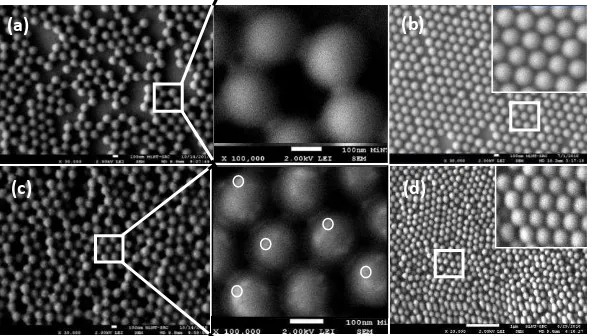
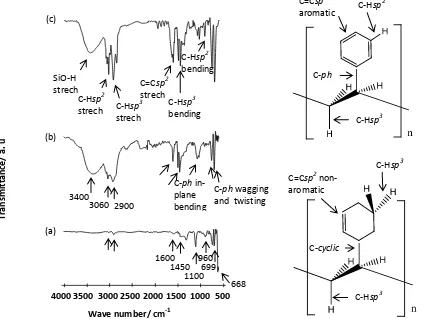
FESEM images of their surface morphology were depicted in Fig. 1. The proposed building model of Cd metal particles-covered PSNs structure was depicted in Fig.2. The ATR-FTIR spectra of the Cd-metal particles-covered- PSNs thin film material and that of pristine PSNs explored under Tune-Up, ATR correction, Based line correction and Normalization modes sequences was depicted in Fig. 3.

Figure 1. FESEM images of surface morphology of Cd metal particles-covered PSNs (a), pristine PSNs (b), Cd metal particles-covered PSNs irradiated by continues laser (c) and pristine PSNs irradiated by continues laser (d). 3.1. FESEM Images interpretation:

There was a very interesting view shown in Fig 1(a) that between two PSNs particles adjacent were properly connected each other by a nice bridge of likely Cd metal particles aggregates forming a dumbbell-like shape of which it could not be seen in pristine PSNs thin film, Fig 1(b). This metal particles aggregations seem might deliver its advantage properties to the throughout formed thin film surface since the Cd metal-covered PSNs expressed significantly resist towards continuous laser exposure of 633 nm wavelength for 20 minute compared to the pristine PSNs as it can be seen in Fig.1(c) and Fig.1(d) respectively. It was surprise the very small aggregate of around 30 nm in diameter which could be attributed as Cd metal particles covering the PSNs surface formed during the exposure could be seen clearly (see white color circles, Fig.1(c)).

(b) (a) (a)

(4)

In contrast, any aggregates deposit could not be generated at all by the same laser light irradiated to the pristine PSNs as shown in Fig. 1(d). This nice phenomenon indicated that Cd metal particles could enhance significantly the capability of PSNs particles in interacting with laser lights exposed to them compared to the pristine ones. Furthermore, the existence of Cd metal particles seem could also enhance significantly the surface morphology of Cd metal-covered PSNs thin film as it was shown in Fig.1(a) and Fig.1(c) each compared to Fig.1(b) and Fig.1(d) respectively. This fact matchs to the previous report [22]. From nanomaterial engineering point of view, it was a very respective phenomenon particularly on adsorbent and catalytic nanomaterial manufacturing of which the both required tightly for porous material.

On the other hand, physically effect of the laser lights exposure could be approximately explored through the determination of particles density of each the fabricated thin film material. In this context, the PSNs-based particles density could be defined as the total amount of according PSNs particles fill-up the area of 103 nm2 in size, and the mentioned density could be calculated by applying either equation 1a or 1b, where d1000 is particles

density for 1000 nm2 area and Bp is the amount of particles body fill up area of 49×10

4

nm2 while CPHAH is a

constant of conversion namely PHAH constant (PHAH stands for Pratama, Hashim, Arif and Hadi), that is a constant to calculate nanoparticles density in either every rectangular or circle space with 700 nm length in side or 700 nm length in diameter. In this context, the value of CPHAH for the rectangular space had already been well determined

as big as 2.0408×10⁻³.

Moreover, let, in this case, 1 Cm length was approximately equivalence to 100 nm length such that every rectangular drawn on all the Fig. 1 would be representing an area of 49×104 nm2 due to its side length was 7 Cm. We saw clearly that the rectangular of Fig.1(a), (1b), (1c) and (1d) had already been filled up by 6 bodies of Cd metal particles-covered PSNs, 8 bodies of pristine PSNs, 7 bodies of exposed PSNs and 13 bodies of laser-exposed pristine PSNs respectively. By applying the equation 1a, we found that the particles density of the sequences Figures was as it could be summarized in Table 1. Now more clearer that the existence of Cd metal particles covering PSNs body could provide it at least on two impacts, the first one was enhancing porosity as its d1000 value lesser than that of pristine PSNs, and the second one was enhancing its resistivity towards laser

exposure as the same reason as the aforementioned.

Table 1. Particles density* of some fabricated PSN-based thin film materials

Figure Material Bp/ particle** d1000 / 10

-3

particle nm-2

1a Cd metal particles-covered PSNs 6 12.2448

1b Pristine PSNs 8 16.3264

1c Laser-exposed Cd metal particles-covered PSNs 7 14.2856

1d Laser-exposed Pristine 13 16.5304

*It was defined as the particles number of every 1000 nm2 wide. **The particles number of every 700 nm2 wide of area

Nevertheless, as we can see in the all aforementioned figures the spherical shape of the both materials particles did not change at all under laser exposure. These phenomena guided us to understanding that the Cd metal particles might have coverred fully the surface of PSNs body. It was therefore we could propose a nice model of Cd metal particles-covered PSNs body as it had been sketched out in Fig. 2.

Figure 2. Proposed model of Cd metal particles-covered PSNs body constructed up PSNs-based material thin film

3.2. ATTTR-FTIR spectra interpretation:

It was very interesting in by comparing Fig.3(b) to Fig.3(c) we possible to suppose that Cd metal particles might settled down well at surround polystyrenes phenyl moieties and its backbone chain since its wave number

: Polystyrene Nanospheres (PSNs)

: Cadmium metal particle (1b) (1a) d1000 = CPHAH × Bp

(5)

peak pattern slightly changed. Unfortunately this position was likely lack of advantage due to it could not prevent the bonds from laser exposure as its ATR-FTIR spectrum in ranging wave number bands of 3080-2920 cm-1 was disappeared followed continuous laser light exposed them for 20 minute as shown in Fig. 3(a). It means hydrogen atoms of polystyrenes phenyl moieties and those of its backbone chain collapsed during laser light exposure. This situation lead to the formation of a reactive molecular ionic radical which drove the according phenyl intra-molecule degradations progressed since it was justified by disappearing wave number peak of around 1600 cm-1 which was commonly attributed, in this case, to the phenyl ring. C=Csp2 stretching vibration as shown in Fig.3(a).

Figure 3. ATR-FTIR spectra of Laser-exposed Cd metal particles-covered PSNs (a), Cd metal particles-covered PSNs (b) and pristine PSNs (c). These spectra were analyzed under the sequence modes of Tune-Up, ATR correction, Base line correction and

Normalization and quoted from reference [22] for spectra (b) and (c).Right: Roughsketch ofPolystyrene unit molecular structure.

In contrast, however it was surprise that ATR-FTIR spectrum of around 790 cm-1, 699 cm-1 and 668 cm-1 represented the bending; wagging and twisting vibration of C-ph bonds (ph stands for phenyl moiety) was still generated from the Cd metal particles-covered PSNs thin film during the laser exposure as it can be seen in Fig.3(a). It attributed that probable the aromatic ring of phenyl moiety actually did not totally destructed but it was just transformed to be non-aromatic one during the laser exposure. This possibility was clearly confirmed by its surface morphology image that kept in spherical shape as shown in Fig.1(d). This phenomenon might be very unique due to the Cd metal particles settled therein could act as a shield-like that prevent selectively a lot of covalent bonds towards laser irradiation.

4. Conclusions:

(6)

surface might act selectively as a shield to prevent certain atomic bonds of polystyrene framework towards continuous laser light irradiation of 632 nm wavelength for 20 minute exposure. This research was successfully performed since the proposed one unit particles model of Cd metal particles-covered PSNs as depicted in Fig.2 could be created.

Acknowledgments

The first author is deeply grateful the Post Graduate Study, Universiti Tun Hussien Onn Malaysia (UTHM) for the scholarship so that this research could be conducted. The sincere thanks were also addressed to both a head of MiNT-SRC UTHM, Dr. Nafarizal and the director of Ibnu Sina Institute for Fundamental Science Studies, Universiti Teknologi Malaysia for the technical and chemicals support during performed this research.

References

[1] Tseng C.C, Chang C.P, Ou J.L, Sung Y, Ger M.D. 2008. The preparation of metal-styrene oligomer and metal-SSNa nanocomposites through single thermal process. Colloidal and Surface A: Physicochem. Eng. Aspects 330: 42-48 [2] Wang Xian-Yong and Weck Marcus. 2005. Poly(styrene)-Supported Alq3 and BPh2q, Macromolecules 38: 7219-7224 [3] Kamrupi I.R, Phukon P, Konwer B.K, Dolui S.K. 2011. Synthesis of silver-polystyrene nanocomposite particles using water

in supercritical carbon dioxide medium and its antimicrobial activity, The Journal of Supercritical Fluids, 55: 1089-1094

[4] Shi Donglu, Cho Hoon Sung, Chen Yan, Xu Hong, Gu Hongchen, Lian Jie, WangWei, Liu Guokui, Huth Christopher, Wang Lumin,. Ewing Rodney C, Budko Sergei, Pauletti Giovanni M, Dong Zhongyun. 2009. Fluorescent Polystyrene–Fe3O4 Composite Nanospheres for In Vivo Imaging and Hyperthermia, Adv. Mater. 21: 2170–2173

[5] Wang Limei, Wang Fujun, Chen Dajun. 2008. Fabrication and characterization of silver/polystyrene nanospheres with more complete coverage of silver nano-shell, Materials Letters 62: 2153–2156

[6] Chen Ying, Cho Juhee, Young Alex, Taton T Andrew. 2007. Enhanced Stability and Bioconjugation of Photo-cross-linked Polystyrene-Shell, Au-Core Nanoparticles, Langmuir 23(14): 7491–7497

[7] Astilean S, Bolboaca M, Maniau D, Illiescu T. 2004. Odered Metallic Nanostructures for Surface Enhance Raman Spectroscopy, Romanian Reports in Physics, 56(3): 346 – 351

[8] Moyo Mambo, Okonkwo Jonathan O, Agyei Nana M. 2012. Recent Advances in Polymeric Materials Used as Electron Mediators and Immobilizing Matrices in Developing Enzyme Electrodes, Sensors 12, 2012: 923-953

[9] Jamois Cécile, Li Cheng, Gerelli Emmanuel, Orobtchouk Régis, Benyattou Taha, Belarouci Ali, Chevolot Yann, Monnier Virginie, Souteyrand Eliane. 2011. New Concepts of Integrated Photonic Biosensors Based on Porous Silicon, Biosensors– Emerging Materials and Applications, InTech, Ch.14, 2011: 265-290

[10] Sarmaa Anil Kumar, Vatsyayanb Preety, Goswamib Pranab, Minteerc Shelley D. 2009. Recent advances in material science for developing enzyme electrodes, Biosensors and Bioelectronics 24: 2313–2322

[11] Cheng Cheanyeh, Huang Zhu-Ming, Chung Wen-Yaw, Pijanowskad Dorota G, Dawguld Marek. 2012. Development of Polymeric Resin Ion-exchanger Based Chloride Ion-selective Electrode for Monitoring Chloride Ion in Environmental Water, J. Chin. Chem. Soc. 59: 122-131

[12] Moura Ruan C.A, Bertuol Daniel A, Ferreira Carlos A, Amado Franco D.R. 2012. Study of Chromium Removal by the Electrodialysis of Tannery and Metal-Finishing Effluents, International Journal of Chemical Engineering: 1-7

[13] Šljukić Biljana, Mo ais Ana L, Santos Diogo M. F, Se uei a Césa A C. . Anion-or Cation-Exchange Membranes for NaBH4/H2O2 Fuel Cells, Membranes 2: 478-492

[14] Charoenmark Lalida, Polpanich Duangporn, Thiramanas Raweewan, Tangboriboonrat Pramuan. 2012. Preparation of Superparamagnetic Polystyrene-Based Nanoparticles Functionalized by Acrylic Acid, Macromolecular Research, 20 (6):590-596

[15] Pellach Mechal and Margel Shlomo. 2011. The encapsulation of an amphiphile into polystyrene microspheres of narrow size distribution, Chemistry Central Journal, 5: 78

[16] Ward Mark A and Georgiou Theoni K. 2011.Thermoresponsive Polymers for Biomedical Applications, Polymers 3:1215-1242

[17] Nyström Anderas M. and Wooley Karen L. 2008. Thiol-functionalized shell crosslinked knedel-like (SCK) nanoparticles: A versatile entry for their conjuction with biomacromolecules, Tetrahedron 64(36): 8543-8552

[18] Nakajima Kiyotaka and Hara Michikazu. 2012. Materials and Structures Laboratory, Tokyo Institute of Technology, ACS Catal., 2(7):1296–1304

[19] Gu Xuefeng, Qiu Teng, Zhang Wenjun, Chu Paul K. 2011. Light-emitting diode enhanced by localized surface Plasmon resonance, Nanoscale Research Letters 6:199

[20] Scarmagnani Silvia, Walsh Zarah, Slater Conor, Alhashimy Nameer, Paull Brett, Macka Mirek, Diamond Dermot.2008. Polystyrene bead-based system for optical sensing using spiropyran photoswitches , J. Mater. Chem., 18: 5063-5071 [21] Qua Jian-Bo, HuangYong-Dong, Jing Guang-Lun, Liua Jian-Guo, Zhoub Wei-Qing, Zhua Hu, Lua Jian-Ren. 2011. A novel

(7)

[22] Wibawa Pratama Jujur, Saim Hashim, Agam Mohd. Arif, Nur Hadi. 2011. Design, Preparation and Characterization of Polystyrene Nanospheres Based-Porous Structure towards UV-Vis and Infrared Light Absorption, 2011 International Conference on Physics Science and Technology (ICPST 2011), Physics Procedia 22: 524 – 531

[23] Shiju Raveendran N and Guliants Vadim V. 2009. Recent developments in catalysis using nanostructured materials, Applied Catalysis A: General 356: 1–17.

[24] Djakovitch Laurent, Batail Nelly, Genelot Marie. 2011. Recent Advances in the Synthesis of N-Containing Heteroaromatics via Heterogeneously Transition Metal Catalysed Cross-Coupling Reactions, Molecules, 16: 5241-5267.

[25] Hickner Michael A, Ghassemi Hossein, Kim Yu Seung, Einsla Brian R, McGrath James E. 2004. Alternative Polymer Systems for Proton Exchange Membranes (PEMs), Chem. Rev. 104: 4587-4612

[26] Wibawa Pratama Jujur, Agam Mohd. Arif, Nur Hadi, Saim Hashim. 2010. Changes in Physical Properties and

Gambar

Figure 1. FESEM images of surface morphology of Cd metal particles-covered PSNs (a), pristine PSNs (b), Cd metal particles-covered PSNs irradiated by continues laser (c) and pristine PSNs irradiated by continues laser (d)
Figure 3. ATR-FTIR spectra of Laser-exposed Cd metal particles-covered PSNs (a), Cd metal particles-covered PSNs (b) and pristine PSNs (c)

Referensi

Dokumen terkait

menyusun naik batu sementara Nabi Ismail pula mengutip batu-batu besar seperti yang difirman oleh Allah S.W.T yang bermaksud, “Dan (ingatlah) ketika Nabi Ibrahim bersama-sama

bertahan di Gunung Pongporang tidak tahan lama. Terjadi konflik intern antara Dipati Ukur yang ingin tetap bertahan dengan keempat umbul pengikutnya

Apabila Saudara tidak menghadiri dan tidak menyampaikan bukti-bukti dokumen maka saudara dianggap gugur dan akan dikenakan sanksi sesuai ketentuan dalam Perpres No.70

didasarkan pada pengelolahan data dan pengujian hipotesis, maka dapat diperoleh simpulan dalam penelitian ini adalah ada pengaruh media ular tangga terhadap hasil

Pelayanan rawat inap adalah pelayanan terhadap pasien masuk rumah sakit yang menempati tempat tidur perawatan untuk keperluan observasi, diagnosa,

Pelabuhan  Padang  Bai  yang  merupakan  satu­satunya  tempat  penyeberangan  bagi  para  pemudik  tujuan  Indonesia timur  dan  sebaliknya,  siap  melayani 

A) No reason to search unless there is sufficient evidence to believe they have occurred. B) Same audit responsibility as the search for financial statement fraud. C) Same

Kenyataan bahwa sebagian besar bangsa Indonesia beragama Islam merupakan suatu dukungan, karena Islam adalah agama yang pengalamannya dalam melaksanakan toleransi