TRADITIONAL DANCE AND E-LEARNING: THE
WEBDANCE LEARNING ENVIRONMENT
by
Evangelia Kavakli, Sophia Bakogianni, Adam Damianakis, Maria Loumou, Dimitris Tsatsos
Abstract. This paper presents the WebDANCE project: Web Dance for All Using Advanced E-Learning Tools. WebDANCE promotes the use of new technologies in dance education and in particular (a) the use of interactive multimedia technologies (e.g., video, 2D and 3D graphics, interactive images and text) for representing information about traditional dances and (b) the use of the Internet as the learning medium.
Keywords: traditional dance, e – learning, multimedia application, conceptual modelling
1.Introduction
With respect to dance education, teaching of traditional dances forms part of most of the school curricula in many European countries under the remit of arts or physical education (Europe of Cultural Co-operation, 2002). Existing teaching aids are limited to books and video recordings, which despite their wide use provide only a fragmented picture of the dance experience, focusing either on the cultural or the movement aspects of the dance. Limited teaching resources carry the danger of dance either being taught as a set of steps/movements devoid of cultural meaning or as a quaint art form that does not retain dynamic social involvement.
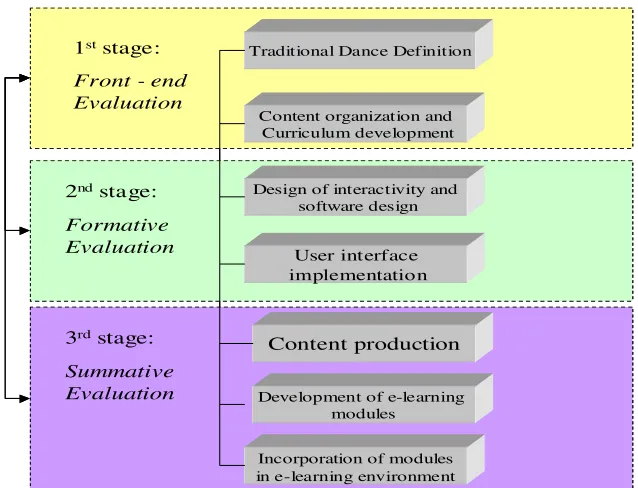
From a methodological perspective, design and development of the WebDANCE Learning Environment for assisting traditional dance education requires (a) to identify the abstract concepts that define traditional dance together with the appropriate hypermedia forms for describing/visualizing each concept; (b) to organize the content and develop the teaching curriculum; (c) to design the structure and interactivity of the learning environment; (d) to implement the user interface; (e) to proceed in content production; (f) to develop e-learning modules; (g) to incorporate the separate modules in the WebDANCE e-learning environment and (h) to produce the accompanying material with explicit instructions for the users. In WebDANCE evaluation plays an important role in all the above activities involved in the design and the development of the suggested educational environment. The aim of the evaluation process is both to prevent the appearance of problems as well as to improve the design, development and application, of the proposed WebDANCE learning environment. The WebDANCE evaluation process consists of the following three phases and runs through the whole process of the design, development and implementation: front-end, formative and summative evaluation (Papadopoulos, 1999, Panagiotakopoulos et. al., 2003). The overall process of the design and development is shown in Figure 1.
Traditional Dance Definition
Content production Content organization and
Curriculum development
Development of e-learning modules
Design of interactivity and software design
User interface implementation
Incorporation of modules in e-learning environment
Development of e-learning modules
Design of interactivity and software design
User interface implementation
2. The WebDANCE Conceptual Model of Traditional Dance
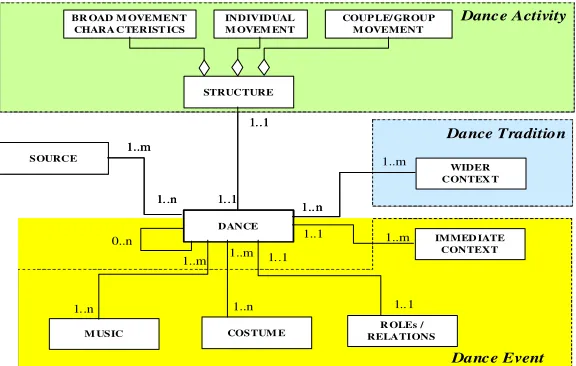
The conceptual model of traditional Dance of the WebDANCE learning environment is based on the dance conceptualization framework that has been developed from WebDANCE Consortium (Karkou, 2003). This was motivated by the need to face the concept of Dance in a holistic approach without following the usuall discrimination between movement and context (Royce, 1977, Zographou, 1989, Sermpezis and Goulimaris, 2001), which only provides a fragmented view of the dance experience.
Dance Tradition
M USIC COSTUM E
1..n
BR OAD M OVEMENT CHARA CTERIST ICS
M USIC COSTUM E
1..n
BR OAD M OVEMENT CHARA CTERIST ICS
Figure 2: The WebDANCE Conceptual Model
DANCE LESSON
L_ID
Focus (Dance Activity, Dance Event, Dance Tradition) Learning Objective (Skills, Performance, Knowledge, Appreciation)
Description (T)
DANCE CONCEPT
1..m 1..1
uses
SOURCE S TRUCTURE
DANCE IMMED IAT E
CONTEXT
WIDER CONTEXT MUS IC
COS TUME ROLES / RELAT IONS
specialisation
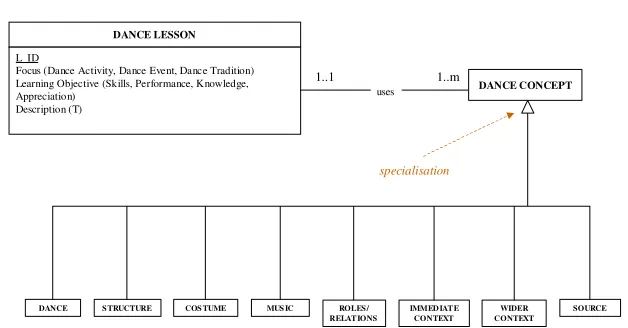
Figure 3: Relation of dance concepts and dance lessons
Each dance concept is further analyzed and the resulting descriptions formulate the different sections of a lesson. For example, the concept of Dance Costumes is analyzed in the following: common costume components, distinctive costume components, relationship of costume to movement and relationship of costume to everyday clothes that form the subsections of the corresponding lesson.
3. The WebDANCE Learning Model
1st stage
orientation
reflection
3rd stage
construction
2nd stage Dance Conceptual
Model
Technology
Resources
interaction
interaction interaction
1st stage
orientation
1st stage
orientation
reflection
3rd stage
reflection
3rd stage
construction
2nd stage
construction
2nd stage Dance Conceptual
Model
Technology
Resources
interaction
interaction interaction
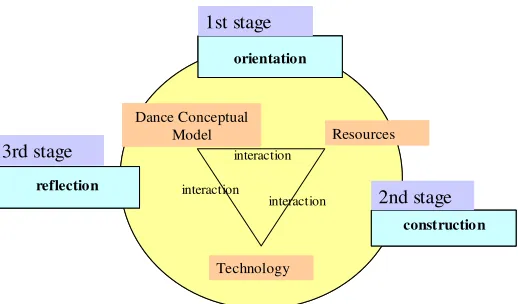
Figure 4: The WebDANCE learning model
Vital in this model are two approaches. The first is the goal – based approach (Schank, 1992) whereby the learning process is driven by the goal that the learner aims to achieve (e.g., to present a certain dance in the school journal); this goal directs the learner’s activities serving as a motivator for learning. The second is the learning by doing approach that focuses on acting rather than memorising facts and concepts. This is achieved by incorporating interactive components in the form of questions and answers, quizzes, and the use of extended activities.
4. The structure of the WebDANCE Curriculum
Curriculum
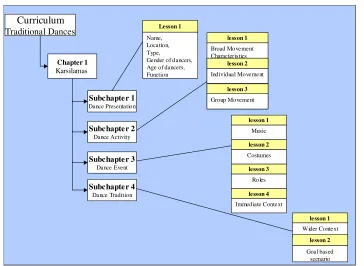
Figure 5: The WebDANCE Curriculum
A dance lesson is the smallest entity of the curriculum and is structured in terms of learning goals, educational activities, associated resources and self-evaluation tasks that can be used either in combination with other lessons or on its own. Teachers and students in a school environment or individual users on the web can create their own paths to investigate the curriculum depending on their specific goals and their interests. Dance Lessons can be combined and used in several ways depending on the teaching methodology followed and the specific learning objective that one wishes to achieve; when a holistic approach is taken then information about a whole dance (e.g. in the form of a video clip of the dance) may be used. Alternatively, when an analytical approach is preferred then the step-by-step analysis of the dance (e.g. using an interactive 3D animation tool) will be more appropriate.
4. Technical Implementation: The WebDANCE Learning Environment
capable of providing the tutor with reports about student attendance and progress. As a general guideline for the realization of the project the AICC protocol is used.
The WebDANCE Learning Environment uses the Lotus LearningSpace 5 platform as a framework for managing and delivery online courses, which is fully compatible with the AICC model and also compatible with SCORM. ( Damianakis and Loumou, 2003).
For the implementation of the content of a lesson a new system was designed, consisting of a set of different files.
The main content (text and filenames for multimedia files) of a lesson are included in an XML file describing the lesson structure in sequences each consisting of several frames (according to the AICC structure for levels). A Sample XML lesson is the following:
<?xml version="1.0" encoding="UTF-16" ?>
<lesson > <sequence > <frame >
<p img=”01_01.jpg “ > text , text , text , text </p> <p img=”01_02.jpg “ > text , text , text , text </p> <p img=”02s.swf“> more text </p>
</frame> </sequence>
<sequence > <frame > <p>……</p></frame ></sequence > .
. .
</lesson>
An XML parser then processes the XML file and the data contained are presented to the user in the form of the Lesson. Furthermore the parser is encapsulated in a module that is capable of communicating with the LMS and reporting the user progress.
The following shows the files contained in the folder of a sample lesson:
theFile.xml The file that contain all the text data. It also contains the file name
of non-text data such as images, animations, video, and sounds.
main.swf The XML parser. This file contains the program that reads the
mixing text with multimedia material. The program is developed in Flash MX.
lesson.html main.html results.htm
These files encapsulate the XML parser and are used to transfer data between the Lesson and the LMS.
01_01.jpg 01_02.jpg 01_03.jpg 01_04.jpg 01_05.jpg 02s.swf
Some multimedia files that are included in the presentation of the lesson.
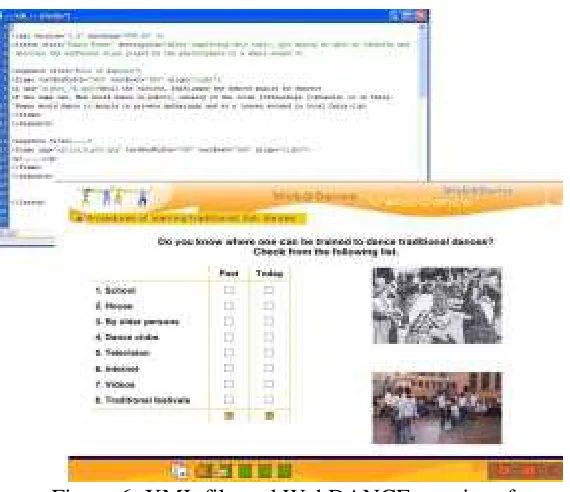
The content of each lesson is created separately using appropriate tools (e.g., text editors, multimedia authoring tools) and is then integrated into the XML file. The following figure shows a snapshot of the XML file and the corresponding lesson as it is presented to the user.
Figure 6: XML file and WebDANCE user interface
o There is a distinction between multimedia and text in the file system itself.
o A simple text editor is sufficient for authoring the XML file.
o Incorporation of existing multimedia material in a lesson is very simple, just
by adding a reference to the XML file, without the use of any special program.
o Since lesson components (text and multimedia) are developed outside the
WebDANCE platform, they can be created in parallel by different authors and then combined into the same XML file.
o The multimedia material can be reused for different lessons.
o The communication between the lesson and the LMS is standardized and there
is no need to be implemented in each and every lesson separately by the authors.
o The same XML file containing the content of a lesson can be presented in
different ways creating a different user interface each time.
There are also some drawbacks, which in no case outweigh the advantages described above:
o Certain file types of the multimedia are not supported.
o Specialized activities (e.g., a quiz activity) cannot be implemented directly,
but should be developed separately using an appropriate authoring tool such as Flash MX.
6. Summary - Conclusions
The WebDANCE project promotes the use of e-learning technologies in traditional dance education. So far the conceptual model for representing traditional dance has been defined and the structure of the WebDANCE Curriculum has been modulated. In addition, a prototype version of the WebDANCE Learning Environment has been developed. In order to test the appropriateness and efficiency of the proposed Learning Environment, the prototype version will be put in use in two pilot secondary schools in Greece and UK using information about traditional Greek and English dances. The results of this pilot usage will feed into the implementation of the full version of the WebDANCE platform.
7. Acknowledgements
We also thank European Social Fund (ESF), Operational Program for Educational and Vocational Training II (EPEAEK II) and particularly the Program ARCHIMEDES, for funding part of the above work.
References:
1. Europe of Cultural Co-operation (2002) A survey on arts education in Europe. Retrieved 09/02/2002 from http://culture.coe.fr
2. Ferreira, M., MacKinnon, L., Demulliez, M., Foulk, P. (1998) A multimedia Telematics Network for On-the-Job Training, Tutoring and Assessment, in conference proceedings ICEE ’98: International Conference on Engineering Education, 17-20/08/1998, Rio de Janeiro, Brazil
3. Panagiotakopoulos, C., Pierrakeas, C., Pintelas, P. (2003) The educational software and its evaluation, Athens: Metaixmio (in Greek)
4. Papadopoulos, G. (1999) Evaluating the quality of educational software: The role of the Greek Pedagogical Institute (PI), Retrieved 15/10/2002 from 5. http://www.pi-schools.gr/hdtc/material/ict.htm
6. Royce, A. P. (1977) The anthropology of dance, Bloomington: Indiana University.
7. Serpezis, B. and Goulimaris, D. (2001) Towards a scientific way of teaching Greek traditional dance, Sports and Society, 29, 54-61 (in Greek) 8. Schank R.C. (1992) Goal-Based Scenarios. Retrieved 15/10/2002 from the http://cogprints.ecs.soton.ac.uk/archive/00000624/00/V11ANSEK.html
9. Karkou, V. (2003) Conceptual Model of Traditional / Folk Dance,
WebDANCE Technical Report, Ref No: WebDance\W1\UH\01, 19 June 2003. 10.Kavakli, E., Chortarias, N., Tsakogianni, M. (2003) WebDANCE Dance
Database: Technical and User Requirements, Technical Report, Ref No:
WebDance\W1\UoA\02, 20 June 2003.
11.Damianakis, A. and Loumou, M. (2003) Technical and User Requirements
for the Web3D learning platform, Internal Report, Ref No:
WebDance\W4\CONCEPTUM\01, 8 June 2003.
12.Zographou, M. (1989) Laographical / Anthropological approach of the dance SERA of Pontus. Unpublished Ph.D. thesis, University of Ioannina, Greece (in Greek)
Authors: