79
DAFTAR PUSTAKA
1. Ruby P, Giorgio WC, Stephen TH, Richard FL. WAO White Book on Allergy 2011-2012:Executive Summary. World Allergy Organization; 2011
2. Antonius HP, Badriul H, Setyo H, Nikmah SI, Ellen PG, Eva DH. Pedoman Pelayanan Medis Ikatan Dokter Anak Indonesia. IDAI; 2009
3. Baratawidjaja KG, Rengganis I. Gambaran umum penyakit alergi. Dalam : Alergi Dasar. Edisi ke-1. Jakarta: Interna Publishing; 2009. (Disitasi oleh: Wistiani, Harsoyo Notoatmojo. Hubungan Pajanan Alergen Terhadap Kejadian Alergi pada Anak. Sari Pediatri. 2011;13(3):186)
4. Yeo HP, Kyung WK, Bon SC, Hye MJ, Myung HS, Kyu EK. Relationship between mode of delivery in childbirth and prevalence of allergic diseases in Korean children. Allergy, Asthma & Immunology Research [Internet]. 2010 [cited 2014 August 1];2.1:28. Available from: www.ncbi.nlm.nih.gov
5. Liselotte BH, Lotte L, Frederik FB, Tove A, Lone S, Matthew S, et al. Development of Atopic Dermatitis During the First 3 Years of Life. American Medical Association [Internet]. 2006 [cited 2014 August 1];142:561-566. 6. Mansjoer, Arif. Kapita Selekta Kedokteran (Jilid 1). Jakarta: Media
Aesculapius; 2005 [cited 2014 August 1].
7. Riset Kesehatan Dasar (RISKESDAS). Badan Penelitian dan Pengembangan Kesehatan Kementerian Kesehatan RI; 2010
8. Neu J, Rushing J. Cesarean versus Vaginal Delivery: Long term infant outcomes and the Hygiene Hypothesis. NIH-PA Author Manuscript [Internet]. 2011 June [cited 2014 September 14]; 38(2): 321-331. Available from: www.ncbi.nlm.nih.gov
9. Infant gut microbiota influenced by caesarean section and breastfeeding practices. Canadian Medical Association Journal. 2013 February 11.
80
10. Lee AJ, Meera T, Lee BW. Food allergy in Asia: how does it compare? Asia Pac Allergy [Internet]. 2013 [cited 2014 September 15];3:3-14. Available from: www.ncbi.nlm.nih.gov
11. Laubereau B, Filipiak-Pittroff B, von Berg A, Grubl A, Reinhardt D, Wichmann HE, et al. Caesarean section and gastrointestinal symptoms, atopic dermatitis, and sensitisation during the first year of life. Arch Dis Child [Internet]. 2004 [cited 2014 September 15]; 89(11):993-997.
12. van Nimwegen FA, Penders J, Stobberingh EE, Postma DS, Koppelmen GH, Kerkhof M, et al. Mode and place of delivery, gastrointestinal microbiota, and their influence on asthma and atopy. J Allergy Clin Immunol [Internet]. 2011 [cited 2014 October 1]. Available from: J Allergy Clin Immunol
13. Kelly DK, Ian MP, J Alexander L, Sharon S, Nurgul CS, Kent EV, et al. A retrospective chart review to identify perinatal factors associated with food allergies. Nutrition Journal [Internet]. 2012 [cited 2014 October 2]; 11:87. 14. World Health Organization. Prevention of Allergy and Allergic Asthma.
Geneva: WHO; 2002
15. Arwin AP, Zakiudin M, Nia K. Buku Ajar Alergi-Imunologi Anak Edisi Kedua. Jakarta: Ikatan Dokter Anak Indonesia; 2008
16. Johansson SGO, Bieber T, Dahl R, Friedman PR, Lanier BQ, Lockey RF, et al. Revised nomenclature for allergy for global use: report of the nomenclature review committee of the world allergy organization. J Allergy Clin Immunol. 2004[cited October 2];113:832-6
17. Scurlock AM, Lee LA, Burks AW. Food allergy in children. Immunol Allergy Clin N Am [Internet]. 2005 [cited 2014 October 2];25:369-88
18. Sybilski AJ, Doboszynska A, Samolinski B. Prediction of Atopy in the First Year of Life Using Cord Blood IgE Levels and Family History. Eur J Med Res [Internet]. 2009 [cited 2014 October 15]; 15(Suppl. IV):227-232.
81
19. Wahn U, von Mutius E. Childhood risk factors for atopy and the importance of early intervention. J Allergy Clin Immunol [Internet]. 2001 Apr [cited 2014 October 15];107(4):567-74.
20. Halkjaer LB, Loland L, Buchvald FF, Agner T, Skov L, Strand M, Bisgaard H. Development of atopic dermatitis during the first 3 years of life - The Copenhagen Prospective Study on Asthma in Childhood cohort study in high-risk children. Archives of Dermatology. COPSAC [Internet]. 2006 [cited 2014 October 15];142:561-566.
21. Kay AB. The New England Journal of Medicine ALLERGY AND ALLERGIC DISEASES First of Two Parts. N Engl J Med [Internet]. 2001 [cited 2014 October 15];344(1):30-37. Avilable from: New England Journal of Medicine.
22. Martien LK, Catharien MUH, Tineke CMT, van der Pouw K, Eddy AW, Pawel K. Atopic Allergy: A Failure of Antigen-Presenting Cells to Properly Polarize Helper T Cells?. Am J Respir Crit Care Med [Internet]. 2000 [cited 2014 October 15]:162 ppS76-S80.
23. Coico R, Sunshine G. Immunology: A Short Course [Internet]. Amerika Serikat: John Wiley & Sons; 2009 [cited 2014 October 20].
24. Dvorak AM. Ultrastructural Studies OF Human Basophils and Mast Cells J Histochem Cytochem [Internet]. 2005 [cited 2014 October 20];53(9);1043. 25. Isabela PS, Cassim M, Erika JJ. Asthma and Allergic Disease in Pregnancy.
WAO Journal;2009.
26. Stephen C. Hipersensitivity mechanisms: an overview. Pulmonary, allergy and critical care medicine.
27. Motala C, Hawarden D. Guideline Diagnosis testing in allergy. Allergy Society of South Africa [Internet]. July 2009 [cited 2014 October 20]; 99(7). 28. Sarwono Prawirohardjo. Ilmu Kebidanan. Jakarta: Bina Pustaka Sarwono
82
29. Caisedo RA, Schanler RJ, Li N, Neu J. The developing intestinal ecosystem: implications for the neonate. Pediatr Res [Internet]. 2005 [cited 2014 October 20]; 58(4):625-8.
30. Guarner F, Malagelda JR. Gut flora in health and disease. Lancet [Internet]. 2003 [cited 2014 October 25]; 361(9356):512-9.
31. Rook GA. 99th Dahlem conference on infection, inflammation and chronic inflammatory disorders: Darwinian medicine and the „hygiene‟ or „old friends‟ hypothesis. Clin Exp Immunol. 2010; 160(1):70-90.
32. Neish as. Microbes in gastrointestinal health and disease. Gastroenterology. 2009; 136(1):65-80.
33. Round JL, O‟Connell RM, Mazmanian SK. Coordination of tolerogenic
immune responses by the commensal microbiota. J Autoimmun. 2010;
34(3):J220-5.
34. Cotton CM, Taylor S, Stoll B, et al. Prolonged duration of initial empirical antibiotic treatment is associated with increased rates of necrotizing enterocolitis and death for extremely low birth weight infants. Pediatrics. 2009; 123(1):58-66.
35. Okada H, Kuhn C, Feillet H, Bach JF. The „hygiene hypothesis‟ for autoimmune and allergic diseases: an update. Clin Exp Immunol [Internet]. 2010 [cited 2014 November 14];160(1): 1-9.
36. Arbibe L, Kim DW, Batsche E, Pedron T, Mateescu B, Muchard C, et al. An injected bacterial effector targets chromatin access for transcription factor NF-KB to alter transcription for host genes involved in immune responses. Nat Immunol [Internet]. 2007 [cited 2014 November 14];8(1):47-56.
37. Romagnani S. The increased prevalence of allergy and the hygiene hypothesis: missing immune deviation, reduced immune suppression, or both?. Immunology [Internet]. 2004 [cited 2014 November 14];112(3)3523. 38. Schaub B, Liu J, Hoppler S, Scleich I, Huehn J, Olek S, et al. Maternal farm
83
J Allergy Clin Immunol [Internet]. 2009 [cited 2014 November 14];123(4):774-782, e5. Available from: Elsevier
39. Dahlan, M Sopiyudin. Besar sampel dan cara pengambilan sampel dalam penelitian kedokteran dan kesehatan, edisi 3 – cetakan kedua. Jakarta: Penerbit Salemba Medika; 2012.
40. Dahlan, M Sopiyudin. Statistik untuk kedokteran dan kesehatan: deskriptif, bivariat, dan multivariat, edisi 5 – cetakan ketiga. Jakarta: Salemba Medika;2013.
41. Maria CM, Siri EH, Hein S, Per N, Stephanie JL, Siri V, et al. Delivery by caesarean section and early childhood respiratory symptoms and disorders. American Journal of Epidemiology. 2011;174(11):1275-1285.
42. Michael P, Diane RG, Hassen AM, Elaine H, Juan CC. Birth by caesarean section, allergic rhinitis, and allergic sensitization among children with a parental history of atopy. J Allergy Clin Immunol. 2008;122(2):274-279. 43. Almqvist C, Cnattingius S, Lichtenstein P, Lundholm C. The impact of birth
mode of delivery in childhood asthma and allergic diseases-a sibling study. Clinical & Experimental Allergy. 2012;(42):1369-1376.
44. Vael C, Desager K. The importance of the development of the intestinal microbiota in infancy. Curr Opin Pediatr. 2009;21(6):794-800.
45. Huurre A, Kalliomaki M, Rautava S. Mode of delivery-effects on gut microbiota and humorial immunity. Neonatology. 2008;94(4):236-240.
46. Penders J, Stobberingh EE, van den Brandt PA. The role of the intestinal microbiota in the development of atopic disorders. Allergy. 2007;62(11):1223-1236.
47. Mihaela P, Nicolae MP, Daniela AI. Caesarian section delivery and atopic dermatitis – meta-analysis of observation studies. Ginecoro. 2012;8(30):196-198.
48. Kelly MJ, Andrea MN. Breasfeeding, the Immune Response, and Long-term Health. J Am Osteopath Assoc. 2006;106:203-207.
84
49. Kull I, Wickman M, Lilja G, Nordvall SL, Pershagen G. Breast feeding and allergic diseases in infants – a prospective birth cohort study. Arch Dis Child. 2002;87:478-481.
50. Kull I, Maria B, Carl FW, Nordvall SL, Pershagen G, Wickman M. Breast-feeding reduces the risk for childhood eczema. J Allergy Clin Immunol. 2005;116(3):657-661.
51. Johannes Ring. Allergy in practice: Genetic and environment in the development of allergy. German: Springer; 2004.
52. Wylie B, Megan F, Kate R, Lindsay H, Chris C. Family history as a predictor of asthma risk. Am J Prev Med. 2003;24(2):160-169.
53. Christine CJ, Dennis RO, Suzanne LH, Edward LP. Family history, dust mite exposure in early childhood, and risk for pediatric atopy and asthma. American Academy of Allergy, Asthma and Immunology. 2004;10:106-110. 54. Susan LP, Mimi LK. The Australian Society of Clinical Immunology and
Allergy position statement: summary of allergy prevention in children. MJA. 2005;182(9):464-467
96
Lampiran 4. Hasil analisis (output analisis program statistic)
Bivariat Metode persalinan – manifestasi alergi
Metode Persalinan * Manifestasi Alergi Crosstabulation
Manifestasi Alergi Total Ya Tidak
Metode Persalinan SC
Count 27 8 35
Expected Count 24.2 10.8 35.0 % within Metode Persalinan 77.1% 22.9% 100.0%
PV
Count 20 13 33
Expected Count 22.8 10.2 33.0 % within Metode Persalinan 60.6% 39.4% 100.0%
Total
Count 47 21 68
Expected Count 47.0 21.0 68.0 % within Metode Persalinan 69.1% 30.9% 100.0%
Chi-Square Testsc
Value df Asymp. Sig. (2-sided) Exact Sig. (2-sided) Exact Sig. (1-sided) Pearson Chi-Square 2.176a 1 .140 .191 .113 Continuity Correctionb 1.470 1 .225 Likelihood Ratio 2.190 1 .139 .191 .113
Fisher's Exact Test .191 .113
N of Valid Cases 68
a. 0 cells (.0%) have expected count less than 5. The minimum expected count is 10.19. b. Computed only for a 2x2 table
c. For 2x2 crosstabulation, exact results are provided instead of Monte Carlo results.
Risk Estimate
Value 95% Confidence Interval Lower Upper Odds Ratio for Metode Persalinan (SC / PV) 2.194 .765 6.291 For cohort Manifestasi Alergi = Ya 1.273 .916 1.769
97
For cohort Manifestasi Alergi = Tidak .580 .276 1.218
N of Valid Cases 68
Bivariat Riwayat penggunaan antibiotik ibu hamil – manifestasi alergi
Antibiotik ibu hamil * Manifestasi Alergi Crosstabulation
Manifestasi Alergi Total Ya Tidak
Antibiotik ibu hamil
Antibiotik
Count 20 7 27
Expected Count 18.7 8.3 27.0
% within Antibiotik ibu hamil 74.1% 25.9% 100.0%
Tidak
Count 27 14 41
Expected Count 28.3 12.7 41.0
% within Antibiotik ibu hamil 65.9% 34.1% 100.0%
Total
Count 47 21 68
Expected Count 47.0 21.0 68.0
% within Antibiotik ibu hamil 69.1% 30.9% 100.0%
Chi-Square Testsc
Value df Asymp. Sig. (2-sided) Exact Sig. (2-sided) Exact Sig. (1-sided) Pearson Chi-Square .515a 1 .473 .594 .329 Continuity Correctionb .202 1 .653 Likelihood Ratio .522 1 .470 .594 .329
Fisher's Exact Test .594 .329
N of Valid Cases 68
a. 0 cells (.0%) have expected count less than 5. The minimum expected count is 8.34. b. Computed only for a 2x2 table
c. For 2x2 crosstabulation, exact results are provided instead of Monte Carlo results.
Risk Estimate
Value 95% Confidence Interval Lower Upper Odds Ratio for Antibiotik ibu hamil (Antibiotik /
Tidak)
98
For cohort Manifestasi Alergi = Ya 1.125 .822 1.539 For cohort Manifestasi Alergi = Tidak .759 .353 1.634
N of Valid Cases 68
Bivariat Riwayat alergi keluarga – manifestasi alergi
Riwayat Alergi Keluarga * Manifestasi Alergi Crosstabulation
Manifestasi Alergi Total Ya Tidak
Riwayat Alergi Keluarga
Kedua orangtua alergi sama
Count 4 0 4
Expected Count 2.8 1.2 4.0
% within Riwayat Alergi Keluarga 100.0% 0.0% 100.0%
Orangtua alergi berbeda
Count 5 0 5
Expected Count 3.5 1.5 5.0
% within Riwayat Alergi Keluarga 100.0% 0.0% 100.0%
Hanya salah satu orangtua alergi
Count 18 6 24
Expected Count 16.6 7.4 24.0
% within Riwayat Alergi Keluarga 75.0% 25.0% 100.0%
Saudara alergi
Count 1 2 3
Expected Count 2.1 .9 3.0
% within Riwayat Alergi Keluarga 33.3% 66.7% 100.0%
Tidak terdapat riwayat alergi
Count 19 13 32
Expected Count 22.1 9.9 32.0
% within Riwayat Alergi Keluarga 59.4% 40.6% 100.0%
Total
Count 47 21 68
Expected Count 47.0 21.0 68.0
% within Riwayat Alergi Keluarga 69.1% 30.9% 100.0%
Chi-Square Tests Value Df Asymp. Sig.
(2-sided)
Monte Carlo Sig. (2-sided) Sig. 95% Confidence Interval
Lower Bound Upper Bound
Pearson Chi-Square 7.633a 4 .106 .097b .091 .103
Likelihood Ratio 10.028 4 .040 .059b .055 .064
99
Riwayat Alergi Keluarga. * Manifestasi Alergi Crosstabulation
Manifestasi Alergi Total Ya Tidak
Riwayat Alergi Keluarga.
Ada riwayat alergi
Count 28 8 36
Expected Count 24.9 11.1 36.0
% within Riwayat Alergi Keluarga. 77.8% 22.2% 100.0%
Tidak ada riwayat alergi
Count 19 13 32
Expected Count 22.1 9.9 32.0
% within Riwayat Alergi Keluarga. 59.4% 40.6% 100.0%
Total
Count 47 21 68
Expected Count 47.0 21.0 68.0
% within Riwayat Alergi Keluarga. 69.1% 30.9% 100.0%
Chi-Square Testsc
Value df Asymp. Sig. (2-sided) Exact Sig. (2-sided) Exact Sig. (1-sided) Pearson Chi-Square 2.688a 1 .101 .121 .084 Continuity Correctionb 1.895 1 .169 Likelihood Ratio 2.701 1 .100 .121 .084
Fisher's Exact Test .121 .084
N of Valid Cases 68
a. 0 cells (.0%) have expected count less than 5. The minimum expected count is 9.88. b. Computed only for a 2x2 table
c. For 2x2 crosstabulation, exact results are provided instead of Monte Carlo results.
Risk Estimate
Value 95% Confidence Interval Lower Upper Odds Ratio for Riwayat Alergi Keluarga. (Ada riwayat
alergi / Tidak ada riwayat alergi)
2.395 .833 6.884 N of Valid Cases 68
a. 6 cells (60.0%) have expected count less than 5. The minimum expected count is .93. b. Based on 10000 sampled tables with starting seed 1314643744.
100
For cohort Manifestasi Alergi = Ya 1.310 .936 1.832 For cohort Manifestasi Alergi = Tidak .547 .261 1.148
N of Valid Cases 68
Bivariat Paparan asap rokok – manifestasi alergi
Paparan Asap Rokok * Manifestasi Alergi Crosstabulation
Manifestasi Alergi Total Ya Tidak
Paparan Asap Rokok Ada
Count 31 12 43
Expected Count 29.7 13.3 43.0
% within Paparan Asap Rokok 72.1% 27.9% 100.0%
Tidak Ada
Count 16 9 25
Expected Count 17.3 7.7 25.0
% within Paparan Asap Rokok 64.0% 36.0% 100.0%
Total
Count 47 21 68
Expected Count 47.0 21.0 68.0
% within Paparan Asap Rokok 69.1% 30.9% 100.0%
Chi-Square Testsc
Value df Asymp. Sig. (2-sided) Exact Sig. (2-sided) Exact Sig. (1-sided) Pearson Chi-Square .485a 1 .486 .588 .333 Continuity Correctionb .180 1 .671 Likelihood Ratio .480 1 .488 .588 .333
Fisher's Exact Test .588 .333
N of Valid Cases 68
a. 0 cells (.0%) have expected count less than 5. The minimum expected count is 7.72. b. Computed only for a 2x2 table
101
Risk Estimate
Value 95% Confidence Interval Lower Upper Odds Ratio for Paparan Asap Rokok (Ada / Tidak
Ada)
1.453 .506 4.169
For cohort Manifestasi Alergi = Ya 1.126 .795 1.595 For cohort Manifestasi Alergi = Tidak .775 .381 1.577
N of Valid Cases 68
Bivariat Berat bayi lahir – manifestasi alergi
Berat Bayi Lahir * Manifestasi Alergi Crosstabulation
Manifestasi Alergi Total Ya Tidak
Berat Bayi Lahir
Kurang dari 2500 gram
Count 5 2 7
Expected Count 4.8 2.2 7.0
% within Berat Bayi Lahir 71.4% 28.6% 100.0%
Lebih dari sama dengan 2500 gram
Count 42 19 61
Expected Count 42.2 18.8 61.0 % within Berat Bayi Lahir 68.9% 31.1% 100.0%
Total
Count 47 21 68
Expected Count 47.0 21.0 68.0 % within Berat Bayi Lahir 69.1% 30.9% 100.0%
Chi-Square Testsc
Value df Asymp. Sig. (2-sided) Exact Sig. (2-sided) Exact Sig. (1-sided) Pearson Chi-Square .020a 1 .889 1.000 .630 Continuity Correctionb .000 1 1.000 Likelihood Ratio .020 1 .888 1.000 .630
Fisher's Exact Test 1.000 .630
N of Valid Cases 68
a. 2 cells (50.0%) have expected count less than 5. The minimum expected count is 2.16. b. Computed only for a 2x2 table
102
Risk Estimate
Value 95% Confidence Interval Lower Upper Odds Ratio for Berat Bayi Lahir (Kurang dari 2500
gram / Lebih dari sama dengan 2500 gram)
1.131 .201 6.360
For cohort Manifestasi Alergi = Ya 1.037 .630 1.707 For cohort Manifestasi Alergi = Tidak .917 .268 3.136
N of Valid Cases 68
Bivariat Nutrisi bayi – manifestasi alergi
Nutrisi Bayi * Manifestasi Alergi Crosstabulation
Manifestasi Alergi Total Ya Tidak
Nutrisi Bayi
ASI dengan makanan/minuman lain
Count 34 10 44
Expected Count 30.4 13.6 44.0 % within Nutrisi Bayi 77.3% 22.7% 100.0%
ASI
Count 13 11 24
Expected Count 16.6 7.4 24.0 % within Nutrisi Bayi 54.2% 45.8% 100.0%
Total
Count 47 21 68
Expected Count 47.0 21.0 68.0 % within Nutrisi Bayi 69.1% 30.9% 100.0%
Chi-Square Testsc
Value df Asymp. Sig. (2-sided) Exact Sig. (2-sided) Exact Sig. (1-sided) Pearson Chi-Square 3.884a 1 .049 .059 .046 Continuity Correctionb 2.877 1 .090 Likelihood Ratio 3.801 1 .051 .059 .046
Fisher's Exact Test .059 .046
N of Valid Cases 68
a. 0 cells (.0%) have expected count less than 5. The minimum expected count is 7.41. b. Computed only for a 2x2 table
103
c. For 2x2 crosstabulation, exact results are provided instead of Monte Carlo results.
Risk Estimate
Value 95% Confidence Interval Lower Upper Odds Ratio for Nutrisi Bayi (ASI dengan
makanan/minuman lain / ASI)
2.877 .988 8.375
For cohort Manifestasi Alergi = Ya 1.427 .955 2.131 For cohort Manifestasi Alergi = Tidak .496 .247 .996
N of Valid Cases 68
Bivariat kepemilikan hewan peliharaan – manifestasi alergi
Hewan Peliharaan1 * Manifestasi Alergi Crosstabulation
Manifestasi Alergi Total Ya Tidak
Hewan Peliharaan1
Ada hewan peliharaan
Count 18 9 27
Expected Count 18.7 8.3 27.0
% within Hewan Peliharaan1 66.7% 33.3% 100.0%
Tidak ada hewan peliharaan
Count 29 12 41
Expected Count 28.3 12.7 41.0
% within Hewan Peliharaan1 70.7% 29.3% 100.0%
Total
Count 47 21 68
Expected Count 47.0 21.0 68.0
% within Hewan Peliharaan1 69.1% 30.9% 100.0%
Chi-Square Testsc
Value df Asymp. Sig. (2-sided) Exact Sig. (2-sided) Exact Sig. (1-sided) Pearson Chi-Square .126a 1 .723 .792 .463 Continuity Correctionb .008 1 .931 Likelihood Ratio .125 1 .723 .792 .463
104
N of Valid Cases 68
a. 0 cells (.0%) have expected count less than 5. The minimum expected count is 8.34. b. Computed only for a 2x2 table
c. For 2x2 crosstabulation, exact results are provided instead of Monte Carlo results.
Risk Estimate
Value 95% Confidence Interval Lower Upper Odds Ratio for Hewan Peliharaan1 (Ada hewan
peliharaan / Tidak ada hewan peliharaan)
.828 .291 2.354
For cohort Manifestasi Alergi = Ya .943 .677 1.313 For cohort Manifestasi Alergi = Tidak 1.139 .557 2.328
N of Valid Cases 68
Analisis Multivariat
Case Processing Summary
Unweighted Casesa N Percent
Selected Cases Included in Analysis 68 100.0 Missing Cases 0 .0 Total 68 100.0 Unselected Cases 0 .0 Total 68 100.0
a. If weight is in effect, see classification table for the total number of cases.
Dependent Variable Encoding Original Value Internal Value
Ya 0
Tidak 1
Categorical Variables Codings
Frequency Parameter coding (1)
Metode Persalinan
0 35 1.000
105
Riwayat Alergi Keluarga.
0 36 1.000
1 32 .000
Nutrisi Bayi
0 44 1.000
1 24 .000
Block 0: Beginning Block
Classification Tablea,b
Observed Predicted
Manifestasi Alergi Percentage Correct Ya Tidak Step 0 Manifestasi Alergi Ya 47 0 100.0 Tidak 21 0 .0 Overall Percentage 69.1
a. Constant is included in the model. b. The cut value is .500
Variables in the Equation
B S.E. Wald df Sig. Exp(B)
Step 0 Constant -.806 .262 9.421 1 .002 .447
Variables not in the Equation
Score Df Sig. Step 0 Variables Nutrisi_bayi(1) 3.884 1 .049 Riwayat_alergi_keluarga(1) 2.688 1 .101 Metode_persalinan(1) 2.176 1 .140 Overall Statistics 9.343 3 .025
Block 1: Method = Backward Stepwise (Likelihood Ratio) Omnibus Tests of Model Coefficients
Chi-square df Sig. Step 1 Step 9.638 3 .022 Block 9.638 3 .022 Model 9.638 3 .022 Step 2a Step -2.332 1 .127
106
Block 7.306 2 .026
Model 7.306 2 .026
a. A negative Chi-squares value indicates that the Chi-squares value has decreased from the previous step.
Model Summary Step -2 Log likelihood Cox & Snell R
Square
Nagelkerke R Square
1 74.431a .132 .186
2 76.763a .102 .144
a. Estimation terminated at iteration number 4 because parameter estimates changed by less than .001.
Hosmer and Lemeshow Test Step Chi-square Df Sig.
1 2.441 5 .785
2 .006 2 .997
Contingency Table for Hosmer and Lemeshow Test
Manifestasi Alergi = Ya Manifestasi Alergi = Tidak Total Observed Expected Observed Expected
Step 1 1 8 9.075 2 .925 10 2 11 9.670 1 2.330 12 3 10 9.994 3 3.006 13 4 6 5.949 2 2.051 8 5 5 5.261 4 3.739 9 6 3 3.306 3 2.694 6 7 4 3.745 6 6.255 10 Step 2 1 19 18.932 3 3.068 22 2 15 15.068 7 6.932 22 3 9 9.068 5 4.932 14 4 4 3.932 6 6.068 10
107
Classification Tablea
Observed Predicted
Manifestasi Alergi Percentage Correct Ya Tidak Step 1 Manifestasi Alergi Ya 43 4 91.5 Tidak 15 6 28.6 Overall Percentage 72.1 Step 2 Manifestasi Alergi Ya 43 4 91.5 Tidak 15 6 28.6 Overall Percentage 72.1
a. The cut value is .500
Variables in the Equation
B S.E. Wald df Sig. Exp(B) 95% C.I.for EXP(B) Lower Upper S t e p 1 a Nutrisi_bayi(1) -1.219 .586 4.328 1 .037 .296 .094 .932 Riwayat_alergi_keluarga(1) -1.082 .582 3.460 1 .063 .339 .108 1.060 Metode_persalinan(1) -.860 .571 2.264 1 .132 .423 .138 1.297 Constant .877 .627 1.958 1 .162 2.404 S t e p 2 a Nutrisi_bayi(1) -1.211 .574 4.445 1 .035 .298 .097 .918 Riwayat_alergi_keluarga(1) -1.043 .571 3.333 1 .068 .352 .115 1.080 Constant .434 .535 .658 1 .417 1.543
108
Model if Term Removed
Variable Model Log
Likelihood Change in -2 Log Likelihood df Sig. of the Change Step 1 Nutrisi_bayi -39.459 4.487 1 .034 Riwayat_alergi_keluarga -39.039 3.647 1 .056 Metode_persalinan -38.381 2.332 1 .127 Step 2 Nutrisi_bayi -40.684 4.606 1 .032 Riwayat_alergi_keluarga -40.134 3.506 1 .061
Variables not in the Equation
Score df Sig.
Step 2a
Variables Metode_persalinan(1) 2.318 1 .128
Overall Statistics 2.318 1 .128
109
Lampiran 5. Kuesioner Penelitian
KUISIONER 1
(IDENTIFIKASI FAKTOR RESIKO PERINATAL)
Tanggal Pengisian : Nama bayi : Jenis Kelamin : Tanggal lahir : IDENTITAS IBU Nama : Umur : tahun Pendidikan terakhir : Pekerjaan : Alamat : Telp/Hp : IDENTITAS AYAH Nama : Umur : tahun Pendidikan terakhir : Pekerjaan : Alamat : Telp/Hp
110
RIWAYAT IBU SELAMA HAMIL
1. Apakah ibu pernah sakit selama hamil ? 1.Ya 2. Tidak
Jenis penyakit :...
2. Apakah selama sakit tersebut pernah mendapat pengobatan antibiotika ? 1.Ya 2. Tidak
Bila ya, Jenis antibiotika :...
Bila ya, umur kehamilan :...
3. Apakah antibiotik yang dikonsumsi tercatat dalam KMS (catatan) Ibu hamil? Ya 2. Tidak
4. Apakah anda pernah membeli antibiotik tanpa resep dokter selama kehamilan?
YA
111
RIWAYAT PERINATAL
1. Berapakah usia kehamilan saat lahir : ... minggu 2. Berat badan lahir :... gram
3. Klasifikasi berdasarkan kurva Lubchenco (kurva hubungan usia kehamilan dan berat bayi)
1.SMK (Berat bayi sesuai dengan masa kehamilan) 2. KMK (Berat bayi kecil untuk masa kehamilan) 3. BMK (Berat bayi besar untuk masa kehamilan) 4. Panjang badan :... cm 5. Proses Kelahiran
1.Bedah sesar
2.Pervaginam: Lahir Spontan Dengan bantuan alat 6. Tempat bersalin
□ RS umum/swasta □ Praktik bidan
□ Puskesmas □ lain-lain, sebutkan… □ Rumah bersalin
112
KARTU DETEKSI DINI ALERGI
Berilah tanda centang (√) pada kolom AYAH, IBU, atau SAUDARA sesuai dengan kolom KETERANGAN
AYAH IBU SAUDARA KETERANGAN SKOR %
RISIKO ALERGI Pernah didiagnosa atau
dinyatakan oleh dokter menderita alergi
Suspek alergi :
didapatkan pernah mengalami gejala bersin-bersin atau hidung meler, tersumbat saat pagi hari dan membaik menjelang siang
didapatkan riwayat asma atau mengi berulang
didapatkan riwayat urtikaria atau gatal-gatal berulang ketika makan ikan laut, seafood
didapatkan riwayat / gejala eksim
Tidak didapatkan gejala alergi
113
KUESIONER II
(RIWAYAT POST NATAL, RESIKO ALERGI DARI LINGKUNGAN DAN
MANIFESTASI ALERGI PADA SAAT BAYI BERUMUR … BULAN)
Tanggal pengisian : Kelompok Penelitian :
Nama :
Berat badan sekarang : Panjang badan sekarang :
Status Gizi : (berdasarkan KMS: Hijau/Kuning/Merah)
RIWAYAT POST NATAL
1. Apakah ibu pernah mengkonsumsi jamu? 1.Ya 2. Tidak
Bila iya :
1.1 Apakah merupakan jamu bersalin? 1.Ya 2. Tidak
Sebutkan jenis jamu yang digunakan :……… 1.2 Apakah mengkonsumsi jamu selama menyusui bayi?
1.Ya 2. Tidak
114
2. Apakah bayi pernah mengalami sakit yang sampai diberikan pengobatan antibiotika oleh dokter atau bidan sejak 1 bulan terakhir?
1.Ya 2. Tidak Bila iya :
2.1. Sebutkan jenis sakit yang diderita bayi :... 2.2. Saat usia ...bulan
2.3. Sebutkan jenis antibiotika yang diminum bayi :... 3. Apakah bayi pernah mengalami diare selama 1 bulan awal ini?
1.Ya 2. Tidak Bila iya,
3.1. berapa kali...
3.2. berapa lama diare tersebut terjadi?
1.< 7 hari 2. 7-14 hari 3. >14 hari 3.3. Apakah diare disertai adanya darah ?
1.Ya 2. Tidak 3.4. Apakah diare disertai demam ?
1.Ya 2. Tidak 3.5. Apakah disertai muntah ?
1.Ya 2. Tidak
3.6. Apakah < 2 minggu sebelumnya minum susu formula/ganti susu formula? 1.Ya 2. Tidak
115
3.7. Apakah disertai gejala lain seperti batuk-pilek ? 1.Ya 2. Tidak
3.8. Apakah mendapat susu khusus selama diare? 1.Ya 2. Tidak
3.8.1. Apakah muncul gejala-gejala seperti berikut setelah bayi diberikan jenis pengganti susu lain ?
1. Muntah 2. Diare 3. gatal-gatal (kemerahan di pipi dll) 4. tidak ada
4. Bagaimanakah proses menyusui pada bayi ? Apakah 1.Hanya ASI saja
2. ASI dengan makanan tambahan jenis tambahan :
a. Susu formula b. air gula c. tajin d. madu e. lainnya 3. Hanya susu formula
5. Apabila bayi mulai diberikan susu selain ASI 5.1. Kapan bayi mulai diberikan susu selain ASI :
116
1. < 1bln 2. 1-2 bln 3. 2-3 bln 5.2. Jenis susu yang diberikan :
5.2.1 bahan dasar kedelai :1. susu Soya 2. lainnya 5.2.2. bahan dasar susu sapi :1. susu formula standar
2. susu formula parsial hidrolisat (hipoalergenik)
3. susu extensive hidrolisat 4. susu asam amino
5.2.3. lainnya
5.3.Bagaimana reaksi bayi setelah diberikan susu selain ASI tersebut?
1. Muntah 2. Diare 3. gatal-gatal (kemerahan di pipi dll) 4. tidak ada
6. Apakah bayi telah diberikan makanan padat lain selain ASI dan Susu Formula?
1.Ya 2. Tidak Bila ya
6.1. usia mulai diberikan
1. < 1bln 2. 1-2 bln 3. 2-3 bln 4. > 3 bln 6.2. jenis makanan padat yang diberikan
117 2. bubur 3. pisang uleg 4. jeruk peras 5. lainnya... FAKTOR LINGKUNGAN
1. Bahan bakar apa yang dipakai untuk memasak di rumah?
1. listrik 2. elpiji (gas)
3. kayu bakar/ batu bara 4. minyak tanah
5. lainnya... 2. Apakah ada anggota keluarga yang merokok ?
1.Ya 2. Tidak Jumlah perokok :... orang
3. Apakah banyak kendaraan roda 4/roda 2 yang berlalu lalang atau berhenti menunggu
penumpang di jalan depan rumah ? 1.Ya 2. Tidak
118
5. Berapakah luas bangunan rumah ?... m2 6. terbuat dari apakah bangunan rumah :
1. tembok 2. kayu 3. bata 4. lainnya ... 7. Apakah terdapat ventilasi di ruang tidur bayi?
1.Ya 2. Tidak
8. Apakah sinar matahari pagi dapat masuk ke dalam setiap ruangan dengan terang?
1.Ya 2. Tidak
9. Apakah bapak/ibu memiliki hewan peliharaan di dalam rumah ?
1.Ya 2. Tidak Bila ya, jenis peliharaan :
1. kucing 2. anjing 3. burung 4. lainnya ... 10. Apakah di rumah menggunakan karpet ?
1.Ya 2. Tidak
11. Bagaimana cara pembersihan rumah / debu?
1. di sapu 2. di lap 3. dengan penyedot debu 4. lainnya ...
12. Sebutkan tempat tidur yang digunakan
119
MANIFESTASI ALERGI
Berilah tanda centang (√) pada kolom YA / TIDAK
MANIFESTASI ALERGI YA TIDAK
Apakah bayi pernah mengalami episode wheezing mengi/ bungi ngik-ngik ) dalam 1 bulan terakhir ?
Apakah bayi pernah mengalami ruam kemerahan yang gatal dalam periode waktu sekurang-kurangnya 2 minggu dengan distribusi yang khas (wajah, lipatan siku, di daerah belakang sendi lutut (fossa poplitea), bagian belakang pergelangan tangan dan kaki atau di ankle bagian depan) dan kulit yang kering atau telah didiagnosis oleh dokter menderita eksim
Apakah bayi pernah mengalami mengi atau gejala batuk yang mengganggu bayi setelah bayi terpapar dengan hewan peliharaan yang berbulu atau serbuk sari
Apakah bayi pernah mengalami diare yang berkepanjangan, berulang, yang kadang dapat disertai darah , muntah, nyeri perut (rewel) dimana tidak disertai demam atau gejala infeksi lain seperti batuk pilek, dan telah ditetapkan oleh dokter bukan disebabkan oleh infeksi
Apakah orang tua mengeluhkan bayi pernah bernafas “grok-grok” di luar episode mengalami infeksi saluran pernafasan.
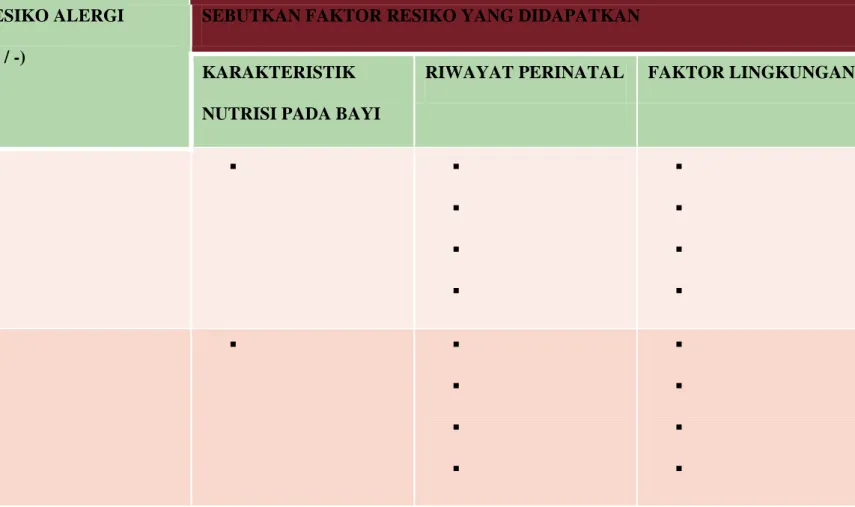
TABEL PENELITIAN
RESIKO ALERGI
( + / -)
SEBUTKAN FAKTOR RESIKO YANG DIDAPATKAN
KARAKTERISTIK
NUTRISI PADA BAYI
RIWAYAT PERINATAL FAKTOR LINGKUNGAN
Lampiran 6. Dokumentasi penelitian
Wawancara dengan ibu subjek di rumah subjek penelitian
Wawancara dengan ibu subjek di Puskesmas Srondol
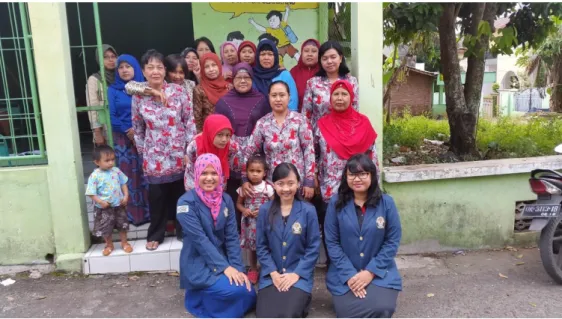
Foto bersama kader Posyandu
Lampiran 7. Biodata mahasiswa
Identitas
Nama : Luh Putu Uthari NIM : 22010111110084
Tempat/tanggal lahir : Amlapura – Bali, 28 Maret 1993 Jenis kelamin : Wanita
Alamat : Jalan Gunung Kapur No 3 Denpasar Bali No. HP : 08990155788
e-mail : [email protected] Riwayat Pendidikan Formal
1. SD : SD 26 Pemecutan – Denpasar Lulus tahun: 2005 2. SMP : SMP Negeri 1 Denpasar Lulus tahun: 2008 3. SMA : SMA Negeri 4 Denpasar Lulus tahun: 2011 4. FK UNDIP : S1 Program Studi Pendidikan Dokter Lulus tahun: 2015
Pengalaman Organisasi
1. Wakil ketua Jurnalistik SMP Negeri 1 Denpasar tahun 2007 2. Ketua Jurnalistik SMA Negeri 4 Denpasar tahun 2009 – 2010
3. Staf Bidang Riset Himpunan Mahasiswa (HIMA) Kedokteran Umum tahun 2012
4. Staf Divisi Eksterna Kelompok Studi Mahasiswa (KSM) FK UNDIP tahun 2012
5. Staf Divisi Dana Usaha Badan Analisis dan Pengembangan Ilmiah Nasional – Ikatan Senat Mahasiswa Kedokteran Indonesia (BAPIN ISMKI) tahun 2013 6. Staf Divisi Pengembangan Mahasiswa dan Penelitian (PMP) KSM FK UNDIP
2013
7. Ketua Bidang Riset HIMA KU UNDIP tahun 2013
8. Koordinator Departemen Project Affair HIMA KU UNDIP tahun 2014
Pengalaman penelitian
1. Anggota peneliti Penelitian Multi Center (PMC) BAPIN ISMKI regio FK UNDIP – Semarang “Prevalensi Infeksi Cacing Tambang dan Cacing Cambuk pada Ibu Hamil di Kota Semarang” tahun 2013
Pengalaman publikasi tulisan ilmiah
1. “Teh Hijau Cegah Kepikunan” – surat kabar Suara Merdeka 28 Desember 2012
Pengalaman presentasi karya ilmiah
1. Poster ilmiah “Pengaruh Kombinasi Kloramfenikol dengan Virgina coconut oil terhadap Jumlah Koloni Kuman di Hepar Mencit Balb/c yang Diinfeksi oleh
Salmonella typhimurium” – Scientific Fair FK UNDIP 2013
Pengalaman mengikuti lomba karya ilmiah
1. Gagasan tertulis “Pengaruh aktivitas antimikroba Azadirachta indica A. juss untuk pengobatan penyakit Pertusis” – Gamamed Fair FK UGM tahun 2012 2. Gagasan tertulis “Potensi Epigallocatechin gallate (EGCG) sebagai
Penghambat Inisiasi Reaksi Inflamasi dalam Pencegahan Progresivitas Penyakit Alzheimer” - Temu Ilmiah Nasional tahun 2012
3. Poster ilmiah “Pengaruh Kombinasi Kloramfenikol dengan Virgina coconut oil terhadap Jumlah Koloni Kuman di Hepar Mencit Balb/c yang Diinfeksi oleh
Salmonella typhimurium” – Scientific Fair FK UNDIP 2013
4. Gagasan tertulis “Potensi Penisilin Terfortifikasi Punika gramatum terhadap Terapi Leptospirosis” – Temu Ilmiah Nasional 2013