The Model of Institutional Management in Small Islands of Bunaken National Park,
North Sulawesi
Diane Tangian
*, Bernadain Dainty Polii
State Polytechnic of Manado, Manado, Indonesia Abstract
Bunaken National Park (BNP), North Sulawesi, is a conservation area that has the beauty underwater tourism attraction. The beautiful of underwater landscapes attract both domestic and foreign tourists to visit this region. Economically, tourism has positive impact on improving the economy and welfare of the community. There are, however, negative impacts of tourism to the quality of the local environment. It is characterized by the decline in coral cover area, caused by tourism activity itself. Utilization of natural resources as objects and tourist attraction should be done carefully, considering the balance of ecological, socio-economic and socio-cultural aspects. The concept of ecotourism is a concept that takes into account the balance of these three aspects, for the BNP travel management needs to be done based on the concept of ecotourism. Model of BNP travel management institutions use the systems approach to the Interpretative Structural Modeling (ISM) method. This method is carried out to see the degree of interest among the elements involved in the management of Bunaken National Parks with reference to the expert opinion. Results obtained show that the goals are to protect coral reef ecosystems as objects and tourist attraction, the institutions involved are the Board of Bunaken National Park, a strategic program that is required is to set the number of tourist visits, and the major constraint for the program is the lack of commitment from the actors involved.
Keywords: Conservation Area, Ecotourism, Interpretative Structural Modeling, Model, Sustainable Management.
INTRODUCTION*
Bunaken National Park (BNP) is a conservation area that become the object and tourist attraction, which has the underwater beauty and attractiveness. The area ± 89,065 ha in accordance with the Decree of the Minister of Forestry No. 730/Kpts-II/1991. Utilization of Bunaken National Park as one of the tourism attractions has a positive impact on the economy of local communities. Economically with tourism activities in Bunaken National Park, the local community's economy is progressing, but in terms of the environment, BNP suffered environmental degradation. It is widely identified from reduced coral cover. The decline in the percentage of live coral cover drastically occurred at a depth of 3 m.
Stated that the increase of human activities in the utilization of coral reef ecosystems can cause damage to the coral reef ecosystem itself [1]. Use of natural resources as objects and tourist attraction, necessarily requires a careful manage-ment planning as it may result in environmanage-mental degradation. Tourism as an industry must really have a good planning, implementation and
*Correspondence Address:
Diane Tangian
Email : [email protected]
Address : State Polytechnic of Manado, Mapanget District, Manado, 95252
evaluation in order that the negative impacts of tourism can be tolerated [2]. Furthermore, institutions involved in the management of Bunaken National Park currently consist of the central government and local governments. This resulted in some overlapping of authorities that lead to inefficient and ineffective management of Bunaken National Park. Sustainable tourism policy could be a useful way to encourage new forms of business, increase employment and promote conservation [3]. Sustainable tourism development should be based on the actual analysis of the environmental, social, cultural and socio-economic potentials utilized to improve the welfare of local communities [4].
Institutional Management in Bunaken National Park used interpretative method approach with Interpretative Structural Modeling (ISM). ISM is a computer-based methodology that helps the group identify relations among issues idea and the complex structure. ISM is implemented interactive and a group methodology. ISM is a computer-based method to identify the correlation between ideas and structure within a complex issue. The elements of the system was analyzed and solved into graphic that describe the relation between elements and the level of hierarchy. Related to the contextual correlation, the direct relation is in varied contexts. Stages of this method are:
1. To identify elements that can be acquired through research, brainstorming, etc. related to the ecotourism management policies in Bunaken National Park.
2. Building a contextual relationship between the elements based on the purpose of modeling.
3. Make a single Matrix Interactions. This matrix represents the element of respondents to the preparation of the target element. Four symbols used:
V ... The relationship of elements Ei toEj, not vice versa.
A ...The relationship of elements Ejto Ei, not vice versa.
X ... Interrelasi relationships betweenEi and Ej, (can conversely).
O ...Shows that Ei and Ej, not related.
4. Make a Reachability Matrix (RM) by changing the symbols of Structural Self Interaction Matrix (SSIM) into a binary matrix. The following conversion rules apply:
7. Make digraph is a concept derived from the Directional Graph, a graph of the elements that are interconnected directly, and the level of the hierarchy.
8. Make Interpretive Structural Model where ISM generated by moving the entire number of elements with a description of the actual elements.
Analysis of the institutional model is basically to draw up a hierarchy of each sub-element of the element studied, and then make a classification into four sectors, to determine which sub-elements belonging to the AUTONOMOUS variable, DEPENDENT, LINKAGE or INDEPENDENT.
Furthermore, for every element of the program is studied are translated a number of sub elements. After that, specified the relationship contextual between sub elements contained existence of a briefing in terminology subordinate toward the paired comparisons, such as "whether the purpose of A is more important than the destination B?", Paired comparisons illustrate the interconnectedness among sub elements or the relationship contextual conducted by experts.If the number of experts is more than one then be made flattening. Rate contextual relationship to the pairwise comparison matrix using the symbol:
V if eij = 1 and eji = 0 A if eij = 0 and eji = 1 X if eij = 1 and eji = 1 O if eij = 0 and eji = 0
Definition of the value eji = 1 there’s
contextual relationship between the sub element - i and j, while the value eji = 0 is no contextual
Classification of sub-element refers to the processed results of Reachability Matrix (RM) that have met the rules tran-sitivitas. Processed products obtained the value of Driver-Power (DP) and the value of Dependence (D) to determine the classification of sub-elements. Broadly speaking, the classification of sub-elements are classified into 4 sectors:
a. sector 1; weak driver-weak dependent variables (AUTONOMUS). Sub elements included in this sector are generally not associated with the system, and may have little relationship, although the relationship can be strong. Sub elements that go in
sector 1 if: DP value ≤ 0.5 X and D value ≤
0.5 X, X is the number of sub elements. b. Sector 2; weak-driver strongly dependent
variables (DEPENDENT). Generally, elements that go into this sector is a sub-element that is not free. Sub sub-elements that
go in sector 2 if:DP value ≤ 0.5 X and D
values> 0.5 X, X is the number of sub eleme. c. Sector 3; strong driver-strongly dependent variable (LINKAGE). Sub elements that go into this sector should be examined carefully, because the relationship between the sub-element is not stable. Any action on the sub-elements will have an impact on other elements and influences sub feedback can magnify the impact. Sub elements that go in sector 3 if: The value of DP> 0.5 X and the value of D> 0.5 X, X is the number of sub elements.
d. Sector 4; strong-weak driver dependent variables (INDEPENDENT). Sub elements that go into this sector is the remaining part of the system and so-called independent variables. Sub elements that go in sector 4
if:DP value> 0.5 X and D value ≤ 0.5 X, X is
the number of sub-elements.
Figure 1. Map of Research location[5]
ZONE MAP BUNAKEN NATIONAL PARK
NORTH SULAWESI 89,065 ha
Scale 1 : 100,000
kilometer
edge road river
Border of Bunaken National Park Settlement
Core Zone 1,077.6 ha Wilderness Zone 1,528.32 ha
Rehabilitation Zone 142.9 ha Tourism Zone 1,233.43 ha Public Zone 1,528.32 ha Traditional Zone 10,460.69 ha
Institutional Management in Bunaken National Park (Tangian & Polii)
Data Collection
Based on the type, research data are distinguished as the primary data and secondary data. The primary data obtained through observations and in-depth interviews with public figures, related agencies, the business community which conducts its business activities around Bunaken National Park (tour operator) and the related Society of Social Institutions.
Data Analysis
This study uses a systems approach with the Interpretative Structural Modeling (ISM) method. This method is carried out to see the degree of interest among the elements involved in the management of Bunaken National Park with reference to the expert opinion. Stages: 1) Identify the elements that will be studied through research, brainstorming, and others related to management of tourism park, 2) design of the questionnaire and data retrieval expert, 3) Make Matrix Interactions Single, 4) make Reachability Matrix, and 5) perform the analysis based on the structure and hierarchy. This analysis was basically to draw up a hierarchy
of each sub-element of the element studied, and then make a classification into four sectors, to determine which sub-elements belong to the autonomous variable, DEPENDENT, LINKAGE or INDEPENDENT [6].
RESULTS AND DISCUSSION Goals to be Achieved
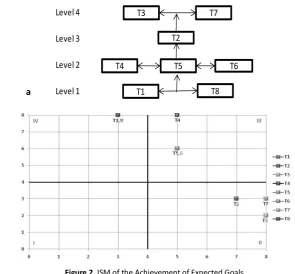
The ISM analysis showed that the achievement of the expected goals has to be conducted in four stages (Fig. 2a). The first stage consists of sub-elements 1 and 8, the second stage includes sub elements 4, 5 and 6, the third stage is sub-element 2, and the fourth stage comprises sub elements 3 and 7. Sub elements that protect coral reef ecosystems as objects and attractions, and sub elements that exploit the potential of attractions inside and outside the region, are the first things that must be considered by the government. This is consistent with the fact that occur in Bunaken National Park, where there is a marked reduction in environmental degradation with extensive coral coverage annually.
Figure 2. ISM ofthe Achievement of Expected Goals
a. Hierarchical structure of sub-element objectives, b. Matrix of Driver Power - Dependence on Sub Elements Objectives. Description: T1-T8 = Gols 1-8, i.e. 1. Protecting coral reef ecosystems as objects and attractions; 2. Ensuring that the
maintenance of security comforts the local environment; 3. Providing a vehicle for research, education and training; 4. Improving the welfare of the community; 5. Strengthening the structure of the regional economy with strong linkages and mutual support among sectors; 6. Expanding employment and increase employment oppor-tunities; 7. Ensuring the maintenance of the existence and potential of culture; 8. Utilizing the potential attractions inside and outside the region.
T6 T4
T8
T3 T7
T1
T2
T5
Level 1 Level 2 Level 3 Level 4
a
Overall attraction utilization potential both within and outside the region can withstand the pressure on the environment of BunakenNational Park. Environment has limitations. It was in their utilization requires knowledge and caring attitude [7]. Management of travel on an ongoing basis with reference to the concept of ecotourism, it is necessary to do in Bunaken National Park to maintain the balance of environmental, socio-economic and socio-cultural functions [8]. Stakeholders supposed to give attention to the sustainability of the important dimensions of governance of protected areas [9]. Ecotourism is a concept that has accommodated tourism demand and tourism supply, where it is seen in the six elements that follow the concept of ecotourism, namely: conservation, education, ethics, sustainable development, impact and local benefit [10].
In the second stage, the necessary things to be done are improving the welfare of society, strengthening the regional economic structure with strong linkages and mutual support among sectors and expanding employment as well as increasing employment opportunities. This needs to be done by the government with reference to the principles of tourism development in a sustainable manner with the orientation on efforts to increase employment opportunities, poverty reduction, environmental protection, good governance, integration among the cross-sectors, cross-regional and cross-offenders, and encourage partnerships public and private sectors. If the potential of the tourism sector can be utilized optimally, then the sector can play an important role in efforts to accelerate economic development as a whole.
The third stage what needs to be done is to ensure the maintenance of security that comforts the local environment. It is very closely related to the tourists who visit that require a sense of security and comfort while in Bunaken National Park. Related to the things mentioned above, where tourists who dive often feel disturbed by motorboats passing through them with close proximity that might cause accidents. When all three phases mentioned above are met, then the other sub elements will go according to their program. Sub elements 4,5 and 6 are included in the third sector which is a sub-element of the hook (Linkage) from other sub-elements. Sub This element needs attention because it is a sub-element which is not stable so that any action on this sub elements will affect impact other sub-elements of involved institutions consisting of 15 sub-elements. ISM results (Fig. 3a) show the agencies that involved in the management of Bunaken National Park the first is sub element 6, Board of Bunaken National Park. Council Bunaken National Park was established by Decree of the Governor of Sulawesi Uatara No. 23 of 2000. Board of Bunaken National Park has a role in terms of mediating without siding (media-tion) and managing conflict (resolu(media-tion) between the parties, helping the security and surveillance, assessing the regional arrangement, and giving consideration to the relevant agencies for issuance of licenses relating to the management of Bunaken National Park.
Next is the Department of Tourism as the party which has the authority and responsibility in the field of tourism. Today the mainstay in the promotion attraction is North Sulawesi Bunaken National Park. As the program launched by the Ministry of Tourism and Creative Economy program at this time is the Destination of Management Organisation (DMO) in a number of tourist sites located throughout Indonesia, and one of them is the Bunaken National Park.
Institutional Management in Bunaken National Park (Tangian & Polii)
Figure 3. ISM of Agencies Involved in the Management of Bunaken National Park
a. Structure of hierarchical sub elements involved institutions. b. Matrix of Driver Power – Dependence of Institutions Involved. Description: L1-L15 = Institutions 1-15, i.e. 1. the Local Community (2), Forestry (3), Department of Fisheries and Marine Resources (4), the Ministry of Environment (5) Hall Bunaken National Park center, (6) the Council of Bunaken National Park, (7), Universities (8) The provincial government (9), District / City (10) Department of Education, (11) Department of Tourism and Creative Economy, (12) the Ministry of Forestry, (13) Environmental NGO, (14) Business and Tourism Services Sector, and (15) the Public.
Any action on the sub elements involved institutions will affect the success of the program management of Bunaken National Park travel. Likewise, the lack of attention to the sub-elements will affect the travel management program failure Bunaken National Park. Sub elements 5, 7 10, 12, 13, and 15 are in quadrant II. Sub-element is the result of actions performed on a sub element above. If the sub-elements above are met, then the sub element is very important.
Strategic Program
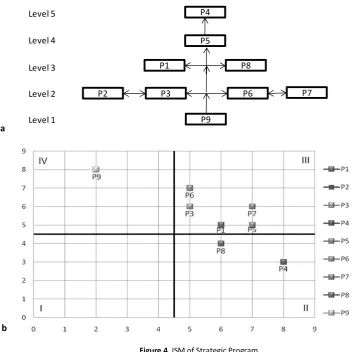
Based on the results of expert opinion, there are nine necessary sub elements of a strategic program. Based on the results of ISM programs and strategies carried out in five phases: the first sub-element 9, the second stage is a sub-element of 2, 3, 6, 7, and the third stage is sub elements 1 and 8 (Fig. 4a).
The program and strategy needed at this time in the management of Bunaken National Parks is setting number of visits. This is consistent with current condition in Bunaken National Park, where the number of tourist arrivals is too high resuling in higher pressure on the environment, which in turn leads to environmental damage. For the next strategy needs to be done is the development of alternative tourism area. Development of alternative area is intended to address the environmental damage caused by greater amount of traffic that exceeds the limit of carrying capacity.
The most important thing to consider in planning tourism development are sustainable ecological, social, economic, and social cultural aspects. Development planning efforts need to involve related stakeholders, to jointly evaluate the advantages and challenges for setting future strategy on an ongoing basis so that tourism can be achieved.
L6 L8 L3
L2 L9 L11
L4
L1 L7
L14 L10
L5 L12
L15 L13
Level 6
Level 5
Level 4
Level 3
Level 2
Level 1 a
Law enforcement needs to be done in terms of the management of Bunaken National Parks, such as offenses committed while performing tourist activity. Such violations may be stepping on corals, anchoring carelessly, feed the fish, and dispose of waste are not in place. When these problems occur also in the National Park Buanaken is rising trash.
Figure 4b shows that the sub-element (9) Establishing the number of visits is included in quadrant IV. Sub This element is a contributing factor to the other sub-elements. This subelement needs serious attention because it is a sub element that has a great driving force (power driver) in travel management of Bunaken National Park, and has a dependency (dependence) is low on the strategy to be achieved.
Sub elements 1, 2, 3, 5, 6, and 7 are entered in the third sector. There are sub elements of a sub-element of the hook (lingkages) of sub other elements. Sub elements in this sector have a great driving force (power driver)that greatly contribute to the success of the program, but they have a great dependency (dependence). Any action on the sub elements institutions involved will affect the success of program management strategies of Bunaken National Park travel. Likewise, the lack of attention to the sub-elements will affect the travel management program failure of Bunaken National Park. Sub elements 4 and 8 are included in quadrant II. This sub-element is the result of actions performed on a sub element above. If the sub-elements above are met, then the sub element is very important.
Figure 4. ISM of Strategic Program
a. Hierarchical Structure of program strategies, b. Matrix Driver Power - dependence on desirable strategy program
Description: P1-P9 = Strategic program 1-9, i.e. 1. Preparation of clear rules and firm; 2. Development of area of alternative; 3. law enforcement; 4. Increased community involvement in aspects of control; 5. business development outside of Bunaken National Park; 6. Determination of zoning; 7. Enhancement of the public through craft industry; 8. Limitation of visit time; 9. Establishment of the number of visits.
P9
P3 P6 P7
P2
P1 P8
P5 P4 Level 5
Level 4
Level 3
Level 2
Level 1
a
Institutional Management in Bunaken National Park (Tangian & Polii)
The Main Obstacle Courses
Based on the expert opinion, 11 sub-elements become obstacles. The results of the analysis of ISM, major program constraint in the manage-ment of Bunaken National Park carried out in six stages (Fig. 5a). The first stage is is sub-element (9) Low commitment of the actors involved, the second stage is a sub element (1) Lack of management of National Park, and the third stage is a sub-element (3) Low Knowledge and Public Awareness, and sub elements (6) the lack of coordination in the management of the National Park. The sub elements need attention from the government to achieve the objectives of the program management of Bunaken National Park travel. The principle of conservation area management is based on ownership,
co-operation and co-responsibility [11]. The principle of co-ownership, is a common travel area for the utilization and protection carried out jointly based on the value of local wisdom and culture technology. In planning these aspects, we should consider to be successful in the management. In relation to the principle of co-operation, the ecotourism area management has something to do with the principle of setting the respective roles that can be done by the community and all stakeholders [12]. The principle of co-responsibility in the management of the area for ecotourism, protection activities and regional development are a shared responsibility among government, communities and all stakeholders.
Figure 5. ISM of Main Obstacles in Bunaken National Park
a. Structure of the program's main constraint hierarchy, b. Matrix power drivers - the main obstacle of dependence program Description: K1-K11 = Obstacle 1-11, i.e. 1. Lack of national park management; 2. Limitations of the quality and quantity of
human resources for securing and managing national parks; 3. Lack of knowledge and community care; 4. low income of local communities around the national park; 5. the low level of education of local communities around national parks; 6. lack of coordination in the management of national parks; 7. lack of involvement of local communities; 8. the difference of interest among stakeholders; 9. lack of commitment of the actors involved; 10. lack of coordination among institutions; 11. low management.
a
Governments have a a great influence in the management of Bunaken National Park based society. One of the policies that needs to be done by the local government is to foster and encourage local communities and form a community institution that is able to manage Bunaken National Park. Involvement of local communities in the management of travel will have a positive impact both on the government, the environment and society itself [12].
Community-based management can be defined as a system of natural resources management in a place where the local people in these places are actively involved in the management of natural resources contained therein. Thus the public will feel concerned with the resource as a unity in life [13].
Figure 5b shows the sub-element (1) Lack of national park management, sub-element (3) Lack of knowledge of benefits and community care, sub-element (6) lack of coordination in the management of national park, and the sub-element (9) Low commitment of the actors involved is at sector IV. Sub This element was a contributing factor to the other sub-elements. Sub This element needs serious attention managing national parks and sub-element (10) lack of coordination among agencies that are in quadrant III. Sub elementsabove area sub-element of the hook (lingkages) of other sub elements. Sub elements in this sector have a great driving force (power driver), but it has a great dependency (dependence) as well. Any action on the sub element of this constraint will affect the success of the tourism management of Bunaken National Park. Likewise, the lack of attention to the sub-elements will affect the tourism management failures in Bunaken National Park.
Sub elements (4) Low income communities, sub-element (5) The low level of education of local communities around Bunaken National Park, sub element (8) The difference of interest among stakeholders, and sub-element (11) Low entry management are in quadrant II.This sub-element is the result of actions performed on a sub element above. If the sub-elements above are fulfilled, then the sub element becomes very important. considered by the government. This is consistent with the fact that occurs in Bunaken National Park, where there is a marked reduction in environmental degradation with extensive coral coverage annually.
Institutions involved in the management of Bunaken National Parkare is the first sub element of Board of Bunaken National Park. The board has a role in terms of mediating without siding (mediation) and managing conflict (resolution) between the parties, helping the security and surveillance, assessing the arrangement of the region, as well as giving consideration to the relevant agencies for issuance of licenses relating to the management of Bunaken National Park.
Sub elements of setting number of visits is a program and a strategy that is needed today in the tourism management of Bunaken National Park. This is consistent with the current condition in Bunaken National Park,where the number of tourist arrivals is too high (exceeding the carrying capacity limits) causing higher pressure on the environment, which in turn leads to damage to the environment.
Sub elements of the lack of commitment of the actors involved need to get the government's attention for the achievement of the tourism management program Bunaken National Park. The principle of co-ownership is a common area of tourism for the utilization and protection carried out jointly based on the value of local wisdom and culture.
REFERENCES
[1] Supit, A. A. G. 2007. Impact of tourism visit toward change of coral reefs condition in Bunaken Island North Sulawesi Province. Master Thesis. Program of Environmental Studies. Bogor Agricultural University. Bogor.
[2] Mangkudilaga, S. 2000. Participation pover-ty alleviation tourism. Scientific Manage-ment EnvironManage-ment 2(7), 9-16.
Institutional Management in Bunaken National Park (Tangian & Polii)
[4] Rydin, Y., N. Holman and E. Wolff. 2003. Local sustainability indicators. Local Envi-ronment 8(6), 581–589.
[5] Bunaken National Park. 2008. Zonation of Bunaken National Park, North Sulawesi. Office of BUnaken National Park.
[6] Marimin. 2004. Decision making compound criteria of technique and application. Gramedia Widiasarana Indonesia. Jakarta. [7] Gilbert, R. 2003. Ecotourism and education
for sustainability: a critical approach. International Review for Environmental Strategies 4(1), 75 – 83.
[8] Eryadi, A. and H. Erkus. 2010. Environmental governance for sustainable tourism development: collaborative net-works and organisation building in the Antalya tourism region. Journal of the Tourism Management 31, 113–124.
[9] Bawole. 2012. Analysis and mapping of stakeholders in traditional use zone within marine protected area. Journal of Tropical Forest Management 2, 110-117.
[10] McIntosh, R. W., C. R. Goeldner and J. R. B. Ritchie. 1995. Tourism principles, practice philosophies. Willey. New York.
[11] Tangian, D. and Supit A. 2009. Introduction ecotourism. State Polytechnic of Manado. Manado.
[12] Kiss, A. 2004. Is community-based eco-tourism a good use of biodiversity conservation funds?. Trends in Ecology and Evolution 19(5), 232-237.
![Figure 1. Map of Research location[5]](https://thumb-ap.123doks.com/thumbv2/123dok/2888184.1697520/3.595.76.490.349.721/figure-map-of-research-location.webp)