Detection of Genotype D8 Measles virus in Indonesia in 2014
DOI: 10.22435/hsji.v8i1.6445.
Subangkit
1, Mursinah
1, Rudi Hendro Putranto
2, Vivi Setiawaty
11 Research and Development Center for Biomedical and Basic Health Technology, National Insitute of Health
Research and Development, Ministry of Health, Jakarta, Indonesia
2 Research and Development Center for Health Resources and Services, National Insitute of Health Research
and Development, Ministry of Health, Jakarta, Indonesia
Corresponding address: Subangkit, S. Si, MBiomed Email: [email protected]
Received: March 29, 2017; Revised: April 24, 2017 Accepted: May 8, 2017
Abstrak
Latar Belakang: Campak adalah salah satu penyakit menular dan dapat menyebabkan penyakit serius sampai kematian. Campak masih merupakan masalah kesehatan masyarakat karena wabah campak masih terjadi di seluruh Indonesia. Surveilans berbasis laboratorium berikut penyelidikan epidemiologi molekuler memiliki kontribusi besar untuk mencegah wabah campak. Studi sebelumnya telah mendokumentasikan kehadiran genotipe virus campak G2, G3 dan D9 di Indonesia, dan genotipe lainnya seperti B3, D4, D5, D8 dan H1 telah terdeteksi di negara-negara tetangga. Penelitian ini bertujuan untuk mengkarakterisasi virus campak yang menyebabkan wabah di Indonesia pada tahun 2014.
Metode: Tujuh puluh empat spesimen urin yang dikumpulkan dari delapan provinsi dan diperiksa secara RT-PCR satu langkah serta metode sekuensing Sanger. Analisis sekuensing dilakukan dengan menggunakan perangkat lunak Bioedit 7.1; DNAstar 7.0 dan MEGA 5.0.
Hasil: Hasil PCR menunjukkan 34 dari 74 spesimen klinis positif dari virus campak. Kami menemukan genotipe dari 34 virus campak milik genotipe D8, D9 dan G3.
Kesimpulan: Campak pertama genotipe D8 telah terdeteksi dari Indonesia pada tahun 2014 meskipun campak lainnya genotipe masih dapat ditemukan di Indonesia. (Health Science Journal of Indonesia 2017;8(1):7-11) Kata kunci: virus campak, D8 genotipe, wabah, Indonesia
Abstract
Background: Measles is a highly contagious viral disease. It remains an important cause of death among young children globally, despite the availability of a safe and effective vaccine. Measles is still a public health problem in Indonesia and measles outbreak still reported from many areas throughout Indonesia.. Molecular epidemiology of measles viruses is an important component in outbreak investigations to to monitor the presence of circulating wild–type measles strains. Previous studies in Indonesia have documented the presence of measles virus genotypes G2, G3 and D9 in Indonesia, and the other genotypes such as B3, D4, D5, D8 and H1 have been detected in neighboring countries. This study aims to characterize the measles virus that causing outbreak in Indonesia in 2014.
Methods: Seventy four urine specimens were collected from eight provinces and examined by one step RT-PCR and Sanger sequencing method. Sequencing analysis were conducted using Bioedit 7.1; DNA Star 7.0 and MEGA 5.0 software.
Results: The PCR results showed 34 out of 74 clinical specimens positive of measles virus. We found the genotype of 34 measles viruses belongs to genotype D8, D9 and G3.
Conclusion: The first measles genotype D8 has been detected from Indonesia in 2014 although other measles genotype still can be found in Indonesia. (Health Science Journal of Indonesia 2017;8(1):7-11)
Measles is one of the most infectious human diseases and can cause serious illness, lifelong complications and deaths. Measles is still a public health problem in Indonesia since the measles outbreak still occurred throughout the country. Therefore, virology surveillance following molecular epidemiology investigations have a major contribution to prevent and control of measles.1There are eight clades (A – H) of measles virus and have been divided into 22 genotypes. Clade A, E and F contain only one genotype, while clade B, C, D, G and H contain multiple genotypes; B1-3, C1-2, D1-10, G1-3, H1-2.2 Previous studies have documented the presence of measles virus genotypes G2, G3 and D9 in Indonesia, and the other genotypes such as B3, D4, D5, D8 and H1 have been detected in neighboringcountries.3 Genotype B3 was
first detected in 1993 in Gambia but has subsequently been detected in cases from Philippines and Papua New Guinea.4 Genotypes D4 and H1 appear to have been co-circulating in Australia.3Genotype D8 is associated with endemic transmission in India, Bangladesh and Nepal.5Genotype D8 also associated with importation in Australia, Japan, Malaysia and Singapore.6,7
Measles is one of the vaccine-preventable diseases, and the world measles vaccination coverage for the first dose was 84%.8 Indonesia measles vaccination
coverage for the first dose of measles vaccine was 97.85% in 2013 and 94.76% in 2014.9 The available measles vaccine recently should be enough to provide protection since serum from a vaccinated person can neutralized all measles genotypes, although the efficiency varies.10 Although it was high vaccination coverage, the outbreak still occurred sporadically in several provinces. The number of measles cases was reported from surveillance increasing from 11521 in 2013 to 12943 in 2014.9 Accordingly, it is necessary to do the molecular testing to determine genotypes of measles virus that cause outbreaks and can help identify the epidemiological association between cases in a region with an outbreak location and discover importation cases. Here we report the complete genome sequence of wild-type measles virus isolated from measles cases during measles outbreaks reported in Indonesia in 2014.
Measles surveillance with laboratory confirmation of suspected cases has been implemented in Indonesia since 2003.11 The laboratory test has been expand to
molecular based for measles genetic characterization. Baseline data on circulating measles virus genotypes are needed for measles elimination, but such data are not available especially in measles outbreak.9 In this context, we performed a pilot genetic analysis of the measles virus strains that was collected during outbreak measles in 2014. This study aims to characterize the genotypes of measles virus that caused outbreaks in Indonesia during 2014.
METHODS
Measles cases were identified and classified according to the World Health Organization (WHO) and national guidelines.12 The urine was collected from suspected measles cases reported during January – November 2014 outbreaks. Measles virus were detected by RT-PCR assay13 at virology laboratory of the National Insitute of Health Research and Development (NIHRD), Jakarta.
The RNA has been extracted directly from the samples using Viral RNA Mini Kit (Qiagen, Hilden, Germany) and performed reverse transcription PCR using a One StepRT-PCR kit (Qiagen) with previously described primers.14 Virus genotyping was based on the 450-nt coding sequence for the carboxyl terminus of nucleoprotein (N) of measles virus, as recommended by the World Health Organization.15Amplicons were subjected to bidirectional sequencing using a Big Dye Terminator v3.1 cycle sequencing kit (Applied Biosystems, Foster City, CA, USA). We edited and aligned nucleotide sequences using Bio Edit 7.1 and DNA Star 7.0 software.16,17 Phylogenetic analysis was performed by using the Neighbour Joining method implemented in the MEGA 5 program to compare the determined N gene sequences with the World Health Organization reference sequences.1
RESULTS
There were 74 measles suspected cases were reported during the outbreaks from 8 provinces. The data of the cases were presented on the tabel 1.
All provincesreported positive results, except Kepulauan Riau province.
Table 1. Demography status of measles suspected cases
Demography status Frequency Percent (%)
Sex
Male 43 58
Female 31 42
Age
Less than 1 year old 13 17.6
1 - 4 years old 27 36.5
5 - 14 years old 26 35.1
15 - 46 years old 8 10.8
Table 2. Urine Specimen 2014 by Provinces
Provinces n RT-PCR
Positive Results (%) Genotype
Bangka Belitung 4 1 (25) D8
DKI Jakarta 2 2 (100) D8, D9
Jambi 28 12 (43) D8, D9, G3
Center Kalimantan 5 2 (40) D9
East Kalimantan 3 2 (67) D9
Kepulauan Riau 2 0 (0)
-Riau 9 2 (22) D9
South Sumatera 21 13 (62) D8, D9
Total 74 34 (46)
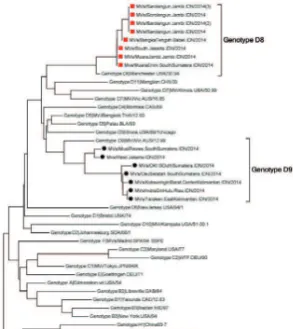
Phylogenetic analysis revealed measles virus strains
circulated in Indonesia are genotype G3, D9 and D8 (Figure 1).
The distribution of measles genotypes can be seen in figure 2. There are two genotypes of which D9 and G3 which are still circulating in Indonesia. The Genotype D9 was detected in 5 provinces and Genotype G3 was only detected in Jambi Province. The Genotype D8 was detected in 4 provinces.
DISCUSSION
Measles virus identification by molecular assay through virology based surveillance prior to 2007 indicated that genotypes G2, G3, and D9 appeared to be the endemic genotypes in Indonesia and East Timor.18 Genotype G2 has been detected in Indonesia in the early 2000s,19 but no report for re-circulating.1 Until recently, G3 and D9 are still circulating in Indonesia. This is understandable because the genetic measles virus is very stable and only slight variations in the sequences that occur in the long term. Mutation rate of measles virus ranged from 4-5 x 10⁻⁴ substitutions per base per year. The base substitution rate of the measles virus is lower than the estimated rate of substitution of other RNA viruses such as Influenza A, human immunodeficiency virus
Figure. 1. Phylogenetic Measles virus in Indonesia, 2014 (based on NJ Methods)
type 1 (HIV-1) which have ranged between 1.6 x 10⁻³ substitutions per base per year.20
Interestingly, we detected a novel measles virus strain, D8 genotype, from measles outbreak in several provinces in Indonesia. Mainly, the Genotype D8 was found in Malaysia,21Thailand22 and Singapore.7 During January – November 2014, Singapore also reported the D8 genotype in local residents. On the otherhand, Singapore also reported one imported cases of D8 genotype from Indonesia.23 The D8 genotype that was detected in four provinces in Indonesia may be caused by infection of measles virus from outside of Indonesia, likely from neighboring countries. The results of the analysis using the BLAST-ncbi showed measles virus genotype D8 is closely related to the virus found in Kuala Lumpur (Malaysia) and Australia.24 Nowadays the transportations across country borders are increasing rapidly and that it will increase the infection during the travelling. People from Indonesia can get infections including measles from foreigners and vice versa so measles genotypes that are found can be different from endemic genotype circulated in Indonesia. Since Measles can spread to many people easily by the respiratory route, including airborne transmission.
In 2014 the National Institute of Health Research and Development Ministry of Health Indonesia only received urine samples from 8 provinces in which 4 provinces were found to have genotype D8. The possibility of D8 genotype already existed in Indonesia before 2014 but not detected based on the fact that the focus of surveillance based on IgM detection and the delivery of virological specimens (urine) is still very low and did not cover all provinces. Indonesia has 34 provinces so it is necessary to conduct further studies with samples from a wider `geographic area of Indonesia to determine the spread and genetic diversity of these strains and ascertain their relationship to the global D8 strains. It would also be of interest to determine whether D8 strains co-circulate with G3 and D9 strains, whether they will eventually replace G3 as the predominant genotype in Indonesia.
Although there are many genetic variations of measles virus, but the virus has only one serotype which showed a high similarity of the entire surface antigen of measles virus genotype. Based on this, the antibodies due to vaccination or natural immunity can neutralize the entire genotype measles virus albeit with neutralization capabilities are different.
In conclusion, the first measles genotype D8 has been detected from Indonesia in 2014 alongside with genotype D9 and G3 which are endemic measles genotype in Indonesia. Molecular epidemiology of measles viruses is an important component in outbreak investigations to monitor the presence of circulating wild–type measles strains.
Acknowledgments
We would like to thank to Director of Research and Development Center for Biomedical and Basic Health Technology, National Insitute of Health Research and Development, Jakarta, Indonesia who give full support for the virological surveillance activity. We gratefully acknowledge the district health officers who provided the reports of the outbreak cases and assist for specimens collecton. The funding of this Project was supported by Indonesian Government and WHO. The authors would like to thank to Measles-Rubella Laboratory Network in Indonesia.
REFERENCES
1. Rota PA, Brown KE, Hübschen JM, et al. Improving global virologic surveillance for measles and rubella. Journal of Infectious Diseases 2011;204:S506-S13. 2. Lochlainn LN, Mandal S, de Sousa R, et al. A unique
measles B3 cluster in the United Kingdom and the Netherlands linked to air travel and transit at a large international airport, February to April 2014. Eurosurveillance 2016;21.
3. Rota P, Featherstone D, Bellini W. Molecular epidemiology of measles virus. Measles: Springer;2009:129-50. 4. Rota J. Identical Genotype B3 Sequences from Measles
Patients in 4 Countries, 2005-Volume 12, Number 11— November 2006-Emerging Infectious Disease journal-CDC. 2006.
5. Urone N, Colomba C, Ferraro D. Characterization of measles virus strains circulating in Southern Italy (Palermo area, Sicily) between 2010 and 2011. Infection, Genetics and Evolution 2016;38:117-21.
6. Heywood AE, Gidding HF, Riddell MA, et al.. Elimination of endemic measles transmission in Australia. Bulletin of the World Health Organization 2009;87:64-71.
7. Ho HJ, Low C, Ang LW, et al. Progress towards measles elimination in Singapore. Vaccine 2014;32:6927-33. 8. Harris JB, Gacic-Dobo M, Eggers R, et al. Global routine
vaccination coverage, 2013. MMWR Morb Mortal Wkly Rep 2014;63:1055-8.
9. Indonesia MoH. Indonesia Health Profile 2014. Jakarta:
Ministry Of Health RI; 2015. Report No.: 978-602-235-949-4.
of measles: A highly contagious and vaccine preventable disease-what went wrong in Africa? Journal of Cell and Animal Biology 2013;3:119-40.
11. Perry RT, Gacic-Dobo M, Dabbagh A, et al. Progress toward regional measles elimination-worldwide, 2000-2013. MMWR Morb Mortal Wkly Rep 2014;63:1034-8. 12. Organization WH. Manual for the laboratory diagnosis
of measles and rubella virus infection. 2007.
13. Piccirilli G, Chiereghin A, Pascucci MG, et al. Molecular detection and genetic characterization of circulating measles virus in northern Italy. Journal of Clinical Virology 2016;81:34-42.
14. Figueiredo CA, Yu ALF, Afonso AMS, et al. Molecular analysis of rubella virus in travelers suspected of measles infection in São Paulo, Brazil. Revista da Associação Médica Brasileira (English Edition) 2012;58:527-31. 15. Kalaycioglu AT, Yolbakan S, Guldemir D, et al. Towards
measles elimination: Phylogenetic analysis of measles
viruses in Turkey (2012–2013) and identification of geno
type D8. Journal of medical virology 2016;88:1867-73. 16. Hall BG. Phylogenetic trees made easy: a how-to
manual: Sinauer Associates Sunderland, MA; 2004.
17. Tamura K, Peterson D, Peterson N, et al. MEGA5: molecular evolutionary genetics analysis using maxi-mum likelihood, evolutionary distance, and maximaxi-mum parsimony methods. Molecular biology and evolution 2011;28:2731-9.
18. Chibo D, Riddell M, Catton M, et al. Novel measles virus genotype, East Timor and Australia. Emerging infectious diseases 2002;8:735-7.
19. Rota PA, Liffick S, Rosenthal S, et al. Measles
genotype G2 in Indonesia and Malaysia. The Lancet 2000;355:1557-8.
20. Beaty SM, Lee B. Constraints on the genetic and antigenic variability of measles virus. Viruses 2016;8:109.
21. Amendola A, Bianchi S, Lai A, et al. Measles re-emergence in Northern Italy: Pathways of measles virus genotype D8, 2013–2014. Infection, Genetics and Evolution 2017;48:120-6.
22. Patel MK. Progress Toward Regional Measles Elimination—Worldwide, 2000–2015. MMWR Morbidity and Mortality Weekly Report 2016;65.
23. Singapore MoH. Communicable Diseases Surveillance in Singapore 2014 Annual Report. Singapore: Ministry Of Health Singapore; 2015.