UNIVERSITI TEKNIKAL MALAYSIA MELAKA
A STUDY ON THE RELATIONSHIP BETWEEN EFFECT OF DIFFERENT TYRE PRESSURE, WEIGHT LOAD AND FUEL CONSUMPTION BY
USING STATISTICAL ANALYSIS
This report is submitted in accordance with the requirement of the Universiti Teknikal Malaysia Melaka (UTeM) for the Bachelor of Mechanical Engineering Technology
(Automotive) with Honours.
by
MOHD ADI HAFRIZ BIN MOHD RAZALI B071510177
931120-14-6705
FACULTY OF ENGINEERING TECHNOLOGY
2018
FACULTY OF MECHANICAL AND MANUFACTURING ENGINEERING TECHNOLOGY
Tajuk: “A study on the relationship between effect of different tyre pressure, weight load and fuel consumption by using statistical analysis”
Sesi Pengajian: 2019
Saya MOHD ADI HAFRIZ BIN MOHD RAZALI mengaku membenarkan Laporan PSM ini disimpan di Perpustakaan Universiti Teknikal Malaysia Melaka (UTeM) dengan syarat-syarat kegunaan seperti berikut:
1. Laporan PSM adalah hak milik Universiti Teknikal Malaysia Melaka dan penulis. 2. Perpustakaan Universiti Teknikal Malaysia Melaka dibenarkan membuat salinan untuk
tujuan pengajian sahaja dengan izin penulis.
3. Perpustakaan dibenarkan membuat salinan laporan PSM ini sebagai bahan pertukaran antara institusi pengajian tinggi.
4. **Sila tandakan (X)
☐
SULIT* Mengandungi maklumat yang berdarjah keselamatan atau kepentingan Malaysia sebagaimana yang termaktub dalam AKTA RAHSIA RASMI 1972.☐
TERHAD* Mengandungi maklumat TERHAD yang telah ditentukan oleh organisasi/badan di mana penyelidikan dijalankan.☒
TIDAK TERHADYang benar, Disahkan oleh penyelia:
... ... MOHD ADI HAFRIZ BIN MOHD
RAZALI
Alamat Tetap: Cop Rasmi Penyelia
No 18 Jalan 13/23B,
Taman Danau Kota, Setapak, 53300 Kuala Lumpur
Tarikh: Tarikh:
UNIVERSITI TEKNIKAL MALAYSIA MELAKA
BORANG PENGESAHAN STATUS LAPORAN PROJEK SARJANA MUDA
*Jika Laporan PSM ini SULIT atau TERHAD, sila lampirkan surat daripada pihak berkuasa/organisasi berkenaan dengan menyatakan sekali sebab dan tempoh laporan PSM ini perlu dikelaskan sebagai SULIT atau TERHAD.
i
DECLARATION
I hereby, declared this report entitled “A study on the relationship between effect of different tyre pressure, weight load and fuel consumption by using statistical analysis” is the results of my own research except as cited in references.
Signature : ………
Author : MOHD ADI HAFRIZ BIN MOHD RAZALI
ii APPROVAL
This report is submitted to the Faculty of Mechanical and Manufacturing Engineering Technology of Universiti Teknikal Malaysia Melaka (UTeM) as a partial fulfilment of the requirements for the degree of Bachelor of Mechanical Engineering Technology (Automotive) with Honours. The member of the supervisory is as follow:
Signature : ………. Supervisor : MDM NURUL AMIRA BINTI ZAINAL
iii ABSTRAK
Oleh kerana harga minyak mentah dunia kebelakangan ini sering naik, banyak negara turut mengalami kenaikan harga petrol. Di Malaysia, minyak petrol dijual dalam dua jenis gred iaitu RON 95 dan RON 97 manakala untuk kenderaan berat akan menggunakan diesel. Harga minyak di Malaysia juga dikawal oleh kerajaan Malaysia. Menjelang akhir tahun 2017, harga minyak di Malaysia berubah setiap minggu iaitu pada hari Khamis. Oleh yang demikian, pengguna akan berusaha untuk menjimatkan kadar penggunaan minyak pada setiap hari. Kedua-dua petrol RON 95 dan RON 97 mempunyai nilai oktana yang berbeza dan juga mempunyai tahap pembakaran yang berlainan di dalam enjin pembakaran. Terdapat beberapa faktor yang boleh mempengaruhi pembakaran di dalam enjin kenderaan. Selain itu, terdapat juga faktor-faktor lain yang boleh mempengaruhi kadar penggunaan minyak pada setiap hari seperti, kapasiti enjin kereta itu sendiri, jumlah beban yang dibawa di dalam kenderaan, keadaan suhu disekeliling seperti suhu berlainan di waktu pagi, tengah hari dan juga malam. Tambahan pula, cara pemanduan juga memainkan peranan penting dalam penggunaan kadar petrol di dalam enjin seperti memandu pada had laju yang tidak sekata dan memandu dengan cara yang agresif ataupun memecut kenderaan dengan kadar segera. Selain itu, tekanan tayar juga boleh mempengaruhi kadar pengunaan minyak pada sesebuah kenderaan, kerana ianya boleh meningkatkan kadar rintangan terhadap tayar kenderaan. Semakin kurang kadar rintangan terhadap tayar, semakin kurang kadar penggunaan minyak terhadap kenderaan. Dalam kaedah penyelidikan ini, beberapa kaedah telah digunakan seperti bahan bacaan dari jurnal dalam talian, pengumpulan data daripada bacaan meter minyak yang masuk di dalam enjin yang akan dipasang pada laluan minyak dan kiraan menggunakan kaedah statistik. Data kemudian dianalisis dan faktor yang paling mempengaruhi kadar penggunaan minyak di dalam kenderaan akan ditentukan. Oleh itu, kajian ini dijalankan untuk mengkaji samada tekanan tayar yang berlainan dan berat bebanan boleh mempengaruhi kadar penggunaan minyak terhadap sesebuah kenderaan atau tidak.
iv ABSTRACT
Due to world's crude oil prices that are increasing lately, many countries are also experiencing a rise in petrol prices. In Malaysia, petrol is sold in two types of grade, RON 95 and RON 97 while diesel is used for heavy vehicles. Fuel prices in Malaysia are controlled by the Malaysian government. By the end of 2017, oil prices in Malaysia becomes fluctuate every week, which is on Thursday. Consequently, consumers seek to save on the daily rate of fuel consumption. Both RON 95 and RON 97 petrol have different octane values and also have a different combustion levels in the combustion engine. There are several factors that can affect combustion in the engine. In addition, there are also some other factors that can affect the daily rate of fuel consumption such as the engine capacity of the car itself, the amount of load carried on the vehicle, the temperature surrounding as in the morning, noon and even night. Additionally, driving can also play an important role in the use of gasoline in the engine such as driving at uneven speed and driving in an aggressive manner or accelerating the vehicle quickly. Moreover, tyre pressure are also affect the fuel consumption rate of a vehicle, as it can increase the rolling resistance of the vehicle's tyre. The less resistance the tyre is, the less fuel consumption the vehicle uses. In this research, several methods have been used such as reading materials from online journals, data collection from fuel counter meter that will be installed on the fuel line to calculate the data statistically. The data can be analyzed and the factors that most affect the fuel consumption in the vehicle will be determined. Therefore, this study is conducted to investigate either different tyre pressure and weight load can affect the fuel consumption of a vehicle or not.
v
DEDICATION
To my beloved mother and father, my family, my lecturer and my fellow friends, thank you for the support and help given to me on completing this thesis.
vi
ACKNOWLEDGEMENT
Firstly, thanks to Allah for giving me the opportunity to complete this “Final Year Project” with flying colors. I also like to thank my parents for encouraging me and keep supporting on my studies. I would not be in this university for my degree project without their permission and blessing. Not forget to thanks my supervisor, Puan Nurul Amira Binti Zainal for guiding me and provide me with new knowledge in this project involving statistical analysis and succeed in completing this project and report. Besides that, I would like to thanks to all my fellow friends that helps me on my experiment, giving their opinion and sharing knowledge together. Lastly, I would like to thanks to anyone that contribute in my final year project and for giving me the support and help to makes this project and report success.
vii
TABLE OF CONTENTS
PAGE
1.0 Introduction 1
1.1 Background of The Study 1
1.2 Problem Statement 2 1.3 Objective of Study 3 1.4 Scope of Study 3 1.5 Expected Outcome 4 2.0 Introduction 5 2.1 Background Study 5
2.2 Factor That Effecting Fuel Consumption 7
viii
2.4 Statistic of Fuel Consumption in Malaysia 24
3.0 Introduction 29 3.1 Flow Chart 29 3.2 Method of Experiment 31 3.2.7.1 Road Selection 36
3.2.7.2 Data Collection 37
3.2.7.3 Pressure Gauge Device 38
3.3 Statistical Analysis (ANOVA) 39
3.4 Minitab Software 40 4.0 Introduction 43 4.1 Data Collected 43
4.1.1.2 Tyre Pressure vs Fuel Consumption (Afternoon) 49
4.1.1.3 Tyre Pressure vs Fuel Consumption (Evening) 50
4.1.1.4 Passenger Load vs Fuel Consumption (Morning) 51
ix
4.1.1.6 Passenger Load vs Fuel Consumption (Evening) 54
5.0 Introduction 78
5.1 Summary of Studies 78
5.2 Achievement of Objective 79
x
LIST OF TABLES
TABLE TITLE PAGE
Table 2.1: Engine Specifications for Proton Vehicle 8 Table 2.2: Engine Specifications for Perodua Vehicle 10 Table 2.3: Source: Continental Malaysia, Side Wall Tyre Information 18 Table 2.4: Source: Continental Malaysia, Vehicle Tyre Speed Index 19
Table 2.5: Example of Tyre Design 19
Table 3.1: Template for Recorded Data Tyre Pressure 35 Table 3.2: Template for Recorded Data Number of Passenger 35 Table 4.1: Data Recorded for Different Tyre Pressure 44 Table 4.2: Data Recorded for Different Weight Load of Passenger 45
xi
LIST OF FIGURES
FIGURE TITLE PAGE
Figure 2.1: Four Stroke Engine Cycle 11
Figure 2.2: Fuel Consumption Data for Eight Different Vehicles Tested Fuel 14
Figure 2.3: Tyre Structure 17
Figure 2.4: Continental Malaysia Tyre 18
Figure 2.5: Inflation Tyre and Correct Inflation Tyre 22 Figure 2.6: Statistic of Crude Oil Production 2005-2015 24 Figure 2.7: Statistic of Crude Oil Import and Export 25 Figure 2.8: Statistic of Malaysia Reserve of Crude Oil 26 Figure 2.9: Statistic of Final Consumption of Petroleum Product 27
Figure 3.1: Flow Chart 30
Figure 3.2: Example of Fuel Counter Device 33
Figure 3.3: Experimental Diagram 34
Figure 3.4: Map of Experiment Track 37
Figure 3.5: Data Collection Meter 38
Figure 3.6: Pressure Gauge 39
Figure 3.7: Minitab Worksheet 41
xii
Figure 3.9: Minitab Histogram Window 42
Figure 3.10: Minitab Menu 42
Figure 4.1: Tyre Pressure vs Fuel Consumption 46
Figure 4.2: Tyre Pressure Index Perodua Myvi 47
Figure 4.3: Load of Passenger vs Fuel Consumption 47
Figure 4.4: Tyre Pressure vs Morning Data 48
Figure 4.5: Correlation Result in Minitab 49
Figure 4.6: Tyre Pressure vs Afternoon Data 49
Figure 4.7: Correlation Result in Minitab 50
Figure 4.8: Tyre Pressure vs Evening Data 50
Figure 4.9: Correlation Result in Minitab 51
Figure 4.10: Passenger Load vs Morning Data 51
Figure 4.11: Correlation Result in Minitab 52
Figure 4.12: Passenger Load vs Afternoon Data 53
Figure 4.13: Correlation Result in Minitab 53
Figure 4.14: Passenger Load vs Evening Data 54
Figure 4.15: Correlation Result in Minitab 54
Figure 4.16: Analysis of Variance for Fuel Consumption vs Load 55
Figure 4.17: F-Distribution Table 57
Figure 4.18: F-Ratio Graph 58
xiii
Figure 4.20: Residual Plots for Fuel Consumption 60
Figure 4.21: Normality Test For Error Residual 61
Figure 4.22: Probability Plot of Fuel Consumption 67kg of Passenger Load 62 Figure 4.23: Probability Plot of Fuel Consumption 131kg of Passenger Load 63 Figure 4.24: Probability Plot of Fuel Consumption 194kg of Passenger Load 64 Figure 4.25: Grouping Information Using Tukey Method and 95% Confident 65 Figure 4.26: Tukey Simultaneous 95% CIs for Fuel Consumption and Passenger Load 66 Figure 4.27: Analysis of Variance for Fuel Consumption vs Different Tyre Pressure 67
Figure 4.28: F-Distribution Table 68
Figure 4.29: F-Ratio Graph 69
Figure 4.30: Boxplot of Fuel Consumption 70
Figure 4.31: Residual Plots for Fuel Consumption 71
Figure 4.32: Normality Test for Error Residual 72
Figure 4.33: Probability Plot of Fuel Consumption at Tyre Pressure 28psi 73 Figure 4.34: Probability Plot of Fuel Consumption at Tyre Pressure 30psi 74 Figure 4.35: Probability Plot of Fuel Consumption at Tyre Pressure 32psi 75 Figure 4.36: Grouping Information Using Tukey Method and 95% Confident 76 Figure 4.37: Tukey Simultaneous 95% CIs for Fuel Consumption and Tyre Pressure 77
1
INTRODUCTION
1.0 Introduction
This section explains the objective and the scope of this study, the problem statement and also the research significant is presented. In this study, the factor of fuel consumption is analyzed on the local (national) car which is Perodua MYVI Icon Special Edition, manufactured in 2015. Some other factors that may affect the fuel consumption of a car are also investigated.
1.1 Background of the Study
Nowadays, a number of the vehicles used is increase from day to days. Fuel consumption rate is important to minimize fuel waste in incorrect tyre conditions. Vehicle tyre that is not in a good condition may increase fuel consumption rate. In addition, poor tyre pressure condition may cause vehicle tyre to be damaged. There are other consequences such as when making cornering, tyre surface does not fully contact to the road surface and this can make the driver lose control of the vehicles. Moreover, there are other problems such as increasing the rolling resistance of the tyre, that directly leading to the increasing of the fuel consumption. The optimized amount of air in the tyres is based on the different driving condition such as road quality and driving styles. For examples on the highway, the vehicle operates at a constant velocity most of the time and the tyres require a low rolling resistance to achieve better fuel efficiency (Varghese, 2013). This experiment aim to investigate and analyse the effects of tyre inflation pressure
2
on the vehicle and calculate the fuel consumption with different tyre pressure. Malaysia has several types of fuel such as RON95, RON97, and diesel. This experiment used RON95 to investigate the objectives of this study. Actually, RON is a Research Octane Number and it is an investigation for the anti-knock quality for gasoline engine (Leppard et al., 1990). Usually, engine that used RON contained a spark plug as the spark ignition to burn the fuel in combustion chamber. Differ with diesel type, it used a compression and fuel injector to burn the diesel in the combustion chamber. Actually, in this study we focused on SI engine (Spark Ignition). We fixed the time to run this experiment at certain period in the morning, afternoon and night with different tyre pressure and number of passenger in a vehicle. Then, we investigate and analyzed the collected data by using the statistical method. Fuel counter device is used in this experiment to record the data of fuel consumption during the experiment. This study is able to justify the influence of tyre pressure and also obtain the result in a real-world situation of fuel consumption, especially in Malaysia.
1.2 Problem Statement
Nowadays, numbers of road user are increasing and it indicates that the number of the vehicles also raised on the Malaysia roads. In the middle of the hectic life, the majority of the motor vehicle user has no time to check their car condition, especially on the tyre pressure level before driving to works or before off to some other places because people tend to assume that their car is in a good shape until the car is broke down. Actually, if the car is not in their perfect condition, it will affect the performance of the car. For example, the tyre pressure of car may look effortless but nonetheless, it is actually has a great impact on the engine performance and the fuel consumption of the car. This
3
leads to the excess use of the fuel of the car that also may contribute to the increment of cost expenditures.
1.3 Objective of Study
The objectives of this research are:
1) To investigate the relationship between different tyre pressure and fuel consumption in a passenger car using ANOVA.
2) To analyze the relationship between different weight load and fuel consumption in a passenger car using ANOVA.
1.4 Scope of Study
This research is conducted to investigate the factor that affects the fuel consumption of Perodua MYVI Icon Special Edition manufactured in 2015 by using the statistical method. The statistical method is being used as the main analysis tools with the aid of Minitab software. This research is divided into several stages. The first stage is to determine the factor that effecting the fuel consumption of Perodua MYVI Icon Special Edition manufactured in 2015, as listed in chapter 2. Then, the most influenced factors is determined which is the tyre pressure that will be the main focus of this study. Later, an experimental analysis is conducted to gather the data. Secondly, the collected data is analyzed by using the mathematical software i.e Minitab software. Finally, the result and findings of this study is discussed based on the analysis and result obtained.
4 1.4 Expected Outcome
The expected outcomes of this study are:
1) Relationship between different tyre pressure and fuel consumption in a passenger car can be determined.
2) Relationship between different weight load and fuel consumption in a passenger car can be determined.
5
LITERATURE REVIEW
2.0 Introduction
This chapter discussed several factors that affected the fuel consumption and vehicle tyre. It also includes the statistic of residual fuel production from the selected journal. Besides that, other factors such as power factor of engine capacity, the number of passengers, temperature surrounding, driving style and vehicle tyre are also been investigated in this chapter.
2.1 Background Study
Nowadays, the users of petroleum in Malaysia are increasing because of the demand for everyday usage by Malaysian. It can be predicted that the fuel production and demand also increases. In Malaysia, petroleum industry began in early 1910 with the discovery of the first commercial plant in Miri, Sarawak. At the end of 1991, the petroleum industry has become a major contributor to the country (Samsuri et. al., 1992). PETRONAS or Petroleum Nasional Berhad is the oil and gas company in Malaysia that was established on 17 August 1974 (Sinar Harian, 2015).
In Malaysia, there are three sort of energy sources that is very common to be utilized by the users, which are RON95, RON97 and diesel. Generally, the anti-knock quality of gasoline fills can be portrayed by the investigation of the research octane number or also knows as RON that is measured in standardized single cylinder carburetor SI engine fundamentally (Leppard et. al., 1990). The octane rating means the durability
6
of the fuel before it explodes or lit in the engine. It is just a measure of fuel resistance against its own flame and RON is a mixture of two base mixtures of octane and pentane complete its properties into petrol fuel.
Gasoline engines detailing are basically ordered with regard to octane numbers RON. Octane appraisals are respected among the most vital parameters in finding fuel quality and deciding motor execution and outflows of the vehicle. Engine type for research octane number (RON) is used spark ignition as a combustion process (Wang et. al., 2017). Malaysia is a part of south-east Asian that fully utilize of the motor vehicle as the main transportation. Thus, the vehicle either passenger cars or other types such as multi-purpose vehicles (MPV) or sports utility vehicle (SUV) with higher engine capacity requiring a larger number of RON to drive in order to move stable, smooth and convincing driving. A car with low capacity or moderate tends to use RON95 compared to RON97 that suits for performance car or car with higher capacity. (Ahmad Amran, Utusan Online; 2009).
On the other hand, diesel fuel is the non-aqueous phase liquids (LNAPLs) that contain an organic liquid such as gasoline and other petroleum hydrocarbon products (Safarov et. al., 2018). Internal combustion engines that used a diesel fuel are alluring in comparison to gasoline engines since the relatively low carbon dioxide (CO2) emissions are more powerful and dependable in its usefulness. Basically, diesel engine used an injector. Injection design in diesel engines affects the vehicle performance, because of its high achievement in a diesel engine which directly from good injector fuel delivered to the engine cylinder. Engine diesel has a bigger compression and the compression can reach up to 200Mpa. This type of engine used at a high load vehicle such as lorry, bus and also in a pickup truck. (Ma et. al., 2015) and (Safarov et. al., 2018).
7 2.2 Factor That Effecting Fuel Consumption
There are several factors that affected the fuel consumption of the vehicle. The related factors are discussed in next subsection.
2.2.1 Power Factor of Engine Capacity
In Malaysia, there are two companies that produce local cars which are PROTON Holding Berhad and Perusahaan Otomobil Kedua (PERODUA). The founder of PROTON Holding Berhad is our current Prime Minister of Malaysia, Tun Dr Mahathir Mohamad. In addition, PROTON Holding Berhad headquarters is located in Shah Alam, Selangor and operate in additional facilities at the Proton City in Tanjung Malim, Perak. PROTON in from generating cars, Proton Holding Berhad also carried out sales and its distributors made by PROTON Edar users in Malaysia and not only in Malaysia but there are also outside the country such as in Southeast Asia, Australia, United Kingdom, Turkey and Middle East country. PROTON Holding also provides after sale service such as car maintenance, Proton mobile assist and also warranty services.
Perusahaan Otomobile Kedua (PERODUA) was established in 1993 and PERODUA is a joint venture company between Malaysia and Japanese. PERODUA have a shareholder with UMW Coporation Sdn Bhd, Daihatsu Motor Co. Ltd, MBM Resources Bhd, PNB Equity Resources Corporation Sdn Bhd, Mitsui & Co. Ltd and also Daihatsu (Malaysia) Sdn Bhd. PERODUA is divided into three section and the first section is Perodua Sales Sdn Bhd (PSSB) which responsible for sales, marketing and distribution of Perodua vehicle. Secondly is a Perodua Manufacturing Sdn Bhd (PMSB) and this section is responsible for manufacturing Perodua vehicles. Last but not least is Perodua Engine Manufacture Sdn Bhd (PEMSB) which assemble the vehicle engines and
8
manufacture selected engine component parts. PERODUA also provided after-sales service as PROTON Holding.
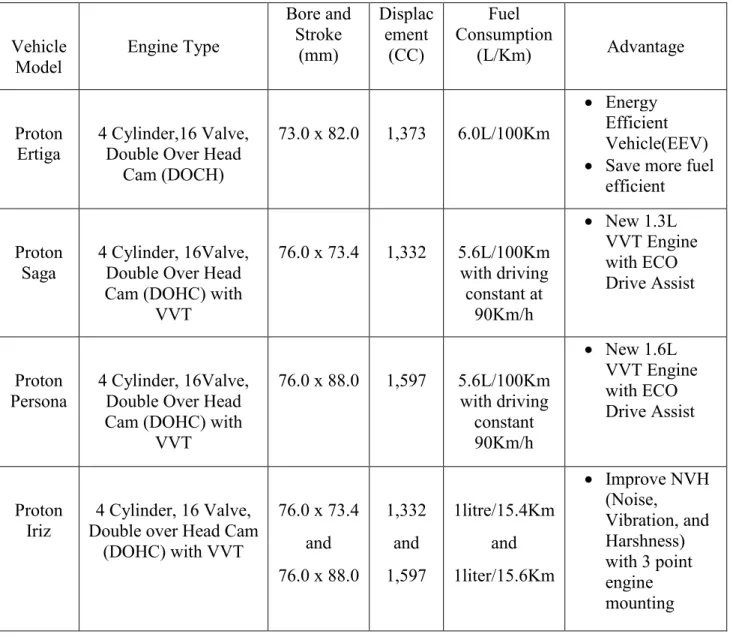
Malaysia has a several among of engines type which different engines capacity that used in local cars such as PROTON and PERODUA. Table 2.1 and 2.2 show the engine specifications for both of cars manufacturer.
Table 2.1: Engine Specifications for Proton Vehicle
Vehicle
Model Engine Type
Bore and Stroke (mm) Displac ement (CC) Fuel Consumption (L/Km) Advantage Proton
Ertiga 4 Cylinder,16 Valve, Double Over Head Cam (DOCH)
73.0 x 82.0 1,373 6.0L/100Km
Energy Efficient Vehicle(EEV)
Save more fuel efficient
Proton
Saga 4 Cylinder, 16Valve, Double Over Head Cam (DOHC) with
VVT 76.0 x 73.4 1,332 5.6L/100Km with driving constant at 90Km/h New 1.3L VVT Engine with ECO Drive Assist Proton
Persona 4 Cylinder, 16Valve, Double Over Head Cam (DOHC) with
VVT 76.0 x 88.0 1,597 5.6L/100Km with driving constant 90Km/h New 1.6L VVT Engine with ECO Drive Assist Proton
Iriz Double over Head Cam 4 Cylinder, 16 Valve, (DOHC) with VVT 76.0 x 73.4 and 76.0 x 88.0 1,332 and 1,597 1litre/15.4Km and 1liter/15.6Km Improve NVH (Noise, Vibration, and Harshness) with 3 point engine mounting
9 Proton
Preve 4 Cylinder,16 Valve, Double Over Head Cam (DOCH),Turbocharge 76.0 x 86.0 1,561 6.6L/100Km at 90Km/h Good handling Give performance like a 2.0L engine with a 1.6L fuel economy Proton
Exora Valve,Double Over 4 Cylinder,16 Head Cam (DOCH),Turbocharge 76.0 x 86.0 1,561 7.8L/100Km at 90Km/h MPV and good engine performance with 1.6L turbocharged Proton Perdana 4 Cylinder, 16 Valve, Single Over Head Cam
(SOHC) and
4 Cylinder, 16 Valve, Double Over Head
Cam(DOHC) 81.0 x 96.9 and 87.0 x 99.0 1,997 and 2,354 Not stated Powerful engine at 2.4L with 178 horsepower (HP) 2.0L with 154 horsepower (HP) Proton Suprima S 4 Cylinder,16 Valve, Double Over Head
Cam (DOCH),Turbocharged 76.0 x 86.0 1,561 9.1L/100 Km Good handling Give performance like a 2.0L engine with a 1.6L fuel economy