ABSTRACT
Pungki Ekopratomo Rusmayadi. (2016). A Corpus Based Comparative Analysis of Two Synonymous Words: Prohibit and Forbid. Yogyakarta English Language Education Study Program, Department of Language and Arts Education, Faculty of Teachers Training and Education, Sanata Dharma University.
Words with the same meaning are called synonym. There are two kinds of synonyms, absolute synonym and near-synonym. Most of synonyms are likely considered as near-synonym because fulfilling the conditions of absolute synonym is extremely hard. Whereas not all synonymous words can be substituted by other synonymous words but there is a central shared meaning between near-synonyms.
This study is concerned with a corpus-based analysis of two synonymous words prohibit and forbid. The first procedure of this study is comparing the definitions of the two synonymous words via three online available dictionaries which are The Macmillan Dictionary, The Collins American Dictionary and The Meriam Webster Dictionary. Second, the nominal collocation of the near-synonym is measured by raw frequency and MI-scores are examined via the Corpus of Contemporary American English (COCA). The top lists of the nominal collocation are grouped into lexical patterns. The third, the stylistic variation of the near-synonym is investigated across the five different genres provided by the COCA (spoken, fiction, magazine, newspaper, and academic writing).
The findings showed that the synonymous words of prohibit and forbid have collocation differences and that synonymous words are not perfectly interchangeable. The existing dictionary definitions are overgeneralized. Hence the study suggests ways to complement the dictionary entries with more frequently used expressions and collocations. The word prohibit is likely used to describe something related to governmental-related things and used in more formal registers.Whereas forbid is frequently used in religion belief and used in more informal registers.
Key words: Near-synonym, Collocation, Stylistic variation
i
ABSTRAK
Pungki Ekopratomo Rusmayadi. (2016). A Corpus Based Comparative Analysis of Two Synonymous Words: Prohibit and Forbid. Yogyakarta:
Program Studi Pendidikan Bahasa Inggris, UniversitasSanata Dharma.
Kata-kata dengan arti yang sama disebut sinonim. Ada dua jenis sinonim,
absolute synonym dan synonym. Kebanyakan sinonim termasuk dalam near-synonym karena untuk memenuhi kondisi dari absolute near-synonym sangatlah sulit.
Disisi lain tidak semua kata sinonim bias digantikan dengan kata sinonim yang lain tetapi terdapat makna yang sama diantara sinonim tersebut.
Studi ini berkaitan dengan analisa corpus-based antara dua sinonim
prohibit dan forbid. Prosedur pertama dalam penelitian ini adalah
membandingkan definisi dari kedua kata tersebut melalui tiga kamus online yaitu
The Macmillan Dictionary, The Collins American Dictionary dan The Meriam Webster Dictionary. Kedua, gabungan kata dari sinonim yang diukur dengan
frekuensi mentah dan MI-score diteliti lewat Corpus of Contemporary American
English (COCA). Data teratas dari gabungan kata tersebut dikelompokkan
kedalam pola leksikal. Ketiga, gaya variasi dari sinonim tersebut diteliti lewat lima gaya yang berbeda yang disediakan oleh COCA (lisan, fiksi, majalah, surat kabar dan karyailmiah).
Hasil menunjukkan bahwa kata prohibit dan forbid memiliki perbedaan gabungan kata dan tidak bisa saling menggantikan secara sempurna. Penjelasan kamus yang sudah ada menunjukkan penjelasan yang terlalu general. Karena itu studi ini menyarankan untuk lebih melengkapi penjelasan kamus dengan ekspresi yang sering digunakan serta gabungan kata. Kata prohibit sering digunakan untuk menjelaskan sesuatu yang berhubungan dengan pemerintahan dan digunakan dalam gaya bahasa yang lebih bersifat formal. Sedangkan forbid sering digunakan untuk menjelaskan sesuatu yang berhubungan dengan agama dan kepercayaan dan digunakan dalam gaya bahasa yang lebih bersifat kurang formal.
Kata kunci: Near-synonym, Collocation, Stylistic variation
A CORPUS BASED COMPARATIVE ANALYSIS
OF TWO SYNONYMOUS WORDS:
PROHIBIT AND FORBID
A SARJANA PENDIDIKAN FINAL PAPER
Presented as a Partial Fulfillment of the Requirements to Obtain the Sarjana Pendidikan Degree
in English Language Education
By
Pungki Ekopratomo Rusmayadi Student Number: 091214061
ENGLISH LANGUAGE EDUCATION STUDY PROGRAM DEPARTMENT OF LANGUAGE AND ARTS EDUCATION FACULTY OF TEACHERS TRAINING AND EDUCATION
SANATA DHARMA UNIVERSITY YOGYAKARTA
2016
i
A CORPUS BASED COMPARATIVE ANALYSIS
OF TWO SYNONYMOUS WORDS:
PROHIBIT AND FORBID
A SARJANA PENDIDIKAN FINAL PAPER
Presented as a Partial Fulfillment of the Requirements to Obtain the Sarjana Pendidikan Degree
in English Language Education
By
Pungki Ekopratomo Rusmayadi Student Number: 091214061
ENGLISH LANGUAGE EDUCATION STUDY PROGRAM DEPARTMENT OF LANGUAGE AND ARTS EDUCATION FACULTY OF TEACHERS TRAINING AND EDUCATION
SANATA DHARMA UNIVERSITY YOGYAKARTA
vi ABSTRACT
Pungki Ekopratomo Rusmayadi. (2016). A Corpus Based Comparative Analysis of Two Synonymous Words: Prohibit and Forbid. Yogyakarta. English Language Education Study Program, Department of Language and Arts Education, Faculty of Teachers Training and Education, Sanata Dharma University.
Words with the same meaning are called synonym. There are two kinds of synonyms, absolute synonym and near-synonym. Most of synonyms are likely considered as near-synonym because fulfilling the conditions of absolute synonym is extremely hard. Whereas not all synonymous words can be substituted by other synonymous words but there is a central shared meaning between near-synonyms.
This study is concerned with a corpus-based analysis of two synonymous words prohibit and forbid. The first procedure of this study is comparing the definitions of the two synonymous words via three online available dictionaries which are The Macmillan Dictionary, The Collins American Dictionary and The Meriam Webster Dictionary. Second, the nominal collocation of the near-synonym is measured by raw frequency and MI-scores are examined via the Corpus of Contemporary American English (COCA). The top lists of the nominal collocation are grouped into lexical patterns. The third, the stylistic variation of the near-synonym is investigated across the five different genres provided by the COCA (spoken, fiction, magazine, newspaper, and academic writing).
The findings showed that the synonymous words of prohibit and forbid have collocation differences and that synonymous words are not perfectly interchangeable. The existing dictionary definitions are over generalized. Hence the study suggests ways to complement the dictionary entries with more frequently used expressions and collocations. The word prohibit is likely used to describe something related to governmental-related things and used in more formal registers. Whereas forbid is frequently used in religion belief and used in more informal registers.
Key words: Near-synonym, Collocation, Stylistic variation
vii
ABSTRAK
Pungki Ekopratomo Rusmayadi. (2016). A Corpus Based Comparative Analysis of Two Synonymous Words: Prohibit and Forbid. Yogyakarta:
Program Studi Pendidikan Bahasa Inggris, Universitas Sanata Dharma.
Kata-kata dengan arti yang sama disebut sinonim. Ada dua jenis sinonim,
absolute synonym dan synonym. Kebanyakan sinonim termasuk dalam near-synonym karena untuk memenuhi kondisi dari absolute near-synonym sangatlah sulit.
Disisi lain tidak semua kata sinonim bisa digantikan dengan kata sinonim yang lain tetapi terdapat makna yang sama diantara sinonim tersebut.
Studi ini berkaitan dengan analisa corpus-based antara dua sinonim
prohibit dan forbid. Prosedur pertama dalam penelitian ini adalah
membandingkan definisi dari kedua kata tersebut melalui tiga kamus online yaitu
The Macmillan Dictionary, The Collins American Dictionary dan The Meriam Webster Dictionary. Kedua, gabungan kata dari sinonim yang diukur dengan
frekuensi mentah dan MI-score diteliti lewat Corpus of Contemporary American
English (COCA). Data teratas dari gabungan kata tersebut dikelompokkan
kedalam pola leksikal. Ketiga, gaya variasi dari sinonim tersebut diteliti lewat lima gaya yang berbeda yang disediakan oleh COCA (lisan, fiksi, majalah, surat kabar dan karya ilmiah).
Hasil menunjukkan bahwa kata prohibit dan forbid memiliki perbedaan gabungan kata dan tidak bisa saling menggantikan secara sempurna. Penjelasan kamus yang sudah ada menunjukkan penjelasan yang terlalu general. Karena itu studi ini menyarankan untuk lebih melengkapi penjelasan kamus dengan ekspresi yang sering digunakan serta gabungan kata. Kata prohibit sering digunakan untuk menjelaskan sesuatu yang berhubungan dengan pemerintahan dan digunakan dalam gaya bahasa yang lebih bersifat formal. Sedangkan forbid sering digunakan untuk menjelaskan sesuatu yang berhubungan dengan agama dan kepercayaan dan digunakan dalam gaya bahasa yang lebih bersifat kurang formal.
viii
You can close your eyes to the
things you don’t want to see,
But you can’t close your heart
to the things you don’t want
to feel
Johnny Depp
I dedicate this final paper to my mother, my father, my sister, my brother and
myself.
ix
ACKNOWLEDGEMENTS
My greatest gratitude goes to Allah SWT, who always blesses me and
makes me able to finish this final paper. Especially during the deterioration which
I felt empty and nothing to do.
I would like to express my gratitude to my advisor, Carla Sih Prabandari,
S. Pd., M. Hum., for her guidance and understanding which make me to have hope. I also thank her for her patience in guiding me as I become someone who
was difficult to be found. I would like to express my sincere gratitude to my
parents, Rusinah, Jarot Teguh Wiratmaya and my little sister and brother
Rheynalda Dewi Rusmayadi and Arya Saskara Putra Rusmayadi, for their kindness, warmth, understanding and trust that given to me. I would also give my
appreciation to all PBI Lecturers for guiding, understanding and trusting me until
finishing my final paper.
It is a fortune for having Titus, Angie and Soni to share a lot of joy and
foolish moment when I felt nothing. Bayu, Dion and Erda also have their special
moments with me. I would be nothing without them. I also thank to my PBI 2009
partner, Kristin, Briggita, Alex, Mas Anggit, Andre and Wira. Radio Istakalisa
crew also became my spirit, Sila, Deli, Mas Joko, Mbak Maya, Mbak Ulfa,
Mbak Vera, Ayub, Joe, Ana, Rico, Klara, Nidya, Aan, Arin, Mas Saum, Weri, Mutiara, and Mas Wijang. They always pushed and supported me to finish my final paper. I also thank to my new family, Jalu, Mulyan, Yudhek,
x
being good friends of mine and Chandra who helped me in the last minute before
submitting my final paper. All PBI students batch 2009 especially class B for
becoming a great comrade in collage.
Last, I would like to give my gratitude to Chintya Debby Chandra
Kharisma, someone whom I met in early 2015. I learned so many lessons and from her, I could open my eyes to see this wide world. She got her part so I could
finish my final paper.
xi
A. Qualitative Analysis of The Dictionary Entries of The
Near-Synonyms ...
1. Definitions of Forbid ...
2. Definitions of Prohibit ...
3. Comparison of Definition ...
B. Quantitative Analysis of The Dictionary Entries of The
Near-Synonyms ...
1. Frequency Pattern of Near-Synonym ...
2. Nominal Collocations Measured by Raw Frequencies ...
3. Nominal Collocations Measured by MI-score ...
4. Comparison of top list measured by raw frequency and
xii
5. Stylistic variation of the near-synonyms ...22
CHAPTER III. CONCLUSION AND RECOMENDATIONS
Conclusions ...24
REFERENCES ...
APPENDICES ... 25
1
CHAPTER I INTRODUCTION
This chapter consists of research background and research method. In the
background, the writer tells the main topic and also gives the reason in choosing
the topic. Problem formulation, problem limitation and purpose of the study are
also stated. Meanwhile, the subject of the study as well as its procedure are
discussed in the research method.
A. Background of the Study
Lyons (1995, p. 60) states that expressions with the same meaning are
called synonym. He also states that there are two kinds of synonyms,
near-synonyms and absolute-near-synonyms. Near-near-synonyms is expressions that more or
less similar but not identical in meaning. Some examples of near-synonyms are
begin – start, allow – permit, and bear – carry. Two or more expressions can be
called as absolute-synonyms if fulfilling the three following conditions:
1. All their meaning are identical
2. They are synonymous in all contexts
3. They are semantically equivalent on all dimension of meaning, descriptive and
non-descriptive (Lyons, 1995).
By seeing those conditions it is hard to find absolute-synonym and it is extremely
2
Most of the synonyms are likely to be near synonyms rather than absolute
synonyms. Usually people substitute some synonymous words based on their
habit in using a certain word and also their sense of the word (Lyons, 1995).
Near-synonyms, as Cruse (1986, p. 267) defines them are “lexical items whose sense
are identical in respect of central semantic traits, but differ in minor or peripheral
traits.” Therefore, there will be central shared meanings between near-synonyms.
Usually near-synonyms are described and defined by using their
neighboring lexical items which result in vague definitions since the differences in
meaning of the synonyms are denied and the definitions imply that the
near-synonyms are interchangeable. These inaccurate dictionary definitions present a
particular difficulty for students of English as a foreigner language. Leitner (1993,
p. 50) doubts that dictionaries come close to represent real English and that they
give appropriate example to illustrate the meaning.
The Macmillan Dictionary, The Collins American Dictionary and The
Merriam Webster Dictionary are chosen to define the near-synonyms. Those three
dictionaries are available online and printed version. However in this study, the
writer use the online version of the dictionary in order to maximize the use of
online resources. The Macmillan Dictionary includes the British and American
variety, The Collins American Dictionary and The Merriam Webster Dictionary
are specialized in American variety.
This study is corpus based research. Therefore The Corpus of
corpus of English is the main source in this study. COCA is created by Mark
Davies of Birmingham Young University and it provides 450 million words
which collected from 1990 to 2015. It is divided among five registers which are
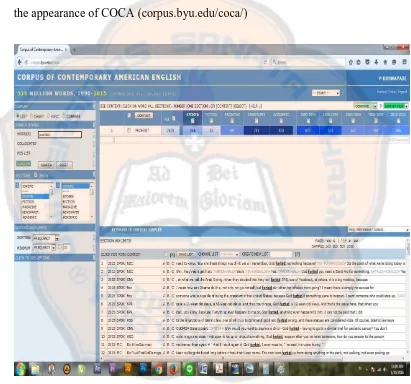
spoken, fiction, magazines, newspapers, and academic text. The figure below is
the appearance of COCA (corpus.byu.edu/coca/)
Figure 1.1 The Appearance of COCA
This study gets the data from COCA by writing the word prohibit and forbid in
the word(s) section. Getting the collocation data by writes in the collocates
section and filling the numbers after and before the collocations. On the below
4
American text samples are selected due to the use of American-based dictionaries
for the qualitative analysis of the near-synonyms.
Prohibit and forbid are selected in this study. COCA shows that prohibit
and forbid are two verbs that constantly used over years from 1990 to 2015.
Although it is constantly used over years, the number of appearance is not really
high compared to other verbs. Other verbs such as refuse appears more than seven
thousand times, reject more than five thousand times, begin more than sixty
thousand times, and start appears more than hundred thousand times. Those
numbers are really high compared to the appearance number of prohibit and
forbid which is only reach two thousand times. In 2010 to 2015 those two words
appear in almost exact number. The word prohibit appears 195 times and forbid
196 times. Those facts are the reason of choosing those two verbs.
There are some benefits of conducting this study. First, the reader be
aware of the existence of near-synonym and absolute synonym. This study will
show information that not all synonymous words can be substituted by other
synonym words. Second, the reader will understand the differences between
words prohibit and forbid. Later this study will show the detailed information and
data between words prohibit and forbid.
This study will answer one question by using two methods which are
qualitative and quantitative analysis of the near-synonyms. The qualitative
analysis is the interpretation of definitions of dictionary entries of the
consists of frequency pattern of near-synonym, nominal collocations measured by
raw frequencies, nominal collocations measured by MI-score, comparison list
measured by raw frequency and MI-score and the stylistic variation of the
near-synonym. COCA provides all the data of this quantitative analysis. As stated on
the research background there is a central shared meaning between
near-synonyms. For this present study, it is writer’s objective to identify these central
and peripheral meanings.
B. Research Question
This study is focusing on verbs prohibit and forbid answering one problem
formulation which is what are the collocation differences of synonymous words
prohibit and forbid?
B. Methodology
Research method applied in this study was divided into two parts. First the
qualitative method and second the quantitative method.
The qualitative method of the study consist of the description of the
dictionaries of near-synonyms prohibit and forbid. Meriam (2002) sataes that
qualitative research is characterized by the search of meaning and understanding
and it becomes the main instrument of data collection and analysis. Ary, Jacobs,
and Sorensen (2010) states the goal of qualitative research is a whole picture and
depth of understanding. Three online dictionaries were used in this study, there
were The Macmillan Dictionary, The Collins American Dictionary and The
6
dictionaries, therefore content analysis was an appropriate method. As stated by
Ary et al. (2010) that content analysis focuses on analysing and interpreting
recorded material.
Quantitative research was important to compare synonymous words (Biber
et al., 2002) and the objective of quantitative research was to gather numerical
data. This study only used simple quantitative research that gatherting the data
which were presented by frequency and precentage of the occurance of the
synonymous words. The quantitative method which involves computation of
collocations or experimental result was used in this study. It also can be seen in
Church, Gale, Hanks, Hindle and Moon (1994) in which the verb request and ask
for were compared in terms of substitutability. Taylor (2002) also had some
studies which carried out experiments in order to test similarities and differences
of near-synonyms. Taylor contrasted the adjective tall and high using
acceptability rating task in which subject were asked to rate whether the use of
these two adjectives was acceptable under different context. Taylor claimed that
the dominant fixed landmark in both and the recessive dimentional uses for tall
and positional uses for high meanings of two adjectives could be found.
First of all, The Macmillan Dictionary, The Collins American Dictionary
and The Meriam Webster Dictionary were examined how they defined the
synonyms. The description of the dictionaries pointed out the similarities or the
central semantic traits and differences or peripheral semantic traits of the
near-synonyms prohibit and forbid. If the near-near-synonyms were defined in terms of their
they were not defined through none of their near-synonyms, this might indicate
that they were not used synonymously and their semantic traits differ remarkably.
Second, the data in COCA was queried for the overall frequency patterns.
The nominal collocations of the near-synonyms were examined and measured by
raw frequencies and the Mutual Information (MI-score). The nominal collocations
in this study focus on the left collocation which is as the subject of the
near-synonyms. The MI-score above 3 suggest that two words often collocate with
each other. In the present study, the MI-score is the only applied statistical
measurement since the MI-score usually examines content words to which
category adjectives belong as Liu (2010, p. 63) described. The result was sorted
from the top list of the collocating nouns measured by raw frequency and
compared the nouns to see if the adjectives modify the same words. Then the
nouns were categorized into lexical groups which later were used for gathering
more insights about the type of nouns the adjectives modify.
Third, the procedure was repeated but with the nominal collocations
measured by MI-score. Top lists were created and the nouns were grouped into
certain categories. Moreover, the top lists measured by raw frequency and by
MI-score were compared and it was analyzed if the corpus research could confirm the
definitions of the dictionary entries of the qualitative method.
The last, the register in which they nominal collocations most frequently
occur was investigated. The top list of the nominal collocations of each of the
adjectival near-synonyms measured by score was examined since the
8
CHAPTER II DISCUSSION
This chapter consists of review of related literature and findings. First the
results of the qualitative analysis are outlined. Second, the outcome of the
quantitative analysis is presented.
A. Qualitative Analysis of The Dictionary Entries of The Near-Synonyms
Qualitative analysis is the interpretation of definitions of dictionary entries
of the near-synonyms. Cruse (1986, p. 265) said that there are sets of words or
lexical items which point towards a special similarity. Synonym, however as
Cruse (2004, p. 154) has explained, it should not simply be considered as
sameness of meaning because the analysis of identical meaning is unnecessary
and redundant. Divjack (2006, p. 21) adds to the understanding of synonyms that
if they describe one and the same situation, they name it different ways and they
represent it from different perspectives. To avoid the assumption of the sameness
of meaning, Cruse (2004) additionally suggests that there are some groups of
synonyms which bear a closer semantic resemblance than other sets. Normally
there are three kinds of synonym.
The first is absolute synonym, it is defined as lexical items which could be
used interchangeable in all contexts. However, it is impossible to check all these
contextual relations (Cruse; 1986, p. 268) and therefore if they exist they would
be extremely uncommon (Cruse; 1986, p. 270).
The second is cognitive synonym. Cruse (1986, p. 270) defines cognitive
synonyms as lexical items which have certain semantic properties in common.
Semantic mode is a term used in addressing these semantic properties which
divided into the propositional mode and the expressive mode. The propositional
mode is expressed by the form of the sentence, if the sentence expresses a
statement, question, command, exclamation etc. Whereas the meaning of
propositional meaning is determined by the truth condition uttered in the sentence.
The truth condition does not play a role in the expressive meaning of lexical item.
Later Cruse (1986, p. 273) describes words are defined as cognitive synonyms if
they share the propositional meaning but differ in their expressive modes.
The third is near-synonym. Cruse (1986, p. 285) states the third group of
synonyms as plesionyms, whereas other experts (Edmonds & Hirts; 2002, p. 107;
Storjohann; 2009, p. 2140) refer to them as near-synonyms. Cruse (1986, p. 285)
contrast near-synonym from cognitive synonyms since they express different truth
conditions in a given context. If two parallel structured sentences differ only in the
use of the synonym, they are not mutually entailing. However, if the
near-synonyms stand in a hyponymous relation, they can be unilaterally entailed. In
this case, one part of the near-synonyms can be asserted but it denies the other
part at the same time. Cruse (1986) gives examples to illustrate his assumptions:
“It wasn’t foggy last Friday – just misty. He was not murdered, he was legally
executed.”
Foggy and misty, as well as, murdered and executed are in hyponymous
10
cognitive synonyms. The boundaries between near-synonyms and non-synonyms
are rather fuzzy because with increasing semantic differences the near-synonyms
are converted into non-synonyms. Edmonds and Hirst (2002, p. 105) also stress
the importance of observing the differences of near-synonyms. They emphasize
the implications, connotations and the speaker’s attitude which are added to the
basic dictionary meaning of the words. For a particular communicative situation it
is crucial to use the adequate word which expresses precisely the meaning
intended by the speaker and to find the right word. Near-synonym in contrast to
absolute synonyms are not identical in meaning therefore there must be some
nuances in meaning which make them different.
1. Definitions of Forbid
There are two main definitions according to The Macmillian Dictionary
(MD) entry of forbid. The first definition is not allowing to do something against
the rule or law. The second definition is to make something impossible or to
prevent something from happening.
The Collins American Dictionary (CAD) defines three definitions of
forbid. The first definition clearly mentions the word prohibit. It indicates that
those two words have a shared central meaning and as Cruse (1986, p. 270) said
that those two words are in hyponymous relation, close in meaning and can be
accounted as near synonym. The second definition, The CAD also states the same
definition as The MD which is to make impossible and prevent. The last definition
The Merriam Webster Dictionary (MWD) has the same definition with the
other Dictionaries. Forbid is described as to proscribe from or as if from the
position of one in authority and also prevent as if by an effectual command.
2. Definitions of Prohibit
The MD defines prohibit as to stop and prevent something from being
done especially by making it illegal. Prohibit is defined as something related to
law and authority. The CAD and MWD state the same definition by mentioning
the word forbid in their definition. They also state the word prevent in defining
prohibit.
3. Comparison of Definition
In terms of comparing the dictionary entries, the lexical items are
commonly defined by using one or more near-synonyms of the word. The
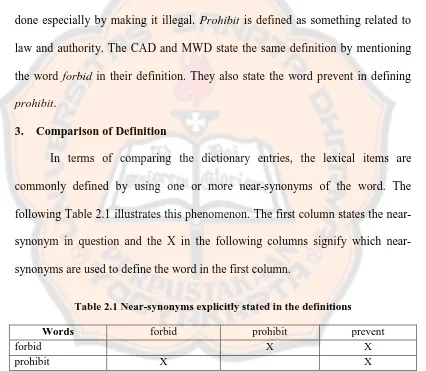
following Table 2.1 illustrates this phenomenon. The first column states the
synonym in question and the X in the following columns signify which
near-synonyms are used to define the word in the first column.
Table 2.1 Near-synonyms explicitly stated in the definitions
Words forbid prohibit prevent
forbid X X
prohibit X X
The table suggests that prohibit and forbid are defining each other. Forbid
is defined by the word prohibit while prohibit is defined by the word forbid in the
dictionary. Regarding to the three online dictionaries, The MD, CAD and MWD,
those two words share another lexical item in their definition which is prevent. As
12
towards a special similarity called synonym. It appears that the word prevent also
have a shared central meaning with prohibit and forbid. The word prevent is the
most frequently stated near-synonym in the definitions. This could indicate that
the meaning of prevent is the most diverse, consequently and more
interchangeable. In order to have deeper understanding, the following is example
of prevent which is lexical item of words prohibit and forbid shared.
[1] The cost of safety glass often prohibits its use in private buildings.
According to The MD, CAD and MWD, the word prohibit in the example
is defined as to prevent something from happening or being done. Therefore
prohibit in the example could be replaced by the word forbid as the
near-synonyms share the same lexical item which is prevent.
Of course, the table is an overgeneralization but it helps to identify which
words of the group of near-synonyms might have a closer relationship and might
be more synonymous and interchangeable. In the next step, the collocations of the
near-synonym are analyzed via the corpus research to verify these assumptions.
B. Quantitative Analysis of The Dictionary Entries of The Near-Synonyms This qualitative analysis part consists of the outcome of the corpus study.
First, the results of the overall frequency pattern of the near-synonyms are stated.
The second sub-chapter comprises the result of the analysis of the collocating
nouns measured by MI-score are articulated. The previous result are compared,
summaries the results of the investigation of the stylistic variation of the
near-synonyms.
1. Frequency Pattern of Near-Synonym
The data stated below are based on the Corpus of Contemporary American
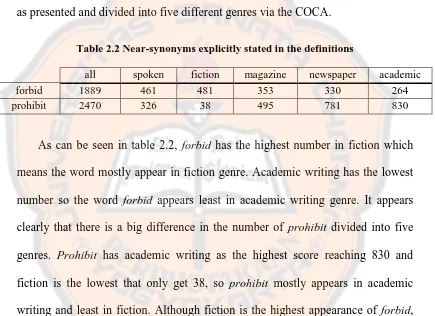
English (COCA). Table 2.2 states the near-synonyms and their number of tokens
as presented and divided into five different genres via the COCA.
Table 2.2 Near-synonyms explicitly stated in the definitions
all spoken fiction magazine newspaper academic forbid 1889 461 481 353 330 264 prohibit 2470 326 38 495 781 830
As can be seen in table 2.2, forbid has the highest number in fiction which
means the word mostly appear in fiction genre. Academic writing has the lowest
number so the word forbid appears least in academic writing genre. It appears
clearly that there is a big difference in the number of prohibit divided into five
genres. Prohibit has academic writing as the highest score reaching 830 and
fiction is the lowest that only get 38, so prohibit mostly appears in academic
writing and least in fiction. Although fiction is the highest appearance of forbid,
prohibit do not do the same thing, it has the lowest in fiction instead. However,
the total frequency information does not give any account of the usage patterns of
the verbs and their differences in meaning. Therefore, the next step of the
14
2. Nominal Collocations Measured by Raw Frequencies
According to Sinclair (1991, p.115) the collocation properties of lexical
items are intrinsic and crucial to their meaning. He calls this phenomenon idiom
principle which he describes via collocations. Hoey (2005, p.2) defines
collocations as property of language whereby two or more words seem to appear
frequently in each other’s company. Moreover, he states that collocations depict
what is natural in a language and what is used by the speaker and they do not
replicate what is theoretically possible in the particular language. Additionally,
Hoey (2005, p. 3) proclaims that collocations must not be confused with lexical
co-occurrence, which he defines as co-occurrence of two or more words within a
short space of each other. He also said that collocations are psychological
association between words up to four words apart and evidenced by their
occurrence together in corpora more often than is explicable in terms of random
distribution. Therefore, he considers collocations as psycholinguistic phenomenon
for which evidence can be found statistically in computer corpora.
Although the concept of lexical priming is usually associated with other
fields of linguistics and psychology, Hoey (2005, p. 8) integrates the concept into
corpus linguistics. In general, he claims that a word is acquired through
encountering the lexical item in spoken or written text. Each time a person
reencounters a word its co-text, the collocation, the grammatical pattern, the
grammatical function, the associated meaning and pragmatics are mentally
recorded. Furthermore, the mind subconsciously stores the genre, the style, the
Hoey (2005, p. 8) calls this process nesting. Lexical priming is an individual
human product since every person has unique experiences with linguistic context.
Therefore, not every speaker is primed in the same way. He asserts that corpus
can only point towards the priming which is likely to be shared by a large number
of speakers. As a consequence, lexical priming cannot be demonstrated directly
by a corpus since a corpus does not represent an individual’s linguistic
experience. However, when the origins of the text samples provided by a corpus
are analyzed, the corpus permits assumptions about how a person might be primed
by reading the specific genre and text type.
There are left and right collocations which appear before and after the
word. While the nominal collocations in this study focus on the left collocation
which is as the subject of the word prohibit and forbid. The data was collected
from COCA and first of all the nominal collocations were investigated to discover
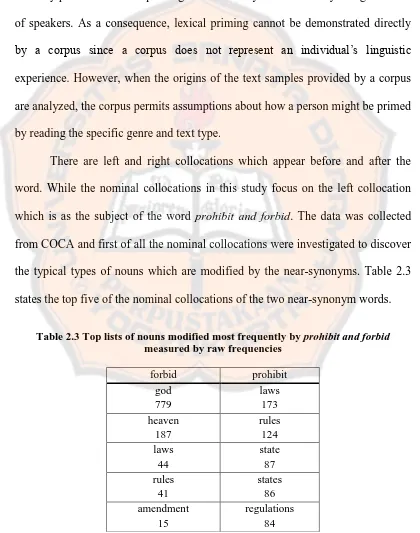
the typical types of nouns which are modified by the near-synonyms. Table 2.3
states the top five of the nominal collocations of the two near-synonym words.
16
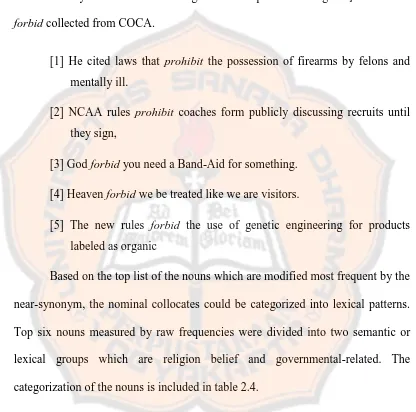
As can be seen from the Table 2.3, prohibit and forbid share two nominal
collocations which are laws and rules. This might indicate that their semantic
traits are fairly similar. The following is the example of the usage of prohibit and
forbid collected from COCA.
[1] He cited laws that prohibit the possession of firearms by felons and
mentally ill.
[2] NCAA rules prohibit coaches form publicly discussing recruits until
they sign,
[3] God forbid you need a Band-Aid for something.
[4] Heaven forbid we be treated like we are visitors.
[5] The new rules forbid the use of genetic engineering for products
labeled as organic
Based on the top list of the nouns which are modified most frequent by the
near-synonym, the nominal collocates could be categorized into lexical patterns.
Top six nouns measured by raw frequencies were divided into two semantic or
lexical groups which are religion belief and governmental-related. The
categorization of the nouns is included in table 2.4.
The lexical patterns in reference to the near-synonyms reveal some
interesting points. There are only two lexical patterns of the collocation nouns
which are religion belief and governmental-related. The near-synonym forbid is
not only used in governmental-related but also in religion belief. Whereas prohibit
is only used in governmental-related lexical patterns.
The analysis of the nominal collocations of the near-synonyms revealed
some interesting insights to the usage patterns. However Liu (2010, p. 64) states
raw frequencies privilege words that have an overall high frequency in the corpus,
yet it undervalues those have a lower general frequency but occur habitually with
one of the near-synonyms. Therefore, the next step is to investigate and describe
the nominal collocations measured by MI-score.
3. Nominal Collocations Measured by MI-score
The MI-score is a statistical measurement that indicates collocates of
lexical items which have a rather low overall frequency in the corpus but which
are co-occurring repeatedly with the node. An MI-score around 0 suggests that the
two words do not collocate while a score of 3 or higher indicates that the two
items often co-occur. Liu (2010 p. 74) states the MI-score is considered to be the
most appropriate statistical measurement for this research because it favors the
category of content words to which adjectives belong. The results were sorted by
relevance which is the term in the COCA for the MI-score.
The collocation analysis for the near-synonyms measured by the MI-score
18
Table 2.5 depicts the top result of the nominal collocation analyses measured by
MI-score.
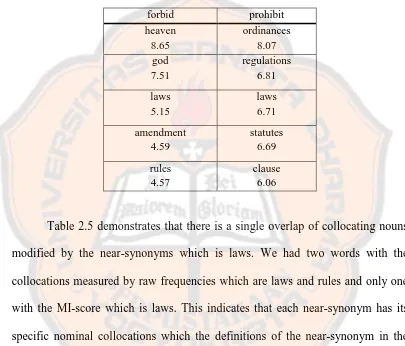
Table 2.5 Top lists of nouns modified most frequently by prohibit and forbid measured by MI-score
Table 2.5 demonstrates that there is a single overlap of collocating nouns
modified by the near-synonyms which is laws. We had two words with the
collocations measured by raw frequencies which are laws and rules and only one
with the MI-score which is laws. This indicates that each near-synonym has its
specific nominal collocations which the definitions of the near-synonym in the
dictionaries should include since it is evidence that the presumable near-synonyms
are not all intersubstitutable but have their fixed collocations and expressions. For
further deatail, the following is the example collected from COCA.
[1] They explain that local ordinances prohibit artificial lighting near
beaches.
[2] Regulations prohibit her from stopping at any points.
[3] Heaven forbid if he woke the girls!
[4] God forbid you try and dine downtown when one of our sports teams
are playing.
There are the example of two top nouns based on MI-Score which collocate with
prohibit and forbid. The two top nouns of prohibit are ordinances and regulations,
whether nouns of forbid are heaven and god. Based on the top lists of the nouns
which are modified most frequently by the near-synonym, it also could be
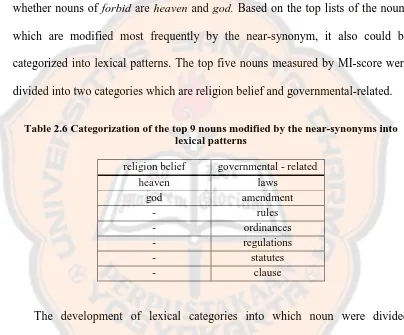
categorized into lexical patterns. The top five nouns measured by MI-score were
divided into two categories which are religion belief and governmental-related.
Table 2.6 Categorization of the top 9 nouns modified by the near-synonyms into lexical patterns
religion belief governmental - related heaven laws
demonstrates that the word prohibit and forbid are also used in the same way as
suggested by the nominal collocation analyses measured by raw frequency.
Religion belief and governmental-related are the two lexical items which
suggested in the nominal collocation analyses measured by raw frequency and
20
4. Comparison of top list measured by raw frequency and MI-score for each near-synonym
In this part comparisons are made between the top lists measured by raw
frequency and by MI-score for each near-synonym and conclusions are drawn in
reference to the definitions of the dictionary entries. First, the top list of forbid are
considered and compared. The table below shows the top lists of forbid measured
by raw frequency and MI-score.
Table 2.7 Top lists of forbid measured by raw frequency and MI-score
raw frequency MI-score
amendment are the nouns in raw frequency which refer to governmental-related.
On the list of the MI-score also shows three nouns related to governmental-related
which are laws, amendment and rules. Raw frequency and MI-score of forbid
shows god and heaven are the top two nouns. The focus of the dictionary entries
by both analyses. However the definitions might include religious belief. Second,
the top lists of prohibit are analyzed.
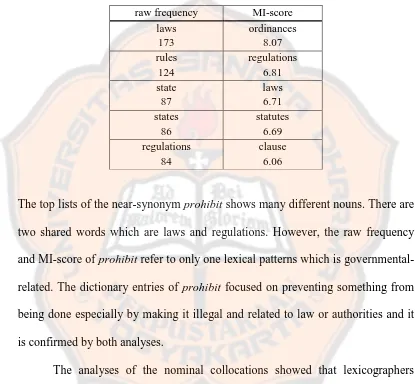
Table 2.8 Top lists of prohibit measured by raw frequency and MI-score
raw frequency MI-score
The top lists of the near-synonym prohibit shows many different nouns. There are
two shared words which are laws and regulations. However, the raw frequency
and MI-score of prohibit refer to only one lexical patterns which is
governmental-related. The dictionary entries of prohibit focused on preventing something from
being done especially by making it illegal and related to law or authorities and it
is confirmed by both analyses.
The analyses of the nominal collocations showed that lexicographers
might over think and change the example of common expressions and state more
collocations in order to clarify the peripheral semantic differences between the
near-synonyms. This is especially important for learners of English of second
language learners who are unfamiliar with these rather fixed phrases. When
dictionaries state these frequent collocations, foreign language learners prime the
22
similar to the priming of native speakers and the language learners acquire the
different nuances in meaning of the near-synonyms.
5. Stylistic variation of the near-synonyms
The last part of the study deals with the usage differences of the set of
near-synonyms in terms of stylistic variation or register. Edmond and Hirst (2002,
p. 109) consider stylistic variation of near synonyms as crucial for the
differentiation of their meanings. Furthermore, the register distribution pattern
reveals important information for learners of English as a second or foreign
language since it is rather difficult for them to use the words in the appropriate
register (Liu 2010, p. 77). Therefore, another vital aspect which should be
mentioned in the dictionary entries is which near-synonym is used in a rather
formal and which in a more informal or colloquial register. For register
distribution pattern of the near-synonym prohibit and forbid this study queried the
COCA across the five provided register which are fiction, newspaper, magazine,
academic writing and spoken. A scale of formality was established for the five
registers provided by the COCA. The scale reaches from most formal to least
formal and proposes this order: academic writing, newspaper, magazine, fiction
and spoken.
The starting point for the analysis of the register distributional pattern
formed the top list nominal collocations measured by MI-score. The COCA was
queried for each near-synonym prohibit and forbid, again collocating with nouns
and the result were sorted by relevance of MI-score. The top nominal collocations
form the basis for the following assumptions: The top list nominal collocations
with the near-synonym forbid mostly appear in the spoken genre. The nominal
collocations with prohibit are most frequently used the academic writing genre.
This genre is the most formal register according to the scale stated above. The
word prohibit is mostly used in more formal registers whether forbid is used in
less formal registers. This information should also be included in the dictionary
24
CHAPTER III CONCLUSIONS
In the this chapter, the writer aims to conclude the finding of this study.
The corpus-based research proved to be a successful method for describing a new
set of near-synonyms and identified meaning differentiating traits of the words
prohibit and forbid via an analysis of the nominal collocations and the stylistic
variation. The study showed that the existing dictionary definitions are over
generalized and consequently not sufficient to explain the meaning differences
between the two near-synonym words. Hence the study suggests ways to
complement the dictionary entries with more frequently used expressions and
collocations. It seems that the reference works were only comprised via
collocation analysis of near synonyms measured by raw frequency since the result
of this part of the study reflect the picture given in the dictionaries, namely that
the two synonymous words are intersubstitutable and that they modify the same
type of nouns. The collocation analysis measured by raw frequency and MI-score
demonstrated that the definition of the word forbid should include that this
near-synonyms is frequently used to describe something related to religious belief.
Furthermore, the study found that prohibit is frequently used in
governmental-related things. The analysis of the stylistic variation revealed that forbid is used in
25
REFERENCES
Ary, D., Jacob, L. C., & Sorensen, C. K. (2010). Introduction to research in
education (8th ed.). Belmont: Wadswoth.
Biber, D., Conrad, S., & Reppen, R. (2002). Corpus linguistics: Investigating
language structure and use. New York: Cambridge University Press
Cruse, D. A. (1986). Lexical Semantics. Cambridge: Cambridge University Press.
Cruse, Alan. (2004). Meaning in Language: An Introduction to Semantics and Pragmatics. (2nd Edition). Oxford: Oxford University Press.
Church, K. W., W. Gale, P. Hanks, D. Hindle, and R. Moon.1994. Lexical Substitutability,” in B. T. S. Atkins and A. Zampolli (eds.), Computational Approaches to the Lexicon, 153-177.
Divjak, Dagmar; Gries Stefan. (2006). “Ways of trying in Russian: Clustering behavioral profiles”. Corpus Linguistics and Linguistic Theory, 23-60.
Edmonds, Philip; Hirst, Graeme. (2002). “Near-synonymy and Lexical Choice”. Computational Linguistics, 105-144.
Frawley, W. (1992). Linguistic Semantic. Hove and London: Lawrence Erlbaum Associates, Publishers.
Hoey, Michael. (2005). Lexical Priming. A new Theory of Words and Language. London: Routledge.
Leitner, Gerhard. (1993). “Where to Begin or Start? Aspectual Verbs in Dictionaries”. In Hoey, Michael. Data, description, discourse. Papers on the English language in honour of John Mch Sinclair on his sixtieth birthday. London: HarperCollins, 50-63.
Liu, Dilin. (2010). “Is it a chief, main, major, primary, or principal concern? A corpus-based behavioral profile study of the near-synonyms”. International Journal of Corpus Linguistics 15(1), 56-87.
Lyons, J. (1995). Linguistic Semantics: An Introduction. Cambridge University Press.
McEnery, T & Wilson, A. (2001). Corpus Linguistic: An Introduction. (2nd ed.). Edinburg University Press.
Merriam, S. B. (2002). Qualitative research in practice: Example for discussion
26
Sinclair, John. (1991). Corpus, concordance, collocation. Oxford: Oxford University Press.
Storjohann, Petra. (2009). “Plesionymy: A case of synonymy or Contrast?”. Journals of Pragmatics, 2140-2158.
Taylor, J. R. (2002). “Near Synonyms as Co-extebsive Categories: „High‟ and „Tall‟ Revisited. Language Sciences, 25, 263-284.
27
APPENDIX 1
28
30
32
APPENDIX 2
CORPUS OF CONTEMPORARY AMERICAN ENGLISH A. Forbid
1. All Frequencies
all spoken fiction magazine newspaper academic
forbid 1889 461 481 353 330 264
1990-1994 1995-1999 2000-2004 2005-2009 2010-2015
forbid 385 368 360 357 419
2. Collocation List Before Synonym Word
freq all MI
god 779 121865 8.50
heaven 187 13114 9.65
laws 44 37466 6.05
rules 41 48632 5.57
amendment 15 17600 5.59
regulations 13 16545 5.47
specifically 9 25918 4.29
constitution 8 20888 4.44
absolutely 8 49915 3.08
explicitly 7 6669 5.89
34
spoken fiction magazine newspaper academic
B. Prohibit
1. All Frequencies
all spoken fiction magazine newspaper academic
prohibit 2470 326 38 495 781 830
1990-1994 1995-1999 2000-2004 2005-2009 2010-2015
prohibit 637 571 442 384 436
2. Collocation List Before Synonym Word
freq all MI
would 342 1210028 3.61
laws 173 37466 7.64
does 137 420718 3.82
rules 124 48632 6.78
state 87 331955 3.50
states 86 246428 3.91
regulation 84 16545 7.78
law 77 138577 4.59
bill 60 126264 4.36
government 52 225768 3.32
36
spoken fiction magazine newspaper academic