REINWARDTIA
A JOURNAL ON TAXONOMIC BOTANY,
PLANT SOCIOLOGY AND ECOLOGY
Vol. 14(1): 1-248, December 23, 2014
Chief Editor
Kartini Kramadibrata (Mycologist, Herbarium Bogoriense, Indonesia)
Editors
Dedy Darnaedi (Taxonomist, Herbarium Bogoriense, Indonesia) Tukirin Partomihardjo (Ecologist, Herbarium Bogoriense, Indonesia) Joeni Setijo Rahajoe (Ecologist, Herbarium Bogoriense, Indonesia) Marlina Ardiyani (Taxonomist, Herbarium Bogoriense, Indonesia) Topik Hidayat (Taxonomist, Indonesia University of Education, Indonesia) Eizi Suzuki (Ecologist, Kagoshima University, Japan)
Jun Wen (Taxonomist, Smithsonian Natural History Museum, USA)
Managing Editor
Himmah Rustiami (Taxonomist, Herbarium Bogoriense, Indonesia) Lulut Dwi Sulistyaningsih (Taxonomist, Herbarium Bogoriense, Indonesia) Secretary
Endang Tri Utami
Layout Editor
Deden Sumirat Hidayat Medi Sutiyatno
Illustrators
Subari
Wahyudi Santoso Anne Kusumawaty
Correspondence on editorial matters and subscriptions for Reinwardtia should be addressed to: HERBARIUM BOGORIENSE, BOTANY DIVISION,
RESEARCH CENTER FOR BIOLOGY- INDONESIAN INSTITUTE OF SCIENCES CIBINONG SCIENCE CENTER, JLN. RAYA JAKARTA - BOGOR KM 46, CIBINONG 16911, P.O. Box 25 Cibinong
INDONESIA
PHONE (+62) 21 8765066; Fax (+62) 21 8765062 E-MAIL: [email protected]
1 2 3
4
1 3 4
4
Abdulrokhman Kartonegoro - Herbarium Bogoriense, Bogor, Indonesia Altafhusain B. Nadaf - University of Pune, Pune, India
Amy Y. Rossman - Systematic Mycology & Microbiology Laboratory USDA-ARS, Beltsville, USA Andre Schuiteman - Royal Botanic Gardens, Kew, UK
Ary P. Keim - Herbarium Bogoriense, Bogor, Indonesia
Barry Conn - Royal Botanic Gardens National Herbarium of New South Wales, Sydney, Australia Dato' Abdul Latiff Mohamad - Universiti Kebangsaan Malaysia, Bangi, Selangor, Malaysia Daniel Potter - Department of Plant Sciences, University of California, Davis, California, USA
Deby Arifiani - Herbarium Bogoriense, Bogor, Indonesia Ferry J. W. Slik - University of Brunei Darussalam, Brunei
Henti H. Rachmat - Conservation and Rehabilitation Research and Development Center, Bogor, Indonesia Ian M. Turner - Royal Botanic Gardens, Kew, UK
Iskandar Z. Siregar - Bogor Agricultural University, Bogor, Indonesia Jay H. Bernstein - Kingsborough Community College, Brooklyn, New York, USA
Jens G. Rohwer - University of Hamburg, Hamburg, Germany Joan Pereira - SAN Herbarium, Sabah Forestry Department, Sabah, Malaysia
Kuswata Kartawinata - Herbarium Bogoriense, Bogor, Indonesia Lars H. Schmidt - University of Copenhagen, Copenhagen, Denmark
Mark Hughes - Royal Botanic Gardens, Edinburgh, UK Masahiro Kato - Kyoto University, Kyoto, Japan Nuril Hidayati - Herbarium Bogoriense, Bogor, Indonesia Ong Poh Teck - Forest Research Institute Malaysia, Kepong, Malaysia
Peter C. van Welzen - National Herbarium Netherlands, Leiden University Branch, Leiden, Netherlands Reuben Nilus - Sabah Forestry Department, Sabah, Malaysia
Rugayah - Herbarium Bogoriense, Bogor, Indonesia
Ruth Kiew - Forest Research Institute of Malaysia, Kepong, Malaysia
REINWARDTIA
Received February 6, 2014: accepted October 20, 2014
EKA FATMAWATI TIHURUA
Herbarium Bogoriense, Botany Division, Research Center for Biology-LIPI, Cibinong Science Center, Jln. Raya Jakarta-Bogor Km. 46, Cibinong 16911, Bogor, Indonesia. E-mail: [email protected]
INA ERLINAWATI
Herbarium Bogoriense, Botany Division, Research Center for Biology-LIPI, Cibinong Science Center, Jln. Raya Jakarta-Bogor Km. 46, Cibinong 16911, Bogor, Indonesia. E-mail: [email protected];
ABSTRACT
TIHURUA, E. F. & ERLINAWATI, I. 2014. Leaf anatomy of Pandanus spp. (Pandanaceae) from Sebangau and Bukit Baka-Bukit Raya National Park, Kalimantan, Indonesia. Reinwardtia 14 (1): 223 – 231. ― Cross sections of leaves of Pandanus spp. showed that their leaf anatomy is similar, whilst paradermal sections indicated that crystal numbers differ. Variation was found in the anticlinal epidermal cell walls, stomata, hypodermis, sclerenchyma, meso-phyll and crystals, as discussed in this paper.
Key words: Bukit Raya-Bukit Baka National Park, leaf anatomy, Pandanus spp., Sebangau.
ABSTRAK
TIHURUA, E. F. & ERLINAWATI, I. 2014. Anatomi daun Pandanus spp. (Pandanaceae) dari Sebangau dan Taman Nasional Bukit Baka-Bukit Raya, Kalimantan, Indonesia. Reinwardtia 14(1): 223 – 231. ― Irisan melintang daun Pandanus spp. menunjukkan bahwa anatomi daunnya sama, akan tetapi irisan paradermal mengindikasikan bahwa jumlah kristalnya berbeda. Variasi yang ditemukan di dinding sel epidermal antiklinal, stomata, hypodermis, skleren-kim, mesofil dan kristal dibahas dalam makalah ini.
Kata kunci: Taman Nasional Bukit Raya-Bukit Baka, anatomi daun, Pandanus spp., Sebangau.
INTRODUCTION
Pandanus is one of the member of Pandanaceae family which has the broadest geographical distribution, occurring throughout the Old World tropics, from East Africa westward to Polynesia, widely distributed to East Asia and Pacific (Stone, 1965) with tree and shrub habit (Nadaf & Zanan, 2012), contains more than 600 species (Kam, 1971). Pandan of Kalimantan is still little known. The exploration conducted in Sebangau National Park (Palangkaraya, Central Kalimantan) and Bukit Raya-Bukit Baka National Park (West Kalimantan) in 2006 found several Pandanus spp. including specimens belonging to the Pandanus motleyanus complex species, which species is synonymised with P. yvanii Solms according to Keim et al. (2011). Also four new species of Pandanus were collected. Recognizing and identifying species is difficult, therefore additional characters, e.g. leaf anatomy, are needed to support the morphological approach.
Little work has been done on the leaf anatomy of Pandanaceae. Kam (1971) has investigated the leaf anatomy of Pandanus species in Malaya, anatomical leaf structure (including leaf micro-morphology and transversal section) of some Pandanus, which was collected from two locations in Kalimantan to support morphological data of Pandanus spp.
MATERIAL AND METHODS
para-dermal cuttings (Cutler, 1978) were used for this study.
RESULTS AND DISCUSSION
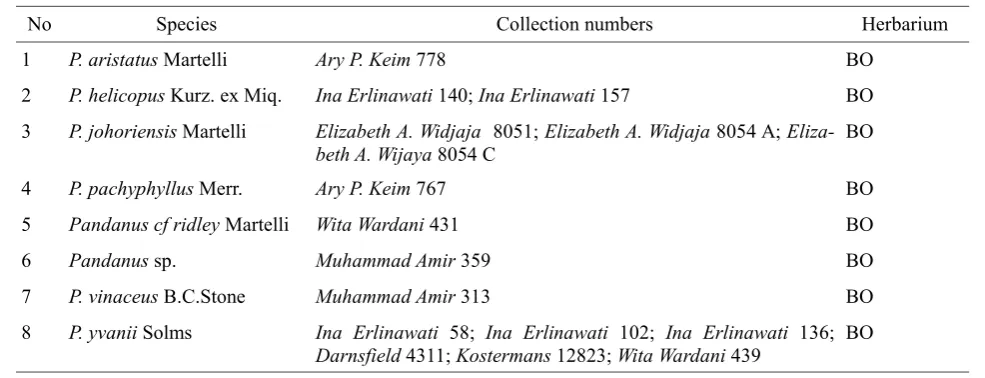
Pandanus spp. have straight, wavy and curved anticlinal walls. The epidermis cells vary in shape between square, polygonal and sometimes irregu-lar (Fig. 1). Anatomically there are two types of leaf known from the collections (Table 1). The anatomy of the first type shows a dorsiventral parenchyma with the mesophyll differentiated into palisade and sponge tissue. The second type shows a homogenous leaf anatomy, lacking a differentia-tion into palisade and sponge tissue. Dorsiventral leaves are the common type shown by all Panda-nus species except the P. johoriensis complex and P. yvanii, which have both leaf types.
Adaxial epidermis anticlinal cell walls are straight in P. helicopus, P. johoriensis and Pandanus sp., while straight to wavy could be find
in P. aristatus, P. pachyphyllus, Pandanus cf P. yvanii and slightly wavy in P. pachyphyllus. Shape of epidermis cell in both surfaces are square to polygonal found in all examined Pandanus species, but straight to slightly irregular in adaxial epidermis of P. yvanii and abaxial epidermis cell of P. helicopus and P. yvanii.
Special focus on stomata
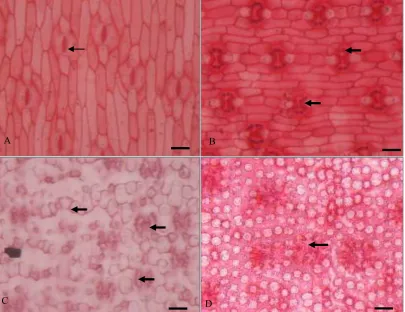
The stomata of Pandanaceae are tetracytic and found on the adaxial and abaxial surface, but less numerous adaxially. The stomata are level to the epidermal cells in the transverse section. The stomata may be accompanied by papillae. The pa-pillae appear on the subsidiary or sometimes on
No Species Collection numbers Herbarium
1 P. aristatus Martelli Ary P. Keim 778 BO
2 P. helicopus Kurz.ex Miq. Ina Erlinawati 140; Ina Erlinawati 157 BO
3 P. johoriensis Martelli Elizabeth A. Widjaja 8051; Elizabeth A. Widjaja 8054 A; Eliza-beth A. Wijaya 8054 C Darnsfield 4311; Kostermans 12823; Wita Wardani 439
BO Table 1. Specimens examined of Pandanus.
2014] TIHURUA & ERLINAWATI: Leaf anatomy of Pandanus spp. from Kalimantan 225
the adjacent epidermal cells. The papillae on the terminal subsidiary cells are simple, forked or sometimes dendritic. Whereas papillae on the lat-eral subsidiary cells are globose in 3-7 alignments. (Fig. 2B & 2C). Based on the presence of papillae four classes of stomatal types (Tomlinson, 1965) can be discerned. The first type consists of unspe-cialized stomata lacking papillae (Fig. 2A). The second type shows stomata with papillae on the terminal and lateral of subsidiary cells as shown by P. aristatus, P. vinaceus and P. yvanii (Fig. 2B). The third type has papillae on the subsidiary cells of the stomata and on the neighboring epider-mal cells (Fig. 2C); they are found in P. helicopus, P. johoriensis, Pandanus cf. ridley and P. yvanii. The fourth type is defined by dendritic papillae present on the whole surface of the leaf. This type is found in P. pachypilus (Fig. 2D). Tomlinson (1965) mentioned that there are five types of stomata followed by Rahayu et al. (2012) in their study about Pandanus in Java. In this study, we could not find the type of stomata which papillose are arranged in the lateral subsidiary cells.
Hypodermis
All examined Pandanus species has hypodermis tissue in the adaxial and abaxial side (Fig. 3),
except for P. aristatus that has this tissue only on adaxial part. The hypodermis tissue occur in 2 rows sometimes more.
Mesophyll
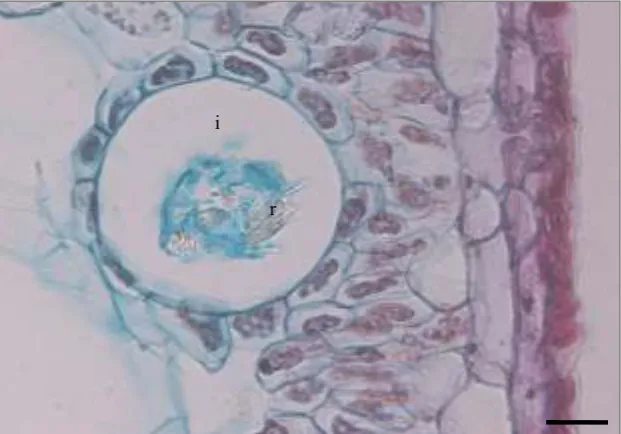
The palisade also occur in the adaxial and abaxial part (Fig. 3) but not in P. pachyphyllus and Pandanus cf ridley that only occur in adaxial part. Cuboid (Fig. 3) and raphide crystal (Fig. 4) are distributed in the mesophyll of all Pandanus species leaf.
Specific Descriptions of Pandanus species in Kalimantan
P. aristatus Martelli
Leaf dorsiventral. Adaxial and abaxial epidermis anticlinal cell walls straight and curved, sometimes wavy in the adaxial surface. Epidermis cell shape square, polygonal (Fig. 5A). Stomata in both surface with papillae on subsidiary cell at the abaxial side (Fig. 7A). Two layers hypodermis in the adaxial part of leaf. Mesophyll differentiated into 2-3 palisade layers in the adaxial and 1 layer in the abaxial part of leaf. Pseudolacuna between two vascular bundles (Fig. 10A).
A B
C D
Pandanus helicopus Kurz.ex Miq.
Leaf dorsiventral. Adaxial epidermis cell with straight and slightly curved wall; while abaxial epidermis cell wall straight, slightly wavy and curved. Adaxial and abaxial epidermis cell shape square, polygonal, with elongated cells in the adaxial and slightly irregular in the abaxial (Fig. 5B). Stomata in the adaxial epidermis sometimes present with papillae in the polar subsidiary cell, while papillae of abaxial epidermis cell occur at the subsidiary and/or epidermal cells (Fig. 7B). Hypodermis two layers in the adaxial and abaxial part of the leaf; long and thin, square. Palisade 1-3 layers in the adaxial and a layer in the abaxial part of the leaf (Fig. 9A). Stellate parenchyma laid between 2 vascular bundles.
Fig. 3. Cross section of Pandanus leaf. Leaf with branched parenchyma (stellate) exist between 2 vascular bundles (above), when get mature leaf, it will form pseudolacuna (below). bp: branched parenchyma; e: epidermis; h: hypodermis layer; p: palisade tissue; pl: pseudolacuna; s: sponge tissue; vb: vascular bundle; crystal in meso-phyll (thin arrow); schlerenchyma (thick arrow). Scale bar 50 µm.
i
r
Fig. 4. Cross section of Pandanus leaf. Idioblast cell (i) with raphides (r) present in the mesophyll. Scale bar 20 µm.
Pandanus johorensis Martelli complex
Leaf homogen or dorsiventral. Adaxial and abaxial epidermis cell has straight wall, slightly curved in the abaxial side (Fig. 5C). Adaxial and abaxial epidermis cell shape are square and polygonal shape. Adaxial epidermis is showed short and long cell conspicuously. Stomata in the both leaf surface with papillae in the epidermal and subsidiary cells of abaxial surface (Fig. 7C). Hypodermis two layers in the adaxial and abaxial part, sometimes up to 3 layers in adaxial. Dorsiventral leaf has 2-5 layers adaxial palisade and 1-3 layers abaxial palisade. Stellate parenchyma occurs in the middle of the leaf of this species.
p
vb
h
pl
2014] TIHURUA & ERLINAWATI: Leaf anatomy of Pandanus spp. from Kalimantan 227
Pandanus pachyphyllus Merr.
Leaf dorsiventral. Adaxial epidermal cell wall straight, curved and slightly wavy. Abaxial epider-mal cell slightly wavy wall. Dendritic papillae co-vered epidermis cells and stomata (Fig. 7D, see appendix). 2-3 layers hypodermis presents in the adaxial and abaxial part of leaf. Mesophyll was differentiated into 2 layers of palisade in the adaxial part of leaf and sponge below. Pseudolacuna presents between 2 vascular bundles.
Pandanus cf. ridley Martelli
Leaf dorsiventral. Adaxial and abaxial epidermis cell wall is straight and slightly wavy, also wavy anticlinal cell wall in the abaxial surface. Epidermis cell shape is square, polygonal in the the both surface. There are short and long cells in the adaxial surface (Fig. 6A). Stomata in the both surface and papillae present in epidermal and subsidiary cells of abaxial surface (Fig. 8A). Hypodermis 2-3 layers in the adaxial and 2 layers in the abaxial part of leaf (Fig. 9B). Mesophyll is arranged by palisade tissue adaxial part of the leaf 1-3 layers and sponge below with branched parenchyma.
Pandanus sp.
Leaf dorsiventral. Adaxial and abaxial epidermis with straight anticlinal cell wall and square shape. Unspecialized stomata in both leaf surface (Fig. 6B & 8B). Hypodermis two layers on both part of leaf. 1-2 layers of palisade took place in adaxial and a layer in the abaxial leaf part, sponge exist between both parts. Branched sponge between 2 vascular bundles (Fig. 9).
Pandanus vinaceus B. C. Stone
Leaf dorsiventral. Adaxial and abaxial epidermis has straight, slightly curved, slightly wavy wall; square and curved polygonal in shape or sometimes slightly wavy in the abaxial epidermis. Stomata spread in both surface, but papillae occur only at subsidiary cells of the abaxial surface (Fig. 8C). Two layers of hypodermis in both part of leaf. Palisade tissue 1-2 layers in the adaxial part (Fig. 10C) and single very slightly wavy-wavy, slightly curved. Epidermis cell shape in the both surfaces is square, polygonal, curved or slightly irregular; sometimes short and long cells present obviously in the adaxial surface. Stomata distributed in both leaf surfaces, but papillae only present in the subsidiary and epidermis cell of abaxial epidermis (Fig. 8D). Hypodermis 2-3 layers in both part of Longman. London and New York.
KAM, Y. K. 1971. Comparative Systematic Foliar Anatomy of Malayan Pandanus. Botanical Journal of Linnean Society (64): 315‒351.
KEIM, A. P., RUGAYAH & RUSTIAMI, H. 2011. The Pandanaceae of the Bukit Baka Bukit Raya National Park and adjacent areas, West and Central Kalimantan, Indonesia, with notes on their nomenclature and the rediscovery of Pandanus aristatus and several new records. Gardens’ Bulletin Singapore 63(1 & 2): 31–62.
NADAF, A. & ZANAN, R. 2012. Indian Pandanaceae-an overview. Springer. India.
PASARIBU, N. 2010. Frecynetia (Pandanaceae) of Sumatra. Postgraduate School Bogor Agricultural University. (Dissertation).
RAHAYU, S. E., KARTAWINATA, K., CHIK-MAWATI, T. & HARTANA, A. 2012. Leaf anat-omy of Pandanus species (Pandanaceae) from Java. Reinwardtia 13 (3): 305‒313.
SASS, J. E. 1951. Botanical Microtechnique. 2nd edition. The Iowa State College Press. Iowa. USA. STONE, B.C. 1965. Pandanus Stickm, In the Malayan
Peninsula, Singapore and abaxial Thailand. Part 1. Malayan Nature Journal 19: 205.
A
e
C
e
C
e
D
e
Fig. 5. Adaxial surface of P. aristatus Martelli (A), P. helicopus Kurz.ex Miq. (B), Pandanus johoriensis Martelli (C), P. pachyphyllus (D). e: epidermal cell, stomata (arrow head) present in both surface of leaf and papillae (arrow) seen only in abaxial surface. Scale bar 20 µm.
A
e
B
e
C
e
D e
2014] TIHURUA & ERLINAWATI: Leaf anatomy of Pandanus spp. from Kalimantan 229
A e
B e
C
e
D
Fig. 7. Abaxial surface of P. aristatus Martelli (A), P. helicopus Kurz. ex Miq. (B), P. johoriensis Martelli (C), P. pachyphyllus (D) leaves. e: epidermal cell, stomata (arrow head) present in both surface of leaf and papillae (arrow) in simple, forked or dendritic type seen only in abaxial surface. Scale bar 20 µm.
A
e
B
e
C
e
D
e
A
p
s
vb
h
B
h
p s
vb
h
C
vb
s h p
D
s
vb h
h
2014] TIHURUA & ERLINAWATI: Leaf anatomy of Pandanus spp. from Kalimantan 231
A
pl
vb p
h
B
pl
vb
p h
C
pl
vb
h p
s
D
pl
h vb
INSTRUCTION TO AUTHORS
Scope. Reinwardtia is a scientific irregular journal on plant taxonomy, plant ecology and ethnobotany published in December. Manuscript intended for a publication should be written in English.
Titles. Titles should be brief, informative and followed by author's name and mailing address in one-paragraphed.
Abstract. English abstract followed by Indonesian abstract of not more than 250 words. Keywords should be given below each abstract.
Manuscript. Manuscript is original paper and represent an article which has not been published in any other journal or proceedings. The manuscript of no more than 200 pages by using Times New Roman 11, MS Word for Windows of A4 with double spacing, submitted to the editor through <[email protected]>. New paragraph should be indented in by 5 characters. For the style of presentation, authors should follow the latest issue of Reinwardtia very closely. Author(s) should send the preferred running title of the article submitted. Every manuscript will be sent to two blind reviewers.
Identification key. Taxonomic identification key should be prepared using the aligned couplet type.
Nomenclature. Strict adherence to the International Code of Botanical Nomenclature is observed, so that taxonomic and nomenclatural novelties should be clearly shown. English description for new taxon proposed should be provided and the herbaria where the type specimens area deposited should be presented. Name of taxon in taxonomic treatment should be presented in the long form that is name of taxon, author's name, year of publication, abbreviated journal or book title, volume, number and page.
Map/line drawing illustration/photograph. Map, line drawing illustration, or photograph preferably should be prepared in landscape presentation to occupy two columns. Illustration must be submitted as original art accompanying, but separated from the manuscript. The illustration should be saved in JPG or GIF format at least 350 pixels. Legends or illustration must be submitted separately at the end of the manuscript.
References. Bibliography, list of literature cited or references follow the Harvard system as the following examples.
Journal : KRAENZLIN, F. 1913. Cyrtandraceae novae Philippinenses I. Philipp. J. Sci. 8: 163-179.
MAYER, V., MOLLER, ML, PERRET, M. & WEBER, A. 2003. Phylogenetic position and generic differentiation of Epithemateae (Gesneriaceae) inferred from plastid DNA sequence data. American J. Bot. 90: 321-329.
Proceedings :TEMU, S. T. 1995. Peranan tumbuhan dan ternak dalam upacara adat "Djoka Dju" pada suku Lio, Ende, Flores, Nusa Tenggara Timur. In: NASUTION, E. (Ed.). Presiding Seminar dan Lokakarya Nasional Etnobotani II. LIP1 & Perpustakaan Nasional: 263-268. (In Indonesian).
SIMBOLON, H. & MIRMANTO, E. 2000. Checklist of plant species in the peat swamp forests of Central Kalimantan, Indonesia. In: IWAKUMA et al. (Eds.) Proceedings of the International Symposium on: Tropical Peatlands. Pp. 179-190.
Book : RIDLEY, H. N. 1923. Flora of the Malay Peninsula 2. L. Reeve & Co. Ltd, London.
Part of Book : BENTHAM, G. 1876. Gesneriaceae. In: BENTHAM, G. & HOOKER, J. D. Genera plantarum 2. Lovell Reeve & Co., London. Pp. 990-1025.
Thesis : BAIRD, L. 2002. A Grammar of Keo: An Austronesian language of East Nusantara. Australian National University, Canberra. [PhD. Thesis].
Indonesian Institute of Sciences
Address: Jin. Raya Jakarta-Bogor Km. 46 Cibinong 16911, P.O. Box 25 Cibinong Telp. (+ 62) 21 8765066; Fax (+62) 21 8765062
E-mail: [email protected]
REINWARDTIA Author Agreement Form
Title of article
Name of Author(s) :
I/We hereby declare that:
• My/Our manuscript was based on my/our original work.
• It was not published or submitted to other journal for publication.
• I/we agree to publish my/our manuscript and the copyright of this article is owned by Reinwardtia. • We have obtained written permission from copyright owners for any excerpts from copyrighted
works that are included and have credited the sources in our article.
Author signature (s) Date
MUHAMMAD EFFENDI, TATIK CHIKMAWATI & DEDY DARNAEDI. New cytotypes of Pteris ensiformis var. victoria from Indonesia 133
SUZANA SABRAN, REUBEN NILUS, JOAN T. PEREIRA & JOHN BAPTIST SUGAU. Contribution of the heart of Borneo (HoB) initiative towards botanical exploration in Sabah, Malaysia 137
WENNI SETYO LESTARI, BAYU ADJIE, TASSANAI JARUWATANAPHAN, YASUYUKI WATANO & MADE PHAR-MAWATI. Molecular phylogeny of maidenhair fern genus Adiantum (Pteridaceae) from Lesser Sunda Islands, Indonesia based on
Rbcl and Trnl-f 143
ELIZABETH A. WIDJAJA & DANIEL POTTER. Floristic study of Mekongga Protected Forest: towards establishment of the Mekongga National Park 157
YESSI SANTIKA, EKA FATMAWATI TIHURUA & TEGUH TRIONO. Comparative leaves anatomy of Pandanus, Freycinetia
and Sararanga (Pandanaceae) and their diagnostic value 163
SUHARDJONO PRAWIROATMODJO & KUSWATA KARTAWINATA. Floristic diversity and structural characteristics of mangrove forest of Raj a Ampat, West Papua, Indonesia 171
IAN M. TURNER. A new combination in Orophea (Annonaceae) for Uvaria nitida Roxb. ex G. Don 181
IVAN S AVINOV. Taxonomic revision of Asian genus Glyptopetalum Thwaites (Celastraceae R. Br.) 183
YUSI ROSALINA, NISYAWATL ERWIN NURDIN, JATNA SUPRIATNA & KUSWATA KARTAWINATA. Floristic compo-sition and structure of a peat swamp forest in the conservation area of the PT National Sago Prima, Selat Panjang, Riau, Indone-sia 193
IMAN HID AY AT & JAMJAN MEEBOON. Cercospora brunfelsiicola (Fungi, Mycosphaerellaceae), a new tropical Cercosporoid
fungus on Brunfelsia uniflora 211
MAX VAN BALGOOY & ELIZABETH A. WIDJAJA. Flora of Bali: a provisional checklist 219
EKA FATMAWATI TIHURUA & INA ERLINAWATI. Leaf anatomy of Pandanus spp. (Pandanceae) from Sebangau and Bukit
Baka-Bukit Raya National Park, Kalimantan, Indonesia 223
JULIA SANG & RUTH KIEW. Diversity of Begonia (Begoniaceae) in Borneo - How many species are there? 23 3
DIAN LATIFAH, ROBERT A. CONGDON & JOSEPH A. HOLTUM. A Physiological approach to conservation of four palm
CONTENTS
PageABDULROKHMAN KARTONEGORO & DANIEL POTTER. The Gesneriaceae of Sulawesi VI: the species from Mekongga Mts.
with a new species of Cyrtandra described 1
LIM CHUNG LU & RUTH KIEW. Codonoboea (Gesneriaceae) sections in Peninsular Malaysia 13
WISNU H. ARDI, YAYAN W. C. KUSUMA, CARL E. LEWIS, ROSNIATI A. RISNA, HARRY WIRIADINATA, MELISSA E. ABDO & DANIEL C. THOMAS. Studies on Begonia (Begoniaceae) of the Molucca Islands I: Two new species from Halmahera,
Indonesia, and an updated description of Begonia holosericea 19
YUZAMMI, JOKO R. WITONO & WILBERT L. A. HETTERSCHEID. Conservation status of Amorphophallus discophorus
Backer & Alderw. (Araceae) in Java, Indonesia 27
MOHAMMAD F. ROYYANI & JOENI S. RAHAJOE. Behind the sacred tree: local people and their natural resources sustainabil-ity 35
FIFI GUS DWIYANTI, KOICHI KAMIYA & KO HARADA. Phylogeographic structure of the commercially important tropical
tree species, Dryobalanops aromatica Gaertn. F. (Dipterocarpaceae) revealed by microsatellite markers 43
SACHIKO NISHIDA & HENK VAN DER WERFF. Do cuticle characters support the recognition of Alseodaphne, Nothaphoebe
and Dehaasia as distinct genera? 53
NURUL AMAL LATIFF, RAHAYU SUKMARIA SUKRI & FAIZAH METALI. Nepenthes diversity and abundance in five
habi-tats in Brunei Damssalam 67
NURUL HAZLINA ZATNI & RAHAYU SUKMARIA SUKRI. The diversity and abundance of ground herbs in lowland mixed Dipterocarp forest and heath forest in Brunei Darussalam 73
MUHAMMAD AMIRUL AIMAN AHMAD JUHARI, NORATNI TALIP, CHE NURUL ATNI CHE AMRI & MOHAMAD RUZI
ABDUL RAHMAN. Trichomes morphology of petals in some species of Acanthaceae 79
DIAN ROSLEINE, EIZI SUZUKI, ATIH SUNDAWIATI, WARDI SEPTIANA & DESY EKAWATI. The effect of land use history on natural forest rehabilitation at corridor area of Gunung Halimun Salak National Park, West Java, Indonesia 85
JULIUS KULIP. The Ethnobotany of the Dusun people in Tikolod village, Tambunan district, Sabah, Malaysia 101
PETER O'BYRNE. On the evolution of Dipodium R. Br 123
Reinwardtia is a LIPI accredited Journal (517/AU2/P2MI-LIPI/04/2013) Herbarium Bogoriense
Botany Division
Research Center for Biology - Indonesian Institute of Sciences Cibinong Science Center