MLA makes no representation as to the accuracy of any
information or advice contained in this document and excludes all liability, whether in contract, tort (including negligence or breach of statutory duty) or otherwise as a result of reliance by any person on such information or advice. © Meat and Livestock Australia (2000)
Report prepared for MLA and Livecorp by:
Hassall & Associates Pty Ltd
Level 4, 52 Phillip Street
GPO Box 4625
SYDNEY NSW 2001
Ph: 02 9241 5655
Fax: 02 9241 5684
Published by Meat & Livestock Australia Ltd
ABN 39 081 678 364
September 2003
ISBN
9781741915754
S t r a t e g i c P l a n
P
LANP
URPOSE... 3
A
NA
NALYTICF
RAMEWORK... 3
A STRATEGIC PLAN FOR R&D ... 5
V
ISION... 5
O
BJECTIVES... 5
R&D
P
RIORITIES... 5
P
ROGRAMS AND PROJECTS FOR THE NEXT5
YEARS... 6
O
NF
ARM... 6
P
RED
ELIVERY... 7
S
HIPBOARD... 8
P
OSTD
ISCHARGE... 9
I
NS
UMMARY... 10
P
RIORITISATION OFR&D
I
SSUES... 11
C
RITERIA FORS
ELECTINGP
ROJECTS... 12
R
ECOMMENDATIONS FORP
ROJECTS
ELECTION... 13
P
LANR
ISKS... 13
M
EASURINGP
LANS
UCCESS... 14
C
OMPARISONS WITH OTHERR&D
C
ORPORATIONS... 14
APPENDIX 1 CURRENT STATUS OF R&D ... 15
APPENDIX 2 PLAN PREPARATION METHODOLOGY... 16
APPENDIX 3 COMPARATIVE RDC PRIORITIES ... 17
Abbreviations used in this report
ALEC Australian Livestock Exporters Council ALES Australian Livestock Export Standards
EMS Environmental Management System (environmental QA) HGP Hormone Growth Promotent
IIP Industry Initiated Projects
LEAP Livestock Export Accreditation Program NPV Net Present Value
PR Public Relations R&D Research and Development
INTRODUCTION
Plan Purpose
To date live export Research and Development (R&D) has served the industry by focusing on immediate needs (see Appendix 1 – Current Status of Live Export R&D).
This plan sets out an R&D investment strategy for achieving industry excellence.
The plan provides a vision for R&D, strategic objectives, a program priority matrix, project suggestions and criteria for evaluating project proposals. Plan preparation methodology is detailed in Appendix 2.
An Analytic Framework
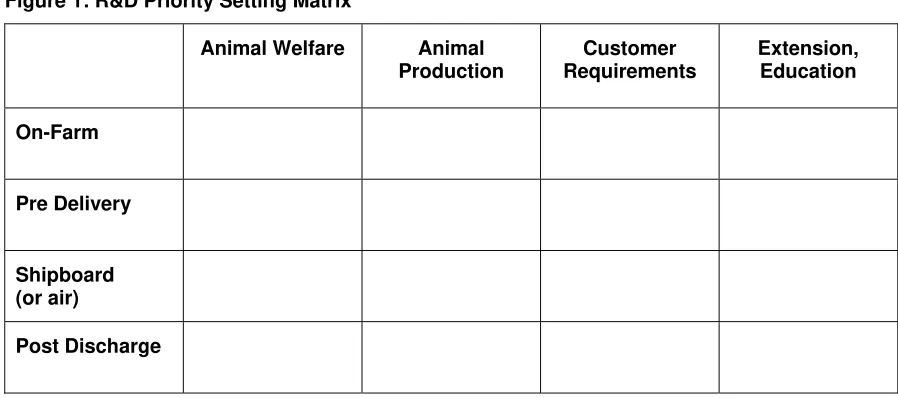
[image:3.595.104.553.322.521.2]An R&D Steering Committee workshop convened to assist plan preparation and subsequent analysis resulted in the following R&D priority-setting matrix.
Figure 1: R&D Priority Setting Matrix
Animal Welfare Animal
Production
Customer Requirements
Extension, Education
On-Farm
Pre Delivery
Shipboard (or air)
Post Discharge
The R&D priority-setting matrix retains the current supply chain focus adopted for R&D allocation and expands it to include specific consideration of on farm R&D relevant to live export (column one) and four overarching industry issues (row one). If this R&D Plan is adopted work will be required to
compartmentalise Live Export on farm R&D and other MLA activities. Live Export On Farm R&D may simply inform MLA programs and assist MLA priority setting. Definitions of supply chain links and overarching industry issues are provided below.
Supply Chain considerations:
On Farm: includes all those activities that take place prior to final yarding that have a bearing on Live Export efficiency, best practice and animal welfare e.g. stock management, stock selection, feeding, etc.
Pre Delivery: starts at the yards on farm and includes road transport, Australian feedlots and boarding logistics.
Shipboard: addresses all activities that take place on the vessel or aircraft in the case of airfreighted livestock.
Overarching Issues:
Animal welfare: mortality, morbidity and animal stress levels as well as public perceptions and criticism associated with animal treatment.
Animal production: health, nutrition, veterinary management, livestock management and husbandry. Animal production issues, such as salmonella in sheep, also have an animal welfare dimension.
Customer requirements: market research and feedback, production specifications, product safety, QA and environmental management.
Extension and education: delivery and uptake of R&D outcomes as well as those activities currently included as industry learning and communication.
The proposed matrix therefore proposes a wider portfolio of investment for Live Export R&D than is currently the case.
A STRATEGIC PLAN FOR R&D
Vision
The vision for R&D is:
“Investment to achieve excellence in the live export industry from farm to customer”.
This vision replaces the R&D Advisory Committee’s current overall goal (see appendix 1).
The R&D Advisory Committee strongly supported a decision to pursue excellence. R&D will be driven from an industry needs basis rather than focus on what industry will currently accept.
Objectives
In addition to a vision statement two specific R&D objectives are proposed to guide R&D priority setting, they are:
R&D for an industry that embraces best practice and the long-term profitability and productivity that best practice delivers.
R&D for an industry that constantly improves animal welfare consistent with best practice. R&D should therefore be driven by measures to improve profitability/productivity (primary consideration otherwise we don’t have an industry in which to invest) and, in all instances, consider the implications for animal welfare (a critical auxiliary objective – stakeholders without a financial interest in our industry have the capacity to shut it down).
R&D Priorities
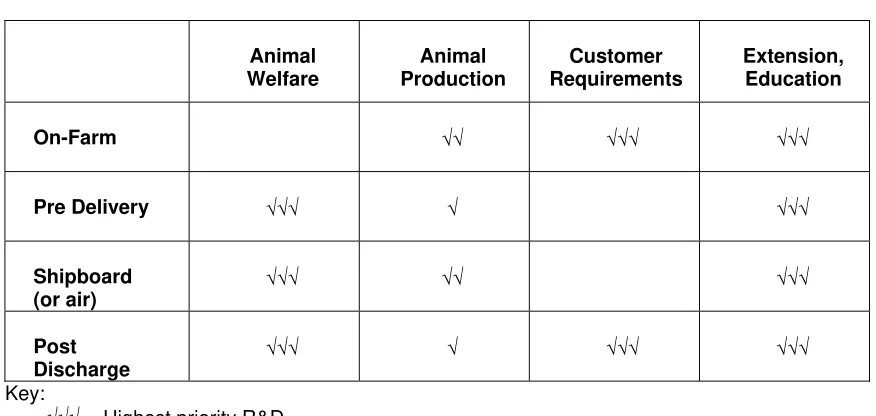
[image:5.595.111.549.528.736.2]R&D priorities for the 5-years to 2008 are outlined in the following matrix. Priorities are the result of comment received during consultation (September 2003), the R&D Advisory Committee Workshop of 9 September 2003 and comment received on the draft plan. Priorities are driven by the R&D Plans twin objectives.
Figure 2: R&D Priorities through to 2008
Animal Welfare
Animal Production
Customer Requirements
Extension, Education
On-Farm
Pre Delivery
Shipboard (or air)
Post Discharge
Key:
= Highest priority R&D
= R&D that should be completed as part of the plan
= Low priority R&D
Programs and projects for the next 5 years
The program priorities detailed below are consistent with the matrix. Project suggestions are provided as a guide against which the R&D Coordinator and Advisory Committee can evaluate research proposals and commission research studies. The relevant industry issue/knowledge gap is underlined for clarity.
On Farm
On Farm/Animal Welfare
Uptake of existing knowledge - Stock selection, preparation, water and feed requirements prior to transport are all well known (see for instance work completed by Richard Norris on stock
selection for live export). Their communication and application by producers needs to be improved. Poorly selected and managed stock creates an animal welfare risk further along the supply chain. On farm investment in animal welfare should concentrate on communicating and providing incentives for the uptake of existing knowledge (no new R&D projects suggested).
On Farm/Animal Production
Flock selection for salmonella - Salmonella type diseases are the major cause of shipboard death in sheep. On farm factors like soil type, pastures, weaning, animal husbandry, etc have unknown affects on predisposition to salmonella. These predisposition factors need to be further
understood so that flocks that are likely to be susceptible can be identified and culled from the trade and/or appropriate on farm management interventions undertaken ( = R&D that should be completed as part of the plan).
Management of entire males - A market preference has been expressed for entire male cattle. Their management on farm is difficult. Research is required to deliver best practice management farm systems. Systems also have applicability right along the supply chain ( = R&D that should be completed as part of the plan).
On Farm/Customer Requirements
Market dynamics - There is a need to provide improved information to producers on market dynamics “what does the customer require” “what sort of beast is required for which market” “how did my stock perform” “where is the market going’ “what new markets/market threats are
emerging”. Research on market information design is a Live Export R&D program priority; implementation of an improved system of communicating market dynamics could be negotiated with MLA to obtain appropriate leverage of Live Export R&D funds ( = Highest priority R&D).
Livestock supply - A shortage of stock is likely to be an issue in the short to medium term. Forecasts of sheep supply, for example, are required by the Live Export industry and this is an MLA responsibility (no new R&D projects suggested).
On Farm/Education, Extension
Uptake of existing animal welfare and production knowledge - Provision of information to producers to assist with implementation of best practice stock preparation is an R&D priority. Use of a producer language could be part of this project ( = Highest priority R&D).
Pre Delivery
Pre Delivery /Animal Welfare
Best practice for long road trips (>8 hours) – this is a major issue in animal transport in Europe. Australian commercial realities and stock types might dictate alternative practices to those employed in Europe. Information is required on whether a single journey or the spelling of stock is preferred – this issue needs research and access to scientific data for the Australian situation before European standards are imposed. The issue is relevant to all livestock industries and a project may be jointly funded with another RDC ( = Highest priority R&D).
Monitor ALFA feedlot standards – to ensure best practice in feedlot management, monitor and apply developments in ALFA feedlot standards. R&D in this area will address both potential environmental and animal welfare concerns ( = R&D that should be completed as part of the plan).
Hydration test kit – develop a simple stock hydration test kit for application pre delivery, shipboard and post discharge ( = R&D that should be completed as part of the plan).
Pre Delivery/Animal Production
Stockman and stock interactions - Quiet stock perform better during transport, feedlotting, shipping and slaughter. “Domestication” is particularly important for cattle and goats. Innovative research has been completed in the pig industry on stock/stockman interaction that may have applicability to live exports (David Adams has details). A project is suggested that might review this learning and prepare and disseminate best practice material. The material would also be relevant in other parts of the supply chain ( = Low priority R&D).
Salmonella in feedlots: - salmonella is an issue in feedlots and a major cause of shipboard death in sheep. A project linked to proposed on farm investment is warranted ( = Low priority R&D).
Pre Delivery /Customer Requirements
Producers and buyers supply stock outside specifications - again this issue can be addressed with communication of existing knowledge rather than the commissioning of new research (no new R&D projects suggested).
EMS - Other industry bodies cover development and application of Environmental Management Systems. No new research proposed (no new R&D projects suggested.).
Pre Delivery /Education, Extension
Shipboard
Shipboard/Animal Welfare
Animal mortality risk modelling – stress in animals is cumulative; multiple stress events are more damaging to animal welfare than are single events. Techniques for preparing a cumulative risk assessment are required and long-term research is needed to develop an understanding of the physiological basis of animal stress ( = Highest priority R&D).
“HS” for all situations – research and calibration of the industry developed heat stress model (“HS”) for application to all situations including the cattle trade with South East Asia. A project here would also link with animal mortality risk modelling ( = Highest priority R&D).
Wetting, moving, ship cleaning - the animal welfare (and economic) implications of hosing down stock, moving them between decks and ship cleaning between shipments needs to be
understood and best practice guidelines prepared ( = Highest priority R&D).
Heat radiated through the sides of ships during transit – heat radiated in this manner is a major source of heat stress in stock. Research to reduce heat radiation might include paint, insulation, a cavity construction in new vessels, etc. ( = R&D that should be completed as part of the plan).
Science based stocking densities – currently stocking densities are based on working
conventions rather than scientific data, research is required to generate objective data on animal welfare measures ( = Highest priority R&D).
Develop superior indicators of animal welfare – move away from mortality as the single indicator of welfare status to more sophisticated measures. Other indicators might include length of rest, room to lie, measures of “wellness”, etc ( = R&D that should be completed as part of the plan).
Shipboard/Animal Production
Weight performance research – R&D addressing shipboard animal performance has delivered increased returns and a sound scientific basis for the trade. Future animal production research would profitably address stock weight performance and the ultimate goal of shipboard weight gain
( = R&D that should be completed as part of the plan).
Airfreight livestock risk assessment – airfreight industry is based around high value livestock, including breeding stock. A risk assessment and recommendations regarding best practice are required (= Low priority R&D).
Shipboard/Customer Requirements
Carcase and manure disposal - “Customer requirements” is broadly defined to include
environmental management. Carcase and manure disposal in the open ocean and within more confined waterways is governed by International Marine Organisation requirements. These requirements may be further tightened in the future and R&D may be required to address future shortcomings in practice. For the life of this plan no research is suggested (no new R&D).
Shipboard/Education, Extension
Post Discharge
Post Discharge/Animal Welfare
Documentation of superior slaughter practices – best practice standards, relevant to conditions in destination markets (eg requirements for Halal slaughter), need to be identified, documented and training packages developed. Animal welfare gains from innovations like the Geoffrey Beere slaughter restraining box need to be classified and measured (in the same way as Temple Grandin has measured animal welfare improvements associated with her livestock handling equipment). Research is also required on barriers to adoption of best practice. ( = Highest priority R&D).
Develop and document training and accreditation standards for destination stockmen and slaughtermen – Formalise current systems for those involved in delivering animal welfare standards and product quality to customers post discharge ( = Highest priority R&D).
Research potential for cross border partnerships with importing countries – Cross border partnerships to ensure best practice animal welfare and capitalise on international trends in this area before they become a threat ( = Highest priority R&D).
Post Discharge/Animal Production
No new research projects suggested, research is a priority but secondary to post discharge animal welfare, customer requirements and extension. A single tick ranking is given to ensure this research area is not overlooked (= Low priority R&D).
Post Discharge/Customer Requirements
Market research on buyer and ultimate customer requirements – market research is required post discharge to ensure that all aspects of the supply chain are well informed and R&D is being appropriately directed. Research to be completed jointly with market access research. Aspects of the research to include requirements for different species in different markets and alternative products like “entire males” and cryptorchids. Market opportunity assessment will be critical post suspension of the Saudi sheep trade ( = Highest priority R&D).
Quality systems for post discharge supply chain - Develop quality systems to ensure appropriate product is delivered through the feedlot, transport and slaughter supply chain in destination markets. Investment in this program will ensure Australian product has an ongoing competitive advantage. This area has not received R&D funding in the past ( = Highest priority R&D).
Competitor research – market intelligence information is required on competitor status and forecast eg Nth African sheep supplies. Needs to be in depth ( = Highest priority R&D).
Impacts of trade on local agriculture – including research on both positive (opportunities for farmers to supply inputs to feedlots) and negative (social disruptions to cattle producers in Indonesian) impacts. Research here will provide useful hard data to manage possible threats to the trade ( = R&D that should be completed as part of the plan).
Post Discharge/Education, Extension
Communicate animal welfare breakthroughs – progress is being made in destination countries with regard to improved slaughter practices (e.g. uptake of Geoffrey Beere’s knocking box). This information needs communicating to the widest possible set of industry stakeholders. Information preparation is a function of R&D, communication is part of the wider MLA/LiveCorp Joint Program
( = Highest priority R&D).
HGP in Indonesian cattle – ensure uptake of current research findings ( = R&D that should be completed as part of the plan).
In Summary
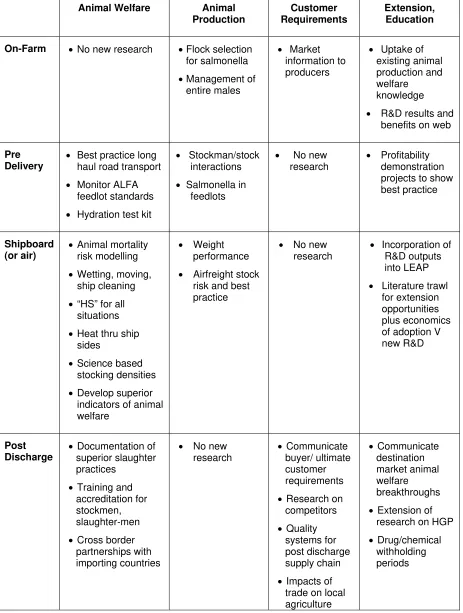
[image:10.595.86.549.187.800.2]The following summary is provided for ease of reference for suggested projects.
Figure 3: Example Projects through to 2008
Animal Welfare Animal
Production
Customer Requirements
Extension, Education
On-Farm No new research Flock selection for salmonella
Management of entire males
Market information to producers
Uptake of existing animal production and welfare knowledge
R&D results and benefits on web
Pre Delivery
Best practice long haul road transport
Monitor ALFA feedlot standards
Hydration test kit
Stockman/stock interactions
Salmonella in feedlots
No new research
Profitability demonstration projects to show best practice
Shipboard (or air)
Animal mortality risk modelling
Wetting, moving, ship cleaning
“HS” for all situations
Heat thru ship sides
Science based stocking densities
Develop superior indicators of animal welfare
Weight performance
Airfreight stock risk and best practice
No new research
Incorporation of R&D outputs into LEAP
Literature trawl for extension opportunities plus economics of adoption V new R&D
Post Discharge
Documentation of superior slaughter practices
Training and accreditation for stockmen, slaughter-men
Cross border partnerships with importing countries
No new research
Communicate buyer/ ultimate customer requirements
Research on competitors
Quality systems for post discharge supply chain
Communicate destination market animal welfare breakthroughs
Extension of research on HGP
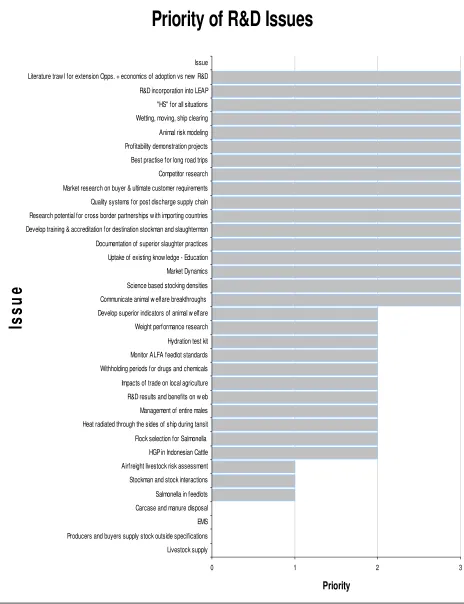
Prioritisation of R&D Issues
Figure 4: Graphical Presentation of R&D Priorities
Priority of R&D Issues
0 1 2 3
Livestock supply Producers and buyers supply stock outside specifications EMS Carcase and manure disposal Salmonella in feedlots Stockman and stock interactions Airfreight livestock risk assessment HGP in Indonesian Cattle Flock selection for Salmonella Heat radiated through the sides of ship during tansit Management of entire males R&D results and benefits on w eb Impacts of trade on local agriculture Withholding periods for drugs and chemicals Monitor ALFA feedlot standards Hydration test kit Weight performance research Develop superior indicators of animal w elfare Communicate animal w elfare breakthroughs Science based stocking densities Market Dynamics Uptake of existing know ledge - Education Documentation of superior slaughter practices Develop training & accreditation for destination stockman and slaughterman Research potential for cross border partnerships w ith importing countries Quality systems for post discharge supply chain Market research on buyer & ultimate customer requirements Competitor research Best practise for long road trips Profitability demonstration projects Animal risk modeling Wetting, moving, ship clearing "HS" for all situations R&D incorporation into LEAP Literature traw l for extension Opps. + economics of adoption vs new R&D Issue
Is
s
u
e
Criteria for Selecting Projects
The R&D Advisory Committee should be proactive. The Committee should actively pursue projects with three ticks rather than wait for them to be suggested by potential researchers. Researchers should be invited to submit proposals for priority research and these proposals should be evaluated in an annual funding round at the same time as non-commissioned proposals using the following criteria:
1. The proposed project will shift the industry toward best practice i.e. the project will increase overall long-term industry net benefit (measured as total Net Present Value (NPV) and NPV per $ invested by the Joint Program). While best practice is more than just profitability, net benefit provides an objective measure of the relative improvement offered by the project relative to other project proposals. The process is consistent with other RDCs.
2. The proposal results in an improvement in animal welfare, especially one that can be communicated to the wider community.
3. The proposal addresses the priorities identified in the R&D priority matrix.
4. An appropriately detailed literature review accompanies the research application so that existing knowledge is not replicated. Much is already known about animal production in live export chains. 5. Researcher disclosure - the application for funding must disclose sufficient information to permit its evaluation, must agree to report progress sufficient to monitor outcomes and reveal other project commitments. These steps will assist MLA/LiveCorp in capture of resultant intellectual property. 6. The application is consistent with MLA project evaluation procedures. The Committee can use a
simple table and “tick based scoring” to apply these procedures or they can be tested more thoroughly using MLA’s Bubble Plot Software. Relevant MLA criteria include:
The proposal is technically achievable and clear;
The technical skills base proposed by the researcher is appropriate;
Project objectives are clear and well defined;
There is a market need for the R&D output;
Product and delivery systems are well defined and there is a high chance of adoption;
A credible commercialisation pathway is proposed;
The proposal is consistent with regulatory, social and political realities;
The R&D will create a positive or neutral environmental impact;
The R&D will create a positive or neutral social and political impact;
Stakeholder groups that will benefit from the R&D have been identified, higher priority is afforded to proposals that benefit a larger number of stakeholder groups;
The project is relatively easy to execute;
Leverage – the project may open up potential for new technical or commercial opportunities;
R&D outputs are durable;
There is synergy with other industry R&D outputs; and
There are benefits for other linked industries eg Australian meat industry. 6. The R&D Advisory Committee might also like to consider:
Who captures the benefit of the R&D outputs – are they Australian or foreign owned
interests. In some instances there may be mutual benefit, for example, where animal welfare standards are improved; and
Recommendations for Project Selection
The consultant recommends the following evaluation pathway. A decision tree style approach is
suggested, i.e. if research proposals or commissioned studies pass through criteria 1 they are suitable for consideration for criteria 2, and so on. The R&D Coordinator would complete each of the following steps with information provided by the research applicant. The R&D Advisory Committee would then review the R&D Coordinators evaluation. In detail, project selection would be as follows:
1. The proposal must contribute to overall industry best practice as measured by an increase in net benefit somewhere in the supply chain (Plan Objective 1). Difficulty with calculation should not prevent an “educated estimate” being made. Proposals should be funded where net benefit is likely to be greatest. Who earns the benefit is a secondary consideration and may be used as a proposal selection tool after primary criteria are exhausted (see criteria 6).
It is recommended that estimates of likely net benefit be made by researchers and checked by the R&D Coordinator prior to consideration by the R&D Advisory Committee.
2. The proposal results in an improvement in industry animal welfare practices (Plan Objective 2). If the proposal is positive (or at the very least neutral on this criterion) it should be further considered for funding. This criteria is ranked two to best practice in order to prevent the funding of non commercial animal welfare outcomes (e.g. air-conditioned ships).
3. The proposal addresses the industry priorities highlighted in the priority matrix. Given finite industry resources proposals that address three tick items should be funded/commissioned first.
4. The application for funding is accompanied by an appropriately detailed literature review and
disclosure statement. Proposals that lack a suitable literature review and disclosure statement should be provided with the opportunity to resubmit after the information has been assembled.
5. A tick-based checklist be developed from the criteria included in the MLA Bubble Plot Software. These criteria should be tailored to address the technical quality of the proposal. A three, two, one tick rating should be applied. A simple tick based checklist prepared for all project proposals by the R&D Coordinator for review by the R&D Advisory Committee is preferred to use of the bubble plot software. A checklist is transparent and rankings are immediately available to R&D Advisory Committee members.
6. Finally, if additional criteria are needed to sort close proposals (and this is unlikely) – priority needs to be given to proposals that result in capture of benefits by Australian stakeholders. LiveCorp’s
Horizontal Bar Graph approach that prioritises R&D outcomes by stakeholder could be used in this instance (Jane Cleeve has details).
Plan Risks
The proposed plan is strategic in its outlook; twin objectives have been set and a wider portfolio of research priorities established. However, the plan is not without risks and the following will need to be managed to ensure the industry vision is realised:
Other species – the plan has dealt implicitly with beef cattle and sheep. Project selection will also need to recognise the special research requirements of breeding livestock, dairy livestock and currently less significant species, especially goats.
Is the mix between basic research, applied research, extension, commercialisation and support correct - a portfolio of research has been suggested with a strong emphasis on development and extension of existing knowledge. This recommendation has been prepared on the basis that much is already known about livestock performance and management. The R&D Advisory Committee will need to be mindful of any emerging needs for long-term pure research in areas not addressed in this plan.
Measuring Plan Success
If the plan is successful the R&D priorities identified will be researched, communicated and the outputs adopted by industry. This success can be measured by a shift from current practice toward best practice and can be measured in terms of:
Ex-poste cost benefit analysis – to measure whether forecast benefits achieved actual industry benefits.
R&D outputs that are suitable for communication to the wider community demonstrating improvements in animal welfare (measured in press releases announcing positive changes in animal welfare and a decrease in “bad news” stories).
Changes in LEAP/ALES reflecting additional knowledge generated by R&D.
Improvements in mortality/morbidity onboard ship.
Producers with better knowledge of market requirements and gearing their production base to non-opportunistic supply.
Detailed indicators of plan success should be prepared as part of plan implementation.
Comparisons with other R&D Corporations
The plan’s success needs also to be measured against the activities of other R&D Corporations.
The proposed plan shifts Live export R&D towards a wider portfolio of investments and this is consistent with the priorities of other primary industry R&D Corporations, see appendix 3. In comparison to other R&D Corporations, Live Export R&D expenditure is modest, for instance:
1.8% of wool gross value is invested in R&D;
1% of grains gross value is invested in R&D;
0.5% of horticulture gross value is invested in R&D; and
0.1% of live export gross value is invested in R&D.
APPENDIX 1 CURRENT STATUS OF R&D
The Live Export Joint Program is an initiative of MLA and LiveCorp that funds activities in the following areas:
Trade support i.e. market access, market support and trade development;
Industry standards;
Communications; and
R&D.
The joint MLA/LiveCorp R&D Program has been in place since 1998. The R&D component has an annual budget in excess of $1 million.
The overall goal of the R&D Program is to:
“Assist in improving the efficiency of the live export industry in ways that meet the expectations of the industry stakeholders which includes producers, exporters, ship owners, animal welfare groups, regulators, importers and community as a whole”.
Meat and livestock R&D is widely defined. To qualify as R&D, projects must fit within the following definition:
Meat and livestock R & D means systematic experimentation or analysis in any field of science, technology or economics (including the study of the social or environmental consequences of the adoption of new technology) carried out with the object of:
(a) Acquiring knowledge for the purpose of obtaining or furthering an objective of the meat and livestock industry, including knowledge that may be of use in improving any aspect of the production, processing, storage, transport or marketing of meat or livestock, or goods that are derived from them; or,
(b) Applying knowledge for the purpose referred to in paragraph (a).
The Joint MLA/LiveCorp R&D Program is currently divided into four areas of research that follow the supply chain, i.e.:
Pre delivery management (starts at yards on farm);
Shipboard management;
Post discharge management; and
Industry learning and communication (technical forums, scholarships, databases, etc).
To date the Joint MLA/LiveCorp R&D Program has:
Focused on the supply chain;
Funded priority research on a project by project basis;
Directed investment to immediate needs rather than longer term strategic goals;
Allocated most funds to shipboard management (50% plus), allocated some funds to pre delivery management (35% plus), invested little in post discharge projects (5%) and applied the balance of funding to learning and communication; and
Average project budget was approximately $44,000 in 2002/03. Project budgets range from around $10,000 (for workshops) to $222,000 (heat stress).
APPENDIX 2 PLAN PREPARATION METHODOLOGY
The following steps were completed in preparing the plan:
Current and future issues and knowledge gaps facing the live export industry supply chain were identified by reviewing industry literature and consulting with industry stakeholders.
A background paper was prepared and circulated prior to an R&D Advisory Committee workshop in Adelaide 9 September 2003.
The workshop reviewed the background paper, an analytic framework was suggested and industry R&D priorities discussed.
Subsequent to the workshop the consulting team has refined the analytic framework and
formulated a draft plan that includes a vision statement, plan objectives, plan programs, program priorities and suggestions for research projects.
The plan also includes an analysis of risks, criteria for evaluating projects and suggestions for measuring plan success.
APPENDIX 3 COMPARATIVE RDC PRIORITIES
In Summary
Supply chain
Customer requirements, new markets
QA, food safety, consumer confidence
Market access and trade
Environment, sustainability and EMS
Extension and education
GRDC
Supply chain
Product quality, QA
Improving productivity
Environment protection
Delivering outcomes, extension
Cotton RDC
Sustainability
Trade and market access
Product meets consumer requirements
New markets, consumer confidence, food safety
Biotechnology
Community and economics
Dairy RDC
Natural resources
Feed base
Animal performance
Change management and delivery
Manufacturing and R&D operations
Horticulture Australia
New markets, consumer requirements
Supply chain innovation
Conservation and food safety
QA – clean and green
RIRDC
Global competitiveness
EMS
Human capital, communications
Information systems
Farm safety
Sugar RDC
Supply chain
Farming systems, sustainable production
Processing and distribution – sustainable and cost efficient