1
BUILDING CONSTRUCTION’S RESPONSE TO THE EARTHQUAKE Case study: Lamban Tuha and Bidai House
by:
widya fransiska febriati
Departement of Architecture, Sriwijaya University, Palembang [email protected]
and wisnu setiawan
Departement of Architecture, Muhammadiyah University of Surakarta, Surakarta [email protected]
Abstract
Earthquake is one of nature phenomenon that must be considered in making proper building structure. Geographic characters in certain place have been inspiring people to decide a suitable structure system for their dwellings. They had a basic understanding on construction which lead them to make a responsive construction for earthquake.
This paper discuss two kinds of structure system which were belong to Lamban Tuha in West Ogan Komering Ulu, South Sumatera and Rumah Bidai in Rejang Lebong, Bengkulu. They were chosen because of their uniqueness structures, Kalindang and Ari for Lamban Tuha and Bidai Wall for Rumah Bidai. The resistancy of these building will be observed by using the analysis of earthquake resistant building structure, according to earthquake resistant building general theory.
Keywords: earthquake resistant building, structure
I. Introduction
In responding the nature, people had created responsive structure which could be judged as an adaptive (or responsive) structure on the spesifix nature character. This paper discussed two example of earthquake resistant solution. Firstly, it will discuss the Lamban Tuha, located at West Ogan Komering Ulu Regency, South Sumatera Province, which had Ari and Kalindang system on its structure. This building had erected for more than 200 years and had been proven resistant to earthquake that happened nearby the location frequently. When the most hazardous earthquake happened in Liwa (1933), all the buildings in this village were damaged except Lamban Tuha House. This earthquake intensity was 6.7 in Richter scale. (Siswanto, 1997)
Table 1. Hystory of Big earthquake in South Sumatera Region ( Bengkulu, Lampung and South Sumatera Provices) for the last 200 years Year Frequent of
1933 1 times Very high (6.7 in richter scale) Lahat, South Sumatera 1963 1 times High (4.7 in richter scale) Kotabumi, Lampung
1994 1 times High Liwa, Lampung
2
The second one is Bidai House, located at Rejang Lebong Regency, Bengkulu Province. This building had bidai structure. Even though this technology relatively younger compare to Ari and Kalindang’s, it was also proven as an earthquake resistant building sturcuture, when the recent earthquake happened in Bengkulu in 2000 (in 5.7 Richter scale).
Table 2. Description of Earthquake nearby Bengkulu Year 2004-2005
Year Frequent of EQ Intensity Location
2004 11 times 4.6 - 7.3 Richter scale Bengkulu
2005 9 times 3,8 - 5,6 Richter scale Bengkulu
3 times 5,5 - 6,6 Richter scale Lampung Source: Earthquake News, National Earthquake Center, BMG
The tracing these two uniquenesses on earthquake resistancy would be investigated by using the literature study of earthquake resistance building general theory. The observation scope was limited on general building structure system.
II. Earthquake Theory on Building Structure (Schodek, 1980)
According to Schodek, earthquakes are vibratory phenomena associated with shaking loading on the earth crust. There are several basic types of hazard associated with earthquake. These include surface fault raptures, ground shaking, ground failure and tsunami. The waves cusse the earth’s surface and any building resting on its to vibration. As the building is vibrated, forces are developed in the structure of the building because of the tendency of the mass of the building to resist the motion. The forces developed are consequently inertial in character. The magnitude of these forces depens on many factors. The mass of the building is clearly important, since the forces involved are inertial. Other factor include the way the mass is distribute the stiffness of the structure, the stiffness of the soil, the type of foundation, the presence of damping mechanisms in the builing, and, of course, the nature are magnitude of the vibratory motions themselves.
In designing structural systems, the way lateral stability is achieved is an issue of fundamental importance. The issue is important in buildings of any height but absolutely crucial in high-rise constrction. The way a structure resists lateral forces not only
• Diagonal bracing (joins can be pin-connected) • Frame action (joints must be rigid)
• Shear wall (joints can be pin-connected) • Brace frame (a redundant system)
In his book, Schodek also stated there are some general considerations in designing dan planning the earthquake resistant building structure as follows:
3
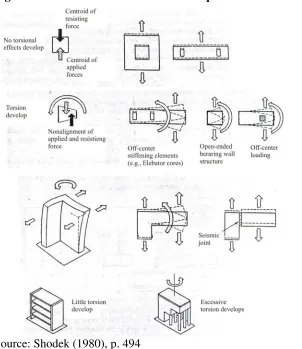
b. Structures that are nonsymmetrical because of either their basic configuration of nonsymmetrical placement of lateral-load-resisting elements typically experiences high torsional forces which are very destructive. Nonsymmetrically-placed masses can also lead to similar torsional effects.
c. Nonsymmetrical configurations with reentrant corner (e.g., L- or H-shaped buildings) are particularly susceptible to destructive torsional effects. Primary damage often occurs at the reentrant corners. Allowing separate building masses to vibrate independently by using seismic separator joints that allow free movement to occure generally improves structural performance.
d. Building that are nonsymmetrical in the vertical direction also experience destructive torsional effects. Discontinuous shear wall are particularly problematical.
Figure 1 General Consideration in Earthquake Resistant Building Planning
Source: Shodek (1980), p. 494
General Characteristics of Earthquake-Resistant Structures
4
column-and-beam elements are generally coaxial. Offsets or nonaligned members often present extremely difficult design problems.
Materials
Timber can be an extremely good material for use in earthquake region. It is light in weight and capable of absorbing large amounts of energy when deformed and before collaps. Low-rise wood-framed structures are highly earthquake-resistant and perform well in earthquake regions.
III. Lamban Tuha Building (Siswanto et.al, 1997)
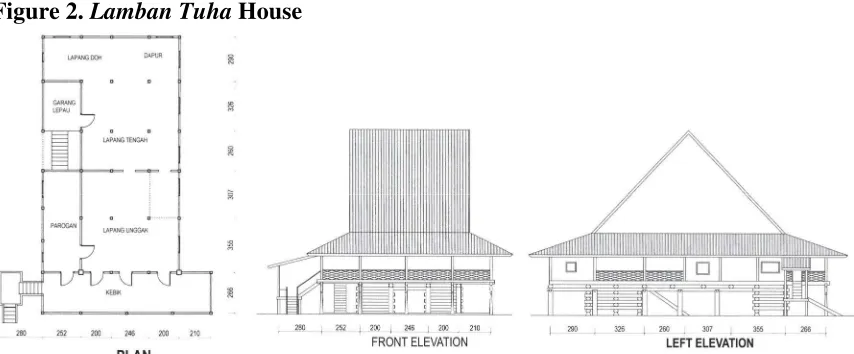
Lamban Tuha building is an old tradisional house owned by Ranau ethnic which lived near by Ranau Lake, the border area between Lampung Province and South Sumatera Province. Research did by Siswanto et.al (1997) observed Lamban Tuha in Banding Agung District, Ogan Komering Ulu Regency, South Sumatera Province. Its building support system was able to anticipate the earthquake effect. When the earthquake happened, the flexible kalindang structure would be shaking without making any damage caused by earthquake.
Figure 2. Lamban Tuha House
Source: Redrawed from Siswanto et.al (1997)
5 Figure 3. Section of Lamban Tuha
Source: Redrawed from Siswanto et.al (1997)
The body of building was consisting of a column structure (named Sako) and building cover. The floor construction was consist of some boards, were supported the floor by using some balks. These balks were carried by a bigger round balk.
The supported column for the bottom of building called Ari. Ari was located under the floor, and in certain case, Ari’s location was not coaxial with the sako (approximately 30 cm in distance). Sako worked for the body of building, while the Ari worked for the bottom one. If we look further as a whole building, Sako’s locations used at additional room were not coaxial with the Ari. On the contrary, Sako used at a main room of building were co-axial with the Ari. The Ari carried on big stone on a hard land surface
Figure 4. Axonometri: Kalindang, Lamban Tuha House
Source: Redrawed from Siswanto et.al (1997)
6
amongs the kalindang’s balks were categorized as tension, compression and fixed connection. Those joints were carried by the strength of the timber balks. There was no nail used in its joint system, but it was still able to netralized the force caused by earthquake.
The foundation of lamban tuha was pematuan (with one or several big stones) which combined with a base round timber balk. This system was placed on a hard surface. This system was considered as a good earthquake solution because it made the column would not be broken caused by the earthquake vibration.
IV. Bidai House (Fransiska, et.al, 2003)
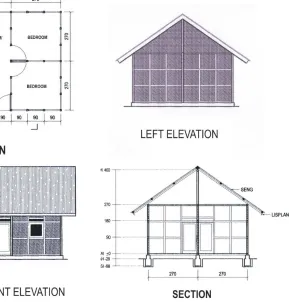
Clearly, bidai house would see similar with other brick house. Generally, bidai house were erected on a stone foundation. Most of bidai house were not rise building, and it could be categorized as a semi-permanent building. The main structure was made by timber. The use of timber frame can be seen from the column made by timber (10/10 cm). Timber frame could be also use as frame for roof structure. The roofing frame use a simple form, saddle form, which carried by a column (10/10). The joint between ring balk and the roofing frame using full-lap joint.
Figure 5. Bidai House
7
This house use pebble or river stone for its foundation. There was nothing special founded in this structure. Eventhough the area where this building located is known as frequently earthquake happened, this stone foundation still used commonly. It is believed that the bidai structure in its wall structure made flexible structure beside the light building load.
The wall had a frame system which made from timber frame in modular arrangement. At the timber frame, there were two nails which tighted the wire line bottom and up of modul in 20 cm of distances. At the end of right and left of wiring arrangement, there were a series of nails as a place for tightening the key of plaited bamboo.
Figure 6. Wall: Bidai
Source: Fransiska (2003)
The wire which tigthned along up and bottom nail became the vertical bone (or bracing) for bidai wall structure. Bamboos were plaited on these vertical wires in crisscross order. It used bamboo Telang, a local name for local species of bamboo. The length of the space between bamboos’s joint was approximately 70 – 100 cm. The modul of bidai wall was made based on this physic structure of bamboo; the average distance of bamboo joints. The plaited bamboo will be locked by a plaited bamboo, located at the end of wall fram (left and right of modul)
After the plaited bamboo had been formed, the wall was covered by mortar. This mortar consists of cement and sand with 1: 5 comparations in its composition. The way to covered the wall was started from the inside part of wall, then continued to outside, and it continued one after another.
8 V. Discussion
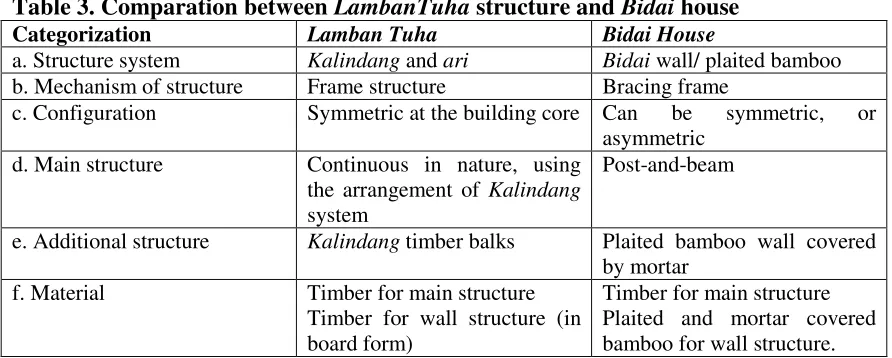
From the both description, there are some conclusions can be drawed. Both systems had some similarities and differences which are shown as follows.
Table 3. Comparation between LambanTuha structure and Bidai house Categorization Lamban Tuha Bidai House
a. Structure system Kalindang and ari Bidai wall/ plaited bamboo b. Mechanism of structure Frame structure Bracing frame
c. Configuration Symmetric at the building core Can be symmetric, or asymmetric
d. Main structure Continuous in nature, using the arrangement of Kalindang system
Post-and-beam
e. Additional structure Kalindang timber balks Plaited bamboo wall covered by mortar
f. Material Timber for main structure Timber for wall structure (in
helped this building to overcome the unsteady situation caused by earthquake.
• The structure system of Lamban Tuha used a rigid combination between support
point dan continuous in nature system. It made a flexible and simple system for its building structure. Bidai structure used a support point system with mortar covered plaited bamboo as wall bracing.
• Because of its long form, kalindang were placed at the shortest side of building. It is
in line with the theory that for symmetry plan, the shortest wall should be strengthen to minimize the earthquake effect to overcome the effect of lateral forces caused by earthquake.
• Timber is still a good material for earth quake resistant building. Both building
system use this positive timber character to overcome the earthquake effect.
References
Fransiska, Widya et.al (2003), Studi Rumah Dinding Bambu Plester di kabupaten Rejang Lebong, Bengkulu sebagai Alternative Bahan Bangunan Bagi Rumah Sederhana, Penelitian DIK-S, Lembaga Penelitian, Universitas Sriwijaya
Fransiska, Widya (2005), Pengembangan Modul Konstruksi Bambu Plester Sebagai Alternatif Kulit Bangunan, Proceeding in Seminar RAPI IV- UMS 2005
Siswanto, Ari et.al (1997), Analisis Aspek Arsitektur dan Konstruksi Bangunan Lamban Tuha, tipikal rumah ulu yang tahan gempa di kabupaten Ogan Komering Ulu, Pusat Penelitian Tata Ruang, Lembaga Penelitian Universitas Sriwijaya.
Schodek, Daniel (1980), Structure, Prentice-Hall., Inc., Englewoods. Schodek, Daniel (1995), Struktur, Eresco, Bandung, translated edition.