IN 2016/2017
THESIS
BY
YUSPINTA KRISTIANI GEA Reg. Number 122108132
INSTITUTE OF TEACHER TRAINING AND EDUCATION OF GUNUNGSITOLI FACULTY OF EDUCATION OF LANGUAGES AND ARTS
THE EFFECT OF SIGHT WORD STRATEGY ON THE STUDENTS’ ABILITY IN MASTERING VOCABULARY AT THE EIGHTH
GRADE OF SMP NEGERI 1 TUHEMBERUA IN 2016/2017
THESIS
Submitted to
Institute of Teacher Training and Education of Gunungsitoli in Partial Fulfillment of Requirements
for the Degree of Sarjana Pendidikan
By
YUSPINTA KRISTIANI GEA Reg. Number 122108132
INSTITUTE OF TEACHER TRAINING AND EDUCATION OF GUNUNGSITOLI FACULTY OF EDUCATION OF LANGUAGES AND ARTS
i ABSTRACT
Gea, Kristiani, Yuspinta. 2016. The effectof Sight Word Strategy on the students’ ability in mastering vocabulary at the eighth grade of SMP Negeri 1
Tuhemberua. Thesis. Advisors (1) Drs. Ellyanus, M.Pd., (2) Yasminar
Amaerita Telaumbanua, S.Pd., M.Pd.
Keywords: Effect, Sight Word Strategy, Mastering Vocabulary.
The importance of reading skill to transmit the information has allowed the students to develop their ability in gaining the information from the written source. In most of the school, the main source of the lesson material comes from the written language, which means the students challenge to get more practices in reading, whether they want it or not. Sight Word Strategy is useful for developing the
students’ ability in mastering vocabulary.
The purposes of this research are: (1) to find out whether there is a significant difference between using Sight Word Strategy and the students’ ability in mastering vocabulary especially in instruction form at the eighth class of SMP 1 Tuhemberua.
(2) to find out the students’ ability in mastering vocabulary especially in instruction form by using Sight Word Strategy at the eighth class of SMP 1 Tuhemberua. (3) to
find out the students’ ability in mastering vocabulary especially in instruction form by using Sight Word Strategy at the s eighth class of SMP 1 Tuhemberua. (4) to find out which is the better strategy between Sight Word Strategy towards the students’ ability in mastering vocabulary especially in instruction form at the eighth class of SMP 1 Tuhemberua. This research is held at SMP 1 Tuhemberua in 2016/2017. The subject of the action is the eighth class students. This research is held by using Ex Post Facto Research.
The instrument used by the researcher is evaluation paper. The evaluation
paper is given to the students in order to evaluate the students’ ability in mastering vocabulary, either in Class using Sight Word Strategy. The result of this research is:
ii
ACKNOWLEDGEMENTS
The researcher thanks to God, because He always blesses the researcher during making the research.
Since the researcher started the research, there were a lot of things that challenged the researcher in making the research. The researcher has been supported by many valuable people to finish her thesis. Hence, the researcher wants to express her sincere appreciation and thanks to: Her beloved Parents: Father Talizaro Gea and Mother Yunila Zalukhu. Thank you for love, prays, motivations, and supports from all of you. Ms. Yasminar Amaerita Telaumbanua, M.Pd,as the Chair of English Education Study Program, and alsoas the second advisor, who has given her time, support, motivation, guidance and suggestion in completing the thesis. Mr. Afore Tahir Harefa, S.Pd, M.Hum as the secretary of English Education Program, as her examiner of education, who gives corrections and ideas in building the thesis. Mr. Adieli Laoli, S.Pd., M.Pd, as the Dean of FPBSand alsoas the examiner of study who always guides her patiently by giving suggestions and ideas in finishing the thesis.
VIII-iii
2, as the sample of the research, who has given his/her time in teaching learning process. The students of the eighth grade of SMP Negeri 2 Tuhemberua conduct external validity by trying out the items test. Mr. Heza’aro Zai, as the Headmaster of SMP Negeri 1 Tuhemberua who gives permission and facilitates the researcher in conducting the research. Mr. Mediyunus Zai, S.Pd, as the English teacher in SMP SMP Negeri 2 Tuhemberua, who gives a good contribution to help the researcher. The best friends: Yusni Mendrofa S.Pd, Damai Kristian Telaumbanua S.Pd, Agusriang Laia S.Pd, Siliria Telaumbanua S.Pd and all of the students class C English Deparments generation 2012.
Finally, the researcher realizes that the thesis is far from being perfect. Therefore, she hopes all constructive suggestions and criticisms so the thesis can be better, and hopefully the thesis will be useful for the readers.
Gunungsitoli, December 2016 The Researcher,
iv
THE LIST OF CONTENTS
Pages
THE AGREEMENT OF THESIS ADVISORS ………. i
THESIS APROVAL ………. ii
B.The Identifications of the Problems …..……… 5
v
g. Story Grammar Strategy through Narrative Text ... 36
vi
D.The Kind of Data and Research Instruments …... 52
E.The Procedures of Collecting the Data ... 53
F. The Techniques of Data Analysis ... .. 54
1. Examining the Validity of the Instrument …………. 54
2. Examining the Reliability of the Instrument ……….. 55
3. Determining the Students’ Ability in Reading Comprehension ……….. 56
4. Determining the Mean score and Standard Deviation ……….. 57
5. Examining the Normality ……….. 58
6. Examining the Homogeneity ………. 59
7. Examining the Hypothesis (t-test) ……….. 60
CHAPTER IV : RESEARCH FINDINGS AND DISCUSSION ……….. 62
A.Research Findings Descriptive……… 62
1. The Try Out Instrument... 62
1. The Common Response of the Research Problem ……….. 71
2. The Analysis of the Research Findings ……… 72
vii
4. The Research Findings Implication ……….. 74
5. The Research Findings versus Theories ………….. 75
6. The Analysis of the Research Findings Limitation ………. 76
CHAPTER V : CLOSING ……… 77
A. Conclusions ……… 77
B. Suggestions……… 78
BIBLIOGRAPHY ... 79
APPENDICES ... 82
viii
THE LIST OF TABLES
Tables Pages
1. Research Design ……….………...……… 49
2. The Population Condition of the Eleventh Grade of SMA Negeri 1 Gunungsitoli in 2011/2012……… 51
3. The Total Sample of the the Eleventh Grade of SMA Negeri 1 Gunungsitoli in 2011/2012 ……….……….. 52
4. Work Table for Lilliefors Formula ………. 59
5. The Validation Result of Item One to Ten in Research Try Out Instrument ………. 63
6. The Normality Examining of Experiment’s Pre Test ……… 66
7. The Normality Examining of Experiment’s Post Test ……… 66
8. The Normality Examining of Control Class Pre Test ……… 67
9. The Normality Examining of Control Class Post Test ……… 67
10. T –Test through Independent Samples Test ………... 69
11. The Score of Research’s Try Out Instrument at the Eleventh Grade of SMA Swasta Pembda 2 Gunungsitoli in 2011/2012 …………..…………... 109
12. Pearson Correlation ……… 111
13. The Preparation for Seeking the Validity of Item One in Research Try Out Instrument ………. 112
14. The Validation Result of Item One to Ten in Research Try Out Instrument ……… 114
15. Case Processing Summary of Reliability test……… 115
16. Reliability Statistics ……….. 115
ix
18. Item-Total Statistic ………. 116
19. Scale Statistics ……….. 116
20. Mean, Standard Deviation, and Variance of the Data …..……… 117 21. Students’ Score of Pre Test of
Experimental Class …..….…..……….. 119 22. Students’ Score of Post Test of Experimental Class ……..……….. 120 23. Frequencies Statistics of Pre test and Post Test
of Experimental Class ……….………... 121
24. Frequency Pre test ……… 121
25. Frequency Post test……… 122
26. Mean, Standard Deviation, and Variance of Pre Test
of Experimental Class ……… 123
27. Mean, Standard Deviation, and Variance of Post Test
of Experimental Class ……… 124
28. Students’ Score of Pre Test of
Control Class ……….... 125
29. Students’ Score of Post Test of
Control Class ……….... 126
30. Frequencies Statistics of Pre test and Post test
of Control Class ……….. 127
31. Frequency Pre test ……… 127
32. Frequency Post test……… 128
33. Mean, Standard Deviation, and Variance of Pre Test
of Control Class ……..……… 129
34. Mean, Standard Deviation, and Variance of Post Test
of Control Class ……..……… 130
x
36. Descriptives of Pre Test Normality ……… 132
37. Test of Normality (Pre Test Normality) ………... 132
38. The Normality Examining of Experiment’s Pre Test ………. 136
39. The Normality Examining of Control’s Pre Test ………. 137
40. Case Processing Summary (Post Test Normality) ……… 139
41. Descriptives of Post Test Normality ……… 140
42. Test of Normality (Post Test Normality) ……….. 140
43. The Normality Examining of Experimental Class Post Test ………. 144
44. The Normality Examining of Control’s Post Test ………. 145
45. Case Processing Summary (Pre Test Homogeneity)……… 146
46. Descriptives of Pre Test Homogeneity……… 147
47. Test of Homogeneity of Variance (Pre Test Homogeneity) .………... 147
48. Case Processing Summary (Post Test Homogeneity)………. 149
49. Descriptives of Post Test Homogeneity………. 150
50. Test of Homogeneity of Variance (Post Test Homogeneity) .………. 150
51. Group Statistics ………. 152
xi
THE LIST OF FRAMES
Frames Pages
2.1 Irwin’s Five Basic Comprehension ……… 28
xii
THE LIST OF FIGURES
Figures Pages
2.1 Story Map with C-SPACE ……….……… 38
2.2 Story Face ……….………. 39
xiii
THE LIST OF GRAPHICS
Graphic Pages
1. Normal Q-Q Plot of Pretest (Experimental Class) ……… 133
2. Normal Q-Q Plot of Pretest ( Control Class) ……… .... 133
3. Detrended Normal Q-Q Plot of Pretest (Experimental Class) ………….. 134
4. Detrended Normal Q-Q Plot of Pretest (Control Class) ………. 134
5. Pre Test Normality Graph ………... 135
6. Normal Q-Q Plot of Post Test (Experimental Class) ……… 141
7. Normal Q-Q Plot of Post Test ( Control Class) ……… . 141
8. Detrended Normal Q-Q Plot of Post Test (Experimental Class) ………… 142
9. Detrended Normal Q-Q Plot of Post Test (Control Class) ………. 142
xiv
THE LIST OF APPENDICES
Appendices Pages
1. Test for Try-Out ………... 82
2. Lesson Plan for Control Class . ………...……….. 84
3. Lesson Plan for Experimental Class ……….……….……….. 88
4. Material for Control Class ………. 92
5. Material for Experimental Class ………...……… 94
6. Post-Test for Control Class ….….……….. 97
7. Post-Test for Experimental Class ………….……….. 99
8. Pre-Test for Control Class ……..………. 101
9. Pre-Test for Experimental Class …………..……….. 102
10. Syllabus ………..……….. 103
11 The Key Answer ……….….……….. 104
12 Minimum Competence Criterion ………. 105
13. Testing Instrument (The Score Result of Research’s Try-Out Instrument at the Eleventh Grade Science of SMA Swasta Pembda 2 Gunungsitoli in 2011/2012) ……… 109
14. Reliability Test ……….……… 115
15. Mean, Standard Deviation, and Variance (Experimental Class) …..……… 119
16. Mean, Standard Deviation, and Variance (Control Class) ………..…..……… 125
xv
18. Examining Normality (Post-Test of Experimental
and Control Class) …………..………. 139
19. Examining the Homogeneity (Pre-Test of Experimental and Control Class ) .……….……….. 146
20. Examining the Homogeneity (Post-Test of Experimental and Control Class) .……….……… 149
21. Examining Hypothesis (T-Test) …..………. 152
22. Students’ Evaluation Paper ………. 155
1 A. The Background of the Problem
In junior High School, English subject becomes one of the basic subjects especially vocabulary subject that must be learnt by the students. As teacher knows, there are four skills in mastering English; they are listening, speaking, reading, and writing. These skill are supported by four components such as grammar, vocabulary, spelling and pronouncation. Vocabulary is one of the important aspects in teaching English language, as stated by Edward (1997:149)
Vocabulary is one of the important factors in all language teaching, students must continually be learning words as they learn structure and as they practice sound system.
In addition vocabulary is much more than grammar, it is the key for the students to understand what they hear, write, read, and communicating successfully with other people. For this reason, it is very important to quickly build up a large store of the words. Related to that, Richards and Renandya (2002:255) affirm,
“Vocabulary is a core component of language proficiency and provides much of the
basis how well learners speak, listen, read and write.” In this case vocabulary is very important, not only to build up students words but also supporting the four skills in a language especially in reading skill to be mastered.
2
provides opportunities to introduce new topic, to stimulate discussion to study language (e. q. Vocabulary, grammar, and idioms). They emphasize what we suppose to principles to be done in teaching reading text. Building a strong vocabulary belongs to principles to be done in teaching reading. Furthermore, Richard and Renandya (2002:273) add to reading and comprehend the text, one of them is the important of vocabulary in language learning. In other words, when the students read a text, in the same time they suppose learning about vocabulary too. Learning vocabulary can help the students in comprehending reading text.
In fact, the students get many problems in learning English. They are not able to make a good communication with each other by using English. And also they
are difficult to read the text in English. This is caused by the limited of students’
vocabulary in learning English, it is difficult for them to remind words in English and they are not interested to learn English. The problems above are caused by some factors namely; the English teacher has the lack to use media in learning vocabulary, and the lack of choosing appropriate strategy in teaching vocabulary. Most of the students cannot reach what the syllabus asks them for. It can be seen for the score they got; most of them cannot pass of the Minimum Competence Criterion (MCC) 60 score.
To solve the students’ problem, the researcher will apply Sight Word Strategy to increasing the students’ ability in mastering vocabulary. Wilskfuyzi (2004:52) states “Sight Word Strategy is useful for developing the students’ ability in
mastering vocabulary”. According to Schooll (2012:80),” Sight Word is a common and frequent word that occur in every day reading and writing ”. The goals of the strategy to increase independent learning, memorize key vocabulary, and provide a sense of control over learning and to promote motivation about learning new
strategies.” There for the researcher believed that this strategy will be useful to
develop the students’ ability in mastering vocabulary.
4
B. The Identification of the Problems
The identification of the problems in the research, namely: 1. Some of the students could not identify the definition of the words. 2. Most of the students could not pronounce the words.
3. The lack of the teacher’s teaching media. 4. The students lack of prior knowledge.
C. The Limitation of the Problems
The researcher wants to limit the problem. In the research, the researcher
will search the effect of Sight Word Strategy on the students’ ability in mastering
vocabulary especially in noun as pronoun of the students can understand to read the text well by using Sight Word at the eighth grade of SMP Negeri 1 Tuhemberua in 2016/2017.
D. The Formulation of the Problem
Based on the limitation of the problems, the researcher wants to formulate
the problem namely: “Is there a significant effect of Sight Word Strategy on the
E. The Purposes of the Research
The purpose of the research is to insvestigate whether there is effect of using Sight Word Strategy on the students’ ability in mastering vocabulary in noun as pronoun of the students can understand to read the text by using Sight Word at the
eighth grade of SMP Negeri 1 Tuhemberua in 2016/2017”.
F.The Significant of the Research
The significance of this research can be useful for:
1. The researcher, as experience and practice to teach in vocabulary Mastery in her teaching activities in learning English by using Sight Word.
2. The students, as guideline to get more information from the content of reading text
3. The English teacher, as contribution strategy on the implement in teaching-learning process especially in vocabulary Mastery.
4. The other researcher, as a comparative material of her/his research that is relevant to the topic of this research.
5. The reader, as the information about the effect of using focus Sight Word on the
6
G.The Hypothesis of Research
In this research, the hypothesis of research are:
Ha : There is the significant effect of using Sight Word on the students’ ability in
mastering vocabulary at the eighth grade of SMP Negeri 1 Tuhemberua in 2016/2017.
Ho : There is not the significant effect of using Sight Word on the students’ ability in
mastering vocabulary at the eighth grade of SMP Negeri 1 Tuhemberua in 2016/2017.
H.The Assumptions in this Research
As the assumption of this research are:
1. Vocabulary is a core component of language proficiency and provides much of the basis for how well learners speak, listen, read, and write.
2. Reading is a process the readers to get the information and knowledge.
I. The Research Limitation
In the research, the researcher focuses on:
1. The population of the research is the eighth grade of SMP Negeri 1 Tuhemberua in 2016/2017.
2. Samples of the research is theclass VIII-1
3. The research will conduct Quantitative Research Method with general types is Experimental which is specified into Quasi Experimental with Pre Test and Post test design.
4. The researcher will implement Sight word Strategy in teaching vocabulary and descritive text as material especially in noun and pronoun by using Sight Word Strategy.
J. The Key Terms Definition of the Research The key terms definition of the research are:
1. Vocabulary is the key to help the students to comprehend, analyze and predict the certain text.
8 CHAPTER II
REVIEW OF RELATED LITERATURE A. Theoretical Framework
1. Sight Word Strategy
a. The Definitions of Sight Word Strategy
Since reading comprehension is an important skill of reading, the readers or the students should have the ability to recognize some words before they are going to read and comprehend the meaning in the text. If the readers do not know familiar word in assigned readings, it is difficult for them to read the text well even understand the meaning correctly and briefly.
According to Johnson (2012:80), Sight Word are common and frequent word that occur in everyday reading and writing.
Ehri (2015:10) says;
Sight Word Strategy is a word that is immediately recognized as a whole and does not require word analysis for identification. Good readers instantly recognize sight words without having to decode them. Sight words are usually "high-frequency" words, which occur most frequently in our language.
According to Lysman (1981:129), “Sight Word Strategy is useful for developing the students’ ability in mastering vocabulary”.
b. Teaching Vocabulary of Sight Word
In teaching vocabulary the English teachers must prepare her/him self before teaching the students. The teacher must teach the students as in the lesson plan. To present the new words for the students, the teacher should find the best or the effectiveness in the communication between the teacher and the students in the teaching-learning process, it is also used to stimulate the students’ motivation and
students’ interest to learn English. Because of that, the researcher tries to teach
vocabulary to the students through Sight Word in English class.
Carleton in Sethna (2011:30) states same steps of Sight Word Strategy, as follows.
1) Do a comprehension/ vocabulary preview (see steps 1-3 of the sample lesson). 2) Practice some of sight words from the story in isolation or material.
3) Make a set word cards. Place the word cards in an empty container, such us an empty tennis ball container. Make several sets of these.
4) Devided the class into small groups, give each group a word card container. 5) When students come to unknown word that do not follow the typical decoding
rules as they read the text, ask them to identify the parts of the word they know. Tell them how to pronounce the remaining parts of the word.
6) Ask students to read the word again, and then reread the sentences containing the word.
7) Continue reading, reviewing any difficult sight word.
8) After reading the entire book or reading passage, discuss what happened in the
story and the students’ reaction to it.
Next, Lysman (1981:129) gives some steps in process of using Sight Word Strategy they are:
1) Have a peer tutor go through the cards with students who are having difficulty with the words.
2) Show each word in turn to the class and call the more capable students first. 3) Allow the students with difficulties an opportunity to revise or learn the
words.
10
5) Use the monitoring sheet to check targeted students’ progress.
6) A word is mastered when it is known within there second on three consecutive days.
7) Allows the students having difficulty to practise the words, preferably with a helper and using a game like snap or concentration, for a couple of minutes each lesson until they are mastered.
Based on the steps of teaching Sight Word Strategy above, the researcher will modify the steps to teach the students vocabulary at the eighth grade of SMP Negeri 1 Tuhemberua, they are:
1) The researcher makes a set cards into an empty container from a story or materials.
2) The researcher consolidate words that students can read or answered students correctly within 2 seconds. This is the "knowns".
3) The researcher consolidate words that students can not read or answered correctly within 2 seconds. It is an 'unknown'.
4) The researcher takes first card the students read aloud.
5) The researcher present unknown cards and read the words aloud, having students repeat the word.
6) The researcher takes the next card, if students make mistakes on the card or hesitation for more than two seconds, the researcher reads the card aloud, and then ask students to read the words.
7) The researcher uses monitoring sheets to check the progress of students. A word that is controlled when out in 2 seconds.
c. The Advantages and Disadvantages of Sight Word Strategy
According to Rwrith (2004:45), there are some advantages and disadvantages of Sight Word Strategy, there are:
1) Advantages of Sight Word Strategy, they are: a) Lack of students decoding skills.
b) Students’ vocabulary is limited.
c) Students' do not understand the sentence.
d) Students are less able to read a sentence in English.
e) Increase the students’ ability to independently learn key vocabulary. 2) Disadvantages of Sight Word Strategy, they are:
a) It is slow process to find a word.
b) Only nouns that can be described through this strategy.
2. Conventional Teaching Method
a). Definition of Conventional Teaching Method
In conducting the research, the researcher will compare the use of Conventional Method which is usually implemented by the English teacher in teaching narrative text to the students with Sight Word. According to Marbun et al (2009:74), Conventional Method is a teaching method used by the teacher to transfer information to the students verbally.
b). Procedure to do Conventional Method
According to Sellers, et al., (2007:67-68) there are some steps in using Conventional Method, they are:
1) The teacher prepares the material teaching and the handout.
2) The teacher presents the material orally in the front of the classroom in a whole of teaching-learning activity.
12
c). Advantages and Disadvantages of Conventional Method
According to Sinarno in Suryobroto (2009), there are some advantages in applying Conventional Method in teaching material to the students, namely.
1) The teacher can control the class easily.
2) Easy to organize the students’ place in the classroom. 3) It can be followed by the large students.
4) It is easy for the teachers to conduct the teaching-learning activity. 5) Make the teacher easily explain the teaching material.
Besides some advantages which have been stated by Sinarno in Suryobroto (2009), there are some disadvantages in applying Conventional Method in teaching material to the students too, namely.
1) Execution of the method is dominant to define words by words.
2) If the method always used, it makes the teacher and the students feel bored.
3) The method makes the students are passive.
Furthermore, Hornby (1987:959) states,
Vocabulary is the total number of words, (which rules for combining them) makes up a language. It is true that vocabulary is the number of the words with their meanings which is used by someone to communicate with the other people.
Furthermore, according to Manser (1995:461) vocabularies are, (1) Total number of words in a language, (2) Words known to a person, (3) List of words with their meaning. According to Burgess (1997:1707) vocabulary is:
1) All the words that a person knows or uses, 2) All the words in a particular language,
3) The words that people use when they are talking about a particular subject,
4) A list of words with their meanings, especially in a book for learning a foreign language.
Furthermore, Princeton (2007:6) affirms, “Vocabulary is a broad topic, and it forms the foundation for reading comprehension, grammar, and spelling”. In addition, Buehl (2001:127) says, “Vocabulary is a key predicator of how well a student will comprehend a given text.” It is emphasized that vocabulary has strength influence in mastering reading skill and it is called as foundation in developing the reading skill.
14
b. Teaching Vocabulary
Teacher needs a serious attention in teaching vocabulary to the students. As Richards and Renandya (2002:46) state, teacher is the most powerful player in classroom dynamic and determines the class structure. In other words, a good teacher should have a good ability in teaching and learning process in the classroom. The teacher should be a creative person and attractive to organize and manage the class more interesting and enjoyable in order that the students do not get bored to follow the teaching and learning process.
Marzano in Blachowicz (2008:201) proposes six steps to teaching content vocabulary, the steps are:
1) Explain: Provide a student-friendly description, explanation, or example of the new term.
2) Restate: Ask students to restate the description, explanation, or example in their own words.
3) Show: Ask students to construct a picture, symbol, or graphic representation of the term.
4) Discuss: Engage students periodically in structured vocabulary discussions that help them add to their knowledge of the terms in their vocabulary notebooks. 5) Refine and reflect: Periodically ask students to return to their notebooks to
discuss and refine entries.
6) Apply in learning games: Involve students periodically in games that allow them to play with terms.
Furthermore, Blake and Majors in Nation (2001:107) describe a five steps in teaching vocabulary, they are:
1) Pre teaching of vocabulary.
2) Oral reading of a text containing the vocabulary with discussion of the meaning of the text.
3) Deliberate word study.
From the theories on the previous page, it can be concluded that teaching vocabulary is a fundamental process to build the students’ vocabulary. A good teaching vocabulary strategy gives initiative to the students to master vocabulary well. Therefore, the teacher must be creative to make up the class during the teaching-learning process.
c . Types of Vocabulary
According to Wren (1999:19) there are four types of vocabulary, namely: 1) Reading vocabulary
A person’s reading vocabulary is all the words he/she can recognize when
reading. This the largest type of vocabulary simply because is includes the other three.
A person’s writing vocabulary is all the words he/she can in writing. Contrary the previous two vocabularies Components, writing vocabulary stimulated by its users.
4) Speaking vocabulary
A person’s speaking vocabulary is all the words he/she can use in speech. Due to
the spontaneous nature of the speaking vocabulary, words are often misused. This misused though slight and unintentional by expressions, tone of voice, or hand gesture.
Based on the expert’s opinion above, it can be infereed that vocabulary consists of four types which are reading vocabulary, listening vocabulary, writing vocabulary and speaking vocabulary. However, the types of vocabulary that are explained above does not mean there are differences among vocabulary found in listening, speaking, reading, and writing. Clearly, all vocabularies can be used in all
16
Furthermore, from the types of vocabulary on the previous page, the researcher chooses reading vocabulary as a target in to search the effect of Sight
Word Strategy on the students’ ability in mastering vocabulary.
d. The Importance of Vocabulary
Mastering vocabulary in English is very important. It is basic item in a language. In learning language, the students learn all about the language included the vocabulary of the language. Then, mastering the basic item in the language can influence toward the language.
The knowledge of vocabulary meanings and the ability to access that knowledge as important factors in reading and listening comprehension, speaking and writing fluency. According to McKeown (2002:8), “Vocabulary knowledge is the heart of a language comprehension and use”. Additionally, Barra (1995:3) suggests that to comprehend a text successfully students need to have sufficient word knowledge. It is clear that comprehension of a language depends on the amount of words that are known in that language. Also, students need to have sufficient word knowledge to understand what the students already read. Students can understand a
writer’s message only if they know the meaning of most of the words used in a text.
Furthermore, Steven (1999: 3) states, “To develop students’ language skills in
Truly vocabulary is very important to recognize by the students for mastering the fourth skills in English.
From the statement above it can be concluded that, vocabulary is very necessary to the students and the English teacher should teach vocabulary clearly for the students and explain the importance of mastering vocabulary to make them interested to learn English. Therefore, the students should master a lof of vocabulary to help them to improve their ability in comprehending and understanding the meaning of the certain text.
e. Kinds of Vocabulary
Wren and Martin (1990:3) say that the words are devided into different kinds or classes, called parts of speech as follows: noun, pronoun, verb, adjective, adverb, preposition, conjunction and interjection.
1) Noun
Noun is a word used as the name of a person, place, thing, quality, and activity. The examples: The girl goes to school.
The leader is cruel.
A verb is a word that tells or asks something about the subject or that commands something of the subject.
The examples: My friend repairs my computer. Her uncle like jogging.
18
4) Adjective
An adjective is a modifier which is used to describe or limit the meaning of a noun or pronoun.
The examples: He is a good boy. I have a bad condition. She is very happy. A man is handsome. 5) Adverb
An adverb is a modifier. It modifies a verb, and adjecrive or another adverb. The examples: He is watching a horror film now.
My mother will visit my aunt in the hospital tomorrow. His nephew plays football there.
They solve the problem well. 6) Preposition
Preposition is a word which is used to show relationship between a noun or pronoun.
The examples: He puts the book in my bag. She stands on the table.
He hides himself behind the door. 7) Conjunction
A conjunction is a word that shows connection.
The Examples: Ranti and I are students at IKIP Gunungsitoli. I would like Italian or Chinese food for dinner. The sports car was beautiful but expensive. Yanty is not only beautiful but also clever. 8) Interjection
An interjection is a word that shows strong feeling. The examples: Hurrah! I am the winner.
Wow! I love this food. Bravo! That is a great goal. Hey! Look at that!
f. The Relationship between Vocabulary and Reading
Vocabulary and reading cannot be separated because both of the items support each other for understanding the content of the text. The students who master vocabulary well, the students can read the text fluently. The students who can read
the text well, it will enrich the students’ vocabulary knowledge. That is supported by Rupley (2005:140), “Vocabulary is “the glue that hold stories, ideas, and content together and that facilitates making comprehension accessible for children”.
Furthermore, Stahl in Nation (2001:144) says “Vocabulary knowledge can help
reading and can contribute to vocabulary growth”. In this case that through reading activity, it can enlarge the students’ vocabulary knowledge.
In addition, Pinnel and Fountas in Ellery (2005:106) say, “If students do not understand the meaning of the words they read, the reading process merely becomes
meaningless decoding”. Clearly, lack of vocabulary, process of getting the content of the text is meaningless. Moreover, Jeanne (2006:306) clarifies, “Limited vocabulary
is thus both a cause and an effect of poor achievement in reading”. Of course, limited
vocabulary, comprehension is poor towards the meaning of the text.
20
g. Vocabulary Evaluation
Evaluating of vocabulary is an important activity to do after teaching-learning
of vocabulary. Madsen (1983:12) says, “The purpose of vocabulary tests is to measure the comprehension of word use in speaking or writing.” It indicates that by evaluating, the researcher can get the result of the students’ ability in mastering the material.
Ur (1996:70-73), asserts that there are some kinds of tests to evaluate vocabulary that is commonly called in language testing:
1) Multiple-choice Test 1) A multiple-choice test
Circle the choice that best gives the meaning of the underlined word.
Chronic means a) lasting for a long time b) dissatisfied
c) to greatly decrease d) effective and harmless e) don’t know
2) Matching Test
Choose one word from the list on the right to complete the sentence. Do not use the same word twice.
a) A journey straight to a place is faint
3) Odd one out Test
Underline the odd one out: goat, horse, cow, spiders, sheep, dog, cat. 4) Writing sentences Test
For each of the following words, write a sentence that makes its meaning clear. 1. Wealth 2. Laughter 3.Decision 4. Brilliant 5) Gap-filling Test
In the seventeenth Spanish ships sailed to Central and . America to fetch gold for the Spanish . The ships were often attacked by ,who infested the 'Spanish Main '(the sea
north-east of Central and South America). 6) Translation Test
Translate the underlined words into your first language. a) You can see how the town has develop.
b) I cannot say much about his character. c) Her idea is a very good one.
d) I want to hear only the facts.
7) Sentence Completion Test Finish the following sentences: 1. I feel depressed when.. .
22
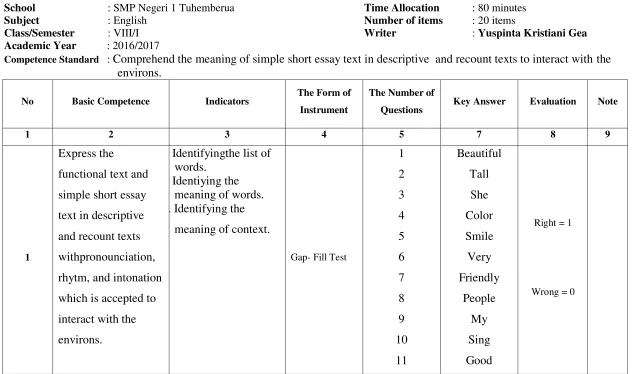
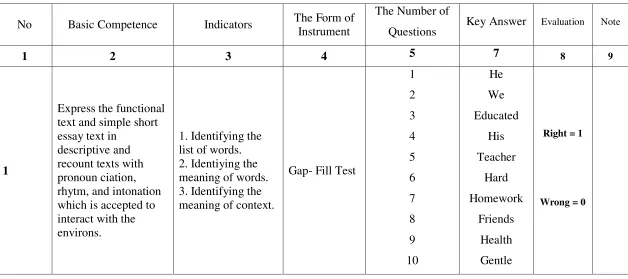
From the kinds of vocabulary test above, the researcher chooses gap-filling Test as the kind of vocabulary test in the research. Through gap-filling, the researcher gets the result of the students’ ability in mastering vocabulary by using Sight Word.
In gaining the students score, the researcher will use the formula from Sudijono (2009: 303):
Note: S = Score
R = Right answer
Finally, the researcher will use the formula suggested by Cartier et al. in Brown (1996:1-8) to find the students’ mark, as follows.
h. The Relationship between Vocabulary and Sight Word Strategy
Sight Word has a close relationshipin teaching vocabulary. Willskfuyzi
(2004:52) says, ”Sight Word are each followed by a sentence using the word. The
sentence is to help your child figure out word through the context of the sentences”.
Regarding to the expert’s opinion above, it can be concluded that Sight Word
is appropriate in the teaching vocabulary because Sight Word Strategy can be implemented to students to know words.
R=S
Students’
mark:
i. The Syllabus of SMP Negeri 1 Tuhemberua in 2016/2017
In the English syllabus at the eighth grade of SMP Negeri 1 Tuhemberua especially in the second semester, From the four skills, reading is one of the four skills that should be mastered by the students. In the competence standard of the eighth grade expects that the students to be able to comprehending the meaning of written text and short essays in a very simple form of descriptive and procedure texts related to the environs.
Furthermore, the basic competence expects the students to be able to respond meaning and rhetorical stages accurately, fluently and receive to a very simple essay related to the environs in the form of descriptive or procedure texts.
Based on the competences above, the researcher will focus on reading text that tells about descriptive texts.
1) Descriptive text
According to Linda Gerot, Peter Wignell,('Making Sense of Functional Grammar,1994) in M Mursyid PW
Descriptive Text is a kind of text with a purpose to give information. The context of this kind of text is the description of particular thing, animal, person, or others, for instance: our pets or a person we know well. It differs from Report which describes things, animals, persons, or others in general. The Social Function of Descriptive Text is to describe a particular person, place, or thing.
a) Generic Structure:
(1) Identification: identifies the phenomenon to be described.
24
b) Purpose / social function
As a feature, description in descriptive text is a style of writing which can be useful for other variety of purposes as:
(1) To engage a reader’s attention (2) To create characters
(3) To set a mood or create an atmosphere (4) To being writing to life
c) The language features in descriptive text are : (1) Using Simple Present Tense
(2) Using action verbs (3) Using passive voice (4) Using noun phrase (5) Using adverbial phrase (6) Using technical terms
(7) Using general and abstract noun
(8) Using conjunction of time and cause-effect.
The example of descriptive text:
My cat
I have a cat in my house, the cat is male. I like call him “Papay”. He is an
adorable cat, my cat is cute. His body is fat. He has black and white fur.
in my house. When he feels tired or sleepy, he usually sleeps on the sofa in the living room or sometime under the table.
“Papay” often goes out to find for food at night. And sometime he brings a mouse on
his mouth. Then he eats the mouse in the back of my house for himself.
The types of text above, the research states the texts are important for the students to learn. However, in the research, the research chooses descriptive text as the teaching material when implemeting Sight Word Strategy.
B. The Latest Related Research
Williams there is a latest research that related with this research, that is Williams research. The latest related research and the research apply the same
strategy, it is Sight Word Strategy and focus on the students’ ability in mastering
vocabulary. Based on the result of the latest research indicates that most of the students in University of Memphis were able to increase their ability in learnig
vocabulary by applying Sight Word Strategy in 2008 May and the researcher’s. He concluded that Sight Word Strategy is an interesting and creative strategy to be implemented in the teaching vocabulary in the classroom. The result of the research shows that Sight Word made the students’ vocabulary improved.
26
research of Quantitative Research only to make an experiment whether if the current sight word has the effect with the students or not.
C. The Conceptual Framework
In SMP Negeri 1 Tuhemberua, vocabulary is necessary to be mastered by the students for building good comprehension towards the content of the text. The expectation is still not achieved yet because the students have limited vocabulary. The
teacher’s creativity in choosing an appropriate strategy in teaching vocabulary is one
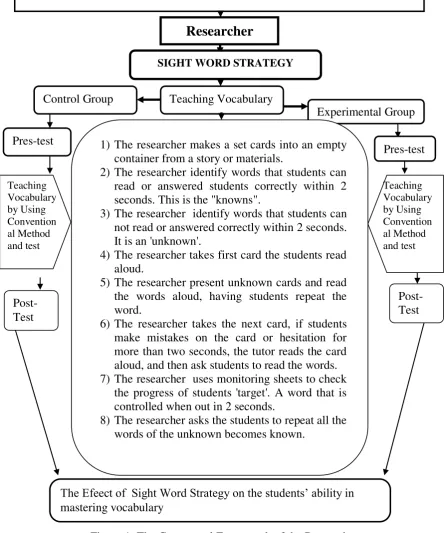
Figure 1: The Conceptual Framework of the Research The Syllabus of Reading at the Eighth Grade of SMP Negeri 1 Tuhemberua
Researcher
Control Group Teaching Vocabulary
Experimental Group
The Efeect of Sight Word Strategy on the students’ ability in
mastering vocabulary
Post-Test
Post-Test 1) The researcher makes a set cards into an empty
container from a story or materials.
2) The researcher identify words that students can read or answered students correctly within 2 seconds. This is the "knowns".
3) The researcher identify words that students can not read or answered correctly within 2 seconds. It is an 'unknown'.
4) The researcher takes first card the students read aloud.
5) The researcher present unknown cards and read the words aloud, having students repeat the word.
6) The researcher takes the next card, if students make mistakes on the card or hesitation for more than two seconds, the tutor reads the card aloud, and then ask students to read the words. 7) The researcher uses monitoring sheets to check
the progress of students 'target'. A word that is controlled when out in 2 seconds.
8) The researcher asks the students to repeat all the words of the unknown becomes known.
28 CHAPTER III RESEARCH METHOD
A. Design of the Research
In investigating the effect of Sight Word Strategy on the students’ ability in mastering vocabulary at the eighth grade of SMP Negeri 1 Tuhemberua, the researcher will conduct Quantitative Research with general types is Experimental which is specified into Quasi-experimental with pre test and post test design. It is suitable in the research since it is related to the purpose of the research. Campbell
(1963:12) states, “A quasi-experimental is one that applies an experimental mode of analysis and interpretation to bodies of data not meeting the full requirements of experimental control.”
Furthermore, Anderson (2005:263) defines that Quasi-experimental as a form of research that examines differences between research groups based on some natural characteristic using treatments or interventions, but not randomization. Blessing (2009:266) adds that Quasi-experiments are experiments that have treatment, pre-tests, post-pre-tests, and cases, but do not random assignment.
Then, Quasi-experimental studies attempt to examine the effects of an intervention on a specific population. Moreover, the most common form of a quasi experimental study includes a pre-post test design with both a treatment group and a control group.
group is divided into two groups as the sample of research, one group is experimental group and the other is control group. In experimental group, the researcher will apply Sight Word Strategy while in control group the researcher will apply Conventional Strategy in teaching and learning process. For more understanding, the research design can be shown in the table below.
Table 1
RESEARCH DESIGN
Class Pretest Treatment Posttest
Experimental Group
O1(e) X(e) O2 (e)
Control group O1 (c) - O2 (c)
Sugiyono (2004:12) Where:
O1 (e) = Giving the pretest to Experimental group O1 (c) = Giving the pretest to Control group X (e) = Teaching by Sight Word Strategy
- = Teaching using Conventional Teaching Strategy O2 (e) = Giving the post test to Experimental group
30
B. Variables of the Research
There are two variables in the research. The variables are Sight Word Strategy as independent variable (X), and the students’ ability in mastering vocabulary as dependent variable (Y). In this case, the researcher will use the two variables in conducting the research that is to know the effect of Sight Word Strategy
on the students’ ability in the mastering vocabulary at the eighth grade of SMP Negeri 1 Tuhemberua in 2015/2016.
C. Population and Sample 1. Population
Gay (2000:140) states, “Population is the group to which a researcher would
like the result of study to be generalizable”.
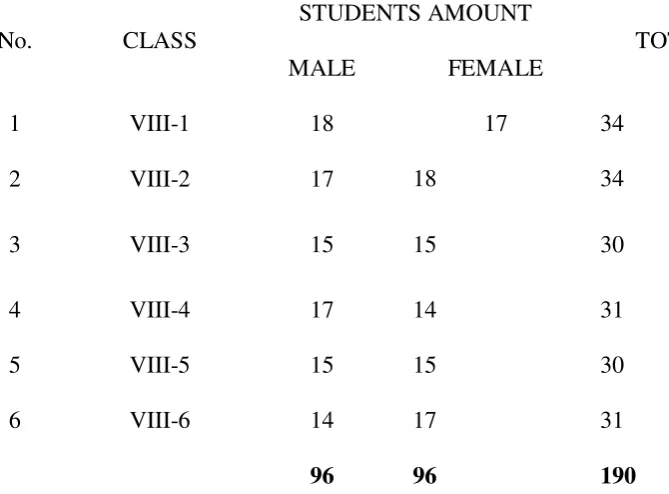
The number of population can be seen at the following table. Table 2
THE POPULATION CONDITION OF THE EIGHTH GRADE OF SMP NEGERI 1 TUHEMBERU IN 2015/2016
Source: Office Administration of SMP Negeri 1 tuhemberua 2016 2. Sample
Sample is the group of elements, or a single element, from which data are obtained Mcmillan (1996:86). So, the sample is part of the population which can describe the whole characteristics of the population by clustering sample. Cluster sampling is a cluster from individuals that is available as the units in population. To take the sample in the research, the researcher uses Cluster Sampling Technique.
No. CLASS
STUDENTS AMOUNT
TOTAL
MALE FEMALE
1 VIII-1 18 17 34
2 VIII-2 17 18 34
3 VIII-3 15 15 30
4 VIII-4 17 14 31
5 VIII-5 15 15 30
6 VIII-6 14 17 31
32
As Khotary (2004:55) says that the researcher must prepare a sample design for her study, plan how a sample should be selected and of what size such as a sample would be. So, the researcher must determine the number of cluster to be selected and select it randomly. This is chosen by the researcher as her design of sampling because considering the policy of the school and the similarity of the students’ ability in studying as she found from that school.
The sample consists of two classes, they are VIII-2 and VIII-1 of SMP Negeri 1 Tuhemberua.
The number of the sample can be seen at the following table. Table 3
THE TOTAL SAMPLE OF THE EIGHTH GRADE OF SMP NEGERI 1 TUHEMBERUA
IN 2016/2017
D. The Instruments of Collecting Data
The kind of data which will look for in this research is quantitative data. the type of data is primary data. According to Azwar (2007:91), primary data is the data that is obtained directly from the research sample as the source of data by using instrument or data measurer. So the primary data that will be taken in the research is
the students’ data eighth grade of SMP Negeri 1 Tuhemberua that consists 190
To collect the required data the researcher will apply the instrument is evaluation paper. Evaluation paper will be used to know the students’ ability in mastering vocabulary. It can be seen from the test given to the students. There are two types of test, pre-test and post-test. Pre-test is given to the students before they get any treatment, while post-test is given to the students after they get a treatment.
E. Procedures of Collecting the Data
There are some procedures which the researcher uses in this research, they are:
1. Finding the location. The location of the research is the SMP Negeri 1 Tuhemberua.
2. Selecting the population. The population of the research is the 8th grade students of SMP Negeri 1 Tuhemberua.
3. Selecting sample. The samples in the research are control group and experimental group.
4. Holding the try out instrument at the 8th grade students of SMP Negeri 2 Tuhemberua. To analyze the data, the researcher will use the product moment correlation formula.
5. Holding the pretest on experimental group and control group.
6. Holding the treatment by using different strategy in which Sight Word Strategy will be used to the experimental group and conventional strategy will be used to control group.
34
8. After doing it, the researcher analyze the result by using the test. 9. Analyzing the data, getting finding and drawing the conclusion.
F. Techniques of Analyzing the Data 1. Examining the Validity of the Instrument
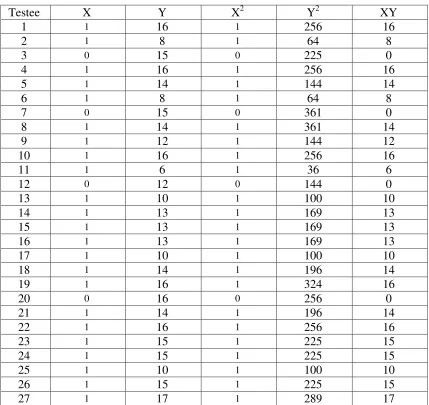
In the research, the instrument will be tried out by the researcher in SMP Arikunto (2002: 146) says that the formula of correlation that can be used is as what Pearson states. It is known as product moment correlation.
Then, the researcher held the try out instrument at SMP Negeri 2 Tuhemberua to get the scores. The scores can be high or low. The good validity can be got from items score which has the parallel of the total parallel. The parallel can be understood as correlation. To get the correlation the researcher uses the product moment formula.
xy = The total score of Y after quadrate
xy = The sum of multiplication of X and YAfter rxy has been known, then consulted with the value of rtable to know
whether the correlation is significant or no. The significant level is 5 % (α=0,05). If rxy>rt is significant. But if the value of rxy<rt is not significant.
2. Examining the Reliability of the Instruments
The reliability of a measuring instrument is the degree of consistency with
which it measure whatever it is measuring”. Reliability of a good test refers to the
consistency measurement. To obtain the reliability test, the researcher uses “Kuder Richhardson 20 (K-R 20)”. Because of the researcher has an abnormal item (20 items) which gives to the students.
Which:
R11 = the reliability of a test
P = the proportion of students responding correctly Q = the proportion of students responding incorrectly
36
pq = the sum of multiplication of p and qK = the number of test item S = standard deviation
3. The determining of the Students’ Ability in mastering vocabulary
To find the students’ ability in answering the test, the researcher will use the
formula written by Cartier in Brown (2004:1-8):
4. Mean Sore and Standard Deviation
Djiwandono to get the mean score (2008: 212) :
Which:
X = The score of item
_
X = The mean for the data N = The number of the sample
5. Examining the Normality
The normality of the data is used to know whether experimental group and control group has normal data distribution or not. The normality of data can be analyzed by using chi square formula, as follows:
Which:
X2 = the chi square (X count)
Fo = the perception of result frequency Fe = the expected frequency
The criteria of examining the normality of data is : if X2 ≥X2 table means that the data is not normal if X2≤X2 table the data is normal.
The criteria of examining the normality of data is if X2 ≥ X2table means the
data is not normal but if x2 ≤ X2table, the data is normal.
6. Examining the Homogeneity
k
2 X
38
In this research as the last result of the research, the researcher will analyze the hypothesis as follow:
Ha : There is a significant effect of Sight Word Strategy on the students’ ability in
mastering vocabulary at the eighth grade of SMP Negeri 1 Tuhemberua. Ho : There is no a significant the effect of Sight Word Strategy on the students’
ability in mastering vocabulary at the eighth grade of SMP Negeri 1 Tuhemberua.
The hypothesis alternative (Ha) will be accepted if tcount calculated is
higher than ttable at 5 % level from significant, and will be denied if tcount calculated
is lower than ttable. To examine whether using sight word strategy teaching in
classroom significance improved the students’ ability in mastering vocabulary, so the research will use the t test of polled variant formula from Arikunto (2001:95) as follows.
Which :
t count = Amount of tcount
= The mean of Experimental group
= The mean of Control group n1 = Total of Experimental group
n2 = Total of Control group
S22 = The Variants of Control group
S = The Unity of Standard Deviation
Then it will be confirmed to ttable where the level significance is 0,05 and
statistic tcount above is students distribution, dk (n1+n2– 2).
Examining criteria is Ho is accepted if – t (1-½α) < t <t (1-½α) and the others t, Ho is
40 CHAPTER IV
RESEARCH FINDINGS AND DISCUSSIONS
A. Research Findings 1. Try Out Instrument a. Validity
In conducting the research, the researcher prepared the instruments in collecting the data before going to the subject of the research. The researcher did the try out to examine whether the tests were valid and reliable. So, before the researcher conducted the research in SMP Negeri 1 Tuhemberua, the researcher did the try out for pretest and posttest in SMP Negeri 2 Tuhemberua at the eighth grade in 2016/2017. The researcher gave the tests to the students in SMP Negeri 2
Tuhemberua especially at the eighth grade. Then, the researcher gave the students’
b. Reliability
After the tests were valid the researcher examined the reliability of the tests. To examine the reliability of the pretest and posttest, the researcher uses K-R 20 formula. In Appendix 11a, it showed that the reliability score of the pretest was r1 = 0.685, and based on Appendix 11b, the reliability score of posttest was r1 = 0.630. The result of r1 was consulted to rtable with the respondents N = 33 students at the
significant level 5% (α = 0.05) that indicated rtable = 0.388 and then it got r1 > rtable.
In conclusion, both of the tests were reliable.
c. Item Facility Analysis
Item facility analysis is used to find out the difficulty, and easiness of items. Based on the calculation shown in Appendix 12a (Table 18) and Appendix 12b (Table 19), in the pretest and posttest are dominated by 7 items of the medium items and 9 items of the difficult items. So, it can be concluded that the items of the tests were in both of medium and difficult items.
d. Item Discrimination Analysis
42
concluded that all of the items in the pretest and posttest can be used and have the strength to separate the students who perform well and who perform poorly.
2. Data Analysis
a) The Pretest and Posttest Analysis
In examining the pretest’ normality and homogeneity, the researcher gave the
pretest to both groups. The students’ score of the pretest was shown in Appendix 14a
(Table 22) and Appendix 16a (Table 26). The students’ score of the posttest was
shown in Appendix 14b (Table 23) and Appendix 16b (Table 27). Based on the appendices, the researcher counted the mean score, the standard deviation, and the variance.
1) The Mean
The mean mark of the pre-test for the experimental class is 64. 7 (Appendix 22) classified less; while in the post test was 81,61 (Appendix 23) classified good. And then, the mean mark of the pre-test for the control class was 69.70 (Appendix 23) classified less while in the post-test was 75 (Appendix 23) classified less.
For more comprehending, table below will show it. Table 5
THE MEAN SCORE of EXPERIMENTAL and CONTROL GROUP
Group N Pre-test Post-test
Control Group 34 69.70 75
1) The Standard Deviation
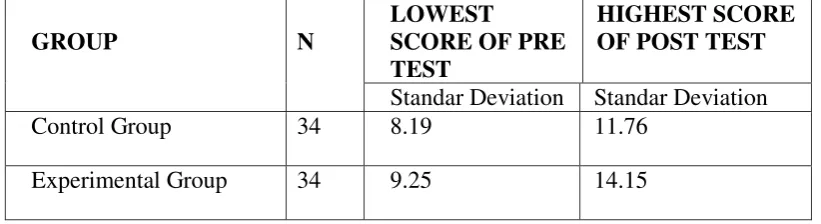
The standard deviation of the pre-test for the experimental class was 90,40 (Appendix 22), while in the post-test was 14.15 (Appendix 26). And then, the standard deviation of the pre-test for the control class was 8.91 (Appendix 23) while in the post-test was 11.76 (Appendix 25).
For more comprehending, table bellow will show it. Table 6
THE LOWEST and HIGHEST of STANDAR DEVIATION of PRE TEST and POST TEST in CONTROL and EXPERIMENTAL GROUP
GROUP Standar Deviation Standar Deviation
Control Group 34 8.19 11.76
Experimental Group 34 9.25 14.15
2) The Variants
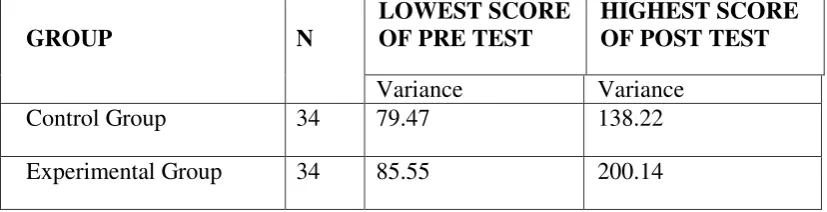
The variants of the pre-test for the experimental class is 85.55 (appendix 22), while in the post-test was 200.14 (Appendix 23). And then, the variants of pre-test for the control class is 79.47 (Appendix 25) while in the post-test was 138.22 (Appendix 25).
44
Table 7
THE LOWEST and HIGHEST of VARIANCE of PRE TEST and POST TEST in CONTROL and EXPERIMENTAL GROUP
GROUP
N
LOWEST SCORE OF PRE TEST
HIGHEST SCORE OF POST TEST
Variance Variance
Control Group 34 79.47 138.22
Experimental Group 34 85.55 200.14
3) The Normality
The data of the pre-test for the experimental class is Lcount 0.1047 (Appendix
27a, Table 33) with Ltable= 0.161, while in the post-test is Lcount (0.1113) (Appendix
27c, Table 34) lower than Ltable (0.161). It concludes that both of the result of the
pre-test and post-pre-test for the experimental class are stated normal distribution. Furthermore, the date of the pre-test for the control class is Lcount 0.1179 (Appendix
27b, Table 33) was lower than Ltable (0.161), while in the post-test is Lcount 0.1258
(Appendix 27d, Table 35). It concludes that both of the result of the pre-test and post-test for the control class is stated normal distribution.
Table 8
THE LOWEST and HIGHEST of NORMALITY of PRE TEST and POST TEST in CONTROL and EXPERIMENTAL GROUP
GROUP Ltable Lcount Ltable Lcount
Control Group 34 0.161 0.1179 0.161 0.1258
Experimental Group 34 0.161 0.1047 0.161 0.1113
4) The Homogenity
Based on Appendix 27a, it is shown that the result of the homogeneity ofthe pre test computations indicated Ftable= 1.859, is consulted to the score Fcount. to dk=n1
-1, n2-1 at the significant level 5% is gotten Fcount= 1.077. Since Ftable(1.859) >Fcount
(1.077),it can be concluded that both groups of the pre test is stated Homogenous. Based on Appendix 27b, it is shown that the result of the homogeneity of the post test computations indicated Ftable= 1.859, consulted to the score Fcount. to dk=n1-1,
n2-1 at the significant level 5% is gotten Fcount= 1.448. Since Ftable(1.859) >Fcount
(1.448),it can be concluded that both groups ofthe post test is stated Homogenous. For more comprehending, table bellow will show it.
Table 9
THE LOWEST and HIGHEST of HOMOGENITY of PRE TEST and POST TEST in CONTROL and EXPERIMENTAL GROUP
Ftable Fcount Ftable Fcount
46
6. The Hypothesis testing (t-test)
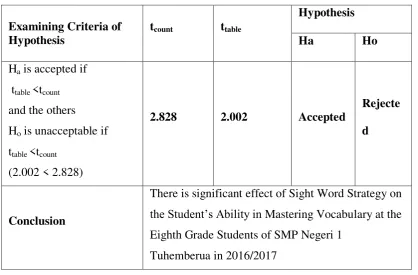
The testing hypotheses in Appendix 30, the table value of t-table dk = 2(n-2) = 2(30-2) = 58 and the significance level is 5% ( ), so, ttable = t1/2 (dk) = t0.025 x 58 = 2.002. Since tcount ( ) > ttable (2.002) it can be concluded that Ha is accepted
and Ho is rejected.
Table 10
THE RESULT of EXAMINING HYPOTHESIS
Examining Criteria of
There is significant effect of Sight Word Strategy on
the Student’s Ability in Mastering Vocabulary at the Eighth Grade Students of SMP Negeri 1
Tuhemberua in 2016/2017
experimental class after doing the treatment by implementing Sight Word Strategy, the examining hypothesis accepted. The researcher gave evaluation to the students by using post-test, which the result has a very good effect on the students’ ability in reading comprehension especially in descriptive text. In the research, especially from the computations of the obtained data either experimental class and control class, it
was proved that there is the different students’ learning outcome. When taking the
pre-test namely the students’ ability tests to both classes are stated low. And then, the researcher gives the treatment to the experimental class by implementing Sight Word Strategy. By applying Sight Word Strategy in teaching the students especially in descriptive text, the students have shown their ability in reading. After doing the treatment, the researcher gave the post-test namely the students’ ability in mastering
vocabulary test of both classes. The researcher stated that the students’ post-test score was higher than the students’ pre-test score. Then, when comparing to the post-test result of the control class without the treatment, it is shown that the result of the experimental class is higher than the control class. In other words there is a significant effect on the students’ ability in reading comprehension after
implementing Sight Word Strategy. In the conventional teaching strategy didn’t
accept because without treatment.
48
B. Discussions
1. The Common Response of the Research Problem
The main problem of the research is to know whether the students are able to master the vocabulary well through Sight Word Strategy. The researcher proves that through Sight Word Strategy, the students be able to master the vocabulary well. This research was done by conducting pretest and posttest. In the pretest, the average of
the students’ mark in vocabulary mastery before using SIGHT WORD strategy was
63.79. And in posttest, the average of the students’ mark by using SIGHT WORD
strategy was 82.33. Based on the average of the students’ mark, it can be concluded
that there is a significant effect of Sight Word Strategy on the students’ ability in vocabulary mastery.
2. The Analysis and Interpretation of the Research Findings
Sight Word Strategy is teaching vocabulary strategy that helps students to evaluate their prior knowledge of keywords to reading a passage and to build knowledge during reading. This strategy is introducing the key vocabulary in
teaching and learning process based on the students’ prior knowledge about the words
are read from the passage. Based on the data analysis of pretest, it shown that the mean score of the experimental group in the pretest is 70.79 and the students’ ability in mastering vocabulary is classified adequate. After taking the pretest, the researcher continued the teaching-learning process by applying Sight Word Strategy. Then, the researcher gave posttest to the students to find out whether it has the significant effect