Internet
Television
Internet
Television
Edited by
Eli Noam
Jo Groebel
Darcy Gerbarg
Edited by
Eli Noam
Jo Groebel
Jo Groebel, Series Editor
Kevin • Europe in the Media: A Comparison of Reporting, Representation and Rhetoric in National Media Systems
Noam/Groebel/Gerbarg • Internet Television
Lange/Ward • Media and Elections: A Comparative Study
Van Ginneken • Collective Behavior and Public Opinion: Rapid Shifts in Opinion and Communication
edited by
Eli Noam
Jo Groebel
Darcy Gerbarg
LAWRENCE ERLBAUM ASSOCIATES, PUBLISHERS
2004
Mahwah, New Jersey
London
form, by photostat, microform, retrieval system, or any other means, without prior written permission of the publisher.
Lawrence Erlbaum Associates, Inc., Publishers 10 Industrial Avenue
Mahwah, NJ 07430
Cover design by Sean Sciarrone
Library of Congress Cataloging-in-Publication Data
Internet television / edited by Eli Noam, Jo Groebel, Darcy Gerbarg. p. cm.
Includes bibliographical references and index. ISBN 0-8058-4305-1 (c : alk. paper)
ISBN 0-8058-4306-X (pbk. : alk. paper)
TK6679.3 .I59 2003
384.55dc21 2002035400
CIP
Books publishedby Lawrence Erlbaum Associates are printed on acid-free paper, and their bindings are chosen for strength and durability.
Printed in the United States of America
Acknowledgments
ix
Contributors
xi
Introduction
xxi
Darcy Gerbarg and Eli Noam
I Infrastructure Implications of Internet TV
1
Internet Television: Definition and Prospects
1A. Michael Noll
2
Implications for the Long Distance Network
9
Andrew Odlyzko
3
Television Over the Internet:
Technological Challenges
19
A. Michael Noll
II Network Business Models and Strategies
4
Industry Structure and Competition
Absent Distribution Bottlenecks
31
Michael L. Katz
5
Business Models and Program Content
61
David Waterman
6
Broadcasters’ Internet Engagement:
From Being Present to Becoming Successful
81
Bertram Konert
III Policy
7
Regulatory Concerns
105
Robert Pepper
8
The Challenges of Standardization:
Toward the Next Generation Internet
113
Christopher T. Marsden
9
Intellectual Property Concerns
for Television Syndication Over the Internet
143
Kenneth R. Carter
10
Internet Television and Copyright Licensing:
Balancing Cents and Sensibility
157
Michael A. Einhorn
11
Network Business Models and Strategies:
The Role of Public Service Broadcasting
173
Fritz Pleitgen
12
International Regulatory Issues
179
Stephen Whittle
IV Content and Culture
13
Audience Demand for TV Over the Internet
187
John Carey
14
Content Models: Will IPTV Be More of the Same,
or Different?
205
15
The Content Landscape
215
Gali Einav
V Future Impacts
16
Will Internet TV Be American?
235Eli Noam
Author Index
243
This book is the result of a transatlantic collaboration between the Colum-bia Institute for Tele-Information (CITI) and the European Institute for the Media (EIM). Also participating was the Center for Global Communica-tions at the International University of Japan (GLOCOM). The aim was to look at the advent of widely available individual broadband internet com-munications and its impact on a new stage in the development of televi-sion: Internet television. This global approach produced a broad range of focused, in-depth discussions covering many important issues. The com-missioned research papers, collected and edited for this book, provide many insights and much information on Internet television.
This book benefited greatly from the research and administrative help provided by many people. Among them are the following: Reuben Abra-ham, Keisha E. Burgess, Jason H. Chen, Gabriele Eigen, Raymond Fong, Danilo “Jun” Lopez, Yuko Miyazaki, Rosa M. Morales, Jasmina Pejcinovic, and Stefanie Winde. We thank Robert C. Atkinson, Kenneth R. Carter, Bertram Konert, Koichiro Hayashi, Nobuo Ikeda, and A. Michael Noll for their managerial and substantive contributions to this project. Special thanks go to the authors and to Linda Bathgate, the book’s editor at Law-rence Erlbaum Associates.
Michael Einhorn was an especially important collaborator in the pro-ject, helping in the conceptualization of the issues and in the identification of leading experts. He deserves much credit.
We are grateful to the Alfred P. Sloan Foundation and its program director, Dr. A. Frank Mayadas, for their support of CITI, as well as to David A. Schaefer of Loeb & Loeb, LLP, and John S. Redpath, Jr., of Home Box Office, Inc. In ad-dition, we wish to thank the State Chancellery North Rhine-Westphalia, Vic-toria Versicherungen AG, and PriceWaterhouseCoopers for their support of EIM in this project.
Our gratitude is no less to those inadvertently omitted.
John Carey
Managing Director, Greystone Communications, Affiliated Research Fellow at the Columbia Institute for Tele-Information, and Adjunct Professor, Columbia University Business School
John Carey is Managing Director of Greystone Communications, a media research and planning firm. He conducts research studies of new commu-nication services directed toward homes, businesses, and schools. Cur-rently, he is conducting research about broadband web service, e-commerce, interactive television, personal video recorders, and digital satellite radio service for cars.
His clients have included American Express, AT&T, A&E Television Net-works, Bell Atlantic, Cablevision, Corporation for Public Broadcasting, Digitas, Into Networks, Loral Space Systems, NBC, the New York Times Digi-tal Media Company, Public Broadcasting Service, Rogers, Cablesystems, and XM Satellite Radio, among others.
Dr. Carey is also an Adjunct Professor at Columbia University Business School, where he teaches graduate courses on Demand for New Media. He is an Affiliated Research Fellow at the Columbia Institute for Tele-Infor-mation. He holds a PhD from the Annenberg School for Communications at the University of Pennsylvania and is the author of more than 50 publica-tions on interactive media and the adoption of new telecommunication technologies.
Kenneth R. Carter
Deputy Director, Columbia Institute for Tele-Information, Columbia University Business School
Kenneth Carter is the Deputy Director of CITI and a candidate for an Execu-tive MBA at Columbia University. He joined the institute in June 1998 as As-sociate Director. Previously, Mr. Carter worked for the Federal Trade Commission (FTC) on such issues as the FTC’s jurisdiction over resellers of prepaid telecommunication services for deceptive advertising of tariff rates. Mr. Carter has a background in media and communications, having worked for MTV Networks, Island Records, and the international television syndication firm D.L. Taffner. As Deputy Director, he manages CITI’s re-search agenda, assists the development of the institute’s online rere-search platform, the Virtual Institute of Information, and serves as the institute’s counsel. Mr. Carter’s current research includes the Emerging Market Economy in Bandwidth, Over the Internet, and the regulatory and intellec-tual property issues in telecommunications. He received his JD from the Benjamin N. Cardozo School of Law, where he was a member of The Cardozo Arts & Entertainment Law Journaland President of the Asian and Pacific Law Students Association. Mr. Carter was awarded an Alexander Judicial Fellowship, serving as a full-time junior clerk in the chambers of Hon. John C. Lifland, U.S.D.J. He was graduated from Colgate University with an A.B. in Economics and East Asian Studies after studying abroad in England and Japan, and is proficient in Japanese. He is presently admitted to the bar in New York State and the District of Columbia.
Gali Einav
PhD candidate, School of Journalism, Researcher at the Interactive Design Lab, Columbia University
Gali Einav has a BA in political science and an MA in communications and journalism from Hebrew University, Jerusalem. She has worked both as a senior producer and journalist for the second television channel in Israel. Ms. Einav taught media studies at the New School of Communications in Tel Aviv. She is currently a PhD candidate in the communications program and a researcher at the Interactive Design Lab at Columbia University’s School of Journalism. Her research interests include content models for interactive media.
Michael A. Einhorn
Principal in the New York office of LECG, LLC
Professor Einhorn has considerable professional experience in media and entertainment, having written articles, prepared affidavits, or testified in matters related to music licensing, antitrust, Internet television, peer-to-peer file sharing, digital rights management, anticircumvention, and misuse of copyright. He received a BA from Dartmouth College and a PhD in economics from Yale University. He also served as a professor of economics at Rutgers University and worked as an economist in the Anti-trust Division of the U.S. Department of Justice and at Broadcast Music Inc.
Darcy Gerbarg
Executive Director, Marconi International Fellowship Foundation and Senior Fellow, Columbia Institute for Tele-Information, Columbia University Business School
Darcy Gerbarg is a Senior Fellow at the Columbia Institute for Tele-Infor-mation, Columbia University Business School, since 1997. In 2000, she was Director of Business Development at Everest Broadband Networks. Prior to that time, she held research positions at Courant Institute for Mathemat-ical Sciences, New York University, and the Computer Graphics Lab, New York Institute of Technology. She has been an adjunct faculty member at the Interactive Telecommunications Graduate Program and the Film and Television Departments at New York University. She was an adjunct faculty member at the State University of New York at Stony Brook, where she also built networked multimedia labs. Ms. Gerbarg started and directed the Graduate Program in Computer Art and the Computer Institute for Arts at the School of Visual Arts in New York. She also initiated and chaired the first SIGGRAPH Computer Art Shows.
Ms. Gerbarg has lectured, organized, and conducted panels, workshops, and presentations at professional conferences for industries, companies, and universities. She has a continuing interest in entrepreneurial activities, start-ups, and venture capital. Conferences she has organized for CITI in-clude the Future of Digital TV (1997) and Venture Capital in New Media (1999). Ms. Gerbarg’s edited publications includeThe Economics, Technol-ogy and Content of Digital TV(Kluwer Academic Publishers, 1999) and Digi-tal TV (Prometheus, the Journal of Issues in Technological Change, Innovation, Information Economics, Communications and Science Policy, Carfax Publishing Ltd., June 1998). Ms. Gerbarg has a BA from the University of Pennsylvania and an MBA from New York University.
Jo Groebel
Professor and Director, European Institute for the Media, EIM
in Los Angeles (UCLA) and the University St. Gallen. He was President of the Dutch Association for Communication Sciences, and advisor to the Dutch and German governments at the highest levels, the UN, and sev-eral broadcasters and media firms. He is author/editor of 20 books. He has worked on numerous TV and radio productions internationally and contributed to many publications.
Jeffrey Hart
Professor of Political Science, Indiana University
Jeffrey Hart is Professor of Political Science at Indiana University, Bloomington, where he has taught international politics and international po-litical economy since 1981. His first teaching position was at Princeton Univer-sity from 1973 to 1980. He was a professional staff member of the President’s Commission for a National Agenda for the Eighties from 1980 to 1981.
Professor Hart worked at the Office of Technology Assessment of the U.S. Congress in 1985–1986 as an internal contractor and helped to write their reportInternational Competition in Services(1987). He was visiting scholar at the Berkeley Roundtable on the International Econ-omy, 1987–1989. His publications includeThe New International Eco-nomic Order (1983), Interdependence in the Post Multilateral Era (1985),Rival Capitalists(1992), and (with Joan Spero)The Politics of In-ternational.
Michael L. Katz
Professor of Business Administration and Economics, Director of the Center for Telecommunications and Digital Convergence, University of California at Berkeley
Michael L. Katz is the Edward J. and Mollie Arnold Professor of Business Administration at the University of California at Berkeley. He also holds an appointment as Professor in the Department of Economics. Professor Katz is the faculty leader of the Haas Business School’s e-business initiatives, and serves as Director of the Center for Telecommunications and Digital Convergence. He is a four-time finalist for the Earl F. Cheit award for out-standing teaching and has won it twice.
Dr. Katz has published numerous articles on the economics of net-works industries, intellectual property licensing, telecommunications pol-icy, and cooperative research and development. He is coeditor of the California Management Reviewand serves on the editorial board of the Journal of Economics and Management Strategy. Dr. Katz also serves on the Computer Science and Telecommunications Board of the National Academy of Sciences.
com-mission jurisdiction, including broadcasting, cable, telephone, and wire-less communications.
Dr. Katz holds an ABsumma cum laudefrom Harvard University and a DPhil from Oxford University. Both degrees are in economics.
Bertram Konert
Head, Digital World Program the European Institute for the Media, Lecturer, University of Düsseldorf
Bertram Konert is head of the “Digital World Program” at the European In-stitute for the Media and lectured in media science at the University of Düsseldorf. After training as a banker, he studied social science at the Uni-versity of Osnabrück (1982–1987). He started his career as a researcher of telecommunications policy and electronic banking and received his doc-torate in the area of economic and social science from the University of Osnabrück in1993. Afterward, he worked for several years as a project manager for a computer company, where he was responsible for cus-tomer relations in the area of ISDN-networks and data communications. Since June 1996, his main research interests at the European Institute for the Media include the socioeconomic developments of media trans-formation and convergence, particularly in the areas of digital broadcast-ing and new Internet services. In 2001, Dr. Konert became an editorial advisor on the editorial board of the research journalConvergence, pub-lished by the University of Luton Press.
Christopher T. Marsden
Consultant with Re: Think, www.re-think.com, [email protected], and Research Associate of the Phoenix Center, Washington, DC
(www.re-think.com), and has been expert consultant to the Chief Executive of the Independent Television Commission (2000), the Council of Europe MM-S-PL Committee on digital media pluralism (1999), and Shell Interna-tional’s Global Scenario Planning team (2000). He was UK Regulatory Direc-tor of MCI Worldcom from 2001–2002 when he resigned.
Eli M. Noam
Professor of Economics and Finance, and Director of the Columbia Institute for Tele-Information, Columbia University Business School Eli Noam is the Professor of Economics and Finance at the Columbia Uni-versity Business School since 1976. After having served for 3 years as Com-missioner of the New York State Public Service Commission, he returned to Columbia in 1990. He served as Director of the Columbia Institute for Tele-Information, an independent university-based research center focus-ing on strategy, management, and policy issues in telecommunications, computing, and electronic mass media; and Chairman of MBA concentra-tion in the Management of Entertainment, Communicaconcentra-tions, and Media at the Business School. He has also taught at Columbia Law School and Princeton University’s Economics Department and Woodrow Wilson School. Professor Noam has published over 20 books and 400 articles in economic journals, law reviews, and interdisciplinary journals and has served on the editorial boards of other Columbia University Press aca-demic journals. He was a member of the advisory boards for the federal government’s FTS-2000 telecommunications network, the IRS’s computer system reorganization, and the National Computer Systems Laboratory. He received an AB (Phi Beta Kappa), MA, PhD (Economics) and JD from Harvard University.
A. Michael Noll
Professor of Communications at the University of Southern California, Annenberg School for Communication, Director of Technology
Research at the Columbia Institute for Tele-Information, Columbia University Business School
seasoned author of op-ed pieces and a frequent columnist in trade maga-zines. He received his PhD in Electrical Engineering from the Polytechnic Institute of Brooklyn in 1971, MEE from New York University in 1963, and BSEE from Newark College of Engineering in 1961. He is a Senior Member of the Institute of Electrical and Electronics Engineers (IEEE) and is a mem-ber of the Audio Engineering Society, the Society for Information Display, and the Society of Motion Picture and Television Engineers.
Andrew Odlyzko
Professor of Mathematics, Director Digital Technology Center, Assistant Vice President for Research, University of Minnesota
Andrew Odlyzko has recently assumed the positions of Professor of Math-ematics, Director Digital Technology Center, and Assistant Vice President for Research at the University of Minnesota. Until this year, he was the head of the Mathematics and Cryptography Research Department at AT&T Labs. He has done extensive research in technical areas such as computa-tional complexity, cryptography, number theory, combinatorics, coding theory, analysis, and probability theory. In recent years, he has also been working on electronic publishing, electronic commerce, and economics of data networks. Professor Odlyzko is the author of such widely cited pa-pers as “Tragic Loss or Good Riddance? The Impending Demise of Tradi-tional Scholarly Journals,” “The Decline of Unfettered Research,” and “The Bumpy Road of Electronic Commerce.”
Robert Pepper
Chief, Office of Plans and Policy, Federal Communications Commission Robert Pepper has been Chief of the Office of Plans and Policy (OPP) at the Federal Communications Commission (FCC) since December 1989. Under Pepper’s leadership, OPP is responsible for policy questions that cut across traditional industry and institutional boundaries, especially those arising from the development of new technologies. At OPP, Dr. Pep-per’s responsibilities have included leading teams implementing provi-sions of the Telecommunications Act of 1996; assessing the development of the Internet; designing and implementing the first spectrum auctions in the United States; developing more market-based spectrum policies; assessing competition in the video marketplace; and assessing the im-pact of the development of the Internet on traditional communications policy structures.
He is a graduate of the University of Wisconsin-Madison, where he also received his doctorate.
Fritz F. Pleitgen
Director-General, WDR
Fritz Pleitgen is the Director-General of WDR, Westdeutscher Rundfunk, the largest broadcasting corporation in the German Association of Public Broadcasting Corporations, ARD. He took up this post in 1995. In January 2001, he became chairman of the ARD.
Initially a newspaper journalist, Mr. Pleitgen joined the WDR in 1963 as a reporter for ARD’s main news program. In 1970, he was appointed ARD-correspondent in Moscow. He became Head of the ARD Studio in East Berlin in 1977. In 1982, he and his family moved to the United States, where he took over the ARD Studio in Washington. Mr. Pleitgen held this post for 5 years and then became head of the ARD Studio in New York. He returned to the WDR headquarters in Cologne in 1988 to become Edi-tor-in-Chief of WDR television and head of the politics and current affairs section. During this period, Mr. Pleitgen won great acclaim for his reports on German reunification and the collapse of the Soviet Union. He was ap-pointed Radio Director in 1994. In addition, Mr. Pleitgen regularly appears in television programs on WDR and ARD, both as presenter and reporter.
David Waterman
Professor, Department of Telecommunications, Indiana University David Waterman is Associate Professor in the Department of Telecom-munications at Indiana University, Bloomington, since 1993. He was pre-viously a faculty member of the Annenberg School for Communication at the University of Southern California. At USC, Professor Waterman taught in the Annenberg School’s Communications Management Masters pro-gram and in the Department of Economics. Prior to joining USC, Profes-sor Waterman was the principal of Waterman & Associates, a Los Angeles consulting firm providing economic, policy, and market re-search services to communications industry and federal government cli-ents. He has also served as Research Economist at the National Endowment for the Arts in Washington.
books. The Corporation for Public Broadcasting and the National Endow-ment for the Arts have supported his research. Professor Waterman has presented his research in testimony before the U.S. Congress, and has served on expert panels or in an advisory capacity for the Federal Commu-nications Commission, the Federal Trade Commission, the U.S. Depart-ment of Justice, and the General Accounting Office of the United States.
Professor Waterman received a PhD in Economics in 1979 from Stan-ford University. He completed his BA in Economics at USC.
Stephen Whittle
Darcy Gerbarg and Eli Noam
Columbia Institute for Tele-Information
Internet television is the quintessential digital convergence medium, putt-ing together television, telecommunications, the Internet, computer appli-cations, games, and more. It is part of a historic move from individualized narrowband capacity, measured by kilobits per user, to one of broadband with a capacity of megabits per user. This move will have major conse-quences for many aspects of society and the economy, similar to the im-pact the automobile had when it replaced trains, horses, and bicycles. It will affect, in particular, the medium now called television.
What exactly is Internet television (TV)? There is no agreement on a def-inition. It comes with different names—web TV, IPTV, enhanced TV, per-sonal TV, and interactive TV, for example—which signify slightly different things. At the lower end of complexity, it is merely a narrowband two-way Internet-style individualized (“asynchronous”) channel that accompanies regular one-way “synchronous” broadband broadcast TV or cable. This Internet channel can provide information in conjunction with broadcast programs, such as details on news and sports, or enable transactions (in-cluding e-commerce) in response to TV advertisements. This is known as “enhanced TV.” At the other end of complexity is a fully asynchronous two-way TV, with each user receiving and transmitting individualized TV programs, including direct interaction in the program plot line. In between is one-way broadband with a narrowband return channel that can be used to select video programs on demand (VOD). What Internet TV is today and can be in the future forms the context of this book.
This new medium is knocking at the door. Already, music is reaching millions of listeners around the world through the Internet. Video clips have traveled likewise. It will not be long before popular video programs are regularly delivered over the Internet as well, at significantly better quality and lower cost. People with broadband connections already download feature-length films, and in Japan, Yahoo BB is launching a portal of video channels.
Every new medium starts as a substitute and then evolves into some-thing quite new. Internet TV, too, will first be used to access video servers that store existing programs, making them available for viewing at any time. But soon, going beyond the convenience of viewer choice and con-trol, Internet TV will enable and encourage new types of entertainment, education, and games that take advantage of the Internet’s interactive ca-pabilities. This assumes, of course, technical capability and economic via-bility, subjects of analysis in this volume.
This book is organized into five major sections: Infrastructure Implica-tions, Network Business Models and Strategies, Content and Culture, Pol-icy, and Global Impacts. Each section is introduced here.
INFRASTRUCTURE IMPLICATIONS
Ubiquitous and affordable broadband would enable Internet TV to rival traditional broadcast cable and satellite distribution. However, Internet TV, if used by millions in an asynchronous fashion, would require prodigious amounts of bandwidth. This raises questions about the required network capacity for various quality grades. Delivering individualized broadband to the home is hence a costly and difficult roadblock.
Intermediate solutions include the squeezing of more transmission ca-pacity out of an existing basic infrastructure. Advanced variants of digital subscriber loops (DSL) are one example. Signal compression, caching, and mirroring are other approaches. The infrastructure consists of net-works, servers, home terminals, various forms of software, and content. Many approaches require the technical interoperability of a variety of hard-ware devices and softhard-ware. Internet TV therefore requires cooperation be-tween several industries, which has contributed to the difficulties in defining technical standards.
chapter with a discussion of various possible scenarios and identifies un-certainties in this path.
Andrew Odlyzko, of the University of Minnesota, discusses the implica-tions of Internet TV for long distance networks. He explains why there will be plenty of bandwidth in the backbone of telecom networks to carry video. But, because transmission capacity will be vastly more expensive than storage capacity, the trend will be toward store-and-replay models.
In his second chapter, Noll provides technical specifications and re-quirements for Internet TV, including reviews of delivery infrastructure and compression. He challenges some technical assumptions and usage data while pointing to problems and solutions arrived at in radio, satellite, and cable distribution. He looks at the changes radio has undergone with the advent of the Internet and projects similar changes for television. He presents various delivery options and reviews alternative technological convergence scenarios, concluding with a review of open technical and other issues that require resolution.
NETWORK BUSINESS MODELS AND STRATEGIES
Although the technical issues that must be overcome are complex, they pale before the business challenges. Simply put, no one has found a way to make Internet TV a financial success. Early Internet TV content companies struggled to develop a customer base. Some companies tried to create original content to gain new audiences, but this proved very expensive. All seemed to have overestimated the attractiveness of the medium at the time. A major problem encountered was that audi-ences expect a similar production quality from Internet TV that exists in broadcast and cable television.
The revenue side is equally daunting. Audiences accustomed to receiv-ing Internet and broadcast TV content for free expect Internet TV to be sim-ilarly priced. One major challenge for Internet TV is to create content for which people are willing to pay. This may entail completely new forms of content or conventional programs offered in new ways.
Advertising has been the major source of revenue for broadcast televi-sion and it may also eventually support Internet TV. But despite the prom-ise of choice demographics, transaction tie-ins, and individual viewer targeting, advertisers still do not see a sufficient number of consumers watching video programs on computers to justify spending their dollars on Internet TV. Other potential revenue sources include promotional pro-grams, or subsidies by established media institutions that are seeking to establish themselves in this new field. This last source might well be the economic foundation of Internet TV for some time.
deter-mine how Internet TV might function in a world without distribution bottle-necks. He focuses on how Internet distribution will impact the television industry and points out four technological trends that will effect competi-tion in each segment of the television value chain. He looks at vertical inte-gration and bundling and analyzes their consequences for consumers and TV companies. He concludes that consumers will be the winners and lo-cal broadcasters will be the losers.
David Waterman of Indiana University identifies five economic char-acteristics of Internet technology and shows how they will lead to greater efficiencies. Economic models for content providers are developed based on his examination of the economic characteristics of Internet technology and how greater efficiencies are likely to shape them. Water-man uses historical evidence to predict that niche programs will flourish on the Internet but that high production value programming, particularly Hollywood movies, will continue to have a broader appeal. His implica-tion is that, despite its potential reach, Internet TV may not have the cul-tural impact Hollywood enjoys.
Bertram Konert of the European Institute for the Media points out that new entrants and audience fragmentation are changing traditional media markets. In the long run, as bandwidth penetration increases, Konert sees Internet TV providing the new TV distribution system and recognizes the broadcasters’ need to explore this distribution channel. Nonetheless, he argues for broadcasters to focus their efforts on developing multiple, self-supporting revenue streams and reminds them that return on invest-ment is more important in the long term than the number of web impres-sions. Konert also warns against the continued subsidization of unprofitable engagements with revenues from profitable divisions.
POLICY
This section of the book looks at policy issues, including copyright and reg-ulation. It begins with a discussion of the regulatory climate for Internet TV in the United States and expands to a global perspective. The role of public service broadcasting is reviewed. One concern is that an information gap will emerge in society. Other issues involve content censorship, access regulation, cultural protection, copyrights, and compulsory licensing. The way that governments will regulate Internet TV is an open issue. Copyright laws may have to be adjusted.
tra-ditional regimes for regulating telecommunications, broadcast, cable TV, and the print press exist. It is not likely that migrating one or another of these to Internet TV will work.
Robert Pepper of the Federal Communications Commission takes a look at the consumer content industries in the United States and on whole-sale transmission. He sees a credible group of new entrants investing sub-stantial dollars in infrastructure, and is encouraged that competition is well on its way. Pepper explains the past and present regulatory regimes. He points out the current dilemma concerning which regulatory model to use, if any, for Internet TV. He believes that complex intellectual property issues form the biggest barrier to Internet TV.
Christopher Marsden of the Economic and Social Research Council (ESRC) Globalization Center at the University of Warwick identifies and ex-plores seven “pillars” of video over the Internet, namely, security, property rights, revenue, quality, access, standards, and competition. He contends that it is necessary to have a more legally certain international allocation of property rights to secure content from unauthorized use. Marsden also provides a review of current and developing technical standards. He con-cludes by examining competitive and oligopolistic scenarios for national and global market development.
Kenneth Carter of the Columbia Institute for Tele-Information points out the difficulties in implementing boundary-less Internet TV content in a television distribution environment divided into geographically defined broadcast regions. He reviews the history of the growth of this distribution network from its roots in analog radio to the present. Carter focuses on the intellectual property and distribution rights issues facing Internet delivery of video content. He points to potential consequences for content distribu-tors should they fail to grasp the opportunities offered by the Internet.
Michael Einhorn of William Patterson University and CITI examines broadcast content copyright and licensing issues arising from new cre-ation and distribution opportunities on the Internet. He believes that cyber-programmers will be able to time and space shift, edit, personalize, and repackage digital content at will to create new programs and venues. Einhorn acknowledges that the U.S. Copyright Office is correct in its deter-mination that compulsory licensing for pricing retransmission is inappro-priate. He then goes on to suggest, however, that such licensing might be appropriate in specific instances.
Fritz Pleitgen of the major German broadcaster, WDR, believes that it is the role of public service broadcasting to be the communications platform for all. He relates the efforts of German public broadcasting and its dual TV digitization and Internet initiatives that reflect their position on the future coexistence of the Internet and broadcasting.
illegal, unlawful, and harmful content and how to deal appropriately with each. He addresses the global issue of haves and have-nots—the “digital divide.” Whittle speculates that an interest in the public, particularly through education and culture, might be broadband’s means to success.
CONTENT AND CULTURE
This section looks at what content is available, who is creating it, and how consumers view Internet TV content. Television viewing has been a pas-sive experience in which viewers, often in groups, sit back and relax in their seats. Computers, in contrast, encourage a leaning forward posture, require more participation, and is usually a solitary activity.
John Carey of Greystone Communications examines the consumer de-mand for Internet TV. His research looks into the homes of ordinary Ameri-cans to show how technology is being used and how people’s lives and homes have adapted to accommodate it. Carey notes that the use of com-puters in the home, coupled with the new opportunity to view Internet TV on these machines, has changed the way people organize their living spaces. His seeks to understand how people will choose to view television programs in the future based on changing consumer behavior today.
Jeffrey Hart of Indiana University asks whether Internet TV will be more of the same old TV. He explores the content companies and their business models, as well as the types of Internet TV content created. Hart divides Internet TV providers into several categories. He analyzes both new forms of intermediation made possible by Internet delivery and the strategies of leading streaming media players.
Gali Einav of Columbia University provides a look at the broad range of content companies that create and distribute interactive TV programs over the Internet. Her study gives an overview of the content side of this in-dustry. She defines and examines the content provider landscape, which includes television broadcasters, Hollywood studios, independent pro-ducers, content syndicators and licensors, and user-generated content. Einav shows that Internet TV content models are based on both original and repurposed programming. Many of the early content companies did not survive. Constant adaptation to the environment has been essential to the rest. The traditional television content developers, including the TV networks, sustained losses and encountered technological limitations.
GLOBAL IMPACTS
section takes a look at some future global prospects for Internet TV con-tent creation and distribution.
Eli Noam, Director of the Columbia Institute for Tele-Information, con-cludes the book with a discourse on the role the United States continues to play in television content creation and global distribution. To answer the question of the role of Hollywood in global content, Noam examines first the cost structures for several major different media: broadcast, theater, film, broadcast cable, TV, and Internet video. Among the electronic media, Internet TV is by far the most expensive method for distributing content. It is also fairly expensive to produce content for it. This leads to an analysis of what kinds of video content might be distributed over the Internet. These content types are premium VOD movies, specialized programs for dis-persed niche markets, and interactive multimedia programs. The latter, in particular, also requires large production budgets, marketing skills, and advanced technology. Because the United States excels in supplying these components, Noam believes that it will continue its dominance in content production and distribution for traditional media with Internet TV. But, he points out, this U.S. dominance may trigger cultural and trade wars over Internet TV issues that will affect the move to an individualized Internet TV.
Thus, major obstacles must be overcome if Internet TV is to succeed. The road to its success is far more complex than the one from over-the-air TV to cable. Sufficient transmission capacity at the global, national, local, and home levels must be provided. Practices long established in the broadcast and cable industries must adapt. New business models and an adjustment in the value chain for TV content distribution are needed. Orig-inal Internet TV content productions must take advantage of the unique properties of computers and the Internet. Consumer behavior needs to evolve toward an acceptance of paid Internet content, and sufficient audi-ences must emerge. Regulators need to adjust their rules to a TV medium that is not based on scarce spectrum. The difficulties in achieving these major changes, in contrast to the hype surrounding it, have contributed to a slow start for Internet TV.
I
1
Internet Television:
Definition and Prospects
A. Michael Noll
University of Southern California
The Internet has been increasingly used during the past few years as a means to listen to radio shows in real time and to download audio. The downloaded audio could be music recordings (although copyright in-fringement has become an issue) and recordings of meetings and talks. The downloading of audio may extend in the near future to include the widespread downloading of video programming, perhaps even in real time, or what today is called video streaming.
Broadcast television is increasingly digital (Noll, 1988, 1999), so the transmission of video in digital form over the Internet on a broad basis may be appealing. Meanwhile, the display technology of the TV receiver and the personal computer are already similar, and TV sets are increasingly uti-lizing the processing power of computer technology. Thus, the technolo-gies of the TV set and the personal computer are converging.
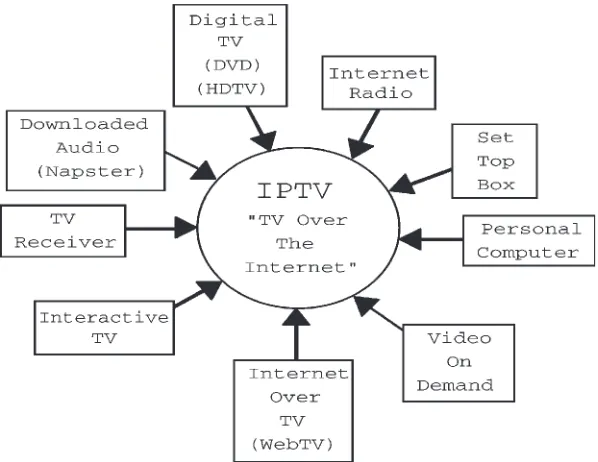
All paths appear to converge on Internet television (TV), as depicted in Fig. 1.1. Perhaps this convergence should be called “The Internet Meets Hollywood!” or “Video Meets the Internet.” It is clear that the term “TV Over the Internet” is probably too narrow because it implies the use of a packet-switched data network to deliver conventional television video. Internet TV could be much broader and all inclusive than just this narrow definition. All these various forces focusing their energies on Internet TV might create an implosion of activity in the future, as shown in Fig. 1.2, or
2
all the activity might create so much confusion and diffusion that some real opportunities could be lost along the way.
INTERNET TV DEFINED
What is Internet TV? The definition depends on the definitions of television and Internet. Although the two terms might seem quite clear, they both are actually evolving with different meanings to different people.
In 1945, everyone knew that television was the broadcasting of moving images, along with sound, over the airwaves to homes for viewing on a television receiver. The content of these early days of television was news, movies, drama, sports, and variety shows. Later, television evolved to in-clude the distribution of video content over coaxial cable, videotape, and videodisc. Although the distribution technology evolved, the content re-mained mostly unchanged.
Today, the media continually touts that “the Internet is everything.” With consumers routinely downloading audio recordings and programs over the Internet, the next wave will be the routine, widespread down-loading of video in real time over the Internet—a technology known as video streaming. Alternatively, video could be sent as a large file transfer and viewed at a later time. Either way, this could be the death knell of con-ventional television broadcasting, the video rental store, and such physical media as the digital videodisc (DVD). Consumers would then be able to pick and choose any video and television program for downloading and viewing at their convenience. The old dream of video-on-demand (VOD) will finally be realized.
But the network capacity required to transmit lengthy high quality video material to tens of millions of consumers will be costly and complicated to develop. The Internet is already used to download video shorts and car-toons. Some of this new video material is interactive, creating a new form of interactive television (ITV).
accessed and displayed in color and graphics from various Web sites. Clearly, the Internet is many things.
The various key features of the Internet are as follows: look and feel (color/graphics), browsers, hypertext markup language, Internet protocol for packet switching, and worldwide packet network for data transmission. What this all means is that the definitions of both the Internet and television are evolving. Hence, the definition of Internet TV, because it combines ele-ments of both, is also evolving and is not yet clear. Therefore, the technology and future of Internet TV are somewhat speculative because of this unclear definition. If the definition of the “it” is unclear, then most consumers will not buy “it,” and the “it” will have problems in the marketplace or evolve into an “it” that is less hazy and more clearly defined.
INTERNET TV CAN BE MANY THINGS
Internet TV is many things, or even a combination of things. In its most ob-vious implementation, Internet TV is conventional television obtained over the Internet. Rather than watching television programs broadcast over the air or over cable, television programs are accessed over the Internet and then watched in real time, using a technology known as video streaming. Not only conventional television, but also cartoons and video shorts, are sent over the Internet with video streaming. All this video is watched on the personal computer. Computer technology will be incorpo-rated within future television sets to facilitate television access over the Internet. The television set thus converges with the personal computer.
Internet TV is the adoption of an Internet-like interface in accessing and watching television—a new form of video navigation over the Internet. Internet TV is a more interactive approach to controlling the television ex-perience with the ability to obtain all sorts of ancillary information while watching television, as promoted by Wink Communications.
Internet TV is the use of the home TV set to view Internet sites, as offered by WebTV Networks, perhaps in conjunction with conventional television viewing. These kinds of applications of Internet TV create an interactive television experience called Internet-enhanced TV. Such Internet-en-hanced TV could then evolve into Internet-delivered TV on a wide basis.
Internet TV is the use of the Internet protocol to store and transmit video, both at the TV studio and also to various locations. Rather than stor-ing and transmittstor-ing digital video as a continuous stream of bits, the digital video is packetized into the packets specified by the Internet protocol.
EVOLUTIONARY CONVERGENCE
co-axial cable. The personal computer is situated at the home work center. Television is watched on the home television receiver, physically placed at the home entertainment center. Will the personal computer evolve into an entertainment center? Will the home television receiver become the means to access the Internet, as promoted by Web TV? Or will television receivers of the future increasingly adapt digital technology for entertain-ment purposes, leaving the personal computer as a separate work appli-ance in the home?
LESSONS FROM WEB RADIO
Radio is being changed because of the Internet. Will similar changes oc-cur to television? Consumers in rural areas now “listen” to the radio over the Internet. A colleague in rural New Hampshire accesses WQXR in New York City over the Internet to listen to classical music. Will radio stations re-turn their broadcast licenses as they migrate to the Internet?
Indeed, there is growing evidence of a much broader market for radio stations beyond their local market. But there are more technologically effi-cient ways to extend this reach than the use of the packet-switched Internet. One way would be geostationary satellite transmission of all ra-dio stations. Just two satellite transponders could handle 10,000 rara-dio sta-tions in a compressed digital format. But would small inexpensive satellite radio receivers be developed?
Internet TV could then simply evolve into a form of “world TV” in which all television programming from the entire planet would be transmitted by satellite to everyone on the earth. The capacity to do this would require only a few geostationary satellites.
A LITANY OF FAILURES, YET CAUSE FOR HOPE
An issue ofThe Economistcharacterizes “the digital revolution in enter-tainment … [as] somewhere between a disappointment and a disaster” (Duncan, 2000). Indeed, much of the rhetoric of Internet television is very similar to the words of the recent past about such technologies as video dialtone (VDT), video-on-demand (VOD), interactive TV (ITV), and fiber to the home (FTTH). Unfortunately, these technologies are a litany of failures, along with such others as Web TV and high-definition digital TV.
over standards, teletext never developed in the United States. The success of the Internet, which offers access to far more information than teletext, means that teletext has a dim future.
Interactive two-way television was pioneered decades ago by Warner Cable in Columbus, Ohio. The Warner QUBE system was initiated in 1977, but was later terminated in the late 1980s. Although all sorts of wild prom-ises were made for its application, a major use of QUBE was to obtain in-stant audience reaction to new programs.
Web TV offers Internet access over the home television receiver using a keyboard that attaches to the telephone line and to the TV set for dis-play. The service has met with very little consumer acceptance (“What-ever Happened to WebTV?,” 2000). Yet, the predictions of a huge market for interactive television continue to be made, with Forrester Research predicting over 20% of TV revenue from smart set-top boxes by 2005 (“Microsoft’s Blank Screen,” 2000).
GTE offered all sorts of interactive, two-way, broadband video in Cerritos, California, from the late 1980s to the late 1990s. The consumer in-terest simply was not present for the video-on-demand (VOD) service. In 1992, Bell Atlantic promised to deploy optical fiber in the local loop for video dialtone (VDT) and predicted to have 1.2 million homes connected by end of 1995. Nearly 6,000 homes in Dover Township, New Jersey, were connected to an optical fiber system in 1996, only to be disconnected a few years later. The service was apparently far too costly to continue to offer. Bell Atlantic has never explained the reasons for withdrawing the service.
High-definition television (HDTV) doubles the number of scan lines of conventional television. HDTV is being used in the TV studio to capture video in a high quality format. HDTV is also being broadcast in a digital for-mat in an additional channel in the UHF spectrum given to conventional VHF broadcasters. Consumers, thus far, have shown little interest in HDTV. A key issue will occur over what to do with all the UHF spectrum given to the broadcasters for a service that is little watched.
The telephone network is a switched audio network. It could have been used as a means to call radio stations to listen to programs on a switched basis. But the switched public telephone network is not used that way, per-haps because of the cost. Listening to radio programs over the telephone network at 5 cents per minute equates to $3 per hour, which is quite pro-hibitive. The advantage of the Internet for doing the same thing is that the Internet is “free” to consumers and does not have usage sensitive pricing.
against the overwhelming tide of failures will say the time is now, but it might be still just too soon.
UNCERTAINTIES ABOUND
There are technological challenges and hurdles that would need to be overcome for Internet television to become a reality. However, the real un-certainties are not technological in nature but involve consumer needs and behavior, industry structure, and finance. In addition, there are issues over copyright and ownership protection that would need to be resolved.
The Internet is mostly “free” except for a fixed monthly access charge paid to the Internet access provider. But if there were tremendous use of the Internet to send huge amount of video data, usage sensitive pricing might be needed (Noll, 1997b). Even a usage charge as low as 0.1 µ¢/bit (0.1 × 10⁻⁶cents per bit) adds up quickly when video data is sent
continu-ously at 4 Mbps. A minute of such Internet high quality video would incur usage charges of 24 cents, which is prohibitively expensive. However, there are many other uncertainties about Internet television.
Are consumers demanding Internet television? Do consumers want to interact with their television sets? Is it possible to overcome the history of the past failures and false promises of video dialtone, video-on-demand, interactive TV, and fiber to the home?
Is Internet TV a revolution or will it become yet another evolution in the distribution of video programming in digital form? As bandwidth continues to become available, will consumers demand improved quality so that compression is no longer wanted or needed? Is Internet TV a way to be en-tertained or a way to obtain information? How will conventional broad-casters respond? Is Internet TV just an evolutionary enhancement of digital CATV? Will new unexpected applications evolve and change the Internet TV landscape? What will Internet TV cost, who will finance it, and who will afford it? The answers to these key questions are currently un-clear. Thus far, Internet TV has been driven mostly by technology push. Will consumer pull develop, thereby leading to success? Only time will tell.
ACKNOWLEDGMENT
Many of the definitions of Internet TV presented in this chapter are a result of discussions with Darcy Gerbarg, and her contributions to this chapter are gratefully acknowledged.
REFERENCES
Hansell, S. (2000, September 20). Clicking outside the box.The New York Times,p. H1.
Microsoft’s blank screen. (2000, September 16).The Economist,p. 74–75. Noll, M. A. (1985, ). Videotex: Anatomy of a failure.Information &
Manage-ment, 9(2), 99–109.
Noll, M. A. (1989, September). The broadbandwagon. Telecommunica-tions Policy, 13(3), 197–201.
Noll, M. A. (1991). High definition television (HDTV). In A. A. Berger (Ed.), Media USA(2nd ed., pp. 431–438). New York: Longman.
Noll, M. A. (1997a).Highway of dreams: A critical appraisal of the commu-nication superhighway.Mahwah, NJ: Lawrence Erlbaum Associates. Noll, M. A., (1997b). Internet pricing vs. reality.Communications of the
ACM, 40(8), 118–121.
Noll, M. A. (1998). The digital mystique: A review of digital technology and its application to television.Prometheus, 16(2), 145–153.
Noll, M. A. (1999). The evolution of television technology. In D. Gerbarg (Ed.),The economics, technology and content of digital TV(pp. 3–17). Boston: Kluwer.
2
Implications for the Long
Distance Network
Andrew Odlyzko
University of Minnesota
Traditional concerns about the impact of television on the long distance links in the Internet are unjustified. The convergence of TV and the Internet is likely to be slower and take a path different from the one nor-mally envisioned. There are various definitions of Internet television. (See Egan, 1996; Noll, chaps. 1 and 3 in this vol.; Owen, 1999.) But, the precise one does not matter much for the purposes of this chapter.
Data networks developed rapidly largely because they could use the huge existing infrastructure of the telephone network. Without all the in-vestments made to provide voice services, long distance data transmis-sion would have grown much more slowly. As it is, growth has been fast, although not as fast as is commonly believed. The bandwidth of data net-works in the United States already exceeds that of voice netnet-works (see the next section for more details). Sometime in 2001 or 2002, the volume of data transmitted on data networks exceeded that of voice. (See Coffman and Odlyzko, 2001b, for the historical growth rates of different types of data and nondata traffic, and of predictions of when data would exceed voice.)
Despite all the publicity it attracted in the late 1990s, packetized voice is still a tiny fraction of Internet backbone traffic. This is not likely to change, even as a greater fraction of voice is sent over the Internet. The reason is the far higher growth rate of data traffic than of voice calling, about 100% versus under 10% per year. Even today, to move all current voice traffic to the Internet would require much less than a doubling of the Internet’s capacity.
Although there are still about as many bytes of voice traffic as of Internet traf-fic, packetization of voice naturally lends itself to compression. Hence, if voice traffic were to move to the Internet, then the volume of packet traffic that would result would be far smaller than current data traffic.
The general conclusion is that the volume of voice calls is not going to overwhelm the Internet. (There are quality issues as well that matter, but this chapter does not deal with those here.) Historically, however, data networks have developed in the shadow of the telephone network. Not only have data networks relied on the infrastructure of voice telephony, but their development was strongly influenced by the prospect that even-tually they would carry voice. Because the telephone network was so much larger than the data networks, the quality requirements for voice transmission played a major role in the planning of data transmission technologies. Right now, it is increasingly realized that voice will not be a large part of the traffic in the future, simply because there is too much data. On the other hand, video is now playing a similar role to the one voice used to play. The volume of TV transmissions is so large that the re-quirements of real-time streaming video dominate planning for the fu-ture of the Internet. However, that is also likely to turn out to be a mistake. By the time TV moves to the Internet, data traffic will likely be so large that streaming video will not dominate it. Moreover, the video traffic on the Internet is likely to be primarily in the form of file transfers, not streaming real-time transmission.
The aforementioned contrarian predictions are based on a study of rates of change in different fields. Storage, processing, display, and trans-mission technologies are advancing at rather regular and predictable rates. This is considered in later sections. (“Moore’s Law” for semiconduc-tors is only the most famous of the various “laws” that govern progress.) In addition, rates at which new technologies are adopted by society, al-though not as regular, are almost universally much slower than is com-monly supposed. (“Internet time” is a myth.) This is discussed at greater length later. As a result, there is some confidence in expecting that by the time TV moves to the Internet in a noticeable way, the latter will have huge capacity, at least on the long distance links.
The prediction that the predominant mode of video transmission on the Internet is likely to be through file transfers is justified briefly later. The con-cluding section is devoted to what appears to be the most likely impact of the Internet on TV, namely, in providing greater flexibility that will encour-age exploration of technologies like high-definition television (HDTV).
NETWORK SIZES AND GROWTH RATES
compa-rable to that of the voice network, with the public Internet a small fraction of the total. Today, the Internet is by far the largest in terms of bandwidth. How-ever, because bandwidth is hard to measure and changes irregularly, due to the lumpy nature of network capacity as well as the financial climate, it is hard to estimate it precisely. Table 2.1 presents the estimate from Coffman and Odlyzko (2002b) of the traffic (in terabytes, units of 10^12 bytes, per month). The key point, discussed in great detail in Coffman and Odlyzko (1998, 2002b) is that Internet traffic is growing at about 100% per year. That is the growth rate the Internet experienced during the early 1990s. There was then a brief period of 2 years (1995, 1996) when growth was at the “doubling every three or four months” rate that is usually mentioned. Starting in 1997, however, growth again slowed down to doubling each year. At this rate, by some time in 2001 or 2002, there was more data than voice traffic in the United States, as predicted in Coffman and Odlyzko (1998).
Further, technology advances in transmission and switching appear to offer the prospects of traffic growing at about 100% a year through 2010 without astronomical increases in spending. Even if growth occurs by a cumulative factor of 100 over the first decade of the 21st century (as op-posed to a factor of 1,024 that results from a doubling each year), there will be around 3 million TB per month of traffic by the end of 2010, or around 10 GB per person per month. Now a 90-minute movie, digitized for high reso-lution at 10 Mb/s, comes to about 7 GB, so it would be possible to transmit only about two movies per person (counting all men, women, and chil-dren) per month in that format. However, if the resolution is lowered to 2 Mb/s, and it is assumed that traffic continues doubling each year, by 2010 it would be possible to send 100 movies per person per month. Thus, the general conclusion is that by 2010, or soon thereafter, the long distance Internet backbone could transmit all the entertainment TV signals that are likely to be demanded.
Another way to consider the problem of the transportation task im-posed by TV is by considering capacities of fibers. If each of the
approxi-TABLE 2.1
Traffic on U.S. long distance networks (year-end 2000)
Network Traffic (TB/month)
U.S. voice 53,000
Internet 20,000–35,000
mately 300 million inhabitants of the United States is given a 10 Mb/s traffic stream, the total demand would be for 3,000 Tb/s of transmission capacity. The dense wavelength division multiplexing (DWDM) technologies that are widely deployed typically reach about 0.8 Tb/s per fiber strand, but there are good prospects of reaching 10 Tb/s in a few years, and there are even hopes of achieving 100 Tb/s.1If it is assumed conservatively that 10
Tb/s capacity per fiber will be widely deployed by 2010, then it would re-quire just 300 strands to provide the 3,000 Tb/s of capacity that the 10 Mb/s traffic stream per person involves. (Actually, double that would be needed for two directions of traffic, plus other small multiplier factors to provide for redundancy, etc., but those are not huge factors.) Today, there are sev-eral hundred strands of fiber running from coast to coast, and many empty conduits that could be filled with additional fiber. Thus, as far as fiber itself is concerned, there will be plenty of capacity.
Most of the fiber that is in place in the long distance networks is not uti-lized (“lit” in industry language), and even when it is in use, it is often used at a small fraction of its capacity. The reason is that there is not enough de-mand to create more usable capacity, certainly not even at the prices of 2001 (which are much lower than they were just a couple of years ago). (The present fiber glut resulted from an assumption that there was an insa-tiable demand for bandwidth. It ignored three key factors: lack of “last mile” connectivity; the cost to provide usable bandwidth, as opposed to raw fiber; and, perhaps most important, traffic demand is growing at only about 100% per year, even in the absence of bandwidth constraints, gated more by rate of adoption of new applications than anything else.)
The general conclusion is that there already is enough fiber to allow for transmission of individual TV signals over the long distance Internet backbones, and sometime around 2010, transmission and switching technologies are likely to allow for this to be done economically. The question is, will we want to do that? The volume of unique TV content is simply not all that large, as is shown in Lesk, (1997) and Lyman and Varian (n.d.). Given the trends in storage capacity mentioned later, it is feasible to store copies of all the nonreal-time material (which is the overwhelming bulk of what TV transmits) on multiple local servers, and avoid burdening the backbones with it.
MOORE’S LAWS (TECHNOLOGY TRENDS)
In the previous section, there was an implicit assumption, namely, that the highest resolution video signals that would be typical by 2010 would be no more than 10 Mb/s. Today, on digital cable TV systems, typical transmission
rates are around 2 Mb/s, and HDTV signals tend to be compressed to somewhat below 10 Mb/s. Increases in resolution of video signals can cer-tainly be expected. (Movies are filmed at over 1 Gb/s, and stored as such.) However, these increases are likely to be modest. (Note that TV resolution has not changed in over 50 years, and HDTV and other forms of enhanced display technologies have been making slight progress, a point to be con-sidered further later.)
In general, technological prognostications have a miserable track re-cord. The one area where they have been outstandingly successful, how-ever, has been in forecasting continuation of various types of laws similar to the “Moore’s Law” of semiconductors, which says that the number of transistors on a chip doubles every 18 months. (See Schaller, 1997, for the history and fuller description. The basic law is often reported as stating that processor power doubles every 18 months, which is not quite right, but reasonably close.) The key point, discussed at greater length in Coffman and Odlyzko (2002b), is that the different Moore’s laws for different areas operate at different speeds. Display resolution is improving slowly (and battery capacity even more slowly), and transmission and magnetic stor-age capacity are growing even faster than processor power. Table 2.2 shows the growth in the volume of hard disc storage that is shipped each year. It is about doubling annually, comparable to the rate at which trans-mission capacity is growing.
The rapid growth of storage capacity is significant, because it makes nonstreaming modes of operation much more attractive. Back in the 1980s and 1990s, disc storage available on PCs in households was so small that streaming real-time delivery of video was the only feasible alternative. Today, local storage is becoming viable even for high resolution movies. (Note the estimate of 7 GB for a single HDTV movie, versus a capacity of 80 GB that often comes with high-end PCs in mid-2001, and the likelihood that this will reach 1 TB around 2005). As time goes on, and the disc capac-ity grows rapidly while digital movie sizes grow slowly, the attractions of lo-cal storage will only increase.
RATES OF CHANGE, TECHNOLOGICAL AND SOCIOLOGICAL
People hear constantly how they live on “Internet time,” and how the Internet changes everything. Yet “Internet time” is a myth. The pace at which new products and services are adopted is not notably faster than it used to be in the past. This contrarian view is considered in greater detail in Odlyzko (1997). Because it is so contrarian, some space here is devoted to justifying it (and presenting more examples).
Yes, the telephone, the automobile, and electricity did spread slowly, but then each had to build its own extensive infrastructure, and each one was very expensive in its first few decades. The Internet could take ad-vantage of the existing telephone network to grow, and yet even the Internet did not really grow on “Internet time,” because its origins go back to the Arpanet, which was put into operation in 1969. For successful new consumer products or services that do not require large invest-ments, a decade appears to be about the length of time it takes for wide penetration. This was noted a long time ago.
A modern maxim says:
People tend to overestimate what can be done in one year and to underesti-mate what can be done in five or ten years. (Licklider, 1965, p. 17)
Arthur C. Clarke, the science fiction writer, is said to have similarly claimed that people tend to overestimate the short-term impact of new technologies and to underestimate the long-term impact.
Color TV took about a decade to reach 75% of the households in the United States. It is not much different today. Odlyzko (1997) presented
TABLE 2.2
Worldwide Hard Disc Drive Market
Year Revenues (Billions) Storage Capacity (Terabytes)
1995 $21.593 76,243
1996 24.655 147,200
1997 27.339 334,791
1998 26.969 695,140
1999 29.143 1,463,109
2000 32.519 3,222,153
2001 36.219 7,239,972
2002 40.683 15,424,824
2003 30,239,756
2004 56,558,700
statistics on sales of recorded music in the United States by format. Music CDs are much better than vinyl LPs (at least for 99% of the population, al-though there is a small but influential segment that insists on the superi-ority of the older medium), yet it took them around a decade to attain dominance. Cell phones are all the rage, but they have been around since the mid-1980s, and yet by the end of 2000 they were used by just about 40% of the U.S. population.
The standard example of how things do move on “Internet time” is the browser. It did attain dominance in providing online access in under 2 years. But that is just about the only such example of rapid change! Even on the Internet, technologies such as IPv6 and HTTP1.1 have been talked about as the “next big thing” for about half a dozen years, and are not yet dominant. Amazon.com did revolutionize retailing. However, it took quite awhile, because it was established in November 1994, and 6 years later it had not yet taken even 10% of the U.S. book market. (Whether Ama-zon.com is viable in the long run or just an outstanding example of the “ir-rational exuberance” of the financial markets is another story.)
Much of the dot-com bubble appears to have been due to the expecta-tions that the world was changing on Internet time. For example, in the middle of 2001, just before Webvan closed down, its new CEO was quoted as saying, “We made the assumption that capital was endless, and de-mand was endless.” The idea of deliveries to the home may yet find a mar-ket and lead to financial success. However, Webvan was acting under the assumption that they had to build a giant distribution network in a year or two, or else somebody else would. Instead, when demand was slow to materialize, they went bankrupt.
The entertainment area is full of examples of slow changes. Galbi (2001) provided interesting statistics on a variety of subjects. Some of the most relevant have to do with the slow rate at which people reallo-cate their time. For example, reading went from 4 hours per week to 3 hours, but this change took from 1965 to 1995, a 30-year period, to oc-cur. More examples of slow consumer adoption rates are appearing all the time. For example, personal video recorders, such as TiVo and ReplayTV, have so far failed to take off, even though their users praise them highly (Hamilton, 2001).