Special FocuS Review: Neglected vacciNeS—developiNg woRld
Human vaccines 7:11, 1234-1244; November 2011; © 2011 landes Bioscience
1234
Human vaccines
volume 7 issue 11
Understanding the Impact of Hookworm Infection
Human hookworms are some of the world’s most common
para-sitic helminths and are prevalent in South and Central America,
sub-Saharan Africa and East Asia. Until half a century ago,
hookworms were also prevalent in the US, Southern Europe
and Australia.
1,2As a result of considerable economic growth
and development, especially in the years following World
War II, which included programs of mass chemotherapy with
anthelminthic medications, improved sanitation and health
education, the soil-transmitted helminths (STHs), which also
*Correspondence to: Jeffrey M. Bethony; Email: [email protected]
Submitted: 10/10/11; Accepted: 10/17/11
DOI: 10.4161/hv.7.11.18443
the human hookworms Necator americanus and Ancylostoma
duodenale remain among the most common infections of
humans in areas of rural poverty in the developing regions
of the world, with an estimated 1 billion people infected
with one or more of these parasites. Herein, we review the
nearly 100 years of research, development, animal testing and
fieldwork that have led to our current progress in recombinant
hookworm vaccines. we begin with the identification of
hookworm at the start of the 20
thcentury in Southern
uS, then discuss the progress in developed countries to
eliminate human hookworm infection, and then the industrial
development and field use in the 1970s a canine hookworm
vaccine (Ancylostoma caninum), and finally our progress to
date in the development and clinical testing of an array of
recombinant antigens to prevent human hookworm disease
from
N. americanus infection. Special attention is given to
the challenges faced in the development of a vaccine against
a blood-feeding nematode, including the epidemiology of
infection (high prevalence of infection), pathogenesis (chronic
infection that increases with the age of the host), and a robust
immune response that fails to confer the protection in the
host and a concomitant absence of correlates of protection by
a successful vaccine could be developed and tested. Finally,
we provide the optimal and acceptable profiles of a human
hookworm vaccine, including the proposed indication, target
population and route of administration, as developed by the
Human Hookworm vaccine initiative, the only group currently
working on vaccines targeting this parasite.
A history of hookworm vaccine development
Brent Schneider,
1amar R. Jariwala,
1Maria victoria periago,
2Maria Flávia gazzinelli,
3Swaroop N. Bose,
1peter J. Hotez,
4david J. diemert
1,* and Jeffrey M. Bethony
1,*
1department of Microbiology, immunology and tropical Medicine; the george washington university Medical center; washington, dc uSa;
2clinical immunology laboratory; instituto René Rachou, Belo Horizonte; Minas gerais, Brazil; 3departamento de enfermagem aplicada, escola de enfermagem universidade
Federal de Minas gerais, Brazil; 4pediatrics and Molecular & virology and Microbiology; Baylor college of Medicine; Houston, tX uSa
Key words:
hookworm diseases, recombinant protein vaccine, neglected tropical disease, canine hookworm vaccine,
Necator americanus
include
Ascaris lumbricoides
and
Trichuris trichiura
, as well as
the focus of the current review the hookworms
Necator
ameri-canus
and
Ancylostoma duodenale
were eliminated from most of
these regions. However, the STHs, especially the hookworms,
remain the most common infections of humans in areas of
rural poverty in the developing regions of the world, with an
estimated 1 billion people infected with one or more of these
parasites. The epidemiology of hookworm infection (either
Necator americanus
or
Ancylostoma duodenale
) as it relates to the
rationale for a hookworm vaccine has been extensively reviewed
by us elsewhere.
3-5In brief, current control efforts focus on
the administration of anti-nematode drugs (“anthelminthics”)
from the benzimidazole (BMZ) class of drugs, either
albenda-zole or mebendaalbenda-zole.
3-5While BMZ class anthelminthics are
highly effective at removing established (“patent”) infections,
they do not confer lasting protection against new infection—
hence, individuals resident in hookworm endemic areas are
rap-idly re-infected even after successful treatment. For this reason,
the extensive use of chemotherapy has failed to interrupt and,
in some cases, even limit transmission of these blood-feeding
nematode parasites—with individuals becoming re-infected
to their previous levels of infection within 12 months of
treat-ment.
3-5Current control efforts center on mass drug
admin-istration (MDA), which refers to the adminadmin-istration of BMZ
class anthelminthics to entire populations resident in endemic
areas irrespective of their individual infection status, has also
raised concerns about the rates of drug failure (mebendazole)
when used in a single dose and the possible emergence of drug
resistance, as seen in veterinary uses of the BMZ class of drugs.
6These concerns have stimulated efforts to develop a
hook-worm vaccine that would provide long-term protection against
disease due to
N. americanus
, the most prevalent hookworm
worldwide.
3-5History of Hookworm Infection
www.landesbioscience.com
Human vaccines
1235
Special FocuS Review: Neglected vacciNeS—developiNg woRldSpecial FocuS Review: Neglected vacciNeS—developiNg woRld
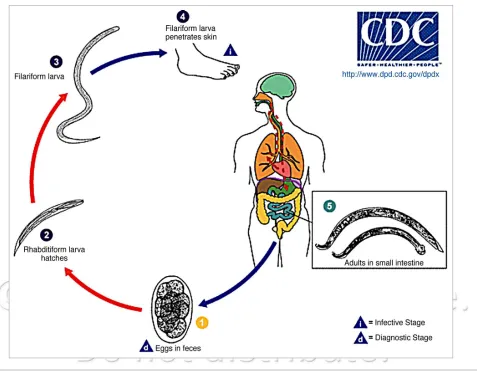
molt twice into L3 that seek higher ground to come into contact
with human skin.
Intestinal blood loss is the main clinical manifestation of
human hookworm infection.
3-5Heavily and even moderately
infected patients with underlying iron or protein nutritional
defi-ciencies can develop hookworm disease—the clinical entity that
specifically refers to the resulting iron deficiency anemia [IDA],
which is a microcytic and hypochromic, anemia, that occurs
when hookworms feeding on the blood host with poor nutritional
background.
3-5Hookworm-induced blood loss is estimated to be
as high as 9·0 mL per day in heavy infections, with hookworm
burdens of 40–160 worms sufficient to cause anemia.
22In
school-aged children and adults in resource-poor countries, where host
iron stores are often lower than those in developed countries,
there is a well-established relationship between the intensity of
hookworm infection, intestinal blood loss and anemia.
3-5The Human Immune Response
to Hookworm Infection
As with other helminths that infect humans, the robust immune
response is induced by hookworm infection fails to confer
pro-tection against new or established infection. This phenomenon
has been extensively reviewed elsewhere for hookworm
23and for
helminths in general, as well as the consequences it has on the
discovery and development of vaccines against these parasites.
The major impediment to the development of vaccines for these
infections is that there is no evidence of protection in humans.
An important reason for this “major impediment” is the
natu-ral history of hookworm infections: individuals can be infected
for years, starting as young as 12 months of age, with hookworms
sometimes infecting up to 70% of individuals at risk in endemic
areas (i.e., 70% an entire village may be infected). As such, it
is difficult to find individuals in endemic areas who have not
been continuously infected for months, years or even decades.
More specifically, it is nearly impossible to find hookworm-näive
individuals (i.e., individuals who have never been infected),
fol-low them longitudinally and observe them for incident or “new”
infection in order to elucidate the manner in which the human
immune response evolves over time to this pathogen. Hence,
most of our knowledge of the human immune responses to
hookworm infection comes from individuals who have failed
to mount a protective immune response against the pathogen,
leaving us without a model for a “successful” immune response
that could be used to predict vaccine-induced protection or at
least determine a “correlate of protection” (CoP).
24,25The lack of
a CoP profoundly effects the pre-clinical and clinical
develop-ment of hookworm vaccines in variety of ways; for example, the
lack of a CoP makes difficult to test the variation in “potency” of
different manufactured lots of a hookworm vaccine as we do not
know the biologically effective level of antibody needed to induce
protection. or if one even exists Additionally, the lack of CoP or
a model of protection necessitates the inclusion of much higher
sample sizes in phase 2 and 3 trials of candidate hookworm
vac-cines, since the endpoints must be clinically-based rather than an
easier-to-measure CoP.
hookworm infection in the US, and its impact on the
popu-lation, especially school-aged children.
8-10Prompted by these
reports, the Rockefeller hookworm eradication campaign was
soon underway in the Southern US and quickly expanded
glob-ally.
11Despite some successes, the overall impact of the
cam-paign on reducing the prevalence and intensity of hookworm
infection remains controversial.
12,13In 1947, Norman Stoll
14made the first global estimate of the
number of individuals infected with human hookworm when he
claimed that nearly one third of the world’s population (over 600
million cases at that time) was infected with hookworm, which
would make hookworm one of the most common human
infec-tions.
14,15Over the next half of a century, efforts have been
under-taken to reduce the prevalence of hookworm in regions as diverse
as North America, Asia, sub-Saharan Africa and Latin America
through a combination of improvements in infrastructure and
widespread anthelminthic drug treatment.
16Today, endemic
hookworm has been essentially eliminated from the US.
17,18Economic development in countries such as Taiwan, Japan and
South Korea during the 1960–1970s also resulted in significant
control of hookworm transmission, with national prevalence
lev-els currently below 1%.
14Additionally, over the past 20 y, the
People Republic of China has successfully decreased the national
hookworm infection prevalence levels, especially in eastern
China.
19Latin America and the Caribbean have experienced
noticeable decreases in the prevalence of hookworm infections
over time with the implementation of various national treatment
programs coupled with economic growth.
20Today, hookworm
remains highly prevalent in regions (especially rural) of the low-
and middle-income countries of Africa, Asia and the Americas
where economic development has not yet taken place, and is not
expected to anytime soon.
15Despite the successful control of
hookworm in several parts of the world, an estimated 576–740
million cases still exist worldwide, a figure very close to Stoll’s
original estimate more than 60 years ago.
21Natural History of Hookworm
The life cycles of
N. americanus
and
A. duodenale
as they relate
1236
Human Vaccines
Volume 7 Issue 11
Protein-2), are associated with a decreased risk of heavy
hook-worm infection.
35The Th2 response during helminth infection is induced
against a background of potent, parasite-induced
immuno-regulation, referred to as a “modified” Th2 response.
28-32This
response consists of alternatively activated macrophages, Foxp3
+CD4 regulatory T [Treg] cells, and CD4
+Tr1-IL-10 producing
T cells.
28-32The effect of this response is to create an immune
environment so extensively downregulated that it may protect the
host not only from the strong inflammatory effects of helminth
infections, but also against the effects of other IgE-mediated
dis-orders such as atopy, asthma and anaphylaxis.
32Reduced allergic
responses have been shown in studies of infection of mice with
various helminth infections (see Erb
36for review). Moreover,
epi-demiological evidence suggests that hookworm infection is
asso-ciated with reduced skin reactivity to common allergens and a
lowered risk of extrinsic asthma.
37As seen with other helminth
infections, hookworm is associated with a systemic
down-mod-ulation of immune responsive, with measurable attenuation of
While host immune response to hookworm infection is robust
and comprehensive in scope, activating both strong humoral
and cellular immune responses, it fails to elicit protection.
Naturally-infected humans mount strong antibody responses
against hookworms, involving all isotypes and most IgG
sub-classes, with IgG4 and IgE exhibiting the greatest increases.
These antibody responses can be detected to all stages of the
pathogen in the host (L3, L4 and L5).
26,27It is well accepted that
a T-helper type 2 (Th2) cellular immune responses is elicited
during hookworm infection (as with other helminth infections
such as schistosomiasis, onchocerciasis and filariasis
28-32). As
part of this Th2 response, individuals develop elevated levels
of total IgE and parasite-specific IgE, increased levels of
inter-leukin [IL]-4, IL-5, IL-10 and IL-13, and an increase in
eosino-phils and mast cells. There has been a long-standing hypothesis
that parasite-specific IgE can have a partially protective effect
against helminth infections such as Schistosoma spp.
33,34Our
own studies have shown that elevated levels of IgE to the
recom-binant
Ac
-ASP-2 (
Ancylostoma caninum
Ancylostoma Secreted
www.landesbioscience.com
Human Vaccines
1237
challenged with Ancylostoma spp and
N. americanus
. However,
none of these are permissive hosts for the human hookworms; in
many cases, their infective larvae fail to mature into blood-feeding
adult hookworms. Consequently, mice challenged with hookworm
larvae do not go on to experience intestinal blood loss.
The First Hookworm Vaccine
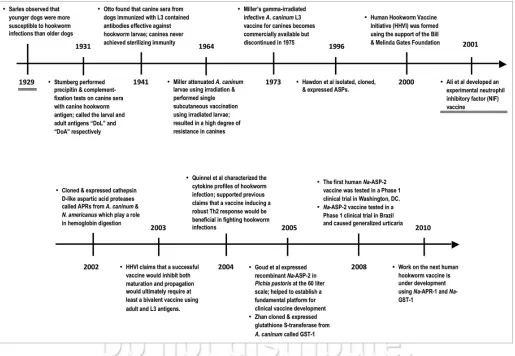
A detailed history of the advances leading to canine and human
vaccines can be found in
Figure 2
. Briefly, in 1964, Miller
44showed that
Ancylostoma caninum
larvae could be attenuated
using 40,000 röntgens of X-ray. As the amount of radiation
increased, the larval infectivity decreased and the pathogenicity
was also reduced. He also observed that female larvae irradiated
at 40,000 röntgens or more were consistently sterile. In a single
subcutaneous vaccination in dogs 3–4 months old using 1,000
A. caninum
larvae exposed to 40,000 röntgens of X-ray, a single
subcutaneous vaccination resulted in a high degree of resistance
to the challenge burden of normal worms in terms of
hematologi-cal, clinical and coprological changes. Miller then conducted a
series of experiments to investigate the effect of double
vaccina-tion with irradiated
A. caninum
larvae (irL3) and if the determine
the route of vaccine administration [subcutaneous (s.c.) or oral]
had any effect on the immunogenic efficiency.
44,45He concluded
that double oral vaccination was not as effective as double s.c.
vaccination in dogs that were 3–4 months of age, by measuring
the establishment of adult hookworms after challenge with
infec-tive larvae. Both routes of vaccination seemed equally effecinfec-tive in
terms of resistance to the pathogenic effects of hookworm
infec-tion, involving hematologic, coprologic (eggs per gram of feces),
and clinical observations after challenge with infection with
L3. The arrest of irL3 in somatic locations along their
migra-tory route (primarily the lungs) after subcutaneous inoculation
generated a more intense immunogenic stimulation of the canine
host.
44,45Consequently, Miller favored subcutaneous vaccination
for the commercialized version of the irL3 vaccine.
42,46As mentioned above, Miller believed that the presence or
absence of somatic migration (L3 migrating to the lungs) was
a primary moderator in the increased efficacy observed when
irradiated larvae were administered subcutaneously rather than
orally.
45,46This hypothesis was established on the observed basis
that nearly 75% of irL3 became “arrested” before or died prior
to reaching the intestines, the location where the hookworm
cause substantial host blood loss. Miller believed that the
lar-vae’s journey to the intestines concluded in the lungs, which
was the case in a hypothesis put forth for an experimental
irra-diated schistosome vaccine
47and for irradiated
Nippostrongylus
brasiliensis
larvae.
48Moreover, Miller showed that subsequent
challenge infections of vaccinated dogs was due to the
adminis-tration of irradiation to third stage infective larvae (L3), which
attenuated the L3. As stated by Miller,
44three characteristics of
attenuation were observed when irL3 were used to immunize
canines:
(1)
a reduction in larval infectivity;
44(2)
a reduction in the pathogenicity of the worms that
even-tually reached the small intestine;
44and
responses to bystander antigens to immunization with routinely
administered vaccines.
As mentioned above, there is no CoP (as defined either by Qin
38or by Plotkin
24,25) that has been identified for human hookworm
infection. The fact that the immune system reacts vigorously to
hookworm infection and fails to harm the parasite not only
ham-pers identification of target vaccine molecules for antigen
discov-ery (about which much has been written
3-5,28,39), but also provides
challenges for development of potential vaccine antigens.
Hookworm in the Laboratory
The life cycle of many viral and bacterial pathogens are easy to
maintain in vitro and permissive animal models exist for them as
well, making the testing of vaccines targeting these organisms for
efficacy, immunogenicity and potency relatively straightforward.
However, like many other Neglected Tropical Diseases (NTDs),
the life cycle of hookworms is difficult to maintain in vitro or as
lab-oratory strains within animal models. In some cases, only a single
stage of the life cycle can be consistently maintained in the
labora-tory. Moreover, like many NTDs, the laboratory animals that
per-mit hookworm testing are large, expensive and require extra care to
maintain (e.g., canines). There also remains considerable scientific
debate as to whether these animal models reproduce the infection as
it occurs in the human host (see Fujiwara et al.
40for review).
The current models used in the testing of experimental
hook-worm vaccines are canines and hamsters. Canines can be
experi-mentally infected with
A. caninum
, which closely resembles human
N.
hookworm infection.
40The hamster
Mesocricetus auratus
can be
infected with either
A. ceylanicum
or
N. americanus
. These animal
models are of limited benefit for the following reasons:
(1) While initially permissive to infection by third-stage
infective larvae (L3), both models become refractory to the
infec-tion over time.
41,42For example, canines develop natural
resis-tance to hookworm infection after 20 weeks of infection, after
which time the parasites are expelled from the host.
41,42This
makes the immunization and challenge model difficult to mount
and a long-term pathological endpoint such as anemia difficult to
induce given such a short time span of infection.
(2)
Neither canines nor hamsters easily reproduce the
clini-cal endpoints seen with human hookworm disease—specificlini-cally,
development of IDA is uncommon. The relationship between
worm burden and intestinal blood loss is not straightforward in
either model, probably due to the method of infection (a single
bolus challenge of infective larvae), which has to be given over a
short time frame to permissively infect a large group of animals.
(3)
Finally, the hamster model, especially for
N. americanus
,
has the further limitation that even under optimal conditions,
less than 20% of infective larvae develop into adult hookworms
in the gastrointestinal tract during challenge infections.
43Over the last few decades there have been several attempts to
create alternative animal models for hookworm infection.
40The
1238
Human Vaccines
Volume 7 Issue 11
vaccine was discontinued in 1975 due to commercial failure;
most veterinarians were unwilling to incorporate it into their
vac-cination programs because of difficulties in storing the vaccine,
the short shelf life, the lack of sterilizing immunity, and
econom-ics—it prevented routine de-worming of canines, a routine and
rather lucrative source of income for veterinarians.
42A Chance for Learning
Although the irL3 vaccine failed commercially, it provide
com-pelling evidence that the possible existence of human
hook-worm vaccine and the expectations (see Target Product Profile in
Table 1
) of such a vaccine.
39First, dog owners complained about
the appearance of eggs in feces following vaccination. Miller
countered that it was an “unrealistic expectation for successful
banishing of all hookworm infection: and that sterilizing
immu-nity to such macro-parasite was probably not option; a
reduc-ing in the number of worms and not complete elimination of
the worms was sufficient to have an important clinical effect”.
42Indeed, such expectation on the part of the dog-owners was not
unreasonable. The majority of human vaccines are indeed
steril-izing in nature, eliciting a rapid and specific immune response
that kills the pathogen—a characteristic vital to combating
(3) a sterilizing effect on female worm’s fecundity as
mea-sured by eggs per gram of feces (epg).
47Until this point in time, successful passive immunization for
helminth parasites exhibited variable and contradictory results
primarily because of experimental techniques. A few years after
establishing his “characteristics of attenuation,” Miller conducted
a series of experiments revealing that the immunity of double
vaccinated dogs with X-irradiated
A. caninum
larvae could be
passively and adoptively transferred to susceptible pups using
serum and/or lymphoid cells.
49Despite a lack of immunological
reagents at this time (e.g., monoclonal antibodies, cell surface
markers), these findings on passive immunization enabled Miller
to conclude that the mechanism of resistance induced to irL3
was the result of an immunological phenomenon rather than a
mechanical event (the attenuated L3 being trapped in the lung).
Miller used these “characteristics of attenuation” for the,
product development, industrial manufacture and USDA
licens-ing of the 1
sthookworm vaccine, which consisted of
gamma-irra-diated infective
A. caninum
L3 vaccine for canine.
42The vaccine
was field tested by approximately 1,500 practicing veterinarians
across the US.
41,42While the vaccine proved to be safe for the
dogs and even effective (90%) for canine, it had a considerably
short shelf-life (6 mo) and a unique set of storage condition. The
www.landesbioscience.com
Human Vaccines
1239
vaccine should target “hookworm disease” and not “target
hook-worm infection”. More specifically, a human hookhook-worm vaccine
should diminish the risk for moderate and heavy worm burdens
and the possible clinical sequelae.
3,42,54,55A critical characteristic of the irradiated canine hookworm
vaccine developed by Miller was that the efficacy of the vaccine
depended on the viability of the larvae.
39More specifically, the
attenuated larvae in the canine vaccine were able to live and
gen-erate antigens that would be secreted upon entry in the host.
39,42This viability factor has proven to be extremely informative for
the development of a recombinant human hookworm vaccine.
While immunizing canines with live attenuated hookworm
lar-vae appears to have a low risk-benefit ratio, immunizing children
with live attenuated hookworm larvae is both unpractical for
hookworm control. Consequently, the observation dealing with
larval viability coupled with findings that larval-secreted antigens
induce protective immunity
39,42inspired era of successful antigen
discovery 30 years later (
Box 2
).
A Model of Human Hookworm Infection
During the early 1980s, Carroll and Grove started doing work
with the hookworm
Ancylostoma ceylanicum
.
53-58This species of
hookworm could be a model of human hookworm due to its
abil-ity to infect humans. In 1984, they began a series of experiments
to observe the parasitological, hematologic and immunologic
responses to these hookworms in dogs.
53-58They successfully
stimulated transitory lymphocytes using adult
A. ceylanicum
anti-gens. Carroll and Grove further observed that IgG antibodies to
the antigens persisted for an indefinite period of time while
spe-cific IgM antibodies only lasted temporarily. Carroll and Grove
later discovered that two immunizing doses of 1 mg of protein
from
A. ceylanicum
suspended in Freund’s complete adjuvant
viral and bacterial pathogens that reproduce asexually, such as
varicella and measles or the effect of toxins such as from
teta-nus. Additionally, the success of human vaccines against viral
and bacterial pathogens are measured in terms of the decreasing
the incidence of disease in populations receiving the vaccination
and also generate “herd immunity.” However, given the size and
the life cycle of this blood-feeding parasitic nematodes, a human
hookworm (or any other helminth vaccine for that matter) is
unlikely have a sterilizing effect (see Maizels
28,50for classic and
still timely reviews of the challenges facing helminth
vaccinolo-gists)(
Box 1
). Hence, an important lesson learned from Miller is
to product profile of a human hookworm vaccine (see
Table 1
),
the indication of which would be to reduce the total worm
bur-den, resulting in an associated decrease in the morbidity from
hookworm diseases (
Table 1
).
39For example, Miller claimed that
the irradiated canine hookworm vaccine was discontinued due
to “the failure of veterinarians to differentially diagnose
hook-worm infection from hookhook-worm disease.”
42In other words, it
failed to induce a sterilizing immunity in canines. However, as
Miller goes on to argue, the degree of pathology generated from
“hookworm is directly related to the number of worms residing
within the host”
42and not simply infection alone; i.e., there is
a critical difference between “hookworm infection” and
“hook-worm disease”, and it is based on the intensity of infection. The
more hookworms infect the human or canine host the greater
the chance for hookworm disease; hence, a human hookworm
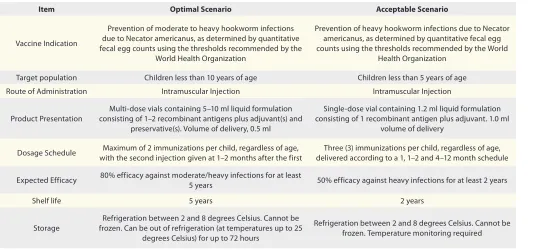
Table 1. The optimal and acceptable profiles of a human hookworm vaccine given
Item
Optimal Scenario
Acceptable Scenario
Vaccine Indication
Prevention of moderate to heavy hookworm infections
due to Necator americanus, as determined by quantitative
fecal egg counts using the thresholds recommended by the
World Health Organization
Prevention of heavy hookworm infections due to Necator
americanus, as determined by quantitative fecal egg
counts using the thresholds recommended by the World
Health Organization
Target population
Children less than 10 years of age
Children less than 5 years of age
Route of Administration
Intramuscular Injection
Intramuscular Injection
Product Presentation
Multi-dose vials containing 5–10 ml liquid formulation
consisting of 1–2 recombinant antigens plus adjuvant(s) and
preservative(s). Volume of delivery, 0.5 ml
Single-dose vial containing 1.2 ml liquid formulation
consisting of 1 recombinant antigen plus adjuvant. 1.0 ml
volume of delivery
Dosage Schedule
Maximum of 2 immunizations per child, regardless of age,
with the second injection given at 1–2 months after the first
Three (3) immunizations per child, regardless of age,
delivered according to a 1, 1–2 and 4–12 month schedule
Expected Efficacy
80% efficacy against moderate/heavy infections for at least
5 years
50% efficacy against heavy infections for at least 2 years
Shelf life
5 years
2 years
Storage
Refrigeration between 2 and 8 degrees Celsius. Cannot be
frozen. Can be out of refrigeration (at temperatures up to 25
degrees Celsius) for up to 72 hours
Refrigeration between 2 and 8 degrees Celsius. Cannot be
frozen. Temperature monitoring required
1240
Human vaccines
volume 7 issue 11
areas have also shown that antibodies to ASP-2 are associated
with a reduced risk of developing heavy hookworm infections.
35Based on these results, Na-ASP-2 was chosen as a lead
hook-worm vaccine candidate.
39In a phase 1 study in hookworm-naïve
adults living in the US, Na-ASP-2 adjuvanted with Alhydrogel
®was well-tolerated and immunogenic.
65However, a phase 1
safety and immunogenicity trial of this vaccine in healthy adults
from a hookworm endemic area in rural Brazil has to be halted
when 3 participants developed immediate, generalized urticarial
reactions following a single injection of 10 ug of recombinant
Na-ASP-2. Subsequent analysis showed that the urticarial
reac-tions were associated with elevated levels of IgE antibodies
spe-cific for Na-ASP-2, which were present before immunization,
most likely as a result of previous infection with hookworm.
66A
survey of adults and children from the same hookworm-endemic
area revealed that a significant proportion had elevated levels of
IgE to Na-ASP-2, therefore halting further development of the
vaccine. These findings had a major implication for the
develop-ment of vaccines against not only hookworm, but all helminths
given their common propensity to induce strong T helper cell
type 2 (Th2) immune responses and elevated levels of IgE to
both parasite and bystander antigens.
Systemic allergic reactions are rare for licensed vaccines,
averaging 0.65 cases per million doses.
67Few of these reactions
implicate the immunizing agent itself, as was the case with
Na-ASP-2. More common are reports of allergic reactions to
incipient components such as animal protein (gelatin),
antibiot-ics (neomyocin) or latex (vial stoppers).
68However, a comparable
situation was reported for the clinical testing of the
circumspo-rozoite Multiple Antigen Meptide (MAP) vaccine, an
experi-mental vaccine against Plasmodium falciparum.
69During phase
1 trials in malaria-unexposed individuals, vaccinees developed
Iimediate-type hypersensitivity (ITH) reactions associated with
elevated levels of IgE to MAP.
69However, in contrast to the
data presented here, vaccinees developed MAP-specific IgE
only after repeated vaccinations and were not sensitized by a
natural parasite infection such as was the case with Na-ASP-2.
The mechanism behind these ITH reactions was hypothesized
to be the presence of recombinant malarial proteins that were
unbound to adjuvant, which cross-linked IgE attached to mast
cells to stimulate release of histamine and other mast cell
medi-ators involved in the pathogenesis of acute urticaria.
69We
pro-pose a similar hypothesis whereby Na-ASP-2 cross-linked the
IgE on mast cells armed during years of chronic infection, thus
triggering a substantial histamine release.
It is possible that intrinsic structural or biological properties
of the Na-ASP-2 molecule were responsible for the ITH reactions
in previously infected individuals.
70Few molecules have the
nec-essary properties to bind and crosslink IgE
71(Traidl-Hoffmann
2009). An intriguing possibility is that humans have targeted
a restricted range of antigens from metazoan parasites, such as
helminths, to enable host defense without inducing self-harm or
tolerance.
72In this context, Na-ASP-2 would be both an
attrac-tive target for antibody-mediated defense against hookworm
infection and a target for IgE. During penetration of host
tis-sue, infective L3 of N. americanus encounter host-specific signals
significantly reduced fecal egg output and total intestinal adult
hookworm numbers.
53-58They concluded that injection of soluble
adult hookworm antigens preceding an infection would establish
specific protective immunity. Simultaneously, Hotez and Cerami
proposed developing vaccines comprised of recombinant soluble
enzymes.
59,60These observations further improved the outlook
for human hookworm vaccine development using soluble
mol-ecules rather than entire parasites that have previously been
irra-diated. Using such soluble molecules completely eliminated the
chance of accidental infection that persisted with vaccines
con-structed from whole hookworm larvae. These findings proved to
revolutionize the search for a successful human hookworm
vac-cine during the two decades to follow.
39The Human Hookworm Vaccine
Table 1
shows the optimal and acceptable profiles of a human
hookworm vaccine, including the proposed indication, target
population and route of administration, as developed by the
Human Hookworm Vaccine Initiative, the only group currently
working on vaccines targeting this parasite. Ancylostoma Secreted
Protein-2 of N. americanus (Na-ASP-2) is a 21 kDa protein that
is secreted by infective hookworm larvae upon entry into the
host.
61-64Vaccination of hamsters and dogs with recombinant
ASP-2 results in reduced worm burdens and fecundity following
challenge infection.
35Furthermore, sera from vaccinated animals
inhibit the migration of infective hookworm larvae through
tis-sue in vitro. Studies of populations living in hookworm endemic
Box 2.
limitations of field epidemiological of the immune response to
hookworm and the impact on vaccine development.
• Only a snapshot of a failed immunological situation can be taken, in
which generations of the parasite have already successfully colonized
its human host for months, years or possibly, even decades. while
hook-worms are though to live for 5 to 7 y in their human host 21, individuals
are constantly becoming re-infected, substituting “old” infections with
“new” infection and in many cases accumulating infections. in fact, the
prevalence and intensity of hookworm infection increases with age,
such that the elderly often have the greatest number of parasites in
endemic areas.
86,87• It is difficult to classify humans into the different phases of hookwrom
infection: (1) exposure, (2) pre-patency (larvae), patency (estbalsihed
blood feeding infection) and post-patency (cured) as most individuals
resident in endemic areas have already been infected for several years.
indeed, given the chronicity (5 to 7 y per worm) and the prevalence
(up to 70% in some communities), it is often difficult to find hookworm
näive individuals to follow longitudinally in order to elucidate the
evolution of an immune response to pathogen from initial exposure to
acute infection to chronic infection.
• Moreover, it is not ethically acceptable to follow hookworm-infected
individuals for long periods of time without offering treatment, thus
hampering longitudinal studies, on the evolution of chronic infection.
www.landesbioscience.com
Human vaccines
1241
worm fecundity (
Fig. 3
).
N. americanus
hookworms depend on
host hemoglobin for survival.
75Following hemolysis, adult
N.
americanus
use an ordered cascade of hemoglobinases beginning
with the cleavage of intact hemoglobin by the aspartic protease
Na
-APR-1.
74-77The freed heme generates toxic oxygen radicals
that can be bound and detoxified by homodimeric glutathione
S-transferases (
Na
-GSTs).
78Na
-glutathione S-transferase 1 (
Na
-GST-1) is a 24-kDa
pro-tein comprised of 205 amino acids and one N-glycosylation site.
79Recombinant
Na
-GST-1 has been expressed in
P. pastoris
at high
yield (>0.2 g/L) and purified by three chromatographic steps.
The X-ray crystal structure of this protein has been solved.
79In
dogs challenged with infective larvae, vaccination with
Ac
-GST-1
(the canine hookworm ortholog) induced high levels of antibody
and resulted in substantially lower worm burdens (40%) and
fecal egg counts compared with controls.
77Using the hamster
model of hookworm infection, approximately 57% protection (as
measured by worm burden) was achieved by immunization with
either
Ac
-GST-1 or
Na
-GST-1.
79,80Additionally, recent
immu-noepidemiological studies indicate that individuals living in
hookworm endemic areas of Brazil who acquire anti-
Na
-GST-1
IgG1 antibodies have a significantly reduced risk of having heavy
hookworm infections (unpublished data).
N. americanus
-Aspartic Protease-1 (
Na
-APR-1) is a 45-kDa
recombinant protein consisting of 407 amino acids with a
C-terminal histidine tag.
77,81For stability and safety reasons, this
aspartic protease has been inactivated by the mutation of the two
canonical aspartic acid residues to alanines.
76The recombinant
protein has been expressed in multiple systems, with tobacco
plants (
Nicotania benthamiana
) producing the highest yields
with the greatest stability and solubility being achieved in the
presence of zwitterionic detergents (unpublished data). In
ani-mals models, immunization with recombinant
Na
-APR-1 or its
canine ortholog
Ac
-APR-1 substantially diminished blood loss,
adult hookworm burden and fecal egg counts, as well as reduced
gut pathology compared with controls animals immunized with
adjuvant alone.
74,76Both
Na
-GST-1 and
Na
-APR-1 have been formulated with
the aluminum salt adjuvant Alhydrogel
®. However, in addition
to Alhydrogel
®, it may be advantageous to co-administer these
formulated antigens with one of the new generation of
immu-nostimulants such as the Toll-like receptor agonist GLA-AF
(an aqueous formulation of synthetic glucopyranosyl lipid A) as
described in
82-85to improve not only the quantity of the antibody
response (more antibody), but also the quality of this response
(better affinity and the develop or greater memory B cells
pro-duction) (
Box 3
).
that induce a programmed chain of developmental events that
result in the successful establishment of the parasitic relationship.
Among the most abundant proteins released by hookworm larvae
during this transition to parasitism are ASP-1 and ASP-2,
65both
of which belong to the Pathogensis Related Protein (PRP)
super-family.
61-64Recombinant
Na
-ASP-2, expressed in
Pichia pastoris
,
has shown significant protection in laboratory animal models,
with sera from animals immunized with ASP-2 inhibiting the
migration of infective larvae in vitro through host tissue.
35,73The
latter observation suggests that antibodies against
Na
-ASP-2
might attenuate larvae during tissue migration and prevent them
from reaching the host intestine and therefore developing into
healthy adult hookworms.
35,39New Generation Hookworm Vaccines
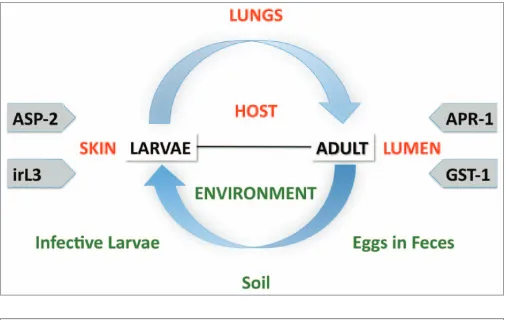
A new generation of hookworm vaccines have been described in
detail in reference 3–5, and are shown in
Figure 3
in regards
to their place in the hookworm life cycle. In brief, from more
than 20 potential target proteins involved in the hookworm
blood feeding process,
51,74,75two lead proteins have emerged as
promising candidate antigens for further clinical development,
based on preclinical efficacy testing and reduced concern of
hypersensitivity reactions as supported by data from human
immunoepidemiology studies:
Na
-GST-1 and
Na
-APR-1. Each
vaccine antigen is an enzyme (or modified enzyme) required for
parasite blood feeding. When used as a vaccine, we hypothesize
that they will induce neutralizing antibodies that will interfere
with parasite blood-feeding and cause parasite death and reduced
Figure 3.
the strategy for a human hookworm vaccine. our previous
strategy focused on excretory/secretory factors from the infective larval
stage (l3). a newer strategy focuses on inhibit the consumption and
detoxification of heme by the adult hookworm.
Box 3.
technical challenges for the development of a human hookworm vaccine.
1. The difficulty of maintaining human hookworms in animal models and the cost of maintaining the hookworm in laboratory-canine model.
2. the absence of an laboratory animal that is permissive to human hookworms and can accurately reproduce human disease (anemia).
3. paucity of in vitro functional tests to determine the effectiveness of the immune response induced by an experimental hookworm vaccine.
4. the lack of a protective immune response in humans and the consequent absence of correlates of protection (cop) that can guide the discovery of
vaccine antigens and be used to assess their effectiveness in preclinical and clinical trials.
1242
Human Vaccines
Volume 7 Issue 11
References
1. Brooker S, Bethony J, Hotez PJ. Human hookworm infection in the 21st century. Adv Parasitol 2004; 58:197-288; PMID:15603764; DOI:10.1016/S0065-308X(04)58004-1.
2. Thompson RC, Reynoldson JA, Garrow SC, McCarthy JS, Behnke JM. Towards the eradication of hookworm in an isolated Australian community. Lancet 2001; 357:770-1; PMID:11253974; DOI:10.1016/S0140-6736(00)04162-3.
3. Bethony JM, Cole RN, Guo X, Kamhawi S, Lightowlers MW, Loukas A, et al. Vaccines to combat the neglected tropical diseases. Immunol Rev 2011; 239:237-70; PMID:21198676; DOI:10.1111/j.1600-065X.2010.00976.x.
4. Hotez PJ, Bethony JM, Diemert DJ, Pearson M, Loukas A. Developing vaccines to combat hook-worm infection and intestinal schistosomiasis. Nat Rev Microbiol 2010; 8:814-26; PMID:20948553; DOI:10.1038/nrmicro2438.
5. Hotez PJ, Bethony JM, Oliveira SC, Brindley PJ, Loukas A. Multivalent anthelminthic vaccine to prevent hookworm and schistosomiasis. Expert Rev Vaccines 2008; 7:745-52; PMID:18665774; DOI:10.1586/14760584.7.6.745.
6. Keiser J, Utzinger J. Efficacy of current drugs against soil-transmitted helminth infections: systematic review and meta-analysis. JAMA 2008; 299:1937-48; PMID:18430913; DOI:10.1001/jama.299.16.1937. 7. Gonçalves ML, Araujo A, Ferreira LF. Human intestinal
parasites in the past: new findings and a review. Mem Inst Oswaldo Cruz 2003; 98:103-18; PMID:12687769; DOI:10.1590/S0074-02762003000900016. 8. Dock G, Bass C. Hookworm Disease. St. Louis: Mosby
Co. 1910.
9. Stiles CW. A new species of hookworm (Uncinaria americana) parasite in man. American Medicine 1902; 3:777-8.
10. Stiles CW. Frequency ofhookworm disease or ground itch anemia among public school children in Southern Florida. Public Health Rep 1910; 25:351-4; PMID:19314191; DOI:10.2307/4564592.
11. Farley J. To Cast Out Disease: A History of the International Health Division of Rockefeller Foundation [1913–1951], Oxford University Press 2004.
12. Stiles CW, Leonard G. Hookworm Diseases: number of treatments and number of doses of thymol admin-isered in 61 hospital and 22 home-cured cases of hook-worm infection. Public Health Rep 1913; 28:119-24; DOI:10.2307/4569192.
13. Stiles CW, Miller H. Observatioins on the viability of the eggs of hookworms (Necator americanus) and of eel-worms (Ascaris lumbricoides) in feces allowed to decom-pose in water. Public Health Rep 1911; 26:1565-600; PMID:19314272; DOI:10.2307/4566877.
14. Stoll NR. This wormy world. J Parasitol 1947; 33:1-18; PMID:20284977.
15. de Silva NR, Brooker S, Hotez PJ, Montresor A, Engels D, Savioli L. Soil-transmitted helminth infec-tions: updating the global picture. Trends Parasitol 2003; 19:547-51; PMID:14642761; DOI:10.1016/j. pt.2003.10.002.
16. Nawalinski T, Schad G. Historical Introduction. In: Gilles H, Ball P, Eds. Human parasitic dieases: Hookwrom Infection 1991; 4:1-4.
17. Bundy D. Is hookworm just another geohelminth? In: Schad GA, Warren K, Eds. Hookworm Diseases–cur-rent status and new directions. London: Taylor and Francis 1990; 146-64.
18. Stiles CW. Is It “Fair to Say That Hookworm Disease Has Almost Disappeared from the United States?”. Science 1933; 77:237-9; PMID:17773059; DOI:10.1126/science.77.1992.237.
19. Ministry of Health PRC, National Institute of Parasitic Diseases. Report on the national survey of the current situation of major human parasitic diseases in China. Beijing: Ministry of Health 2005.
20. Ehrenberg JP, Ault SK. Neglected diseases of neglect-ed populations: thinking to reshape the determi-nants of health in Latin America and the Caribbean. BMC Public Health 2005; 5:119; PMID:16283932; DOI:10.1186/1471-2458-5-119.
21. Bethony J, Brooker S, Albonico M, Geiger SM, Loukas A, Diemert D, et al. Soil-transmitted helminth infec-tions: ascariasis, trichuriasis and hookworm. Lancet 2006; 367:1521-32; PMID:16679166; DOI:10.1016/ S0140-6736(06)68653-4.
22. Crompton DW. The public health impor-tance of hookworm disease. Parasitology 2000; 121:39-50; PMID:11386690; DOI:10.1017/ S0031182000006454.
23. Loukas A, Constant SL, Bethony JM. Immunobiology of hookworm infection. FEMS Immunol Med Microbiol 2005; 43:115-24; PMID:15681140; DOI:10.1016/j.femsim.2004.11.006.
24. Plotkin SA. Immunologic correlates of protection induced by vaccination. Pediatr Infect Dis J 2001; 20:63-75; PMID:11176570; DOI:10.1097/00006454-200101000-00013.
25. Plotkin SA. Correlates of protection induced by vac-cination. Clin Vaccine Immunol 2010; 17:1055-65; PMID:20463105; DOI:10.1128/CVI.00131-10. 26. Geiger SM, Caldas IR, Mc Glone BE,
Campi-Azevedo AC, De Oliveira LM, Brooker S, et al. Stage-specific immune responses in human Necator americanus infection. Parasite Immunol 2007; 29:347-58; PMID:17576364; DOI:10.1111/j.1365-3024.2007.00950.x.
27. Geiger SM, Fujiwara RT, Santiago H, Correa-Oliveira R, Bethony JM. Early stage-specific immune responses in primary experimental human hookworm infection. Microbes Infect 2008; 10:1524-35; PMID:18848637; DOI:10.1016/j.micinf.2008.09.003.
28. Maizels RM, Holland MJ, Falcone FH, Zang XX, Yazdanbakhsh M. Vaccination against helminth parasites—the ultimate challenge for vaccinologists? Immunol Rev 1999; 171:125-47; PMID:10582168; DOI:10.1111/j.1600-065X.1999.tb01345.x. 29. Maizels RM, Pearce EJ, Artis D, Yazdanbakhsh M,
Wynn TA. Regulation of pathogenesis and immunity in helminth infections. J Exp Med 2009; 206:2059-66; PMID:19770272; DOI:10.1084/jem.20091903. 30. Maizels RM, Yazdanbakhsh M. T-cell regulation in
hel-minth parasite infections: implications for inflammato-ry diseases. Chem Immunol Allergy 2008; 94:112-23; PMID:18802342; DOI:10.1159/000154944. 31. Maizels RM, Yazdanbakhsh M. Immune regulation by
helminth parasites: cellular and molecular mechanisms. Nat Rev Immunol 2003; 3:733-44; PMID:12949497; DOI:10.1038/nri1183.
32. Yazdanbakhsh M, van den Biggelaar A, Maizels RM. Th2 responses without atopy: immunoregulation in chronic helminth infections and reduced allergic disease. Trends Immunol 2001; 22:372-7; PMID:11429321; DOI:10.1016/S1471-4906(01)01958-5.
33. Hagan P. IgE and protective immunity to hel-minth infections. Parasite Immunol 1993; 15:1-4; PMID:8433850; DOI:10.1111/j.1365-3024.1993. tb00565.x.
34. Hagan P, Blumenthal UJ, Dunn D, Simpson AJ, Wilkins HA. Human IgE, IgG4 and resistance to rein-fection with Schistosoma haematobium. Nature 1991; 349:243-5; PMID:1898985; DOI:10.1038/349243a0. 35. Bethony J, Loukas A, Smout M, Brooker S, Mendez S,
Plieskatt J, et al. Antibodies against a secreted protein from hookworm larvae reduce the intensity of hook-worm infection in humans and vaccinated laboratory animals. FASEB J 2005; 19:1743-5; PMID:16037096. 36. Erb KJ. Helminths, allergic disorders and IgE-mediated immune responses: where do we stand? Eur J Immunol 2007; 37:1170-3; PMID:17447233; DOI:10.1002/ eji.200737314.
37. Leonardi-Bee J, Pritchard D, Britton J. Asthma and current intestinal parasite infection: systematic review and meta-analysis. Am J Respir Crit Care Med 2006; 174:514-23; PMID:16778161; DOI:10.1164/ rccm.200603-331OC.
38. Qin L, Gilbert PB, Corey L, McElrath MJ, Self SG. A framework for assessing immunological correlates of protection in vaccine trials. J Infect Dis 2007; 196:1304-12; PMID:17922394; DOI:10.1086/522428. 39. Loukas A, Bethony J, Brooker S, Hotez P. Hookworm
vaccines: past, present and future. Lancet Infect Dis 2006; 6:733-41; PMID:17067922; DOI:10.1016/ S1473-3099(06)70630-2.
40. Fujiwara RT, Geiger SM, Bethony J, Mendez S. Comparative immunology of human and animal mod-els of hookworm infection. Parasite Immunol 2006; 28:285-93; PMID:16842265; DOI:10.1111/j.1365-3024.2006.00821.x.
Current Plans
By simultaneously targeting two enzymes in the blood digestion
and detoxification pathway, we hypothesize that the bivalent
human hookworm vaccine will elicit neutralizing antibodies
that will have a substantial impact on host worm burden (as
measured by quantitative fecal egg counts) and blood loss. It
is anticipated that vaccination with both recombinant proteins
will be needed to disrupt this complex system of hemoglobin
digestion, and thereby reduce parasite fecundity and survival
at a more rapid rate. Based on previous animal trials conducted
during preclinical efficacy testing of each antigen individually,
it is anticipated that the impact of the HHV on human
popula-tions will prevent the establishment of adult hookworms in the
range of 40–50%. By preventing the establishment (or
re-estab-lishment with reinfection) of adult hookworms, most (
≥
80%)
moderate and heavy infections would be prevented along with
the associated IDA.
Acknowledgements
www.landesbioscience.com
Human Vaccines
1243
73. Goud GN, Bottazzi ME, Zhan B, Mendez S, Deumic V, Plieskatt J, et al. Expression of the Necator ameri-canus hookworm larval antigen Na-ASP-2 in Pichia pastoris and purification of the recombinant pro-tein for use in human clinical trials. Vaccine 2005; 23:4754-64; PMID:16054275; DOI:10.1016/j.vac-cine.2005.04.040.
74. Williamson AL, Lecchi P, Turk BE, Choe Y, Hotez PJ, McKerrow JH, et al. A multi-enzyme cascade of hemoglobin proteolysis in the intestine of blood-feeding hookworms. J Biol Chem 2004; 279:35950-7; PMID:15199048; DOI:10.1074/jbc.M405842200. 75. Ranjit N, Zhan B, Hamilton B, Stenzel D, Lowther
J, Pearson M, et al. Proteolytic degradation of hemo-globin in the intestine of the human hookworm Necator americanus. J Infect Dis 2009; 199:904-12; PMID:19434933; DOI:10.1086/597048.
76. Loukas A, Bethony JM, Mendez S, Fujiwara RT, Goud GN, Ranjit N, et al. Vaccination with recombinant aspartic hemoglobinase reduces parasite load and blood loss after hookworm infection in dogs. PLoS Med 2005; 2:295; PMID:16231975; DOI:10.1371/journal. pmed.0020295.
77. Pearson MS, Bethony JM, Pickering DA, de Oliveira LM, Jariwala A, Santiago H, et al. An enzymatically inactivated hemoglobinase from Necator americanus induces neutralizing antibodies against multiple hook-worm species and protects dogs against heterologous hookworm infection. FASEB J 2009; 23:3007-19; PMID:19380510; DOI:10.1096/fj.09-131433. 78. Perally S, Lacourse EJ, Campbell AM, Brophy PM.
Heme transport and detoxification in nematodes: subproteomics evidence of differential role of gluta-thione transferases. J Proteome Res 2008; 7:4557-65; PMID:18720983; DOI:10.1021/pr800395x. 79. Zhan B, Liu S, Perally S, Xue J, Fujiwara R, Brophy P,
et al. Biochemical characterization and vaccine poten-tial of a heme-binding glutathione transferase from the adult hookworm Ancylostoma caninum. Infect Immun 2005; 73:6903-11; PMID:16177370; DOI:10.1128/ IAI.73.10.6903-11.2005.
80. Zhan B, Perally S, Brophy PM, Xue J, Goud G, Liu S, et al. Molecular cloning, biochemical characterization and partial protective immunity of the heme-binding glutathione S-transferases from the human hookworm Necator americanus. Infect Immun 2010; 78:1552-63; PMID:20145100; DOI:10.1128/IAI.00848-09. 81. Pearson MS, Pickering DA, Tribolet L, Cooper L,
Mulvenna J, Oliveira LM, et al. Neutralizing antibodies to the hookworm hemoglobinase Na-APR-1: implica-tions for a multivalent vaccine against hookworm infec-tion and schistosomiasis. J Infect Dis 2010; 201:1561-9; PMID:20367477; DOI:10.1086/651953. 82. Coler RN, Bertholet S, Moutaftsi M, Guderian JA,
Windish HP, Baldwin SL, et al. Development and characterization of synthetic glucopyranosyl lipid adju-vant system as a vaccine adjuadju-vant. PLoS ONE 2011; 6:16333; PMID:21298114; DOI:10.1371/journal. pone.0016333.
83. Coler RN, Baldwin SL, Shaverdian N, Bertholet S, Reed SJ, Raman VS, et al. A synthetic adjuvant to enhance and expand immune responses to influenza vaccines. PLoS ONE 2010; 5:13677; PMID:21060869; DOI:10.1371/journal.pone.0013677.
84. Coler RN, Carter D, Friede M, Reed SG. Adjuvants for malaria vaccines. Parasite Immunol 2009; 31:520-8; PMID:19691556; DOI:10.1111/j.1365-3024.2009.01142.x.
85. Reed SG, Bertholet S, Coler RN, Friede M. New horizons in adjuvants for vaccine development. Trends Immunol 2009; 30:23-32; PMID:19059004; DOI:10.1016/j.it.2008.09.006.
86. Bethony J, Chen J, Lin S, Xiao S, Zhan B, Li S, et al. Emerging patterns of hookworm infection: influ-ence of aging on the intensity of Necator infection in Hainan Province, People’s Republic of China. Clin Infect Dis 2002; 35:1336-44; PMID:12439796; DOI:10.1086/344268.
58. Carroll SM, Robertson TA, Papadimitriou JM, Grove DI. Transmission electron microscopical studies of the site of attachment of Ancylostoma ceylanicum to the small bowel mucosa of the dog. J Helminthol 1984; 58:313-20; PMID:6520374; DOI:10.1017/ S0022149X00025189.
59. Hotez PJ, Le Trang N, Cerami A. Hookworm antigens: the potential for vaccination. Parasitol Today 1987; 3:247-9; PMID:15462967; DOI:10.1016/0169-4758(87)90148-7.
60. Hotez PJ, Trang NL, McKerrow JH, Cerami A. Isolation and characterization of a proteolytic enzyme from the adult hookworm Ancylostoma caninum. J Biol Chem 1985; 260:7343-8; PMID:3888998.
61. Asojo OA, Homma K, Sedlacek M, Ngamelue M, Goud GN, Zhan B, et al. X-ray structures of Na-GST-1
and Na-GST-2 two glutathione S-transferase
from the human hookworm Necator americanus. BMC Struct Biol 2007; 7:42; PMID:17594497; DOI:10.1186/1472-6807-7-42.
62. Hawdon JM, Jones BF, Hoffman DR, Hotez PJ. Cloning and characterization of Ancylostoma-secreted protein. A novel protein associated with the transition to parasitism by infective hookworm larvae. J Biol Chem 1996; 271:6672-8; PMID:8636085.
63. Hawdon JM, Narasimhan S, Hotez PJ. Ancylostoma secreted protein 2: cloning and characterization of a sec-ond member of a family of nematode secreted proteins from Ancylostoma caninum. Mol Biochem Parasitol 1999; 99:149-65; PMID:10340481; DOI:10.1016/ S0166-6851(99)00011-0.
64. Parkinson J, Mitreva M, Whitton C, Thomson M, Daub J, Martin J, et al. A transcriptomic analysis of the phylum Nematoda. Nat Genet 2004; 36:1259-67; PMID:15543149; DOI:10.1038/ng1472.
65. Bethony JM, Simon G, Diemert DJ, Parenti D, Desrosiers A, Schuck S, et al. Randomized, placebo-controlled, double-blind trial of the Na-ASP-2 hook-worm vaccine in unexposed adults. Vaccine 2008; 26:2408-17; PMID:18396361; DOI:10.1016/j.vac-cine.2008.02.049.
66. Diemert DJ, Pinto AG, Freire J, Jariwala A, Hamilton R, Periago MV, et al. Generalized Urticaria Induced by the Na-ASP-2 hookworm vaccine—implications for the development of vaccines against helminths. J Allergy Clin Immunol 2011; submitted.
67. Bohlke K, Davis RL, Marcy SM, Braun MM, DeStefano F, Black SB, et al. Risk of anaphylaxis after vaccination of children and adolescents. Pediatrics 2003; 112:815-20; PMID:14523172; DOI:10.1542/ peds.112.4.815.
68. Madaan A, Maddox DE. Vaccine allergy: diagnosis and management. Immunol Allergy Clin North Am 2003; 23:555-88; PMID:14753381; DOI:10.1016/S0889-8561(03)00099-7.
69. Edelman R, Wasserman SS, Kublin JG, Bodison SA, Nardin EH, Oliveira GA, et al. Immediate-type hypersensitivity and other clinical reactions in volunteers immunized with a synthetic multi-antigen peptide vaccine (PfCS-MAP1NYU) against Plasmodium falciparum sporozoites. Vaccine 2002; 21:269-80; PMID:12450702; DOI:10.1016/S0264-410X(02)00468-1.
70. Chapman MD, Pomes A, Breiteneder H, Ferreira F. Nomenclature and structural biology of aller-gens. J Allergy Clin Immunol 2007; 119:414-20; PMID:17166572; DOI:10.1016/j.jaci.2006.11.001. 71. Traidl-Hoffmann C, Jakob T, Behrendt H.
Determinants of allergenicity. J Allergy Clin Immunol 2009; 123:558-66; PMID:19152966; DOI:10.1016/j. jaci.2008.12.003.
72. Fitzsimmons CM, Dunne DW. Survival of the fit-test: allergology or parasitology? Trends Parasitol 2009; 25:447-51; PMID:19744885; DOI:10.1016/j. pt.2009.07.004.
41. Miller TA. Vaccination against the canine hookworm diseases. Adv Parasitol 1971; 9:153-83; PMID:4932829; DOI:10.1016/S0065-308X(08)60161-X.
42. Miller TA. Industrial development and field use of the canine hookworm vaccine. Adv Parasitol 1978; 16:333-42; PMID:364958; DOI:10.1016/S0065-308X(08)60577-1.
43. Xiao S, Zhan B, Xue J, Goud GN, Loukas A, Liu Y, et al. The evaluation of recombinant hookworm antigens as vaccines in hamsters (Mesocricetus auratus) chal-lenged with human hookworm, Necator americanus. Exp Parasitol 2008; 118:32-40; PMID:17645877; DOI:10.1016/j.exppara.2007.05.010.
44. Miller TA. Effect of X-irradiation upon the infective larvae of Ancylostoma caninum and the immunogenic effect in dogs of a single infection with 40 Kr-Irradiated larvae. J Parasitol 1964; 50:735-42; PMID:14244804; DOI:10.2307/3276194.
45. Miller TA. Effect of age of the dog on immuno-genic efficiency of double vaccination with x-irradiated Ancylostoma caninum larvae. Am J Vet Res 1965; 26:1383-90; PMID:5882555.
46. Miller TA. Effect of route of administration of vaccine and challenge on the immunogenic efficiency of dou-ble vaccination with irradiated Ancylostoma Caninum Larvae. J Parasitol 1965; 51:200-6; PMID:14275207; DOI:10.2307/3276081.
47. Wilson RA, Coulson PS, Mountford AP. Immune responses to the radiation-attenuated schistosome vaccine: what can we learn from knock-out mice? Immunol Lett 1999; 65:117-23; PMID:10065637; DOI:10.1016/S0165-2478(98)00134-5.
48. Jennings FW, Mulligan W, Urquhart GM. Variables in X-ray “inactivation” of Nippostrongylus Brasiliensis larvae. Exp Parasitol 1963; 13:367-73; DOI:10.1016/0014-4894(63)90087-0.
49. Miller TA. Transfer of immunity to Ancylostoma cani-num infection in pups by serum and lymphoid cells. Immunology 1967; 12:231-41; PMID:6020124. 50. Maizels RM, Balic A, Gomez-Escobar N, Nair M,
Taylor MD, Allen JE. Helminth parasites–mas-ters of regulation. Immunol Rev 2004; 201:89-116; PMID:15361235; DOI:10.1111/j.0105-2896.2004.00191.x.
51. Bethony JM, Loukas A, Hotez PJ, Knox DP. Vaccines against blood-feeding nematodes of humans and live-stock. Parasitology 2006; 133:63-79; PMID:17274849; DOI:10.1017/S0031182006001818.
52. Diemert DJ, Bethony JM, Hotez PJ. Hookworm vaccines. Clin Infect Dis 2008; 46:282-8; PMID:18171264; DOI:10.1086/524070.
53. Carroll SM, Grove DI, Heenan PJ. Kinetics of cells in the intestinal mucosa of mice following oral infec-tion with Ancylostoma ceylanicum. Int Arch Allergy Appl Immunol 1986; 79:26-32; PMID:3941009; DOI:10.1159/000233937.
54. Carroll SM, Howse DJ, Grove DI. The anticoagulant effects of the hookworm, Ancylostoma ceylanicum: observations on human and dog blood in vitro and infected dogs in vivo. Thromb Haemost 1984; 51:222-7; PMID:6740554.
55. Carroll SM, Karthigasu KT, Grove DI. Serodiagnosis of human strongyloidiasis by an enzyme-linked immu-nosorbent assay. Trans R Soc Trop Med Hyg 1981; 75:706-9; PMID:7036430; DOI:10.1016/0035-9203(81)90156-5.
56. Carroll SM, Mayrhofer G, Dawkins HJ, Grove DI. Kinetics of intestinal lamina propria mast cells, globule leucocytes, intraepithelial lymphocytes, goblet cells and eosinophils in murine strongyloidiasis. Int Arch Allergy Appl Immunol 1984; 74:311-7; PMID:6735488; DOI:10.1159/000233566.
1244
Human Vaccines
Volume 7 Issue 11
87. Gandhi NS, Jizhang C, Khoshnood K, Fuying X,Shanwen L, Yaoruo L, et al. Epidemiology of Necator americanus hookworm infections in Xiulongkan
Village, Hainan Province, China: high prevalence and intensity among middle-aged and elderly residents. J Parasitol 2001; 87:739-43; PMID:11534635. 88. Quinnell RJ, Pullan RL, Breitling LP, Geiger SM,