117
copyright
SPACE :IDENTIFICATIONS AND DEFINITIONS
Case study on The Traditional Malay Dwellings of West Kalimantan Indonesia
Zairin Zain
Lecturer, Faculty of Engineering Tanjungpura University, Indonesia Doctorate student, Vienna University of Technology, Austria
ABSTRACT. A house has function as a shelter for the occupants from directly physical influence of the environmental changes such as climate or weather. Each object of traditional Malay dwellings which taken as case study represent the type of traditional Malay dwellings in each city across West Kalimantan. According to the indentifications on the space, researcher have found the definitions of respective rooms within The Traditional Malay Dwellings of West Kalimantan which is related to the religious belief of the Malays. The teaching of Islam is manifested in the design of house’s form and elements that support the space inside the dwellings.
Keywords : traditional dwelling, space, identification, definitions
ABSTRAK. Sebuah rumah memiliki fungsi sebagai pelindung bagi penghuninya dari pengaruh fisik secara langsung dari perubahan lingkungan seperti iklim atau cuaca. Setiap obyek dari hunian tradisional Melayu yang diambil sebagai studi kasus mewakili setiap tipe hunian tradisional Melayu pada setiap kota di Kalimantan Barat. Berdasarkan identifikasi ruang, peneliti menemukan definisi dari ruang tertentu dalam hunian tradisional Melayu di Kalimantan Barat yang dikaitkan dengan kepercayaan agama dari orang Melayu. Ajaran Islam diwujudkan dalam disain bentuk rumah dan elemen-elemen yang mendukung ruang di dalam hunian-hunian tersebut.
Kaca kunci: hunian tradisional, ruang, identifikasi, definisi
INTRODUCTION
118
copyright
building, in this case is the house, was established by observing the nature or the environmental conditions and then embodied in an artefact. But this great concern is not an obstacle to realize the building comforts in dwellings, humans will continue to make adjustments to get their wish of comfort level.The human needs a dwelling that will continue to evolved which is followed their knowledge developments and the interactions that they was doing with the environment conditions and the societies. A house is needed to provide security feeling and also to fulfill the functions of comfort, privacy and identity. The traditional Malays dwellings of West Kalimantan as the shelter for its occupants, also has an definition in its space sequence. The influences of the religious concepts, their beliefs and the community culture, expressed in the physical architectural form of their dwellings.
BACKGROUND KNOWLEDGE
Unwin (2003: 53-54), identified the place as the architectural elements. A place to do activities may identified in many ways, with the platform, with the lights, or with the numbers of pillars which marking the area as a stipulation of the land. Meanwhile, according to Arnheim (1977: 10, 32), physically, the space defined by the physical extension of the material or areas that adjacent to each other. Space was created and structured by objects that filled them.
RESEARCH SCOPES
119
copyright
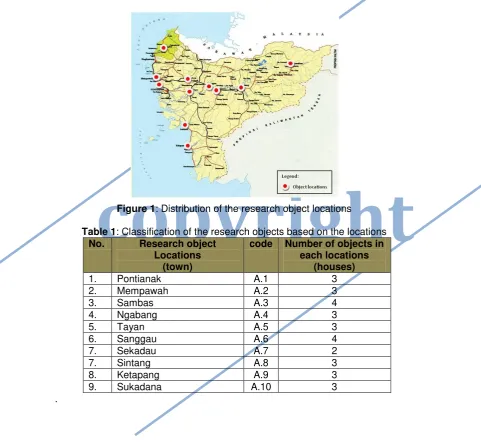
Figure 1: Distribution of the research object locations Table 1: Classification of the research objects based on the locationsNo. Research object Locations
(town)
code Number of objects in each locations
(houses)
1. Pontianak A.1 3
2. Mempawah A.2 3
3. Sambas A.3 4
4. Ngabang A.4 3
5. Tayan A.5 3
6. Sanggau A.6 4
7. Sekadau A.7 2
7. Sintang A.8 3
8. Ketapang A.9 3
9. Sukadana A.10 3
120
copyright
OUTLINES OF THE INVESTIGATIONSMalay people visualize the honour of distinguished guests who come with a differences the place to receive guests of men and women. Differenciation of the recipient place of guests in accordance with the Islamic teachings, as specified in the Qur'an that God instructed the believing women that they should hold their views, and maintain their genitals, and they do not reveal "their jewelry" except the usual look of them. Jewelry is meant here as the whole human body parts except the face, palms and feet soles, or Malay's people commonly knows it as aurat.
“And tell the believing women to lower their gaze and be modest, and to display of their adornment only that which is apparent, and to draw their veils over their bosoms, and not to reveal their adornment save to their own husbands or fathers or husbands' fathers, or their sons or their husbands' sons, or their brothers or their brothers' sons or sisters' sons, or their women, or their slaves, or male attendants who lack vigour, or children who know naught of women's nakedness. And let them not stamp their feet so as to reveal what they hide of their adornment. And turn unto Allah together, O believers, in order that ye may succeed”. (QS. 24:31)
“As for women past child-bearing, who have no hope of marriage, it is no sin for them if they discard their (outer) clothing in such a way as not to show adornment. But to refrain is better for them. Allah is Hearer, Knower”. (QS. 24:60)
Front Serambi is the place to served guests of men, while Rear Serambi is the place to served guests of women. Room for girls is located in parak (attic), with stairs as the access to parak which placed in the backward side of living room. Parak has no partitions as boundaries and usually by carpets, mats or mattresses placed on the floor as the marking place. Placement of the girls have the meaning to maintain the safety and honour and dignity of the girls as family members. Keeping the girl child's behavior in interacting with the opposite sex is the main thing in an effort to maintain their purity from un-propriety attitudes. Therefore, in the Malay culture to meet the girl was not easy because their parents always supervise the conduct of his daughters. The family honour depends on the family behavior, in accordance to this, Malay's people usually strict to give the Islamic learnings to their children both in education and the basic behaviors in society.
121
copyright
main house. The main house is marked with a higher floor elevation than the support's house. Generally, the difference between the floor elevation of the main house with support's house is ranged from 10 cm up to 30 cm. Characteristic of the main house has a front serambi (veranda) and wall enveloped each sides of the building mass with a lot of windows or door openings, while the support's house has a platform (roofed or un-roofed) with a little bit space divisions and some of the sides did not covered by walls.Elevates the main house up from the support house or the surrounding environment is the intents to purify of the islamic teachings, because the main house is a means to perform the worship of God, including the prayers conducted several times a day. By maintaining cleanliness of the main house as well as the efforts to carry out God's commands, as mentioned below: ...Allah loveth the purifiers. (QS. 9:108). In their daily conversation, Malay's people use the term "naik (up)" as a sign to permit the guests to entering the house, while to come out the house usually used the term "turun (down)" The living room is often identified as the front room for most people wither. this term is the way of Malay's people to indentified space between "inside" and "outside". Inside is the clean place, while outside is the non clean place, So, naik means as steps toward the clean place, while turun means as steps towards the non-clean place.
Generally, the front Serambi in the Malay traditional dwellings devided into two types, the front Serambi with roof to covering space and front Serambi with canopy. The front Serambi with canopy usually found at the main house of 2 grids and some 3 grids, while the front Serambi with roof covers found in the main house of 3 or 4 grids. The front Serambi made larger and constructed as part of the main house. the front Serambi with roof structured blend to the structure of other rooms. In malay cultures, the front Serambi is the place to receive the unformal guests and the relaxing area.
122
copyright
fundamental differences of these two rooms is the providing of chairs in the middle serambi while in the rear serambi, guests usually served by sitting down in the carpets or mats which is held on the floor. In some cases, the Malay traditional dwellings provide a special room for guests who stay overnight. These rooms are located on the front adjacent to the living room.Figure 2: Hierarchy and the composition of space in the Malay traditional dwellings of West Kalimantan
The space composition in Malay traditional dwellings showed the levels of functionality based on the space allotment of defined activities. These levels intended to distinguish the function of each room according to their hierarchy. In the hierarchy of main house, the more into the spaces formed, more private the defined activities (see figure 3). the
Support house
main house
Public space
123
copyright
path circulations for guests of men to entering the house with permittion only from the front serambi toward support house. this is the ciculation path which crossed from the public space to the semi private space. Placement of the bedroom in the next to or on both side of the rear serambi is an effort to "hide" the private space and also the aims to avoided of encounter with people who are not Muhrim of the daughters or wife. It also includes the placing the stairs of parak in backward of the rear serambi to anticipate if there are male guests who are not Muhrim of daughters or wife want to entering the inside house, the father will ask time for their girls to go into the bedroom or running up to the parak (see figure 2).Every room in the Malay traditional dwellings has name, specific function and meanings. the first space found in the front is selang or usually called as front selang. the front selang serves as the place to put the goods of guests, which can not brought into the room. The front selang is an open platform that also serves as the drying place of the agricultural crops, fishery or plantations. Malay’s people usually called as pelataran depan (the front platform). In the past, the platforms still be found in some areas of West Kalimantan. According to Zain (2003), an open platform is found in the Malay traditional Malay in the town of Sambas. Selang serves as the end point of the guests to use the footwear. Typically, guests who come will put their footwear on the front selang before entering the room, while for the guests with no footwear will clean their foot also on this platform.
124
copyright
Figure 3: the gerata’ (the wood footsteps) as artifact of front selang before entering the house. I also found the decayed foundation of the front selang
Figure 4: The side door of rear selang of the Malay traditional dwellings West Kalimantan. the door could be found in both sides
The front Serambi (veranda) serves as a place to receive male guests, neighbors, and the elders. Middle serambi as the guest room is the formal place to receives and serves the highly respected guests. Rear Serambi is the place to receive guests of women. Usually, if there was a women guests, either relatives or foreign guests, will be served on the rear serambi by the wife of owner, and separated with the male guests which is served the front or middle serambi by the family head. If a guest comes while the family head does not exist in inside, usually the door will not open and the guests will not be allowed to entering the house. In Islamic teachings, the wife may not accept guests who are not muhrim at the time her husband was not at home.
And if ye find no-one therein, still enter not until permission hath been given. And if it be said unto you: Go away again, then go away, for it is purer for you. Allah knoweth what ye do. (QS. 24:28)
Rear selang serves as the place to put items that are not brought into the rear serambi. Usually entering the main house from the side door of rear selang, or used the support house door. The rear selang also called as pelataran belakang (the rear platform). This place is an entrance for the female guests that are accessed from gerata' in the side of
125
copyright
the house, directly to the side door of platform or support house. These platforms found in to two forms, roofed or un roofed.The support house is consists of kitchen and platform. Kitchen is used for cooking and storing the kitchen goods. Kitchen also as the place to serving food to the family members. Because the composition of the wood floor constructed rarely, then the cooking wastes can be directly discharged into the ground. Platform was also found at the support house. Platform was found in all cases in two purposes function. The first, separated the function of the rear selang and the platform of washing food or clothing, but the second, combined both the function of the rear selang and the platform of washing food or clothing in one space. Selang in the rear side is aims to anticipating of fire danger from the kitchen.
The bedroom is mainly for parent and commonly found also for the girls. Bedrooms parents usually placed near of the main post or for the Malays they called as tiang seri. Tiang seri is the first erected column when building a new house. This column became a central pillar for the surrounding spaces. Boys (malay people usually called them as anak bujang or the adult boys but unmarried) do not have their own bedrooms. In the past anak bujang should have to sleep in the mushalla (small mosque) or in the middle serambi. In some cases, found bedroom for anak bujang in the support house. This aims to separate the adults boys from girls and also to guards the main house.
126
copyright
bedroom found in case of A.2.1., the room boundaries marked by a partition ofcabinets and curtains. According to the house’s heir, this mark's boundaries always in
this way since the first was made like that because of the influenced of the origin of his parents. His parent was from macassar and according to him, buginese usually use curtains to boundaries the bedroom.
In some cases found a special room called puadai. Puadai is the special room for bride to stand and sitting in the ceremony when they got married. In addtion, in some cases, found also a special room for newly married couples for staying in the house. The couple will leave the room after their family members have a newly married couple or this couple already have their own home. For Malay's people, married is the way to implement the Sunnah of the prophet Muhammad. for the Malay, married is one of the religious teachings of Islam and moslems encouraged to do so. being understood by moslems that the man who married is the efforts to fulfill the teachings of Islam religion. Therefore, giving special place for newly married couples as a joy for the bride happiness.
“And Allah hath given you wives of your own kind, and hath given you, from your wives, sons and grandsons, and hath made provision of good things for you. Is it then in vanity that they believe and in the grace of Allah that they disbelieve ?” (QS. 16:72)
“And of His signs is this: He created for you helpmeets from yourselves that ye might find rest in them, and He ordained between you love and mercy. Lo! herein indeed are portents for folk who reflect.” (QS. 30:21)
127
copyright
Figure 5: Beams above the floor as the boundaries of spaces foundin the Malay traditional Malay dwellings of West Kalimantan
Figure 6: Partition as the spaces boundaries found the Malay traditional dwellings of West Kalimantan
128
copyright
Figure 7: Puadai in The Malay tradisional dwellingsFigure 8: Special room for newly married couple
129
copyright
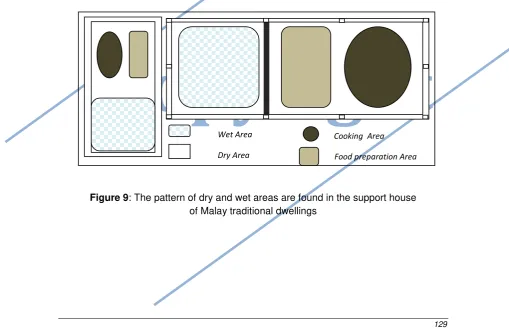
eating together; and the third is place for washing the cooking utensils, washing area of the processed food or vegetables, and also as the area of cloths washing . The two of space which mentioned firstly usually known as dry area, and the last is wet area. The fireplace and firewood interspace usually placed in one corner of the support house. Each areas usually has boundaries to marking the space. a beam on the floor used to marked spece between dry area from wet area, while Carpet or mats is laid on the floor is a marks of the seating areas to processing food and eating together. Usually, after the cooking time is finished, they provide the cooking meal on the mats and asked the family members to eat together. On case A.1.3., firmly separates the space of cooking area and the preparing area, by placed rooms into the separate roof structure.Figure 9: The pattern of dry and wet areas are found in the support house of Malay traditional dwellings
Wet Area
Dry Area
Cooking Area
130
copyright
The fireplace with the columns boundaries
The sitting area with mat boundaries
Figure 10 : The area boundaries found in the Malay traditional dwelling
CONCLUSIONS
Physical barrier that surrounds the space and also limiting human access to the spaces causes of the similarities and differences of the term of privacy found in the Malay traditional houses of West Kalimantan. The religious belief is manifested in the creation of house’s form and elements that support the space inside the dwellings.
REFERENCES
Al-Bugha, Musthafa Dieb and Muhyiddin Mistu. (2005). Al Wafi Fi syarhil Arbai’in An
Nawawiyah. Translation version by Muhil Dhofir. Al-I’tishom Cahaya Umat. Jakarta
Arnheim, Rudolf. (1977). The Dynamic of Architectural Form. University of California Press publishing. Barkeley and Los Angeles
Lefas, Favlos. (2009). Dwelling and Architecture. Jovis Verlag GmbH. Berlin
Ministry of Hajj and Endowments the Kingdom of Saudi Arabia, 1413 Hijra, The Holy
Qur’an English Translation of the Meaning and Commentary, Mushaf
Al-Madinah An-Nabawiyah revised dan edited by the Presidency of Islamic Researches, IFTA, Call and Guidances, The Custodian of the Two Holy
Mosques King Fahd Complex for the Printing of the Holy Qur’an, Al-Madinah
Al-Munawarah