in the Retail Industry
Key insights
ii
Becoming a digital retail business
2
Digital disruption is happening—ready or not
3
Where to start
4
Top ten sources of digital value in retail
Reduce costs and drive revenue 7
Increase efficiency and improve productivity 8
Build customer trust 9
Enhance customer experience and increase sales 10
Reduce costs 11
Improve efficiency and safety 12
Increase productivity and customer satisfaction 13
Where are you on your digital journey?
13
Develop your roadmap
16
Authors
Joel Barbier
Nicole France
Shaun Kirby
Brian McDonald
Kathy O’Connell
This paper details the major areas of global digital value in retail over the next
three years.
Key Insights
Digital disruption is happening in retail (something most retail executives
acknowledge), yet less than one-quarter of retailers are actively doing anything
about it.
Disruption presents both a major threat and a big opportunity.
Failing to adapt
puts you at high risk of being displaced. “Disrupting yourself” and becoming a
digital retailer opens up a world of new possibilities.
The opportunity is huge.
Retail Digital Value at Stake is $506 billion globally over
the next three years.
Last year, the retail industry as a whole
realized only 15
percent of its potential Digital Value at Stake.
To capture more of this value,
you need to build a digital roadmap
that combines
use cases that support your primary business objectives and deliver the biggest
near- and medium-term returns.
Digital capabilities generate value through six drivers: employee productivity,
innovation, customer experience, asset utilization, supply chain & logistics, and
sustainability.
Ten use cases account for over 90 percent of retail Digital Value at Stake.
These use cases span the scope of retail operations and provide the foundation
for digital retail business capabilities.
When building your roadmap, first evaluate whether your main priority is to
enable
IT agility and operational effectiveness,
differentiate
your business strategy, or
define
digitally enabled business processes.
Select use cases that deliver the highest short- and medium-term value, and
support your business objectives.
To create sustained competitive advantage, use digital capabilities to define new
ways of working and
new business models
. Innovation is not limited to
digital-native competitors.
Introduction
If, as a retailer today, you aren’t racing to develop digital business
capabilities as quickly as you can, you’re facing an imminent
competitive threat and missing a major financial opportunity. The retail
industry has the potential to generate $506 billion in digital business
value through 2018. Retailers realized only 15 percent of this Digital
Value at Stake in 2015.
The threat is very real: comparatively low IT intensity—investment in IT as a percentage of revenues—and a general complacency with the status quo put retail at a high risk of disruption by technology-savvy incumbents and digital-native upstarts. If you think e-commerce was disruptive, just wait for what’s coming.
Now is the time to embrace digital transformation fully—and pull ahead of the competition in doing so. Developing the digital capabilities that are
essential to success in the retail industry takes time, regardless of where you are today. A well-considered investment plan will help you generate savings, grow revenue, and stay the course on your digital transformation journey. While most of the market waits for someone else to make the first move, you gain a lead—and a sustainable competitive advantage. Failing to act now poses a serious threat to your success, and even your survival.
“ Digital was considered what was going to kill us.
Now it's our friend.”
Becoming a Digital Retailer
Retailers have always sought to understand their customers well enough to anticipate their needs and serve them more effectively than the competition. Today, in an environment where consumers are just as likely to shop online or through a mobile app as they are in a store, you need new sources of information, context, and analytics about those customers. You must also be able to act quickly on the new insights you generate.
Digital business in retail isn’t just about online shopping. Success now requires a consistent, appealing customer experience that delivers the value they expect, wherever they are at a given point in time, through whatever channels they choose. Offering consumers upside value— whether through greater efficiency, savings, or engagement—at any point in the shopping journey is what we term hyper-relevance.
Hyper-relevance is a new paradigm that enables consumers to receive what they want, when and how they want it. Hyper-relevance is made possible by new digitally enabled solutions and innovative business models that deliver value—efficiency, savings, or engagement—in real time throughout the shopping lifecycle. It requires an analytics-driven approach that applies intelligence to the context of the consumer (where he or she is, what he or she is looking to accomplish), thereby allowing retailers to dynamically provide the most suitable experience.
If hyper-relevance is the goal, digital business transformation is the means to achieve it.
Three Interconnected Capabilities of a Digital Retailer
Hyperawareness: the ability to monitor and detect changes in the company’s business environment.
In retail, this means generating and analyzing data from a number of sources: warehouses, online, in-store, mobile, and competitors. Generating insight from customers in stores is a particular challenge for most retailers. A combination of cameras and sensors with mobile device tracking enables that ability. Integration with mobile apps initiates further insights into shopper behavior patterns, for both in-store and online.
Informed decision-making: the ability to make the best decision possible in a given situation and context. To do this, data collected as part of a company’s hyperawareness processes must be analyzed, packaged, and distributed with scale throughout the organization. Informed decision-making relies heavily on mature data analytics capabilities to augment human judgment.
For retailers, informed decision-making spans a huge range of activities—everything from optimizing out-of-stock management to planning connected advertising campaigns. Having the appropriate insight to make good decisions feeds into all aspects of management, whether on the shop floor or in headquarters.
Fast execution: the ability to carry out plans quickly and effectively. Fast execution depends enormously on change management to ensure quality and alignment to corporate strategy. It can also include automation of workflows—or the ability to extend real-time offers based on shoppers’ location and context.
One simple example of fast execution is using data on footfall coming into the store to predict the impact on checkout times. This allows the retailer to open more checkout lanes before lines start to grow long. This one area alone can have a substantial impact on customer satisfaction, workforce effectiveness, and sales. The potential business impact from applying fast execution to strategic areas like distribution, promotion, or rollout is even greater.
Digital Disruption Is Happening—Ready or Not
Three characteristics—hyperawareness, informed decision-making, and fast execution—encompass a wide range of digital business capabilities that for most established retailers amount to a fundamental transformation in the way they do business. This isn’t simply a question of making new technology investments. It means redesigning whole business processes.
While most retailers have made at least some major investments in digitizing their businesses, the retail industry remains one of the most at-risk for digital disruption.1 Exacerbated by the sector’s relatively low “IT intensity”—that is, the rate of IT investment as a percentage of revenue2—the market is wide open to disruption by both new and incumbent competitors that embrace technology to generate insights and drive operations.
Retailers seem aware of the risk but hindered by inaction. The Global Center for Digital Business Transformation (DBT Center), an International Institute of Management Development (IMD) and Cisco initiative, investigated the state of digital disruption in a study entitled
Digital Vortex: How Digital Disruption Is Redefining Industries. We found that although 56 percent of retail executives say digital disruption is a board-level or CXO concern, fewer than one-quarter are doing anything about it by actively disrupting their own businesses.3 Instead, 30 percent of retail companies are taking a “follower” approach,
Digital Vortex: Retail Industry at Risk for Disruption
#1 Technology #4 Financial Services #6 Education #9 Healthcare #11
Oil & Gas
#10 Utilities #2 Media & Entertainment #7 Hospitality & Travel #8 CPG / Manufacturing #5 Telecommunications #12 Pharmaceuticals #3 Retail The impact of digital disruption can best be
understood through the construct of a vortex. A vortex exerts a rotational force that draws everything that surrounds it into its center. The Digital Vortex is the inevitable movement of industries toward a “digital center” in which business models, offerings, and value chains are digitized to the maximum extent possible. As industries move toward the center of the Digital Vortex, physical components that inhibit competitive advantage (such as manual, paper-based processes) are shed. Whatever can be digitized is digitized. The components of digital value can then be readily combined as disruptive business models. These models knit together different types of capabilities and deliver customer value in new ways. The most successful disruptors employ “combinatorial disruption,” in which multiple sources of value— cost, experience, and platform—are fused to create disruptive new business models and exponential gains.
waiting for a competitor to make the first move. Significantly, the remaining 46 percent of retail executives surveyed say that leadership is aware of digital disruption, but is either doing nothing or responding inappropriately.
For many retailers, the problem is mapping the route to become a digital business and knowing where to start. It’s not a question of choosing whether to invest in digitally enabling internal processes or in applying technology to improve the customer experience. Both areas of investment are critical for success, and the investments you make in one will help the other.
Where to Start
In order to build a roadmap for digital transformation, it’s important to have a clear sense of the potential value of specific investments that create digital business capabilities. To this end, Cisco conducted a new economic analysis to calculate the Digital Value at Stake for private sector organizations across 16 industries, including retail. The analysis is rooted in customer engagements and evaluation of 350 private sector digital use cases, including 24 in retail.
Digital Value at Stake is based on two components: 1) entirely new sources of value emanating from digital investments and innovations, and 2) value shifting among companies and industries based on their ability (or inability) to harness digital capabilities (in essence, value moving from “losers” to “winners”).
Cisco’s analysis shows that a $20 billion retailer4 that fully embraces digital business transformation has the potential to save $33 million in IT costs annually and generate $823 million in annual earnings before interest and taxes (EBIT). These gains come from a combination of increased business efficiency and higher revenue due to improved customer engagement.
For the retail industry as a whole, this translates into Digital Value at Stake of $506 billion worldwide through 2018.5 Although the highest concentrations of Digital Value at Stake are in North America (36 percent) and Western Europe (29 percent), Asia Pacific is quickly gaining ground (23 percent).
However, the retail industry is currently leaving 85 percent of this value on the table. In other words, our analysis estimates that retailers realized just 15 percent of their potential Digital Value at Stake in 2015, a significantly lower percentage than other industries that are also highly susceptible to digital disruption, such as telecommunications (21 percent), financial services (29 percent), and media and entertainment (18 percent).6
Our analysis highlights immediate areas of investment that feed the bottom line. Cisco’s estimates of how much impact these use cases have on EBIT are, if anything, conservative. Industry analyst research suggests the potential profit at stake is even larger.7
24 Retail Use Cases
Digital Value at Stake Defined
The following uses cases were assessed to project the Digital Value at Stake for the retail industry:
Assortment optimization Augmented reality Checkout optimizer Connected ads, marketing Connected cars
Connected fleets Connected supply chain Cybersecurity
Endless aisles Fast IT / technology In-store analytics Interactive kiosks
Loss prevention, physical security Next-generation workers Out-of-stock optimizer Payments Remote expert Self-checkout lanes Self-serve channels Smart buildings Smart fitting rooms Smart grid
Smart lockers Travel substitution Digital Value at Stake is based on:
1) entirely new sources of value emanating from digital investments and innovations
Six primary digital value drivers for retail along with their corresponding digital use cases and business outcomes are listed in Figure 1.
Digital connections are becoming increasingly people-centric. In fact, according to our analysis, employee productivity (largely fueled by digital capabilities that enhance collaboration) is the top driver of digital value. Digital technologies are not only creating wholly new capabilities—automation, for example, enabled by embedded analytics—but changing the role of the workforce and redefining operating models.
Asset Utilization
In-store analytics Checkout optimizer Remote expert, mobile advisor Smart lockers Interactive kiosks Next-generation workers
Increase employee eiciency Better manage opening and closing registers Increase utilization of experts Improve worker collaboration
Sustainability $187B $91B $131B $54B $38B Employee Productivity Customer Experience Improve inventory management Determine best product
mix per store Increase revenues
Connected supply chain Assortment optimization Out-of-stock reduction
Supply Chain & Logistics
Increase customer engagement Increase upsell opportunites Reduce friction between online
and offline experiences
Payments Remote expert Self-serve channels Endless aisles Smart lockers Checkout optimizer
Innovation Harness insights from video and store analytics Enable in-store personalized advertising In-store analytics Interactive kiosks Assortment optimization Out-of-stock reduction In-store navigation Connected ads, marketing
Improve security, reduce theft
Reduce operations and maintenance costs
Cybersecurity Loss prevention/ physical security
Sustainability Reduce costs
Increase staing eiciency
Smart grid
Next-generation workers
$5B
Retail
$506B Digital Value at Stake
Top Ten Sources of Digital Value in Retail
Digital capabilities can enable retailers to address a number of challenges, including improving in-store customer engagement and workforce efficiency, increasing physical security and cybersecurity, reducing shrinkage, and streamlining inventory management and checkout processes.
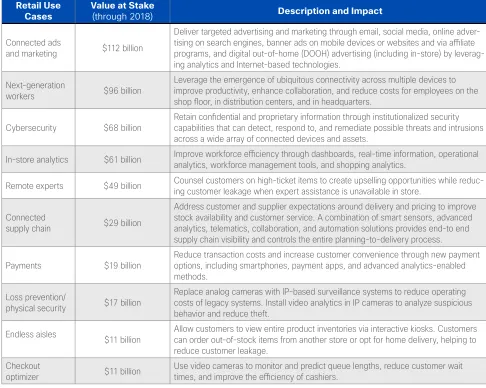
The top 10 use cases, listed in Table 1, have the potential to generate the greatest Digital Value at Stake for retail worldwide through 2018. While these use cases have been ranked from highest to lowest in Digital Value at Stake, this doesn’t necessarily reflect the order in which they should be prioritized or implemented. Cybersecurity is an important case in point: it ranks third in terms of Digital Value at Stake, but is fundamental to all aspects of digital business.
Although each use case has been assessed and quantified individually, in practice, the greatest benefits come from combining use cases—that is, merging several use cases within one business case—and building on them sequentially.
Retail Use Cases
Value at Stake
(through 2018) Description and Impact
Connected ads
and marketing $112 billion
Deliver targeted advertising and marketing through email, social media, online adver-tising on search engines, banner ads on mobile devices or websites and via affiliate programs, and digital out-of-home (DOOH) advertising (including in-store) by leverag-ing analytics and Internet-based technologies.
Next-generation
workers $96 billion
Leverage the emergence of ubiquitous connectivity across multiple devices to improve productivity, enhance collaboration, and reduce costs for employees on the shop loor, in distribution centers, and in headquarters.
Cybersecurity $68 billion
Retain conidential and proprietary information through institutionalized security capabilities that can detect, respond to, and remediate possible threats and intrusions across a wide array of connected devices and assets.
In-store analytics $61 billion Improve workforce efficiency through dashboards, real-time information, operational analytics, workforce management tools, and shopping analytics.
Remote experts $49 billion Counsel customers on high-ticket items to create upselling opportunities while reduc-ing customer leakage when expert assistance is unavailable in store.
Connected
supply chain $29 billion
Address customer and supplier expectations around delivery and pricing to improve stock availability and customer service. A combination of smart sensors, advanced analytics, telematics, collaboration, and automation solutions provides end-to end supply chain visibility and controls the entire planning-to-delivery process.
Payments $19 billion
Reduce transaction costs and increase customer convenience through new payment options, including smartphones, payment apps, and advanced analytics-enabled methods.
Loss prevention/
physical security $17 billion
Replace analog cameras with IP-based surveillance systems to reduce operating costs of legacy systems. Install video analytics in IP cameras to analyze suspicious behavior and reduce theft.
Endless aisles
$11 billion
Allow customers to view entire product inventories via interactive kiosks. Customers can order out-of-stock items from another store or opt for home delivery, helping to reduce customer leakage.
Checkout
optimizer $11 billion
[image:9.612.60.546.347.735.2]Use video cameras to monitor and predict queue lengths, reduce customer wait times, and improve the efficiency of cashiers.
Table 1
This is especially true where multiple use cases leverage similar technology investments and support the same business objectives. Several of our examples encompass multiple use cases to illustrate this point.
Reduce Cost and Drive Revenue:
Payments and Connected Advertising
Alternative payment methods and connected advertising/marketing are major sources of Digital Value at Stake in retail. New payment options, including smartphones, payment apps, and advanced, analytics-enabled methods, offer retailers a means to reduce transaction costs and increase customer convenience.
Connected advertising and marketing have the potential to drive revenue growth through highly effective, targeted communications to consumers. Advanced analytics make this possible across a wide array of channels: online, via mobile devices, and in stores. Yet, to succeed, connected ads and marketing must leverage other digital business capabilities (such as payments) that promote customer engagement and generate critical insights.
Starbucks was an early pioneer in developing its own mobile payment app, building on a trend the company had noticed in the way its gift cards were used: many of the same customers who were giving the cards as gifts were also buying them for their own use.8 By putting the Starbucks payment card on a smartphone, the company linked the payment app to its customer loyalty program—customers get stars or points toward free coffees for using the app. Starbucks also avoided a significant proportion of merchant fees they would have paid on credit or debit card transactions.
The ease, simplicity, and appeal of Starbucks’ mobile payment/loyalty app had already earned it an enviable following, making it the most frequently used mobile payment app in the United States by 2015. When the company decided to address a new customer concern, “line anxiety,” it looked to mobile devices. Starbucks created its Mobile Order & Pay (MOP) app, taking mobile payments a step further by allowing customers to preorder and pay for their beverages, skipping the line to pick up their orders in the store of their choice. Starbucks rolled out the app throughout the United States within 10 months of the pilot, then internationally one month later.
The ease, simplicity, and appeal of Starbucks’ mobile
payment/loyalty app helped make it the most frequently
used mobile payment app in the United States.
MOP built on the prior success of Starbucks’ mobile payment app: the company has reported that the mobile app accounts for more than 21 percent of total purchases, with nearly two-thirds of those payments coming through MOP.9 In addition, the app opened up new opportunities for connected ads. Because MOP is tied to the inventory management systems in individual stores, it offers a channel for
promoting upsell opportunities and impulse purchases (would you like a muffin with your latte?). This, in addition to eliminating card transaction fees, has increased the transaction value of purchases made through the app.
The opportunity for connected advertising isn’t limited to offers within the MOP app, but continues in the store. Dynamic digital signage in stores can be tied to in-store inventory, time of day, and even purchasing behaviors of customers using the MOP app in a particular store.
Increase Efficiency and Improve Productivity:
Next-Generation Workers
One of the biggest areas of digital value is using technology to change the way the workforce collaborates, meets, and shares information. Tools such as mobile collaboration and video conferencing, combined with policy changes such as bring your own device (BYOD) and telecommuting, reduce costs and increase employee productivity. While such tools and policies are well suited to headquarters
operations, they can also be successfully applied to store operations as well.
An example is the way U.K. retailer John Lewis10 used digital technology to manage training and information sharing across the staff of its geographically dispersed John Lewis At Home shops. As a new format within John Lewis, the At Home shops had newly formed teams in entirely new stores. They needed training, the ability to share lessons and best practices among stores, and an efficient means of communicating with headquarters—without taking time away from serving customers.
By implementing high-definition video conferencing and a video portal at each store, the company was able to deliver on-demand staff training, information sharing and collaboration among stores, and rapid communication between stores and the head office. The result was a high degree of engagement and satisfaction among staff—92 percent said video conferencing made their jobs easier, 89 percent that it saved them time—all while reducing travel time and associated
Staff at John Lewis reported a high degree of
expenses by 50 percent. The results in the At Home business were so successful that John Lewis subsequently rolled out the same capabilities across the whole company.
Gaining significant efficiencies through next-generation worker
technologies isn’t limited to back-office operations—it can also improve productivity on the shop floor. Another retailer explored the potential of using sales associates’ own smartphones (BYOD) to install collaboration apps. These apps served a dual purpose:
One objective was to save time on frequent, mundane tasks. Apps allowed associates to validate their identities when signing on for a shift and to check stock or perform a price check directly from their device.
The other goal was to give store management a much clearer view into the actual activities and outcomes on the shop floor. By tracking and analyzing associates’ pattern of movements, management had a much clearer idea of what was really happening in the store, which associates were most productive, and which best practices to encourage all associates to adopt.
Build Customer Trust: Cybersecurity
Retail is particularly vulnerable to cyber attacks given all the customer credit card accounts involved. Generating valuable insights into buyer behavior only increases the appeal of retail targets. Customers (and shareholders) expect the stores they buy from to protect their sensitive information. At the same time, the nature of today’s cybersecurity threats demands a new approach to cybersecurity.
Traditional defenses that rely exclusively on detection and blocking for protection are no longer adequate. Perimeter-based defenses and preventive techniques will only leave attackers free to act as they please once inside the network. Today we’re faced with advanced malware, targeted attacks, and advanced persistent threats (APTs). It’s time for a new security model that addresses the full attack continuum—before, during, and after an attack.
As cyber criminals have realized there is significant money to be made, their work has become more standardized, mechanized, and process-driven. Attackers understand the static nature of classic security technologies and their disparate deployments, so they can exploit the gaps between—and vulnerabilities within—them.
As a retailer, the question is when you will next be attacked—not if—and how you respond. Developing a threat-centric approach to security, rather than one of trying to secure all the endpoints, offers a compelling prescription for managing this reality.
Enhance Customer Experience and Increase Sales: In-Store
Analytics, Connected Ads, Endless Aisles, Remote Expert
Data gathering and analytics across all channels are vital to success in retail, but generating useful data and insights in physical stores is a particular challenge for established retailers. Where online channels provide abundant information on dwell times, browsing patterns, and conversion, stores frequently do not. By implementing a combination of smart store technologies such as IP cameras, sensors, Wi-Fi tags, and mobile technologies, stores become equally valuable sources of insight into buyer behavior and the interaction between customers and staff. The objective is to understand your business better through rich insights generated by better data coming from across your business. With this understanding, you can make better, faster decisions—both locally in stores and in headquarters.
One large office supply company was eager to put these principles to the test by implementing in-store analytics. The company deployed sensors and cameras throughout the store to examine interactions between associates and customers, category-level conversion, dwell times, customer traffic heat maps, and paths to purchase. This information, combined with existing transactional and other data, is allowing management to answer questions that go far beyond store operations alone—things like conversion by product category. These insights can be applied to shaping the customer journey, not just in stores but online as well.
In another example, the desire for similar insights—and the ability to build a consistent, interactive customer experience both in stores and online—drove F&F, the clothing brand of U.K. grocery retailer Tesco,11 to implement smart store technologies as well. The brand was faced with multiple challenges: limited floor space, little visibility into what customers did in stores, and poor customer awareness of F&F online.
Using a combination of in-store Wi-Fi and integrated mobile and tablet access for shop associates, F&F management could track customer journeys and gain insight into customer behavior. Free Wi-Fi gave F&F the ability to track customer journeys in greater detail. It also provided a means to deliver curated content and context-specific
Free Wi-Fi gave F&F the ability to track customer
journeys in detail and provided a means to deliver
curated content and context-specific offers.
offers directly to customers’ mobile phones, incorporating connected advertising.
Over three months, the number of customers logging onto Wi-Fi increased 50 percent. Customers spent roughly 30 to 50 percent of their physical dwell time online on personal devices, while also engaging with push offers. This engagement changed customer behavior, increasing dwell times and sales.
As much as F&F wanted to know more about what was happening in stores, the brand was eager to build its online customer base to augment its relatively small physical floor space. Key technologies in the store made this possible. Interactive kiosks in stores allowed customers to order items online and have them delivered to the store or their home. This reduced the number of customers leaving empty-handed because their size or preferred style wasn’t in stock at the store. It also offered a strong introduction to F&F online—and to styles customers might not otherwise have seen. The brand has experienced a steady increase in online sales as a result. The “endless aisles,” made possible through the in-store kiosk, have increased both in-store sales and online sales simultaneously.
F&F has also piloted “remote expert,” a means of providing virtual access to a style advisor who isn’t physically present in the store. Although associates on the floor are armed with tablets to help advise customers, remote experts offer personal styling advice. Using the same kinds of technology tools as next-generation workers, remote experts employ video conferencing to increase customer engagement—supporting sales, especially on higher-ticket items—and to promote F&F as a fashion brand.
Reduce Costs: Loss Prevention and Physical Security
Physical security in retail floor space isn’t just a matter of keeping staff and shoppers safe. It’s a crucial element of compliance with payment card industry (PCI) regulations and the main tool to prevent shoplifting and other loss of stock.
For SpartanNash, a food distribution and supermarket company, moving to an IP-based video surveillance system offered the best means to comply with PCI security regulations and reduce overhead costs in stores. This approach provides the video quality and storage capacity SpartanNash required at lower cost than the prior closed-circuit television (CCTV) system. It also dramatically simplifies
surveillance management. Access rights for different staff and requirements are managed centrally, rather than store-by-store.
The IP system eliminates the need for security staff to check
whether the system is functioning, allowing them to spend more time proactively monitoring what’s happening in stores. They can identify suspicious activity and deter it before losses occur. Video monitoring also gives SpartanNash the ability to monitor shelves for low or missing stock, triggering a refresh.
A large eyewear retailer applied a similar approach to its stores. The company generated $1.3 million in annual operating expenditure savings with a net neutral capital cost per store. Improved surveillance and security is delivering a 10-20 percent reduction in loss as well.
Shopping center operators like Trinity Leeds and Intu are combining similar IP-based security systems with Wi-Fi access to develop a better understanding of buyer behavior. Combining data from traffic patterns monitored by security systems with behavioral data from customers’ mobile devices is generating rich insights into customers’ needs and preferences when they come to shop.
Improve Efficiency and Safety: Connected Supply Chain
Supply chains offer significant potential to generate greater value in retail, whether through leveraging scale in negotiating with suppliers, improving efficiency and productivity in warehouses, reducing the need for stock checks, automating resupply, or improving collaboration and communication with suppliers.
For one large retailer, the priority was to improve efficiency and safety as it overhauled warehouse operations. Previously, the layout of the warehouse, timing of key deliveries, and poor communication among staff in the warehouse created major bottlenecks—and a high risk of workplace accidents. Using Wi-Fi data to track handheld scanners and forklift trucks in the warehouse, management could see where and when the bottlenecks and safety hazards occurred.
The company adapted by giving warehouse staff specific information on the route they should use for picking (that is, selecting the
items needed to fulfill a particular order) in order to optimize traffic through the warehouse. This approach also minimized the amount of time workers spent making decisions on where to go, and in what sequence, to fulfill a given order. The result has been both a substantial
increase in the number of orders filled per shift and a reduction in the risk of collisions on the warehouse floor.
For Italian pasta producer Barilla,12 the main issue was improving visibility across the entire production chain, from field to finished product. To respond to customers’ desire to know where their food comes from—and to offer an added layer of food safety—Barilla piloted track-and-trace technology on a limited edition of its pastas and sauces. By scanning a QR code on the package, consumers can see where the ingredients for that particular batch were grown and a detailed view of their journey through the production process. In addition to providing significant marketing value, this ability to trace foods through the whole chain of production is becoming a key capability as international standards on food safety, quality, and origin increase.
Increase Productivity and Customer Satisfaction:
Checkout Optimization
The advantages of using digital technologies to predict queue length and avoid unexpected spikes in checkout times became very clear at a large global retailer. Using IP cameras to monitor footfall coming into the store from the parking lot, the system alerted store managers when traffic exceeded a defined threshold. With enough advance notice to act, managers could reassign staff from other activities to checkout registers before queue times began to increase.
This approach marked a major change from the traditional response to avoiding long checkout queues: adding more staff to the shift. In a head-to-head comparison, the traditional approach was a failure. Adding staff increased costs, but had little or no impact on reducing unexpected spikes in checkout times.
The results of the optimized checkout were significant: up to a 50 percent reduction in wait times with two to three fewer staff members (FTEs) required at the register, freeing them up to work in other areas. These results indicate that across the retailer’s 1500 stores, there was $100 million in potential savings.
Where Are You on Your Digital Journey?
The key to developing a digitization roadmap is to understand where you are today, decide where you want to be, and develop an investment plan that allows you to build the digital business foundation that will get you there. Figure 2 (next page) illustrates where Cisco sees the use cases described here contributing to that journey.
Our observation from working with our customers is that every retailer is starting from a different point. What may seem advanced to one is basic to another, and vice-versa. Even so, almost every established retailer still has significant areas that require digitization.
develop digital retail capabilities, but you can proceed with incremental building-block steps once the right foundation is in place.
Create a Self-funding Model: Enable Your Digital Strategy
Building a solid foundation of digital capabilities allows you to leverage cumulative investments to significantly enhance operations. In this “enable” phase, you’re seeking IT agility and operational effectiveness, the ability to move faster, and ways to reduce your cost structure. This is where most established retailers are today.
The important areas to address here are those that provide the basic infrastructure for hyper-awareness—those capabilities that generate data on what’s happening throughout the organization, whether that’s in the warehouse or in stores. With a better understanding of what’s happening also comes the ability to operate more efficiently: streamlining supply chain, optimizing checkout, improving physical security and cybersecurity, understanding patterns of movement among customers and staff, and giving associates the insights they need to act quickly and eliminate unnecessary activity.
The gains that these investments generate—in terms of both cost savings and revenue growth—provide the means to fund ongoing investment in digital capabilities. By implementing the core digital capabilities to enable your business, you’re also providing the foundation on which to make incremental investments to drive even greater benefits. Asset Utilization Employee Productivity Supply Chain & Logistics Innovation Sustainability Customer Experience Enable
IT agility and operational effectiveness
Diferentiate
with products, services, and business processes
Define
new business models
Next-generation workers*
*Use cases detailed in this paper
Next-generation workers*
Smart
grid buildingsSmart substitutionTravel Connected cars
&RQQHFWHG̃HHWV Connected advertising*
(including digital signs and targeted ads) Smart lockers
Checkout optimizer* Remote expert* Augmented
reality
Licensing mobile order and pay
Selling buyer insight Endless aisles*
Self checkout Payments*
In-store analytics* Click-and-collect
Cybersecurity* Fast IT/technology Out-of-stock reduction Assortment optimization Loss prevention/ physical security*
Connected supply chain* Self-serve
[image:17.612.64.552.94.389.2]Smart ́WWLQJURRPV
Figure 2
Invest to Innovate: Differentiate Your Strategy
With the appropriate foundation in place, you can embrace the insights generated across your business to differentiate your business strategy through hyper-relevance. This is where some retail leaders are today. Here, the emphasis is on engaging customers to deliver context-specific value. The ability to do this effectively depends on the understanding you have of customers’ needs and priorities across channels.
It requires digital capabilities that allow you to engage customers across channels as well, switching smoothly among them as the context dictates. This includes dynamic, cloud-delivered digital
signage and other targeted advertising that may be location-specific. It also means enhancing the experience of customers in stores, whether through mobile payments, remote experts, endless aisles, or smart lockers.
To deliver a differentiated, hyper-relevant customer experience, understand that we are now in an age of “post-demographic consumerism.”13 Traditional assumptions of buying behavior based on demographic groups no longer apply. For example, our research has shown that the belief that Gen Y consumers are monolithic in their preference for digital is, in fact, incorrect.14 Successful retailers will concentrate on digital behavior, not age- or income-related demographics.
Build Sustainable Competitive Advantage:
Define New Strategies
With a broad set of digital retail business capabilities in place, you have the ability to define new ways of doing business—and potentially new business models—that keep you ahead of the competition.
Digital retail capabilities create the opportunity to generate new sources of customer value: cost value, experience value, and platform value. Cost value delivers lower prices to customers, whether through price transparency, consumption-based pricing, rebates and rewards, or other methods. Experience value derives customer benefits from greater choice, personalization, automation, and the opportunity to make purchases through any device at any time. Platform value leverages the network effect to create marketplaces, peer-to-peer exchanges, and data monetization. These new, disruptive business models and others are discussed in detail in New Paths to Customer
Digital retail capabilities create the opportunity to
Value: Disruptive Business Models in the Digital Vortex, published by the DBT Center.
For retailers, competing on cost and customer experience is nothing new. Digital disruptors, however, are changing the nature of this competition by combining multiple types of value, leveraging the significant efficiencies and insights of digital operations, and moving with breathtaking speed. Importantly, the potential to disrupt is not limited to digital-native competitors. Starbucks has reported being in discussions to license its mobile app—a whole new revenue stream for the coffee chain.15
Many established retailers are already experimenting with disruptive new business models. Some concentrate on right-here, right-now fulfillment options like click-and-collect (now a standard option for Tesco customers) and smart lockers that give customers the option to collect their purchases without having to wait. Drones could extend this delivery reach even further, faster. Others are focusing on platform value designed to provide a better customer experience. By collecting and analyzing buyer behavior online and in-store, these retailers are selling the insights they generate on customer segments.
These are just some examples. The opportunities are limited only by your imagination—and the digital capabilities you have in place.
Develop Your Roadmap
Becoming a digital retail business is an imperative to thrive in the retail industry. Although the journey is a long one, now is the time to make your move.
First, evaluate where you are on the journey—enable, differentiate, or define. Evaluate the capabilities you have today. There’s a good chance that you already have key elements of the digital foundation you need in place.
Second, build an investment plan to meet your business objectives. Prioritize the biggest areas of payback and plan short-term gains that can fund ongoing investment.
Finally, use this investment plan to close the gap between the digital capabilities you need and the outcomes you want. While the fundamentals will remain the same, your objectives and priorities may change over time.
Cisco has more than 200 offices worldwide. Addresses, phone numbers, and fax numbers are listed on the Cisco Website at www.cisco.com/go/offices.
Cisco and the Cisco Logo are trademarks of Cisco Systems, Inc. and/or its affiliates in the U.S. and other countries. A listing of Cisco’s trademarks can be found at www.cisco.com/go/ trademarks. Third party trademarks mentioned are the property of their respective owners. The use of the word partner does not imply a partnership relationship between Cisco and any other company. (1005R)
Americas Headquarters
Cisco Systems, Inc. San Jose, CA
Asia Paciic Headquarters
Cisco Systems (USA) Pte. Ltd. Singapore
Europe Headquarters
Cisco Systems International BV Amsterdam, The Netherlands
Acknowledgments
The authors gratefully acknowledge the important contributions of the following people to the development of this paper: Kevin Bandy, Ruba Borno, Lauren Buckalew, Joel Conover, Kevin Delaney, Beth Ellis, Scott Fields, Helen Fridell, Cheri Goodman, Pankaj Gupta, Kathryn Howe, Ed Jiminez, Lisa Lahde, Jeff Loucks, James Macaulay, Robert Moriarty, Chet Namboodri, Andy Noronha, Christopher Reberger, Virgil Vidal, Michael Wade, and Edward Westenberg.
1. “Digital Vortex: How Digital Disruption Is Redefining Industries,” Global Center for Digital Business Transformation, June 2015
2. Cisco, 2015
3. Global Center for Digital Business Transformation, 2015. Based on a survey of 117 retail executives in 13 countries.
4. Assumes a retailer with $20 billion in annual revenue, 120,000 employees, 900 stores, 113 million square feet of retail space, and 7 percent EBIT margin.
5. Over 10 years (2015-2024), Cisco estimates that the global retail industry will generate $2.8 trillion in Digital Value at Stake
6. “Digital Vortex: How Digital Disruption Is Redefining Industries,” Global Center for Digital Business Transformation, June 2015
7. In “We Lost Australia! Retail’s $1.1 Trillion Inventory Distortion Problem,” IHL analysts estimate that inventory distortions alone account for $1.1 trillion of lost revenue in retail globally. 8. “Why Is The Starbucks Mobile Payments App So Successful?” Forbes, June 2014
9. “Starbucks Mobile Order Pops As Android To Join Apple” Investor Business Daily, September 2015 10. “John Lewis Changes the Face of Shop Operations by Using Video,” Cisco, July 2012 11. “Digital Transformation with the Internet of Everything,” Cisco, 2015
12. “From the Ground to the Grocer, Barilla Makes Use of Cisco’s Internet of Everything to Give Consumers Insight into the Journey of Their Food;” “IoT for Food Manufacturing: Beyond Food Safety to Savvy Marketing,” Cisco, September-October 2015
13. “Post-Demographic Consumerism,” trendwatching.com, November 2014
14. “The Hyper-Relevant Retailer: Around the World, Insight is Currency, Context is King,” Cisco, August 2015