Gadjah Mada International Journal of Business
Vol. 16, No. 2 (May-August 2014): 143-166
Dynamic Marketing and Service Innovation
for Service Excellence
Evo S. Hariandja,* Togar M. Simatupang, Reza A. Nasution,
and
Dwi Larso
School of Business and Management, Bandung Institute of Techmology (ITB), Indonesia
Abstract: This study aims at creating a framework describing how the interaction capabilities between dynamic marketing and service innovation can influence service excellence. In this study market sensing, market learning, market targeting or positioning are classified as dynamic marketing capabilities (DMC), while sensing, seizing, and transformi ng are classified as service innovation capabilities (SIC). Hence, the drivers of service excellence for the framework being developed are divided into three main categories: dynamic marketing capability, service innovation capability, and their interaction. The findings of the study on three hotels, ranging from 4-star to 5-star hotels and operating in Indonesia, suggest that both capabilities and their interaction play their roles in achieving service excellence.
Abstrak: Riset ini bertujuan untuk menciptakan kerangka yang menggambarkan bagaimana kapabilitas interaksi antara pemasaran dinamik dan inovasi jasa dapat mempengaruhi keunggulan layanan. Dalam riset ini, penginderaan pasar, pembelajaran pasar, target pasar serta positioning diklasifikasikan sebagai kapabilitas pemasaran dinamik (DMC), sementara penginderaan (sensing), merebut (seizing), dan transform-ing diklasifikasikan sebagai kapabilitas inovasi jasa (SIC). Oleh karena itu, penggerak keunggulan layanan untuk kerangka yang dikembangkan dibagi menjadi tiga kategori utama: kapabilitas pemasaran dinamik, kapabilitas inovasi jasa, dan interaksi diantara kedua kapabilitas. Temuan studi pada tiga hotel yang dijadikan sebagai studi kasus di hotel bintang 4 (empat) dan 5 (lima) yang beroperasi di Indonesia, menunjukkan bahwa kedua kapabilitas dan interaksinya memainkan peran mereka dalam mencapai keunggulan layanan.
Hariandja et al.
144
Introduction
Research into the capability interaction between marketing and innovation has mostly been disregarded (Moorman and Slotegraaf 1999). Innovation capability has become a critical component of a firm’s mar-keting capability if it intends to maintain its long-term performance (Atuahene-Gima 1996). A study conducted by Ngo and O’Cass (2012) and Tushman (1997) concluded that long-term success is not assured by innova-tion only. A firm will likely leverage its inno-vation capabilities if it possesses better ket-related capabilities in servicing its mar-ket, new market entry, and customers with greater value. Under the concept of comple-mentary capability, combining the capabili-ties results in enhancing a firm’s performance. (Song et al. 2005). Recent studies have shown that a capability interaction between market-ing and innovation affects performance-based customers (O’Cass and Ngo 2011; Ngo and O’Cass 2012). In this context, marketing and innovation are perceived as complementary to improve a synergistic market performance. The study of the capability interaction between innovation and marketing has still not been explored very much, especially in the hospitality industry. A study conducted on manufacturing firms by Sok and O’Cass (2010, 2011) has shown that complementary capability between innovation and market-ing is positively related with performance. Interfunctional coordination and interaction between marketing and innovation can exist in the sharing of market information that is crucial for substantially new service devel-opment in the service context (Henard and Szymanski 2001; Im and Workman 2004). However, that study has not yet explored the interaction capability on service excellence in the hotel industry. Since service excellence
plays an important role in the hotel industry, it must adapt continuously to a dynamic mar-ket. This study thus aims to explore the above mentioned research gap via two research ob-jectives: to create a framework describing how dynamic marketing capability and ser-vice innovation capability can influence the service excellence and to investigate the ca-pability interaction that can be formulated in a hospitable context in order to achieve ser-vice excellence.
This paper is organized as follows. First, it presents a literature review on dynamic marketing and service innovation capability, the capabilities interaction, and service ex-cellence. Second, it discusses the development of the conceptual framework that illustrates the capability interaction in achieving service excellence. Third, it discusses the research methods. Fourth, it present the findings of three case studies. Fifth, it discusses the ca-pabilities related to service excellence. Finally, it presents the conclusion of the results of qualitative study.
Literature Review
in prospective and present markets (Day 1994; Kok et al. 2003).
The learning capability enables firms to maintain long-term competitive advantages over their rivals, to survive in dynamic and competitive environments, and to be recep-tive to acquiring and assimilating external knowledge (Hooley et al. 2008). This learn-ing capability enables them to identify new opportunities, and to allow for repetition to integrate information from the external envi-ronment in pursuit of improved effectiveness (Zollo and Winter 2002).
Market targeting or the positioning ca-pability is a firm’s ability to identify alterna-tive opportunities and then select appropri-ate market targets that are aligned for the best effect. Aligning resources and capabilities with changing markets needs to take account of the marketing competencies.
Service Innovation Capability
(SIC)
Service innovation is defined as a new or significantly improved service concept that is taken into practice (TEKES 2009). Gadrey et al. (1995) stated that service innovation is the variations in product delivery that cause an appreciation in the service experience for consumers. This study adopts the study of Pöppelbuß et al. (2011) that SIC contains sensing, seizing, and transformation compo-nents. Sensing refers to the identification of the need to change service operations or op-portunities; seizing refers to exploring and selecting feasible opportunities for change; and transformation is concerned with the new service implementation. In line with this per-ception, the models of new service develop-ment, service innovation, or service design can be seen as the dynamic capability of ser-vice innovation.
Capability Interaction Between
Dynamic Marketing and Service
innovation
Interaction is synonimous with contact, interface, relations, and communication which has a mutual, reciprocal action or in-fluence between two actors in an organiza-tion (Backstrand 2007). Thompson’s (1967) classification of interfunctional interface con-sists of a pooled, sequential, and reciprocal interface. Pooled interface means that each part makes a discrete contribution to the whole and not necessarily depends on or sup-ports every other part directly. Sequential in-terface is a serial relationship where the out-put of a part is the inout-put of another one. Reciprocal interface is a relationship where the outputs of each part become the inputs for the others. Thus each unit is penetrated by the others.
capabili-Hariandja et al.
146
ties that combine effectively to enhance per-formance.
Vorhies and Morgan (2005) showed that the effect of capabilities on the result is the greatest. Complementary capabilities can in-crease the firm’s effectiveness and/or effi-ciency (Milgrom and Roberts 1990; Moorman and Slotegraaf 1999; King et al. 2008). The complementarity between innovation and marketing has been acknowledged (Drucker 1954). Although the studies exploring the effects of innovation capability, marketing capability, and their interaction on perfor-mance have been done (Ngo and O’Cass 2012; O’Cass and Ngo 2011), research on their interaction on service excellence is still to be done. Capability theorists seek to ex-plain how the combinations of resources and capabilities can be developed and deployed in response to dynamic business environ-ments (Teece et al. 1997).
In this study, service innovation and dynamic marketing are seen as complemen-tary in that they synergistically improve ser-vice excellence. It is contended here that DMC and SIC have greater synergy when combined to achieve common outcomes, and that their integration results in service excel-lence (SE).
Service Excellence
Organisations are increasingly provid-ing service excellence as an integral part of their superior service to win the customers’ hearts and stay competitive in the market (Berry and Parasuraman 1992). Service ex-cellence, which is viewed as being “easy to do business with” (Johnston 2004), delivers promises and is an expression of very high satisfaction (Oliver 1997). This suggests that the service organization does not only need
to satisfy the customers but has to delight them as well (Aziz and Wahiddin 2010).
Service excellence in this study is based on service delivery, servicescapes, customer participation, and customer responsiveness. Flexibility and customization in service pro-cess and delivery are highly appreciated by customers (Bettencourt and Gwinner 1996). Well planned and designed service delivery may directly contribute to the whole service excellence. Servicescape is related to the style and appearance of the physical atmosphere and environment in a service organization that has some impacts on customers’ experience (Lovelock et al. 2005). Dube and Renaghan (2000) also confirmed the importance of ar-chitecture and design as key value drivers that influence the customers’ perceptions of ser-vice excellence.
Customers’ participation increasingly plays an active and even a leading roles in service production and delivery processes (Xue and Harker 2002) in most of the ser-vice organisations. The nature of serser-vice char-acteristics that is highly simultaneous requires customers to be part of the service transac-tion or act as a co-producer. The customer’s engagement with the service as a co-producer is important in the cost reduction and ser-vice quality improvement process (Heskett et al. 1997). Thus, the degree of service suc-cess may depend very much on the customer’s participation to make the service happen. In other words, in some services, the customer is acting as a partial employee of the organi-zation.
Conceptual Framework
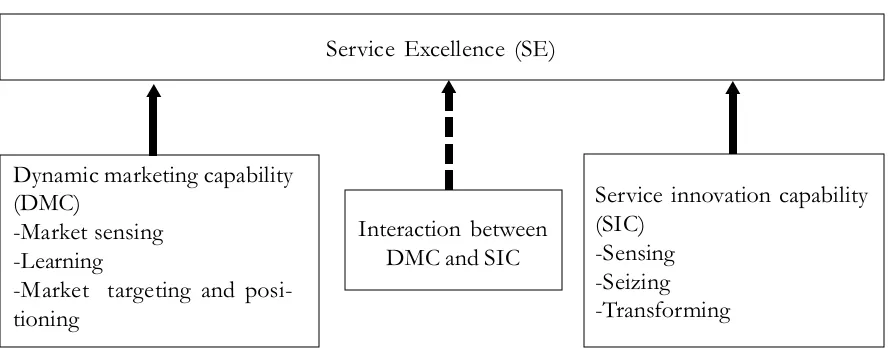
capabil-ity that influence the service excellence (also shown in Figure 1. The conceptual framework being developed explains three direct relation-ships: the relationship between DMC and Service Excellence (SE), the relationship between SIC and SE, and the relationship between DMC-SIC and SE. The third rela-tionship explains the interaction between DMC and SIC. The interaction between DMC and SIC is denoted with dashed lines and the direct relationship is denoted with solid lines.
Dynamic Marketing Capability
and Service Excellence
Hotels are competing for the market share and develop new strategies to leave their competitors behind. In order to improve their image and increase their profit, hotels should put more effort into investigating the needs and expectations of their target groups. Only with a deep understanding of their customer’s desires can the hotels keep their customers loyalty (Smolyaninova 2007). The study conducted by de Farias (2010) reveals that market sensing and learning play their roles as determining factors in service
excel-lence. The evolutionary fit between market needs and market offers is the essence of ef-fective service excellence. Sensing captures the effectiveness in order to generate, dis-seminate, and respond to customers’ needs. Firms with higher absorptive capability dem-onstrate greater ability to learn, integrate ex-ternal information, and transform it into their embedded knowledge (Hou 2008).
Service Innovation Capability
and Service Excellence
Service innovation capability refers to a firm’s ability to develop new services through aligning strategic innovative orien-tation with innovative behaviors and pro-cesses (Hou 2008). Meeting clients needs and providing innovative products are essential to deliver service excellence (Eisawi et al. 2012). Such activities as being able to iden-tify the needs; to change, to explore, to se-lect feasible opportunities; and to implement the new services in the organization are sup-porting factors in the hotel’s service excel-lence.
Figure 1. Conceptual Framework for DMC, SIC, Interaction DMC and SIC, and SE
Service Excellence (SE)
Dynamic marketing capability (DMC)
-Market sensing -Learning
-Market targeting and posi-tioning
Interaction between DMC and SIC
Service innovation capability (SIC)
-Sensing -Seizing -Transforming
Hariandja et al.
148
Interaction DMC-SIC and
Service Excellence
The relationship between innovation and marketing has been acknowledged (Drucker 1954; Moorman and Slotegraaf 1999). Vorhies and Morgan (2005) showed that the effect of the combination of capa-bilities on results is greater, and complemen-tary capabilities can increase a firm’s effec-tiveness and/or efficiency (Milgrom and Rob-erts 1990; Moorman and Slotegraaf 1999; King et al. 2008). The studies to date have explored the effects of innovation and mar-keting capability, as well as their interaction on performance in manufacturing and service context (Ngo and O’Cass 2012; O’Cass and Ngo 2011; Sok and O’Cass 2011; Henard and Szymanski 2001; Im and Workman 2004). This study proposes that the interaction of DMC and SIC are determining factors for service excellence.
The Hotel Industry in
Indonesia
The hotel industry in Indonesia has shown significant growth and has gained greater attention in today’s business environ-ment. The average growth rate of GDP in the hotel industry during 2004-2011 was 6.39 percent (www.bps.go.id) based on year 2000 constant price, compared to total Gross Do-mestic Product (GDP) at 5.84 percent. The hospitality sector became important when the government decided to further push the ser-vice sector. The average contribution of the hotel sector to total GDP based on year 2000 constant price within the 2004-2011 period amounted to 0.70 percent. The hotel indus-try is closely related to tourism. The tourism industry contributes the number of tourists who inhabit the hotels. The Indonesian
Cen-tral Bureau of Statistics (www.bps.go.id) re-ported that there were 4.59 million foreign tourists in 2004 which had increased to 7.65 million in 2011. The revenue from interna-tional visitors has increased from US$ 4.80 billion in 2004 to US$ 8.55 billion in 2011. A similar trend can be seen in the number of hotels and the room occupancy rate (ROR). In 2004 there were 1,014 classified hotels (star hotels) and 9,847 nonclassified hotels (non-star hotels). These numbers had in-creased to 1,489 classified hotels and 13,794 nonclassified hotels in 2011. The room oc-cupancy rate in 2004 for classified hotels was 44.98 percent and for nonclassified hotels 28.33 percent and these had increased to 51.25 percent and 38.74 percent respectively in 2011.
Though growing, the Indonesian hotel industry is facing new challenges due to ex-ternal and inex-ternal factors in a business envi-ronment that affects their service excellence. External factors include intense competition from competitors. According to the Chairman of Indonesian Hotels and Restaurants Asso-ciation (PHRI) of West Java, Mr. Herman Muchtar (personal communication, 27th
De-cember 2010), the main issue related to the hospitality industry in Indonesia is the intense competition among star hotels and non-star hotels. This intense competition occurs be-cause of the excess supply of hotels, regula-tions in terms of hotel development and ser-vice standards, and global competition where the hotels chains with an international net-work invest in new potential areas.
pos-sess the proper promotion strategy in accor-dance with its market segment. The rise of low-fare airlines has impacted on the rise of budget hotels. The growth of the hotel busi-ness as a whole is currently positive, but bud-get hotels have the highest growth rate (Bloomberg Businessweek, 4-10 November 2013).
Methods
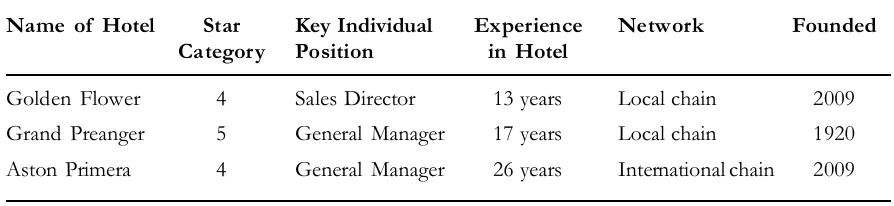
We collected data from 3 hotels. As it allows the questions of what, why, and how to be answered, we used the case study meth-odology (Yin 2003). Cases were selected from hotels based on a literal replication logic, that is, cases were chosen that were expected to lead to similar results (Yin 2003). According to Miles and Huberman (1994), a purposive sampling strategy was used to se-lect cases that offered the best opportunities to build a theory. Our main criteria for case selection was based on: hotel star classifica-tion from 3-star to 5-star in an independent or chain network, and the key individuals have had considerable experience in the hos-pitality business with a wide variety of pre-vious work. Of the hotels that we contacted, three hotels agreed to participate in the study. All of the hotels in our final list were tested by an expert to confirm that they fulfilled the 3-5 star hotel classification. Descriptions of the chosen hotels are provided in Table 1.
The primary data collection method was from interviews with the managers involved in the chosen hotels. The data were collected via semi-structured interviews using a re-search protocol (consisting of competition, dynamic marketing and service innovation capabilities, interaction, and service excel-lence) between September and December 2013. Overall, 3 interviews were conducted, typically lasting 1 to 1.5 hours each. Interviewees came from differing positions in the organizations, their job titles included general manager and sales director.
It is common in case research to use tri-angulation to extend and validate the data collection through the use of multiple sources of evidence (Eisenhardt 1989; Yin 2003). In the present study, this was done through the observation of and participation in some of the hotels studied. These were studied as a supplement to the interviews, enabling us to obtain further insights on the design ap-proaches and to look for additional corrobo-rating or contradicting evidence. We coded the interviews using a predefined code list that was expanded during the analysis to cap-ture emerging themes. The use of software and data coding makes qualitative data analy-sis procedures more systematic and guards against information-processing biases (Eisenhardt 1989; Miles and Huberman 1994). The coded interviews were then ana-lyzed to identify support (or lack of support)
Table 1. Description of Sample
Name of Hotel Star Key Individual Experience Network Founded Category Position in Hotel
Golden Flower 4 Sales Director 13 years Local chain 2009
Grand Preanger 5 General Manager 17 years Local chain 1920
Hariandja et al.
150
using software QSR N-Vivo 10. Specifically, we examined each case for evidence of the capability practices captured in the studies. To further ensure the accuracy and validity of the data, the results were written up in a report that was sent to all respondents for approval, to check that the conclusions ac-curately reflected their practices.
Operationalization of the variable is the process of translating or defining a variable so that it can be measured. Dynamic market-ing capability, service innovation capability, and service excellence are operationalized and discussed below. Table 2 presents the variables operationalization and indicators. The DMC is operationalized through market sensing, learning, and target market/position-ing. Market sensing is measured as the capac-ity to learn the external environment with respect to demands, customers, and competi-tors appropriately, the purpose of which is to guide a firm’s actions (Day 1994). Learning is measured as the ability of the organization to implement the appropriate management practices, structures, and procedures that fa-cilitate and encourage learning (Zollo and Winter 2002). Market targeting or position-ing is measured as the ability to identify al-ternative opportunities before selecting ap-propriate market targets that are aligned for the best effect (Hooley et al. 2008).
The SIC is operationalized through sens-ing, seizsens-ing, and transforming. Sensing is measured as the activity to identify the need to change service operations and innovations. Seizing is measured as the activity to explore and select feasible opportunities for a change. Transforming is measured as the activity to implement the new services in an organiza-tion. All items for service innovation capa-bility are based on Pöppelbuß et al. (2011).
Tabl
e 2.
Ope
rat
io
naliza
tion o
f
Va
ria
ble
Harian
dja
et
al.
152
Tab
le
2.
(Co
Hariandja et al.
154
Findings
Hotel A: Golden Flower
The hotel was established on 1st July
2009 as a 4-star local chain hotel under the Kagum Group. The hotel’s strategy is to be-come the best convention hotel in Bandung by offering an affordable price. In the year 2014, there will be 52 chain hotels in Bandung, including the Royal Tulip, Santika, Swiss Belhotel, and Aston among others. The main competitors for Hotel A are the Savoy Homan, Aston Braga, Aston Primera, Grand Preanger, and Grand Royal Panghegar. In the midst of tight competition, the management remains optimistic and see the hospitality in-dustry as still being prospective and profit-able for the purpose of meetings and the weekend holidaymakers.
DMC-Market Sensing
The events and trends are regularly monitored through the PHRI (Indonesian Association of Hotels and Restaurants), com-petitors, telemarketers, and mass media. The issues include new hotel construction, pro-motion programs, building design, reservation and booking system technology. Customer’s needs and intentions are explored through guest comments/feedback, thank you letters, and other media sources on a regular basis. Through guest comments, the hotels gain an insight, and can rapidly improve their services. Marketing decisions made across the Kagum Group and related hotels are done by ex-changing the information regarding occu-pancy and the rooms being offered. Profit-ability analysis is performed by the sales and marketing department to be shared via email as an input into the decision making process. The hotel does not conduct an independent company’ image study, but utilizes the
“mys-tery guest method” and a services auditor. The mystery guest or services auditor will provide the results of his/her evaluation to the management for consideration in service improvements.
DMC-Learning
Hotel A provides training in self-devel-opment for its sales leaders and engages with staff in the marketing community. In regular meetings, the management gets feedback and ideas from staff for the hotel development. The staff members of the hotel are involved in the marketing plan and sales program ac-tivities. Departments such as F & B, HRD, IT, front-office, and back-office participate in the information gathering about benefits, competitions, services, and designs. Hotel A applies technological developments in its on-line booking, data-base system, new promo-tions, and CRM.
DMC-Market Targeting and Positioning
SIC-Sensing
The innovation goal is to delight cus-tomers and minimize complaints. The mar-keting and sales department of the hotel are responsible for formulating strategic objec-tives and new services. The other departments are involved according to customers’ needs and wants. The marketing, sales, housekeep-ing, and F & B departments ask for the guests’s comments regarding the appropriate-ness of food, beverage, and service supplied, with their expectations and SOP. The com-ments from digital sources, Trip Advisor, and the front-office enter the system and reach the top management. A regular audit is con-ducted in order to monitor the changes in customers’ technological options and wants, such as providing 30 traditional dishes on the menu, the latest in design technology, and energy savings.
SIC-Seizing
The marketing and sales department of the hotel clearly define a new service, par-ticipants, support facilities, and tertiary physi-cal changes tailored to the programs, events, and needs. The hotel’s design factors are for a convention hotel. For example, its meeting rooms have 23 different layouts with the ca-pacity for 20-500 persons, and are designed with a modern concept and equipped with modern equipment and advanced IT. Al-though some of the physical facilities are still limited, the hotel management has been try-ing to improve them. There are artists and contractors responsible for the design. The IT implementation is done by the head office of the Kagum Group. The promotional me-dia, such as logos, fliers, and the layout are discussed and standardized with the head office. The service concept is assessed by a mystery guest with the management’s
ap-proval. The innovation evaluation involves off-line media, on-line media, and the clients.
SIC-Transforming
Before marketing the various services to guests, the marketing/sales department designs a prototype by involving relevant art-ists, designers, and maintenance staff to pro-cess flow, layout, design promotion, and main-tenance facilities. The test marketing done for a new menu launching is with a cooking class, and at a special event, such as Eid, Christ-mas, or Independence Day. The service evaluation is conducted by auditors from the PHRI for overall aspects of the front-office, back-office, housekeeping, F & B, and main-tenance. The impact of the system integra-tion is assessed regularly by the management of the Kagum Group.
Interaction DMC and SIC
The general manager of Hotel A stated that the interaction provides a more power-ful influence on service excellence rather than that conducted partially through intense com-munication and coordination. The activities, such as an event promotion, personal selling, market research, market segmentation, adver-tising, and corporate branding are communi-cated directly to customers by marketing/ sales department. The activities, such as in-novations in features and amenities (internet access, complementary shoe-shines, indi-vidual air conditioning, smoking and non-smoking rooms, keyless rooms, uniforms), are communicated directly by the departments concerned and coordinated by the marketing/ sales department. The innovation activities are done according to both seasonal and mar-ket demands.
Hariandja et al.
156
market identification, promotions, and sales forecasting. For example, the F & B ment coordinates with the marketing depart-ment to test menus and evaluate prices ac-cording to market demands. If they fit the market, then the marketing department will communicate them to customers through bro-chures, leaflets, fliers, and banners to achieve service excellence. For IT-system implemen-tation and room design, the marketing depart-ment interacts with the IT departdepart-ment, build-ing management, and maintenance depart-ment before they are communicated to the customers.
Service Excellence Comparison to Its Competitors
The service excellence of Hotel A is similar to the Savoy Homan, Aston Braga, Aston Primera, and Grand Preanger. The servicescapes of the hotel is lower than its competitors due to its management is still improving the design and layout. Hotel A offers 193 exquisitely furnished guest rooms and luxurious suites equipped with excellent in-room amenities and entertainment. All of the hotel’s function rooms are equipped with essential audio-video equipment, free internet access with Wi-Fi system is available in all areas of the hotel. There is a periodical customer participation program, particularly at such special occasions like Eid, school holidays, Christmas, or birthdays.
Hotel B: Grand Preanger
Hotel B was established in 1920 in the Dutch colonial era, and now it is managed by Aerowisata. Hotel B is a five star chain ho-tel. The aim of Hotel B is to be the perfect hotel where business and leisure, as well as graceful Sundanese hospitality, and the com-fort of a modern business hotel blend. The current business competition is very tight and
competitive, but the area still shows good prospects and good conditions. This compe-tition is also enlivened by the presence of the affiliated chain and budget hotels such as the Accor, Aston and Swiss-Belhotel. In order to face that competition, the hotel’s strategy is to grab both the MICE market and as at des-tination and activities promotion and selling place. The current average occupancy rate is around 50 percent-60 percent.
DMC-Market Sensing
The sales department promotes desti-nations and explores the customer’s opinions for its services. Hotel B regularly monitors such issues as: reservation system technol-ogy, the launching of a new hotel, social media, and building design through the PHRI, Riung Priangan, competitors, and mass me-dia. The consumers’ needs and intentions are surveyed via the guest’s comments that are processed daily and weekly by the front-of-fice department and then reported to general manager. The sales and market share reports are made across the group. The profitability analysis is performed by the sales and mar-keting department to be shared as an input into the decision making process. The hotel conducts its company’s image study on a regu-lar basis using the marketing consultants and Trip Advisor. During eight months in 2013, the hotel’s rank increased from 54 to 22 (out of 120).
DMC-Learning
pro-gram activities to discuss such things as ben-efits, competition, services, design, and changes by their competitors. Hotel B uses technological developments in its on-line booking, customer data-base, new promo-tional strategies, CRM, and energy saving programs.
DMC-Target Market and Positioning
Hotel B mainly focuses its business on (government and parliament staff, state lo-cally-owned companies) and leisure custom-ers (European, Asian, and local tourists). Hotel B positions itself as the perfect hotel where business and leisure as well as ‘art-deco’ architecture and Sundanese hospitality blend. This selling point is communicated to their target customers.
SIC-Sensing
Hotel B sets its measurable, planned, and spontaneous innovation, and adapts it to fit the target market. The hotel emphasizes its innovation with its places of destination and activities program. Its strategic objectives and new services are formulated by its mar-keting department. Its marmar-keting, sales, housekeeping and F & B department ask for the guests’s comments about whether or not the foods, beverages, and services meet with the customer’s expectations and SOP. The comments from digital sources, Trip Advisor, and front-office enter the system and reach the general manager. A regular audit is con-ducted by a mystery guest and TUV-Rheinland. They regularly monitor changes in customers’ wants both in technological options and in other areas, such as providing 10 types of coffee, local cuisines, a museum, in-room slippers, a “kiddy land” with a Tarsius icon, Sundanese uniforms for staff on Fridays, and energy savings.
SIC-Seizing
The hotel’s marketing and sales depart-ment clearly define the new services, partici-pants, support facilities, and tertiary physical changes tailored to the programs, events, and needs. Its design factors are tailored to cap-ture the MICE market. For example, its meet-ing rooms have 12 different layouts with a capacity of 25-1000 persons, and are designed with a modern and ‘art-deco’ concept and equipped with the latest equipment and in-formation technology. Selected designers are responsible for the interior design. IT-imple-mentation is done by the head office of the Aerowisata Group. The hotel’s ideas are pro-moted through logos and fliers, whose lay-outs are adjusted to the standards set by the Aerowisata Group and the nature of the tar-get market. The concept of services is as-sessed by a mystery guest based on the hotel management’s approval. In evaluating its in-novation, Hotel B also involves internal par-ties, the mass media, and selected clients.
SIC-Transforming
Hariandja et al.
158
Interaction DMC and SIC
The general manager of Hotel B stated that the interaction between the dynamic marketing capability and the service innova-tion capability had a more powerful influence on service excellence. The interaction through intense communication and coordi-nation involves all parties in the hotel. The activities such as event promotion, personal selling, market research, advertising, and branding are directly communicated to cus-tomers by the marketing department. For achieving its service excellence, the hotel’s innovation activities features such amenities as internet access, complementary shoe-shines, smoking and nonsmoking rooms, key-less rooms, staff uniforms, guest slippers, bolsters etc., and are communicated directly to customers according to both seasonal and market demands. The innovation activities are managed by the marketing department.
The interaction occurs in terms of the hotel’s menu development, pricing, selling, target marketing, new services, promotions, and sales forecasting. The F & B department will discuss with the marketing and sales de-partment the testing of new menus and evalu-ate their prices according to the market de-mands. If they are a fit to the market, then the marketing department will communicate them to customers through brochures, leaf-lets, fliers, and banners. For the IT-implemen-tation system and room design, the market-ing department interacts with the IT depart-ment, building management and maintenance department to obtain the best system and design before communicating them to cus-tomers.
Service Excellence Comparison to Its Competitors
The service excellence of Hotel B is relatively better than that of the Savoy
Homan, Aston Braga, Aston Primera, Grand Royal Panghegar and Papandayan. Hotel B offers such features and amenities as 187 el-egant art-deco furnished guest rooms from Superior to the Garuda Presidential Suite. Each of the hotel’s guest rooms offers a blend of the art-deco and modern style, as well as excellent in-room amenities, and entertain-ment. The hotel’s meeting and banquet fa-cilities have 12 meeting rooms which can accommodate up to 1000 guests comfortably. All the hotel function rooms are equipped with audio-video equipment and a free Wi-Fi system. Periodical customer participation occurs for special occasions like Eid, school holidays, Christmas, and birthdays.
Hotel C: Aston Primera Pasteur
Hotel C was established in 2009 as an international four-star chain hotel under the Aston Group. The vision of Hotel C is to become the best conference hotel in Bandung by offering different services and facilities. Its competitors are the Savoy Homan, Grand Preanger, Grand Royal Panghegar and new entries such as the Royal Tulip, Santika, and Swiss Belhotel. The interview results showed that the management remains optimistic and forsees that the hospitality industry will still be very profitable, with good prospects pri-marily from meetings and the weekend vaca-tioners.
DMC-Market Sensing
services. The reports of sales, market share, and profitability form the basis for market-ing decision makmarket-ing. The reports gained from the Aston Group and their competitors are shared within the hotel. The hotel conducts a company’ image study on a regular basis using consultants, outsiders, Agoda, and Trip Advisor. Currently, according to the survey from Agoda.com, overall, this hotel’s rank is 7.9 (out of 10 points).
DMC-Learning
The management provides training to staff members, as much as 9 hours per staff member per month, and engages the staff members in its marketing community and self-development program. Feedback and ideas from staff members are elicited regularly dur-ing general meetdur-ings. The management en-courages staff members to get involved in the marketing plans and sales program activities in which they discuss the benefits, competi-tions, services, designs, and opportunities operated by their competitors. The manage-ment is receptive to technological develop-ments in its on-line booking, customer data base, new promotional strategies, CRM, and energy saving.
DMC-Target Market and Positioning
Hotel C mainly focuses on the market of MICE (both government institutions and corporate) and individuals (through non on-line travel agents and on-on-line travel agents). Its MICE market ranges from government institutions to oil and gas companies. It aims to position itself as the conference center that is secure and serves safe and hygienic food for both private companies and government institutions. This becomes the hotel’s selling point to its customers.
SIC-Sensing
Hotel C sets discipline values consist-ing of operational excellence, product excel-lence, and customer intimacy. The hotel em-phasizes its capabilities in the places of des-tination and activities markets. Its marketing department formulates the hotel’s strategic objectives and new service developments. The hotel’s innovation strategy is the differ-entiation in services and facilities. The mar-keting, sales, housekeeping and F & B de-partments ask for the guests’ comments about whether or not the food, beverages and services match their expectations and SOP. The comments from digital media, Trip Ad-visor, and front-office enter the system and are passed to the general manager. Both the service and ISO-9001 audit are conducted regularly. The service audit was last con-ducted by a mystery guest, while the ISO-9001 was conducted by an ISO-ISO-9001 audi-tor. Monitoring changes in customers’ desires and technological options is done by conduct-ing such activities as “little chef for kids” with a certificate, tours of the hotel, and exhibi-tions of modern and local cuisines.
SIC-Seizing
Hariandja et al.
160
they are adjusted to the nature of the target market. The concept of the hotel’s services is assessed by outsiders and auditors from the Hospitality Asia Platinum Awards (HAPA) scheme. In the period from 2012-2014, Ho-tel C achieved “Best 5” and “Recognition of Excellent Master Chef and Asian Cuisine”. In evaluating its innovations, Hotel C in-volves internal parties, the mass media, and selected clients.
SIC-Transforming
The hotel’s prototype designs such as the process flow, layout, promotion, and amenities are conducted by its marketing and sales department together with its designers. The hotel also conducts market tests before launching its new menus and special events. Overall, the services of the hotel are evalu-ated by auditors from the PHRI, HAPA, and Riung Priangan. The impact of its service system integration is assessed regularly by the management and the Aston Group.
Interaction DMC and SIC
The interaction between DMC and SIC provides a more powerful influence on ser-vice excellence through intense communica-tion and coordinacommunica-tion. Such activities as promotion, personal selling, market research, advertising, and branding conducted by the marketing and sales department are then com-municated directly to customers. The inno-vation activities in its features and amenities (internet, complementary shoe-shines, key-less rooms) are conducted by the department in charge according to both seasonal and market demand for service excellence. These innovations activities are managed by the marketing department.
The interaction occurs in such activi-ties as IT-implementation, management sys-tem building, menu developments (little chef,
barbeque night on a Friday), air soft-gun and hiking programs, pricing, selling, target mar-ket identification, promotions, and sales fore-casting. For menu development, the F & B department coordinates and shares the infor-mation with the marketing and sales depart-ment to test the new menus before they are communicated to customers through talk shows, brochures, leaflets, fliers, and banners.
Service Excellence Comparison to Its Competitors
The service excellence of Hotel C is relatively better than the Grand Aquila, Sa-voy Homan, BTC Hotel, Grand Royal Panghegar, Papandayan and Sensa Hotel. In terms of features and amenities, Hotel C of-fers modern and excellent technology. The hotel’s meeting and banquet facilities have 12 meeting rooms which can accommodate up to 1500 guests comfortably. All the hotel function rooms are equipped with audio-video equipment and a free Wi-Fi system. There is periodical customer participation on special occasions like Eid, school holidays, Christmas, and birthdays.
Discussion
cus-tomers, and to offer the best facilities accord-ing to customer expectations.
Market target or positioning of one ho-tel is different from another and has its own unique differentiation. The Grand Preanger Hotel, for example, is focused on being at heritage hotel for tourists especially from the European, Japanese and Indonesian markets. The Aston Primera is more focused on the big oil, gas, and mining companies. The Golden Flower focuses on its convention business, and on tourists from Southeast Asian countries. The ability of each hotel to sort the appropriate segments and communi-cate its own positioning in the minds of cus-tomers makes the service delivery of each hotel match its target market. By engaging customers and responding quickly to fulfill their expectations, each hotel achieves its own desired service excellence.
Each hotel has a different strategy in serving their customers. Each hotel’s inno-vation strategy formulation and new service development are mostly done by its own de-partment of marketing, sales, housekeeping, and F & B. Other departments are involved when they are relevant to the events and oc-casions. Most of the innovations in the three hotels concern the menu development. Regu-lar audits are conducted by inviting outsiders to assess the overall services offered, to an-ticipate changes in customer’s needs, and to evaluate whether the technological options are in accordance with the SOP and custom-ers expectations.
The innovation made by Hotel B is to provide a heritage museum and the implemen-tation of eco-green policies, while the inno-vation made by Hotel C is to conduct its “Little Chefs” and air soft-gun programs. Sensing activities allows hotels to formulate different innovation strategies that can
re-spond to customers and deliver their services to them. Appropriate service delivery and offering the best servicescapes by involving customers will ultimately achieve service ex-cellence in terms of meeting customer expec-tations.
Based on the interview sessions from three key personnel of the hotels, the three case studies indicate that interaction between DMC and SIC is a more powerful influence in order to achieve service excellence. Through the intense communication and co-ordination in which all departments of the hotel are involved, service excellence will be achieved. In order to achieve service excel-lence, activities such as market research, di-rect selling, event promotion, and corporate branding, marketing, and spontaneous inno-vations like amenities, according to seasonal and market demand, are communicated di-rectly to customers. The capability interac-tion occurs mostly in the menu development, event development, price setting, price com-parison, and selling.
Harian
dja
et
al.
162
This study offers an interesting view for the management of hospitality firms. The reason is that the existing service excellence frameworks are mainly based on both dy-namic marketing and service innovation ca-pability as well as their interaction, and there-fore these frameworks have a limited appli-cation potential in a hospitality context. All of the six activities are usable in hotels. The various ways to make marketing strategies achieve service excellence are also illustrated in this study. General managers in hotels can use the proposed 6 different activities for both capabilities as a list of options to affect their hotels’ service excellence. From this list, the general managers can then select the activi-ties that suit their hotels’ needs and service excellence. Hotels have some complex ele-ments, and their service excellence may de-pend on these various elements, or their in-teraction. These case studies show that ser-vice excellence starts with building the asso-ciations of both capabilities. A hotel’s brand successfully positioned in the consumers’ minds will become an asset of the company that contributes to its service excellence. To conclude, the results of these case studies are limited to the hotel industry only.
Conclusions
This study reveals that there is a rela-tionship among dynamic marketing capabil-ity, service innovation capabilcapabil-ity, both capa-bilities interaction, and service excellence. The key informants stated that a dynamic marketing capability and a service innovation capability partially affected service excel-lence, but this relationship had more influ-ence when the dynamic marketing capability and service innovation capability interacted. The conceptual model described in this study is to examine the basis of a direct relation-ship between the dynamic marketing
capa-bility, the service innovation capacapa-bility, and their interaction with service excellence.
The results of the study indicate that the dynamic marketing capability, the service innovation capability, and their interaction in the three hotels show some similarities. The difference lies in the marketing strategies and innovation strategies, which are tailored to the target markets and occasions. The service excellence is strongly influenced by how each of the hotels is able to sense trends and events, respond to the market demands through the learning process, identifies their right target market, and communicate with their customers. The service excellence is achieved by defining the services, partici-pants, and physical facilities clearly; continu-ously performing the audit services; and test the prototypes. The capabilities interaction are mostly determined by the marketing de-partments and the sales by involving other relevant departments.
Hariandja et al.
164
Further research could apply this devel-oped conceptual framework to analyze ho-tels beside 4 and 5 star hoho-tels. Therefore, re-search on other industries (financial service, airlines, consulting, etc.) possessing interac-tion capabilities is needed, by combining it with quantitative (confirmatory) research. From the case studies, the strong brand names of the two hotel seemed to contribute to their service excellence. It is recommended that further research on the relationship be-tween the capabilities interaction and service excellence to the hotel performance should be done.
From a managerial perspective, this study expected to contribute to the
develop-ment of a conceptual model linking dynamic marketing capability, service innovation ca-pability, and the capabilities interaction in order to achieve service excellence in the hotel industry. In practice, this study is aimed at helping the hospitality industry to better plan and move towards effective and intense dynamic marketing and greater service inno-vation implementation. This study will hope-fully provide insights on some of the factors of dynamic marketing capability and service innovation capability which would assist the hospitality industry to create the appropriate environment to encourage the promotion of service excellence and customer satisfaction and finally customer loyalty.
References
Atuahene-Gima, K. 1996. Market orientation and innovation. Journal of Business Research 35 (2): 93-103. Aziz, Y.A., and K. Wahiddin. 2010. Conceptualising the service excellence and its antecedents: the
de-velopment of the structural equation model. Journal of Tourism, Hospitality and Culinary Arts 2 (1): 1-13.
Bäckstrand, J. 2007. Levels of interaction in supply chain relations. Unpublished PhD Thesis. Göteborg, Sweden: Chalmers University of Technology.
Berry, L. L., and A. Parasuraman. 1992. Prescriptions for a service quality revolution in America. Organi-zational Dynamics 20 (4): 5-15.
Bettencourt, L. A., and K. Gwinner. 1996. Customization of the service experience: the role of the frontline employee. International Journal of Service Industry Management 7 (2): 3-20.
Day, G. S. 1994. The capabilities of market-driven organization. The Journal of Marketing 58 (4): 37-61. de Farias, S. A. 2010. Internal marketing (IM): A literature review and research propositions for service
excellence. Brazilian Business Review. Vitória (7) (2) (May-August): 99-115. Drucker, P. F. 1954. The Practice of Management. New York: Harper and Brothers.
Dube, L., and L. M. Renaghan. 2000. Creating visible customer value – how customers view best-practice champions. The Cornell Hotel and Restaurant Administration Quarterly (40) (7): 62-72.
Eisawi, D. A., H. Sekhon, and S. Tanna. 2012. Innovation as a determinant for service excellence in banking. International Journal of e-Education, e-Business, e-Management and e-Learning 2 (4): 336-338. Gadrey, J., F. Gallouj, and O. Weinstein. 1995. New modes of innovation: How services benefit industry.
Garud, R., and P. R. Nayyar. 1994. Transformative capacity: Continual structuring by intertemporal tech-nology transfer. Strategic Management Journal 15 (5): 365–85.
Grönroos, C. 1982. An applied service marketing theory. European Journal of Marketing 16 (7): 30-41. Henard, D., and D. Szymanski. 2001. Why some new products are more successful than others. Journal of
Marketing Research 38 (3): 362–375.
Heskett, J. L., W. E. Sasser, and L. A. Schlesinger. 1997. The Service Profit Chain. New York: The Free Press. Hooley, G. J., N. Piercy, and B. Nicoulaud. 2008. Marketing Strategy and Competitive Positioning. London: FT
Prentice Hall.
Hou, J. J. 2008. Toward a research model of market orientation and dynamic capabilities. Social Behavior and Personality 36 (9): 1251-1268.
Hult, G. T. M., and D. J. Ketchen Jr. 2001. Does market orientation matter?: A test of the relationship between positional advantage and performance. Strategic Management Journal 22 (9): 899–906. Im, S., and J. Workman. 2004. Market orientation, creativity, and new product performance in
high-technology firms. Journal of Marketing 68 (2): 114–132.
Johnston, R. 2004. Towards a better understanding of service excellence. Managing Service Quality 14 (2/3): 129-133.
King, D. R., R. Slotegraaf, and I. Kesner. 2008. Performance implications of firm resource interactions in the acquisition of RandD-intensive firms. Organization Science 19 (2): 327-340.
Kok, R., B. Hillebrand, and W. Biemans. 2003. What makes product development market oriented? Towards a conceptual framework. International Journal of Innovation Management 7 (2): 137-162. Lovelock, C. H., H. T. Keh, X. Lu, and J. Wirtz. 2005. Services Marketing in Asia: Managing People, Technology,
and Strategy (2nd ed.). Singapore: Prentice Hall.
Milgrom, P., and J. Roberts. 1990. The economics of modern manufacturing: Technology, strategy, and organization. The American Economic Review 80 (3): 511-528.
Moorman, C., and R. J. Slotegraaf. 1999. The contingency value of complementary capabilities in prod-uct development. Journal of Marketing Research 36 (2): 239-257.
Ngo, L. V., and A. O’Cass. 2012. In search of innovation and customer-related performance superiority: The role of market orientation, marketing capability and innovation capability interactions. Journal of Product Innovation Management 29 (5): 861–877.
O’Cass, A., and L. V. Ngo. 2011. Winning through innovation and marketing: lessons from Australia and Vietnam. Industrial Marketing Management 40 (8): 1319-1329.
Oliver, R. L. 1997. Satisfaction: A behavioural perspective on the consumer. New York: Irwin/Mc Graw Hill. Pöppelbuß. J., R. Plattfaut, K. Ortbach, A. Malsbender, M. Voigt, and B. Niehaves. 2011. Service
innova-tion capability: Proposing a new framework. Proceedings of the 3rd International Symposium on Services
Science (ISSS) in conjunction with the Federated Conference on Computer Science and Information Systems (FedCSIS), Szczecin, Poland.
Smolyaninova, J. 2007. Hospitality market opportunities for the business market segment in Borlänge.
Unpublished Master’s Thesis. Bournemouth University, Bournemouth, United Kingdom.
Sok, P., and A. O’Cass. 2010. Examining the interactive roles of marketing, innovation and social
net-working capabilities on firms customer-based performance. ANZMAC (November
Hariandja et al.
166
Sok, P., and A. O’Cass. 2011. In search of financial performance superiority via product and customer performance outcome: The role of complementary resource-capability combination within and between innovation and marketing areas. International Conference of Decision Science (July 12-July 16). Taipei, Taiwan.
Song, M., S. Hanvanich, and R. Calantone. 2005. Marketing and technology resource complementarity: An analysis of their interaction effect in two environmental contexts. Strategic Management Journal 26 (3): 259-276.
Teece D. J., G. Pisano, and A. Shuen. 1997. Dynamic capabilities and strategic management. Strategic Management Journal 18 (7): 509-535.
Tekes. 2009. Serve - Innovative Services Technology Programme 2006-2010. Thomson, J. D. 1967. Organisations in Action. New York: McGraw-Hill.
Tushman, M., and C. O’Reilly. 1997. Winning Through Innovation: A Practical Guide to Leading Organizational Change and Renewal. Boston, MA: Harvard Business School Press.
Vorhies, D. W., and N. A. Morgan. 2005. Benchmarking marketing capabilities for sustained competitive advantage. Journal of Marketing 69 (1): 80-94.
Winter, S. G. 2003. Understanding dynamic capabilities. Strategic Management Journal 24 (10): 991-995. Xue, M., and P. T. Harker. 2002. Customer efficiency: Concept and its impact on e-business management.
Journal of Service Research 4 (4): 253-267.
Zollo, M., and S. G. Winter. 2002. Deliberate learning and the evolution of dynamic capabilities. Organiza-tion Science 13 (3): 339-351.
Newspaper:
Prospek budget hotel cerah. (2013, 4-10 November). Bloomberg Businessweek: 6. Websites:
Statistics of Indonesia: Tourism. Http://www.bps.go.id/eng/menutab.php?tabel=1andkat=