50
REINVENTING THE CONCEPT OF ANGLE BY SPATIAL
REPRESENTATIONS AND PHYSICAL ACTIVITIES
Bustang1, Dolly van Eerde2, Zulkardi3, Darmawijoyo3
State University of Makassar1, Utrecht University2, Sriwijaya University3 [email protected],[email protected], [email protected],
Abstract
This research reports on a new approach of students’ learning of the concept of angle by
exploring the idea of vision lines. This approach enables students to work with written work and physical activities involving the idea of vision lines from which the concept of angle could be emerged. This research was conducted within the design research perspectives to support students in acquiring the initial concept of angle. A series of two activities was designed by using Realistic Mathematics Education (RME), known as Pendidikan Matematika Realistik Indonesia (PMRI) as the design heuristic. This research involves 38 students in the teaching experiment and one teacher of grade 3 in SD Muhammadiyah 6 Palembang, Indonesia. The results show that the two activities
could bring the students’ learning gradually developed their understanding the concept
of angle. It has been found that the notion of vision lines and blind spots play an
important role in developing students’ understanding of the concept of angle.
Keywords: spatial representations, physical activities, angle concept, Pendidikan
Matematika Realistik Indonesia (PMRI), design research.
INTRODUCTION
The discussion about the nature of the concept of angle has been carried out for more than two thousand years and the debate is not over yet (Matos, 1990). It reveals that the concept of angle is difficult because each facet has different meanings depending on the physical and mathematical situations at hand. Mitchelmore and White (2000) called this oddness the multifaceted nature of the concept of angle.
The research literature also points out that students often harbour many misconceptions, conceive an erroneous angle representation and have difficulty learning this concept at school. In Indonesian primary schools, the concept of angle usually is given right away to students without allowing them to develop it by themselves. Furthermore, the teaching of angles in the primary schools is mostly done without linking it to physical activities (Fauzan, 2002). The physical context is merely used as an exemplification of the concept and is not studied in its own right (Mitchelmore, 1997). These results give rise to the need of investigating how instructional activities may support students to develop the concept of angle and their spatial abilities regarding this concept. The goal of this study is to design and try out a set of instructional sequence by which students may reinvent the concept of angle. Thus, this study focuses on answering the following research question:
How can physical activities and spatial representations support students’
51
In order to answer this research question, design research approach was chosen for this study. This approach allow us to design physical and written learning activities that aim to promote learning the concept of angle, study of students learning processes and contribute to domain specific theory on learning the concept of angle.
THEORETICAL FRAMEWORK The Multifaceted Concept of Angle
It has been established that angle is a multifaceted concept. Therefore, making a definition of angle becomes a difficult process because all definitions have limitations in describing the concept by emphasizing one facet more heavily than others (Keiser, 2004). Henderson and Taimina (2005; cited by Fyhn, 2007) define angle based on the three different perspectives: angle as geometric shape, angle as dynamic motion (angle as movement) and angle as measure.
A historical review of the concept of angle also provides some important factors to consider when we think of the struggle students have in learning this concept in the classroom. In ancient history, some of the Greek geometers tried to define angles. At that time, most of the definitions of angle were included in one of these three categories: a relation, a quality, or a quantity (Keiser, 2004). One of the famous books in the history of geometry is the one which was written by Euclid. According to the definition of angle that Euclid presented in book I of the Elements, it seems that he thought of an angle as the space in between two lines. The multifaceted concept and definition of angle from an historical perspective can provide insights for this study when designing a sequence of activities that seek to deal with the most common obstacles and conceptions of the students in learning the concept of angle.
Angle Comprehension and Misunderstandings
Many studies pointed out that children s conceptual understanding about the concept of angle needs to be investigated due to several misconceptions and misunderstandings that exist in their thinking when dealing with that concept in the geometry classroom (e.g. Mitchelmore & White, 2000; Clements & Burns, 2000;
Keiser, 4; Munier & Merle, . One of the possible reasons why students
learning of the concept of angle is complicated is that angle is indeed a difficult concept for children to understand. There are many different definitions of angles which vary in their emphases and take different meanings depending on the mathematical situation at hand (Keiser, 2004).
)n the traditional geometry curriculum, the definition of angle is taken from Euclid s
definition. According to the definition presented in Book I of the Elements, Euclid
stated that: A plane angle is the inclination to one another of two lines in a plane
which meet one another and do not lie in a straight line. And when the lines containing the angle are straight, the angle is called rectilinear (Health, 1956, p.
.
)t seems that Euclid s definition of angle excludes the zero angle and angles greater
52
According to the aforementioned studies about angles, there are at least three important conclusions that can be drawn: angle as a complex concept defined in a variety of contexts, the struggle students have in understanding the concept of angle, and traditional teaching methods of the concept of angle which lack the use of realistic contexts as a means to support students learning development. Furthermore, the multiple definitions of angle can also confuse students in their understanding about what an angle truly consists of.
The Notion of Realistic Mathematics Education
The concept of angle is closely related to the real world situation. Mitchelmore
studied children s informal knowledge of physical angle situations and
concluded that children had an excellent informal knowledge of angle situations such as turn, slopes, crossings, bends, rebounds, and corners. Introducing the concept of angle from physical activities and spatial representations are the main concerns in this research and Realistic Mathematics Education (hereafter RME) becomes a domain specific design heuristic underlying the development of the instructional
activities as well as a framework to understand the children s thinking in learning the
concept of angle.
Freudenthal s view of mathematics as a human activity plays an important role in the
development of RME. The main activity in mathematics education, based upon
Freudenthal s view of mathematics, is mathematizing. When setting mathematizing
as a goal for mathematics education, this can involve mathematizing mathematics and mathematizing reality (Gravemeijer, 1994 . )n Freudenthal s view, mathematizing is closely related to level-raising which takes place when learning processes show features that characterize mathematics such as generality, certainty, exactness, and brevity.
Method
This study can be characterized as a design research approach as an appropriate methodology approach for achieving the research aim. Design research consists of three phases; preparing for the experiment, conducting the design experiment, and carrying out the retrospective analysis (Gravemeijer & Cobb, 2006). We chose this approach of design research for at least two reasons. The first is that this study is interested not only to know whether the understanding of the concept of vision lines through physical angle activities and spatial representations could support students learning of the concept of angle, but also understanding about how that learning might takes place. The second reason is that a local instructional theory for learning the concept of angle is lacking. The local instructional theory concerns both the process of learning and the means designed to support that learning.
The study was conducted in the 3rd grade of Muhammadiyah 6 elementary school in
53
Results of a pre-test and post-test were collected both in the pilot experiment and teaching experiment. This paper focuses on the results of 5 students that participated in the pilot experiment.
ANALYSIS AND RESULT
We first present the result of the pretest to give an impression of the starting point of
students learning process. For the analysis of the lessons we observed the video registrations to investigate what the teacher and students do during the teaching experiment and how the activities could support the students learning. Then we selected some critical fragments and we compared the HLT specified for particular
activities with students actual learning during the teaching experiment. We also
analyzed the student written work.
Pre-test
The result of the pre-test is analyzed in order to investigate the present relevant knowledge and to know the starting points of students about the concept of angle. Since the focus of this study is on two meetings, we only analyzed on the first three problems in the pre-test that are related to these two meetings. In the first problem, students worked with a problem depicting a small rowboat rowing toward a ship and asked why the captain of the ship cannot see you in the rowboat. The results showed that students realized that the shape of the ship affects the field of vision. So, at some spots, the captain will not be able to see the small rowboat. The pre-test also reveals that most of the students did not recognize the 0o, 180o, and 360o angles. Their
concept of angles excludes the turning aspect of angle and therefore it was difficult for them to conceptualize 1800 and 3600 angles. Most students were also able to
recognize things in their life that have an angle such as a door and a table. But, mostly the examples that they mentioned is for right angles as a common angle for them. These findings show that students have certain difficulties in dealing with the concept of angle.
Meeting 1
The teacher gave a worksheet that consists of three problems about vision lines and blind spots with mice and cat context. These problems are spatial representations of the situation of the cat looking to the mice hiding behind the jar. We hypothesized that by working with these spatial representations, students could develop their mental visualizations when they are trying to imagining and make sense of the situation that they have not seen. These mental visualizations might be seen as the students start to reason and say something about the vision of the cat in answering the problems. There is also possibility that some students draw any lines that represent the vision of the cat.
The first problem
54
Figure 1. Problem 1
How many mice the cat can see? Explain and write down your reasoning! (You may make any drawing in the figure).
All students were trying to answer this problem 1 by determining the number of mice that the cat can see. Some students argued that the cat can only see the three mice beside the jar because the others are hiding behind the jar. But, also some of them said that the cat can see five mice, three on the right, and two on the left side of the jar. It shows that students were able to look through the eyes of the cat and recognize that some but not all mice can be directly seen by the cat. The fragment below depict the moment when the researcher asked one of students about their answer and drawing this problem.
Researcher : what does the line mean, Ikhsan? (pointing the line drawn by the student).
Ikhsan : Its vision, sir. Its vision is impenetrable by only looking to
this side (pointing the line that goes to the jar). So, it can only see three (pointing the three mice besides the jar).
Researcher : Others? (pointing the other mice).
Ikhsan : Others are invisible because they are behind this (pointing the jar), behind the jar.
Researcher : Behind the jar. Students : (laughing)
Reseacher : How many lines from the cat? How many lines? Ihksan : I do not know.
Researcher : How many lines did you draw? Ikhsan : Three.
Researcher : How many mice touched? Ikhsan : Three.
Reseacher : How about the other mice? (pointing the other mice). Ikhsan : Untouched (by the line), because of this (pointing the jar). Reseacher : So?
Ikhsan : they cannot be seen by the cat. Because the cat stops here (pointing the cat).
55
Furthermore, most of the students were able to draw lines with different forms that represent the vision of the cat (see figure 2). Although they were able to make an inferential reasoning for answering the problem, they still make a mistake in their drawing. Probably, their drawing is not the vision lines of the cat, but just a line that proves the cat can see certain mice as they drew those lines for each of the mice.
Figure . Students drawing of the vision lines of the cat
The second problem
2. Below is the top view of the position of the cat and the mice.
Figure 3. Problem 2
Is there any difference in the number of mice that the cat can see on figure one and figure two? Explain and write down your reasoning! (You may make any drawing in the figure).
In the problem 2, students tried to compare the side view and the top view of the situation. Some of the students were able to recognize that those two figures are different in terms of the number of the mice that the cat can see. In the first drawing, the cat can only see three mice, but in the second drawing the cat can see six mice. Most of them argued that those two figures are different because in the first drawing the vision of the cat was blocked by the jar.
The third problem
3. Then, several minutes later the cat walks slowly to the jar. The mice stay in the same place.
56
One of the students, Andy, said that if the cat comes closer and closer to the mice and they do not walk away, the cat sees less and less mice. Do you agree with Andy? Why/why not? Explain and write down your reasoning in the paper!
In problem 3, some students said that they agreed with the opinion stated in the problem. They argued that as the cat gets closer to the jar, the cat see less mice. Even, if the cat moves very close to the jar, the cat cannot see the mice. But, other students have a different opinion and disagree with the opinion stated in the problem. Some of them argued that if the cat gets closer to the jar, the cat should be able to see more
mice. Although students answers were different, it seems that they realized that the movement of the cat, the position of the cat, can influence the number of the mice that the cat can see.
Based on the results of this activity, we conclude that most of the students had a sense about vision lines and blind spots. They know that the vision of the cat will be different if the cat moves closer to or farther away from the jar. They also tried to make a drawing of the vision of the cat. But, since vision lines cannot be seen in reality, it is understandable that students were struggling to represent these lines in a drawing. Based on these observations we assumed that by doing physical activities on the playground, constructing the vision lines of the observer, the students might become aware that vision lines, are imaginary lines that extend from the eyes of observer to an object. The vision lines constructed by the students are actually tangent lines that are the lines that bounded the visible and invisible area. These lines can also be used as a tool to determine what can and cannot be seen by the observer in the experiment. Furthermore, we assumed that when students would construct the vision lines, the notion of angle might emerge since students could see that the vision lines change as the observer moves into different positions. After the first lesson we concluded to conduct such activities in the second lesson.
Meeting 2
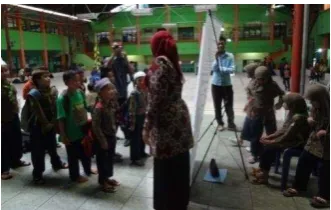
In this second meeting, the teacher encouraged students to conduct physical activities of constructing vision lines and blind spots of observer. The teacher explained to the students that they were going to construct the situation of the cat and mice problem in the last meeting. The teacher put a screen and a chair on the school playground and asked one group of students to be an observer. A student-observer sat in the chair facing the screen and the other students took their school bags lined up behind the screen where they could not be seen, approximately in the middle of the screen.
Figure 5. The teacher encourage students to conduct the physical activities
57
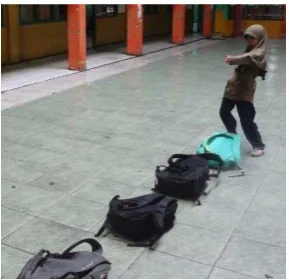
where they stopped. After doing this activity, the teacher posed questions about whether they could predict the next position of school bags. This question is important to be asked to see whether the students could make a prediction or conjecture about what they just have done. Furthermore, this question might reveals whether students realize the pattern of the bags and their reasoning of why they put it on the certain place instead of others. Most of the students said that they could do that and then put their school bags in line with the others. One of the students used her hand to see where she should put the school bags so that it is in line with the others.
Figure . Student s strategy in predicting the next position of the bag
Students then observed the position of the bags and realized that they were
diverging or in line . The teacher proposed to use a rope to check and verify their answer by laying out two ropes along the bags. Next, the teacher asked them whether those two lines can meet somewhere. Some students hypothesized that they meet in the observer and the teacher followed this opinion by asking them to use the rope and validate their answer. By changing the position of the observer, closer to and farther away from the screen, students started to grasp the idea of angle. The concept of angle emerged as the teacher asked questions and guided the students to find the difference while the observer sat closer to the screen or far away from the screen. However, this physical activity still did not help students in dealing with the most common misconceptions about angle namely that the size of angle is determined by the length of its arms. These observations raised the need for revising the activity and adding another activity that may facilitate students to realize this misconception.
Post-test
The post-test was given to assess students understanding about the concept of angle that they could have learned during the lessons. Since this study focuses only on two meetings, we then analyzed and compared the results of the first three problems in the pre-test and post-test related to those two meetings. By comparing the results of students from this post-test with the result of pre-test, we could gain insight into the
development of students learning and understanding of the concept of angle and also into students strategies in solving the problems about angles. The result of analyzing the post-test can also enrich the analysis of the teaching experiment and support the conclusions.
58
informally reason about vision lines and blind spots involved in the context. When they were faced the problem about whether the captain of a ship could see the rowboat in front of the ship, they said that the captain could not see it because his view was blocked by the bow of the ship. Some of them also tried to draw different lines that went from the captain to the rowboat. We also found that spatial representations followed by the physical activities of constructing vision lines and blind spots could help students to grasp the concept of angle.
CONCLUSION
The two activities we analyzed and discussed, confirmed that by allowing students to experience both spatial representations tasks and physical activities, they could grasp the concept of angle as an area bounded by the two vision lines. The students were also able to construct vision lines in two dimensional representations in order to determine blind spots. This limited study, with only two meetings, also points out that students can remember what they have experienced in the physical activities but it does not mean that they are automatically able to transform their experience into abstract knowledge such as the concept of angle. Although students recognized that it is an angle that made the blind spots were different as the observer moved closer or far away to the screen, they still perceived the common misconception that the size of angle is determined by the length of its arms. It raises the need to improve the design by either revising those two activities or adding an activity that more focus on allowing students to validate this misconception.
Since this study only implemented in two meetings, we cannot derive any general conclusion. But, the instructional idea of this limited study is transferable to other context. Other researchers or teachers can use the idea of spatial representations and physical activities in introducing the concept of angle to the third grade students of primary school. However, such activities cannot simply be repeated in other contexts. They always need to be adjusted to local circumstances such as the condition of the classroom and prior knowledge of students if they are to be applied in other situations. Considering the findings of this study, the suggestion for subsequent research is to use spatial representations and physical activities to intertwine the topic of angle concept and coordinate system.
REFERENCES
Bakker, A., & van Eerde, D. (2012). An introduction to design-based researcher for master and PhD students. In Biker-Ahsbahs, A., Knipping, C., & Presmeg, N. (Eds.), Doing (qualitative) Research: Methodology and methods in Mathematics
Education. Concept submitted for publication March 15, 2012.
Clements, D. H., & Burns, B. A. (2000). Students' development of strategies for turn and angle measure. Educational Studies in Mathematics, 41(1), 31-45.
Fauzan, A. (2002). Applying Realistic Mathematics Education (RME) in Teaching
Geometry in Indonesian Primary Schools. Enschede: Doctoral Dissertation,
University of Twente.
59
Freudenthal, H. (1991). Revisiting mathematics education-China lectures. Dordrecht: Kluwer Academic Publishers.
Fynn, A. B. . A climbing class reinvention angles. Educational Studies in
Mathematics, 67, 19-35.
Gravemeijer, K. (1994). Developing Realistic Mathematics Education. Utrecht: CD-ß Press / Freudenthal Institute.
Gravemeijer, K., & Cobb, P. (2006). Design research from the learning design perspective. In Van den Akker, J., Gravemerijer, K., McKenney, S., & Nieveen, N (Eds.), Educational Design Research. London: Routledge.
Health, T. L. (1956). The thirteen books of Euclid’s elements (vol 1). New York, NY: Dover Publications.
Keiser, J. M. (2004). Struggles with developing the concept of angle: comparing
sixth-grade students discourse to the history of the angle concept. Mathematical
thinking and learning, 6(3), 285-306.
Matos, J.(1990). The historical development of the concept of angle.The mathematics
Educator, 1(1), 4-11. Version digital available at
http://math.coe.uga.edu/TME/Issues/v01n1/2matos.pdf
Mitchelmore, M. . Children s informal knowledge of physical angle situations.
Learning and instruction, 7(1), 1-19.
Mitchelmore, M. & White, P. (1998). Development of angle concepts: a framework for research. Mathematics educational research journal, 10(3), 4-27.
Mitchelmore, M. & White, P. (2000). Development of angle concepts by progressive abstraction and generalization. Educational studies in mathematics, 41, 209-238.
Munier, V. & Merle, H. (2009). Interdisciplinary mathematics-physics approaches to teaching the concept of angle in elementary school. International journal of
science education, 31(14), 1857-1895.
Simon, M. A. (1995). Reconstructing mathematics pedagogy from a constructivist perspective. Journal for Research in Mathematics Education, 26, 114-145.
Van den Akker, J., Gravemerijer, K., McKenney, S., & Nieveen, N (Eds.). (2006).
Educational Design Research. London: Routledge.
Zulkardi. (2002). Developing a Learning Environment on Realistic Mathematics
Education for Indonesian Students Teachers. Enschede: Doctoral Dissertation,
University of Twente.
This paper can be cited as Zulkardi(2013). Proceeding The First South East Asia Design/Development Research (SEA-DR) International