CHAPTER II
REVIEW OF LITERATURE
2.1. Overview of Translation
Some experts have given many brief definitions of translation, they are as follows:
There are many definition of translation and every definition will explain the wide range of translation. Nida and Taber (1969:208) state that translation is the reproduction in a receptor language of the closest natural of the source language message, first in terms of meaning, and second in terms of style. This definition is supported by Catford (1974:20) says that translation is the replacement of text material in language (source language) by equivalent textual material in another language (target language).
which is actually seen in print or heard in speech. In translation the form of source language is replaced by the form of the receptor (target) language.”
To be concluded from definition above, translation is transfer the meaning from Source Language to Target Language in the form that best fit with the rules of target language.
2.2. Process of Translation
Process is some activities which done purposely. Translation process can be defined as some activities which done by a translator when he transfers the meaning of ideas or some information from source language into target language. Translation process can also be defined as a certain system in translation activity. Therefore, the translator needs to be careful in doing the translation process, because a mistake in one stage can bring another mistake in the next stages.
Larson (1984:17) says that when translating a text, the translator‟s goal is an
idiomatic translation which makes every effort to communicate the meaning of the source language text into naturalness forms of the target language. The discovered meaning is the re-expressed or reconstructed using the lexicon and grammatical structure which are appropriate in the Target Language (TL) and its cultural context. Larson (1984:4) simply presents the figure of the translation process as follows:
TEXT TO BE
TRANSLATED
Discover The Meaning Re-express The Meaning
Figure 1. Translation Process (Larson, 1984:4)
The forms of the text to be translated and the translation results are shown by the different froms between square and triangle. It means that in translating a text, Larson suggests that the form of the Source Language (SL) may be changed into appropriate forms of the receptor language in order to the idiomatic translation.
The first of these two senses relates to translation as a process, the second to the product. This immediately means that the term translation encompasses very distinct perspectives. The first sense focuses on the role of the translator in taking the original or source text (ST) and turning it into a text in another language (the Target Text, TT). The second sense centers on the concrete translation product produced by the translator (Hatim and Munday, 2004:3).
Nida (in Hatim, 2005:22) says that the processes of translation are analysis, transfer ad restructuring. As Nida (in Hatim, 2005:22) says, “the translator first analyses the message of the source language into its simplest and structurally clearest forms, transfers it at this level, and then restructures it to the level in the receptor language which is most appropriate for the audience which he intends to reach.”
1. Analysis
Analysis begins with a set of of procedures which are employed in „discovering the kernels underlying the source text and the clearest understanding of
the meaning, in preparation for the transfer‟ (Nida and Taber in Hatim, 2005:22). Kernels are the structural elements to which syntactically more elaborate surface structures of a language can be reduced. Underlying the procedure of kernel analysis is a theory semantics: kernels are realized by sequences of items belongings to four basic categories:
Object words (nouns referring to physical objects including human beings).
Event words (including actions represented by verbs).
Relationals (linguistic items functioning as linking devices).
2. Transfer
Transfer is the stage „in which the analyzed material is transferred in the mind
of the translator from language A to language B. The translator has the kernels to work with and in the light of his or her knowledge of target language structure, these are modified until a form is settled on which „will be optimal for transfer into the
receptor language‟.
3. Restructuring
The final stage in the process of translation is „restructuring‟ the transferred
impact which the translation is to have on its intended receptors is what the source-text producer has intended.
Actually, the processes of translation the writer can conclude that process of translation begins from reading the text. Then understanding the context of the text, what does it mean that content in the text. After that, find the difficult word or the terminology from the text and get the meaning of it. At last, translate the text carefully so that the readers can understand it easily.
2.3. Types of Translation
Generally, translation is divided into two types: literal translation and non-literal translation or free translation. Larson (1984:15) stated that translation is classified into two main types, namely form-based and meaning based translation. Form-based translation attempts to follow the form of the Source Language and is known as literal translation, while meaning-based translation makes every effort to communicate the meaning of the SL text in the natural forms of the receptor language. Translation is called idiomatic translation. Idiomatic translation uses the natural form of receptor language. A truly idiomatic translation does not sound like a translation. It sounds like it was written originally in the receptor language.
Figure 2: Translation Gradation by Larson
The translation is often a mixture of literal and idiomatic forms of language. Translation then falls on a continuum from very literal to literal, to modified literal, to near idiomatic, to idiomatic, and may fall, even more on the unduly free.
Unduly free translation is considered unacceptable translations for most purposes. Translation is called unduly free according to the following characteristics:
a. If they add extraneous information not in the source text b. If they change the meaning of Source Language
c. If they distort the facts of the historical and cultural setting of the Source Language text.
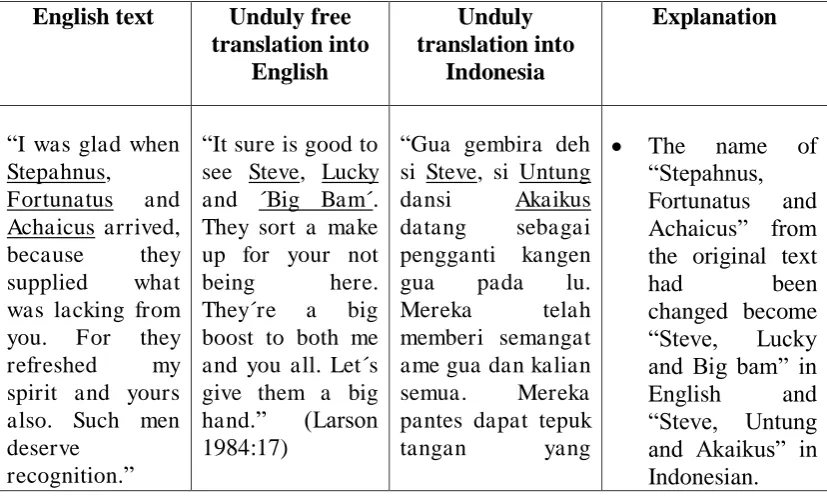
Larson (1984:17) said that sometimes unduly free translation is made for the purposes of humor for bring about a special response from the receptor language speaker. However, they are unacceptable as normal translation. For example:
(Larson 1984:17) meriah.”
The translation gives extraneous information that doesn´t exist in the source text. According to Newmark (1998:45), there are eight types of translation, those are:
a. Word for Word Translation
The SL word order is preserved and the words translated by their most common meanings. Cultural words are translated literally. The main use of this method is either to understand the mechanics of the source language or to construe a difficult text as pre-translation process.
For example:
Batak language Word for word translation into
Indonesian
Dang di rohaku mangan Tidak di hatiku makan
Here, the accurate translation is “Aku tidak berselera makan”. By using this
method we can know the mechanics of batak language, as the SL, in telling “has no appetite”.
b. Literal Translation
The SL grammatical constructions are converted to their nearest TL equivalents but the lexical items are again translated out of context. As pre-translation process, it indicates problems to be solved.
English Indonesian
I love you Aku cinta kamu
Here, the appropriate translation should be “Aku mencintaimu”. By using
literal translation, we can indicate the problem that in Indonesia we usually use article “me-” in front of a lexical verb to indicate doing something.
c. Faithful Translation
It attempts to reproduce the precise contextual meaning of the original within the constraints of the TL grammatical structures. It transfers cultural words and preserves the degree of grammatical and lexical deviation from SL norms. It attempts to be completely faithful to the intentions and the text-realisation of the SL writer.
For example: English
John is too well aware that he is naughty
Indonesian
John menyadari terlalu baik
bahwa ia nakal
d. Semantic Translation
It differs from faithful translation only in as far as it must take more account of the aesthetic value of the SL text, compromising on meaning where appropriate so that no assonance, word play or repetition jars in the finished version. It does not rely on cultural equivalence and makes very small concessions to the readership. While `faithful´ translation is dogmatic, semantic translation is more flexible.
English
He is a book-worm
Indonesian
Dia (laki-laki) adalah orang yang
suka sekali membaca
Book-worm translated flexibelly appropriate with culture context and functional restriction that accepted in target language. But translated above appropriate less and have to translated become “Dia seorang kutu buku”.
e. Communicative Translation
It attempts to render the exact contextual meaning of the original in such a way that both language and content are readily acceptable and comprehensible to the readership.
For example:
English Indonesian
I would admit that I am wrong Saya mau mengakui bahwa saya salah I will admit that I am wrong Saya akan mengakui bahwa saya salah
second sentence indicates that activities will be done by subject of the sentence. Remember in this case tenses is not influence the meaning of the sentence.
f. Idiomatic Translation
It reproduces the message of the original but tends to distort nuances of meaning by preferring colloquialisms and idioms.
For example:
English Indonesian
What are you doing? Lagi ngapain?
Idiomatic translation produces a translation that sound natural. Therefore, sometimes it even sounds like it is not even a translation.
g. Free translation
It reproduces the matter without the manner, or the content without the form of the original. Usually it is a paraphrase much longer than the original.
For example: English
How they live on what he makes? Indonesian
Bagaimana mereka dapat hidup dengan penghasilannya?
This is the freest form of translation mainly used for plays and poetry: themes/ characters/ plots preserved, SL culture converted to TL culture & text is rewritten.
All I´m looking for is only love
There is only love that I need
What I´m looking for is only love
There is only love that I see
Nothing is worth fighting only love
There is only love that makes me bleed
Nothing is worth living only love
There is only love that makes me breath
Here, we can see the translation of Anggun C. Sasmi song “hanya cinta” into “Only Love”, the English version. But the translation does not exactly transfer the
2.4. Error and Error Analysis
Ellis (1997:17) explains that errors reflect gaps in a learner‟s knowledge; they
occur because the learner does not know what is the correct one. By comparing the learner‟s native language with the target language, differences could be identified
and used to predict areas of potential error (Ellis, 1985:23).
Corder (1981:1) observes that learner‟s errors are indicative both the state of the learner‟s knowledge, and of the ways in which a second language is learned.
Strevens (1969, in Richards, 1974:4) hypothesized that errors should not be viewed as problems to be overcome, but rather as normal and inevitable indicating the strategies that learners use. He conjectured that if a regular pattern of errors could be observed in the performance of all learners in a given solution and if learners were seen to progress through this pattern, his errors could be taken as evidence not of failure but success and achievement in learning.
Error analysis is a study to investigate the errors in second language learning by collecting and describing samples made by the language learners. It is used as a procedure to analyze the errors in the language learning process to be known and corrected by using several ways of analyzing. Ellis (1985:296) states that error analysis is a procedure used by both researcher and teacher. It involves collecting samples of learner‟s language. Identifying the error in sample, describing these
Speaking of error analysis there is a clear need to distinguish between mistakes and errors in student production. Brown (2004, in Yakimovskaya, 2012:16) considers mistake a performance error, which is “a noticeable deviation from the adult
grammar of a native speaker, reflecting the interlanguage competence of the learner”.
Sometimes students fail to realize that they commit errors. Mistakes can be self-corrected. Non-native speaker or L2 learners are bound not only to make mistakes, but also commit errors in their written or oral output; one of the major reasons for this is having insufficient knowledge of target language‟s structures and rules.
2.4.1. Usefulness and Necessity of Error Analysis
Error analysis is extremely useful and multifunctional. Yakimovskaya (2012:16) emphasizes further several advantages of EA will be cited:
1. Employing EA teachers can obtain the knowledge of what areas should be paid special attention to, this will lead to a better selection of more appropriate materials and better designed curriculum; besides, it seems necessary for the instructors to know the causes of errors and reasons behind their occurrences. Being familiar with typical errors helps to prevent potential errors and correct existing ones;
2. According to Ferris (2002, in Yakimovskaya, 2012:17) there exist quite conclusive evidence that students linguistic performance will improve thanks to teacher‟s feedback and only explicit knowledge will lead to more accurate
revision of written work and speech monitoring;
learners do realize that a through error analysis will help them to turn into better language users and boost their motivation (Lee, in Yakimovskaya, 2012:17).
As has been mentioned earlier EA is a multifunctional tool used by language teachers; following Keshavars (1999, in Yakimovskaya, 2012:27) EA can be divided into applied and theoretical branches. In the case of applied error analysis the main focus is on creating appropriate materials or devising teaching strategies that are based on the results and findings of theoretical error analysis (Yakimovskaya, 2012:17). If the students have understood the error sources better, teachers are able to direct and guide the foreign language acquisition better and avoid potential problems or deal with them more efficiently.
The branch of applied error analysis, however, would be impossible without theoretical scaffolding. Its central concern is to determine or suggest the strategies and the process of foreign language acquisition and if they are similar to first language learning. Theoretical error analysis tries to analyze such learners‟ strategies as over generalization and simplification, among others.
depending whether the student has the role of language producer or language receiver. It is necessary to take into account another factor as well – universal hierarchy of difficulty, which assumes that certain linguistics features are more complex and difficult as they are independent of the mother tongue or particular capacities of the language learner.
When analyzing learner language all the aforementioned factors, reasons and causes leading to errors can help to explain the nature and origin of committed errors. Judging from regularity of certain error patterns through time teachers can get the evidence of how these patterns change or persist; their modification is to be considered a sign of effective learning (Strevens, 1969, in Yakimovskaya, 2012:20). Nevertheless, error analysis can be useful in the area of translation and investigating translation patterns of professional translators are necessaries, but studying students‟ error patterns are more necessaries with the view to improve instructional process.
2.4.2. Error Analysis in Translation
Errors in translation influence the quality of the final product and the degree of miscomprehension on the part of the reader. However, even professional translators can commit errors. Some errors are unavoidable, as they are quite normal for translators and interpreters to have vocabulary or knowledge gaps.
2.4.2.1. Translation Errors
happen when studies attempt to substitute one syntactically correct structure for another one being equally syntactically correct, but failing to be equal on a semantic level. Sager (1983, in Yakimovskaya, 2012:21) points out two major factors resulting in translation errors – incompetent in a second language and misinterpretation of the source text.
2.4.2.2. Investigation of Translation Errors Occuring When Translating into L1 Extensive research has been done on the mother tongue influence on the foreign language. Many scholars (Dulay and Burt, 1974; Brown, 1994; Kim, 1987, as cited in Yakimovskaya, 2012:22) focused on its possible interference, transfer of meaning, and cross linguistic influence, among others. However, only recently linguists (Cook, 2000; Grosjen, 2001; Joribio, 2001; Noor, 2007 as cited in Yakimovskaya, 2012:23) have started discussing and studying the phenomenon, sometimes referred to as “reverse” or “backward” transfer – L2 influence on L1
production. Kecskes and Papp (2000, in Yakimovskaya, 2012:23), for example, found that Hungarian Children who speak English as a second language use more complex syntactical structures in their mother tongue compared to those who do not have any knowledge of English. According to Yelland et al. (1993, in Yakimovskaya, 2012:23), English children who have one hour of Italian per week develop better reading skills in their L1 than those who do not.
2.4.2.3. Translation Error Categorization
reasons – false friends or situations that have no or too many adequate and equivalent translations (Newmark, 1988, in Yakimovskaya, 2012:25), lack of grammar knowledge (Nord, 1991, in Yakimovskaya, 2012:25).
One of the most famous, and at the same time the most general, categorization was proposed by Newmark (1988, in Yakimovskaya, 2012:25), who divided most of the errors into two types: referential and linguistic. According to this classification, referential errors refer to all the errors linked to misinterpretation of facts or information in the real word, whereas linguistic errors are induced by the translator‟s
lack of proficiency in foreign language. Corder (as cited in Yakimovskaya, 2012:25) grouped errors into two categories: overt (easily identifiable due to their ungrammatical nature) and covert errors (grammatically correct, but failing to transmit the message in communication).
2.5. Grammatical
Burton (1986:251) states that the function of the grammar of a language is to specify which word sequences are, and which are not, in the infinite set of its sentences. Burton (1986:252) also states that a grammar is the description of a language by means of a definition of „sentence‟ in that language.
(grammatically well-formed) phrases, how phrases are put together to form (grammatically well-formed) clauses, and how clauses are put together to form (grammatically well-formed) sentences.
For my research, the writer chose the kinds of grammatical error by Richard (1974:15). Richard (1974:15) suggests that “ultralingual errors are those which reflect the general characteristics of rule learning, such as faulty generalizations, in complete application of rules, and failure to learn conditions under rules apply.” This
can happen when the subject is going out from the rule of a grammar in context. He also states that translation errors can be categorized as follows:
1. Errors in the Production of Verb Groups
In this case, the translation errors are related to the production of verb such as gerunds, infinitives, participles (present/past), errors in the use of verbs forms after modals, and the production of agreements of verbs with subject. The examples are as follows:
a. Errors in the production of tense forms
- He is speaks French.
- He did not asks me.
b. Errors in the production of verbs forms
- I enjoy to work.
c. Errors in the use of verbs forms after modals
- She cannot goes.
- We must worked hard.
d. Errors in the production of agreements of verbs with subjects
- She go to school everyday.
- They walks to the market.
2. Miscellaneous Errors
Miscellaneous errors are classified into errors in the use of pronouns, errors in the adverbs, errors in the use of adjectives, errors in the use of „too‟ or „so‟, errors in the position of words, errors in the use of plural,
and errors in the use of conjunctions. The example are as follows:
a. Errors in the use of pronouns
- Ann met I at the museum.
- She walked between Eni and he.
b. Errors in the use of adverbs
c. Errors in the use of adjectives
- I met a kindly man.
- She is a beautifully woman.
d. Errors in the use of „too‟ or „so‟‟
- I am so lazy to stay at home.
- I am too tired that I cannot work.
e. Errors in the position of words
- She swims often in Tretes.
- He really is a good architect.
f. Errors in the use of plural
- Tina bought a watches.
- There are two dog in his house.
g. Errors in the use of conjunctions
- Though he is poor, but he is very diligent.
- Is a lemon sweet but sour ?
2.6. Relevant Studies
Audiovisual Translation examines error patterns in students‟ translation of the audiovisual discourse and factors influencing the process of interpretation. The data of this study are collected from L2 learners studying at the Department of Translation and Interpretation at Pyatigorsk State Linguistic University (the city of Pyatigorsk, Russia) and organized in two corpora. Being very typical genres present in any motion picture, a monologue and a dialogue were under consideration.As translation into the mother tongue is usually considered to be the norm, abstracts taken from the movie script were rendered by participants from English (L2) into Russian (L1). Her paper can be understood that employing error analysis method often recurred to when studying erroneous forms in student productions, the study established the error taxonomy based on the word‟s lexical meaning of the lexical item. An
additional group of errors was specified for some variants encountered in the monologue and caused by the complexity of syntactical structures unfamiliar to the learners. This research shows several error patterns typical for both the monologue and the dialogue and in accordance with the results some pedagogical applications were formulated in order to improve the didactics of audiovisual translation training. Therefore, it helps the writer in understanding error analysis in translation.
sample was placed under its possible category of errors. Their paper can be understood that grammatical errors held the highest frequency among the other types of errors presented by Keshavarz (1993), holding fifty percent of the total errors occured. Thus, from their paper the writer knows how to use kinds of error by Keshavarz‟ theory in the translation product.