“Midwives Leading The Way
with Quality Care”
PROCEEDING
The International Midwifery
Scientic Conference 2018
Jakarta, Indonesia | May 3-5, 2018
2018
2018
The International Midwifery Scientific ConferenceP R O C E E D I N G
INTERNATIONAL MIDWIFERY SCIENTIFIC CONFERENCE, 2018
“Midwives Leading The Way
with Quality Care”
Conference Committee
Indonesian Midwives Association (IBI/IMA)
Integrated Midwives Association of the Philippines (IMAP), Inc.
2018
Proceeding
International Midwifery Scientific Conference, 2018
May 3rd – 5th, 2018, Jakarta, IndonesiaHosted By IMA/IBI & IMAP
“Midwives Leading The Way with Quality Care”
Editorial Board
Editor in Chief
: Dr. Emi Nurjasmi, M.Kes
Managing Editor
: Yetty Irawan, MSc
Copy Editors
:
1.
Dr. Indra Supradewi, SKM, MKM
2.
Laurensia Lawintono, MSc
3.
Erika Yulita, SST, M. Keb
4.
Zulvi Wiyanti, SST, M.Kes
5.
Bintang Petralina, SST, M.Keb
Editorial Assistant
: Lukmanul Hakim
Technical Editor
: Siti Fatimah, S.Keb, Bd.
ISSN 2599-0411
All rights reserved. Permission to make digital or hard copies of all or part of this work for personal or classroom use is granted without fee provided that copies are not made or distributed for profit or commercial advantage and that copies bear the copyright notice and the full citation on the first page. To copy otherwise, or republish, to post on servers or to redistribute to lists, requires prior written permission of Indonesian Midwives Association (IMA). Indonesian Midwives Association (IMA) is not responsible for the use which might be made of the information contained this book.
Publisher
: Indonesian Midwives Association (IBI/IMA)
Redaksi:
Pengurus Pusat Ikatan Bidan Indonesia
Jl. Johar Baru V No. D13, Johar Baru
Jakarta Pusat 10560 Indonesia
Phone: +6221 4226043, 4247789
Email:
[email protected]
www.ibi.or.id www.e-journal.ibi.or.id/jib/pit Copyright © 2018 by IBI.ACKNOWLEDGMENT
The International Midwifery Scientific Conference 2018 Committee would like to thank all
those people who were involved in making the conference a success.
A great amount of planning an
d organizing is required to hold a successful conference.
We want to thank all speakers for their contribution to the conference;
1.
Prof.Dr.dr. Nila Djuwita F.Moeloek,SpM - Ministry of Health of Republic of Indonesia
2.
Ministry of Research Technology and Higher Education of Republic of Indonesia
3.
Susan Jane Bree - New Zealand College of Midwives
4.
Dr. Emi Nurjami, M.Kes - Indonesian Midwives Association
5.
Asuncion S. Esmele,RM – President of Integrated Midwives Association of the
Philippines (IMAP), Inc.
6.
Patricia M. Gomez, RM - Executive Director Integrated Midwives Association of the
Philippines (IMAP), Inc.
7.
Alejandro R. San Pedro, M.D.,FPOGS - Philippine Obstetrical and Gynecological
Society
8.
Dr. John Flores - Integrated Midwives Association of the Philippines (IMAP), Inc.
9.
dr. Yudianto Budi Saroyo, SpOG (K) - Indonesian Society of Obstetrics & Gynecology
(POGI),
10. Dr. Annette Sachs Robertson–United Nations Population Fund (UNFPA) Indonesia
Representative,
11. Dr. R. Adhi Teguh Perma Iskandar, SpA (K) - Indonesian Pediatric Society (IDAI)
12. Dr. N. Paranietharan - World Health Organization (WHO) Indonesia Representative
13. All researchers and academics in the midwifery field who present their paper in this
conference
Lastly, we are indebted to all committees who volunteered their time and energy for their
great support and contribution to help organize successful conference.
Conference Committee
Proceeding - International Midwifery Scientific Conference 2018
iv
FOREWORD/PREFACE
Every year on May 5th the world celebrate as International Day of The Midwife (IDM) where
internationally midwives, embrace the individual midwife development their professional
skills through many activities with aims to strengthen the network within midwives as well as
other professions to enlarge the knowledge and skills of midwives inselfs.
In order to commemorate IDM 2018, Indonesian Midwives Association (IMA/IBI) in
collaboration with Integrated Midwives Association of the Philippines (IMAP) will held an
INTERNATIONAL
MIDWIFERY
SCIENTIFIC
CONFERENCE
ON
CELEBRATING
THE
INTERNATIONAL DAY OF THE MIDWIFE 2018, it hold in Jakarta, Indonesia on May 3rd up to
May 5th, 2018.
The International Midwifery Scientific Conference is a scientific forum aimed to improve
knowledge and skills of midwives in optimizing the quality care of maternal & child health,
and family planning. This conference, also, as an opportunity to facilitate researchers and
scientists in midwifery field to conduct scientific discussions on developments, as well as
current issues related with Maternal and Child Health services at national and global context.
The 2018 conference theme is “Midwives Leading the Way with Quality Care”.
The International Midwifery Scientific Conference continues a tradition of bringing together
researchers, academics and professionals from all over the world, experts in midwifery. The
conference particularly encouraged the interaction of research students and developing
academics with the more established academic community in an informal setting to present
and to discuss new and current work. Their contributions helped to make the Conference as
outstanding as it has been.
This proceedings record the fully refereed papers presented at the conference. The papers
contributed the most recent scientific knowledge known in the field of midwifery. This
Proceeding will furnish the scientists of the world with an excellent reference book and also
be an impetus to stimulate further study and research in all midwifery areas.
We thank all authors and participants for their contributions.
Indonesian Midwives Association
ISSN 2599-0411
TABLE OF CONTENTSACKNOWLEDGMENT ... iii
FOREWORD/PREFACE ... iv
TABLE OF CONTENTS ... v
PLENARY SESSION SUMMARY
1.
Alejandro R. San PedroEclampsia ... 1-2
2.
Patricia M. GomezChallenges: The Provision of Maternal and Child Health Services by Midwives
In Developing Country ... 3
3.
Rustini FloranitaGlobal Strategic for Midwifery’s Human Resources in Universal Health Coverage Era ... 4
ORAL PRESENTATION
1.
Dainty Maternity,Zakiyatus SalamahPeppermint Oil Giving Effect of Pregnant Women
With Pruritus (Itching) and Trimester III ... 5-10
2.
Sri Wahyuni, Anies, Ariawan Soejoenoes, Suhartono Taat Putra
Perceived Stress and Syndrome Depression among Primigravida Women ... 11-17
3.
Majestika Septikasari
Determinants of Stunting In Tambakreja Village, South Cilacap District, Cilacap ... 18-23
4.
Nurul Husnul Lail, Aulia Restiani
Related Factors with Highly Preeclampsia Events in Pregnant Woman at
Dr. Adjidarmo District Lebak Banten Province in 2016 ... 24-31
5.
Risza Choirunissa, Andi Julia Rifiana
The Effect of Temu Putih (Curcuma Zedoaria) Therapy to Fluor Albus
In Women of Reproductive in Private Midwifery Clinic of Mrs. “S” Midwife On 2017 ... 32-42
6.
Emy Suryani, Siswiyanti
Effectivity of temulawak instant to milk production in postpartum mother ... 43-48
7.
Qorinah Estiningtyas Sakilah Adnani, Judith McAra-Couper, Andrea GilkisonThe Symphony Orchestra of Midwifery Education in Indonesia: a Discussion Paper ... 49-59
8.
Jessie T. OranoProceeding - International Midwifery Scientific Conference 2018
vi Post-Partum Umbilical Cord Care Practices: Basis for Umbilical Cord Home Care Guidelines ... 60-65
9.
Maria Teresa Cruz-PadillaCompetencies of Midwifery Educators: As Basis for the Continuing Education Program ... 66
10.
Asuncion S. Esmele, RM
Labour and Delivery Care: Using the Partograph ... 67
11.
Lourdes Mangahas
Private Birthing Clinics As Alternative to Hospital Births ... 68-69
12.
Jessie T. Oraño
Compliance Level of Registered Midwives to Take Bachelor of Science in Midwifery ... 70
13.
Jordan Hiso Llego, Christopher R. Bañez
Urdaneta City University Midwives across the Years: A Tracer Study ... 71-78
14.
Paras, Corazon L.
Expanding Quality Midwifery Care through Open Lying-In Clinics ... 79-81
15.
Desi Rusmiati, Tiurlan Yunetty Silitonga, Warendi
Knowledge, Attitude and Intention for Early Detection for Cervical Cancer
On Commercial Sex Worker ... 82-85
16.
Dewa Ayu Putu Mariana Kencanawati
Proses Internalisasi Pesan Kehamilan Dengan Media Tradisional (Natoni) Di Kelurahan Bello ... 86-90
17.
Ignasensia D. Mirong
Comunity Screening Sebagai Upaya Deteksi Dini Masalah Kesehatan Bayi Baru Lahir Di Kelurahan Fatukoa Kecamatan Maulafa Kota Kupang Tahun 2016 ... 91-94
18.
Wiwin Mintarsih P
Replikasi Kegiatan Pemanfaatan Buku KIA Melalui Kegiatan Pendampingan
Ibu Hamil, Ibu Balita Oleh Mahasiswa Dan Kader Kesehatan Di Kabupaten Tasikmalaya ... 95-101
19.
Gita Kostania
Efektifitas Penyelenggaraan Kelas Ibu Balita Terhadap Pengetahuan Dan Perilaku Ibu
Tentang MP-ASI Usia 6-12 Bulan Di Wilayah Puskesmas Wedi Kabupaten Klaten ... 102-109
20.
Sri Wahyuni., Astri Wahyuningsih, Wiwin Rohmawati
Kecemasan Dan Kualitas Tidur Ibu Hamil Trimester III ... 110-114
21.
Fitriyani , Suparni , Risqi Dewi Aisyah
Hubungan Usia, Tingkat Pendidikan dan Status Gravida dengan Pengetahuan tentang Brain Booster Pada Ibu Hamil ... 115-120
22.
Nur aini, Desi Rusmiati
Resiko Ergonomi Lowbackpain Dalam Menolong Persalinan
Pada Bidan Praktik Mandiri Di Kecamatan Cimangggis ... 121-124
23.
Rizqi Sri Ayuningsih, Fitria Sari
Komplikasi Persalinan Terkait Preeklampsia Pada Ibu Bersalin
Di Puskesmas Pedes Karawang Tahun 2017 ... 125-132
24.
Sih Rini Handajani, Kh Endah Widhi Astuti
Budaya Pemberian Jamu Cekok Terhadap Peningkatan Berata Badan Batita
Usia 12 Sd 36 Bulan Di Wilayah Kota Surakarta ... 133-142
25.
Yulizawati, Detty Iryani, Lusiana El Sinta Bustami, Aldina Ayunda Insani, Feni Andriani
Analisis Penerapan Mentorship Model Sebagai Upaya Peningkatan Sikap Profesionalisme
Mahasiswa Prodi S1 Kebidanan Tentang Life Skill Profesi Bidan ... 143-149
26.
Yuseva Sariati, Oktavia Manda, Fajar Ari Nugroho
Effect of Green Coconut Water (Cocos Nucifera L.) Toward Pain Intensity
Change of Primary Dysmenorrhea in Young Female ... 150-155
27.
Jundra Darwanty, Lia Komalasari, A.Achmad Fariji
Relevansi Kompetensi Lulusan Program Studi Kebidanan Dengan Kebutuhan Dunia Kerja ... 156-162
28.
Nursari Abdul Syukur, Widyani Utami, Hj. Endah Wahyutri
Hubungan Kadar Hemoglobin pada Ibu Menyusui dengan Kualitas Protein Air Susu Ibu
di Wilayah Kerja Puskesmas Sei Kapih Samarinda Ilir ... 163-169
29.
Henry Manik
Pengaruh Peran Ibu Mertua Terhadap Perubahan Perilaku Ibu
Dalam Upaya Penurunan Aki Di Kabupaten Dairi... 170
30.
Bringiwatty Batbual
Effect of Self-Management to Performance of Investment in Implementation of Prosperity In Pregnant Women in Pregnant Woman in Kupang Regency in the Year 2017 ... 171
POSTER PRESENTATION
1.
Fakhriah, Elli Hidayati
The relationship between maternal factors and Fetal Factors with Delivery of Sectio Caessarea (SC) in maternity mothers at RSIJ Sukapura,
North Jakarta Period 2014- 2016 ... 172-179
2.
Kusmayra Ambarwati, Santi Agustina, Fitria Sari, Miftahul Jannah
The phenomenon of displacement of Professional Midwives in Field Works
(Study Learning & Working in the Diploma IV Program Educator Midwives) ... 180-186
3.
Nelly Apriningrum
Evaluation Input and Output of Cervical Cancer Prevention Program
With Visual Inspection Acetic Acid (VIA) in Karawang District ... 187-193
4.
Rus Martini and Maryanah.
Effect of Relaxation Exercise Pregnant With Low Back Pain ... 194-197
5.
Sri Dinengsih, Ria Rista Indrianti
Relationship between Age, Knowledge of Tradition and Family Support With The Preliminary Circumsition in Babygirl/Female Infant in Cikaduen Village,
In Pandeglang District Banten Province In 2017 ... 198-206
6.
Zulaeha A Amdadi , Agustina Ningsi, Suriani B
Pengaruh Sosialisasi Dalam Mengawal Kehamilan Ibu Dengan Cerdas Terhadap
Pengetahuan Kader Posyandu Dikelurahan Sambung Jawa Kota Makassar Tahun 2017 ... 207-211
7.
Diana Hartaty A, Fauziah
Pengaruh Pijat Bayi Terhadap Kenaikan Berat Badan Dan Panjang Badan Pada Bayi
(Studi Pada Bayi Di Posyandu Kecamatan Cipayung Jakarta Timur) ... 212-215
8.
Endang Siti Mawarni, Dewi Utami, Yuna Trisuci Aprillia
Determinan Yang Berhubungan Dengan Perilaku Vulva Hygiene Pada Siswi
Di SMK X Kota Depok Tahun 2017 ... 216-221
9.
Eprila, Desti Dwi Lestari, Fitria Ramadhani
Pengaruh Hypnobirthing Terhadap Intensitas Rasa Nyeri Dan Kemajuan Persalinan
Pada Ibu Bersalin Di Bpm Kota Palembang Tahun 2017 ... 222-224
10.
Erli Zainal, Iin Nilawati
Proceeding - International Midwifery Scientific Conference 2018
viii Hubungan Ukuran Lila Dan Pertambahan Berat Badan Ibu Selama Hamil Dengan
Berat Badan Bayi Lahir Di Bpm Wilayah Kerja Puskesmas Sawah Lebar Kota Bengkulu ... 225-230
11.
Erliana Ulfah, Teni Nurlatifah HR
Peningkatan Antibodi Pasca Vaksinasi Meales Rubella (MR) Dengan Edmonston-Zagreb (EZ) .... 231-236
12.
Erny Elviany Sabaruddin, Yossi Fitria Damayanti, Daniah
Perbedaan Karakteristik Ibu Dalam Perilaku Penyapihan Balita Di Posyandu Mulya I
Kelurahan Balekambang Jakarta Timur Tahun 2017 ... 237-244
13.
Evy Nurachma
Manfaat Pendidikan Kesehatan Tentang Sadari Terhadap Pengetahuan dan Sikap
Remaja Puteri di SMAN 36 Samarinda Tahun 2017 ... 245-249
14.
Fatimah, Aning Subiyatin, Bilqis Fauzi Islamiah
Relationship between Maternal Factor, Fetal Factor and Placenta Factor
With Low Birth Weight Event in Cempaka Putih Islamic Hospital 2014-2016 ... 250-258
15.
Fauziah Yulfitria
Hubungan Tingkat Kecemasan Dengan Gangguan Menstruasi
Pada Mahasiswa Kebidanan Jakarta ... 259-265
16.
Hadina, Jusuf S Effendi, Hadi Susiarno, Herry Herman, Johanes C. Mose, Deni KSunjaya,
Mardiani Mangun, Hadriani
Learning Process Factors Influencing Graduation Competency Test Diploma III Midwifery
in Polytechnic Midwifery Department of Health Ministry of Palu ... 266-275
17.
Herizasyam
Pengaruh psikoedukasi pada primigravida terhadap jenis persalinan dan
komplikasi persalinan ( studi di wilayah puskesmas jakarta timur tahun 2017) ... 276-284
18.
Hetty Astri, Farida Alhadar
Studi Etnografi Kesehatan Ibu Dan Anak Pada Etnik Ternate Di Kecamatan Pulau Ternate
Provinsi Maluku UtaraTahun 2017 ... 285-291
19.
Junengsih
Kesiapan Fisik Remaja Putri Menjadi Calon Ibu Sehat
Dan Faktor-Faktor Yang Mempengaruhinya ... 292-299
20.
Lestari Wati
Kajian Hubungan Cemas Terhadap Nyeri Pada Persalinan ... 300-303
21.
Lolli Nababan, Sari Widyaningsih
Hubungan Usia Ibu Bersalin Dengan Kejadian Asfiksia Di Ruang Mawar
RSUD Dr. M. Yunus Bengkulu Tahun 2017 ... 304-307
22.
Lusi Andriani, Sri Yanniarti, Mariati
Pengaruh Media Film Berbasis Budaya Bengkulu Terhadap Pengetahuan Dan
Motivasi Wanita Usia Subur (Wus) Dalam Deteksi Dini Kanker Serviks Dengan IVA Tes ... 308-316
23.
Melly Damayanti
Pengaruh Penggunaan Game Kesehatan Reproduksi (Game KEPO) terhadap Motivasi
Kesehatan Reproduksi Remaja Perempuan ... 317-323
24.
Ari Indra Susanti, Neneng Martini, Nurulia Eka Rahmawati
Impact Using The Calender For Monitoring Consumption Tablet Fe On
Haemoglobin Levels Pregnant WomanIn District Community Health Centers Jatinangor ... 324-331
25.
Nessi Meilan
Faktor-Faktor Yang Berhubungan Dengan Perilaku Pencegahan Obesitas Pada Remaja Putri .... 332-338
26.
Ni Nyoman Budiani, Nyoman Suindri, Wayan Suarniti, Dwi Mahayati, Erny Astiti
Hambatan Pembentukan Spermatogonia Anak Tikus Wistar Yang Memeroleh Paparan
Genistein Pada Masa Perikonsepsi ... 339-347
27.
Ni Wayan Ari Adiputri ,Ni Nyoman Deni Witari, Ni Made Darmiyanti
Perbedaan Nyeri Persalinan Kala I Fase Aktif Sebelum Dan Sesudah Pemberian
Aromaterapi Lavender Pada Ibu Primigravida Di Bpm Ni Ketut Nuriasih, S.St, MM ... 348-351
28.
Nova Yulianti, Putri Argianti, Lily Herlina, Siti Nur Indah Oktaviani
Early Detection of Growth and Development Children by Pre – Screening
Questionnaire of Development (Kpsp) At Central Jakarta In October 2017 ... 352-356
29.
Nur Azizah, Erien Luthfia, Umu Qonitun.
Penerapan Inisiasi Menyusu Dini (Imd) Pada Ibu Bersalinterhadaplama Kala III
Dan Pemantauan 2 Jam Paska Persalinan Di Ruang Mina Rs Muhammadiyah Tuban ... 357-363
30.
Rismayani, Dita Selvianti
Hubungan Pengetahuan Wanita Usia Subur Dengan Deteksi Dini Kanker Serviks Menggunakan Metode Iva Di Wilayah Kerja Puskesmas Ratu Agung Kota Bengkulu Tahun 2017... 364-370
31.
Rohmi Handayani, Kuswati
Perbedaan Densitas Mineral Tulang Pada Akseptor Implan Dengan
Akseptor KB Non Hormonal ... 371-377
32.
Sri Wahyuningsih, Ika Rahmawati, Farianingsih
Pelaksanaan Proses Rujukan Terhadap Kesakitan Dan Kematian Ibu Di
RSUD Dr. Haryoto Kabupaten Lumajang Jatim ... 378-381
33.
Sriningsih, Sugeng Mashudi
Optimalisasi Kearifan Lokal Senam Jathilan Ponorogo Terhadap Percepatan
Persalinan Pada Ibu Hamil (Pendekatan Teori Goal Attainment) ... 382-387
34.
Wiwik Muhidayati, Dian Sukmawati
Pengaruh Tehnik Hypnobirthing Terhadap Frekwensi Dan Durasi His
Persalinan Normal Pada Ibu Primigravida Kala I ... 388-394
35.
Anggani Debyanti Larosa, Wulan Nur Insani
Hubungan Maturitas Bayi Dan Inkompatibilitas A B O Antara Ibu Dan Bayi Dengan Kejadian Ikterus Neonatorum Di Ruang Perinatologi
RSUD Majalengka Periode Mei 2016 – April 2017 ... 395-400
36.
Yuna Trisuci Aprillia , Hetty Sandayani, Endang Siti Mawarni
Faktor Yang Berhubungan Dengan Kejadian Anemia Pada Ibu Hamil
Di Puskesmas Kampus Kota Palembang Tahun 2017 ... 401-408
37.
Rosni Lubis, Rusmartini
Hubungan Pengetahuan, Sikap, Dukungan Keluarga Dan Bidan Dengan Pelaksanaan Inisiasi
Menyusu Dini (Studi Di Wilayah Puskesmas Jakarta Timur Tahun 2017) ... 409-413
38.
Mariati, Rialike Burhan, Lusi Andriani
Positive Deviance (Pd) Pada Status Anemia Ibu Hamil Di Kelurahan Padang Serai
Kota Bengkulu ... 414
39.
Yunefit Ulfa, Shigeko Horiuchi
Effectiveness Of Team Based Learning As A Learning Method; A Systematic Review ... 415
40.
Heri Rosyati, Hamidah
Proceeding - International Midwifery Scientific Conference 2018
x Dengan Ketuban Pecah Dini Di Puskesmas Kecamatan Menteng Tahun 2017 ... 416
PLENARY
SESSION
E C L A M P S I A
Alejandro R. San Pedro
Philippines
Eclampsia remains to be among the two top main causes of direct maternal death and
disability in the Philippines. Eclampsia is defined as new onset of grand mal seizure
activity and/or unexplained coma during or after the 20th week of gestation or
postpartum in a woman with signs or symptoms of preeclampsia. However, eclampsia
can occur even in the absence of hypertension with proteinuria based on a study in the
UK. Similarly, hypertension was absent in some cases of eclampsia in a review done in
the United States.
Most cases of eclampsia presents in the third trimester of pregnancy, with about 80% of
eclamptic seizures occuring intrapartum or within the first 48 hours following delivery.
Early detection of preeclampsia is important to identify its clinical manifestations like
hypertension and proteinuria and even some coexisting systematic abnormalities
involving the kidneys, liver or blood. The fetal manifestations of preeclampsia are fetal
growth restriction, reduced amniotic fluid, and abnormal fetal oxygenation.
Delivery of the fetus is the only cure for severe preeclampsia. Magnesium sulfate
(MgSO4) for seizure prophylaxis, antihypertensive management, induction of labor or
cesarean section are treatment options. Although delivery is appropriate for the
mother, it may not be optimal for the premature fetus. Antenatal corticosteroid
injection given to the mother promotes lung maturity of the preterm fetus.
In the Philippines the use of MgS04 is the mainstay in the treatment of eclamptic
convulsion and for seizure prophylaxis for severe preeclampsia. Injection of a loading
dose of MgSO4 is among the signal functions of Basic Emergency Obstetrics and
Newborn Care (BEmONC) for those practicing in areas remote from the hospital. The
use of this life saving drug by midwives is guided by a Philippine Department of Health
Administrative Order (DOH A.O. No. 0020-2015). However, the DOH A.O. specifies that
the drug should be given by a midwife who is trained on its use, the presence of an
E C L A M P S I A
2
obstetrical emergency that warrants it and that there is no doctor. Because the
Midwifery Act of 1992 regulates midwifery practice that focuses on normal pregnancy,
labor and childbirth, a standing order by the back-up doctor in a health facility is
required. MgSO4 injected to the mother is also known to provide neuroprotection to
the newborn baby.
Prevention of preeclampsia and eclampsia remains illusive, although some drugs have
been found to be useful. Given the importance of MgSO4, learning its pharmacology and
safe use gains value because this drug will benefit many women with eclampsia or
severe preeclampsia and their babies when the need for it arises.
CHALLENGES : THE PROVISION OF MATERNAL AND CHILD HEALTH SERVICES BY MIDWIVES IN DEVELOPING COUNTRY
Ms. Patricia M. Gomez, RM
Executive Director Integrated Midwives Association of the Philippines (IMAP), Inc.
Introduction
Midwives in the Philippines face challenges in improving their status and practice. The Department of Health epidemiological trend studies revealed that each year about 2.3 Filipino women become pregnant. An estimated 2 million would give birth per year. In 2010, the maternal mortality ratio due to complications occurring in the course of labor, delivery and puerperium is 38.4/ 1000 live births (DOH 2010), hypertensive complications is 35.2 / 1000 live births (DOH 2010) which can be attributed to close birth spacing, too frequent poor detection management of high risk pregnancies, inadequate referral system, maternal micronutrient malnutrition and inadequate and low utilization of health services, and deliveries done at home. It is for this reason that an assessment of the provision of comprehensive approach of preventive and curative maternal and newborn health care along with legal mandates such as Midwifery Act, Midwifery Education, Continuing Professional Development, Competencies Standards of Practicing Midwives, Political System, increasing trend of private birthing clinics, referral system will be the focus of this paper.
Proceeding - International Midwifery Scientific Conference 2018
GLOBAL STRATEGIC FOR MIDWIFERY’S HUMAN RESOURCES IN UNIVERSAL HEALTH COVERAGE ERA
Rustini Floranita
NPO RMNCAH/GER, WHO Indonesia
In December 2012, the United Nations General Assembly called upon all governments to “urgently and significantly scale up efforts to accelerate the transition towards universal access to affordable and quality healthcare services”. The evolving momentum for universal health coverage (UHC), with its principles of equity and social justice, aims to ensure that all members of a society can access the health-care services they need without incurring financial hardship. UHC encompasses the three dimensions of who is covered (population coverage), what is covered (health-care benefits) and how much of the cost is covered (financial protection), all of which may expand over time.
Addressing these three dimensions of UHC within the boundaries of fiscal space is challenging for all countries. It requires continuing political commitment and leadership to distribute available resources, especially human resources for health (HRH), in an efficient, equitable and sustainable manner to match population needs. The health workforce is central to a country’s response to these challenges. Reaching a greater percentage of the population, extending the benefit package and improving the quality of the care provided requires commensurate attention to the governance and management of the health-care workforce, including its stock, skill mix, distribution, productivity and quality. Matching population health needs with a supply of competent and motivated health workers that are both fit for purpose and fit to practice in the country context is therefore the foundation for accelerating the attainment of UHC.
Nursing and midwifery services are key components of health systems and are essential to society. The contribution of nurses and midwives has long been acknowledged as being crucial to improving the health outcomes of individuals, families and communities. Nurses and midwives being a part of the frontline workers are engaged in efforts to promote health, prevent illness and to renew Primary Health-care (PHC) based on the core values of equity, solidarity, social justice, universal access to efficient and affordable services, multisectoral action, decentralization and community participation.
Universal Health Coverage (UHC) encompasses principles of equity and social justice, arising from the ‘Health for All’ movement of the 1970s, and enshrined in the Alma Ata Declaration on Primary Health-care in 1978. The Government Chief Nursing and Midwifery Officers (GCNMOs) participating in the 2014 Global Forum recognizes that to achieve UHC, several factors must be in place. In particular, a functioning and efficient health system that meets population health needs through people-centred integrated care is essential. Such a system should ensure that people seeking health services do not suffer financial hardship when using and accessing healthcare services. Above all, there should be appropriately educated, regulated, and motivated health workers to provide the services.
The nursing and midwifery professions continue to evolve and their roles are influenced by local and global challenges. Nurses and midwives are prepared to respond and manage health-care needs across the life span. Within the context of Primary health-care and UHC, nursing and midwifery services contribute to reduction of morbidity and mortality, resulting from emerging and re-emerging health problems. Nurses and midwives are frontline professionals who use an integrated and comprehensive approach including health promotion, disease prevention, treatment, rehabilitation and palliative care.
ORAL
PRESENTATION
SESSION
PEPPERRMINT OIL GIVING EFFECT OF PREGNANT WOMEN
WITH PRURITUS (itching) AND TRIMESTER III IN BPS NURHASANNAH S.Tr.Keb TELUK BETUNG SELATAN BANDAR LAMPUNG YEAR 2017
Dainty Maternity,Zakiyatus Salamah
ABSTRACT
Based on research, about 18% of pregnant women in France suffered pruritus. In India of 200 pregnant women, approximately 61.5% were experiencing pruritus. Pruritus is a sensation of skin irritating and provoking to scratch. Itch receptors are not myelinated, has a brush-like nerve endings (penicillate) which is only found in the skin, mucous membranes and cornea. The purpose of research is known the effect of peppermint oil in pregnant women with pruritus (itching) in the third trimester Str.Keb Nurhasannah BPS Teluk Betung Selatan Bandar Lampung Year 2017. This type of research is quantitative approach to pre-experimental design withmethod one sample pretest posttest. The population in this study is the third trimester pregnant women who experienced pruritus (itching) in BPS Nurhasannah, S.Tr.Keb Teluk Betung Selatan Bandar Lampung in 2017. This study was conducted in February-August 2017. Obtained a sample of 15 people with the criteria of pregnant women with pruritus gravidarum, willing to become respondents and peppermint oil applied only to the experiencing itching. Data collection using observation sheet and univariate analysis of data is T-dependent test. The survey results revealed the average value before administration of peppermint oil amounted to 4.67 with a standard deviation of 1.234, while the average value after being given peppermint oil was 2.93 with a standard deviation of 1.223. There is the effect of peppermint oil to cope with pruritus (itching) in the third trimester pregnant women (p value < 0.05 is 0.000). Expected in pregnant women to pay attention to health during pregnancy, especially their symptoms of pruritus (itching) during pregnancy and how to cope by using peppermint oil.
Keywords: Peppermint oil, pruritus (itching), Maternal, Trimester III
PRELIMINARY
Pregnancy is defined as the fertility or unification of spermatozoa and ovum and followed by nidation or implantation. When calculated from the time of fertilization until the birth of the baby, normal pregnancy will take place within 40 weeks or 10 months or 9 months according to the international calendar. 1
Hormonal changes that are triggered by a normal pregnancy may have a considerable effect on the skin. Itchiness or in the world of health is called Pruritus is a common discomfort in the second trimester, or higher in the trimester that occurs when bile secretion does not flow normally in the small channel in the liver, bile salts accumulate in the skin, which makes itchy. Itching can be a person who can be brief and feels normal, and feel a strange excitement when it can scratch that itchy part. There will be some people who take chronic irritants that are very disturbing for years and are felt throughout the body. Itching is very great, can be mentally stressed. Chronic pruritus can really go down the quality of life, arise not pretty anymore due to the rash that imprint on the body.2
Pruritus is an irritating skin sensation and gives rise to stimulation to scratch. The itching receptors do not bermelelin, have a penicillate nerve endings found only in the skin, mucous membranes and cornea. Pruritus is one of the most common complaints of dermatologic disorders. Pruritus is a symptom and various skin diseases. If not accompanied by skin disorders, then called Pruritus Essential or Pruritus sine materia. Essential pruritus is caused by or associated with many conditions. 3
Pruritus gravidarum is induced by estrogen and is sometimes associated with cholestasis (obstruction and stasis in the bile ducts). Pruritus is especially present in the last trimester of pregnancy, starting with the abdomen or body, then becoming a generalist. There are times when Pruritus is accompanied by anorexia, nausea, or vomiting. The objective looks excoriated because of scratching. Pruritus will disappear after delivery, but may be residual in subsequent pregnancies.3
Pruritus treatment can be done using peppermint. Peppermint (Mentha piperita) is a mint family. This plant contains essential oils that the main component is menthol (50-60%). By cooling the skin, menthol, decrease the itch caused by histamine. The administration of pappermint oil during pregnancy
Pepperrmint Oil Giving Effect Of Pregnant…
6
and breastfeeding has no toxic effects present in pappermint oil in overcoming pruritus in pregnancy. The mechanism of menthol effect inhibits itching by activating the A-delta fibers and k-opioid receptors so as not to cause harmful effects for the mother and fetus.4
The results of pre-survey conducted by researchers who average pregnant women who checked into BPS Nurhasannah Str.Keb Teluk Betung Selatan Bandar Lampung as many as 42 people from that number as many as 13 people or (30.95%) who complained Pruritus (itching) during pregnancy.
It is the background of the author to compose Scientific Writing with the title "The Influence of Pepperrmint Oil Giving on Pregnant Women with Pruritus (itching) In Trimester III at BPS Nurhasannah Str.Keb Teluk Betung Selatan Bandar Lampung Year 2017”.
RESEARCH METHODS
The type of research used is quantitative with pre experimental design approach with one sample pretest posttest method. Population in this research is pregnant mother of trimester III that experiencing pruritus (itching) at BPS Nurhasannah, S.Tr.Keb Teluk Betung Selatan Bandar Lampung 2017. This research was conducted in February - August 2017. Obtained sample of 15 people with mother criteria pregnant with pruritus gravidarum, willing to be the respondent and peppermint oil is applied only to the itchy part.
Data collection using observation sheet and univariate analysis of data used is T-dependent test.
WORK STEPS
1. Pre experiment: pre test is done by using VAS used to view Pruritus image before intervention. 2. Experiments: giving 0.5 peppermint essential oil. Peppermint contains essential oils whose components are menthol (50-60%). By cooling the skin, menthol, lower itch caused by histamine by applying on the part of the Pruritus (itching) done 2 times a day for 2 weeks. 3. Post trial: post test conducted using VAS used to view Pruritus picture after intervention.
MEASUREMENT SCALE
In this assessment the client is asked to see the pain that he feels is moderately ill. Numerical scales are used instead of word descriptor tools. In this case the patient with illness 0 to 10. Number 0 means the condition is not sick, the number 10 most severe pain.
Figure 2.2 Intensity Scale of Numerical Pain (0-10)
0 1 2 3 4 5 6 7 8 9 10 No Medium Very
RESEARCH RESULT
Table 1
Characteristics Of Respondents Based On Maternal Age, Gestational Age And Parity At BPS Nurhasannah, S.Tr.Keb Teluk Betung Selatan
Bandar Lampung In 2017
Age Amount Presentase (%) Pruritus (itching) Pre Pruritus (itching) Post < 20-25 year 5 33,4 % 5 3 26-30 year 5 33,3 % 4,4 2,8
> 30 t year 5 33,3 % 4,6 3
Total 15 100 % - -
Usia kehamilan Amount Presentase % Pre Post
30 weeks 1 6.7 % 3 1 31 weeks 1 6,7 % 5 3 33 weeks 2 13,3 % 4 2,5 34 weeks 2 13,3 % 4,5 2,5 35 weeks 3 20,0 % 5,3 3,7 36 weeks 2 13,3 % 5,5 4 37 weeks 3 20,0 % 4,7 2,7 38 weeks 1 6,7 % 4 3 Amount 15 100 % - -
Parity Amount Persentase % Pre Post
PRIMI 3 20,0 % 4 2,3
MULTI 10 66,7 % 5 3,3
GRANDE 2 13,3 % 4 2
Amount 15 100% - -
Table 1 shows the frequency distribution of pregnant women based on maternal age, gestational age and parity that of 15 respondents of trimester III pregnant women can be known who are <20-25 years old as many as 5 (33,4%) respondents, with average value before and (5-3), ages 26-30 years, as many as 5 (33.3%) of respondents, with mean values before and after giving (44-2,8), and age> 30 years were 5 (33, 3%) of respondents, with mean values before and after administration (4.6-3). Based on 30 weeks gestational age of 1 (6.7%) respondents, with average score before and after administration (3-1), 31 weeks gestation age 1 (6.7%) respondents, with mean score before and after delivery (5-3), 33 weeks 'gestational age of 2 (13.3%) of respondents, with mean score before and after administration (4-2,5), 34 weeks' gestational age of 2 (13.3 %) of respondents,with mean values before and after administration (4.5-2.5), 35 weeks' gestation age of 3 (20.0%) of respondents, with mean values before and after (5,3-3,7) 36 weeks' gestational age was 2 (13.3%), with mean score before and after administration (5,5-4), 37 week pregnancy age 3 (20,0%), with mean value before and after delivery (4.7-2.7), 38 weeks gestation age of 1 (6.7%) of respondents, with mean values before and after administration (4-3). And based on parity that primi gravida counted 3 (20,0%) respondents, with mean value before and after giving (4-2,3), multi gravida counted 10 (66,7%) respondents, before and after administration (5-3.3), while in multi gravida grande 2 (13.3%) respondents, with average values before and after administration (4-2).
UNIVARIATE
a. Pregnant Women With Pruritus (Itching) In The Third Trimester Before Being Given Peppermint Oil
Table 2
Pregnant Women With Pruritus (Itching) In The Third Trimester Before Being Given Peppermint Oil At BPS Nurhasannah, S.Tr.Keb Teluk Betung Selatan Bandar Lampung
Year 2017
Pruritus (itching) N The lowest value The highest score Average Standard Devisiasi Before 15 3 7 4,67 1,234
Pepperrmint Oil Giving Effect Of Pregnant…
8
Based on table 2 it is known that the mean (mean) of pregnant women with pruritus (itching) in third trimester before being given peppermint oil at BPS Nurhasannah, S.Tr.Keb Teluk Betung Selatan Bandar Lampung Year 2017 is 4.67 with standard deviation 1,234.
b. Pregnant Women With Pruritus (Itching) In The Third Trimester After Being Given Peppermint Oil
Table 3
Pregnant Women With Pruritus (Itching) In The Third Trimester After Being Given Peppermint Oil At BPS Nurhasannah, S.Tr.Keb Teluk Betung Selatan Bandar Lampung
Year 2017 Pruritus (itching) N The lowest value The highest score Average Standard Devisiasi After 15 1 5 2.93 1,223
Based on table 3 it is known that the mean (mean) of pregnant women with pruritus (itching) in the third trimester after being given peppermint oil at BPS Nurhasannah, S.Tr.Keb Teluk Betung Selatan Bandar Lampung Year 2017 is 2.93 with standard deviation of 1,223.
c. Pregnant Women With Pruritus (Itching) In The Third Trimester Based On The Day Giving Peppermint Oil
Table 4.6
Pruritus Frequency Analysis (Itching) In Pregnant Women After Giving Peppermint Oil
Variable N Mean SD SE P-Value Before 15 4,67 1,234 0,319 0,000 Day 1 15 4,67 1,234 0,319 0,000 Day 2 15 4,67 1,234 0,319 0,000 Day 3 15 4,67 1,234 0,319 0,000 Day 4 15 4,67 1,234 0,319 0,000 Day 5 15 4,67 1,234 0,319 0,000 Day 6 15 4,47 1.060 0,274 0,082 Day 7 15 3,93 1,534 0,396 0,001 Day 8 15 3,73 1,486 0,384 0,000 Day 9 15 3,47 1,356 0,350 0,000 Day 10 15 3,40 1,352 0,349 0,000 Day 11 15 3,13 1,407 0,363 0,000 Day 12 15 2,93 1,223 0,316 0,000 Day 13 15 2,93 1,223 0,316 0,000 Day 14 15 2,93 1,223 0,316 0,000
Based on Table 4.6 it is known that the incidence of third trimester after observation with pappermint oil treatment decreased on day 7 with an average of 3.93, and the most effective and significant on day 12 with an average of 2.93. So it can be concluded the incidence of pruritus (itching) with pappermint oil effectively and efficiently without side effects.
BIVARIATE
This bivariate analysis uses a t test dependent using pretest value (before peppermint oil therapy) and posttest value (on the 14th day after peppermint oil therapy), get the following results:
Table 7
Effect Of Peppermint Oil On Pregnant Women With Pruritus (Itching) In Third Trimester At BPS Nurhasannah, S.Tr.Keb Teluk Betung Selatan Bandar Lampung Year 2017
Pruritus (itching)
N Mean St. Dev p-value T
Before 15 4,67 1,234 0,000 11,309
After 2,93 1,223
Based on Table 7 Pruritus (average) pruritus (itch) rate on respondents before peppermint oil was administered at BPS Nurhasannah, S.Tr.Keb Teluk Betung Selatan Bandar Lampung was 4.67 with a standard deviation of 1,234. While the mean (average) pruritus (itching) on respondents after given peppermint oil at BPS Nurhasannah, S.Tr.Keb Teluk Betung Selatan Bandar Lampung is 2.93 with a standard deviation of 1.223. With t arithmetic of 11.309.
The result of statistical test with paired sample test result of p-value = 0.000 which means p-value <α (0,05) this result show existence of influence of peppermint oil in pregnant mother with pruritus (itch) in third trimester at BPS Nurhasannah, S. Tr.Keb Teluk Betung Selatan Bandar Lampung Year 2017.
DISCUSSION
Based on Table 4.7 Pruritus (average) pruritus (itch) rate on respondents before peppermint oil was administered at BPS Nurhasannah, S.Tr.Keb Teluk Betung Selatan Bandar Lampung was 4.67 with a standard deviation of 1,234. While the mean (average) pruritus (itching) on respondents after given peppermint oil at BPS Nurhasannah, S.Tr.Keb Teluk Betung Selatan Bandar Lampung is 2.93 with a standard deviation of 1,223.
The result of statistical test with paired sample test result of p-value = 0.000 which means p-value <α (0,05) this result show existence of influence of peppermint oil in pregnant mother with pruritus (itch) in third trimester at BPS Nurhasannah, S. Tr.Keb Teluk Betung Selatan Bandar Lampung Year 2017.
The results of this study are supported by research conducted by Greg Arnold on the Effect of Peppermint Oil on Symptomatic Pruritus Treatment in Pregnant Women. The researchers found an 81% reduction in itchy discomfort in pregnant women treated with peppermint oil.
According to the study there was an average difference after peppermint oil treatment of 2.93. According to researchers the average decrease in the scores of the itching rate is due to the effects of menthol that can cool the skin so that it can reduce the severity of itching.
Based on the results of the study of differences in gasification results in pregnant women who have been given peppermint oil therapy for 14 days given 2 times in the morning and afternoon, the results obtained varying degrees. Mothers who experienced a decrease of 1 level as many as 6 respondents, decreased by 2 levels 8 respondents and decreased by 3 levels there was 1 respondent.
Based on the research results, the characteristics of pregnant women consisting of age, gestational age and parity are factors that contribute to the formation of health behaviors, including efforts to overcome the itching of pregnant women. The average occurs in multi gravida with 35 weeks and 37
Pepperrmint Oil Giving Effect Of Pregnant…
10
weeks' gestation. The cause of the occurrence of pruritus (itching) is most prevalent in primi gravida is not known for sure. But usually itchy happens because there are like the stretch of skin and arise strie. A person's age is the number of ages that is largely an indicator of maturity in every decision that exists in each experience. The higher the age, the maturity and strength of a person will be more mature in thinking and logical. Then the parity factor is identical with the experience or perception factor, if the first respondent is pregnant, the respondent is afraid to try new things, but on the contrary the respondent who has been pregnant, they will not be confused in taking their action has never experienced previous pregnancy and want to try new things very high.
So according to researchers giving peppermint oil can be used as an alternative to treat itching in pregnant women who have pruritus gravidarum. Proper herbal treatment to reduce itching and not cause side effects in pregnant women. The results of this study are very precise and flat on average 3.93, and the most effective and significant on day 12 with an average of 2.93. Provision of pappermint oil on pruritus (itching) effective and efficient without any side effects.
CONCLUSION
Based on the results of research and discussion Effect of peppermint oil on pregnant women with pruritus (itching) in the third trimester at BPS Nurhasannah, S.Tr.Keb Gulf Betung Selatan Bandar Lampung it can be concluded as follows:
1. The average distribution before peppermint oil is given at BPS Nurhasannah, S.Tr.Keb Teluk Betung Selatan Bandar Lampung is 4.67 with a standard deviation of 1,234.
2. The average distribution after being given peppermint oil at BPS Nurhasannah, S.Tr.Keb Teluk Betung Selatan Bandar Lampung is 2.93 with a standard deviation of 1,223.
3. There is influence of peppermint oil to overcome pruritus (itching) in third trimester pregnant woman at BPS Nurhasannah, S.Tr.Keb Tekuk Betung Selatan Bandar Lampung. With result of T test analysis (p-value 0,000 (p <0,05) which means Ho refused and Ha accepted.
BIBLIOGRAPHY
1. Elisabeth Siwi, Walyani. 2015. Asuhan Kebidanan Pada Kehamilan. Yogyakarta : Pustaka Baru Press
2. Djuanda, 2010, Ilmu Penyakit kulit dan kelamin. Edisi Kelima. Jakarta : FK UI
3. Rahayu Tutik & Retno Dwi. 2009. Pruritus. Vol XXXI No 115 Maret 2009. Majalah Ilmiah Sultan Agung
4. Amjadi Akhavan et.al. 2011. Jurnal Internasional Pruritus (Pengaruh Peppermint Minyak di Simtomatik Pengobatan pruritus Pada Wanita Hamil. Rasht : RS Rasoul Akram
PERCIEVED STRESS AND SYNDROME DEPRESSION AMONG PRIMIGRAVIDA
WOMEN
Sri Wahyuni, Anies, Ariawan Soejoenoes, Suhartono Taat Putra.
AbstractUnstable emotions are common in mothers who are unable to adjust to pregnancy, difficulty and failure to adapt during perinatal period is a stress transition. This study aims to explore association between perceived stress and depression syndrome on the third trimester of pregnancy. This study used cross sectional design, over primigravida women in the third of pregnancy. A number of 72 participants met the inclusion criteria, completed up to the analysis. The measurement of the perceived stress used PSS questionnaire and syndrome depression was measured using EPDS. Statistical analysis were done to see the correlation between variables. The study results showed the prevalence of high-perceived stress among women in this study was 75%, and the depression syndrome was 37.5% among pregnant women on the third trimester of pregnancy. Between the depression and non-depression groups, there was difference in PSS scores F=5.787 (p=0.019), and there are significant differences in EPDS scores F=122.176 (p<0.001. There is a significant relationship between perceived stress with depression syndrome in third trimester of pregnancy r= 0.386 (p <0.001). Conclusion: The higher the perceived stress is significantly correlated with the depressive syndrome in third trimester of the first pregnancy, so it is important to reduce stress during pregnancy so that the depression syndrome can be prevented.
Keywords: Perceived Stress, Depression Syndrome, Primigravida Women.
INTRODUCTION
Unstable emotions are common in mothers who are unable to adjust to pregnancy,
difficulty and failure to adapt during perinatal period is a stress transition
[1,2]. The transition
period in
primigravidas
(mothers who are at the first being pregnant) requires not only
physical, psychological and social readiness but also an attitude of willingness to accept
changes after pregnancy.
Stress is a process whereby environmental demands exceed the ability or the source of
the individual to overcome it
[3]which requires individuals to adapt or adapt. Stress sources are
called stressors that can be derived from psychological factors, such as social relationships or
life changes such as pregnancy and stressors that come from daily life problems
[4]. Low rates
of self-esteem and social support, residential mobility, abuse before/during pregnancy, and
experiencing discrimination were significantly associated with high levels of perceived
prenatal stress
[5].
Physical, emotional and social changes in pregnancy can be stressors, and furthermore
maternity concerns include physical changes, appearance, interpersonal relationships and how
to manage it, labor, infant health and about how to care for the baby after birth, pregnant
women are also at risk due to medical conditions, pregnancy complications or distress
conditions
[6].
Primigravida's women changed for the first time; such as physical changes, fatigue,
changes in interpersonal and occupational relationships, worrying about the health and care of
pregnancy; so that the women are more sensitive to emotional changes and trigger stress
[6–8],
so prone to syndrome depression. Increased risk of depression syndrome associated with
stress, firstly motherhood, financial problems, lack of spouse support and family members,
history of depression
[9]. The results of studies suggest that antenatal depression and anxiety
are significantly associated with feelings of distress[10], The highest odds ratio of postpartum
Perceived Stress And Syndrome Depression…
education
[11].
Several studies have found that syndrome depression affects childhood developmental
disorders in the first year
[12], increases the likelihood of suicide
[13]and termination of
breastfeeding within 6 months of postpartum
[14], as well as depression mothers is less
indicative of attachment, sensitivity and behavioral care of children
[15].
Stress during pregnancy will cause the activation of the nervous system and other
hormones, and trigger inflammation
[16]. In the third trimester of pregnancy, levels of
pro-inflammatory cytokines increase, and they work against infection and heal wounds, however
when followed by stress may increase the risk of depression, therefore third trimester pregnant
women are at higher risk for depression than during the postpartum period
[17].
This study aims to explore association between perceived stress and depression
syndrome on primigravida women, as our assumption that there is a correlation between
perceived stress and depression syndrome in the third trimester of first pregnancy.
METHODS
This study used cross sectional design to investigate the correlation between perceived
stress and depression syndrome. The respondents in this study were on the third trimester of
pregnancy (TM III) (27–36 weeks gestation) in sixth health centers of Klaten city. We applied
the following inclusion criteria: normal third-trimester pregnant women who wish to give
birth vaginally and can read and write in Bahasa. The participants who were on treatment for
the depression syndrome were excluded from the study. Eligible participants of 72 pregnant
women on TM III met the inclusion criteria, completed until the end of the study period and
up to the analysis.
The permission was asked to the health center, and then, based on the recommendation
of midwives, participant recruitment was conducted. Researchers explained the research
objectives, benefits and consequences orally and written to the participants and to provide
participants the opportunity to decide on participation in the study.
The perceived stress and syndrome depression have been be examined at the TM III of
pregnancy. Perceived stress is translated into psychological responses by using a Perceived
Scale Stress (PSS) questionnaire to measure how far pregnant women feel unpredictable,
uncontrollable and stress-free stressors overload)
[18]. The authors used the Perceived Stress
Scale/PSS
[19]; is used to measure the extent to which situations in a person's life are rated as
stress, and also to measure stress during pregnancy; comprised 10 items, each item was rated
on a 5-point scale ranging from never (0) to almost always (4). Higher scores indicated higher
levels of perceived stress. A score of greater than 13 was chosen to indicate a high level of
perceived stress
[18]. Syndrome depression was measured by the EPDS
[20], that have been
translated into Bahasa
[21], comprised 10 items, choice answers should have one according to
gradation of maternal feeling you get the moment. A score of greater than 10 as indicated as a
depression
[20]. Test results on PSS instruments showed that 10 items have Cronbach Alpha
0.702 and EPDS instruments showed Cronbach Alpha value of 0.759; indicated values greater
than the minimum correlation coefficient (0.3) that were considered valid.
Data collection has been helped by 6 midwife enumerators that have equality of
perception by following trainings.
Research at the Faculty of Medicine Diponegoro University and Kariadi Hospital. All
participant was signed the informed consent in Bahasa.
Our research design was to see prevalence of the perceived stress and depression
syndrome, test the difference in perceived stress to depression syndrome and to correlate the
results of PSS with those of EPDS in the third trimester of pregnancy. The significance
differences in this study was determined with p value <0.05.
RESULTS AND DISCUSSION
The mean age of the women was 23.49 years (±3.43) and all the women were married.
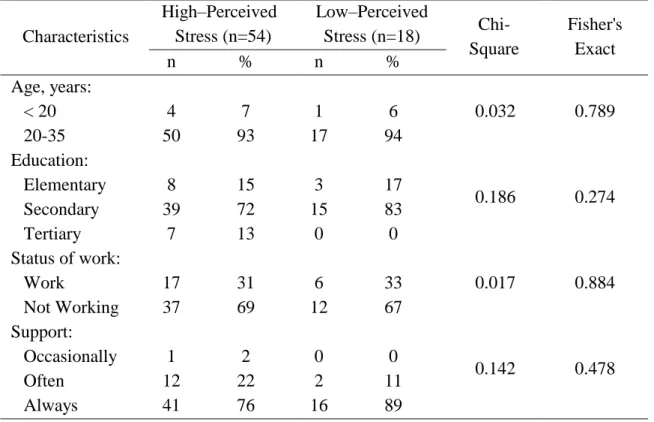
The prevalence of high-perceived stress and depression are shown in table 1 and table 2.
Among these 72 pregnant women, 18 (25%) reported low perceived stress, and 54 (75%)
reported high levels of perceived stress. A comparison of the demographic characteristics of
the women in the high- and low–perceived stress groups is presented in Table 1.
Most pregnant women with high levels of the perceived stress were on range age 20-35
years (93%), had secondary school education (72%), as not working women (69%), has
always family support (76%), had a family income of less than the minimum regional wage
per month (57%). Results show that low-perceived stress were on range age 20-35 years
(94%), had secondary school education (83%), as not working women (67%), has always
family support (89%), had a family income of less than the minimum regional wage per
month (61%). Differences between the groups were noted in age, category of work and family
income, and through statistical analysis it was shown that these differences did not occur by
chance.
Table 1: Comparison of Demographic Characteristics between Women with High–Perceived
Stress and Low–Perceived Stress.
Characteristics
High–Perceived
Stress (n=54)
Low–Perceived
Stress (n=18)
Chi-Square
Fisher's
Exact
n
%
n
%
Age, years:
0.032
0.789
< 20
4
7
1
6
20-35
50
93
17
94
Education:
0.186
0.274
Elementary
8
15
3
17
Secondary
39
72
15
83
Tertiary
7
13
0
0
Status of work:
0.017
0.884
Work
17
31
6
33
Not Working
37
69
12
67
Support:
0.142
0.478
Occasionally
1
2
0
0
Often
12
22
2
11
Always
41
76
16
89
Perceived Stress And Syndrome Depression…
Family Income:
0.033
0.783
>MRW*
23
43
7
39
< MRW*
31
57
11
61
*
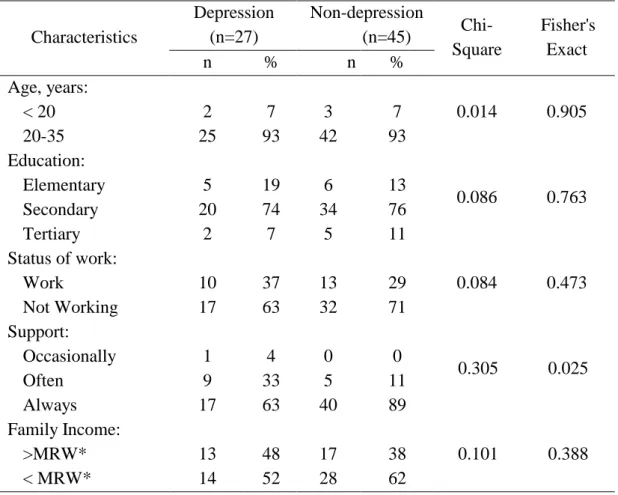
MRW: Minimum regional wageThese pregnant women categorized as non-depression 45 (63%) and as depression 27
(35%). A comparison of the demographic characteristics of the women in the depression and
non-depression groups is presented in Table 2. Most pregnant women as the depression were
on range age 20-35 years (93%), had secondary school education (74%), as not working
women (63%), has always family support (63%), had a family income of less than the
minimum regional wage per month (52%). Results show that the pregnant women as
non-depression were on range age 20-35 years (93%), had secondary school education (76%), as
not working women (71%), has always family support (89%), had a family income of less
than the minimum regional wage per month (62%). Differences between the groups were
noted in age and through statistical analysis it was shown that these differences did not occur
by chance.
Table 2: Comparison of Demographic Characteristics Between depression Women and
non-depression women
Characteristics
Depression
(n=27)
Non-depression
(n=45)
Chi-Square
Fisher's
Exact
n
%
n
%
Age, years:
0.014
0.905
< 20
2
7
3
7
20-35
25
93
42
93
Education:
0.086
0.763
Elementary
5
19
6
13
Secondary
20
74
34
76
Tertiary
2
7
5
11
Status of work:
0.084
0.473
Work
10
37
13
29
Not Working
17
63
32
71
Support:
0.305
0.025
Occasionally
1
4
0
0
Often
9
33
5
11
Always
17
63
40
89
Family Income:
0.101
0.388
>MRW*
13
48
17
38
< MRW*
14
52
28
62
*MRW: Minimum regional wage
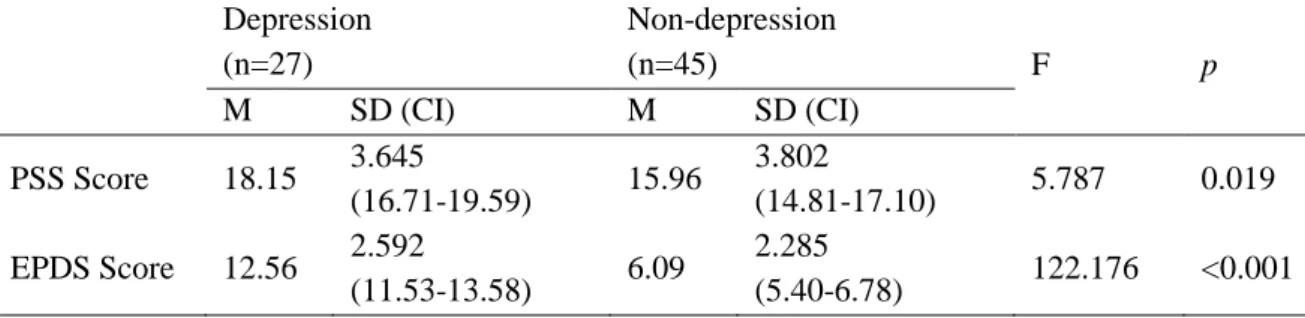
score are shown in table 3. The PSS score was compared between the depression and
non-depression groups. The PSS mean score of non-depression group was 18.15 and non- non-depression
was 15.96, distribution value F=5.787 (>
3,554),
Confidence Interval (CI) 95% does not
exceed 1 and significant value (p) =0.019. So it can be concluded that there are differences in
the PSS scores in the depression and non-depression groups.
Table 3. Comparison of mean the PSS scores and the EPDS scores with depression.
Depression (n=27) Non-depression (n=45) F p M SD (CI) M SD (CI) PSS Score 18.15 3.645 (16.71-19.59) 15.96 3.802 (14.81-17.10) 5.787 0.019 EPDS Score 12.56 2.592 (11.53-13.58) 6.09 2.285 (5.40-6.78) 122.176 <0.001
The EPDS mean score of depression group was 12.56 and non-depression was 6.09, and
distribution value F=122.176 (>3,554), Confidence Interval (CI) 95% does not exceed 1 and
significant value (p) <0.001 as shown on table 3. So it can be concluded that there is
significant difference in the EPDS scores in the depression and non-depression groups.
Based on the last analysis, it obtained the correlation on the Pearson Correlation 0.386,
that there is a significant relationship between perceived stress with depression syndrome in
third trimester of pregnancy (p <0.001). So it can be interpreted that the correlation between
the perceived stress and the depression syndrome is a directly proportional, that the higher the
perceived stress of pregnant women the higher the syndrome of depression.
The prevalence of high-perceived stress among women in this study was 75%, and the
differences between the groups were noted in age, category of work and family income
(<0.05). Previous study found that low rates of self-esteem and social support, residential
mobility, abuse before/during pregnancy, and experiencing discrimination were significantly
associated with high levels of perceived prenatal stress
[5]. Thus the results of this study add to
the study of theories about factors associated with perceived stress during TM III of
pregnancy.
This study revealed the prevalence of depression syndrome in TM III of pregnancy of
37.5%, and the differences between the groups were noted in age (<0.05). Previous study
results showed the syndrome depression associated with stress, firstly motherhood, financial
problems, lack of spouse support and family members, history of depression
[9], and the highest
odds ratio of postpartum depression were associated with husband’s drug abuse, domestic
violence, woman’s education
[11]. This study, confirms previous findings of syndrome
depression on postpartum women, in which that study proved the influential factors of
postpartum depression were occupational and family support
[22]. Thus the results of this study
add to the study of theories about factors associated with the syndrome depression during TM
III of pregnancy.
Furthermore, to our knowledge our study is the first to explain correlation between
perceived prenatal stress and syndrome depression on the third trimester among primigravida
women. This sample of primigravida women, prone to suffer from stress as them changed for
Perceived Stress And Syndrome Depression…