• Tidak ada hasil yang ditemukan

08832323.2010.518647

N/A
N/A
Protected

Academic year: 2017

Membagikan "08832323.2010.518647"

Copied!
16
0
0

Teks penuh

(1)

Full Terms & Conditions of access and use can be found at

http://www.tandfonline.com/action/journalInformation?journalCode=vjeb20

Download by: [Universitas Maritim Raja Ali Haji] Date: 11 January 2016, At: 22:19

Journal of Education for Business

ISSN: 0883-2323 (Print) 1940-3356 (Online) Journal homepage: http://www.tandfonline.com/loi/vjeb20

Deans’ Perceptions of AACSB-Endorsed

Post-Doctoral Bridge Programs

Shawn Mauldin , Bruce McManis & Kevin Breaux

To cite this article: Shawn Mauldin , Bruce McManis & Kevin Breaux (2011) Deans’ Perceptions of AACSB-Endorsed Post-Doctoral Bridge Programs, Journal of Education for Business, 86:5, 279-293, DOI: 10.1080/08832323.2010.518647

To link to this article: http://dx.doi.org/10.1080/08832323.2010.518647

Published online: 21 Jun 2011.

Submit your article to this journal

Article views: 68

(2)

CopyrightC Taylor & Francis Group, LLC ISSN: 0883–2323 print / 1940-3356 online DOI: 10.1080/08832323.2010.518647

Deans’ Perceptions of AACSB-Endorsed

Post-Doctoral Bridge Programs

Shawn Mauldin, Bruce McManis, and Kevin Breaux

Nicholls State University, Thibodaux, Louisiana, USA

The Association to Advance Collegiate Schools of Business (AACSB) International has en-dorsed 5 Post-Doctoral Bridge (PDB) to Business Programs. The objective of these programs is to prepare PhDs from other academic programs for teaching and research careers in busi-ness. The authors solicited feedback from deans of AACSB-accredited business schools as to their perceptions of these PDB programs. The results provide information to business schools offering bridge programs and business schools recruiting graduates of bridge programs, as well as individuals considering the transition. The results indicate that deans’ perceptions of PDB programs are extremely mixed.

Keywords:AACSB academically qualified faculty, AACSB bridge programs, bridge programs, post-doctoral bridge programs

A 2002 report, “Management Education at Risk,” by the As-sociation to Advance Collegiate Schools of Business (offi-cially referred to as AACSB International or more commonly as AACSB) predicted that there would be a significant short-age of business PhDs by the end of the decade. According to a 2007 AACSB report, the shortage of business faculty is projected to increase to 2,400 openings by 2012. The short-age has been exacerbated by the many faculty members who received their PhDs in the 1960s and 1970s preparing to retire in the near future. As a result of the shortage, business fac-ulty salaries continue to increase, as indicated in AACSB’s salary survey reports (AACSB 2008, 2011). It would be safe to say that in recent years the production of doctorates in business-related disciplines has not been sufficient to meet the demand. As a result of this environment, many universi-ties are finding it difficult to hire or retain qualified business faculty.

The AACSB is addressing the faculty shortage with two bridge programs (AACSB, 2008). The first bridge program is the professionally qualified (PQ) bridge program. The PQ bridge program provides training to business professionals to transition them into the academic setting. The second bridge program is the academically qualified (AQ) bridge program and is the focus of this paper. The AACSB has endorsed five

Correspondence should be addressed to Kevin Breaux, Nicholls State University, Department of Accounting and Information Systems, P. O. Box 2015, Thibodaux, LA 70310, USA. E-mail: [email protected]

Post-Doctoral Bridge (PDB) to Business Programs that pre-pare PhDs from other academic disciplines for teaching and research careers in business. It is worth noting that graduates of these programs receive the same initial AQ status as new PhDs in discipline (AQ status for five years from the date that the PDB program is completed).

There is a lack of information related to how graduates of PDB programs may be perceived by the business schools that may employ them. Obviously, this information would be important to the business schools offering the bridge pro-grams, business schools considering graduates from bridge programs, and individuals considering the transition. Ac-cordingly, the purpose of the article is to determine the gen-eral perceptions of deans from AACSB-accredited business schools about transitioning PhDs from nonbusiness disci-plines to teaching and research careers in business. In the next section we present the details of the AACSB’s endorsed PDB programs.

POST-DOCTORAL BRIDGE PROGRAMS

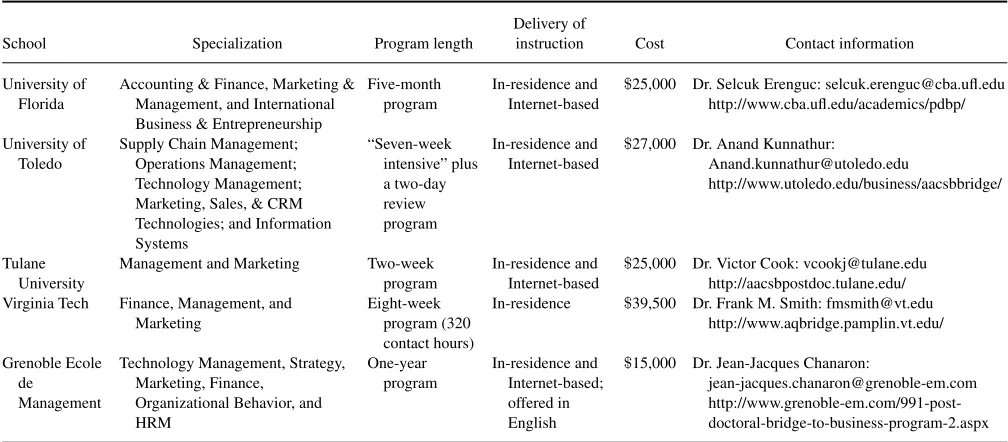
At present, there are five PDB programs endorsed by AACSB. Although each of these schools has the same goal, to bridge a nonbusiness PhD to faculty positions in business, the programs vary on several criteria. In this section, we of-fer a discussion of schools that ofof-fer PDB programs as well as general information about each school’s specializations, program length, method of instruction, student acceptance

(3)

criteria, and cost. The schools presently offering PDB pro-grams endorsed by AACSB are the University of Florida, the University of Toledo, Tulane University, Virginia Poly-technic Institute and State University, and Grenoble Ecole de Management.

The University of Florida’s program offers specialization in the areas of Accounting and Finance, Marketing and Man-agement, and International Business and Entrepreneurship (University of Florida, 2010). The university’s bridge pro-gram is a five-month propro-gram consisting of 10 days of in-residence lectures and seminars in conjunction with Internet-based instruction. U.S. applicants eligible for acceptance into this program must have a nonbusiness PhD from an Associ-ation of American University (AAU) institution or a univer-sity with an AACSB-accredited business school. Non-U.S. applicants should have a nonbusiness PhD from an AACSB-accredited business school, but local accreditation may be used on a case-by-case basis. The University of Florida’s program is offered at a cost of$25,000.

The University of Toledo’s program offers specializa-tion in the areas of supply chain management; operaspecializa-tions management; technology management; marketing, sales, and CRM technologies; and information systems (University of Toledo, 2010). The seven-week program consists of eight residence modules supplemented by Internet-based in-struction during June and July. The seven-week June–July program is followed by a two-day in-residence capstone ex-perience. Applicants are selected on criteria consisting of an earned PhD, continued research productivity, quality and rep-utation of the applicant’s doctoral program, recommendation letters, statement of purpose for applying to the program, and work experience in business fields. The cost of the University of Toledo’s bridge program is$27,000.

Tulane University offers bridge programs in management and marketing (Tulane, 2010). The program consists of a two-week in-residence module. This two-two-week module consists of 10 eight-hour seminars. Applicants with PhDs from insti-tutions with AACSB-accredited business schools are given preference, but consideration is given to others based on the strength of their academic record and business expe-rience. Tulane University’s cost for the bridge program is

$25,000.

Virginia Polytechnic Institute and State University’s pro-gram offers specialization in Finance, Management, and Mar-keting (Virginia Polytechnic Institute and State University, 2010). The program is an eight-week in-residence program offered from June to August, consisting of 320 contact hours. Students wishing to work toward the marketing program must have a doctorate in psychology, sociology, or statis-tics, whereas those students wishing to work toward the finance or management program must have a doctorate in economics. In addition, applicants graduating from U.S. pro-grams must have earned their degree from a university with an AACSB-accredited business program. Applicants gradu-ating from non-U.S. programs must have local accreditation.

The bridge program at Virginia Tech is offered at a cost of

$39,500.

The last AACSB-endorsed PDB program is Grenoble Ecole de Management, offering specializations in market-ing, finance, accountmarket-ing, and strategic management (Greno-ble Ecole de Management, 2010). The program length is one year, with the first six months having three multiday work-shops supplemented with distance learning through special-ized technology. The remaining six months consist of the writing and submission of two publishable-quality articles. This program is offered entirely in English. Applicants must hold doctoral degrees from a recognized university or school. The cost of Grenoble’s PDB program is$15,000. A summary

of the details of the five AACSB-endorsed programs are pro-vided in Table 1, followed by the research methodology used.

METHOD

Research Question

Due to the shortage of doctorates in business-related disci-plines, AACSB has endorsed five PDB programs. Presently, there is no research indicating how these graduates are re-ceived (or perre-ceived) by academia. Therefore, the purpose of this study is to offer preliminary findings on how busi-ness deans perceive the graduates of these bridge programs. Considering that deans play an important role in the hiring process and accreditation efforts, it is important to understand how they perceive graduates of PDB programs.

Research Instrument

A Web-based survey was used designed to obtain deans’ perceptions of these AQ PDB programs and their graduates. The survey consisted of 16 questions, 15 of which were close-ended questions pertaining to the bridge programs and their graduates. The last question was an open-ended question ask-ing deans to provide any other issues or concerns that they felt needed to be expressed with respect to these programs. In addition, the survey gathered demographic data such as the type of institution, separate accounting accreditation, high-est degree awarded in business, and the number of students majoring in business. The complete survey instrument with responses can be found in Appendix A.

Sample Selection

In order to obtain deans’ perceptions, e-mail addresses for colleges and schools of business accredited by the AACSB were collected. At the time of the research, 559 colleges and schools of business were accredited by the AACSB. Accordingly, the sample was the entire population of business deans from AACSB-accredited schools. Of these colleges and schools, 539 e-mail addresses for the dean or director were obtained from the schools’ websites. The remaining 20 schools were either in the middle of changing deans and the

(4)

TABLE 1

Summary of AACSB Endorsed PDB Programs.

School Specialization Program length

Delivery of

instruction Cost Contact information University of

Florida

Accounting & Finance, Marketing & Management, and International

$25,000 Dr. Selcuk Erenguc: [email protected] http://www.cba.ufl.edu/academics/pdbp/ Marketing, Sales, & CRM Technologies; and Information

$27,000 Dr. Anand Kunnathur:

[email protected]

http://www.utoledo.edu/business/aacsbbridge/

Tulane University

Management and Marketing Two-week program

In-residence and Internet-based

$25,000 Dr. Victor Cook: [email protected] http://aacsbpostdoc.tulane.edu/ Virginia Tech Finance, Management, and

Marketing

Eight-week program (320 contact hours)

In-residence $39,500 Dr. Frank M. Smith: [email protected] http://www.aqbridge.pamplin.vt.edu/

$15,000 Dr. Jean-Jacques Chanaron:

[email protected] http://www.grenoble-em.com/991-post-doctoral-bridge-to-business-program-2.aspx

new dean did not yet have an e-mail address, or the website did not provide an e-mail address for its dean. The majority of the 20 schools without e-mail addresses were located outside the United States.

An e-mail was sent to each of the 539 deans having e-mail addresses. The e-mail indicated that the Web-based survey was designed to provide information on how deans perceive these AQ PDB programs. In addition, the e-mail provided a link that allowed responders to access the survey grant-ing them one month to participate in the Web-based survey. Analysis of the data is presented in the following subsection.

Response

Of the 539 deans who received the web-based survey, 120 surveys were completed, for a response rate of 22.3%. Table 2 shows a breakdown of the responses of the survey population by U.S. versus non-U.S. accredited schools.

Although there was a somewhat lower response rate from the non-US schools, on balance the responses seems to be very representative of the population. The results and con-clusions drawn from the survey data are discussed in the next section.

TABLE 2 Response Demographics

Accredited Population No email Sample Response % Total 559 20 539 120 22.3

U.S. 461 7 454 108 23.8

Non-U.S. 98 13 85 12 14.1

RESULTS

In discussing the results of this survey, it is imperative to keep in mind that this research endeavor was designed to be a means to offer deans’ perceptions of these AQ PDB pro-grams. This information is important to the PDB program’s administrators, their graduates, their future and potential stu-dents, and other AACSB-accredited schools of business. A few questions dealt with the programs and the effects of these programs, but a majority of the questions focused on the grad-uates of these programs. We first discuss deans’ familiarity with these PDB programs, and then their perceptions of the graduates of these programs. The responses are reported as percentages in Appendix A.

In responding to the survey, 89% of the respondents were moderately or very familiar with the AQ PDB programs that have been endorsed by the AACSB. In transitioning to the graduates of these PDB programs, 47.5% of the respondents agreed or strongly agreed that the AQ PDB program gradu-ates would be as effectively prepared for teaching careers in business as traditionally trained PhDs in business, whereas only 38% agreed or strongly agreed that these graduates would be as effectively prepared for research careers in busi-ness as traditionally trained PhDs in busibusi-ness. Respondents were also asked if they believed that an individual’s nonbusi-ness PhD needs to be closely related to the bridged discipline to be successful in teaching and research, with 66% agreeing or strongly agreeing in terms of teaching and 62% agreeing or strongly agreeing in terms of research. In trying to delve deeper into the issue, deans were asked to indicate for which disciplines they would likely consider AQ PDB candidates. The results of this statement were harder to address because

(5)

deans were allowed to select multiple disciplines. The re-sponses were fairly consistent across the board in account-ing, finance, information systems, management, marketaccount-ing, and statistics; only economics was inconsistent, indicating that fewer deans would consider candidates as bridged to economics.

In addition, respondents were asked to give their per-ceptions on initial qualification status, hiring decisions, and promotion and tenure decisions. Although 62% of the deans agreed or strongly agreed that graduates of an AQ PDB pro-gram would receive the same initial qualification status as graduates of a business doctoral program, only 31% agreed or strongly agreed that a graduate of an AQ PDB program would be given equal consideration in hiring relative to a PhD in discipline candidate. In addition, only 41% agreed or strongly agreed that a graduate of an AQ PDB program would be given preference in hiring relative to a PQ can-didate. With respect to promotion and tenure, most deans (76%) agreed or strongly agreed that these graduates should be treated the same as PhDs in the discipline in promotion and tenure decisions.

The next category of questions was concerned with deans’ perceptions on faculty supply and faculty shortage issues as they relate to these AQ PDB programs. Of the deans that responded, 65% agreed or strongly agreed that these pro-grams may accomplish the objective of increasing the supply of business faculty. Interestingly, 86% indicated that they may be forced to hire an AQ PDB program graduate in order to maintain accreditation because of the shortage of PhDs in business. Even with the high percentage indicat-ing that they may have to hire one of these graduates, only 67% agreed or strongly agreed that, overall, AQ PDB pro-grams can be a viable tool for reducing or eliminating faculty shortages.

Other questions on the survey focused on the effects that these programs would have on salaries of PhDs in business and how salaries would be set for an AQ PDB program candidate. A large majority of deans (91%) felt that these AACSB-endorsed AQ PDB programs would have no effect or slow the rate of increase slightly on salaries of PhDs in business. In conjunction with that, only 31% would offer the same salary as a PhD in discipline, and 57% would offer a salary somewhere between a PhD in discipline and a PQ candidate in discipline.

In addition to reporting the deans’ perceptions in per-centages, analyses of variance (ANOVAs) were performed to determine the consistency of these perceptions across the demographic characteristics surveyed. Although most of the tests showed no statistical significance, several did exhibit strong evidence that the perceptions of deans were influ-enced by their environment. Appendix B contains the results from the ANOVAs for all significant relationships. These differences are discussed subsequently.

The highest degree awarded by an institution had an im-pact on how deans viewed giving the AQ PDB graduates the

same initial qualification status (p=.011), with those at PhD and specialized master’s-granting institutions agreeing more strongly that they should. Deans of undergraduate-only in-stitutions were more inclined to think that the AQ PDB grad-uates would not be as prepared to be effective researchers (p=.037). Deans of PhD-granting institutions indicated that they would not view AQ PDB graduates any better than a PQ candidate, whereas all of the other categories favored them (p=.047)

Deans of urban institutions were more likely to consider an AQ PDB graduate in economics than were deans of rural institutions (p=.011), but they still were unfavorable toward them.

U.S. schools differed from non-US schools on several characteristics. The schools in the United States were more agreeable to the idea of giving graduates the same initial qualification status (p=.004), had better familiarity with the program (p=.038), believed more strongly that they should be treated the same for promotion and tenure decisions (p=

.040), and were more likely to consider them for management (p=.089) and marketing (p=.073) positions.

The size of the school, measured by the number of stu-dents, also altered perceptions, with larger schools more in agreement that AQ PDB graduates should be given the same initial qualification status (p =.000), having better famil-iarity with the bridge program (p = .049), and believing the graduates should be treated the same for promotion and tenure (p=.033).

Separate accounting accreditation yielded some of the most notable differences in perceptions. Schools with sepa-rate accounting accreditation thought that it would provide a greater increase in the pool of faculty (p=.000), agreed that the AQ PDB graduates should get the same initial qualifica-tion status (p=.035), agreed that graduates should receive the same treatment for promotion and tenure decisions (p=

.029), and were more likely to consider AQ PDB graduates for positions in economics (p=.029), information systems (p=.036), and statistics (p=.096).

Finally, private schools were more likely to consider AQ PDB graduates for positions in accounting (p=.031), eco-nomics (p=.013), and statistics (p=.048).

The survey also provided the opportunity for the participants to express concerns or other issues about the AQ PDB programs. Positive and negative responses were obtained from this open-ended question; however, it is worth mentioning that a majority of the responses had a negative connotation and were more detailed. Some examples of the comments received (positive and negative) are the following: “As they become familiar to more, this type of program has an opportunity to make a real, positive contribution to business education.” “Creative approaches are required under these circumstances.” “Program will only work if accreditation teams recognize the value of bridge programs.” “This program helps teaching institutions but not research-intensive institutions.” “I am very concerned

(6)

about the program being accepted by faculty and department chairs.” A complete list of the comments for this open-ended question is presented in Appendix C.

DISCUSSION

Overall, deans appeared to be familiar with these AQ PDB programs. The results also suggest that over half of the re-sponding deans were in favor of these programs and believed that they would help faculty shortage issues. It is also worth noting that less than half of the deans surveyed believed that these AQ PDB graduates would be as effectively prepared for teaching and research careers in business as traditionally trained PhDs in the discipline. Additionally, it is important to note a couple of limitations of the study. First, the deans might be biased because of their administrative positions and their need to fill positions. It would be interesting to find out what faculty members think about these programs. Second, only 22.3% of deans from AACSB-accredited schools re-sponded. It is certain that only time will tell if these AQ PDB programs are an effective tool to fill the void in the present faculty shortages in business.

REFERENCES

Association to Advance Collegiate Schools of Business. (2002). Man-agement education at risk. Report of the ManMan-agement Education Task Force to the AACSB Board of Directors. Retrieved from http://www.aacsb.edu/publications/researchreports/archives/management-education-at-risk.pdf

Association to Advance Collegiate Schools of Business. (2007). Becom-ing a business professor. Retrieved from http://www.bestbizschools.com/ downloads/Becoming-A-Business-Professor-AACSB-Intl.pdf

Association to Advance Collegiate Schools of Business. (2008). Prepar-ing PhDs from non-business disciplines for business school faculty po-sitions. Retrieved from http://www.aacsb.edu/bridgetobusiness/default. asp

Association to Advance Collegiate Schools of Business. (2011).2010–2011 U.S. salary survey report. 43rd annual salary survey. Retrieved from http://aacsb.edu/publications/datareports/salarysurvey/2010–11.pdf Grenoble Ecole de Management. (2010).Post-doctoral bridge to

busi-ness program. Retrieved from http://www.grenoble-em.com/991-post-doctoral-bridge-to-business-program-2.aspx

Tulane University. (2010). Post doctoral bridge. Retrieved from http://aacsbpostdoc.tulane.edu/

University of Florida. (2010).Post-doctoral bridge program. Retrieved from http://www.cba.ufl.edu/academics/pdbp/

University of Toledo. (2010).AACSB post-doctoral bridge program. Re-trieved from http://www.utoledo.edu/business/aacsbbridge/

Virginia Polytechnic Institute and State University. (2010). Post-doctoral bridge to business program. Retrieved from http://www. aqbridge.pamplin.vt.edu/

APPENDIX A: SURVEY INSTRUMENT: AQ POST-DOCTORAL BRIDGE (PDB) PROGRAM SURVEY WITH RESPONSES

We are conducting a survey of deans of business colleges around the world. AACSB International has endorsed a group of AQ Post-Doctoral Bridge (PDB) programs that are designed to allow individuals with earned doctorates in nonbusiness disciplines to become AQ in a business-related discipline. We would like your feedback on this issue.

Demographics (for classification purposes):

Count Percentage Type of institution:

(Not answered) 2 1.7

Public 84 70.0

Private 34 28.3

Total responses 120 100.0

Do you have separate accounting accreditation?

(Not answered) 3 2.5

Yes 41 34.2

Currently seeking 6 5.0

No 70 58.3

Total responses 120 100.0

Highest degree awarded in business:

(Not answered) 2 1.7

PhD/DBA 33 27.5

Specialized Masters 20 16.7

MBA 54 45.0

Undergraduate 11 9.2

Total responses 120 100.0

(Continued on next page)

(7)

Number of students majoring in business:

(Not answered) 1 0.8

>5000 9 7.5

2500–4999 33 27.5

1000–2499 43 35.8

500–999 23 19.2

<500 11 9.2

Total responses 120 100.0

Content Questions:

1. How familiar are you with the AQ Post-Doctoral Bridge (PDB) programs that have been endorsed by AACSB?

Very familiar 30 25.0

Moderately familiar 77 64.2

Not familiar 13 10.8

Total responses 120 100.0

2. Graduates of an AQ PDB program will receive the same initial qualification status as do graduates of a business doctoral program.

Strongly agree 18 15.0

Agree 57 47.5

Neutral 23 19.2

Disagree 19 15.8

Strongly disagree 3 2.5

Total responses 120 100.0

3. AQ PDB program graduates will be as effectively prepared for TEACHING careers in business as traditionally trained PhDs in business.

(Not answered) 2 1.7

Strongly agree 15 12.5

Agree 42 35.0

Neutral 36 30.0

Disagree 21 17.5

Strongly disagree 4 3.3

Total responses 120 100.0

4. An individual’s non-business PhD needs to be closely related to the bridged business discipline for a reasonable chance of success in TEACHING to exist.

Strongly agree 24 20.0

Agree 55 45.8

Neutral 26 21.7

Disagree 15 12.5

Total responses 120 100.0

5. AQ PDB program graduates will be as effectively prepared for RESEARCH careers in business as traditionally trained PhDs in business.

Strongly agree 9 7.50

Agree 37 30.83

Neutral 32 26.67

Disagree 30 25.00

Strongly disagree 12 10.00

Total responses 120 100

6. An individual’s non-business PhD needs to be closely related to the bridged business discipline for a reasonable chance of success in RESEARCH to exist.

Strongly agree 23 19.2

Agree 52 43.3

Neutral 30 25.0

Disagree 13 10.8

Strongly disagree 2 1.7

Total responses 120 100.0

(Continued on next page)

(8)

7. AQ PDB programs will accomplish the objective of increasing the pool of business faculty.

(Not answered) 1 0.8

Strongly agree 17 14.2

Agree 61 50.8

Neutral 29 24.2

Disagree 12 10.0

Total responses 120 100.0

8. A graduate of an AQ PDB program would be given equal consideration in hiring relative to a PhD in discipline candidate.

Strongly agree 9 7.5

Agree 28 23.3

Neutral 17 14.2

Disagree 53 44.2

Strongly disagree 13 10.8

Total responses 120 100.0

9. A graduate of an AQ PDB program would be given preference in hiring relative to a PQ candidate.

(Not answered) 1 0.8

Strongly agree 12 10.0

Agree 37 30.8

Neutral 31 25.8

Disagree 34 28.3

Strongly disagree 5 4.2

Total responses 120 100.0

10. AQ PDB faculty should be treated the same as PhDs in the discipline in promotion and tenure decisions.

Strongly agree 31 25.8

Agree 60 50.0

Neutral 11 09.2

Disagree 15 12.5

Strongly disagree 3 02.5

Total responses 120 100.0 11. Due to the shortage of PhDs in business, business schools may be forced to

hire an individual who has gone through an AQ PDB program in order to maintain accreditation.

Strongly agree 29 24.2

Agree 74 61.7

Neutral 11 9.2

Disagree 3 2.5

Strongly disagree 3 2.5

Total responses 120 100.0

12. Overall, AQ PDB programs can be a viable tool for reducing or eliminating faculty shortages.

Strongly agree 17 14.2

Agree 64 53.3

Neutral 27 22.5

Disagree 11 9.2

Strongly disagree 1 0.8

Total responses 120 100.0

13. I would likely consider AQ PDB candidates in which of the following disciplines. (Select all that apply.)

(Not answered) 1 .8

Accounting 66 55

Economics 33 27.5

Finance 72 60

Information Systems 67 55.8

Management 71 59.2

Marketing 66 55

Statistics 64 53.3

Would not consider AQ PDB candidates in any discipline×Deans were allowed to select multiple disciplines.

10 8.3

(Continued on next page)

(9)

14. What impact will AACSB endorsed AQ PDB programs have on salaries of PhDs in business?

(Not answered) 2 1.7

No effect 50 41.7

Slow the rate of increase slightly 59 49.2

Slow the rate of increase significantly 8 6.7

Cause salaries to decrease 1 0.8

Total responses 120 100.0

15. If considering an offer to an AQ PDB program candidate, how would you set the salary?

(Not answered) 1 0.8

Would not hire one under any conditions 4 3.3

Would offer the same amount as a PhD in discipline 37 30.8 Would offer something in between a PhD in discipline and a PQ candidate in discipline 68 56.7 Would offer the same amount as a PQ candidate in discipline 7 5.8

Would offer less than a PQ candidate 3 2.5

Total responses 120 100.0

Location of institution

(Not answered) 2 1.7

United States 106 88.3

Outside of the United States 12 10.0

Total responses 120 100.0

Institutional setting

(Not answered) 1 0.8

Urban 80 66.7

Rural 39 32.5

Total responses 120 100.0

APPENDIX B: ANOVA RESULTS

Same Initial Qualification Status×Highest Degree Awarded

Highest Degree Awarded

Missing Undergraduate MBA Specialized master’s PhD/DBA Total Same initial

qualification status

Strongly agree 8 4 6 18

Agree 5 24 11 17 57

Neutral 1 2 11 2 7 23

Disagree 3 11 3 2 19

Strongly disagree 1 1 1 3

Total 2 11 54 20 33 120

Chi-square tests

Value df p

χ2 31.685 16 .011

(Continued on next page)

(10)

Research Effectively Prepared×Highest Degree Awarded

Highest degree awarded

Missing Undergraduate MBA Specialized master’s PhD/DBA Total Research

effectively prepared

Strongly agree 4 1 4 9

Agree 1 3 20 5 8 37

Neutral 16 4 12 32

Disagree 5 10 10 5 30

Strongly disagree 1 3 4 4 12

Total 2 11 54 20 33 120

Chi-square tests

Value df p

χ2 27.388 16 .037

Preference Relative to PQ×Highest Degree Awarded

Highest degree awarded

Missing Undergraduate MBA Specialized master’s PhD/DBA Total Preference relative

to PQ

Strongly agree 6 1 5 12

Agree 1 4 21 8 3 37

Neutral 2 15 3 11 31

Disagree 1 4 12 7 10 34

Strongly disagree 1 4 5

Missing 1 1

Total 2 11 54 20 33 120

Chi-square tests

Value df p

χ2 31.701 20 .047

Consider in ECON×Institutional Setting

Institutional setting

Rural Urban Total

Consider in ECON Yes 5 28 33

No 34 52 86

Total 39 80 119

Chi-square tests

Value df p

χ2 6.436 1 .011

(Continued on next page)

(11)

Same Initial Qualification Status×Location of Institution

Location of institution

Missing

Outside of the United

States United States Total Same initial

qualification status

Strongly agree 18 18

Agree 1 8 48 57

Neutral 2 21 23

Disagree 2 17 19

Strongly disagree 1 2 3

Total 2 12 106 120

Chi-square tests

Value df p

χ2 22.697 8 .004

Familiarity×Location of Institution

Location of institution Outside of the

United States United States Total

Familiarity Very familiar 1 29 30

Moderately familiar 1 8 68 77

Not familiar 4 9 13

Total 2 12 106 120

Chi-square tests

Value df p

χ2 10.171 4 .038

Treated Same in P and T×Location of Institution

Location of institution

Missing

Outside of the United

States United States Total Treated same in P

and T

Strongly agree 2 29 31

Agree 6 54 60

Neutral 2 9 11

Disagree 2 2 11 15

Strongly disagree 3 3

Total 2 12 106 120

Chi-square tests

Value df p

χ2 16.189 8 .040

(Continued on next page)

(12)

Consider in MNGT×Location of Institution

Location of institution

Missing

Outside of the United

States United States Total Consider in

MNGT

Yes 5 66 71

No 2 7 40 49

Total 2 12 106 120

Chi-square tests

Value df p

χ2 4.840 2 .089

Consider in MKTG×Location of Institution

Location of institution

Missing

Outside of the United

States United States Total Consider in

MKTG

Yes 4 62 66

No 2 8 44 54

Total 2 12 106 120

Chi-square tests

Value df p

χ2 5.242 2 .073

Same Initial Qualification Status×Number of Students

Number of students

<500 500–999 1000–2499 2500–4999 >5000 Total Same initial

qualification status

Strongly agree 1 1 6 7 3 18

Agree 5 12 23 14 3 57

Neutral 3 6 3 9 2 23

Disagree 2 4 11 2 19

Strongly disagree 1 1 3

Total 11 23 43 33 9 120

Chi-square tests

Value df p

χ2 61.054 20 .000

(Continued on next page)

(13)

Familiarity×Number of Students

Number of students

<500 500–999 1000—2499 2500–4999 >5000 Total

Familiarity Very Familiar 1 4 2 6 13 4 30

Moderately Familiar 6 17 33 18 3 77

Not Familiar 1 4 4 2 2 13

Total 1 11 23 43 33 9 120

Chi-square tests

Value df p

χ2 18.386 10 .049

Treated Same in P and T×Number of Students

Number of students

Missing <500 500–999 1000–2499 2500–4999 >5000 Total Treated same in P

and T

Strongly agree 2 2 14 10 3 31

Agree 3 14 20 19 4 60

Neutral 4 2 5 11

Disagree 1 2 5 3 3 1 15

Strongly disagree 1 1 1 3

Total 1 11 23 43 33 9 120

Chi-square tests

Value df p

χ2 33.089 20 .033

Increase Pool of Faculty×Separate Accounting Accreditation

Separate accounting accreditation

Missing No Currently seeking Yes Total Increase pool of

faculty

Strongly agree 9 2 6 17

Agree 1 33 2 25 61

Neutral 1 18 2 8 29

Disagree 10 2 12

Missing 1 1

Total 3 70 6 41 120

Chi-square tests

Value df p

χ2 46.643 12 .000

(Continued on next page)

(14)

Same Initial Qualification Status×Separate Accounting Accreditation

Separate accounting accreditation

Missing No Currently seeking Yes Total Same initial

qualification status

Strongly agree 1 6 2 9 18

Agree 35 2 20 57

Neutral 1 13 1 8 23

Disagree 14 1 4 19

Strongly disagree 1 2 3

Total 3 70 6 41 120

Chi-square tests

Value df p

χ2 22.221 12 .035

Treated Same in P and T×Separate Accounting Accreditation

Separate accounting accreditation

Missing No Currently seeking Yes Total Treated same in P

and T

Strongly agree 11 3 17 31

Agree 1 37 3 19 60

Neutral 9 2 11

Disagree 2 10 3 15

Strongly disagree 3 3

Total 3 70 6 41 120

Chi-square tests

Value df p

χ2 22.856 12 .029

Consider in ECON×Separate Accounting Accreditation

Separate accounting accreditation

Missing No Currently seeking Yes Total Consider in

ECON

Yes 14 1 18 33

No 3 56 5 23 87

Total 3 70 6 41 120

Chi-square tests

Value df p

χ2 8.999 3 .029

(Continued on next page)

(15)

Consider in IS×Separate Accounting Accreditation

Separate accounting accreditation

Missing No Currently seeking Yes Total

Consider in IS Yes 2 33 2 30 67

No 1 37 4 11 53

Total 3 70 6 41 120

Chi-square tests

Value df p

χ2 8.516 3 .036

Consider in STAT×Separate Accounting Accreditation

Separate accounting accreditation

Missing No Currently seeking Yes Total

Consider in STAT Yes 3 33 2 26 64

No 37 4 15 56

Total 3 70 6 41 120

Chi-square tests

Value df p

χ2 6.341 3 .096

Consider in ACCT×Type of Institution

Type of institution

Private Public Total

Consider in ACCT Yes 24 41 65

No 10 43 53

Total 34 84 118

Chi-square tests

Value df p

χ2 4.640 1 .031

Consider in ECON×Type of Institution

Type of institution

Private Public Total

Consider in ECON Yes 15 18 33

No 19 66 85

Total 34 84 118

Chi-square tests

Value df p

χ2 6.185 1 .013

(Continued on next page)

(16)

Consider in STAT×Type of Institution

Type of institution

Private Public Total

Consider in STAT Yes 23 40 63

No 11 44 55

Total 34 84 118

Chi-square tests

Value df p

χ2 3.901 1 .048

APPENDIX C: OPEN-ENDED QUESTION RESPONSES

1. If an individual doesn’t have a research and teaching record that would substantiate development in the area for which they are being considered prior to a bridge program or hire, we wouldn’t have any interest in them at all.

2. This program helps teaching institutions but not research-intensive institutions.

3. Unfortunately, I’m not convinced that the AQ PDB programs will address the faculty shortage problems in the areas of greatest need (accounting and finance).

4. As they become familiar to more, this type of program has an opportunity to make a real, positive contribution to business education.

5. I am very concerned about the program being accepted by faculty and department chairs. Deans may accept this program, but deans seldom do the job search and screening – that is done by faculty and chairs.

6. While I applaud AACSB for their efforts to mitigate the issues we all face concerning the shortage of PhD qualified faculty in the marketplace, I believe that this solution will prove to a bit short sided and ineffective.

7. What is next – woodworkers becoming orthopedic surgeons?

8. My main concern is how these non-business trained PhDs can possibly address this gap between business theory and business practice? On this issue, I believe that business practitioners (i.e., PQ faculty) have more to offer than non-business PhDs who have completed a business bridge program.

9. I would hire non-business PhDs without the bridge program if their credentials were close enough. I’m not convinced that there is much value added with thisprogram.

10. I am quite honestly dismayed that someone who has trained in an area and published and spent many years teaching a subject could lose their AQ status due to a couple of slow research years while at the same time someone from a different field/discipline can get 5 years AQ status by attending a crash course.

11. Creative approaches are required under the circumstances.

12. Program will only work if accreditation teams recognize the value of bridge programs.

13. AQ PDB programs are likely to be viewed differently by large institutions vs. small institutions.

14. Many prospective faculty in business disciplines attempt to take the easiest route to become qualified. If AQ PDB candidates receive the same standing as to PhD candidates with a degree in the discipline, the likely result will be fewer students pursuing business PhDs and more students completing doctorates in education and the social sciences. Thus, the bridge program could, and I believe will, create an even greater shortage of candidates with a PhD in the business discipline in which they intend to teach and research.

15. It may be very hard to convince the current faculty from a specific department or discipline (e.g., finance) that AQ PDB faculty are acceptable and deserve consideration in the search process.

16. An alternative that I haven’t heard much about but which might have some merit is something like an executive PhD, the analogy being executive MBA programs.

17. I would rather take someone from industry who has pursued a DBA. In Europe I think this is the most hopeful path towards solving the faculty shortage.

Gambar

TABLE 2

Referensi

Garis besar

Dokumen terkait

a) Dalam hal pembinaan iman dan tauhid, orang tua masih kurang terutama dalam hal membiasakan anak untuk bersyukur atas ni’mat Allah. Hal ini disebabkan kurangnya pengetahuan

MEDIA Pembelaja ran Penggunaan bahan VISUAL dalam studi empiris terbukti meningkatkan efektifitas pencapaian tujuan

Apabila pihak - pihak yang menyanggah tidak dapat menerima jawaban atas sanggahan dari Panitia Pengadaan Barang/ Jasa bersangkutan, maka sanggahan banding dapat diajukan kepada

Belanja barang yang diserahkan kepada masyarakat Bibit Durian (Subsidi Provinsi) Untuk Kecamatan Sekadau Hulu JB: Barang/jasa JP: Barang..

[r]

Pada hari ini, rabu tanggal tujuh belas bulan September tahun dua ribu empat belas, Kelompok Kerja Unit Layanan Pengadaan Gabungan Antara Dinas Pertanian

Just incase I cant sleep I will also make sure to bring a book with me, if for whatever reason I can not fall asleep which does happen to me, I like to take my mind off things

Subbidang PPE fisik, Ekonomi dan pendanaan pembangunan mempunyai tigas pokok melaksanakan penyusunan bahan kebijakan teknis dan koordinasi penelitian serta