1. LIMITS
LIMIT OF A SEQUENCE. As consecutive points, given by the terms of the sequence
1, 3/2, 5/3, 7/4, 9/5, …, 2-1/n (1)
are located on a number scale, it is noted that they cluster about the point 2 in such a way that there are points of the sequence whose different from 2 is less than any preassigned positive number, however small.
For example, the point 2001/1001 and all subsequent are at distance < 1/1000 from 2, the point 20 000 001/10 000 001 and all subsequent points are at a distance < 1/10 000 000 from 2, and so on. This state of affairs is indicated by saying that the limit of the sequence is 2.
If x is variable whose range is the sequence (1), we say that x approaches 2 as limit or x tends to 2 as limit and write x 2.
The sequence (1) does not contain its limit 2 as a term. On the other hand, the
sequence 1, 1/2, 1, ¾, 1, 5/6, 1, … has 1 limit and every odd number term is 1. Thus, a
sequence may or may not reach its limit. Hereinafter, the statement x a will be understood to imply x a, that is, it is to be understood that any given arbitrary sequence does not contain its limit as a term.
LIMIT OF A FUNCTION. Let x 2 over the sequence (1); then f(x) = x2 4 over
the sequence 1, 9/4, 25/9, 49/16, …, (2-1/n)2, … Now let x 2 over the sequence
2.1, 2.01, 2.001, 2.0001, …, 2 + 1/10n, …
(2)
then x2 4 over the sequence 4.41, 4.0401, 4.004001, …, (2 + 1/10n)2, … It would seem reasonable to expect that would approach 4 as limit however x may approach 2 as
limit. Under this assumption, we say “the limit, as x approaches 2, of x2 is 4” and write
4 lim 2
Example 1:
1. Determine the limit of each of the following sequences:
(a) 1, 1/2, 1/3, 1/4, 1/5, … (d). 5, 4, 11/3, 7/2, 17/5, …
(b) 1, 1/4, 1/9, 1/16, 1/25, … (e). 1/2, 1/4, 1/8, 1/16, 1/32, …
(c) 2, 5/2, 8/3, 11/4, 14/5, … (f). .9, .99, .999, .9999, .999 99, …
(a) The general term is 1/n. As n rakes on the values 1, 2, 3, 4, … in turn, 1/n
2. Describe the behaviour of y = x + 2 as x ranges over values of each of the sequences of Prob. 1.
(a) y 2over the sequence 3, 5/2, 7/3, 9/4, 11/5, …, 2 + 1/n, …
(b) y 2over the sequence 3, 9/4, 19/9, 33/16, 51/25, …, 2 + 1/n2, …
(c) y 5over the sequence 4, 9/2, 14/3, 19/4, 24/5, …5 - 1/n, … (d) y 5over the sequence 7, 6, 17/3, 11/2, 27/5, …, 5 + 2/n, …
(e) y 2over the sequence 5/2, 9/4, 17/8, 33/16, 65/32, …, 2 + 1/2n, …
(f) y 3over the sequence 2.9, 2.99, 2.999, 2.9999, …, 3 - n
10 1
, …
3. Evaluate
(a) lim5 5lim 5.2 10
2 2 x x x x
(b) lim(2 3) 2lim lim3
2 2
2 x x
x x x
7 3 2 . 2
(c) lim( 2 4 1) 4 8 1 3
2 x x x
(d)
5 1 ) 2 ( lim
) 2 ( lim
2 2 lim
3 3
3 x
x
x x
x x x
(e) 0
4 4
4 4 4 4
lim 2
2
2x
x
x
(f) lim 25 lim(25 2) 9 3
4 2
4 x x x
x
Note. Do not assume from these problems that lim f(x)
a
x is invariably f(a). By f(a)
2. CONTINUITY
A FUNCTION f(x) is said to be continuous at x = x0, if (i) f(x0) is defined, (ii) lim ( )
0
x f
x
x exists, (iii) lim0 ( ) ( 0)
x f x f
x x
For example f(x) = x2 + 1 is continuous at x = 2 since lim ( ) 0
x f
x
x = 5 = f(2). The
condition (i) implies that a function can be continuous only at points on its domain of
definition. Thus, f(x) 4 x2 is not continuous at x = 3 since f(3) is imaginary, i.e. is not defined.
A function which is continuous at every point of an interval (open or closed) is said to be continuous on that interval. A function f(x) is called continuous if it is continuous at every point on its domain of definition. Thus, f(x)= x2 + 1 and all other polynomials in x are continuous function; other examples are ex¸ sin x, cos x.
If the domain of definition of a function is a closed interval a x b, condition (ii) fails at the endpoints a and b. We shall call such a function continuous if it is continuous on the open interval a < x < b, if lim f(x)
a x
=f(a), and if lim f(x)
b x
=f(b).
Thus 2
9 )
(x x
f will be called a continuous function (see example 1, chapter 2). The functions of elementary calculus are continuous on their domains of definition with the possible exception of a number of isolated points.
A FUNCTION f(x) is said to be discontinuous at x = x0 if one or more of the conditions for continuity fail there. The several types of discontinuity will be illustrated by examples:
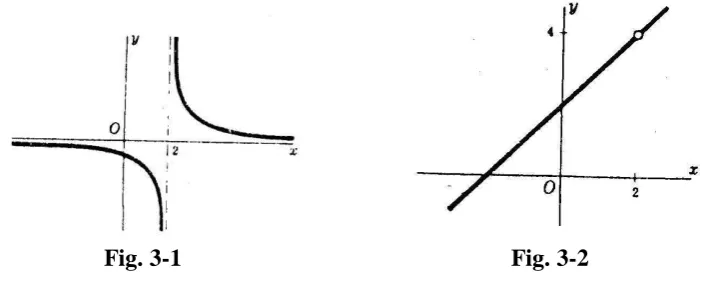
(a)
2 1 ) (
x x
f is discontinuous at x = 2 since
(i) f(2) is not defined (has zero as denominator) (ii) lim ( )
2 f x
x does not exist (equals x).
The function is discontinuous everywhere except at x = 2 where it is said to have an
infinite discontinuity. See Fig. 3-1.
(b)
2 4 )
(
2
x x x
f is discontinuous at x = 2 since
(i) f(2) is not defined (both numerator and denominator are zero). (ii) lim ( )
2 f x
x = 4
The continuity here is called removable since it may be removed by redefining the
function as
2 4 ) (
2
x x x
f , x 2; f(2) = 4. (Note that the discontinuity in (a) connot be so
removed since the limit also does not exist.) The graphs of
2 4 ) (
2
x x x
f and g(x) = x +
2 are identical except at x = 2 where the former has a „hole‟. Removing the discontinuity consists simply of properly filling the „hole.‟
(c)
3 27 )
(
2
x x x
f , x 3; f(3) = 9 is discontinuous at x = 3 since
(i) f(3) = 9, (ii) lim ( ) 27
3 f x
x (iii) limx 3 f(x) f(3)
The discontinuity may be removed by redefining the function as
3 27 )
(
2
x x x
f ,
x 3; f(3) = 27.
(d) The function of Problem 9, Chapter 1, is defined for all x > 0 but has discontinuities at x = 1, 2, 3, … arising form the fact that
) ( lim ) (
lim f x f x
s x s
x
(s any positive integer)
3. THE DERIVATIVE
IN FINDING DERIVATIVES it is customary to drop the subscribe 0 to obtain the
See note following problems 5 (c), Chapter 2.
The derivative of y = f(x) with respect to x may be indicated by any one of the
4. DIFFERENTIATION OF ALGEBRAIC FUNCTION
A FUNCTION is said to be differentiable at x = x0 if it has a derivative there. A function is said to be differentiable on an interval if it is differentiable at every point of the interval.
The functions of elementary calculus are differentiable, except possibly at certain isolated points, on their intervals of definition.
INVERSE FUNCTIONS. Let y = f(x) be differentiable on the interval a x b and suppose that dy/dx does not change sign on the interval. Then from Fig. 5-1a and 5-1 b the function assumes once and only once every value between f(a)= c and f(b) = d.
Thus, for each value of y on the respective interval, there corresponds one and only one value of x and x is a function of y, say x = g(y). The function y = f(x) and x = g(y) are called inverse functions.
Fig. 5-1a Fig. 5-1b
Example I:
(a) y = f(x) = 3x + 2 and x = g(y) = f (y-2) are inverse function
(b) When x 2 and y -1, y = x2 – 4x + 3 and x = 2 - y 1 are inverse function. When x 2 and y -1, y = x2– 4x+ 3 and x = 2 + y 1 are inverse function. To find dy/dx, given x = g(y)
(a) Solve for y, when possible, and differentiate with respect to x; or (b) Differentiate x = g(y) with respect to y and use
Example 2:
Find dy/dx, given x y 5
Using (a) : y = (x - 5)2and dy/dx = 2(x – 5)
Using (b):
y y
dy dx
2 1 2
1 12
; then 2 y 2(x 5) dx
dy
.
DIFFERENTIATION OF A FUNCTION OF A FUNCTION. If y = f(u) and u= g(x), then y = f{g(x)} is a function of x. If y is a differentiable function of u and if u is a differentiable function of x, then y = f{g(x)} is differentiable function of x and the derivative dy/dx may be obtained by one of the following procedures:
(a) Express y explicitly in terms of x and differentiate.
Example 3:
If y = u2 + 3 and u = 2x + 1, then y = (2x + 1)2 + 3 and dy/dx = 8x + 4.
Example 4:
If y = u2 + 3 and u = 2x + 1, then 2 , 2 dx du u du dy
and 4u 8x 4
dx du du dy dx dy
HIGHER DERIVATIVES. Let y = f(x) be a differentiable function of x and let its derivative be called the first derivative of the function. If the first derivative is differentiable, its derivative is called the second derivative of the (original) function
and is denoted by one of the symbols 2
2
dx y d
, y``, or f``(x). In turn, the derivative of the
second derivative is called the third derivative of the function and is denoted by one of
the symbols 33 , y' '',or f' ''(x);
dx y d
Note. The derivative of a given order at a point can exist only when the function and all derivatives of lower order are differentiable at the pont.
5. MAXIMUM AND MINIMUM VALUE
INCREASING AND DECREASING FUNCTION. A function f(x) is said to be
increasing at x = x0 if for h, positive and sufficiently small, f(x0– h) < f(x0) < f(x0+ h). A function f(x) is said to be decreasing at x = x0 if for h, positive and sufficiently small,
f(x0– h) > f(x0) > f(x0+ h)
If f` (x0) > 0, then f(x) is an increasing function at x = x0; if f`(x0) < 0, then f(x) is decreasing function at x = x0. If f`(x0) = 0, then f(x) is said to be stationary at x = x0.
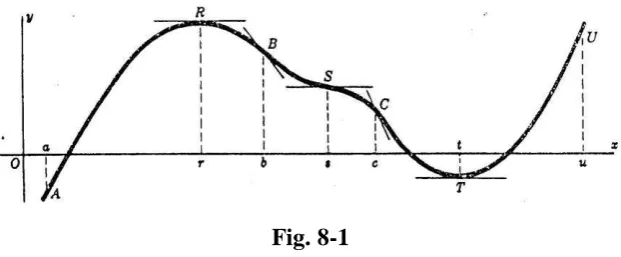
interval r < x < t. The function is stationary at x = r, x = s, and x = t; the curve has a horizontal tangent at the points R, S, and T. The values of x, (r, s, and t), for which the function f(x) is stationary (f`(x)= 0) are more frequently called critical values for the function and the corresponding points (R, S, and T) of the graph are called critical points of the curve.
RELATIVE MAXIMUM AND MINIMUM VALUES OF A FUNCTION. A
function y = f(x) is said to have a relative maximum (relative minimum) value at x= x0 if f(x0) is greater (smaller) than immediately proceeding and succeeding values of the function.
In Fig. 8-1, R( r, f(r)) is relative maximum point of the curve since f(r) > f(x) on any sufficiently small neighbourhood 0 < x - r < 8. We shall say that y = f(x) has a
relative maximum value (= f(r))when x = r. In the same figure, T (t, f(t)) is a relative minimum point of the curve since f(t) < f(x) on any sufficiently small neighbourhood 0 < x - r < 8. We shall say that y = f(x) has a relative minimum value (= f(t)) when x = t. Note that R joins an arch AR which is rising (f`(x)> 0), and an arch RB which is falling
(f`(x)< 0) while T joins an arch CT which is falling [f`(x) < 0] and an arch TU which is rising [f`(x) > 0]. At S two arcs BS and SC both of which are falling are joined; S is neither a relative maximum nor a relative minimum point of the curve.
If y = f(x) is differentiable on a x b and if f(x) has a relative maximum (minimum) value at x = x0, where a < x0 < b, then f`(x0) = 0. For proof, see Prob. 18.
To find the relative maximum (minimum) values (hereinafter called maximum (minimum) values) of function f(x) which, together with their first derivatives, are continuous:
FIRST DERIVATIVE TEST
1. Solve f`(x) = 0 for the critical values.
2. Locate the critical values on a number scale, thereby establishing a number of intervals.
3. Determine the sign of f`(x) on each interval.
4. Let x increase through each critical value x = x0; then
f(x) has a maximum value (= f(x0)) if f`(x) changes from + to -,
f(x) has a minimum value (= f(x0)) if f`(x) changes from - to +,
f(x) has neither a maximum nor a minimum value at x = x0 if f`(x) does not change sign.
A final case in which f(x0) is a maximum (minimum) value although there is no interval x0–8 < x < x0 on which f`(x) is positive (negative) and no interval x0 < x < x0
+ 8 on which f`(x) is negative (positive) will not be treated here.
DIRECTION OF BENDING. An arc of a curve y = f(x) is called concave upward if, at each of its points, the arc lies above the tangent at the point. As x increases, f`(x)
either is of the same sign and increasing (as on the interval b< x < s of Fig. 8-1) or changes sign from negative to positive (as on the interval c < x < u). In either case, the slope f`(x) is increasing and f``(x) > 0.
An arch of a curve y = f(x) is called concave downwa rd if, at each of its points, the arc lies below the tangent at the point. As x increases, f`(x) either is of the same sign and decreasing (as on the interval s < x < c of Fig. 8-1) or changes sign from positive to negative (as on the interval a < x < b). In either case, the slope f`(x) is decreasing and f``(x) < 0.
A POINT OF INFLECTION is a point at which a curve is changing from concave
upward to concave downward, or vice versa. In Fig. 8-1, the points of inflection are B, S, and C.
A curve y = f(x) has one of its points x = x0 as inflection point.
if f``(x0) = 0 or is not defined and
if f``(x) changes sign as x increases through x = x0.
The latter condition may be replaced by f``(x0) 0 when f```(x0) exist.
A SECOND TEST FOR MAXIMA AND MINIMA, SECOND DERIVATE TEST
1. Solve f`(x) = 0 for the critical values. 2. For a critical value x = x0:
f(x) has a maximum value (= f(x0)) if f``(x0) < 0
SOLVED PROBLEMS
1. Gas is escaping from a spherical balloon at the rate of 900 cm3s-1. How fast is the surface area shrinking when the radius is 360 cm?
At time t the sphere has radius r, volume V 34 r3, and surface S = 4 r2. and the altitude is 20 cm, find the rate at which the water level is dropping when it is 5 cm from the top.
Let r be radius and h the height of the surface of the