A STYLISTIC STUDY OF THE INTERIOR MONOLOGUES IN
WILLIAM FAULKNER’S
THE SOUND AND THE FURY
A THESIS
Presented in Partial Fulfillment of the Requirements
for the Degree of
Magister Humaniora (M.Hum)
at English Language Studies
by
Rr Rieta Anggraheni
136332053
THE GRADUATE PROGRAM IN ENGLISH LANGUAGE STUDIES
SANATA DHARMA UNIVERSITY
A tale told by an idiot.
-
Macbeth
-
ACKNOWLEDGEMENTS
This thesis was accomplished with supports and assistance from many
people. First and foremost, I would like to convey my greatest gratitude to Jesus
Christ for allowing me to receive this wonderful blessing and for becoming my
strength.
I would like to express my deepest gratitude to my thesis advisor, Dr. Fr. B.
Alip, M.Pd., M.A. for his guidance and advices in directing this thesis and his
patience in correcting throughout. My gratitude also goes to my thesis reviewers,
Dr. B. B. Dwijatmoko, M. A. who has made me realized the important of being
critical, and Dr. E. Sunarto, M. Hum. for the helpful feedback. I should also
thank Dr. J. Bismoko as one of the examiners for the precious suggestions.
My special thanks also go to Diksita Galuh Nirwinastu, Simon Arsa
Manggala, Fransisca Novitasari, Agnes Siwi Purwaning Tyas, and
Sekartiyasa Kusumastuti who were willing to listen to my problems regarding
my thesis and gave me useful insights and valuable advices.
I also thank my classmates Tia, Joan,
Mba
Adria, Putri,
Mas
Ryan, Nita,
Mba
Mimi, Pak Tangguh, and Inta for the laughter we had during our study. I
really appreciate the time when we could support and help each other.
I really thank my beautiful mother for being the most patient and strongest
mother in the world, and also my two wonderful sisters for giving me incessant
supports and always reminding me to finish this thesis. I also thank my father for
the support and care. Last but not least, I thank Alphon for always being there and
encouraging me.
TABLE OF CONTENTS
Page
TITLE PAGE ... i
ADVISOR APPROVAL PAGE ... ii
APPROVAL PAGE ... iii
STATEMENT OF WORK’S ORIGINALITY
... iv
LEMBAR PERNYATAAN PERSETUJUAN PUBLIKASI KARYA ILMIAH UNTUK
KEPENTINGAN AKADEMIS
... v
DEDICATION PAGE. ... vi
ACKNOWLEDGEMENTS ... vii
TABLE OF CONTENTS ... viii
LIST OF TABLES ... xii
ABSTRACT ... xiii
ABSTRAK
... xv
1. INTRODUCTION ... 1
1.1 Background of the Study ... 1
1.2 Research Question ... 5
1.3 Objectives of the Study ... 5
1.4 Benefits of the Study ... 6
2. REVIEW OF RELATED LITERATURE ... 7
2.1 Theoretical Review ... 7
2.1.1
Faulkner and Faulkner’s Style
... 7
2.1.2
The Sound and The Fury
... 9
2.1.2.1 The Synopsis ... 9
2.1.2.2 The Personae of the Characters ... 12
2.1.3 Style and Stylistics ... 13
2.1.4 Stylistics of Literary Discourse... 16
2.1.4.1 Context of Literary Discourse ... 16
2.1.4.2 Perspective in Narrative Fiction ... 18
2.1.4.3 Speech and Thought Representation ... 19
2.1.4.4 Interior Monologue Style ... 21
2.1.5 Analysis Method in Stylistics ... 24
2.1.5.1 Four Levels of Stylistic Analysis ... 25
2.1.5.2 Lexical Categories ... 27
2.1.5.3 Grammatical Categories ... 28
2.1.5.4 Figures of Speech ... 29
2.1.5.5 Context and Cohesion ... 29
2.1.5.6 Underlexicalization ... 30
2.1.5.7
Halliday’s Metafunctions
... 31
2.2 Related Studies ... 34
2.3 Theoretical Framework ... 37
3. RESEARCH METHODOLOGY ... 39
3.1 Type of Study ... 39
3.2 Research Data and Data Source ... 40
3.3 Data Collection ... 41
3.3.1 Identifying Interior Monologues in
The Sound and The Fury
... 41
3.3.2 Collecting the Data ... 42
3.4 Data Analysis ... 43
3.4.1 Data Analysis Based on Checklist of Features ... 43
3.4.2 Transitivity Analysis ... 44
3.4.3 Interpretation ... 45
4. ANALYSIS RESULTS AND DISCUSSION ... 47
4.1 Interior Monologue Style in
The Sound and The Fury
... 47
4.2 The Linguistic Features in Benjamin’
s Interior Monologue ... 53
4.2.1 Grammatical Features and Their Effects
... 53
4.2.1.1 Sentence Types ... 53
4.2.1.2 Clause Processes ... 56
4.2.1.3 Modality ... 58
4.2.2 Lexical Features and Their Effects ... 59
4.2.2.1 Nouns ... 59
4.2.2.2 Adjectives ... 61
4.2.2.3 Verbs ... 62
4.2.3 Underlexicalization and Its Effects ... 66
4.2.4 Figures of Speech and Their Effects ... 68
4.3 The Linguistic Features in Quentin’s Interior Monologue
... 70
4.3.1 Grammatical Features and Their Effects ... 70
4.3.1.1 Sentence Types ... 70
4.3.1.2 Run-on Sentences ... 71
4.3.1.3 Fragmented Syntax ... 73
4.3.1.4 Pronouns ... 74
4.3.2 Lexical Features and Their Effects ... 76
4.3.2.1 Nouns ... 76
4.3.2.2 Adjectives ... 78
4.3.2.3 Adverbs ... 80
4.3.2.4 Vocabulary ... 83
4.3.3 Figures of Speech and Their Effects ... 85
4.3.3.1 Metaphors ... 85
4.3.3.2 Grammatical and Lexical Schemes ... 88
4.3.4 Graphological Features ... 90
4.4 The Linguistic Features in Jason’s Interior Monologue
... 93
4.4.1 Grammatical Features and Their Effects ... 93
4.4.1.1 Sentence Types ... 93
4.4.3.2 Non-Standard Grammar ... 95
4.4.1.3 Pronouns ... 97
4.4.1.4 First Person Subject Pronoun and Third Person Object Pronoun . 98
4.4.2 Lexical Features and Their Effects ... 98
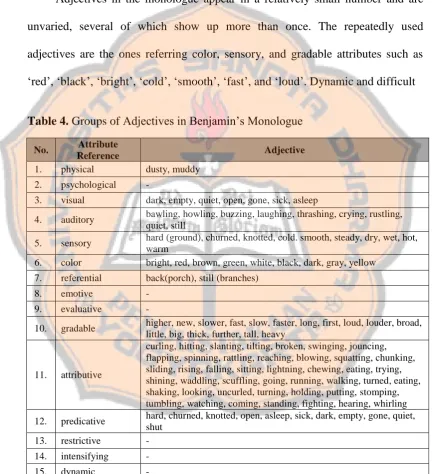
4.4.2.1 Adjectives ... 99
4.4.2.2 Adverbs ... 100
4.4.1.3 Lexical Choice ... 101
4.4.1.4 Vocabulary ... 102
4.4.3 Figure of Speech and Its Effects ... 104
4.5 Conclusion on the Employed Style ... 106
5. CONCLUSION AND SUGGESTION ... 108
5.2 Suggestions for Further Investigations ... 113
BLIBIOGRAPHY ... 116
APPENDICES ... 119
APPENDIX 1 ... 120
APPENDIX 2 ... 123
APPENDIX 3 ... 146
LIST OF TABLES
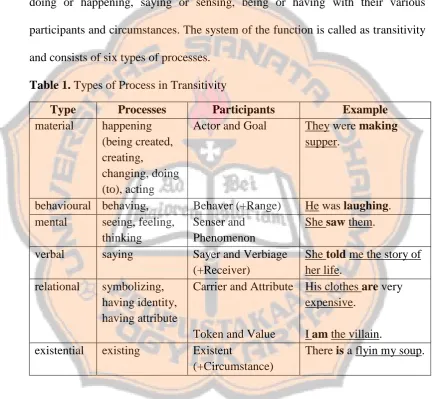
Table 1. Types of Process in Transitivity... 32
Table 2. Sentence
Types in Benjamin’s Monologue
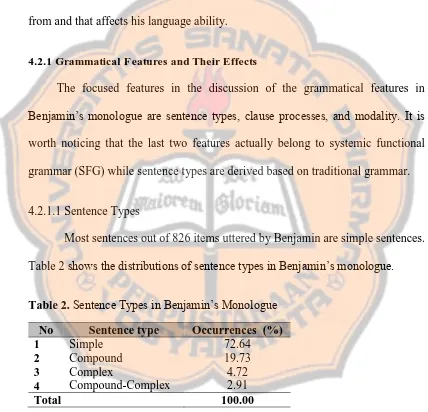
... 53
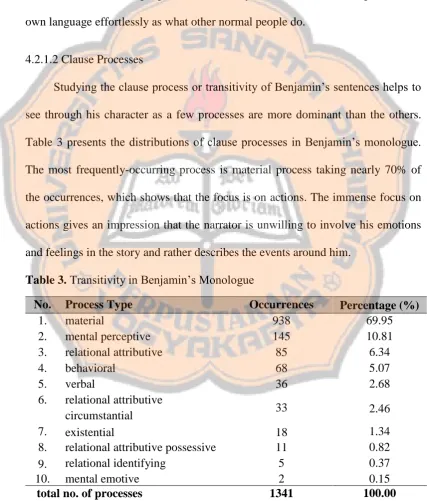
Table 3. Transitivity in Benjamin’s Monologue
... 56
Table 4. Groups of Adjectives in Benjamin’s Monologue
... 61
Table 5. Verbs in Benjamin’s Monologue
... 63
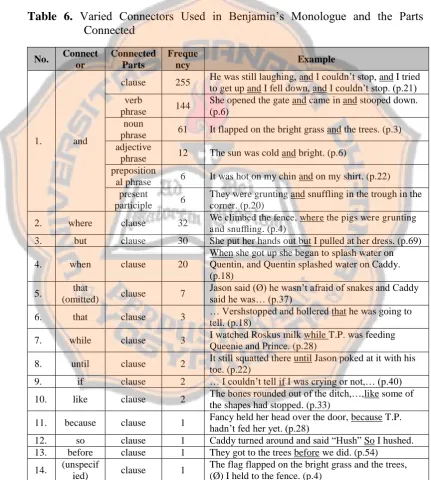
Table 6. Varied Connectors Used in Benjamin’s Monologue and the Parts
Connected ... 64
Table 7. Sentenc
e Types in Quentin’s Monologue
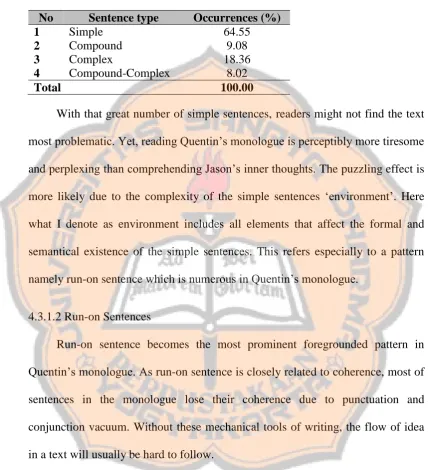
... 71
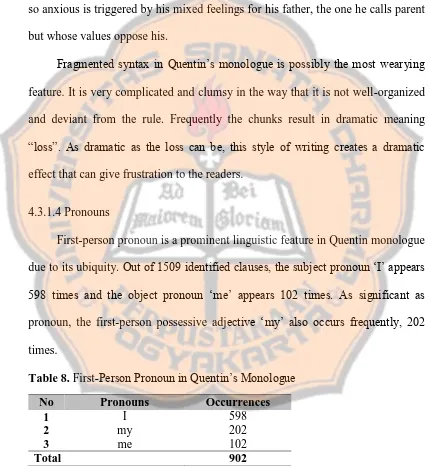
Table 8. First-
Person Pronoun in Quentin’s Monologue
... 74
Table 9. Examples of Abstract Nouns in Quentin’s Monologue
... 77
Table 10. Groups of Adjectives in Quentin’s Monologue
... 79
Table 11. Top Ten Adverbs in Quentin’s Mon
ologue ... 81
Table 12. Examples of Simile in Quentin’s Monologue
... 87
Table 13. Sentence Types in Jason’s Monologue
... 93
ABSTRACT
Rr Rieta Anggraheni. (2016).A Stylistic Study of the Interior Monologues in
William Faulkner’s
The Sound and The F ury.
Yogyakarta: English Language
Studies, Graduate Program, Sanata Dharma University.
The different linguistic styles used by authors in their novel have made them
interesting and challenging to study. Those styles are able to create certain effects
to the readers; they might be empathic, amused, persuaded, or even perplexed.
William Faulkner’s
The Sound and The Fury
is a novel with a very unusual
narrative style, which is widely known as interior monologue. The style utilizes
complicated and assorted language features that might create confusion to the
readers. For this reason, the novel was chosen as the object of this study in the
hope that the whole meaning of the literary work could be clearly explained. The
interior monologue that made it possible for us to see directly through the
windows of the characters’ minds results in the portrayal of their
personae.
Therefore, this study was interested to know what major and salient language
features in each monologue and the effect they raised as well as the impression
they gave
about the characters’ personae.
In order to achieve the purposes, this study used stylistics as an approach
(Verdonk, 2002; Barry, 2002; Leech and Short, 2007).The main research
instrument was the checklist of features by Leech and Short (2007) to examine the
major and significant language features or formal properties in each monologue.
The features included grammatical features, lexical features, figures of speech,
and graphological features.
The analysis was supported by Halliday’s Systemic
Functional Grammar (SFG), specifically transitivity and modality (language
metafunctions) and Fowler’
s underlexicalization. The data analysis encompassed
three main procedures: 1) finding the major and salient features using checklist of
features, 2) conducting transitivity analysis, and 3) making interpretations based
on the analysis sample by Verdonk (2002).
The result confirms that William Faulkner uses interior monologue in the
first three sections in his novel
The Sound and The Fury
. The style is manifested
through different major language features in the three sections which result in
different effects
and correspond to the characters’ personae.
Firstly, the simple language including simple syntax and simple lexis in
Benjamin’s (first) section can make the readers feel as if they were reading a
children story which was so innocent, while incoherence as a result of the
inappropriate use of cohesive devices can frustrate and confuse the readers and
make them experience time shifts. The language features also suggests that
Benjamin is a man-child. This is enforced by the major processes in transitivity
analysis which include material process and mental perceptive process and
underlexicalization cases where Benjamin fails to name or identify things
precisely. The inference to make from those features is that Benjamin suffers a
mental disorder.
can give acute frustration, confusion, and tiredness. However, the complexity may
also create dramatic and artistic effects that amuse the readers. Complex language
features also give an impression that Quentin is an intelligent but extremely
anxious or, using a well-known term, neurotic.
Less unusual language features
in Jason’s (third) section will give relieving
effect for the readers after reading the first two sections which are frustrating.
They make the section way more comprehensible. The non-standard grammar or
informal language including profanity and hedges as the most dominant feature in
the section characterizes the language of Southerners. Aside from informal
language, simple sentences, simple lexis, first-person pronoun dominance, and
similes give a suggestion that Jason is an illiterate, selfish, and aloof person who
is prone to sarcasm, misanthropy, sovereignty, and cynicism. However, the
language features which are simple and normal also imply that he is the most
realistic person among the three characters.
By employing interior monologue style in his novel, Faulkner has created a
brilliant and distinguished novel. The dynamic use of language in the monologues
has resulted in striking and breathtaking effects and enables readers to tune in to
the characters’ minds without
being impeded by the presence of the narrator and
ABSTRAK
Rr Rieta Anggraheni. (2016). A Stylistic Study of the Interior Monologues in
William Faulkner’s
The Sound and The Fury
: Language Features and
Persona. Yogyakarta: Magister Kajian Bahasa Inggris, Program Pasca Sarjana,
Universitas Sanata Dharma.
Gaya bahasa (stile) para penulis yang berbeda-beda menarik dan memiliki
tantangan untuk dikaji. Gaya bahasa tersebut dapat menciptakan efek-efek tertentu
pada pembaca. Mereka bisa merasa turut berempati, terhibur, terbujuk, atau
bahkan merasa bingung.
The Sound and The Fury
karya William Faulkner adalah
sebuah novel dengan gaya bercerita yang sangat tidak biasa, atau yang dikenal
sebagai monolog interior (
interior monologue
). Gaya bercerita ini menggunakan
fitur-fitur bahasa yang rumit dan beragam, yang mungkin akan menyebabkan
kebingungan bagi para pembacanya. Untuk alasan tersebut, novel tersebut dipilih
sebagai objek kajian ini dengan harapan bahwa makna keseluruhan dari karya
sastra tersebut dapat dijelaskan dengan baik. Monolog interior yang
memungkinkan kita untuk melihat langsung melalui jendela pikiran para tokoh
dalam novel menyebabkan adanya penggambaran dari persona mereka. Oleh
karena itu, kajian ini tertarik untuk mengetahui apa saja fitur-fitur bahasa yang
utama dan menonjol di masing-masing monolog dan efek yang dimunculkan serta
kesan yang diberikan mengenai kepribadian para tokoh.
Untuk mencapai tujuan tersebut, kajian ini menggunakan stilistika sebagai
pendekatan (Verdonk, 2002; Barry, 2002; Leech dan Short, 2007). Instrumen
penelitian yang utama adalah
checklist
fitur bahasa oleh Leech dan Short (2007)
untuk menemukan fitur-fitur atau bentuk bahasa yang utama dan signifikan di
masing-masing monolog.Fitur-fitur tersebut meliputi fitur gramatikal, fitur
leksikal, pemajasan, serta fitur grafologikal. Analisa menggunakan instrumen
tersebut didukung oleh
Systemic Functional Grammar (SF G)
dari Halliday,
khususnya transitivitas dan modalitas(metafungsi bahasa)dan fenomena
kekurangan leksikal (
underlexicalization
) yang dicetuskan pertama kali oleh
Fowler. Analisa data mencakup tiga prosedur utama: 1) menemukan fitur-fitur
bahasa yang utama dan menonjol menggunakan
checklist
fitur bahasa, 2)
melakukan analisa transitivitas, dan 3) membuat interpretasi berdasarkan contoh
analisa yang disusun oleh Verdonk (2002).
Hasil penelitian menegaskan bahwa William Faulkner menggunakan
monolog interior di tiga bagian pertama dari novelnya yang berjudul
The Sound
and The Fury
. Stile tersebut terbentuk melalui fitur-fitur bahasa yang berbeda
pada ketiga bagian novel yang menimbulkan efek yang juga berbeda dan mampu
merefleksikan kepribadian para tokoh.
diperkuat oleh analisa transitivitas di mana sebagian besar proses klausanya
adalah proses material dan proses mental perseptif, serta kasus-kasus kekurangan
leksikal (
underlexicalization
) di mana Benjamin gagal menamai atau
mengidentifikasi benda-benda dan hal-hal di sekitarnya dengan istilah yang tepat.
Kesimpulan yang bisa diambil dari fitur-fitur tersebut adalah bahwa Benjamin
menderita gangguan mental.
Kedua,
fitur bahasa yang rumit dan ‘kaya’ seperti frasa nominal yang
seringkali diterangkan oleh adjektiva, metafora, fragmen sintaksis atau kalimat
dalam bentuk pecahan, penyiasatan struktur gramatikal dan leksikal, dan
penggunaan fitur grafologikal yang tidak biasa pada bagian kedua (monolog
Quentin) dapat memberikan efek frustrasi yang amat sangat, kebingungan, dan
kelelahan bagi pembaca. Akan tetapi, kompleksitas bahasa tersebut juga dapat
menimbulkan efek dramatis dan artistik yang menghibur pembaca. Fitur-fitur itu
juga mengisyaratkan bahwa Quentin adalah seseorang yang cerdas dan
berpendidikan akan tetapi memiliki kekhawatiran yang berlebihan atau yang
sering disebut sebagai neurosis.
Fitur-fitur bahasa yang lebih lazim pada bagian ketiga (monolog Jason)
akan memberikan efek melegakan bagi pembaca setelah mereka membaca dua
bagian pertama novel yang membuat frustrasi.Fitur-fitur bahasa tersebut membuat
monolog Jason jauh lebih mudah dipahami. Bahasa tidak baku termasuk umpatan
dan pembatas (
hedges
) sebagai fitur bahasa paling dominan dalam monolog Jason
mencirikan bahasa orang-orang Amerika bagian selatan. Selain bahasa tidak baku,
kalimat sederhana, leksis sederhana, dominasi kata ganti orang pertama, dan
simile memberi kesan bahwa Jason adalah orang yang tidak berpendidikan, hanya
memikirkan kepentingan diri sendiri, dan suka menjauhkan diri dari orang lain.
Dia juga memiliki kecenderungan pada sarkasme, kebencian terhadap orang lain,
dominasi, dan kesinisan. Meskipun begitu, fitur bahasa yang sederhana dan
normal tersebut juga menyiratkan bahwa Jason adalah pribadi yang paling realistis
diantara ketiga tokoh.
Dengan menggunakan gaya tuturmonolog interior dalam novelnya, Faulkner
telah menciptakan sebuah novel yang brilian dan berbeda dari yang lain.
Penggunaan bahasa yang dinamis dalam ketiga monolog menimbulkan efek yang
mengagumkan dan mendebarkan serta memungkinkan pembaca untuk masuk ke
dalam pikiran para tokoh tanpa diintervensi oleh kehadiran narator dan
memungkinkan pembaca untuk mengenali perbedaan individual ketiga tokoh.
Pada akhirnya, kajian ini tidak semata-mata mengkaji gaya bahasa dalam novel
The Sound and The Fury
dan efek yang ditimbulkan, akan tetapi juga
berkontribusi pada langkah awal penentuan sejauh mana stilistika sebagai sebuah
pendekatan dianggap valid untuk mengkaji kepribadian seseorang.
1. INTRODUCTION
This section consists of four main parts namely background of the study
which provides the reasons and the base of conducting the research, research
question as the formulation of the issue that is going to be discussed, objectives of
the study which state the desired goals of the research, and benefits of the study
which elaborate the advantages of the research for the readers. Each part will be
presented as follows.
1.1 Background of the Study
Literary works are the written interpretation of human life which undeniably
carry purposes and meanings. These purposes and meanings can be either stated
or implied through the language used by the writers. The meaning of the work, in
other words, can be seen from the language style used by the writer.
The novel entitled
The Sound and The Fury
which is used as the object in
this study is an example of this kind of work. It was written by William Faulkner,
an American author, who was successful in playing styles. He employs unusual
style in narrating the story, which is seen from the narrative style and the language
features used. The unusual style here refers to a technique called as
stream of
consciousness
(Verdonk, 2002). The more specified term is
“interior monologue”
which utters
human’s thoughts and feelings.
Interior monologue has allowed
Faulkner to dive into the deepest mind of the characters. Since the nature of
humankind is hiding certain matters from other people, Faulkner tries to reveal
that most honest secret. The readers will be brought into a new experience by
seeing from different point of view. That is why the researcher paid considerable
attention to the novel and was interested to make it the object of the study.
The second reason considered by the researcher is the popularity of the
novel.
The Sound and The Fury
was first published in 1929 and was said to be a
successful stylistic novel. With the unusual style, the novel made Faulkner start
receiving critical attention and led him to fame. In fact, Faulkner had taken the
risk by writing an unusual novel but was rewarded with positive critiques from a
number of stylists and linguists.
The third reason, which is probably the most fundamental, is that Faulkner’s
interior monologue in the novel seems to correspond with the characters’
persona.
person who like to beat around the bush instead say “I didn’t eat anything this
morning and I’ve wandered around the city even without chewing sweets
; my
stomach is talking to me”. People who are straightforward more likely p
refer
simple sentences and will probably choose words which precisely convey the
message they intend.
Accordingly, in illustrating the three characters, Faulkner employs different
language styles. When Quentin talks the sentences are mostly unsystematic and
less structured. There are a lot of complex lexical items with considerable
frequencies of metaphors and lexical and syntactical repetitions
. Jason’s sentences
are more well-structured compared to those of the other two monologues, but
there is a tendency of employing informal language.
In Benjamin’s monologue,
the sentences and the lexical features are mostly simple with limited range of
vocabulary. The different language patterns in the three monologues give certain
effects to the novel in general an
d to the illustrations of the three main characters’
personae in particular.
Nonetheless, the theory that language shows individual differences is still
debatable as to some extend it is subjective and hence prone to bias. It needs
stronger validation with a lot more investigations and reliable evidences.
Therefore, the researcher is interested to know how far the current study supports
the theory by relying on textual evidences.
does not merely exhaust rigorous textual analysis based on close-reading, but also
relate the findings with the external backgrounds of the novel, particularly the
socio-cultural context. This is underlain by
Fowler’s
view that says there are two
reasons why we should approach the novel primarily by way of technique (i.e.
style) and desirably by way of linguistics (1977:4)
. The first, “if we employ a
linguistics which treats the sociological and psychological aspects of language, we
can begin to interpret a
writer’s linguistic structure in relation to the values and
the preoccupation of the community for which he writes”
. The second, the novel
is the major medium for technical innovation in European and American
literature, becoming a stimulus to structural criticism, and particularly to criticism
closely engaged with language.
Considering the rationales and the desired goals, this research uses stylistic
perspective in which the discussion will focus on the writing style used by
Faulkner in narrating the story(interior monologue style) and its effect. Therefore,
the research strongly emphasizes the way the language features are used by the
writer to illustrate
the main characters’ thought
s that reflect their personae.
(Lock, 1997; Halliday, 2004), and
Fowler’s theory of
under-lexicalization (Barry,
2002).
1.2 Research Question
This research is governed by the following question:
“
What are the major
language features and their effects
in the main characters’
interior monologues in
William Faulkner’s Novel The Sound and The Fury
?
”
1.3 Objectives of the Study
Based on the problem which was addressed, the current research aimed to
identify the major language features used
in the three main characters’ interior
monologues as well as their effects
in William Faulkner’s novel
The Sound and
The Fury. The analysis was based on Verdonk’s four levels of language
structures: graphology (typographical features), phonology (rhyme, metre,
assonance, alliteration), lexis (vocabulary, metaphor, and other figures of speech),
and syntax(grammatical features)
and used Leech and Short’s checklist of features
as the instrument. However, only major and unusual textual features were
analyzed. This also meant that the study excluded phonological analysis due to the
nature of the novel which is a prose, where phonological features do not play
much role.
As the focus is on the monologue of each character, the study hopes that it
can help in determining the degree by which stylistics is valid to study
personality. This means that this study is expected to provide a measurement on
how extensive a study of linguistic features can be used to identify one’s
Last but not least, the study was also conducted to appreciate William
Faulkner’s literary work, and the researcher hopes that
the study can motivate
other researchers to give similar appreciations to literary works in general, and
Faulkner’s
writings in particular. More studies of language style hopefully can tell
people that language is meant to be used effectively.
1.4 Benefits of the Study
This stylistic study has theoretical and practical benefits. Theoretically, this
study may contribute to the development of the theories on stylistics in particular
and critical linguistics in general. Stylistically, this study adds values to the theory
on mind styles which was popular among the early-twentieth-century authors. In a
wider perspective of linguistics, this study provides another opinion about the
relation between language and persona.
Stylistic analysis has played a role as the basis of many other linguistic
analyses, including discourse analysis and critical discourse analysis. Therefore,
students of linguistic and literature departments can also benefit from this research
as it will help them build a better understanding on the concept of stylistics and
stylistic analysis as an approach for conducting research. Accordingly, this study
is also expected to be a useful resource for linguistic students who are interested
in psycholinguistic analysis, specifically concerning language and its possibility to
reflect personality.
2. REVIEW OF RELATED LITERATURE
This section will cover three parts namely review of related literature,
related studies, and theoretical framework. Firstly, review of related literature
includes the theories employed to analyze the research object. Secondly, related
studies provide the general overview of several studies which bring about the
similar issue to the one addressed in this study. Lastly, the theoretical framework
gives an explanation on how the theories are used to analyze the object.
2.1Theoretical Review
This part is divided into six main subheadings namely Faulkner and
Faulkner’s style, The Sound and The Fury
, style and stylistics, stylistics of literary
discourse, analysis method in stylistics, and four levels of stylistic analysis. The
first subheading provides an introduction about the author, William Faulkner, and
his style of writing. The second subheading includes the synopsis of the novel and
the persona descriptions of the main characters. In the third subheading is given
the definition of style and stylistics. The fourth subheading comprises four
theories which include context of literary discourse, perspective in narrative
fiction, speech and thought representations, and mind style. The fifth subheading
covers the theories for finding major textual features as stylistic markers.
2.1.1 Faulkner and Faulkner’s Style
novels in 1930s (Rampton, 2008). He was also awarded the
France’s Legion of
Honor in 1951. The awards, praise,
and critiques most likely due to Faulkner’s
style in writing his literary works.
The style of Faulkner’s writings is very distinguished and unique. This is in
line with numerous critiques stating that
Faulkner’s
style is distinctive and
difficult (Rueckert, 2004; Rampton, 2008; Matthews, 2009). According to
Rueckert (2004:295
), Faulkner’s novels are characterized by extreme verbal
density, by a kind of unbreaking seamless verbal surface which, to the eye,
presents itself as huge blocks of paragraphed words which cannot be entered
except at the beginning of the paragraphs. His literary works that represent this
argument include
Pylon, Absalom, Absalom!
,
A Fable
,
The Sound and The Fury
(Quentin section),
Light in August, The Bear
, and
Intruder in the Dust
. He further
states that the verbal surface wearies the eye and frustrates the mind as it tries to
read and comprehend.
The Sound and The Fury
itself was reviewed excitedly by a
number of commentators but the book also receives harsh critique that it is
obscure, obsessed with cruelty and violence, and lack of social relevance
(Rampton, 2008). However, the novel has contributed to the initial step of
Faulkner’s popularity among critics.
Most of Faulkner’s literary works were inspired by
the situation in America
during his lifetime (1897-1962) which underwent modernization. Matthews
(2009:2) states that Faulkner’s novels take up all the crucial elements of the event
corporations, centuries of lawful racial discrimination came to an end, sexual
behavior was transformed, and technology was developed. The countries which
were formerly controlled by European colonial empires started the struggle for
independence and integration into the modern world.
The Sound and The Fury
(1929),
Hamlet
(1940),
As I Lay Dying
(1930), and
Sanctuary
(1931) represent the
changing of the era. For instance,
The Sound and The Fury
tells about a heartfelt
tragedy of a Southern family where many of the details confirm to the markers of
the changing era. The aristocracy met its devastation, the racial discrimination
almost came to an end, and farming technology began to develop. Thus, Faulkner
deserves to be called as the most popular and influential author of modern
American literature.
2.1.2 The Sound and The F ury
The following discussion on the novel provides a pragmatic basis to help
the researcher interpret meanings from the textual evidences. The discussion
includes the synopsis of the novel and the descriptions
of the characters’ personae.
2.1.2.1 The Synopsis
worse since the only daughter in the family grew up as a sort of promiscuous girl,
although it is not at all the cause of their family devastation. The changing of the
era (post Civil War)
and the family’s predilection for their own history and legacy
seemingly become the primary detrimental factors.
The story was composed as a four-sectioned novel. Each section is narrated
by different character. The first section is narrated by the last child in Compson
family, Benjamin. The second section is narrated by Quentin, the first child in the
family. The third section is narrated by Jason who is the third child in the family.
Meanwhile, the last section is narrated by the author from Dil
sey’s point of view.
She is a servant in the family. It is worth mentioning that the center of all sections
is the only daughter in the family, Candace. Her character becomes the heart of
the story plot.
The first section entitles April Seventh, 1928. The section which is narrated
by Benjamin tells about some events and scenes that are recorded in his mind. The
chronological order of the events is unclear since Benjamin does not know the
concept of time. He speaks his thoughts freely based on the present situations that
remind him about the past events. In the beginning he talked about the present
time, when he and L
uster, Dilsey’s son, t
ook a walk near the golf field. He
associated the word caddy with his sister, Caddy (Candace). After that, he talked
about the events which took place in different period of time in the past such as
when he went to Mr. Patterson’s hou
se with Candace, when he, with his sister and
birthday in the present time, where he got his birthday cake and blew the candles.
That day on April seventh, 1928 he became a 33-year-old man but he still needed
a 14-year-old boy to take care of him and walk him anywhere.
The second section entitles June Second, 1910. It was the day when Quentin
went outside the whole day and presumably prepared himself to commit suicide.
That day was almost the end of his first year in Harvard. He went there with the
money from selling Benjamin’s pasture.
The section is narrated by Quentin and,
similar to Benjamin’s section,
his section is also full of switches from present
situation to past events, especially the ones that had Candace in it. His story was
begun by his breaking an inherited watch because he wanted it to stop ticking. He
was so upset and angry due to Candace’s loss of virginity. Candace was pregnant
and no one knew who the baby’s father was. With the loss of virginity,
he thought
that nothing was worth to live for anymore. His desperation was deteriorated by
his father’s saying that
human could never defeat time because they all would
finally die. He decided to drown himself in a river. He prepared anything that day,
starting from preparing letters for his father and his fellow, Shreve to buying flat
irons that he hid at the end of the bridge at the river. His section ends with his
dressing up properly and leaving his dorm, seemingly to finally go to the river and
use the flat irons to drown himself.
The third section entitles April Sixth, 1928 and is narrated by Jason. His
monologue focuses on the present time where he often quarrels with Candace’s
stole several thousand dollars from Jason’s savings and went away. Jason tried to
chase her in vain. Meanwhile, on April Eight, 1928 Dilsey brought Benjamin and
her family to the church for Easter service.
2.1.2.2 The Personae of the Characters
Having
clear descriptions about the main characters’ personae prior to the
discussion is important since they become the focus of the current study. The first
child, Quentin, is depicted as a neurotic and over-anxious character who is also
intelligent, yet agonized. He is obsessed with his sister’s virginity as the purest
thing he can find and keep in the middle of his destructed family. He is becoming
tremendously sensitive hearing the issue of younger sister virginity. In addition,
he is haunted by the history and the legacy of his family. The miseries have led
him to a final decision, committing suicide.
The last main character is Jason. As the third child, and the last sane child,
in Compson family, he appears to be the most realistic character among others.
However, being too realistic, he also becomes egoistic, cynical, sarcastic, and
above others, materialistic. What raises his attention is no other but money, the
most realistic thing to struggle for compared to the issue his other family members
attempt to bring about.
2.1.3 Style and Stylistics
The most essential base of conducting a stylistic study is to understand the
concept of style and stylistics. A simple definition of style is given by Verdonk
(2002) who states that style is distinctive linguistic expression. Coming through
this definition of style, he asserts that stylistic is “the analysis of distinctive
expression in language and the description of its purpose and effe
ct” (2002:4).
This means that stylistic, as a modern study of style, seek not only the features of
the different language expressions but also the meanings conveyed through the
language and the effects of using the language.
Stylistics identifies salient textual features that form a style. According to
Leech and Short (2007), who adopt the Saussure’s distinction between langue
and
parole,
style concerns with
parole
, for being the selection from a total linguistic
repertoire that constitute a style in a broad sense. In a more narrow definition,
Leech and Short relate style to the specific domain of style; that is
text
as the
object of linguistic studies. Hence, style in linguistics is simply defined as “the
characteristics of the language used which are usually represented by major
linguistic features or certain patterns of linguistic features.
Conducting a stylistic study is also concerned with formulating and
presenting interpretations by adducing textual evidences. According to Verdonk
(2002:31), multiple interpretations can be made when studying literary texts. In
analyzing a prose, the interpretation process includes inferring a narrating persona
which can only be done by identifying the internal evidence of the text. He further
suggests that “analysis of texture provides supporting evidence for interpretation
by indicating how the macro features that the literary critic is concerned with
might be reflected in the micro features of linguistic texture” (2002:55
-56). Thus,
in stylistic, textual features of a text and the drawn interpretations are interrelated.
In regards with literature, stylistics tries to bridge the aesthetic inclination of
a literary text and certain features of the language. This is in line with the
statement of Verdonk (2002:55-
56) which says that “s
tylistics focuses on how the
significance of aesthetic trends of literature can be related to specific features of
language, to the linguistic texture of the literary text.
”Similar suggestion is also
delivered by Leech and Short (2007) who assert that stylistics aims to relate the
critic’s concern of aesthetic appreciation with the linguist’s concern of linguistic
description.
As mentioned previously, stylistics studies not only the distinctive linguistic
features of a text but also their effects. As Verdonk (2002:36) says, “linguistic
features of a text can help substantiate the impressionistic awareness of its literary
effect.” The effects specific linguistic features create may be varied. They can be,
instance, the use of
enjambment
, which is the running over of a sentence form one
verse or couplet into another so that closely related words fall in different lines
(Merriam-Webster Dictionary), in a poem raise effects of surprise, frustration, and
amusement of the readers (Verdonk, 2002:61).
Another example of the effect of employing certain style is the one related
to
intertextuality
which is defined as “
an allusion to another text and, at the same
time, an appeal to the reader’s awareness of that text” (Verdonk,
2002:5).
Furthermore, Verdonk suggests that intertextuality raises the effect of offering
pleasurable sense of satisfaction as they have spotted the allusion, which more
likely intensifies the overall meaning of a text.
In the modern stylistic analysis, a lot of discourses are analyzed in terms of
the functions of the language which is known as pluralism. This is different from
the stylistics in the traditional sense, which refers to what are called as
dualism
and
monism
. According to Leech and Short (2007), there is a strong tradition of
thought in stylistics which put a limit on the choice of language; that is
manner
2.1.4 Stylistics of Literary Discourse
It is important to note that stylistics of literary text, which is used in the
current research, is not similar to that of the non-literary one. Verdonk (2002:21)
states “whereas the non
-literary text makes a connection with the context of our
everyday social practice, the literary text does not: it is self-
enclosed”.
While
non-literary texts usually have practical functions such as encouraging or persuading
people to do something and promoting a product, literary texts do not. The
potential function of literary texts is individualizing instead of socializing. This
means, as Verdonk (2002:12) says, that a literary text “
enables us to satisfy our
needs as individuals, to escape, be it ever so briefly, from our humdrum socialized
existence, to feel reassured about the disorder and confusion in our minds, and to
find a reflection of our conflicting emotions
”.
This distinction, to some extent, affects the theories to which this study is
related. Yet, before going further to the theories that work within stylistics of
literary discourse, it will be significantly helpful to look at the context of literary
discourse itself.
2.1.4.1 Context of Literary Discourse
In studying a text stylistically, context is important in the attempt of
inferring meanings or in the interpretation process. According to Verdonk
(2002:18), meaning can be inferred when it is employed in a context of use. He
further sug
gests that contextualization of a text is the reader’s reconstruction of
the writer’s intended message. To derive a discourse, there are two kinds of
text, including its sounds, typography, vocabulary, and grammar. On the other
hand, the pragmatic meaning is extracted through the extrinsic contextual factors
which affect its linguistic meaning.
Likewise, stylistics of literary discourse also figures out the interaction
between semantic and pragmatic meanings. However, unlike the non-literary one,
literary discourse is dissociated from the immediacy of social contact. Verdonk
argues that
“the alte
rnative realities represented by literary discourses do not offer
a neat and tidy substitute for the realities which we are in the habit of constructing
as members of a society
”
(2002:21-22). Literary discourse represents a different
world, where meanings are not derived from the social interactions between the
writer and the reader but instead from the reader’s
interpretation of the text based
on its internal and external features, which is supported by the context of his/her
knowledge, emotions, and experiences.
Therefore, the meaning of a literary discourse is not certain. According to
Verdonk (2002:22), “t
he meanings of literary discourses are indefinite,
undetermined, unstable, and indeed often unsettlin
g.”The meanings tend to be
individual and divergent so that there will always be other meanings whenever we
try to infer a discourse from the same literary text. In other words, studying
literary texts can create multiple interpretations (Verdonk, 2002:31).Verdonk
(2002:22) also states that “their (literary texts’)
characteristics use of language,
2.1.4.2 Perspective in Narrative Fiction
The theory of perspective is important in this study since it is a fundamental
basis in analyzing the characters’
personae
as one of this study’s goals.
By
analyzing the perspective employed in the novel, the researcher will be helped to
identify the parts of interior monologues and distinguish them from the author’s
narration.
This is departed from Verdonk’s view tha
t
author’s choice of
perspective is the most important formal aspect in stylistics of literary discourse as
it becomes the controlling consciousness through whose filter readers experience
the events of the story (2002:40). It is also closely related to context which should
be addressed carefully in literary discourse. That is, readers cannot converge on
the writer’s context but only on that which is internally created in the text
(Verdonk, 2002:23). This created context is what we call as perspective or point
of view which is usually signaled by the use of pronouns such as first-person or
third-person pronoun.
The marker of perspective, however, is not only pronoun. It actually refers
to deictics which consist of three types, place deictics, time deictics, and person
deictics. Place deictics include adverbs such as
here
and
there
, prepositional
phrases such as
in front of, behind
, and
to the left
, determiners such as
this
and
that
, and deictic verbs such as
come
and
bring
. Meanwhile, time deictics include
items such as
today, now
, and
yesterday
, present and past tenses of full verbs such
as play/s and played, and auxiliaries such as
have
and
had
. Person deictics include
first-person pronoun and second-person pronoun.
the characters and their language, it is more concerned about the use of
perspective in the first sense which means the angle from which the representation
is seen. In presenting the characters, an author might use internal or external view.
Analyzing the interior monologues, this study deals with internal view which is
said to open the characters’ states of
mind, reactions, and motives. Furthermore,
Fowler (1989:89) states that it can be done through narrative report, telling of
what in real life would be hidden from the observer, or stream of consciousness
techniques.
Among those techniques of narration, Fowler (1989:104) says that Faulkner
has used the stream of consciousness. It is when the narrator effaces himself and
lets the character become an independent subject who expresses the special nature
of his mental experience. This is later confirmed by Verdonk (2002) who suggests
that the narrating style allowing readers to tune in into the character’s train of
thought or stream of consciousness is called as
interior monologue
. Therefore,
this is closely related to mind style and speech and thought representation which
will immediately be described.
2.1.4.3 Speech and Thought Representation
Perspective is tightly bound to the presentation of speech and thought. They
are the modes used by the narrator which will show the readers what perspective
he/she uses to speak or to express what is going on in his/her mind.
words of the person he is reporting. If the indirect speech is used, it gives an effect
that the person is reporting faithfully what was stated and the exact words used to
utter that statement. Secondly, the speech can be presented in the form of free
direct speech (FDS). This is when the features namely quotation marks and
introductory reporting clause are removed from the speech. It will result for
example on a short of ambiguity implied in the words. Thirdly, the speech
representation can be the narrative report of speech acts (NRSA). This type is
used when the narrator does not need to give the sense of what was said and lets
alone the form of words in which they were uttered. Fourthly, the form of speech
representation is free indirect speech (FIS). It is the freer version of the indirect
form.
The presentation of thought is the portrayal of the internal speech (Leech
and Short, 2007:270). The categorization of thought presentation is similar to the
categorization of speec
h presentation. The use of character’s thought
representation chosen by the author will allow us to see things from the
character’s point of view. Using the direct and free direct thoughts, the thoughts
produced by the character acquire a conscious quality. Free direct thought can be
used also to represent sudden strength of realization. On the other hand, free
indirect form (FIT) signifies a movement towards the exact representation of a
character’s thought. FIT directly puts us inside the character’s mind
. Hence,
norm
Speech presentation: NRSA IS FIS DS
FDS
Thought presentation: NRTA IT FIT DT FDT
norm
In this research, the studied novel uses a special speech and thought
representation technique called as interior monologue which in some ways is close
to Free Indirect Speech (FIS) and Free Indirect Thought (FIT). Further
explanation of interior monologue is described in the following subsection.
2.1.4.4 Interior Monologue Style
Monologue is in nature a speech uttered by one person. Abrams and
Harpham (2009:85) state that a monologue is “a lengthy speech by a single
person.”
Interior monologue is a special kind of monologue which is different
from monologues in general.
Interior monologue, as the name suggests, is the monologue of a character’s
internal thoughts. It most likely is the special style of stream of consciousness
technique in which experiencing the character’s inner life i
s not interfered by the
narrator’s commentaries. Humphrey (1954), as cited in Sang (2010:173), defines
interior monologue as
“the technique used in fiction for representing the psychic
content and processes of character, partly or entirely unuttered, just as these
processes exist at various levels of conscious control before they are formulated
for deliberate speech.
” This is strengthened by Verdonk’s explanation on the
difference between stream consciousness and interior monologue, which states
that “strea
m of consciousness technique is used by the narrator to create the
mental processes of the characters; that is to their inner point of view (2002:50).
Interior monologue, he further suggests, is a style through which the reader is
enabled to tune in to the character’s train of thought or stream of consciousness,
seemingly without being hampered by the presence of the narrator; seemingly,
because in reality of course everything is stage-managed by the narrator
(2002:51).
In a play or a drama, the technique where a character utters their inner
thoughts through a monologue is called as
soliloquy
. According to Abrams and
Harpham (2009:335), soliloquy is
“
the act of talking to oneself, whether silently
or aloud.” It is where a character utters his/her inner thoughts aloud on the stage
to
certain direct audience. He further suggests that soliloquy is used by playwrights
as a device to inform the audience about a character’s motives or
state of mind.
An example of soliloquy is Hamlet’s speech.
Thus, the term interior monologue should not be confused with soliloquy.
Unlike soliloquy in which a character on a stage utters his/her long monologue
aloud to certain direct audience, interior monologue does not have audience but
readers. Interior monologue is a narrating style of a written work such as a prose
where the author often disregards grammar and punctuation rules in order for the
readers to get the intimacy with the characte
rs’ inner thoughts.
is dramatizing the unedited thoughts and impressions of the characters as they
appear so that the experience is expressed in all its immediacy. As a result, the
readers more likely feel the sense of closeness to the character’s consciousness.
2.1.4.5 Mind Style
The definition of mind styles is closely related to the presentation of
thoughts.
However, the term “mind style” might be slightly different. Leech and
Short (2007) defines mind style as a realization of a narrative point of view. More
narrowly, he states that “mind style can be associated with quite local stylistic
effects, for exampl
e in the description of a character or a landscape” (p.151).
Accordingly, Fowler (as cited in Leech and Short, 2007:151) asserts that
“c
umulatively, consistent structural options, agreeing in cutting the presented
world to one pattern or another, give rise to an impression of a world-view, what I
shall call a ‘mind style’”. Mind style, in other words, is the narrative style used by
a writer in his/her work which is able to give effects and different view to the
readers. As claimed by Leech and Short (2007:152), linguistic choices can affect
mind style. It can be seen through the clauses used, in relation to the participants.
Leech and short gives an example of this by using a quotation from Isherwood’s A
Single Man
:
“The reflexes are taking over; the left fo
ot comes down with firm even
pressure on the clutch pedal while the right feeds in gas” (
Section 1).
The structure chosen by Isherwood has emphasized that the character’s (George’s)
Leech and Short (2007) has asserted that there are some kinds of mind style
which are unusual. Outside the normal mind style enabling the readers to adopt
invariant views of things, the unusual mind style remains interesting in some
works. One of the examples mentioned
is Powys’ A Glastonbury Romance
. Leech
and Short state that in his work, Powys uses a style in such a way to describe his
point of view that humans and divine beings actually exist in the same place. In
his attempt, he emphasizes the participant relations, in which the mind of the
Creator can act directly on an individual.
“. . . an exceptional stir of heightened consciousness agitates any living
organism . . .
Something passed . . . between the soul of a particular human being . . .
and the divine-diabolic soul of the First Cause of all life.
” (
cited in Leech
and Short, 2007:161).
Besides the presence of unusual mind style, there are also some other styles which
are very unusual. This kind of mind style in which the narrator and the author are
distinguished will show that a particular mind style is deviant. Leech and Short
(2007:163-166) take
Benjy’s language in The Sound and The Fury
as an example
of this style.
2.1.5 Analysis Method in Stylistics
of meaning (2002:27). Furthermore, Verdonk asserts that stylistic analysis aims to
demonstrate how an examination of specific linguistic features of the text can help
corroborate or possibly enhance the impressionistic awareness of its literary effect
(p.36). This emphasizes the strong role of linguistic features, in this case the
specific linguistic patterns, in stylistic analysis.
Based on the contexts of meaning, there are two steps of conducting stylistic
analysis of a literary discourse. The first is language feature analysis or finding
particular stylistic markers in the text, and the second is interpretation which
includes inferring meanings and effect from the particular language patterns and
the context in which they occur. Language feature meant in this study refers to the
traditional element of language whose form varies from a single word, a set of
related words, grammatical construction, or the interaction between particular
words and grammatical structures (Reppen, et al, 2002). Verdonk (2002:19) calls
them as the text’s intrinsic linguistic or formal properties.
To find the major language features in the text, this study used an analysis
instrument by Leech and Short (2007), while the descriptive analysis or the
interpretations were based on the analysis samples by Verdonk (2002). The
checklist was used due to its practicality. It enabled the researcher to identify the
major linguistic features in the text easily and thoroughly. Minor analyses in this
study referred to the theories of language metafunctions (Halliday, 2004) and
underlexicalization (Barry, 2002). Each theory is elaborated as follow.
2.1.5.1 Four Levels of Stylistic Analysis
speech, and cohesion and context. They states that it is useful to have a checklist
of features which may or may not be significant in a given text as it will results in
a range of data that enables a systematic analysis. Nonetheless, it should be noted
that not all results of the checklist are discussed. The researcher will present the
major features found in the data that help to answer the research question.
The categorization of features in
Leech and Short’s checklist is, to some
extent, in accordance with Verdonk’s
four levels of language structure
, including
1. graphology (typographical features),
2. phonology (rhyme, metre, assonance, alliteration),
3. lexis (vocabulary, metaphor, and other figures of speech), and
4. syntax (grammatical structures).
However, it is noticeable that the checklist excludes phonological features, while
Verdonk’s four levels of s
tructure integrate figures of speech into lexical category.
This study which takes a novel as the object does not count in phonological
features as they presence is insignificant.
The aforementioned language features are an important part of a stylistic
study. According to Verdonk (2002:22-26), graphological, lexical, and
grammatical features build a communicative situation in a text and wait to be
inferred. He suggests that they show the perspective or point of view used by the
narrator. Together with the details, the perspective will create an interpretation of
meanings, particularly those which are related to characters and their personae.
The example illustrated by Verdonk (2002:23-26) is an analysis of John
Betjeman’s poem entitled Devonshire Street W
. From the poem, he makes several
complex noun phrases, overloaded use of adjectives, and graphological deviations
have implied heightened perception of detail which reflects the perspective.
the heavy mahogany
DOOR
with its wrought-iron screen
the eighteenth-century
SCENE
with Edwardian faience
adornments - Devonshire Street
the opposite brick-built
HOUSE
its
CHIMNEYS
steady against a mackerel sky
the iron
NOB
of this palisade so cold to the touch
One inference that can be made is that the lines show condemned man’s first
-person perspective on reality. Another example is the consistent use of the simple
present tense, such as
the door…shuts
,
the sound is rich
, and
the X-ray
photographs…confirm the message
, gives a perspective of immediacy to the
man’s experience. This might mean that his perception
s and feelings are actual,
here and now, not distanced in any past-tense narrative.
Considering the importance of the four categories, this study uses Leech and
Short’s checklist of features as the underlying method.
However, the categories
may overlap in a way that certain feature can be classified into more than one
categories. Leech and Short (2007:61) suggest that
“it is the nature of things that
categories will overlap, so that the same feature may will be noted under different
headings”.
Following are the categories under the four headings. The complete
form of checklist of features is presented in the appendix.
2.1.5.2 Lexical Categories
are also important. The verbs might be stative or dynamic, or refer to particular
act. This observation on the verbs is closely related to transitivity analysis. Lastly,
examining the adverbs include taking account the frequency of their occurrence,
as well as the types and the semantic functions they perform.
The analysis of lexical features also includes identifying the choice of words
or the vocabulary and studying their meaning semantically. Some words that are
chosen, Verdonk says, are attitudinal inasmuch as they are derived from the
narrator’s ideological perspective (2002:38).
In this study it means that the lexical
items may signal the narrator’s (character’s) attitude.
2.1.5.3 Grammatical Categories
There are nine points in grammatical categories, encompassing sentence
types, sentence complexity, clause types, clause structure, noun phrases, verbs
phrases, other phrase types, word classes, and general element. It should be noted
whether any general types of grammatical construction such as comparative and
superlative construction are used to special effects.
2.1.5.4 Figures of Speech
Figures of speech in the checklist cover a number of aspects. The three main
points are grammatical and lexical aspects, phonological schemes, and tropes. The
first one includes the possible cases of formal and structural repetition and their
rhetorical effects. The phonological schemes which show phonological patterns
are seemingly not significant to observe in this study. Tropes show whether there
are any violations of the linguistic code such as the presence of neologism;
deviant lexical collocations; and semantic, syntactic, phonological, or
graphological deviations. Those kinds of deviation might be the clue to special
interpretation associated with traditional figures of speech such as metaphor,
metonymy, synecdoche, paradox, and irony.
The separation of figure of speech from lexical category is seemingly due to
the emphasis on features which are foregrounded by virtue of departing from
general norms of communication by means of the language. In other words, the
features are those of ‘unusual phenomena’ which are prone to language deviation,
for example the exploitation of regularities of formal patterning, or of deviations
from the language code. Leech and Short (2007) believe that traditional figures of
speech such as schemes and tropes are useful to identify such features. That is
why they exclude figures of speech from lexical category and make it an
independent heading.
2.1.5.5 Context and Cohesion
through the observation on the representation of thoughts or speech, which can be
direct, indirect, or other techniques. Context, therefore, is the external relation of a
text.
Cohesion, on the other hand, is the internal organization of the text which
can be marked by certain logical or other links between sentences such as
coordinating conjunction or implicit connections of meaning. How the sentences
are connected or how the text is organized will imply the perspective used.
2.1.5.6 Underlexicalization
Underlexicalizationis often important in stylistic analysis. Nafchi et al.
(2016:971) argue that underlexicalization is closely related to stylistics since
underlexicalization relates to linguistic features and is relevant to a method
dealing with linguistic structures such as stylistics. It is a term that was invented
by Fowler (1966, cited in Barry, 2002).
Barry (2002:215), quoting Wales’
statement, says that under-
lexicalization refers to “a lack of an adequate set of
words to express specific concepts”. As a result, we possibly do not know the
term for particular implement. For instance, persons with the case of
under-lexicalization will probably forget the appropriate word to refer to something or
an object, and will substitute it with a vague description instead. Barry gives an
example of substituting the word
handle
with its vague description
the holding
thing
. Assuming that the speaker is mentally and verbally normal in general, this
condition of underlexicalization might indicate that the speaker is not in a
well-maintained emotional state.
that the readers can see even the smallest disruption in the character’s mind. T
o
achieve this goal successfully, a writer will usually use unusual linguistic features
or make some “disruption” to language. Barry (2002:216) implicitly mentions that
underlexicalization is a kind of disruption to language showing disturbed state of
mind.
In this study the case of underlexicalization, corroborated by some other
analysis, suggests mental disability where the utterer is unable to express himself
the way other people do. The presence of underlexicalization raises an immediate
effect that he is a child who speaks children language. This is in accordance with
Fowler’s opinion (2010) that children language is a representation of
underlexicalization (as cited in Nafchi, 2016:975). However, providing that the
speaker is not a child, the remaining possibility is that he is mentally disabled so
that he cannot make use of language well and effectively.
2.1.5.7
Halliday’s
Metafunctions
The current study employs a theory of Halliday’s Systemic Functional