REINWARDTIA
A JOURNAL ON TAXONOMIC BOTANY,
PLANT SOCIOLOGY AND ECOLOGY
Vol. 14(1): 1-248, December 23, 2014
Chief Editor
Kartini Kramadibrata (Mycologist, Herbarium Bogoriense, Indonesia)
Editors
Dedy Darnaedi (Taxonomist, Herbarium Bogoriense, Indonesia) Tukirin Partomihardjo (Ecologist, Herbarium Bogoriense, Indonesia) Joeni Setijo Rahajoe (Ecologist, Herbarium Bogoriense, Indonesia) Marlina Ardiyani (Taxonomist, Herbarium Bogoriense, Indonesia) Topik Hidayat (Taxonomist, Indonesia University of Education, Indonesia) Eizi Suzuki (Ecologist, Kagoshima University, Japan)
Jun Wen (Taxonomist, Smithsonian Natural History Museum, USA)
Managing Editor
Himmah Rustiami (Taxonomist, Herbarium Bogoriense, Indonesia) Lulut Dwi Sulistyaningsih (Taxonomist, Herbarium Bogoriense, Indonesia) Secretary
Endang Tri Utami
Layout Editor Deden Sumirat Hidayat Medi Sutiyatno
Illustrators Subari
Wahyudi Santoso Anne Kusumawaty
Correspondence on editorial matters and subscriptions for Reinwardtia should be addressed to: HERBARIUM BOGORIENSE, BOTANY DIVISION,
RESEARCH CENTER FOR BIOLOGY- INDONESIAN INSTITUTE OF SCIENCES CIBINONG SCIENCE CENTER, JLN. RAYA JAKARTA - BOGOR KM 46, CIBINONG 16911, P.O. Box 25 Cibinong
INDONESIA
PHONE (+62) 21 8765066; Fax (+62) 21 8765062 E-MAIL: [email protected]
1
2 3
4
1
3 4
4
Abdulrokhman Kartonegoro - Herbarium Bogoriense, Bogor, Indonesia Altafhusain B. Nadaf - University of Pune, Pune, India
Amy Y. Rossman - Systematic Mycology & Microbiology Laboratory USDA-ARS, Beltsville, USA Andre Schuiteman - Royal Botanic Gardens, Kew, UK
Ary P. Keim - Herbarium Bogoriense, Bogor, Indonesia
Barry Conn - Royal Botanic Gardens National Herbarium of New South Wales, Sydney, Australia Dato' Abdul Latiff Mohamad - Universiti Kebangsaan Malaysia, Bangi, Selangor, Malaysia Daniel Potter - Department of Plant Sciences, University of California, Davis, California, USA
Deby Arifiani - Herbarium Bogoriense, Bogor, Indonesia Ferry J. W. Slik - University of Brunei Darussalam, Brunei
Henti H. Rachmat - Conservation and Rehabilitation Research and Development Center, Bogor, Indonesia Ian M. Turner - Royal Botanic Gardens, Kew, UK
Iskandar Z. Siregar - Bogor Agricultural University, Bogor, Indonesia Jay H. Bernstein - Kingsborough Community College, Brooklyn, New York, USA
Jens G. Rohwer - University of Hamburg, Hamburg, Germany Joan Pereira - SAN Herbarium, Sabah Forestry Department, Sabah, Malaysia
Kuswata Kartawinata - Herbarium Bogoriense, Bogor, Indonesia Lars H. Schmidt - University of Copenhagen, Copenhagen, Denmark
Mark Hughes - Royal Botanic Gardens, Edinburgh, UK Masahiro Kato - Kyoto University, Kyoto, Japan Nuril Hidayati - Herbarium Bogoriense, Bogor, Indonesia Ong Poh Teck - Forest Research Institute Malaysia, Kepong, Malaysia
Peter C. van Welzen - National Herbarium Netherlands, Leiden University Branch, Leiden, Netherlands Reuben Nilus - Sabah Forestry Department, Sabah, Malaysia
Rugayah - Herbarium Bogoriense, Bogor, Indonesia
Ruth Kiew - Forest Research Institute of Malaysia, Kepong, Malaysia
REINWARDTIA Vol 14, No 1, pp: 143 − 156
143
MOLECULAR PHYLOGENY OF MAIDENHAIR FERN GENUS ADIANTUM
(PTERIDACEAE) FROM LESSER SUNDA ISLANDS INDONESIA BASED
ON RBCL AND TRNL-F
ReceivedDecember 30, 2013; accepted July 25, 2014
WENNI SETYO LESTARI
Bali Botanic Garden, Indonesian Institute of Sciences, Candikuning, Baturiti, Tabanan 82191, Bali, Indonesia. Graduate School of Biology, Udayana University, Jln. Sudirman, Denpasar, Bali, Indonesia.
E-mail : [email protected].
BAYU ADJIE
Bali Botanic Garden, Indonesian Institute of Sciences, Candikuning, Baturiti, Tabanan 82191, Bali, Indonesia.
TASSANAI JARUWATANAPHAN
Department of Horticulture, Faculty of Agriculture, Kasetsart University, Bangkok, Thailand.
YASUYUKI WATANO
Graduate School of Science, Chiba University, 1-33 Yayoi, Inage, Chiba, Japan.
MADE PHARMAWATI
Graduate School of Biology, Udayana University, Jln. Sudirman, Denpasar, Bali, Indonesia.
ABSTRACT
LESTARI, W. S., ADJIE, B., JARUWATANAPHAN, T., WATANO, Y. & PHARMAWATI, M. 2014. Molecular phylogeny of Maidenhair fern genus Adiantum (Pteridaceae) from Lesser Sunda Islands Indonesia based on rbcL and trnL-F. Reinwardtia 14 (1): 143 – 156. — The Lesser Sunda Islands of Indonesia are composed of small islands scattered from Bali to Timor Island. We analyzed a molecular phylogeny of Adiantum collected from Lesser Sunda Islands to reveal its phylogenetic relationships. A total of 12 species of Adiantum from this region and seven species from Java Island were collected and used in this study. Two cpDNA regions (rbcL and trnL-F) were chosen as markers and phylogenetic analyses were conducted using Neighbour-Joining (NJ) and Maximum Parsimony (MP) methods. The tree topologies reconstructed by NJ and MP from specimens used in this study and other species downloaded from GenBank are congruent in which trees are divided into five major clades. Adiantum species of Lesser Sunda Islands are not monophyletic and comprises three clades, i. e. Clade I composed of A. hispidulum group, Clade III composed of A. peruvianum group and Clade IV or A. caudatum group, each together with extra-Lesser Sunda samples. No sample from Lesser Sunda Islands examined is located in Clade II (A. tenerum group) and V (A. capillus-veneris group).
Key words: Adiantum, cpDNA,Lesser Sunda Islands, phylogenetic.
ABSTRAK
LESTARI, W. S., ADJIE, B., JARUWATANAPHAN, T., WATANO, Y. & PHARMAWATI, M. 2014. Hubungan kekerabatan paku suplir marga Adiantum (Pteridaceae) dari Kepulauan Sunda Kecil, Indonesia berdasarkan rbcL dan trnL-F. Reinwardtia 14 (1): 143 – 156. — Penelitian mengenai Adiantum di Indonesia masih terbatas sehingga informasi mengenai marga ini belum banyak tersedia dan jumlah jenisnya di Indonesia belum dapat dipastikan. Kepulauan Sunda Kecil (Bali dan Nusa Tenggara) sebagai salah satu kawasan yang belum banyak terungkap keanekaragaman floranya diharapkan dapat menjadi langkah awal dalam melakukan studi mengenai marga Adiantum di Indonesia. Penelitian ini bertujuan untuk mengetahui keanekaragaman dan hubungan kekerabatan marga Adiantum dari Kepulauan Sunda Kecil berdasarkan sekuen dua daerah pada DNA kloroplas yaitu rbcL dan trnL-F. Dua belas jenis Adiantum yang diperoleh dari Kepulauan Sunda Kecil dan tujuh jenis Adiantum dari Pulau Jawa digunakan dalam
penelitian ini. Analisis filogenetik yang dilakukan pada dua set data secara terpisah menggunakan metode Neighbour-Joining (NJ) dan Maximum Parsimony (MP) dengan menyertakan beberapa sekuen yang diunduh dari GenBank menghasilkan topologi pohon filogeni yang terbagi menjadi lima klad utama. Adiantum dari Kepulauan Sunda Kecil tidak mengelompok bersama berdasarkan daerah asalnya, namun terbagi ke dalam tiga klad yaitu Klad I yang terdiri atas grup A. hispidulum, Klad III yang terdiri atas grup A. peruvianum dan Klad IV atau grup A. caudatum. Tidak
terdapat sampel Adiantum dari Kepulauan Sunda Kecil yang masuk dalam Klad II (grup A. tenerum) maupun Klad V (grup A. capillus-veneris).
INTRODUCTION
Adiantum (Pteridaceae) is a well known group of ferns and probably the most enthusiastic fern genus (Jones, 1998). The genus called Maidenhairs, is easily recognized by the polished black leaf stalks and the sori covered by specialized reflexed margins of the lamina called false indusia. The members of
Adiantum are distributed worldwide, mainly in the tropical and subtropical regions (Korpelainen et al., 2005). Adiantum consist of 200 species (Hoshizaki & Moran, 2002). Many new species of Adiantum
were published recently and it has been assumsed that the number of Adiantum are 280 species globally (Patil et al., 2013). Six species occur in Fiji (Brownsey & Perrie, 2011). Seven species are found in New Zealand (three of them are endemic) (Large & Braggins, 1993; Bouma, 2008). About 60 species are native to Asia (Lu et al., 2012). Holttum (1968) recorded seven species in Malaya. Fifteen species were reported in Vietnam (Phan, 2010). Twenty species and two varieties occur in India (Patil et al., 2013), while eight species are recorded in Japan (one of them is endemic) (Iwatsuki et al., 1995). China is inhabited by 34 species and five varieties (16 species are endemic) (Zhang et al., 2013).
Various groupings of Adiantum have been proposed, primarily based on regional studies (Afriastini, 2003; Lu et al., 2012). There is no up- molecular approach analyses are in incongruence with the previous in-group classification based on morphological characters done by Ching (1957) or Tryon & Tryon (1982).
The genus Adiantum is monophyletic (Lu et al., 2012). Previous studies showed that it is in need of thorough taxonomic revision since the vittarioid ferns were embedded within this genus and treated
Adiantum is monophyletic. Rothfels & Schuettpelz (2013) used six-locus data set (atpA, atpB, rbcL,
atp1, nad5, gapCp) to prove the very strong support for the monophyly of Adiantum. The relationship between Adiantum and the vittarioid ferns were clear as they are sisters to each other and formed the adiantoids clade (Lu et al., 2012; Rothfels & Schuettpelz, 2013).
No study has been made about this genus in Indonesia since Posthumus (1944) who enumerated 11 species from Lesser Sunda Islands of Indonesia. Lesser Sunda Islands (LSI) are composed of small islands scattered from Bali to Timor Island. This eastern region is quite different from other parts of Indonesia in the drier and more seasonal climate, the phylogenetic relationship. rbcLis a gene (more than 1.400 bp) that encodes the large subunit of ribulose 1,5-biphosphate carboxylase/oxygenase (RUBISCO) and being the most characterized plastid coding region in GenBank with sufficient variation to discriminate among species (Soltis & Soltis, 1998; Avise, 2001; Newmaster et al., 2006). The other plastid marker, the trnL-F, is a region between trnL (UAA) 5’ exon and trnF (GAA) (Adjie et al., 2008).This region is the most variable across ferns because it contains an intron of trnL and an intergenic spacer between trnL and trnF, which displays relatively high rates of mutation, making it an ideal locus for detecting variation at the interspecific and intraspecific taxonomic levels (Taberlet et al., 1991; Bouma, 2008; Li et al.,
2
Table 1. List of specimens examined
DNA Extraction, PCR Amplification and Sequencing
Total genomic DNA was extracted from silica-gel-dried leaf tissue using a modification of the CTAB extraction procedure (Doyle & Doyle, 1987). The trnL-F region was amplified and
sequenced with primers ”cF” and ”fR” (Taberlet
et al., 1991), and the rbcL gene was amplified and
sequenced using primers ”aF” and ”cR” (Hasebe
et al., 1994). All amplification were performed in a 25 µl reaction-mixture volume, contained 17.375 µl distilled deionized water, 2.5 µl 10x Buffer, 2 µl dNTP, 1 µl primer (F) 10 µM, 1 µl primer (R) 10 µM, 0.125 µl Ex TaqTM (TaKaRa Bio) and 1 µl DNA sample. For trnL-F, reactions were incubated at 95 C for 3 min, then cycled 35 times (94 C for 1 min; 55 C for 1 min; and 72 C agarose gel electrophoresis and purified using ExoSAP-IT® PCR Product Cleanup (Affymetrix), 1 µl ExoSAP-IT/10 µl sample, then incubated (37ºC, 1.5 h; 80ºC, 15 min). All cycle sequencings were performed in a 10 µl reaction-mixture volume, containing 6.44 µl distilled deionized water, 1.98 µl 5× Sequencing Buffer, 0.08 µl primer (F/R) 10 µM, 0.5 µl Big Dye 3.1 and 1 µl sample. Reactions were performed at 96ºC for 1 min, then cycled 30 times (96ºC for 10 s; 50ºC for 5 s; 60ºC for 4 min), followed by a final extension for 7 min at 60ºC. Each sample then added with 1 µl 125 mM EDTA and 26 µl ethanol : 3 M sodium hydroxide (50:2), and centrifuged (12.500 rpm, 25ºC, 60 min). Precipitate was then added with 50 µl 70% ethanol, centrifuged (12.500 rpm, 25ºC, 45 min) and air-dried, then incubated for 2 min 95ºC and added with formamide then re-incubated (95ºC, 3 min). After cold shock on an ice cube for 3 min, the sequencing reactions were run on an ABI 3500 Genetic Analyzer.
2014] LESTARI et al.: Molecular phylogeny of Adiantum from LSI, Indonesia 147
Clade V
Clade IV
Clade II
Clade I
Outgroup Clade III
automatically using ClustalW (Larkin et al., 2007) as implemented in MEGA 5.05 (Tamura et al., 2011) and followed by manual adjustment.
Phylogenetic Analysis
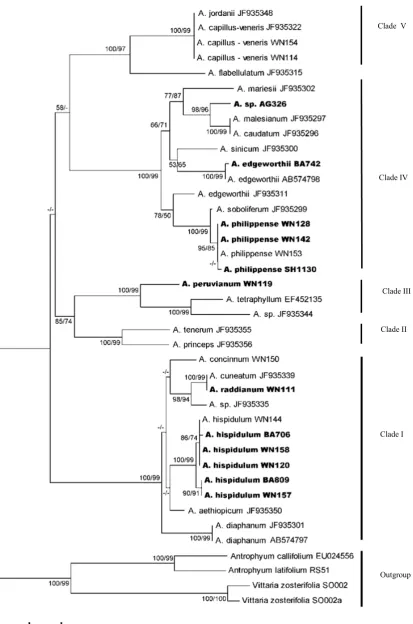
Phylogenetic analyses were conducted separately for the two data set (rbcL and trn L-F),using Neighbour-Joining (NJ) and Maximum Parsimony (MP) on MEGA 5.05. The NJ tree was constructed with genetic distance set according to Jukes-Cantor Model (Jukes & Cantor, 1969) and bootstrapping of 1,000 replicates. MP trees was calculated with the following options: Close-Neighbour-Interchange (CNI) on Random Trees with 1.000 replicates. All characters were equally weighted where indels are coded as missing data. A 50% majority-rule consensus tree was calculated to obtain topology with average branch lengths for all resolved nodes (Adjie et al., 2008). were obtained. The nucleotide sequences obtained in this study were deposited in DNA Data Bank of Japan (DDBJ) under accession number LC004106 to LC004125 for rbcL and LC004375 to raddianum (WN111). No insertion or deletion was observed in any sequences for this gene. The found in this region and alignment of 45 sequences (of which 15 sequences were downloaded from topologies for each data set. In the rbcL analysis, 40 sequences were included in dataset and the MP method recovered 15 most parsimonious trees of 653 steps (CI = 0.550000; RI = 0.862525). Thus, NJ tree with bootstrap values for the rbcL is shown in Fig 1. as representative.
The NJ and MP trees of the rbcL sequences generated five major clades. Clade I (NJ: 100/ MP: 99) is composed of Adiantum hispidulum
group. Adiantum hispidulum and A. raddianum
from Lesser Sunda Islands formed a clade with A. hispidulum, A. cuneatum and A. concinnum
from Java, A. diaphanum from Taiwan and China,
A. aethiopicum from New Zealand and an unidentified specimen from Bolivia.
Clade II (100/99) is composed of Adiantum te- nerum and A. princeps from Mexico, and did not include any sample from Lesser Sunda Islands. Clade III or A. peruvianum group, sister to Clade II, is composed of A. peruvianum from Lesser Sunda, A. tetraphyllum (cultivated) and an uni-dentified specimen from Malaysia. This clade is highly supported (100/99) and the
relationships
between Clade II and Clade III was also
resolved in NJ (85), but was not well supported in MP (74).
Clade IV (100/99) or the Adiantum caudatum
group, is strongly supported, formed by A. philip-pense from Lesser Sundas and Java, an unidenti-fied specimen from Lesser Sundas (AG326),
A. soboliferum, A. caudatum, A. malesianum,
2014] LESTARI et al.: Molecular phylogeny of Adiantum from LSI, Indonesia 149
Clade V
Clade IV
Clade III
Clade II
Clade I
Outgroup
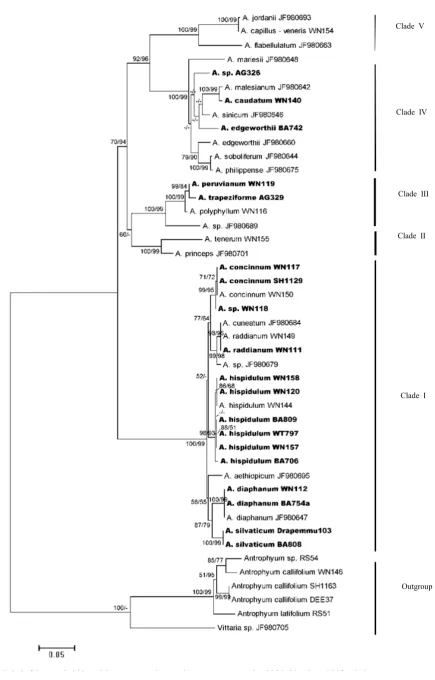
Fig. 2. Neighbour-Joining tree of the trnL-F sequences. Numbers at the nodes indicate bootstrap values (NJ/MP;
In this tree, Adiantum silvaticum, A. diaphanum,
A. concinnum and an unidentified sample from Lesser Sundas (WN118) are included in Clade I. Again, Clades II and V do not include any sample from Lesser Sunda Islands examined. The Brittle Maidenhair from Java, A. tenerum, included in Clade II, while A. trapeziforme from Lesser Sunda and A. polyphyllum from Java included in Clade III, and A. caudatum from Lesser Sunda Islands was included in Clade IV.
DISCUSSION
This study examined 12 species of the Genus
Adiantum as representative species in Lesser Sunda Islands. Six species are considered as native species, i. e. A. caudatum, A. diaphanum, A. edge-worthii, A. hispidulum, A. philippense and A. silva-ticum based on their distribution record. The other species, A. concinnum, A.raddianum and A. trape-ziforme considered as an introduced and natural-ized species, while A. peruvianum considered as cultivated species. The two unidentified specimens,
Adiantum sp. AG326 and WN118 are morphologi-cally distinct from any species reported in Malay Archipelago so far and tentatively considered as native taxa in the present study.
Both phylogenetic trees of rbcLand trnL 5’exon
to trnF (trnL-F) are comprised of five major clades. In the trees, Lesser Sunda’s samples are not monophyletic. Some species of Lesser Sunda Islands have wide distribution and were grouped seven to nine species (of which six are from Lesser Sunda). Intraspecific variation in rbcL and trnL-F sequences were observed in Adiantum hispidulum. The nucleotide substitution occurs in several sites and the A. hispidulum samples were divided into two subclades in the rbcL tree.
Adiantum hispidulum has been considered to be a polymorphic species, due to the variation at several morphological characters. Large and Brag-gins (1993) described two polymorphic members of the New Zealand A. hispidulum complex, A. his-pidulum s.s. and A. pubescens Schkuhr., which dis-tinguished based on their pinnule hairs. One sub-group with short (63-815 µm), stiff, often pigmented hairs with enlarged basal cells was treated as A. hispidulum var. hispidulum, while the other subgroup with long (251-1003 µm), soft, pale hairs with narrow basal cells is given varietal status
as A. hispidulum var. pubescens. Bouma (2008)
found another type of New Zealand’s A.
hispidu-lum pinnule’s hair called type 3, but did not
describe it clearly. Morphological examination of the above two subclades in the rbcL tree do not accord with the subdivision based on pinnule hair character.
Adiantum hispidulum is distributed in southern India, eastern Africa and the Pacific Islands (Hoshizaki & Moran, 2002) and also found in New Zealand (Large & Braggins, 1993), Australia (Bostock et al., 1998), Thailand (Boonkerd & Pollawatn, 2013), Indonesia (Posthumus, 1944; Lu et al., 2012) and China (Lu et al., 2012). The cpDNA variation observed in Adiantum hispidu-lums.l. would be applicable for future studies on phylogeography or on gene flow patterns among continents and islands.
In the trnL-Ftree (Fig. 2), Adiantum silvaticum
from Lesser Sunda is included in Clade I.
Adiantum silvaticum was reported native in eastern Australia. This species is closely related in
A. cunninghamii Hook., A. fulvum Raoul. and A. viridescens Col., endemic to New Zealand (Parris & Croxall, 1974). In our result, A. silvaticum was also related to A. diaphanum. This family Maiden-hair is native to Asia, Australia, New Zealand and the Pacific Islands (Hoshizaki & Moran, 2002). As shown in a recent study by Bouma (2008) and Lu et al. (2012), the result of molecular analy-sis incongruent with the previous ingroup classifi-cation based on morphological characters.
Adiantum concinnum and A. raddianum native to tropical America (Hoshizaki & Moran, 2002) were similar to A. capillus-veneris morphologi-cally. However, the chloroplast sequence data shows that A. capillus-veneris is distantly related to the two. In both rbcL and trnL-Ftrees (Figs. 1 & 2.), A. raddianum was grouped together with A. cuneatum which was recorded as a synonym of A. raddianum (Scamman, 1960; Hoshizaki & Moran, 2002).
Among the samples examined, there was no sample from Lesser Sunda Islands in Clade II. In Clade III or the Adiantum peruvianum group, A. peruvianum and A. trapeziforme from Lesser Sunda were grouped together with A. polyphyllum
2014] LESTARI et al.: Molecular phylogeny of Adiantum from LSI, Indonesia 151
Clades IV (Adiantum caudatum group) is highly supported, although the relationships among its members are not yet well understood. This clade is characterized by the pinnate fronds with the rachis prolonged into a prolifereous whip. Adian-tum edgeworthii is apparently polyphyletic, where Chinese A. edgeworthii form a sub clade with
A. soboliferum and A. philippense, while Japanese
and Lesser Sunda’s form a sub clade with A.
sini-cum. But the supports are very low. Besides Adiantum capillus-veneris clade (Lu et al., 2012).
A. capillus-veneris is a worldwide distributed species, from warm-temperate to subtropical area (Hoshizaki & Moran, 2002). Even the morphological plasticity in frond is very high, all samples from their distribution showed no sequence variation for rbcL. Lu et al. (2012) suggested morphological heterogenity of this species may by due to its wide-spread distribution and broad ecological range, suggesting a recent geographic migration.
CONCLUSION
Adiantum species of Lesser Sunda Islands are not monophyletic and the relationships are in in-congruent with previous morphological in-group
classification either. Lesser Sunda’s Adiantum
divided into three main clades based on two plas-tid markers (rbcL, trnL-F). Clade I of Lesser
and A. edgeworthii. No sample from Lesser Sunda Islands examined is placed in Clades II (A. tenerum group) and Clades V (A. capillus-veneris
group).
ACKNOWLEDGEMENTS
First author would like to thank Indonesian Institute of Sciences through Program Beasiswa Pendidikan Pascasarjana Dalam Negeri and Ministry of Research and Technology through Program Beasiswa Tugas Belajar Non Gelar for funded this research. We also want to thank Mark F. Large, M.Sc. (Hons)., Ph.D.
(UNITEC Institute of Technology, Auckland, New
Zealand), Xian-Chun Zhang, Ph.D. (Chinese National
Herbarium (PE), Institute of Botany, Chinese Academy of Sciences, Beijing, China) and Dr. Michael Sundue
(Pringle Herbarium, Department of Plant Biology,
University of Vermont, USA) for the discussion and all suggestions. Thanks are due to all of the people that helped collecting and taking care of the samples that we can not mentioned one by one.
REFERENCES
ADJIE, B., TAKAMIYA, M., OHTA, M., OHSAWA, T. A. & WATANO, Y. 2008. Molecular phylogeny
of the lady fern genus Athyrium in Japan based on chloroplast rbcL and trnL-trnF sequences. Acta Phytotaxonomica et Geobotanica 59(2): 79–95.
AFRIASTINI, J. J. 2003. Adiantum L. In: DE WINTER, W. P. & AMOROSO, V. B. (Eds.). Plant Resources of South-East Asia No. 15 (2) Cryptogams: Ferns and Fern Allies. Bogor: PROSEA. Pp. 50–55. AVISE, J. C. 2001. Molecular markers, natural history
and evolution. 4th printing. Massachusetts, Kluwer Academic Publishers. 340 p.
BOONKERD, T. & POLLAWATN, R. 2013. Note on Adiantum hispidulum (Pteridaceae), a new record species to fern flora of Thailand. Songklanakarin Journal of Science and Technology 35(5): 513–516. BOSTOCK, P. D., CHAMBERS, T. C. & FARRANT,
P. A. 1998. Adiantaceae. Flora of Australia. CSIRO Publishing, Collingwood.
BOUMA, W. L. M. 2008. A phylogenetic investigation of the New Zealand Pteridaceae ferns. New Zealand, Victoria University of Wellington (Thesis).
BROWNSEY, P. J. & PERRIE, L. R. 2011. A revised checklist of Fijian ferns and Lycophytes. Telopea 13 (3): 513–562.
CHING, R. C. 1957. On the genus Adiantum L. of China with notes on some related species from neighboring regions. Acta Phytotaxonomica Sinica 6: 301–354.
CHRISTENHUSZ, M. J. M., ZHANG, X. & SCHNEI-DER, H. 2011. A linear sequence of extant families and genera of Lycophytes and ferns. Phytotaxa 19:7– 54.
DE GROOT, G. A., DURING, H. J., MAAS, J. W., SCHNEIDER, H., VOGEL, J. C. & ERKENS, R. H. J. 2011. Use of rbcL and trnL-F as a two-locus DNA barcode for identification of NW-European ferns: an ecological perspective. PLoS ONE 6(1): e16371. DE LANG, R. 2011. The snakes of the Lesser Sunda
Islands (Nusa Tenggara), Indonesia. Asian Herpeto-logical Research 2(1): 46–54.
DOYLE, J. J. & DOYLE, J. L. 1987. A rapid DNA iso-lation procedure for small quantities of fresh leaf tissue. Phytochemical Bulletin 19: 11–15.
EBIHARA, A., NITTA, J. H. & ITO, M. 2010. Molecu-lar species identification with rich floristic sampling: DNA barcoding the Pteridophyte flora of Japan. PLoS ONE5(12): e15136.
lineages of Leptosporangiate ferns. Proceedings of the National Academy of Sciences 91: 5730–5734. HOLTTUM, R. E. 1968. Flora of Malaya Vol. II.: Ferns
of Malaya. 2nd Edition. Singapore: Government
Printing Office. Pp. 596–604.
HOSHIZAKi, B. J. & Moran, R. C. 2002. Fern Grower’s Manual. Revised and expanded edition. Portland: Timber Press Inc. Pp. 159–176.
IWATSUKI, K., YAMAZAKI, T., BOUFFORD, D. E. & OHBA, H. (Eds.). 1995. Flora of Japan Vol. I: Pteridophyta and Gymnospermae. Tokyo: Kodansha Ltd. Pp. 82–84.
JONES, D. L. 1998. Encyclopaedia of ferns. Melbourne: Lothian Publishing Company Pty., Ltd. 433 p. JUKES, T. H. & CANTOR, C. R. 1969. Evolution of
protein molecules. In: MUNRO, H. N. (Ed.). Mam-malian protein metabolism. New York: Academic Press. Pp. 21–132.
KORPELAINEN, H., DE BRITTO, J., DOUBLET, J. & PRAVIN, S. 2005. Four tropical, closely related fern species belonging to the genus Adiantum L. are ge-netically distinct as revealed by ISSR fingerprinting. Genetica 125(2-3): 283–291.
LARGE, M. F. & BRAGGINS, J. E. 1993. A morpho-logical assessment of Adiantum hispidulum Swartz and A. pubescens Schkuhr (Adiantaceae: Filicales) in New Zealand. New Zealand Journal of Botany 31: ClustalX version 2. Bioinformatics 23(21): 2947– 2948.
LI, F., TAN, B. C., BUCHBENDER, V., MORAN, R. C., ROUHAN, G., WANG, C. & QUANDT, D. 2009. Identifying a mysterious aquatic fern gameto-phyte. Plant Systematics and Evolution 281:77–86. LU, J., WEN, J., LUTZ, S., WANG, Y. & LI, D. 2012.
Phylogenetic relationships of Chinese Adiantum Based on five plastid markers. Journal of Plant Re-search 125(2): 237–249.
MCCARTHY, M. R. 2012. Molecular systematics and morphology of the Adiantum peruvianum group (P teri dac eae ) US A: Mia mi U ni ver s it y. (Dissertation).
NEWMASTER, S. G., FAZEKAS, A. J. & RAGUPA-THY, S. 2006. DNA barcoding in land plants: evaluation of rbcL in a multigene tiered approach. Canadian Journal of Botany 84: 335–341.
PARRIS, B. S. & CROXALL, J. P. 1974. Adiantum viridescens Colenso in New Zealand. New Zealand Journal of Botany 12(2): 227–233.
PATIL, S., PATIL, S. & DONGARE, V. 2013. The genus Adiantum L. from Maharashtra: a note on ad-dition of two species for Maharashtra, India. Fern Gazette 19(5): 159–163.
PHAN, K. L. 2010. The updated checklist of the fern
flora of Vietnam following the classification scheme of A. Smith et al. (2006).Journal of Fairy-lake Botanical Garden 9(3): 1–13.
POSTHUMUS, O. 1944. Malayan fern studies III: the
ferns of the Lesser Sunda Islands. Annals of the Botanic Gardens 51(1): 35–113.
ROTHFELS, C. J. & SCHUETTPELZ, E. 2013. Accelerated rate of molecular evolution for Vit-tarioid ferns is strong and not driven by selection. Systematic Biology. DOI: 10.1093/sysbio/syst058. RUHFEL, B., LINDSAY, S. & DAVIS, C. C. 2008.
Phylogenetic placement of Rheopteris and the poly-phyly of Monogramma (Pteridaceaes. l.): evidence from rbcL sequence data. Systematic Botany 33 (1):37–43.
SCAMMAN, E. 1960. The Maidenhair ferns (Adiantum) of Costa Rica – contributions from the Gray Herbarium of Harvard University No. 187. Harvard University Herbaria. Pp. 3–22.
SCHUETTPELZ, E., SCHNEIDER, H., HUIET, L., WINDHAM, M. D. & PRYER, K. M. 2007. A molecular phylogeny of the fern family Pterida-ceae: assessing overall relationships and the affini-ties of previously unsampled genera. Molecular Phylogenetics and Evolution 44: 1172–1185. SCHUETTPELZ, E. & PRYER, K. M. 2007. Fern
phylogeny inferred from 400 Leptosporangiate spe-cies and three plastid genes. Taxon 56(4): 1037– 1050.
SOLTIS, D. E. & SOLTIS, P. S. 1998. Choosing an approach and an appropriate gene for phylogenetic analysis. In: SOLTIS, D. E., SOLTIS, P. S. & DOYLE, J. J. (Eds.). Molecular systematics of plants II : DNA Sequencing. Netherlands: Kluwer Academic Publishers. Pp: 1–42.
TABERLET, P., GIELLY, L., PAUTOU, G. & BOU-VET, J. 1991. Universal primers for amplification of three non-coding regions of chloroplast DNA. Plant Molecular Biology 17:1105–1109.
TAMURA, K., PETERSON, D., PETERSON, N., STECHER, G., NEI, M. & KUMAR, S. 2011. MEGA5: Molecular evolutionary genetics analysis using maximum likelihood, evolutionary distance, and maximum parsimony methods. Molecular Biology and Evolution 28(10): 2731–2739.
2014] LESTARI et al.: Molecular phylogeny of Adiantum from LSI, Indonesia 153
Appendix 1.
A.
C.
B.
D. E.
F. G. H.
B.
C.
D.
E.
F.
G.
H.
I.
A.
Appendix 1. Continued
2014] LESTARI et al.: Molecular phylogeny of Adiantum from LSI, Indonesia 155
Appendix 1. Continued.
A. B. C.
D. E. F.
G H
Appendix 2.
List of nucleotide sequences used for phylogenetic analyses
No. Species Origin Accessions No.
rbcL trnL-F
1. Adiantum sp. Bolivia JF935335 JF980679
2. Adiantum sp. Malaysia JF935344 JF980689
3. A. aethiopicum New Zealand JF935350 JF980695
4. A. capillus-veneris China JF935322 -
5. A. caudatum China JF935296 -
6. A. cuneatum Indonesia JF935339 JF980684
7. A. diaphanum Taiwan AB574797 -
8. A. diaphanum China JF935301 JF980647
9. A. edgeworthii Japan AB574798 -
10. A. edgeworthii China JF935311 JF980660
11. A. flabellulatum China JF935315 JF980663
12. A. jordanii USA JF935348 JF980693
13. A. malesianum China JF935297 JF980642
14. A. mariesii China JF935302 JF980648
15. A. philippense Phillipines - JF980675
16. A. princeps Mexico JF935356 JF980701
17. A. sinicum China JF935300 JF980646
18. A. soboliferum China JF935299 JF980644
19. A. tenerum Mexico JF935355 -
20. A. tetraphyllum Cultivated EF452135 -
21. Antrophyum callifolium - EU024556 -
22. Vittaria sp. China - JF980705
INSTRUCTION TO AUTHORS
Scope. Reinwardtia is a scientific irregular journal on plant taxonomy, plant ecology and ethnobotany published in December. Manuscript intended for a publication should be written in English.
Titles. Titles should be brief, informative and followed by author's name and mailing address in one-paragraphed.
Abstract. English abstract followed by Indonesian abstract of not more than 250 words. Keywords should be given below each abstract.
Manuscript. Manuscript is original paper and represent an article which has not been published in any other journal or proceedings. The manuscript of no more than 200 pages by using Times New Roman 11, MS Word for Windows of A4 with double spacing, submitted to the editor through <[email protected]>. New paragraph should be indented in by 5 characters. For the style of presentation, authors should follow the latest issue of Reinwardtia very closely. Author(s) should send the preferred running title of the article submitted. Every manuscript will be sent to two blind reviewers.
Identification key. Taxonomic identification key should be prepared using the aligned couplet type.
Nomenclature. Strict adherence to the International Code of Botanical Nomenclature is observed, so that taxonomic and nomenclatural novelties should be clearly shown. English description for new taxon proposed should be provided and the herbaria where the type specimens area deposited should be presented. Name of taxon in taxonomic treatment should be presented in the long form that is name of taxon, author's name, year of publication, abbreviated journal or book title, volume, number and page.
Map/line drawing illustration/photograph. Map, line drawing illustration, or photograph preferably should be prepared in landscape presentation to occupy two columns. Illustration must be submitted as original art accompanying, but separated from the manuscript. The illustration should be saved in JPG or GIF format at least 350 pixels. Legends or illustration must be submitted separately at the end of the manuscript.
References. Bibliography, list of literature cited or references follow the Harvard system as the following examples.
Journal : KRAENZLIN, F. 1913. Cyrtandraceae novae Philippinenses I. Philipp. J. Sci. 8: 163-179.
MAYER, V., MOLLER, ML, PERRET, M. & WEBER, A. 2003. Phylogenetic position and generic differentiation of Epithemateae (Gesneriaceae) inferred from plastid DNA sequence data. American J. Bot. 90: 321-329.
Proceedings :TEMU, S. T. 1995. Peranan tumbuhan dan ternak dalam upacara adat "Djoka Dju" pada suku Lio, Ende, Flores, Nusa Tenggara Timur. In: NASUTION, E. (Ed.). Presiding Seminar dan Lokakarya Nasional Etnobotani II. LIP1 & Perpustakaan Nasional: 263-268. (In Indonesian).
SIMBOLON, H. & MIRMANTO, E. 2000. Checklist of plant species in the peat swamp forests of Central Kalimantan, Indonesia. In: IWAKUMA et al. (Eds.) Proceedings of the International Symposium on: Tropical Peatlands. Pp. 179-190.
Book : RIDLEY, H. N. 1923. Flora of the Malay Peninsula 2. L. Reeve & Co. Ltd, London.
Part of Book : BENTHAM, G. 1876. Gesneriaceae. In: BENTHAM, G. & HOOKER, J. D. Genera plantarum 2. Lovell Reeve & Co., London. Pp. 990-1025.
Thesis : BAIRD, L. 2002. A Grammar of Keo: An Austronesian language of East Nusantara. Australian National University, Canberra. [PhD. Thesis].
Published by Herbarium Bogoriense, Botany Division, Research Center for Biology, Indonesian Institute of Sciences
Address: Jin. Raya Jakarta-Bogor Km. 46 Cibinong 16911, P.O. Box 25 Cibinong Telp. (+ 62) 21 8765066; Fax (+62) 21 8765062
E-mail: [email protected]
REINWARDTIA
Author Agreement Form
Title of article
Name of Author(s) :
I/We hereby declare that:
• My/Our manuscript was based on my/our original work.
• It was not published or submitted to other journal for publication.
• I/we agree to publish my/our manuscript and the copyright of this article is owned by Reinwardtia. • We have obtained written permission from copyright owners for any excerpts from copyrighted
works that are included and have credited the sources in our article.
Author signature (s) Date
MUHAMMAD EFFENDI, TATIK CHIKMAWATI & DEDY DARNAEDI. New cytotypes of Pteris ensiformis var. victoria from Indonesia 133
SUZANA SABRAN, REUBEN NILUS, JOAN T. PEREIRA & JOHN BAPTIST SUGAU. Contribution of the heart of Borneo (HoB) initiative towards botanical exploration in Sabah, Malaysia 137
WENNI SETYO LESTARI, BAYU ADJIE, TASSANAI JARUWATANAPHAN, YASUYUKI WATANO & MADE PHAR-MAWATI. Molecular phylogeny of maidenhair fern genus Adiantum (Pteridaceae) from Lesser Sunda Islands, Indonesia based on
Rbcl and Trnl-f 143
ELIZABETH A. WIDJAJA & DANIEL POTTER. Floristic study of Mekongga Protected Forest: towards establishment of the Mekongga National Park 157
YESSI SANTIKA, EKA FATMAWATI TIHURUA & TEGUH TRIONO. Comparative leaves anatomy of Pandanus, Freycinetia
and Sararanga (Pandanaceae) and their diagnostic value 163
SUHARDJONO PRAWIROATMODJO & KUSWATA KARTAWINATA. Floristic diversity and structural characteristics of mangrove forest of Raj a Ampat, West Papua, Indonesia 171
IAN M. TURNER. A new combination in Orophea (Annonaceae) for Uvaria nitida Roxb. ex G. Don 181
IVAN S AVINOV. Taxonomic revision of Asian genus Glyptopetalum Thwaites (Celastraceae R. Br.) 183
YUSI ROSALINA, NISYAWATL ERWIN NURDIN, JATNA SUPRIATNA & KUSWATA KARTAWINATA. Floristic compo-sition and structure of a peat swamp forest in the conservation area of the PT National Sago Prima, Selat Panjang, Riau, Indone-sia 193
IMAN HID AY AT & JAMJAN MEEBOON. Cercospora brunfelsiicola (Fungi, Mycosphaerellaceae), a new tropical Cercosporoid
fungus on Brunfelsia uniflora 211
MAX VAN BALGOOY & ELIZABETH A. WIDJAJA. Flora of Bali: a provisional checklist 219
EKA FATMAWATI TIHURUA & INA ERLINAWATI. Leaf anatomy of Pandanus spp. (Pandanceae) from Sebangau and Bukit Baka-Bukit Raya National Park, Kalimantan, Indonesia 223
JULIA SANG & RUTH KIEW. Diversity of Begonia (Begoniaceae) in Borneo - How many species are there? 23 3
Vol. 14. No. 1.2014
CONTENTS
PageABDULROKHMAN KARTONEGORO & DANIEL POTTER. The Gesneriaceae of Sulawesi VI: the species from Mekongga Mts.
with a new species of Cyrtandra described 1
LIM CHUNG LU & RUTH KIEW. Codonoboea (Gesneriaceae) sections in Peninsular Malaysia 13
WISNU H. ARDI, YAYAN W. C. KUSUMA, CARL E. LEWIS, ROSNIATI A. RISNA, HARRY WIRIADINATA, MELISSA E. ABDO & DANIEL C. THOMAS. Studies on Begonia (Begoniaceae) of the Molucca Islands I: Two new species from Halmahera,
Indonesia, and an updated description of Begonia holosericea 19
YUZAMMI, JOKO R. WITONO & WILBERT L. A. HETTERSCHEID. Conservation status of Amorphophallus discophorus
Backer & Alderw. (Araceae) in Java, Indonesia 27
MOHAMMAD F. ROYYANI & JOENI S. RAHAJOE. Behind the sacred tree: local people and their natural resources sustainabil-ity 35
FIFI GUS DWIYANTI, KOICHI KAMIYA & KO HARADA. Phylogeographic structure of the commercially important tropical tree species, Dryobalanops aromatica Gaertn. F. (Dipterocarpaceae) revealed by microsatellite markers 43
SACHIKO NISHIDA & HENK VAN DER WERFF. Do cuticle characters support the recognition of Alseodaphne, Nothaphoebe
and Dehaasia as distinct genera? 53
NURUL AMAL LATIFF, RAHAYU SUKMARIA SUKRI & FAIZAH METALI. Nepenthes diversity and abundance in five habi-tats in Brunei Damssalam 67
NURUL HAZLINA ZATNI & RAHAYU SUKMARIA SUKRI. The diversity and abundance of ground herbs in lowland mixed Dipterocarp forest and heath forest in Brunei Darussalam 73
MUHAMMAD AMIRUL AIMAN AHMAD JUHARI, NORATNI TALIP, CHE NURUL ATNI CHE AMRI & MOHAMAD RUZI ABDUL RAHMAN. Trichomes morphology of petals in some species of Acanthaceae 79
DIAN ROSLEINE, EIZI SUZUKI, ATIH SUNDAWIATI, WARDI SEPTIANA & DESY EKAWATI. The effect of land use history on natural forest rehabilitation at corridor area of Gunung Halimun Salak National Park, West Java, Indonesia 85
JULIUS KULIP. The Ethnobotany of the Dusun people in Tikolod village, Tambunan district, Sabah, Malaysia 101
PETER O'BYRNE. On the evolution of Dipodium R. Br 123
Reinwardtia is a LIPI accredited Journal (517/AU2/P2MI-LIPI/04/2013)
Herbarium Bogoriense Botany Division
Research Center for Biology - Indonesian Institute of Sciences Cibinong Science Center