114
Ecobiology of Bacterial Wilt of Physic Nut in Indonesia
Ekobiologi Layu Bakteri pada Jarak Pagar di Indonesia
Titiek Yulianti
Indonesian Research Institute for Sweetener and Fiber Crops Jln. Raya Karangploso, PO Box 199, Malang, Indonesia
E-mail: [email protected]
Submitted: 21 November 2014; revised: 20 April 2015; accepted: 25 September 2015
ABSTRAK
Budi daya jarak pagar (Jatropha curcas) dengan sistem monokultur pada hamparan yang luas telah menim-bulkan ledakan suatu penyakit. Layu bakteri yang disebabkan oleh Ralstonia solanacearum merupakan salah satu penyakit utama jarak pagar dan ditemukan di beberapa daerah pengembangan. Gejala yang terlihat pada tanaman yang terinfeksi adalah layu dan daun menguning sebelum waktunya atau daun layu tanpa adanya perubahan warna dan masih melekat di batang. Jaringan pembuluh berubah warna kecokelatan. Akar utama dan sekunder busuk berwarna cokelat kehitaman. Pada tanaman yang terinfeksi cukup berat, daun-daunya akan gugur, bagian batang menjadi cokelat, dan akhirnya tanaman mati. Berdasar reaksi oksi-dasi sumber gula, biovar R. solanacearum yang diisolasi dari tanaman jarak pagar dari Malang, Jawa Timur mirip dengan biovar 5, sedangkan yang dari Pati, Jawa Tengah, berbeda dengan biovar standar yang ada. Bakteri ini menginfeksi tomat, cabai merah, dan terong, tetapi tidak menginfeksi tembakau ataupun jagung. Observasi lapangan untuk mengetahui perkembangan layu bakteri pada tanaman jarak pagar dan penyebar-annya menunjukkan bahwa fluktuasi kejadian penyakit berkorelasi positif dengan curah hujan. Streptomycin sulfat atau kombinasi beberapa jenis antagonis merupakan cara pengendalian yang baik. Selain itu, mengo-leskan CaCO3 pada luka akibat pemangkasan dapat mencegah penyakit berkembang lebih lanjut. Arah
pene-litian ke depan untuk pengendalian penyakit ini adalah pengendalian terpadu yang menitikberatkan kepada pertanian dan lingkungan yang keberlanjutan, misalnya penambahan antagonis, mikroorganisme berguna, bahan organik, serta pemupukan seimbang.
Kata kunci: Ralstonia solanacearum, jarak pagar, Indonesia, penyakit
ABSTRACT
Growing physic nut (Jatropha curcas)under monoculture system in large areas has generated disease out-break. Bacterial wilt caused by Ralstonia solanacearum is one of the major diseases found in several regions.
The symptom of the infected plant is wilting and premature leaf yellowing or leaves wilting without changing colour and still attaching to the stem. The vascular tissues show a brown discoloration. The primary and secondary roots may become brown to black. Severe infection causes leaves of diseased plant to fall, the stem to become brown and eventually death. Based on oxidation reaction of sugar source the biovar of R. solanacearum isolated from physic nut in Malang (East Java) was similar to biovar 5, but isolate from Pati, Central Java was different from the standard biovar. The pathogen infected tomato, red chili, and egg plant but not tobacco or maize. A field observation to determine the development of bacterial wilt in physic nut and its spread pattern demonstrated that disease fluctuation incidence was positively correlated to rainfall. Streptomycin sulphate or combination of antagonists gave a good disease control. Furthermore, smearing CaCO3 on wound caused by prunning could prevent disease development. The best control measure is
inte-gration of several control measures which encourage sustainable agriculture and environment, including the addition of antagonists, effective microorganism, organic matter, and balanced fertilizer.
115
INTRODUCTION
urrently, development of physic nut ( Ja-tropha curcas) has been encouraged by the government of Indonesia since 2005 when an issue spread out that reserve of fuel has been depleted. Physic nut is promising source for biofuel or biodiesel and considered as re-newable energy options in the future. Physic nut is mainly developed in marginal lands without irrigation, as Allorerung et al. (2006) noted that the plant could grow in drought climate and marginal land, but it needs suf-ficient water and nutrition for its optimum production. Mulyani et al. (2006) reported that 12.4 millions hectares of an unused land; 3.1 millions hectares of savanna; and around 1 million hectares of blady grass (Imperata cylindrical) land within 13 provinces were potentially suited for physic nut development.
Although the plant is claimed resistant to pests and diseases, growing in large areas will create such problem (Prihandana & Hen-droko 2006). Several diseases such as bacte-rial wilt, charcoal rot, bactebacte-rial blight, Fusari-um wilt, anthracnose, leaf spots, and mildew have been reported in some developed areas (Yulianti et al. 2007; Hartati et al. 2008.; Gin-ting & Maryono 2009; Hendra 2009; Laksono et al. 2010). Based on our observation, bac-terial wilt caused by Ralstonia solanacearum (Smith) Yabuuchi (Yabuuchi et al. 1995) considered as major disease of physic nut since it mild-severely occured in Lampung, Central Java, and West Java. According to Ginting & Maryono (2009), disease severity of bacterial blight in Lampung ranged from 9– 32%. Although, the spread of R. solanacea-rum is generally very restricted and slow, Kar-mawati & Sukamto (2009) found that bacterial wilt rapidly spread and caused around 1% nursery and young plants died within three weeks of 10 hectares area in the nursery garden of Center of Cikarang. This incidence showed that the disease was potentially major constrain in physics nuts development. There
was no estimation of yield loss; however, severe incidence of bacterial blight could kill physic nut plants of more than 50%.
R. solanacearum has more than 200 host plant species of more than 50 botanical families including weeds (Meng 2013). The pathogen is soil borne and could survive for varying periods of time (days to years) in moist soil and in irrigation (drainage) water, even in >75 cm of soil depth depends on tem-perature, pH, soil moisture, organic matter content, and the presence of microbial anta-gonists (Olson 2005).
Physic nut grows well and gives high seed yield in light soil (sandy clay texture) (Okabe & Somabhi 1989), whilst the pathogen is well adapted in the same type of soil tex-ture and warm temperatex-ture (24–35oC). This
means, the plant will severely suffer from the disease, if inoculum of R. solanacearum has been established in the soil.
R. solanacearum has long been known as the main causal agent of tropical plants disease. Therefore, bacterial wilt outbreak will difficult to control. The cheapest way to ma-nage the disease in other crops is prevent the outbreak by using resistant variety. However, the stability of resistance several crops is highly affected by pathogen density, pathogen strains, and several soil factors. Cultural, che-mical, and biological method such as sanita-tion, improve soil ecosystem balance, and crop rotation were reported gave unsatisfied result. Ahmed et al. (2013) reported that R. solanacearum in potato was not effectively control by cultural, chemical, and biological measures due to wide host range and genetic diversity of the pathogen.
This paper review ecobiology of the bac-terial wilt of physic nut in Indonesia, several attempts to control the disease in physic nut under trial scales, other possible control mea-sures to manage the disease based on other crop issues, and future direction for research and development of the disease.
116
DISEASE SYMPTOMS OF
BACTERIAL
WILT (Ralstonia solanacearum) OF
PHYSIC NUT
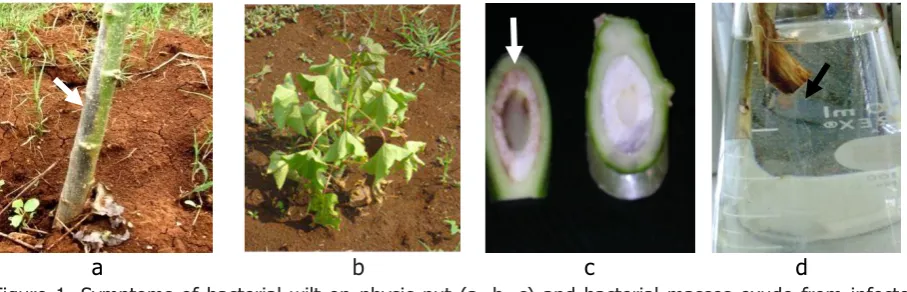
The main symptom of the infected phy-sic nut plant is wilting and premature leaf yellowing. Sometimes, one side of the plant show wilting or rotting symptoms starting from stem above the soil line (Figure 1a). In other cases, leaves wilt without changing colour and stay attached to the stem (Figure 1b). The vascular tissues show a brown disco-loration when cut open (Figure 1c). The pri-mary and secondary roots may become brown to black. Severe infection causes leaves of diseased plant fall, the stem becomes brown, and eventually die. When the plant died, the bacteria spread out of the xylem and returned to the soil through the roots. They survived persist in the environment until next host becomes available (Dalsing & Allen 2014).
A white, slimy mass of bacteria exudes from vascular bundles, when broken or cut. This slime oozes spontaneously from the cut surface of the stem in the form of threads, when suspended in water (Figure 1d).
PHYSIOLOGICAL CHARACTERISTICS
OF
RALSTONIA SOLANACEARUM OF
PHYSIC NUT
Ralstonia solanacearum is a Gram-nega-tive, rod-shaped, strictly aerobic bacterium
that is 0.5–0.7 × 1.5–2.0 µm in size with the optimal growth temperature is 28–32°C. The virulent type colonies appear after 36–38 hours at 28°C as white or cream-colored, irregularly shaped, highly fluidal, and opaque when grown in soil medium. Isolation from symptomatic plant used Kelman’s tetrazolium (TZC) medium produced white slimy colonies with red in the centre (Figure 2a) or murky slimy colonies when cultured in CPG (Figure 2b) (personal collection). The TZC medium was used to differentiate between virulent and non-virulent colony types. As Kelman (1954) reported, virulent colonies looked white with pink centers whilst non-virulent colonies were dark red.
Based on oxidation reaction of sugar source tested at laboratorium of Phytopatho-logy-IRISFC, R. solanacearum isolated from Pati, Central Java used maltose, lactose, cello-biose, mannitol, and sorbitol, except dulcitol.
a b
Figure 2. Colonies of Ralstonia solanacearum on TZC medium (a) and on CPG medium (b)
a b c d
117 In general, cultural methods; genetic
variation of host plant; and environmental factors such as soil, temperature, humidity, and rainfall highly affect the development of bacterial wilt (Supriadi et al. 2001). Bacterial wilt in physic nut was relatively new and there was no information regarding epidemiology of thedisease. Yulianti & Hidayah (2010) showed that bacterial wilt severity on the physic nut was in line with rainfall; higher severity occurred at peak rainy season. This is in agreement with Janse (2004) and Nesmith & Jenkins (1985) that the most favorable for development of R. solanacearum is at rainy season. Furthermore, the spread pattern was irregular but tended to develop spotted around infected plants showing that it was disseminated by soil from diseased roots to healthy ones. The severe the disease, the quicker it is to spread and develop. In ad-dition, the suffered plants were hardly to recover (Yulianti & Hidayah 2010). As Cham-poiseau et al. (2009) described, the bacteria spread from plant to plant when bacteria moved from infected roots to nearby healthy plants roots. It could be also disseminated by soil transfer on machinery and surface run off water after irrigation or rainfall (Coutinho 2005).
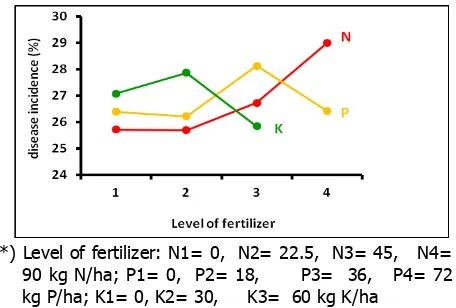
Fertilizer or other soil amendment af-fected disease development differently. Hida-yah & Yulianti (2008) observed bacterial wilt disease incidence on fertilization trial plots. The observation was done every two weeks and terminated when the disease stopped developing. It was found that neither single nor in combination of N, P, or K fertilizers gave significant effect on the disease deve-lopment, but there was a tendency that high nitrogen increased disease incidence and giving higher dosage of potassium decreased it (Figure 3). Dalsing & Allen (2014) revealed that nitrogen promoted R. solanacearum viru-lence through nitrate assimilation. The assimi-lation enhanced bacteria attached root, helped initial stage of infection, and controlled extra-cellular polysaccharide (EPS) production. EPS
is a major bacterial wilt virulence factor by blocking xylem vessels (Genin & Denny, 2012). Messiha et al. (2007) found that me-chanism of disease suppression of R. solana-cearum by means of NPK amendment varied among to the soil type. NPK fertilization re-duced bacterial wilt in Egyptian sandy and clay soils but not in Dutch clay soils.
*) Level of fertilizer: N1= 0, N2= 22.5, N3= 45, N4= 90 kg N/ha; P1= 0, P2= 18, P3= 36, P4= 72 kg P/ha; K1= 0, K2= 30, K3= 60 kg K/ha
Figure 3. Trend of disease incidence of bacterial wilt in physic nut treated with several level of N, P, K fertilizer
CONTROL OF THE DISEASE
There are several general strategies to control bacterial wilt includes the use of re-sistant varieties, cultural, chemical, biofumi-gants, and biological control (Hsu 1991).
118
annuum), egg plant (Solanum melongena)but it did not infect tobacco (Nicotiana tabaccum), peanut (Arachis hypogaea), ginger (Zingiber officinale), or maize (Zea mays). Brassicaceae such mustard (Brassica sinensis), cabbage (B.
oleracea), and Brocolli (B. oleracea ) had been
tried as source of biofumigant for R.
solanace-arum in tobacco (Yulianti 2008). The
reduc-tion of R. solanacearum population sinced isothiocyanates (ITC), released from shredded leaves when the Brassicaceae was incorpo-rated into the soil, was toxic to the pathogen. Composted the Brassicaceae residues also enhanced soil microbial population which then suppressed pathogen population. Supriadi et al. (2001) and Hsu (1991) suggested that grafting on resistant rootstocks or disinfection of plant materials could be used to inhibit disease development.
The pathogen usually infected plants by injured roots, stem wounds, or through sto-mata. Fortnum & Kluepfel (2005) also found that pruning process of tobacco leaves in-creased disease incidence since the bacteria entered into plants through the wound. Hence, the use of calcium carbonate (CaCO3) coating on wounded stalk due to prunning reduced disease incidence of bacterial wilt of physic nut up to 50% (Hidayah & Yulianti 2010). He et al. (2014) obtained that when Ca2+ concentration in plant tissue increased,
pectinase activity of R. solanacearum decreas-ed following rdecreas-educdecreas-ed bacterial wilt disease incidence. In addition, application of organic fertilizer and CaCO3 increased soil pH and
lowered the population of R. solanacearum almost 100 times compared to control. Jiang
et al (2013) obtained that increase the
ad-dition of calcium from 0.5 mM to 25 mM into 3 l nutrient solution for tomato hydroponic re-duced disease severity up to 43%. The reduc-tion of disease severity was due to the increa-sed of H2O2, which was stimulated by calcium.
When plants are underbiotic or environmental stresses, they usually generate reactive oxy-gen species (ROS) i.e. H2O2 which has a
bac-tericidal activity. Calcium also enhanced the
generation rate of polyphenol oxidase (PPO) and peroxidase (POD). Both PPO and POD have an important role in plant disease resis-tance to pathogens. Yamazaki & Hoshina (1995) also reported that calcium increased resistance of tomato to bacterial wilt and decrease the population of pathogen in the xylem.
119 good as the application of streptomycin
sul-phate 20%.
FUTURE DIRECTION FOR BACTERIAL
WILT OF PHYSIC NUTS RESEARCH
AND DEVELOPMENT
Several components of bacterial wilt control of other crops have been issued, but
on Jatropha have not been extensively done.
Considering bacterial wilt as a potential threat
of Jatropha cultivation, research on the
ma-nagement of the disease is urgently needed. The best approach is the method should pro-vide higher growth and production, whilst en-vironmentally friendly manage the disease.
Although physic nut can lives in margi-nal land, it will grow better under appropriate maintenance including irrigation, the addition of effective microorganism (EM), organic mat-ter, and balance fertilizer. Improvement of plant growth performance could increase plant defense ability against pathogen infection di-rectly or indidi-rectly. Djajadi et al. (2010) found that irrigation with 7 days interval enhanced the growth of physic nut. Inoculation of EM into soil would alter soil microbiological equili-brium, improve soil quality, enhance crop pro-duction and protection (Higa & Parr 1994). Lwin & Ranamukhaarachchi (2006) obtained good result when used either EM or Bokashi to control R. solanacearum on tomato. They found that some bacteria isolated from Boka-shi or EM were antagonistic to R. solanacea-rum. According to Hussain et al. (1993) EM contained a mixture of photosynthetic bac-teria, Azotobacter, Streptomyces , and Lacto-bacillus spp. Hence, EM improved crop yield by accelerating nitrogen fixation, decom-position of organic material in the soil, con-trolling soil diseases, and increasing photo-synthesis. Furthermore, the beneficial micro-organisms can fix atmospheric nitrogen, compose organic wastes and residues, de-toxify pesticides, suppress plant diseases and soil-borne pathogens, enhance nutrient
cy-cling, and produce bioactive compounds such as vitamins, hormones, and enzymes that sti-mulate plant grow.
Various arbuscular mycorrhizal fungi (AMF) colonizes root tips of physic nut (Mu-zakkir 2010; Charoenpakdee et al. 2010) and improves the nutritional absorption (Muzakkir 2010), promotes the root growth and dry weight of the plant (Irianto 2009; Saodah et al. 2010), development of seedlings, and enhance the stress tolerance capacity of physic nut (She et al. 2012). The role of AMF as biocontrol agent on physic nut has not been explored, although there were several reports on other crops. Hence, evaluation of AMF isolated from indigenous jatropha for control of bacterial wilt should be conducted. Monther et al. (2012) reported that inocula-tion of Glomus mosseae reduced bacterial wilt infection in tomato, and yet enhanced shoot weight and root morphology (tips, length, surface area volume, fresh weight, and dry weight). Colonization of hyphal net of AMF in roots facilitates roots absorb more nutrient and also modifies the root cortex cells and root structure which helps the plant to pre-vent R. solanacaerum infection. Zhu & Yao (2004) found that AMF (G. versiforme) in-duced phenols production locally or systemic-ally on tomato plant causing inhibition of R. solanacearum infection and decrease the pa-thogen population.
120
REFERENCES
Ahmed, NN, Islam, MR, Hossain, MA, Meah, MB & Hossain, MM 2013, Determination of races and biovars of Ralstonia solanacearum causing bacterial wilt disease of potato, Journal of Agricultural Science, 5(6):86–93, doi:10.5539/jas.v5n6p86 URL: http://dx.doi. org/10.5539/jas.v5n6p86.
Allorerung, D, Mahmud, Z, Rivaie, AA, Effendi, DS & Mulyani, A 2006, Peta kesesuaian lahan dan iklim jarak pagar (Jatropha curcas L.)., Makalah disampaikan pada Lokakarya Status Teknologi Budi Daya Jarak Pagar (Jatropha curcas L.), Badan Penelitian dan Pengem-bangan Pertanian, Jakarta, 11–12 April 2006, 14 hlm.
Ardhana, R 2008, Patogenisitas Ralstonia solanace-arum isolate asal jarak pagar (Jatropha curcas) terhadap beberapa tanaman, Skripsi Sarjana Pertanian Universitas Brawijaya, 34 hlm.
Ayana, G, Fininsa, C, Ahmed, S & Wydra, K 2011, Effects of soil amendment on bacterial wilt caused by Ralstonia solanacerum and tomato yields in Ethiopia, Journal of Plant Protection Research, 51:71–75.
Champoiseau, PG, Jones, JB & Allen, C 2009, Ral-stonia solanacearum race 3 biovar 2 causes tropical losses and temperate anxieties, Online, Plant Health Progress, doi:10.1094/ PHP-2009-0313-01-RV, downloaded on 5 February 2013 (http://www.apsnet.org/publi cations/apsnetfeatures/Pages/Ralstonia.aspx). Charoenpakdee, S, Cherdchai, P, Dell, B &
Lum-yong, S 2010, The mycorrhizal status of indi-genous arbuscular mycorrhizal fungi of physic nut (Jatropha curcas) in Thailand, Myco-sphere, 1(2):167–181.
Coutinho, TA 2005, Introduction and prospectus on the survival of R. solanacearum, in Allen C, Prior, P & Hayward, AC editor, Bacterial wilt disease and the Ralstonia solanacearum spe-cies complex, APS Press, Minnesota, p. 29– 38.
Dalsing, BL & Allen, C 2014, Nitrate assimilation contributes to Ralstonia solanacearum root attachment, stem colonization, and virulence, Journal of Bacteriology, 196:949–996.
Deberdt, P, Gozé, E, Coranson-Beaudu, R, Perrin, B, Fernandes, P, Lucas, P & Ratnadass, A 2015, Crotalaria spectabilis and Raphanus
sativus as previous crops show promise for the control of bacterial wilt of tomato without reducing bacterial populations, Journal of Phytopathology, 163:377–385.
Ding, C, Shen, Q, Zhang, R & Chen, W 2013, Eva-luation of rhizosphere bacteria and derived bioorganic fertilizers as potential biocontrol agents against bacterial wilt (Ralstonia sola-nacearum) of potato, Plant and Soil, 366: 453–466.
Djajadi, Heliyanto, B & Hidayah, N 2010, Pengaruh media tanam dan frekuensi pemberian air terhadap sifat fisik, kimia, dan biologi tanah serta pertumbuhan jarak pagar, Jurnal Littri, 16:64–69.
Fortnum, BA & Kluepfel, D 2005, Mechanization has contributed to the spread of bacterial wilt on flue-cured tobacco in the Southeastern USA, in Allen, C, Prior, P & Hayward, AC editor, Bacterial wilt disease and the Ral-stonia solanacearum species complex, APS Press, Minnesota. p. 51–59.
Frampton, RA, Pitman, AR & Fineran, PC 2012, Advances in bacteriophage-mediated control of plant pathogens, International Journal of Microbiology, 2012:326452, doi: 10.1155/201 2/326452.
Genin, S & Denny, TP 2012, Pathogenomics of the Ralstonia solanacearum species complex. Annu. Rev. Phytopathol. 50:67–89, doi:10.11 46/annurev-phyto-081211-173000.
Ginting, C & Maryono, T 2009, Physic nut ( Jatro-pha curcas L.) diseases in Lampung Province, Biotropia, 16(1):45–54.
Hartati, SY, Wahyuno, D, Karmawati, E & Supriadi 2008, Inventarisasi dan identifikasi penyakit utama pada tanaman jarak pagar (Jatropha curcas L.), Prosiding Lokakarya Nasional III Inovasi Teknologi Jarak Pagar untuk Mendu-kung Program Desa Mandiri Energi, Bayu-media Publishing, Malang, ISBN: 978-602-8299-04-6, hlm. 294–301.
He, K, Yang, SY, Li, H, Wang, H & Li, ZL 2014, Effects of calcium carbonate on the survival of Ralstonia solanacearum in soil and control of tobacco bacterial wilt, European Journal of Plant Pathology, 140:665–675 DOI:10.1007/ s10658-014-0496-4.
Me-121
nuju Kemandirian Energi, Surya Pena Gemi-lang Publishing, MaGemi-lang, ISBN: 978-602-825 3-17-8, hlm. 210–215.
Hidayah, N & Yulianti, T 2008, Perkembangan penyakit layu bakteri jarak pagar (Jatropha curcas L.) di KP Muktiharjo, Prosiding Loka-karya Nasional III Inovasi Teknologi Jarak Pagar untuk Mendukung Program Desa Man-diri Energi, Bayumedia Publishing, Malang, ISBN: 978-602-8299-04-6, hlm. 308–312 Hidayah, N & Yulianti, T 2010, Peranan bahan
pe-nutup luka pangkasan terhadap perkembang-an penyakit layu bakteri, Prosiding Lokakarya Nasional V Inovasi Teknologi dan Cluster Pioneer menuju DME Berbasis Jarak Pagar, Tunggal Mandiri Publishing, Malang, ISBN: 978-602-8878-12-8, hlm. 222–225.
Higa, T & Parr, J 1994, Beneficial and effective microorganisms for sustainable agriculture and environment, Atami, Japan: Internation-al Nature Farming Research Center, down-loaded 12 January 2014 (http://www.agrito n.nl/higa.html
Hsu, ST 1991, Ecology and control of Pseudomo-nas solanacearum in Taiwan, Plant Protection Bulletin Taiwan, 33:72–79.
Hussain, T, Ahmad, R, Jillana, G, Yaseen, M & Akhtar, SN 1993, Applied EM technology, Nature Farm Research Center, University Agriculture, Faisalabad, Pakistan, p. 1–6. Irianto, RSB 2009, Pengaruh inokulasi fungi
mi-koriza arbuskula terhadap pertumbuhan bibit jarak pagar di persemaian, Jurnal Penelitian Hutan dan Konservasi Alam, 6:195–201. Janse, JD 2004, Diagnostic protocols for regulated
pests: Ralstonia solanacearum, OEPP/EPPO Bulletin, 34:173–178.
Jiang, JF, Li, JG & Dong, YH 2013, Effect of calcium nutrition on resistance of tomato against bacterial wilt induced by Ralstonia solanacearum, European Journal of Plant Pathology, 136:547–555, DOI 10.1007/s1065 8-013-0186-7.
Karmawati, E & Sukamto 2009, Pengendalian penyakit bakteri jarak pagar dengan mikroba antagonis, Prosiding Lokakarya Nasional IV Akselerasi Inovasi Teknologi Jarak Pagar Menuju Kemandirian Energi, Surya Pena Gemilang Publishing, Malang, ISBN: 978-602-8253-17-8, hlm. 223–227.
Kelman, A 1954, The relationship of pathogenicity of Pseudomonas solanacearum to colony
appearance in a tetrazolium medium, Phyto-pathology, 44:693–695.
Laksono, DW, Nasahi, C & Susniahi, N 2010, Inventarisasi penyakit jarak pagar (Jatropha curcas L.) pada tiga daerah di Jawa Barat, Jurnal Agrikultura, 21:31–38.
Lwin, M & Ranamukhaarachchi, SL 2006, Develop-ment of biological control of Ralstonia solana-cearum through antagonistic microbial popu-lations, International Journal of Agriculture & Biology, 8:657–660, downloaded 11 October 2013 (http://www.fspublishers.org).
Meng, F 2013, Ralstonia solanacearum species complex and bacterial wilt disease, Bac-teriology & Parasitology, 4:2, downloaded 12 January 2014 (http://dx.doi.org/10.4172/215 5-9597.1000)
Messiha, NAS, van Bruggen, AHC, van Diepe-ningen, AD, de Vosm, OJ, Termorshuizen, AJ, Tjou-Tam-Sin, NNA & Janse, JD 2007, Potato brown rot incidence and severity under dif-ferent management and amendment regimes in different soil types, European Journal of Plant Patholology, 119:367–381.
Monther, MT, Sijam, K & Othman, R 2012, The potential of endomycorrhizal fungi in control-ling tomato bacterial wilt Ralstonia solanace-arum under glasshouse conditions, African Journal of Biotechnology, 11:13.085–13.094, DOI:10.5897/AJB11.3629.
Mulyani, A, Agus, F & Allorerung, D 2006, Potensi sumber daya lahan untuk pengembangan jarak pagar (Jatropha curcas L.) di Indonesia, Jurnal Penelitian dan Pengembangan Pertani-an, 25(4):130–138, downloaded 28 January 2014 (http://www.Pustaka-deptan.go.id/publi cation/p3254 063.pdf).
Muzakkir 2010, Keragaman dan potensi pemanfa-atan fungi mikoriza arbuskula indigenus ber-sama pupuk hijau terhadap tanaman jarak pagar (Jatropha curcas L.) di lahan kritis, (Skripsi), Universitas Andalas, Padang, 210 hlm.
Nesmith, WC & Jenkins, JrSF 1985, Influence of antagonists and controlled matric potential on the survival of Pseudomonas solanacearum in four North Carolina soils, Phytopathology, 75: 1182–1187
122
in Northeast Thailand, Moe Din Daeng, Khon Kaen 40000, Thailand.
Olson, HA 2005, Ralstonia solanacearum: Patho-gen profile, Department of Plant Pathology, NC State University, Raleigh, downloaded on 16 May 2009 (htpp://www.cals.ncsu.edu/co urse/pp728/Ralstonia/Ralstonia_Solanacearu m.html.4).
Pal, KK & Gardener, BMS 2006, Biological control of plant pathogens the plant health instructor, DOI: 10.1094/PHI-A-2006-1117-02, American Phytopathological Society, downloaded 23 Ja-nuary 2014 (http://www.apsnet.org/edcen ter/advanced/topics/Pages/BiologicalControl.a spx).
Prihandana, R & Hendroko, R 2006, Petunjuk budi daya jarak pagar, AgroMedia Pustaka, Tange-rang 79 hlm.
Saodah DW, Nuraini, A, Suherman, C 2010, The growth of the physic nut plant (Jatropha cur-cas L.) inoculated by dosages of arbuscular mycorrhizal fungi (AMF) in various level of drought stress, Prosiding Lokakarya Nasional V Inovasi Teknologi dan Cluster Pioneer me-nuju DME Berbasis Jarak Pagar, Tunggal Mandiri Publishing, Malang, ISBN: 978-602-8878-12-8, hlm. 113–123.
She, SM, Tu, B, Liu, DJ & Yang, XH 2012, Ad-vance and prospect of mycorrhizal physic nut, Advance Material Research, 518–523:5.381– 5.384.
Supriadi, Mulya, K & Sitepu, D 2001, Bacterial wilt disease of woody trees caused by Ralstonia solanacearum: A review, Jurnal Litbang Perta-nian, 20(3):106–112.
Yabuuchi E, Kosako Y, Yano I, Hotta H, Nishiuchi, Y 1995, Transfer of two Burkholderia and an Alcaligenes species to Ralstonia gen. nov.:
proposal of Ralstonia pickettii (Ralston, Palle-roni and Doudoroff 1973) comb. nov., Ralsto-nia solanacearum (Smith 1896) comb. nov. and Ralstonia eutropha (Davis 1969) comb. nov. Microbiology Immunology, 39:897–904.
Yamada, T 2012, Bacteriophages of Ralstonia solanacearum: Their diversity and utilization as biocontrol agents in agriculture in Kurt-boke, I (Ed.), Bacteriphages, p. 113–138, downloaded 23 January 2014 (www.inte chopen.com/download/pdf/32282).
Yamazaki, H & Hoshina, T 1995, Calcium nutrition affects resistance of tomato seedling to bacterial wilt, Horticultural Science, 30:91–93. Yulianti, T 2008, Potency of Brassica residues as biofumigation for control of bacterial wilt of tobacco in Indonesia, Third International Biofumigation Symposium, CSIRO Canberra- Australia.
Yulianti, T & Hidayah, N 2010, Pola sebaran pe-nyakit layu bakteri (Ralstonia solanacearum) pada tanaman jarak pagar, Prosiding Loka-karya Nasional V Inovasi Teknologi dan Clus-ter Pioneer menuju DME Berbasis Jarak Pa-gar, Tunggal Mandiri Publishing, Malang, ISBN: 978-602-8878-12-8, hlm. 172–176. Yulianti, T, Suhara, C & Hidayah, N 2007, Penyakit
tanaman jarak pagar (Jatropha curcas L.). Prosiding Lokakarya II Status Teknologi Jarak Pagar (Jatropha curcas L.), Puslitbangbun Bogor. ISBN: 979-8451-45-7, hlm. 91–96. Zhu, HH & Yao, Q 2004, Localized and systemic