
The Getty Conservation Institute
research in
conservation
Airborne Particles
in Museums
Editor: Dinah Berland
Copyeditor: Lisa Kirk
Cover designer: Joe Molloy
Designer and coordinator: Irina Averkieff
Typographer: FrameMaker / Adobe Palatino and Helvetica Condensed
Illustrator: Ad•Infinitum
Printer: Edwards Bros., Ann Arbor, Michigan
1993 by the J. Paul Getty Trust. All rights reserved Printed in the United States of America.
Library of Congress Cataloging-in-Publication Data Airborne particles in museums/
William W. Nazaroff… [et al.].
p. cm. -- (Research in conservation ;) Includes bibliographical references and index. ISBN 0–89236–187–5 :
1. Art--Conservation and restoration. 2. Air--Pollution. I. Nazaroff, W. W. II. Series.
N8560.P76 1992
702’.8’8--dc20 92–35622
The Getty Conservation Institute
The Getty Conservation Institute, an operating program of the J. Paul Getty Trust, is committed to raising public awareness of the importance of pre-serving cultural heritage worldwide and to fur-thering scientific knowledge and professional practice in the field of conservation. The Institute conducts interdisciplinary programs in research, training, documentation, and conservation activi-ties in several major areas including objects and collections, archaeological sites and monuments, and historic buildings and cities. This is accom-plished through a combination of in-house projects and collaborative ventures with other organizations in the USA and abroad. Special activities such as field projects, international con-ferences, and publications strengthen the role of the Institute.Research in Conservation
Contents
Foreword by Miguel Angel Corzo ix
Introduction by James R. Druzik 1
Background 3
Understanding This Report 6
Chapter 1 Soiling Due to Airborne Particles 17
Objectives and Approach 18
Chapter 2 Characteristics of Airborne Particles Inside Southern California Museums 21
Experimental Methods: Sample Collection 21
Results and Discussion 24
Indoor and Outdoor Particle Mass Concentrations 24
Aerosol Chemical Composition 26
Indoor Sources 27
Particle Deposition 27
Predicting the Mean Particle Deposition Velocity 32
Comparing Modeling and Measurement Results 33
Summary 35
Chapter 3 Mathematical Modeling of Indoor Airborne Particle Dynamics 55
Model Formulation 55
Airborne Particle Representation 55
Ventilation and Filtration 56
Particle Deposition onto Surfaces 56
Test of Model Performance: Evolution of Cigarette Smoke 57
Chapter 4 Concentration and Fate of Airborne Particles in Museums 65
Study Sites 65
Measurement and Modeling Results 67
Filter Efficiency 67
Temperature Differences and Boundary Layer Flows 67
Modeling Airborne Particle Characteristics 68
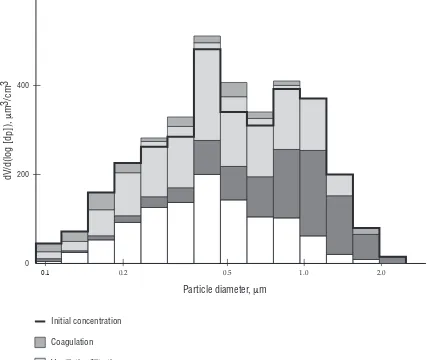
Fate of the Particles Entering from Outdoor Air 71
Particle Deposition onto Indoor Surfaces 72
Chapter 5 Measurements of the Rates of Soiling
Inside Museums Due to Deposition of Airborne Particles 91
Experimental Methods 92
Sample Collection 92
Results and Discussion 93
Estimates of the Time Required for Soiling to Occur 95
Chapter 6 Protecting Museum Collections
from Soiling Due to Deposition of Airborne Particles 97
Factors Governing the Soiling Rate of Indoor Surfaces Due to
Particle Deposition 97
Evaluating the Effectiveness of Measures to Control Soiling
Inside Museums 98
Site Description and Baseline Soiling Conditions 99
Preliminary Renovation: Adding a Conventional Mechanical Ventilation
and Particle Filtration System 104
Evaluation of the Effectiveness of Further Control Measures 105
Reducing Ventilation Rates 105
Improving Particle Filtration 106
Reducing Particle Deposition Velocities 108
Using Display Cases and Framing 111
Site Management to Achieve Low Outdoor
Aerosol Concentrations 112
Limiting Sources of Indoor Aerosol 113
Conclusions 114
References 119
The Authors
William W. Nazaroff William W. Nazaroff received his Ph.D. in environmental engineering science at the California Institute of Technology. He is currently Associate Professor of Civil Engineering, University of California at Berkeley. He is interested in the experimental and theoretical aspects of indoor air quality, including the behavior of small particles, photo-oxidants, and control of radon exposure indoors.
Mary Ligocki Mary P. Ligocki received her B.S. degrees in engineering and mathematics from the California Institute of Technology and her Ph.D. from the Oregon Graduate Institute of Science and Technology. She is presently a senior sci-entist at Systems Applications in San Rafael, California, and is engaged in air pollution research.
Lynn G. Salmon Lynn G. Salmon holds a B.S. degree in engineering from the Massachusetts Institute of Technology and an M.S. degree in engineering from the Univer-sity of California, Los Angeles. She is presently a research engineer at the Environmental Engineering Science Department, California Institute of Technology, where she continues to work on problems of protection of cul-tural properties from damage due to environmental conditions.
Glen R. Cass Glen R. Cass received his Ph.D. in environmental engineering in 1978 from the California Institute of Technology, where he is presently Professor of Environmental Engineering and Mechanical Engineering. His current research interests center on control of air pollution problems, including the problem of protection of works of art from damage due to atmospheric par-ticulate matter.
Theresa Fall Theresa Fall holds a B.S. degree in geology from the University of Califor-nia, Los Angeles. She is presently a staff geologist at Woodward Clyde Con-sultants in Phoenix, Arizona.
Michael C. Jones Michael C. Jones received his B.S. degree in chemical engineering from the California Institute of Technology in 1990. He is presently a graduate stu-dent at the Massachusetts Institute of Technology.
Harvey I. H. Liu Harvey I. H. Liu received his B.S. degree in electrical engineering from the California Institute of Technology in 1989. He is presently a graduate stu-dent at Stanford University.
Foreword
This study represents the latest in a series of research activities aimed at a better understanding of the origin and fate of air pollution within the built environment. Whether these buildings function as art museums, historical houses, archives, libraries, or other institutions housing cultural or nat-ural collections, their contents may be subject to nearly the same risk levels for loss and deteriora-tion from air polludeteriora-tion as if little or no environmental protecdeteriora-tion were present. Today we recognize this as fact, but this was not always the case. Once, many believed that as soon as objects were removed from the vagaries of everyday life and protected by institutions of learning and educa-tion, they would last in perpetuity. This complacent notion was shaken by Russell and Abney in 1888 and subsequently shattered. Throughout the 1960s, 70s, and 80s pictures emerged of life in a museum display or storage areas that were not the salubrious repose of nineteenth-century imag-ination. Buildings do provide objects with significant protection, but—apart from physical and chemical damage caused by humidity and temperature fluctuations and sheltering from general climate—damage caused by outdoor air pollution is only retarded, and is oftentimes replaced by new indoor pollutants equally as damaging.
Keeping pace with the new understanding about indoor pollutant interactions, control and monitoring methodologies have evolved to assist collection caretakers. Now it is pos-sible, at least in theory if not practice, to provide better protection than that previously assumed to be adequate.
Most previous studies of air pollution in cultural institutions have focused on gases. Particles were ignored for many reasons: they seemed to be more easily removed by the building; gaseous air pollutants had been well studied by industry, and their effects on commercial products were heavily documented; and many particle types were considered chemically benign to almost all surfaces. Even carbon black, which is now known to pose enormous degradation risks to the optical and color qualities of paintings and tapestries, is almost totally inert. Recognizing this, and understanding that we needed to know much more about the physics of particle intrusion in museum buildings, in 1987 the Environmental Engineering Lab at the California Institute of Tech-nology, under contract to the Getty Conservation Institute, began a detailed examination of five dif-ferent museums in Southern California. These structures represent a diverse range of architectural and ventilation types. Through this study a powerful computer model was developed that could predict the soiling effects of changes made to the operation or maintenance of a building. This model can even be used to estimate the soiling rates of new buildings or major rehabilitations before any construction work is begun. We feel that this is an important contribution to both the conserva-tion community and the broader field of air quality science.
Miguel Angel Corzo Director
Introduction
The potential damage that may occur to museum collections from gaseous air pollutants is well documented. Until now, however, airborne particles have been largely ignored. Except for the work of Toishi and Kenjo (1968) on alkaline particles from new concrete construction, Baer and Banks (1985) found that surprisingly little was known about the chemical nature of indoor partic-ulate matter. If they found little about the chemical nature of particles, they found still less about the transport or deposition of indoor particles.
The conservator’s concern is twofold. First, research on damaged telecommuni-cations equipment caused by hygroscopic nitrate particles suggests that metal objects in museum collections may be similarly sensitive. Nitrates were commonly found during the win-ter season at all the sites investigated in the present research, and were almost as high in concen-tration indoors as outdoors at the one historical house studied that used no filconcen-tration system. While this study took place in Southern California, the types of particles concerned are ubiqui-tous. Second, it is doubtful that once small particles settle on certain surfaces—such as feathers, fur, botanical specimens, large unframed tapestries and rugs, and unvarnished paintings—they can ever be removed. Larger particles may be partially blown off with an air current, but very small organic carbon and elemental (black) carbon particles cannot be dislodged in this way. A very soft brush may assist further, but once these small particles become imbedded in the surface texture, they become a permanent part of the structure. Just how permanent can be seen from the fact that no simple washing or bleaching technique is known to the field of paper conserva-tion that will remove elemental carbon and that does not pose its own damage or risk of future effects on natural aging.
The conservation scientist’s concerns begin where the conservator’s end. Very small particles—including most of the carbon-based ones—are inefficiently filtered by heating, ventilating, and air-conditioning (HVAC) systems and are not generally removed by gravitation. Rather, their movement is almost totally dominated by the forces of the surrounding air. More precisely, their individual mass is so low that they act more like air molecules than like larger dirt particles that form dust and deposits. The significance of this is that loosely fitted vitrines, wall cases with sliding doors that are not snugly fitted, and Plexiglas panels mounted away from walls, provide less protection than one might otherwise believe. One researcher (J. Druzik) once found visible black carbon particle deposits inside a vitrine, securely screwed down to a wooden plinth.
Introduction 2
The facilities manager’s concerns thus become grave. The kinds of filtration used in the museums studied here provide minimum resistance to airflow. To improve the single-pass filtration efficiency of an HVAC system, more energy may be required to push the building’s air volume though more restrictive filters. Energy is money—just how much money varies depending on the design and size of the building and its mechanical systems. Never as expensive as maintaining relative humidity, a classic energy guzzler, attendant costs could, nev-ertheless, easily run into the thousands, and tens of thousands, of dollars, even if available equipment could do the work. Often existing systems are inadequate, so the total costs may include capital improvements, which are seldom welcomed.
The museum director’s concerns axiomatically become those of the facilities manager, conservation scientist, and conservator when the director takes the trustees on a visit of the storage rooms and hears these influential guests joke about the director’s dirt problem.
This study contains many lessons. Not all of them are original, and not all of them follow purely from this research. Some of them are the direct result of the experience of the staffs of the five institutions involved in the study. The Norton Simon Museum is proportionally the cleanest environment of the five studied, not because of any single design effort, but because people made decisions along the way about how the building was to be constructed and run, and this resulted in a high-quality environment. Slightly more purposeful is the example of the Scott Gallery. During this study, the Scott Gallery was modified to control gaseous pollutants, encouraged to do so by earlier research by the same group from the California Institute of Tech-nology that conducted this particle study. An energy conservation study was also in progress during the particle assessment. The administration of the Scott Gallery was therefore highly sen-sitized to all aspects of the building’s performance. The results of reducing make-up air for ther-mal control from the original design limit of 25% to essentially zero are clearly reflected in the decrease in indoor fine-particle concentrations. At this point, air exchanges between the outdoor and indoor air were entirely due to infiltration, including door openings. Some decisions were intentional, others were synergistic.
Introduction
3
Observation of the interior of the caves shows that many surfaces of the sculp-tures are buried in roughly a quarter-inch-deep blanket of grey particles that probably have been delivered by atmospheric deposition processes. Unless such severe particle deposition processes can be abated, any attempt to preserve or restore the sculptures in the caves may well be defeated by a continuing assault of abrasive and possibly chemically reactive airborne contaminants. Many other similar situations probably exist in other devotional caves, deco-rated underground tombs, and in salt mines containing important sculpture.
Taking the foregoing issues into account, it appeared to those involved at the Getty Conservation Institute that the study of soiling due to airborne particles in museums had to be undertaken. This study was a natural partner to the twenty other environmental research projects originally planned, and ultimately carried out as the thrust of an eight-year research program.
Background
Twenty-five years ago the International Institute for Conservation of Historic and Artistic Works (IIC) sponsored the 1967 London Conference on Museum Climatology, a conference which, for a whole generation of conservators and curators, represented the most comprehensive body of museum environmental knowledge then available. In 1978 came the first edition of The Museum Environment (Thomson), an even more exhaustive treatment. Indicative of the need, it was a run-away best seller in its field. It is not surprising then that in the United States in March 1979, the National Conservation Advisory Council submitted a Report of the Study Committee on Scientific Support for Conservation of Cultural Properties (1979) in which it identified “Deterioration Studies” as needing more basic research and the “Study of Environmental Effects and Counteractive Mea-sures” as one of the four areas where developmental and applied research is especially needed.
Research into the action and control of environmental sources of deterioration is crucial to the survival beyond the immediate future of many artifacts. Decay-ing stone and glass in monuments and buildDecay-ings and fadDecay-ing watercolor pig-ments and textile dyes are but a few examples.
Introduction 4
Building further, Stolow’s Conservation and Exhibitions (1987) includes two chap-ters on environmental monitoring and, in a third, specifically addresses environmental require-ments in storage. Meanwhile, the second edition of The Museum Environment was issued in 1986 as interest in preventive conservation continued to grow. Between the two editions, the Cana-dian Conservation Institute (CCI) established its Environmental and Deterioration Research Division, which stated:
Environmental factors to be controlled include:
• outdoor-generated primary and secondary gaseous air pollution infiltrating the building
• outdoor-generated man-made primary and secondary particles • indoor-generated gaseous air pollution
• indoor-generated particles
• temperature and relative humidity • macro- and microbiological activities
• illumination (intensity and energy distribution) • mechanical stresses (vibration and handling)
• vandals and nondeliberate forms of human intervention
This control can be achieved on four different levels, all interrelated yet having their own unique boundary conditions.
At the building level, the environment is largely dominated by the overall venti-lation design, usually a compromise between aesthetic, economic, historical, geographical, and engineering conditions. Depending on the dominant parameters one wishes to emphasize, all buildings can be organized into any number of independent (rare) or interrelated (common) sets. Discussing just the mechanistic relationships between indoor and outdoor air quality, one possible set is arrayed in a distribution between two extremes: the typical historic house with convection flow facilitated by open windows, which may have rapid or slow air exchanges; and, at the other end, a large art museum, with elaborate multizoned climate control with or without chemical filtration. Regardless of where a given structure fits into this array, air still infiltrates and exfiltrates through numerous gaps in the building shell and is exchanged through bath-rooms, kitchens, workshops, conservation lab spray booths, and fume hoods or theater exhaust systems. These routes ensure that all varieties of gases and particles liberally move between the outdoors and the indoor museum or library environment.
Introduction
5
A third set might be characterized by buildings in which the environment is controlled exclusively by HVAC systems, governed by remote sensors, and under manual or computer control. Ideally, these systems should be slightly pressurized, making the theoretical net flux outward. But this may not be the actual case if large gaps in the building envelope are created during public access to the building. In these instances, air infiltration often places a sig-nificant load on the resident HVAC system’s ability to warm or cool and humidify or dehumid-ify. It was estimated that by 1987, the heat load associated with natural infiltration would cost about 15 billion dollars annually in the United States.
Volent and Baer (1985) point out one instance in which the HVAC system even contributed its own unique pollutant to indoor air. To prevent steam-pipe corrosion, diethyl-iamine ethanol (DEAE) was added routinely to the heating system of the Herbert F. Johnson Museum of Cornell University. In 1982, DEAE was detected visually on the surface of many arti-facts and required cleanup of the entire building after numerous health complaints. Water in building environmental systems can encourage the growth of biological contaminants as well.
At the level of individual rooms and galleries, the HVAC system or overall venti-lation strategy still dominates, but mixing occurs at boundaries between rooms where different air qualities may exist. This is especially noticeable in galleries immediately adjacent to
entrances, exits, subterranean parking facilities, wood and paint shops, etc. Because of the com-bined effects of incandescent lighting, plumbing behind walls, variations in wall insulation, and air inlets, differential particle accumulation on surfaces occurs. Some walls and ceilings heat up, others cool down, and the temperature of the bulk air may be different still. Thermal gradients along the surface of cold walls drive particles in the air toward the surface, and the surface can soil rapidly. The mechanism will be described in greater detail. Suffice it to say now that this mechanism works at close distances to a surface, but the layer undergoing thermal precipitation is constantly being renewed by turbulent mixing and larger thermal convections from the room or gallery bulk-air volume. Nielsen (1940) showed that fractions of a degree Fahrenheit differ-ences in wall or air temperature can cause perceptible soiling. At this level, visitor traffic serves to keep heavier particles stirred up, creates new types such as carpet dust, and emits its own bioeffluents (water vapor, methanol, ethanol, acetone, butyric acid, acetic acid, etc.).
Introduction 6
Buildings in which an energy conservation maintenance policy is being pur-sued may have their 24-hour ventilation rates intentionally reduced, or more dramatically, cut drastically during nonvisiting hours, which would exacerbate the already slower exchanges in storage. If an indoor source of a reactive pollutant species exists, its concentration might increase enough to visibly interact with artifacts. On the other hand, if no important sources of indoor pollutants exist within a given structure, reduced ventilation rates may be used to advantage for slowing particulate soiling and other damage by outdoor gaseous pollutants.
Sealed individual objects may be shielded from outdoor conditions and buffered against cyclical indoor conditions, yet by doing so the object is left to “stew in its own juices,” so to speak. Experimental results are scanty but the generally held opinion of most experts within the paper conservation field, and the universal fear as well, is that autocatalytic degradation may be accelerated with encapsulation if certain protective measures are not taken. If these measures have been systematically investigated, they do not appear in the literature other than in one iso-lated reference by Shahani (1986).
Somewhat less dependent but still influenced by these basic four levels are problems associated with microorganisms, insects and pests, and photochemical deterioration.
Understanding This Report
This research report, although scaled down from the final complete research report (also available from the Getty Conservation Institute [GCI]), still contains a great deal of information not normally encountered by the conservator. This section attempts to alert the reader to important points and useful features in the main body of the text chapter by chapter. When necessary, examples from conservation practice are used for illustration purposes and to allow the reader to draw connec-tions, where appropriate, to related GCI research. Technical terms are also defined here to clarify certain engineering or chemical descriptions that may be unfamiliar. Please refer to the tables and figures cited in the text.
Introduction
7
Chapter 1: Soiling Due to Airborne Particles
Chapter 1 provides the objectives and the approach of the study. Here three key concepts are encountered that will become very important later in this report: (1) movement of fine particles by Brownian diffusion, (2) particle deposition velocity, and (3) the characteristic time for soiling.
That particles settle on horizontal surfaces is well known to everyone, and grav-ity is universally assumed to be responsible although other processes do participate. Why parti-cles settle on vertical surfaces or ceilings, however, is less obvious. The reason is complex because there are several ways any particle can come into contact with any surface. The smaller a particle, the more it acts like a large molecule rather than a particle. As a result, it becomes less influenced by gravity and more influenced by gas molecules smaller than itself. This means that the gas molecules that make up the atmosphere have an effect on small particles simply from the physical effects of their collision. Normally, in a static environment there will be a statistically similar number of collisions on all sides of the particle, causing it to jump around erratically but essentially remain in place. A cloud of particles will expand slowly under this diffusive motion, and if a small particle strikes a surface it will generally stick. If some condition exists that causes more energetic gas/particle collisions on one side of the particle than another, particles will drift in a particular direction. One such important condition, called thermophoresis, is encountered if a thermal gradient exists. This commonly occurs when a surface is cooler than the ambient air. Gas molecules near the cool surface move less energetically than those farther away. Collisions on the cooler surface side of the particle will be less energetic than the other side. Therefore, par-ticles will drift in the cooler direction. This can be seen in black streaks on walls where differen-tial movement occurs because of cooler water pipes or structural supports located behind a wall’s surface.
The second important concept is the “particle deposition velocity.” This is defined not as a true velocity in the sense of particles moving toward a wall, but rather as the ratio of particle flux to a surface divided by the particle number concentration in the ambient air adjacent to that surface. This definition can be applied as a function of particle size in order to track different types and sizes of particles that have different deposition rates as they collect on surfaces. These different rates are affected by gravitational settling and air movement close to surfaces. They are also affected by thermophoresis. The same-sized particles will behave differ-ently in a quickly ventilated airflow with turbulence than in one where large volumes of air are introduced with minimal movement and turbulence.
Introduction 8
Chapter 2: Characteristics of Airborne Particles Inside Southern California Museums
Chapter 2 describes in some detail how airborne particles were measured in five museums in Southern California. This is provided to demonstrate methods that can be used elsewhere. More detailed information may be found in the final report.
The five structures studied here represent a useful range for comparison. The J. Paul Getty Museum, the Norton Simon Museum, and the Scott Gallery are all HVAC-equipped buildings with particle filtration. Their geographic locations range from a cleaner oceanside loca-tion to the heart of the Los Angeles air polluloca-tion corridor in Pasadena and San Marino. The facil-ities studied also have very different particle filtration characteristics. Two other museums are investigated, the Sepulveda House and the Southwest Museum. The former has no HVAC or particle filtration, and the Southwest Museum is a hybrid structure combining HVAC and non-mechanically controlled regions.
During the period in which data were being collected, it was decided to amass information on a wide range of chemically unique particles even though the central thrust of the work was to assess and design control methods for preventing soiling by black elemental carbon particles and by soil dust. This was because if, in the future, a link becomes established between damage and some unique chemical classes of particles about which we now know very little, the data will already have been collected to hypothesize about the risks to museum collections. These data now exist for sulfates, nitrates, ammonium, sodium chloride, soil dust, and elemental and organic carbon.
Chapter 2 clearly defines the soiling risks to museum objects from elemental carbon. Even though the elimination of elemental carbon was highest in the Norton Simon Museum and in the Scott Gallery, the authors found that elemental carbon represented the sec-ond largest component of the indoor fine aerosol in the winter samples at those two sites. For buildings with particle filtration systems, this level can be 20 to 50% of the outdoor levels; for nonfiltered buildings, the level is 50 to 100%. A disturbing finding was that in two of the muse-ums studied, particulate organic matter concentrations indoors were higher than the outdoor concentrations, suggesting that indoor sources augment the outdoor ones.
Chapter 3: Mathematical Modeling of Indoor Airborne Particle Dynamics
To elevate the experimental data to a level at which it can serve as a management and engineering tool, mathematical modeling is required. The model developed here is one of the important con-tributions of this study, yet it may remain the most obtuse and difficult for many to understand. But this need not be the case. To gain a general appreciation of mathematical modeling, one need only consider familiar examples.
Introduction
9
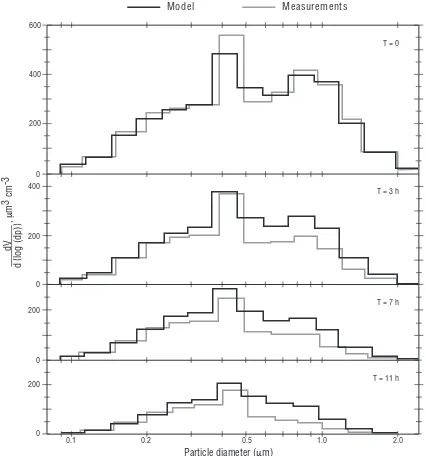
outcome. For instance, when planning for a new car, the model equations demand that other expenses be suppressed and savings increased over time. In planning retirement income, the model covers a greater time span during which the prime interest rate will surely change many times. It also makes use of simple or compounded interest rates for numerous investment options, which, for security, should be diversified. Models such as these have been validated thousands of times, so they can be reliably trusted even if you are using them for the first time. However, unique models, those built for specific engineering or scientific purposes, have no track record and therefore must be initially vindicated to show that they have been designed to take the important aspects of a complex problem into account. Such vindication is called model validation and usually proceeds by ascertaining if the model predicts, with reasonably good agreement, the same conclusions produced by laboriously collected experimental observations. Your financial model will be validated by year-end bank accounts; the present particle model developed in this case was validated against experimental studies of environmental tobacco smoke.
The authors’ model is complex because it must be designed to be adapted to represent many radically different buildings accurately. Its job is, in part, to help assess the risk to museum collections from particle soiling when the objects to be protected must be assumed to be irreplaceable. The conservation scientist will, therefore, wish to have both accuracy and the ability to view different building designs through the computations of the same model. One con-sequence of the high level detail is that this model is unlikely to be employed frequently, unlike models for energy calculations in buildings which have greater availability. Therefore, later in the report, the authors have applied the model to a variety of important cases such that the con-clusions drawn can be assimilated without actually running the model yourself.
Chapter 4: Concentration and Fate of Airborne Particles in Museums
With the model validated, the next step is to compare actual measured and predicted concentra-tions as a point of departure for more sophisticated predicconcentra-tions, including those of importance for conservators and curators. In order to do this, several parameters needed to be measured, includ-ing filter efficiency, temperature differentials between air and walls, and air velocities, particularly near the surface of walls.
Introduction 10
do not wear out or become exhausted like gaseous filters. They actually behave in the opposite manner, getting better the dirtier they become. This can be seen in another way in Table 4.3 (p. 71). The Norton Simon Museum was modeled assuming different cases: Case A in which the make-up air filter was new and the recirculated filter loaded, and Case C in which both filters were loaded. Coarse elemental carbon and soil dust for Case B were only 5% as high as in Case A. For fine particles, the differences are far less, but the simulations still show improvements around 20%. The reduction of particles in the Norton Simon Museum is also due to the fact that recirculated air is continuously passing through FA3 which serves to polish the indoor air quality when make-up air is severely restricted or cut to zero.
Figure 4.3 (pp. 80–82) illustrates the next important set of measurements required by the present model: temperature of the bulk air supply versus the wall temperature and surface air velocities. Two reasons are immediately obvious as to why these are important measurements: First, they permit calculation of thermophoresis as a deposition process that causes particle motion perpendicular to walls; this mechanism produces tiny but persistent net velocities. Second, and more important, air velocities parallel to walls that are huge by compar-ison (5 to 30 cm per second) lead to particle deposition by convective diffusion.
The study of the Scott Gallery on April 24–25, 1988 (Fig. 4.3) represents a fine example of building physics. Roughly at noon on that day, the air conditioning was interrupted and the air temperature began to rise quickly (negative values below the zero line mean the air is warmer than the walls; positive values above this line represent warmer walls relative to the air). Suddenly, at 3:45 p.m., the air conditioning resumed, quickly cooling the air, seen in the graph by the strip recorder jumping up. During the time the air conditioning was off, the gallery and perhaps the entire building went into a semistratification mode as seen by the drop in sur-face-boundary air velocity. Air stratification in buildings may have important practical implica-tions for preventive conservation, since objects react differently depending on their location within thermal and/or humidity gradients. In this situation, two different types of measure-ments not normally found in museums detected the onset of a possibly hazardous stratification almost immediately. Stratification does not always indicate a problem. If an object or surface is thermally or hygroscopically insensitive, stratification permits useful control of deposition.
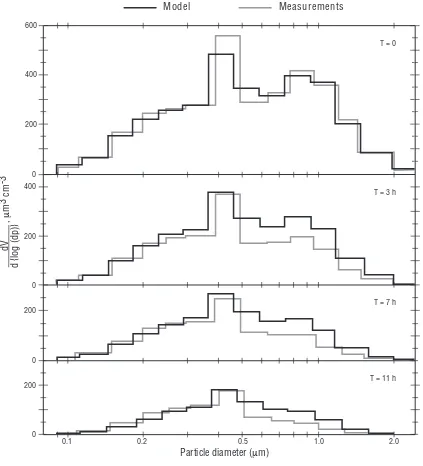
Figure 4.4 (pp. 83–85) compares measured and modeled, outdoor and indoor particle concentrations and shows why the model justifies confidence in it. It also shows why bigger dust problems typically exist in our houses than in museums.
Introduction
11
chemically reactive ones. It is not within the scope of this study to identify chemical risks from particle deposition, but the literature contains more than a few references to indicate that the dangers are clearly worth future investigation.
The authors of this report make one important point on the limitations of their calculations for museum collections. Calculations were done for vertical surfaces that are smooth. For varnished paintings this is true, but for some textiles, ethnographic materials, and natural collections it is not true. Therefore, as indicated previously, rough, porous, and fragile surfaces require special protective consideration.
The comments above introduced the notion of the characteristic time for soiling. This was described as the time it would take for a white surface to become noticeably soiled as determined by an observer. For a smooth white surface, this condition has been determined to represent a coverage of about 0.2% of the surface by black dots too small to be visually resolved. Since white surfaces would be the first to show change, they are logical to use as our standard. Table 4.5 (p. 76) applies this characteristic time of noticeable soiling to the three museums that have been extensively studied in this report. Taking only Case A, the results are impressive. For ceilings, the time to observe soiling varies from centuries to decades to years between the build-ings studied; for walls, from decades to less than a year; for floors, from years to weeks. These data have far-reaching ramifications. The fact that vast improvements in indoor-particle air quality are being shown for buildings equipped with HVAC systems is almost irrelevant for institutions desiring to build new facilities in developing countries or elsewhere where HVAC systems are unlikely to be built because of maintenance and operating costs. However, there may exist passive or less capital-intensive environmental control systems for existing structures, that only filter air through low-tech materials (rather than cool it) that could achieve these types of results. Unlike the stereotypical HVAC installation, such filtration equipment is robust and operates at a fraction of the energy usage typically mandated for temperature and especially humidity control. These and many more techniques may be applied to achieve the same type of results at the Sepulveda House as observed at the Norton Simon Museum and the Scott Gallery, as this report will show.
Chapter 5: Measurements of the Rates
of Soiling Inside Museums Due to Deposition of Airborne Particles
Introduction 12
Deposition of soiling particles was measured on three substrates: white artists’ canvas, Whatman 42 filter paper, and quartz cloth. The measurement of soiling was carried out on a Diano Match-scan II reflectance spectrophotometer. Visual observation of the quartz cloths was also recorded for the horizontal surfaces. It is somewhat discouraging to note that during the sampling period of three months to a year the canvas and the paper samples changed at every site. At two sites where unfiltered outdoor air penetrated the galleries, vertical soiling was visible after one year. Worse yet, inside display cases at the Southwest Museum where sliding glass doors had gaps as large as 4 mm, the change found for a horizontal collection surface in one year was approximately equal to 44 weeks in the open gallery. For all intents and purposes, the protection from particle deposition provided by these cases was small (the cases are, how-ever, useful for reducing ozone concentration within the cases).
Tables 5.2 and 5.3 (pp. 95, 96), calculated from the measurement plan of the sur-vey, tell the full story. What emerges is that the filtered environments of the first three museums have the lowest dark particle buildups (flux), while the unfiltered museums had two to thirteen times the mass of elemental carbon deposited on vertical surfaces. Table 5.3 (p. 96) extrapolates from these data and represents the authors’ best estimates of the times required for perceptible soiling to occur on indoor vertical and horizontal surfaces.
The soiling time on vertical surfaces for filtered museums ranges from 18 years down to 4.8 years, with the J. Paul Getty Museum the fastest soiling of the three. This is due to a combination of two principal factors: The main floor (Antiquities) is served only by ventilation of filtered air between the hours of 8 a.m. and 6 p.m. While open to the public, that same floor has open doors allowing outdoor air to enter the building. For the two unfiltered museums the soiling time collapses further down to 2 and 0.3 years.
Chapter 6: Protecting Museum Collections
from Soiling Due to Deposition of Airborne Particles
Chapter 6 focuses all that has been learned to provide advice on how perceptible soiling times in the relatively open structure of the Sepulveda House can be lengthened to meet or exceed the performance of even the Norton Simon Museum.
Introduction
13
Sepulveda House can be accomplished at virtually any building for which a particle-reduction strategy is being considered or for which particle reduction may be included in a more general management plan.
Seven steps are presented that build on each other in improving the manage-ment of soiling. In its original state, the Sepulveda House had a characteristic soiling time of 0.9 and 1.5 years for walls and ceiling respectively. By adding a conventional mechanical system with filtration only good enough to protect the ventilation system itself—i.e., efficiencies of 15 to 35% per pass through the filters depending on the size of the particles—and sealing the major gaps in the shell, a reduction in the soiling rate of both types of surfaces of slightly better than 40% can be achieved. This type of operation would have been popular prior to the 1970s, before energy conservation was such an important issue. But since the 1970s, reducing high levels of outdoor airflow through the building has been a priority. This outdoor air is called make-up air. By providing just the right amount of outdoor air required for a design occupancy of 20 persons per 1,000 square feet (ASHRAE 1985), plus reducing all make-up air at night and when the build-ing is closed, improvements of 50 to 60% are possible.
The next level of improvement has been discussed by the conservation field itself through debate on the draft ANSI standard (1985) for the storage of library and archival documents. Using these suggested filtration requirements as the basis for substituting higher efficiency filters in the mechanical system, the reduction in soiling time jumps by tenfold, or to 30 to 45 years for walls and ceilings. Even without further modifications soiling rates are achieved that are twice as slow as the sophisticated HVAC-equipped Norton Simon Museum with its nevertheless lower efficiency filters.
Often older buildings have extant ducting for central furnace-style heating. However, when they do not, or when economics plays a vital role, the authors do consider duct-less consoles as a potential solution. The reader is cautioned about going down this road, because in a study by Offermann et al. in 1985, half the units tested had effective cleaning rates so small they would be useful for little more than closets. These units may have worked ade-quately in large display cases, but the conservation field does not need preventive steps that do too little too late.
Thirty to forty-five years is a very long time before visible soiling may occur. Arguably, most museum directors would hesitate to go further, knowing full well that their insti-tutions would now rank among the highest in performance. Since this period of time is longer than the average career length of a museum director, this may also play a part in a spiritless response. Notwithstanding, for those with the will to persevere—and, in particular, for those engaged in new building construction—soiling risks can be reduced from decades to centuries.
Introduction 14
understanding of how soiling rates are influenced by the surface-boundary layer of a wall or ceiling, airflow in and adjacent to those layers, and any temperature variations present. In gen-eral, three air flow regimes types exist that have dynamic roles to play on surface soiling: homo-geneous turbulence, natural convection, and laminar airflow. Turbulent airflow is popular and conventional because it ensures rapid air mixing for thermal and humidity control, but it also promotes particle deposition. Air is usually discharged by small vents near the top of walls at relatively high velocity. Natural convection can be turbulent or nonturbulent depending on other climatic variables and/or building geometry. But laminar airflow, or displacement, venti-lation models provide the least particle deposition because they have the smallest disruptive effect on surface-boundary layers. The Norton Simon Museum is an excellent example of an environment in which a large volume of air is introduced through perforated acoustical ceiling tiles and returned via gallery halls. Rather than small registers injecting air at high velocity, mil-lions of tiny holes provide a system closer to an overhead diffuser than to a conventional venti-lation system. By designing the building to operate in this manner, almost 22,000 cubic meters of air are recirculated every ten minutes. The experimentally derived particle-deposition veloc-ities that result are the lowest of the five museums in this study.
✤
Results such as these excite the imagination. If all factors that contribute to the destruction of cul-tural and nacul-tural objects were divided into basic classes, one might postulate that there are only two possible classes: that which is intrinsic to the object and that which is extrinsic.
Intrinsic deterioration includes both inherent vice contributed by the artist or artisan in which faulty or incompatible materials or construction methods are used, and chemi-cal composition unique to the object. Acidic hydrolysis of paper, loss of plasticizers from cellu-lose nitrate, incompatible pigments, and buffered storage products in contact with some photographic processes are all intrinsic problems. Even further, because oxygen cannot be excluded from museums in general, in spite of improvements in display-case technology, oxida-tion from atmospheric oxygen is effectively a materials-intrinsic process.
Extrinsic deterioration is by far the larger and more ominous class. It is here that one may bundle the effects of light, humidity, temperature, gaseous and particle air pollution, natural and manufactured disasters, and all possible synergistic interconnections of these influ-ences. It is precisely this class that the conservation and museum communities have identified as the most important class when they prioritize preventive conservation over treatment.
Introduction
15
paper, textiles, and synthetic polymers; and of natural disaster and wars on whole cultural pat-rimonies. We know so much, yet frequently do so little. From all the available literature, it is the-oretically possible to build a museum in which the life spans of objects are determined solely by their intrinsic decomposition. In this ideal setting, one could establish an environment in which the most fragile of such collections would outlive any present or past civilization and—barring external destruction—could last, not centuries but many millennia. Whether such a museum is ever built, one may be encouraged by the knowledge that it remains within our province to approximate that goal.
James R. Druzik Conservation Scientist
1
Soiling Due to Airborne Particles
The soiling of works of art due to deposition of airborne particulate matter poses a hazard to museum collections. Over long periods of time, dark deposits build up on the surfaces of paint-ings, sculptures, and stone buildings necessitating cleaning procedures that are expensive and that may pose some risk to the works themselves. Some objects such as old, fragile textiles and tapestries may be almost impossible to clean once they have become soiled.
In addition to soiling by airborne particles, the conservation literature suggests that deposited airborne material can attack collections chemically. Alkaline particles released indoors such as dust from concrete in new buildings are reported to have caused problems in Japan (Toishi and Kenjo 1967, 1968, 1975). Also, one expects metal corrosion to be accelerated by deposition of the acidic particles present in photochemical smog. A recent review of the litera-ture on how to protect museum collections from air pollutants, however, notes that surprisingly little is known about the chemical nature of indoor particulate matter (Baer and Banks 1985).
The rate of deposition of particles onto surfaces is governed by the atmospheric particle concentration and by the size distribution of those particles. Large particles sediment out of the atmosphere under the influence of gravity. Fine particles are driven to surfaces by Brown-ian diffusion, assisted at times by other processes such as thermophoresis. Once the particles have deposited, their optical appearance and chemical interaction with works of art depend on the details of the chemical composition and morphology of the particles. The effectiveness of air-cleaning devices also depends on particle size, with fine particles (smaller than 1 µm in diameter) being much more difficult to remove than larger coarse particles (Friedlander 1977). The tech-nology for protecting works of art from airborne particles must rest on a firm understanding of the chemical composition and size of the particles present.
Experience with outdoor air-pollutant measurements shows that airborne coarse particles cluster into distinctly different size ranges with different chemical properties. Coarse particles (with diameters of about 2 µm and larger) consist largely of soil dust, road dust, and sea salt. Fine particles smaller than 2 µm in diameter consist of vehicle exhaust material, soot, ammonium sulfate, ammonium nitrate, and sometimes sulfuric acid. Under polluted con-ditions, the outdoor air fed to building ventilation systems contains roughly comparable amounts, by mass, of coarse- and fine-particle material. Fine airborne particulate matter contains soot and acidic materials and is characteristically black, while coarse material contains soil-dust components and thus appears brown when collected on a white surface (such as paper). If soil-ing is to be prevented, control of both fine and coarse particles must be considered.
Soiling Due to Airborne Particles
18
soiling particles were not effectively removed by the filters in the air-conditioning systems stud-ied. If such a situation prevails in a museum, then the possibility of damage to the collection over long periods should be seriously considered.
Objectives and Approach
The purpose of the research effort reported here is to establish some of the physical and chemical pathways by which airborne particulate matter acts to damage works of art. Emphasis will be placed on understanding how to break the chain of events leading to the soiling of art objects by particulate matter. We seek to answer the following questions:
1. What are the ranges of chemical composition, concentration, and size dis-tribution of the airborne particulate matter found in the indoor atmosphere of museums?
2. What physical mechanisms govern the transfer of particles from room air to the surface of works of art? How rapid are these deposition processes? 3. How do the deposited particles alter the appearance of a surface?
4. Can particulate matter deposition processes within buildings be modeled on the computer in a way that will aid in the design of a new museum?
5. What approaches can be devised that will protect works of art from damage by airborne particulate matter?
Soiling Due to Airborne Particles
19
Protection of works of art from soiling due to the deposition of airborne part-icles is discussed in Chapter 6. The completed indoor-outdoor particulate air quality and depo-sition model is employed to study the effect of alternative control measures that could be employed to retard soiling by airborne particles. These methods include:
1. Increasing the efficiency of airborne particle filtration by mechanical ventila-tion systems
2. Reducing the rate of induction of outdoor particles into a building 3. Placing objects within display cases or glass frames
4. Managing the outdoor area surrounding the building to achieve lowered outdoor particulate matter concentrations
5. Eliminating indoor particle sources
6. Reducing the particle deposition velocity (e.g., the particle flux per unit of atmospheric particle concentration) onto surfaces of concern
The simultaneous use of several of these control measures may be advisable in order to lengthen the time before soiling due to deposited particles would become noticeable.
Soiling Due to Airborne Particles
2
Characteristics of Airborne Particles
Inside Southern California Museums
In the absence of particle-filtration systems, concentrations of suspended particles indoors can be as high as or higher than those outdoors (Biscontin et al. 1980, Dockery and Spengler 1981). Filters for particle removal have been incorporated into most museum heating, ventilation, and air-conditioning (HVAC) systems for many years. But surprisingly little attention has been paid to the effect that these particle-removal systems have on the concentration, chemical com-position, and size distribution of airborne particles within museums. Studies that have been conducted on particle composition and removal within museums generally have been designed to resolve specific problems encountered in a particular building; for example, the generation and deposition of cement dust inside a freshly poured concrete structure (Toishi and Kenjo 1967, 1975).
An experimental program was initiated to determine the extent to which museum ventilation systems modify the concentration and composition of airborne particulate matter entering from outdoors. Information was sought to identify particulate chemical species for which there may be indoor sources. Additional facets of the present study include measurements of the accumulation rates and deposition velocities of particles to vertical and horizontal surfaces inside museums, and modeling studies of indoor particle concentrations and deposition on surfaces. Taken as a whole, this information provides a series of methods for assessing the effectiveness of building ventilation systems in protecting artifacts from damage due to the intrusion of outdoor particulate air pollution. The present chapter defines baseline conditions for particulate air quality inside and outside the museum sites studied, presents evidence for indoor sources of particles, and examines the particle-deposition rates to surfaces within the museums studied.
Experimental Methods: Sample Collection
Characteristics of Airborne Particles Inside Southern California Museums
22
that has no mechanical ventilation system whatsoever. Building characteristics, ventilation sys-tem parameters, and particle-filtration devices at each museum are described in Table 2.1.
Table 2.1. Building characteristics of the study sites.
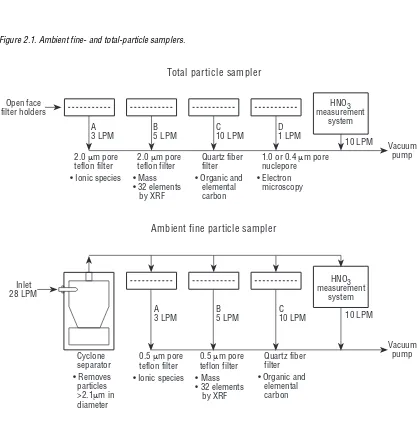
Ambient 24-hour samples of both fine (dp < 2.1 µm) and total airborne particu-late matter were collected indoors and outdoors at each site. A schematic of the samplers used is presented in Figure 2.1 (p. 37). Air drawn through the fine-particle sampler first passed through a cyclone separator (John and Reischl 1980) for removal of coarse particles (dp > 2.1 µm). The airflow was then divided between several parallel 47-mm diameter filter assemblies, each containing a filter substrate compatible with a particular chemical analysis procedure. The chemical analysis procedures used allowed measurements to be taken of an almost complete material balance on the chemical composition of the particles present including organic carbon, elemental carbon (black soot), ionic materials, and trace metals. These chemical analysis proce-dures are described in detail in the final project report (Nazaroff et al. 1990). In the total particle sampler, the same filter substrates were employed in open-face filter holders. A Teflon-coated metal sheet was positioned above the open-face filter holders in order to prevent the sedimenta-tion of large particles onto the filters. Critical flow orifices (Millipore; Bedford, Mass.) were used in both the fine- and total-particle samplers to control the flow rate individually through each filter assembly.
Site Usea Ventilationsystemb
Outdoor air exchange rate (h-1)c
Indoor air recircu-lation rate (h-1)d
Sepulveda House 1 I 1.6–3.6 0
Southwest Museum
(California Room) 2 II 0.3e ndf
Norton Simon Museum 3 III 0.4–0.7 5.4
Scott Gallery 3 III 0.3–1.0g 8.2
Getty Museum
(Gallery 121) 3 III 1.2–1.3f 7.1
a. Uses: (1) historical museum, (2) archaeological museum, (3) art museum.
b. Ventilation system types: (I) no mechanical ventilation system, (II) partial forced ventilation system, no additional particle filtration, (III) modern heating, ventilation, and air-conditioning (HVAC) system with particle filtration. c. Air changes per hour due to outdoor make-up air plus infiltration. Range of measurements obtained from
per-fluorocarbon tracer tests from the summer and winter sampling periods, and sulfur hexafluoride tracer tests for a 24-hour period in spring of 1988.
d. Air changes per hour provided by recirculation of indoor air. e. Summer and winter seasons.
Characteristics of Airborne Particles Inside Southern California Museums
23
Each indoor total-aerosol sampler contained a polycarbonate membrane filter (Nuclepore, 1.0 or 0.4 µm pore size) that had been precoated with vapor-deposited carbon for examination with an automated scanning electron microscope (SEM). The flow rate through the Nuclepore filters was set at 1 LPM to minimize overloading of particles on the filter surface.
Each site was equipped with indoor-vertical and upward-facing horizontal deposition plates. The deposition plates used for single-particle analysis by automated SEM techniques consisted of freshly cleaved mica sheets (Ted Pella, Inc., Redding, Calif.) that had been precoated with a layer of vapor-deposited carbon in order to provide a conductive surface for the electron beam. The plates had dimensions of 5.1 cm x 7.6 cm and approximate thicknesses of 0.03 cm. Some of the mica plates were attached to the walls with thermal joint compound (Thermalcote; Thermalloy, Inc., Dallas) to ensure good thermal contact with the wall. Other mica plates were attached to small, stretched artists’ canvases that were then hung on the walls. Other deposition plates were deployed to collect material for analysis by bulk chemical and optical methods. These plates employed a variety of collection substrates mounted in thin (3 mm) alu-minum frames. The frames were machined with beveled edges to minimize disruption of the boundary layer airflow along the wall. Deposition surfaces included Teflon-membrane filter material (20.3 cm x 25.4 cm, 1 µm pore size, Zefluor; Gelman, Ann Arbor, Mich.) for collection of material to be analyzed for ionic species, quartz fiber filter material for elemental and organic carbon determination, and paper and canvas for optical analysis. (Results from the carbon and optical analyses will be presented in Chapter 5.) Also included were polycarbonate membrane deposition surfaces (Nuclepore filter material without holes; Nuclepore, Pleasanton, Calif.) that were precoated with vapor-deposited carbon and used as alternative substrates for the auto-mated SEM analysis. The aluminum deposition-plate frames were also affixed to the walls with thermal joint compound and secured with small nails at the edges.
corri-Characteristics of Airborne Particles Inside Southern California Museums
24
dor of the building. Most of the artifacts on display at the Sepulveda House during 1987–88 were located in a small room that was isolated from the rest of the building by a glass partition. An additional subset of deposition plates was placed in this room, but long-term ambient sampling was not possible there.
Results and Discussion
Indoor and Outdoor Particle Mass Concentrations
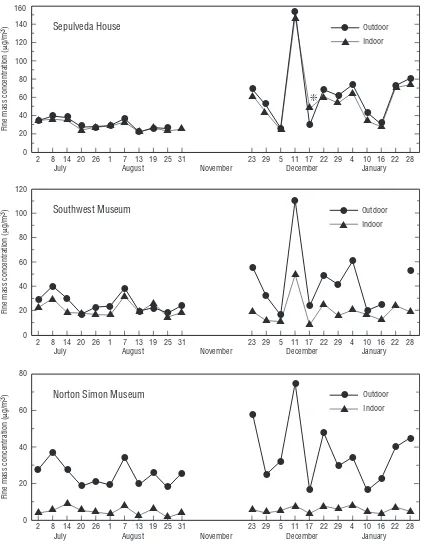
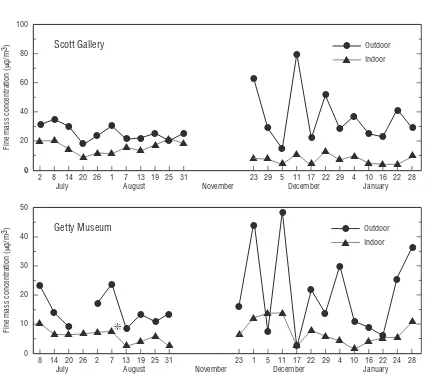
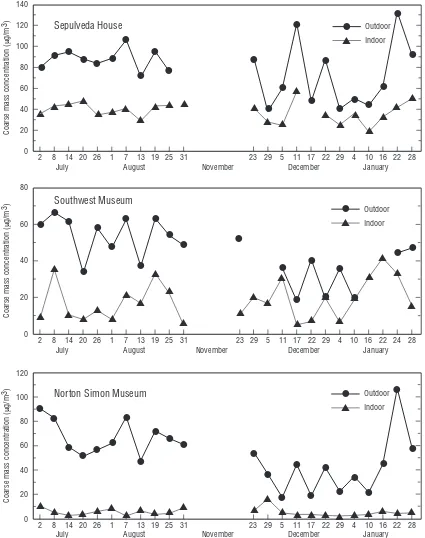
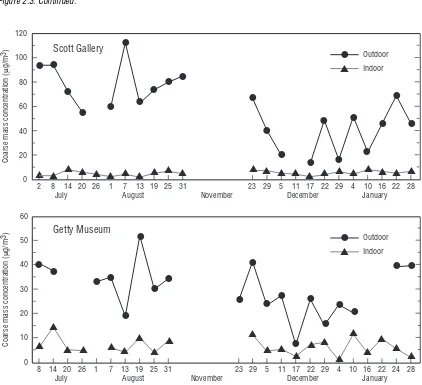
The time series of indoor and outdoor fine- and coarse-particle concentrations, with the summer and winter periods for each, are shown in Figures 2.2 and 2.3 (pp. 38–39, 40–41) respectively. The highest outdoor concentrations for both fine and coarse particles were observed at the
Sepulveda House site (mean concentrations for fine and coarse particles were 30 and 86 µg m-3 in the summer, 62 and 70 µg m-3 in the winter; highest fine concentration was 154 µg m-3 on December 11, 1987, and highest coarse concentration was 132 µg m-3 on January 22, 1988). The lowest outdoor concentrations were found at the Getty Museum, which is located generally upwind of the city of Los Angeles, near the coast (mean concentrations for fine and coarse par-ticles were, 15 and 34 µg m-3 in the summer; 21 and 27 µg m-3 in the winter; highest fine concen-tration was 49 µg m-3 on December 11, 1987; and highest coarse concentration was 52 µg m-3 on August 19, 1987).
Figure 2.2 (pp. 38–39) shows that indoor fine-particle concentrations at the Sepulveda House were nearly identical to those outdoors. This is not surprising in view of the fact that the building has no air-filtration system and that, during the hours when the building is open to the public (10 a.m. to 3 p.m. daily, except Sunday), two large doors on the lower floor and several windows on the upper floor are kept open, leading to large outdoor air-exchange rates. In addition, large gaps around the exterior doors, combined with ceiling vents, lead to rel-atively large outdoor air-exchange rates even when the building is closed. However, as shown in Figure 2.3 (pp. 40–41), coarse-particle concentrations indoors at the Sepulveda House are sub-stantially lower than those outdoors even under these rapid ventilation conditions. This reduc-tion in coarse-particle concentrareduc-tion represents particle deplereduc-tion by gravitareduc-tional settling of airborne particles onto indoor surfaces, combined with their possible removal during the pas-sage of air through narrow cracks in the building shell.
Characteristics of Airborne Particles Inside Southern California Museums
25
portion of the building. There is less correlation between the indoor and outdoor concentrations at the Southwest Museum than was observed at the Sepulveda House. While indoor fine-particle concentrations at the Southwest Museum were considerably lower than outdoor concentrations on some days, they were occasionally higher than outdoor concentrations.
In contrast to the situations at the Sepulveda House and Southwest Museum, indoor particle concentrations at the three facilities employing sophisticated HVAC systems with particle filtration are substantially below those measured outdoors. The lowest indoor particle concentrations were found at the Norton Simon Museum. At this site, the outdoor air entering the ventilation system passes through a fibrous mat filter and an activated carbon filter, and is then blended with return air that has also passed through a fibrous mat filter. The supply-air blower at the Norton Simon Museum is shut off to improve thermal control, resulting in a low outdoor air-exchange rate and a high internal air-recirculation rate (Table 2.1). The high recircu-lation rate results in repeated passes of the indoor air through the particle filters before the air exits the building. The benefits of such a high ratio of recirculated air to outdoor air are demon-strated by the observed average fine-particle concentration reduction of 82% achieved at the Norton Simon Museum, in spite of the fact that the single-pass filtration efficiency of the filters used at the Norton Simon Museum ranges from only 5% for 0.3 µm diameter particles to 95% for 2 µm diameter particles, with a weighted average single-pass filtration efficiency for the fine fraction of about 35% (see Chapter 4). As shown in Figure 2.3 (pp. 40–41), the concentrations of coarse particles inside the Norton Simon Museum were extremely low.
Between the summer and winter study periods, an activated carbon system was added to the particle filtration system already in place at the Scott Gallery. At that time, the out-door air-intake dampers to the mechanical ventilation system were closed, again in order to improve thermal control. Thus, during the winter study, the building was operated with a higher ratio of recirculated air to outdoor air. That change in operations is clearly reflected in the decrease in indoor fine-particle concentrations during the winter period.
At the Getty Museum, the indoor particle concentrations are low in an absolute sense, but the percentage reduction of the indoor concentrations relative to those outdoors is not as impressive as that achieved at the Norton Simon Museum. The Getty Museum employs bag filters for particle removal. However, the ventilation system that serves the main (Antiquities) floor only operates between the hours of 8 a.m. and 6 p.m. In addition, when the museum is open to the public, gallery doors on that floor are generally left open, allowing some unfiltered out-door air to enter directly into the galleries despite attempts to pressurize the building so the air-flow is directed outward.
Characteristics of Airborne Particles Inside Southern California Museums
26
the Scott Gallery in the summertime, to 0.96 for fine mass at the Sepulveda House in the summer. In general, the indoor-outdoor ratios were larger for fine than for coarse particles, reflecting the decreased filtration efficiency for fine particles relative to coarse particles. With the exception of the Scott Gallery, no systematic differences were observed in the indoor-outdoor ratios between the summer and winter sampling periods. At the Scott Gallery, the elimination of outdoor make-up air smake-upplied to the building’s HVAC system, combined with an increase in the number of passes of recirculated air through the particle filters, resulted in a dramatic decrease in the mean indoor-outdoor ratios for fine mass from 0.63 in the summer to 0.19 in the winter. However, a corresponding change in the indoor-outdoor ratios for coarse particles was not observed. The indoor-outdoor coarse mass ratio at the Scott Gallery moved in the opposite direction, from 0.06 in the summer to 0.16 in the winter. This probably can be attributed to the fact that eliminating the outdoor make-up air to the mechanical ventilation system forces the exhaust from the build-ing to be balanced by an increase in the amount of air that leaks unfiltered into the buildbuild-ing or enters through the doors, rather than entering through the ventilation system.
Aerosol Chemical Composition
Material balances taken on the chemical composition of the outdoor and indoor aerosol samples in the fine mode are shown in Figure 2.5 (p. 43). In the fine mode, from 90 to 95% of the mass concentration measured at each site in the summer study was accounted for on the basis of the measured chemical species, while 83 to 92% was accounted for in the winter study. The fine-mass balances on the outdoor aerosol indicate a chemical composition similar to that found pre-viously in the Los Angeles basin (Gray et al. 1986). The outdoor fine-particulate levels and com-position at the Sepulveda House, the Southwest Museum, the Norton Simon Museum, and the Scott Gallery show similarities that reflect the fact that all are located within a 15 km x 5 km area in the central Los Angeles basin. Organic matter dominates the outdoor fine-particle mass at these sites comprising about 40% in both summer and winter. Sulfate is the second largest com-ponent of the fine mass in the summer (20%), while nitrate accounts for 20% of the fine mass in the winter. The outdoor fine-particle composition at the coastal Getty Museum site differs some-what from that found at the sites in the central Los Angeles basin. Sulfates comprise about 30% of the fine-particle mass at this site in the summer, with organic matter comprising only 20%. In the winter, a chemical composition similar to that found at the other four sites is observed at the Getty Museum, although it is lower in absolute concentration.
Characteristics of Airborne Particles Inside Southern California Museums
27
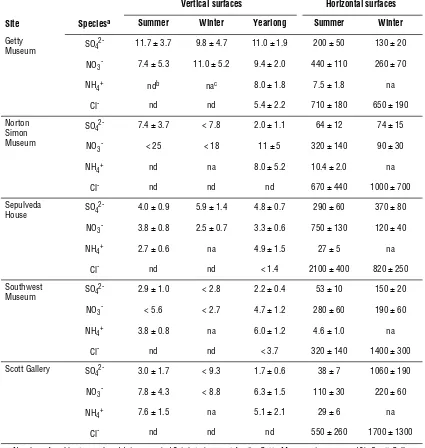
carbon ranged from 0.14 µg m-3 at the Getty Museum in the summertime to 7.4 µg m-3 at
Sepulveda House in the wintertime. At the Norton Simon Museum and the Scott Gallery, the average indoor elemental carbon concentrations during the winter period were 0.7 µg m-3. This concentration is not large compared to the concentrations observed at the Sepulveda House; but nonetheless, elemental carbon represented the second largest component of the indoor fine aero-sol in the winter samples at those two sites.
Material balances on the chemical composition of the outdoor and indoor aero-sol samples in the coarse mode are shown in Figure 2.6 (p. 44). Soil dust is the major component of the coarse-particle fraction. At the Getty Museum, the coarse-particle mode outdoors contains nearly equal amounts of soil-dust and sea-salt (Na + Cl) particles, reflecting the site’s coastal location. At the inland sites, the sea-salt concentration is greatly reduced, and organic material and nitrates are second in concentration behind soil dust. The coarse-mode composition shows little variation from summer to winter, with absolute concentrations somewhat lower in the win-ter. The coarse-particle mode indoors was very small at the three sites with engineered HVAC systems and was dominated by soil dust and organic material. Coarse-mode concentrations were virtually undetectable at the Norton Simon Museum, where coarse-mass concentrations appeared to be < 4 µg m-3. At the other four sites, the measured species accounted for 46 to 74% of the measured indoor coarse-particle mass concentration in the summer, and 64 to 84% in the winter.
Indoor Sources
The observation that particulate organic matter concentrations inside at least two of the muse-ums studied are often higher than those outdoors suggests that there may be indoor sources of organic particles. This possibility is particularly interesting because the usual activities associ-ated with indoor organic particle generation, such as smoking and operation of combustion devices, are prohibited inside museums. From observations of the operations at these facilities, possible indoor sources include particles shed by the visiting public as well as maintenance operations such as floor waxing and vacuuming.
Particle Deposition
Characteristics of Airborne Particles Inside Southern California Museums
28
air adjacent to the surface of interest (number per unit volume), and thus has the dimensions of length per unit time.
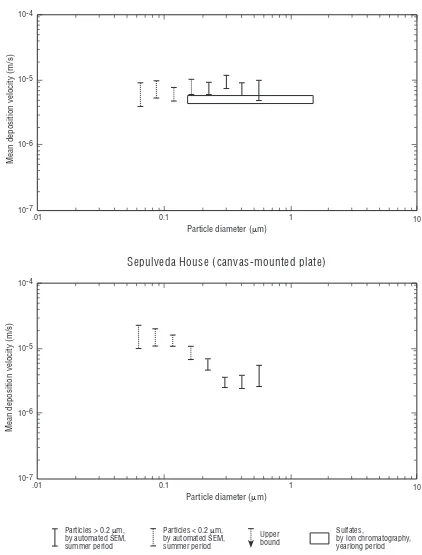
Deposition velocities to vertical surfaces determined from the SEM analyses of deposited particles and airborne particle samples are presented in Figure 2.7a–c (pp. 45–47). These deposition velocities at all sites are in the range of 10-6 to 10-5 m/s. The vertical bars rep-resent a + 1σ confidence interval for the deposition velocity of the particles in the size interval surrounding that bar, considering the uncertainties in particle counting statistics, blank correc-tion, filtration efficiency, and indoor ambient concentration variability from day to day. Also presented are the bulk-deposition velocities for sulfate determined by ion chromatographic (IC) analysis of extracts taken from the Teflon deposition surfaces. These values are presented in the form of boxes, where the vertical dimension again represents the + 1σ confidence interval and the horizontal dimension represents the size range that contains 90% of the particles in the ambi-ent samples that were classified by the SEM as sulfates. Because the bulk analyses were weighted by mass rather than by number, the sulfate deposition velocities would be expected to more closely represent the deposition velocities of the larger particles in the size range given.
Obtaining deposition velocities for the larger particles (0.6–2.1 µm) was diffi-cult. Although such particles may represent a significant fraction of ambient aerosol mass, their number concentrations in both the ambient and vertical deposition samples were so low as to be statistically indistinguishable from the blanks in many cases. In Figure 2.7a–c (pp. 45–47), upper bounds for some deposition velocities in this size range are presented as dashed bars ending in an arrow at the lower end. The deposition velocities reported here for particles smaller than about 0.2 µm in diameter also should be considered uncertain due to particle losses during sam-ple preparation. Because of this additional uncertainty, the deposition velocities for particles smaller than 0.2 µm in diameter are presented as dashed bars.
The Sepulveda House is located in downtown Los Angeles, where outdoor air-borne particle concentrations are high. It is a partially restored, historic structure that has no cen-tral mechanical ventilation system for heating or cooling. Several large doors are left open during operating hours (10 a.m. to 3 p.m.) year-round. As a result, indoor fine-particle levels at this site are nearly as high as those outdoors, as shown in Figure 2.2 (pp. 38–39). In the presence of these high indoor particle concentrations, both the ambient and the deposition samples from the summer study were adequately loaded for analysis by the SEM technique, yielding the best set of data among the five sites studied on particle deposition velocities as a function of size.
Gambar
Garis besar
Dokumen terkait
Kepala ruangan memberikan teguran jika saya tidak mendokumentasikan tindakan keperawatan yang telah saya
Penelitian ini bertujuan untuk mengetahui 1) pengaruh pendidikan perkoperasian terhadap partisipasi anggota Kopma UNY, 2) pengaruh motivasi anggota terhadap
Ekstrak etanol umbi bawang merah (Allium cepa L) mempunyai efek aktivitas immunodulator terhadap respon imun non spesifik pada mencit jantan galur balb/c dengan
Berdasarkan dari perhitungan hipotesa diatas dapat disimpulkan bahwa ada faktor-faktor yang berpengaruh terhadap respon rasa yaitu faktor gula, sari udang, tepung ketan,
Besar Ada Pengaruh Model Kooperatif Tipe Think-Pair-Share (TPS) terhadap Hasil Belajar Siswa Materi Trigonometri Kelas X MIA MAN Rejotangan Tulungagung berdasarkan uji
SIKLUS BELAJAR EMPIRIS-INDUKTIF UNTUK MENINGKATKAN KETERAMPILAN BERPIKIR KRITIS SISWA PADA TOPIK LAJU REAKSI.. Universitas Pendidikan Indonesia | repository.upi.edu
cenderung memiliki emosi yang tidak stabil dan permasalahan yang sering timbul akibat pernikahan dini adalah bagaimana cara mereka mengasuh anak dengan pola
Sistem Informasi Akademik yang Mendukung Green Information System: Studi Kasus pada Sekolah Menengah Pertama Gracia, Seminar Nasional Informatika 2012 (semnasIF 2012),
