Murni Mahmud
([email protected])Universitas Negeri Makassar, Indonesia
Abstract: This paper highlights the impact of gender differences in English Lan-guage Teaching. It explores students’ learning styles as affected by the notions about men and women differences in communication. The data collected in 2008 from 20 males and 20 females’ English students of the State University of Makassar. It is to reveal their attitudes towards speaking to different sex, strategy to express opinion, group work preferences, activeness/passiveness, and their perception to increase Eng-lish skills dealing with sex difference. It is revealed that female than male students were reluctant to speak to different sex; females preferred the direct way to express opinions (writing), work with the same sex, and tended to be passive in class. In ad-dition, females saw the high possibility to increase their English skills by working with the same sex but the reverse is true for males. These different styles of female and male students in learning English were affected by the notions of women’s lan-guage.
Key words: gender differences, women’s language, single-sex group, mixed-sex group, same sex, different sex, English language teaching
Gender differences, which are socially and culturally constructed, are one of the interesting phenomena in contemporary society. Their impacts can not only be seen in political life, where women fight their political rights, or in households, in which women fight to reduce household harassment. Discourse on gender differences, in fact, also exists in the use of language for communi-cation, highlighting that men and women are different in their ways of commu-nication, and therefore they should be treated differently.
This discourse had been hotly and creatively debated since Lakoff (1976) and Tannen (1990), in their study on English speaking countries, illuminated the concept of women’s language which highlights the existence of men and women differences in communication. One characteristic of women’s language as stated by Lakoff (1976) is the great tendency of women in using lexical hedges or fillers (e.g. you know, sort of, well, you see), tag questions (she’s very nice, isn’t she?), rising intonation on declaratives (it’s really good), empty adjectives (divine, charming, cute), precise colour terms (magenta, aquama-rine), intensifiers (just, so), hypercorrect grammar (consistent use of standard verb forms), super polite forms (indirect requests, euphemisms), avoidance of strong swear words (fudge, my goodness), and emphatic stress.
Other research on language and gender also reveals the differences be-tween men and women in using language for communication. One of them is that women are more polite than men. Hobbs (2003:243) notes that when talk-ing with the same sex peers, women will use many positive politeness strate-gies. On the other hand, men in similar circumstances do not show this ten-dency. Lakoff (1976:74) also states that ‘women tend to speak with reference to the rules of politeness, conversational implicature, and interpersonal explora-tion whereas men tend to speak with reference to the rules of conversaexplora-tion and straight factual communication’.
Another difference is that women are more passive than men. If they are talking, they tend to show that they are not sure about what they are saying. The passiveness and tentativeness of women in communication are affirmed by Vanfossen (2001:2), who showed that women like using tag questions, (It’s re-ally cold in here, isn’t it?), disclaimers (I may be wrong but…) and questions as directive statements (won’t you close the door?). These kinds of phrases de-crease the perceived assertiveness of speech.
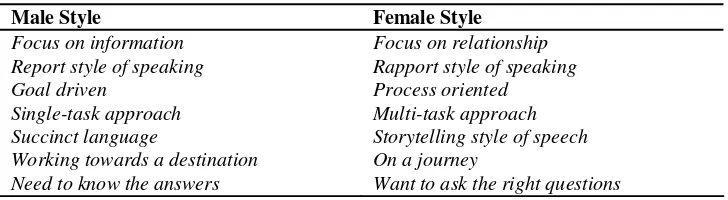
Tymson (1998:8) classifies differences on men and women in communica-tion as seen in Table 1:
Table 1. Male and Female Style of Communication
Male Style Female Style
Focus on information Focus on relationship Report style of speaking Rapport style of speaking
Goal driven Process oriented
Single-task approach Multi-task approach Succinct language Storytelling style of speech Working towards a destination On a journey
Need to know the answers Want to ask the right questions
These differences on men and women communication may affect expecta-tions for men and women in various fields of life. The different ways of men and women in communication can become a critical point of gender inequality. Because of those differences, men and women are treated differently. In terms of leadership, for example, women may be ignored for high position due to their emotional language. A study in the field of organization had shown that the capability of men and women to be a leader may be affected by the notions of emotional women’s language, which is not suitable for a leader (Mahmud, 2008b, 2009c). Brass (1985:327-343) also confirms that in many organizations, ‘differences in gender may be a surrogate for differences in job function, level in hierarchy, proximity, workgroup composition, numerical balance, and status’. Brass furthermore states that ‘women have not acquired status and in-fluence compatible to that of their male counterparts in organizations.
It is interesting to discuss how gender differences in language and com-munication are practiced in different areas. Eckert (1998:64) states that ‘gender practices differ considerably from culture to culture, from place to place, from group to group, living at the intersection of all the other aspects of social iden-tity’. Therefore, practices in language and gender may also vary in a particular society or groups.
gender differences and learning styles and found that ‘men were more likely than women to prefer the abstract conceptualisation mode of learning’. Another study by Logan and Johnston (2009) found that ‘girls had better reading com-prehension, read more frequently and had a more positive attitude to reading and school’ This shows that male and female have different learning styles which can be affected by differences in language usage as discussed in the dis-course of language and gender. This article will also look at how gender dif-ferences in language and communication affect students’ strategies in learning English.
METHOD
This research was based on the data collected in 2008 from the English Department students of the State University of Makassar. The population of the research was the fourth semester students of English Education study program which consists of three classes. Each class consisted of 35 students. For the sampling, the researcher just took 40 students among them randomly: 20 male students and 20 female students.
The respondents were given open-ended questionnaires to reveal their per-ceptions regarding their strategies in learning English as affected by gender dif-ferences. The questionnaires were directed to find out whether or not the stu-dents feel reluctant o speak English with different sex, what ways they prefer to express their opinions either indirect (writing) or direct way (speaking), what kinds of groups they prefer to work with either single-sex group or mixed sex group, whether the students prefer to be active or not (silent), and how the stu-dents’ perception on the strategies to improve English skills dealing with sex difference. The questionnaires are as follows.
1. Do you sometimes fell reluctant to speak English with another sex? Ex-plain!
2. In an English class, what way do you prefer to express your opinions, written or oral form? Explain!
3. In a group discussion, which one do you prefer, working with the same sex or different sex? Explain!
5. Do you think working with the same sex or different sex can make your English better?
FINDINGS
This part provides the discussions of the questionnaires answered by the respondents regarding their strategies in learning English as affected by gender differences.
Students’ Reluctance to Speak English with Different Sex
The first observed aspect was whether the students feel reluctant to speak English with different sex. From the whole population, there were more female students than male students who felt reluctant to speak English to different sex. There were 85% of female students who felt reluctant to speak English to male students whereas only 50% male students who felt reluctant to speak English to female students. Male students also had higher tendency to neutralize their re-luctance by saying that no difference at all (30% students), in which they could communicate using English well to both sexes. In fact, the rest of the male re-spondents (20%) felt more enjoyable to speak English with their female coun-terparts. It is different from female students in which only 15% of them who were not reluctant to speak English with their male counterparts. Their reasons can be seen in the following table:
Table 2: Students’ Reasons to Feel Reluctant to Speak English with Differ-ent Sex
Females’ Reasons Males’ Reasons
Males are arrogant, like to show up Females get offended easily Not good in English Only if females are smarter Ashamed to make mistakes Feeling shy to females Afraid to communicate to male at all Nervous
Students’ Preferences in Expressing Opinions
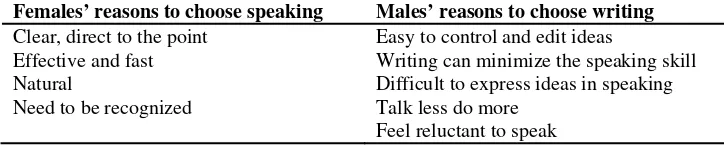
Of the two important productive skills in English, writing and speaking, as the way to express their opinions in English, each female and male respondent had different preferences. There were more male students (60%) than female students (10%) who preferred expressing opinions in English. On the other hand, there were more female students (90%) than male students (25%) who preferred expressing opinions by writing than by speaking. The rest of them could choose either speaking or writing. Their reasons for expressing their opi-nions either with written or oral form can be seen in Table 3.
Table 3. Female Students’ Reasons for Expressing Opinions
Females’ reasons to choose writing Females’ reasons to choose speaking Indirect way as less English capability Willing to share ideas
No confidence to speak More skilled in speaking
Shame, hesitation, afraid Easy, direct, and faster to transfer ideas Not very sure by speaking Need to be more creative
Table 4. Male Students’ Reasons for Expressing Opinions
Females’ reasons to choose speaking Males’ reasons to choose writing Clear, direct to the point Easy to control and edit ideas
Effective and fast Writing can minimize the speaking skill
Natural Difficult to express ideas in speaking
Need to be recognized Talk less do more
Feel reluctant to speak
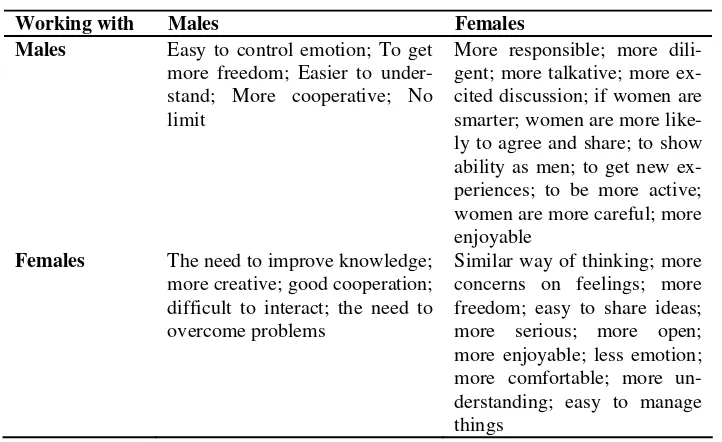
Students’ Preferences in Working with Groups
Table 5: Students’ Reasons for Working in Groups
Working with Males Females
Males Easy to control emotion; To get more freedom; Easier to under-stand; More cooperative; No limit
More responsible; more dili-gent; more talkative; more ex-cited discussion; if women are smarter; women are more like-ly to agree and share; to show ability as men; to get new ex-periences; to be more active; women are more careful; more enjoyable
Females The need to improve knowledge; more creative; good cooperation; difficult to interact; the need to overcome problems
Similar way of thinking; more concerns on feelings; more freedom; easy to share ideas; more serious; more open; more enjoyable; less emotion; more comfortable; more un-derstanding; easy to manage things
Students’ Preferences to be Active or Silent in English Classes
In English classes, female and male students also had different prefer-ences, whether to be active or passive. It is revealed that more women liked to keep silent, which encountered 80% of the respondents, compared to only 15% of male students. The majority of male students preferred to be active (60% students), and the rest could choose either of them. The reasons for being active or silent in English classes can be seen Table 6.
Table 6: Students’ Reasons for being Active or Silent
Males Females
Active Influenced by status; to know more; talk less do more as men; to show ambition and aspiration as men; to show off; a nature to be active; to increase knowledge
Table Continued
Silent Less vocabulary; not interested in the topic; not moody
More comfortable; ashamed; not confident; nervous; the topic is not interesting; not free to express as women; not sure; felt; not understand and not moody
Students’ Perceptions on Strategies to Improve English Dealing with Sex
To improve their English, male and female students also had different per-ceptions. There were 85% of female students who felt likely to improve their English if they were working or speaking with the same sex whereas for males, different sex was the best way to choose to increase English (75%). Some of their reasons can be seen in Table 6.
Table 7: Students’ Perception on Strategies to Improve English Dealing with sex
Same sex Different sex
More discipline; more diligent; more ac-commodating; more reliable; get more knowledge for the same background; feel free to learn; no limit
Ashamed; not confident (if the opposite sex is smarter); for men, women are good inspiration to learn;
DISCUSSION
Eng-lish skills, and therefore they were ashamed of making mistakes especially in front of different sex. This caused less freedom to express their English ability.
However, the data indicated that more females felt reluctant to speak Eng-lish to different sex, 85% of females compared to 50 % of males. Females speaking English to the same sex was more effective than speaking to different sex. Conversely, males speaking to either the same or different sex would not bear any difference (30%). In fact, they could enjoy talking to females (20%). This shows that gender differences influence the tendency of female and male students to speak to different sex. Feeling reluctant to speak to different sex by female students indicates that they are not confident. This may give vital im-pact on the students’ freedom to speak English. Less freedom made them less powerful showing their inferior position.
In terms of the productive skills to choose to express opinions, the data al-so show different patterns. Female students preferred to choose writing as the way to express their opinion in English in order to avoid some obstacles they had such as their low confidence and low capability in English (90% of females compared to 60% of males). On the other hand, males saw speaking as the ef-fective way of expressing opinion efef-fectively regardless of their lack in English (60 % of males compared to 10% of females). In fact, male students considered speaking as the way to show their English ability and therefore, they could be recognized as men. This also shows the great effects of gender differences in the strategies chosen by female and male students to express their opinions. Females’ higher tendency to express their opinion by writing shows their pas-siveness, which become one indicator of women’s language.
gender differences. Males’ preferences in working with different sex show their tendency to challenge the differences in more dynamic situation whereas fe-males tended to be more monotonous showing their less confidence and less certainty.
Another fact differentiating female and male students in English learning is their tendency whether to be active or to be silent in English classroom. This is very important in English classroom as their strong activity in the class will contribute much to their English proficiency, especially in speaking. The study indicated that female students outnumbered male students who liked to be si-lent (80% compared to 15%). Conversely, male students were 60% who liked to be active. This shows the activeness of males and the passiveness of female students in studying English. As indicated in Table 9 above, the activeness of male students was influenced by their need to know and do more, to show am-bition and aspiration as men, or to show off. In fact, they considered that that was their nature to be active. Conversely, female passiveness was mostly influ-enced by their less confidence as women. In the literature of language and gen-der, being active or passive is one of the characteristics differentiating men and women’s styles of communication. Biber and Burges (2000) show the tendency of women to speak less than men, particularly in mixed-gender settings.
Another important finding was their perception about the strategies to im-prove their English. It was revealed that 85% females would increase their English skills with the same sex whereas for males, 75% agreed that they could increase their English skills with different sex. This shows that for female stu-dents, working with the same sex is better than different sex because working with the same sex created more discipline, accommodating, and reliable condi-tions, so that they can be free to learn English. In that way, they can improve their English.
fo-cus on personal and interactional aspects of conversation, whereas men fofo-cus more on transferring information. Women are more tentative while men tend to be certain, using more persuasive strategies. The passiveness and tentativeness of women in communication are affirmed by Vanfossen (2001:2).
These characteristics can be found in the learning styles of female and male students as observed above. The high tendency for females to be passive and feel reluctant to speak to different sex is affected by their emotional and sensitive thoughts. Males’ high confidence, on the other hand, is caused by their need to show up as a competitive, independent, and powerful people.
These differences could be caused by different perceptions on men and women style in communication. Females thought men were arrogant whereas males thought females were emotional. These views may be due to differences in men and women’s views about conversation. According to Stanton (2001), women see conversations as the way to develop and preserve intimacy, while for men conversations are negotiations to achieve and maintain power. Gene-rally, life for men is like a contest, a struggle to preserve independence. There-fore, women may tend to think of interactions in a non-hierarchical way while men typically view the world in a hierarchical way such that, during any inter-action, one person is in a superior position and the other in an inferior position. According to Hassan (2000), women interact in ways that promote solidarity and equality, whereas men interact in ways which maintain and increase their power and status.
CONCLUSION AND SUGGESTIONS
influ-enced by their need to challenge and maintain strength as men can use speaking English ability as the way to show their status as men.
However, these findings on ‘women’s language’ are currently being con-tested. For example, Crawford (1995:34) argues that ‘women’s language can-not be adequately understood by counting features and assigning them to fixed categories of meaning’. This is because these differences may be relative and influenced by situational aspects. Connell (2002:51) also affirms that ‘language use is situational and is shaped by relations of power.’ To learn a language is ‘a species characteristic which underpins the whole culture—including the ideo-logy of gender difference’. As noted by Phillips (1980:541), ‘gender differ-ences in speech in our own society vary, depending on the social context of speech’. In Bugis society, for example, gender is an important aspect in men and women communication. However, some other aspects besides gender also take parts such as social status and age differences and also situations or the settings of conversations. In Bugis society, ‘gender is not the sole factor influ-encing men and women’s communication. Rather, social status for Bugis women in fact influences their gender performance in language’ (Mahmud, 2008a, 2009a, 2009b).
It is suggested, therefore, to get more intensive observation on their learn-ing style in English by recordlearn-ing their conversations, to find out whether there are different patterns in their English expressions as well as their English achievement. In addition, more intensive observation is needed to see other contributing factors influencing these differences. As stated by Phillips (1980:541), research on men’s and women’s speech should more effectively describe and explain ‘the nature of variable relationships between communica-tive form and social function which can be done by more comparacommunica-tive research on gender differences in language use’.
REFERENCES
Brass, D. J. 1985. Men's and Women's Network: A Study of Interaction Pat-terns and Influence in Organization. The Academy of Management Journal
28: 327-343.
Connell, R. W. 2002. Gender. Cambridge: Polity Press in Association with Blackwell Publishing Ltd.
Eckert, P & McConnell-Ginet, S. 1994. Think Practically and Look Locally: Language and Gender as Community-Based Practice. In Camille Roman, Suzanne Juhasz and Cristanne Miller (eds.), The Women and Language Debate, New Brunswick, New Jersey: Rutgers University Press, pp. 432-460.
Griffin, M.A., D. McGahee, and J. Slate. 1999 Gender Differences in Nonver-bal Communication: Valdosta State University.
Hassan, I.H. 2000. Language, Gender, and Power: Analysis of Theme and Top-ic Management in ArabTop-ic Conversational Discourse. The Humanities and Social Science, 61: 591.
Hobbs, P. 2003. The Medium is the Message: Politeness Strategies in Men's and Women's Voice Mail Messages. Journal of Pragmatics, 35: 243-262.
Lakoff, R. T. 1976. Language and Woman's Place. New York: Octagon Books.
Logan, S & Johnston, R. 2009. ‘Gender Differences in Reading Ability and At-titude: Examining Where These Differences Lie’ Journal of Research in Reading, 32 (2): 129-214.
Mahmud, M. 2008a. Politeness in Bugis. A Ph. D Thesis. Canberra: The Aus-tralian National University.
Mahmud, M. 2008b. Bahasa dan Gender dalam Kinerja Organisasi (Language and Gneder in Organizations). Jurnal Administrasi Publik Volume IV No 3 September 2008, published by Pusat Kajian dan Pendidikan dan Pelati-han Aparatur II LAN, Makassar.
Mahmud, M. 2009b. Language and Gender in Bugis Society. Proceeding of Yearly International Linguistic Conference (Konferensi International Lin-guistik Tahunan), KOLITA 7 at UNIKA Atma Jaya, Jakarta, 27-28 April 2009.
Mahmud, M. 2009c. Bahasa Perempuan: Refleksi Gender dalam Kinerja dan Kepemimpinan Organisasi (Women’s Language: Its Reflection on Organ-izational Leadership). Proceeding of the National Seminar on Gender Per-spective Leadership at the Center of Women Studies, Gadjah Mada Uni-versity, 18 Juni 2009.
Mahmud, M .2009d. Bahasa dan Gender dalam Masyarakat Bugis. Makassar: Pustaka Refleksi.
Philips, S. U. 1980. Sex Differences and Language. Annual Review of Anthro-pology, 9: 523-544.
Severiens, S & Dam, G. 2005. ‘Speer, S.A. 2002. Sexist Talk: gender Catego-ries, Participant' Orientations and Irony. Journal of Sociolinguistics, 6(3): 347-377.
Stanton, A. 2001. Men and Women in Conversation: Finding a Way to Bridge
the Gap, University of Massachusets.
http://www.healthandage.com/public/health-center/28/article/1284/Men-and-Women-in-Conversation-Finding-a-Way.html. Accessed 10 July 2008.
Tannen, D. 1990. You Just Don't Understand: Women and Men in Conversa-tion. New York: Morrow.
Tymson, C. 1998. Gender Games: Doing Business with the Opposite Sex. Aus-tralia: Tymson Communication.