ICP11 as Biomarker for WSSV
Disease in
Litopenaeus vannamei
Yuni Kilawati, Yunita Maimunah, and Arning W. Ekawati Faculty of Fisheries and Marine Science, University of Brawijaya
E-mail : [email protected]
ABSTRACT
Environmental pollution could directly reduce water quality for shrimp cultivation. This aims of this research were to determine how the environmental quality, shrimp population and genetic characteristics of shrimp that live in polluted waters in shrimp ponds in East Java associated with WSSV disease that often attacks on cultivated shrimp. The method used was a descriptive exploratory. Data was collected by observation and interview with farmers on disease history. Water was sampled for water quality study and
characterize its suitability for shrimp
cultivations. Shrimps were also sampled for morphological and genetical study for its susceptibility of WSSV. All samples were taken every week during shrimp cultivation in Malang and Gresik. Morphological study using scoring method to determine the disease stages on shrimp, while for genetical study using specific primer for ICP11 for WSSV detection, since ICP 11 was expressed when WSSV infection was occured. Samples were taken from 2 shrimp ponds in South Malang and Gresik. The result showed that the overall water quality was good, except for NO2 and TOM in both seawater shrimp ponds which higher than the
freshwater/estuary shrimp ponds. Light
infections of WSSV were detected in all seawater ponds both in morphology and genetics. However, in the freshwater/ estuary pond only shrimps from freshwater/ estuary Gresik which showing light WSSV infection genetically, but not in the morphological signs. Early disease detection is important to control the disease spread.
Keywords: shrimp ponds, Litopenaeus vannamei, ICP11, pollution.
INTRODUCTION
Diseased shrimp including WSSV, will provide cellular response are manifold. The cells were infected with WSSV experiencing prawns hypertrophy or abnormal growth in the cell nucleus. This hypertrophy causes cell lysis and cause infection in organs attacked. WSSV infected shrimp response can be seen from the expression of genes linked to the infection, including genes encoding resistance and susceptibility (Kilawati, 2011). Factors trigger the disease in shrimp is not always caused by the emergence of organisms, environmental factors such as salinity, O2 content, ammonia levels and lack of food factors also stress on shrimp (Amri, 2006). The environmental factors that lead to the production of antibodies reduced immunity or vannamei shrimp immunity to disease is reduced.
technique of synthesis and DNA amplification in vitro. PCR can be used to amplify DNA segments of the million times in just a few hours. With the discovery of PCR techniques in addition to other techniques such as DNA sequencing, have revolutionized the field of science and technology especially in for diagnosis of genetic diseases, forensic medicine and molecular (Handoyo and Rudiretna, 2000). DNA could also be used as a biomarker for early warning of disease outbreaks. However, there is limited information on shrimp pond condition in east java since it having high contribution on shrimp export in Indonesia.
The objectives of this study were to show water quality condition in shrimp ponds along Malang and Gresik, also the WSSV susceptibility using morphology and genetic characteristic using specific primer ICP11, also to know the correlation between WSSV and water quality condition. It assumed that different water quality characteristics could bring different shrimp condition and adaptation, since water resources has different physical and chemical composition.
MATERIAL & METHODS
The method used in this study was an
observational descriptive method using
random sampling techniques. Vannamei shrimp sampling in South Malang and Gresik
amounted to 20 shrimps. Shrimp taken were approximately 1-2 months old (no age boundries). The material was DNA expression in vannamei shrimp were traced associated with the prevalence of WSSV, in Gresik and South Malang, East Java. Water quality
analyzed were physical (temperature,
brightness), chemical (salinity, pH, DO, TOM, nitrite, ammonia, alkalinity) and biological (bacteria vibrio) parameters. Water quality measurements made in 2-3 different places as much as 1 time in a week for 4 weeks at 10:00 to 11:00 pm at the inlet and outlet.
DNA expression on vannamei shrimp were traced associated with the prevalence of WSSV. Water quality analyzed were temperature, salinity, pH, DO, TOM, nitrite, ammonia, alkalinity and Vibrio presence. Water quality measurements were made in 2-3 different places every week for the next 4 following week 10:00 to 11:00 pm at the inlet and outlet. Method used was observational descriptive method using random sampling techniques.
Morphological analysis by scoring method. Morphological analysis of the level of infection of WSSV in shrimp was analaysis using a code of signs or symptoms encountered. The coding in this study is based on the level of
infection based on morphological
characteristics of vannamei shrimp (Table 1).
Table 1. Morphological signs for scoring shrimp conditions.
Infection
shrimp looks fresh and intact. Kilawati (2011), has the characteristics – bright body color, moving actively, rapidly responds to receive disorders, normal appetite and bottom silent during the day. Amri and Kanna (2008), shrimp swim active and responsive to stimuli as well as the condition of the antenna and antenula intact, complete, not broken, long size; hepatopancreas full and dark; Full intestine; uropod (tail fin) is open and not disabled.
Sign 2) lightly infected
( + )
Polymerase Chain Reaction (PCR) Analysis.
Vannamei shrimp samples were taken of the identified WSSV infected morphologic analysis is then performed for Polymerase Chain Reaction (PCR) test animals to determine the positive or negative WSSV infection
RESULT & DISCUSSIONS
Water Quality Parameters
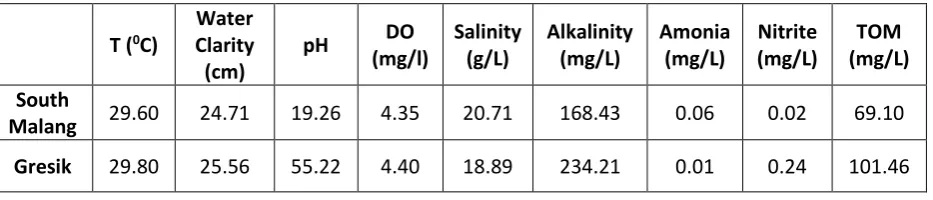
Water quality parameter such as temperature, dissolved oxygen (DO), salinity and pH on all the samples were still within the optimal range for growth of vannamei shrimp (Table 2).
Table 2. Average Water Quality Parameter in Gresik and South Malang shrimp ponds.
T (0C) 21 g/L. Differences in salinity at each pond is affected by salinity of sea water source, and the availability of fresh water in the pond location. Vanname shrimp is an euryhaline animal which have a high tolerance to water salinity, which is 5-30 g/L (Halimah and Adijaya, 2006). According Saoud et al. (2003) also reported that vanamei shrimp can grow in waters with salinity ranging from 0.5-38.3 g/L and grows optimally at 5-35 g/L salinity. Rekasana et al. (2013) explains the effect of salinity on shrimp is at the time of molting (moulting).
The highest water alkalinity found in South Malang (261.87 mg/L). High alkalinity provides a good environment for the shrimp physiological conditions to grow and survive. Mineral concentration is sufficient for
exfoliation and the formation of
exoskeletons, to support the growth and survival of shrimp (Araneda et al., 2008). Optimum alkalinity for Vannamei shrimp farming ranged from 90-150 mg/L. If the alkalinity value is above 150 mg/L, it reqiured dilution salinity and density of
plankton and adequate oxygenation
(Adiwijaya et al., 2008). Range ammonia content was lower for Gresik shrimp Pond
thanSouth Malang. High content of
ammonia which can be caused by the accumulation of organic material from feed residu, feces, organic matter content of water sources (marine and freshwater) and the organism dies. According to Boyd (1990), NH3 content of 0.05 to 0.2 mg/L have hindered the growth rate of shrimp and other aquatic organisms. The content of NH3 as high as 0.45 mg/L can inhibit the growth rate to 50% shrimp, while NH3 content of 1.29 mg/L was able to kill Penaeid shrimp. WSSV disease occurs when there is interaction between the condition of poor water quality, which in turn will trigger the growth of bacteria/viruses, and shrimp cultivation conditions are declining.
Shrimp morphological study.
sign (1) the highest percentage in the estuary ponds 100%: sign (2) the highest at sea water pond by 30%. While samples from
Gresik observations obtained results
morphological percentage of shrimp against WSSV virus attacks were: the characteristics sign (1) the highest percentage in the freshwater ponds of 100%, which means
there are no shrimp morphological
characteristics WSSV infected with the virus, sign (2) the highest in the pond seawater by 60% which means that 60% of WSSV infected shrimp and 40% are not infected with the virus WSSV.
Shrimp Genetical Study.
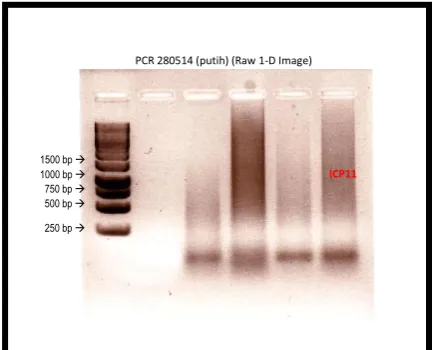
In boths sampling locations, South Malang (Figure 1) and Gresik (Figure 2), estuary and marine ponds found that only trait 1 (healthy shrimp) and trait 2 (lightly infected). For a percentage of the value of shrimp infected with WSSV only mild virus found in seawater pond for 30%. At the mouth of the pond found only 1 was prawns with characteristic morphological features healthy, though not necessarily those not infected shrimp, the shrimp can be a mild viral infection. Results of PCR for detection of WSSV virus can be seen from the DNA bands appear quite obvious (Figure 1 Sample from South Malang). Figure 1 showed that the quantity ICP11 gene on the DNA test results vannamei shrimp in ponds estuaries was indicated by code 2. The presence of WSSV infection by viruses with the ICP11 gene amplification is quite clear, however, the morphology does not appear under 25 bp. While at sea ponds shown with the same code 4 also shows the presence of WSSV infection by viruses with the ICP11 gene amplification (DNA bands were quite clear), this is in accordance with the morphological analysis of vannamei shrimp in sea farms also showed clinical symptoms of WSSV virus mild.
Figure 1. ICP11 gene amplification results of
DNA vannamei shrimp South Malang. 1) Marker, 2) Negative control (-) ddH2O, 3) Estuary shrimp pond and
4) Seawater shrimp pond.
Figure 2. ICP11 gene amplification results of
DNA vannamei shrimp Gresik. M) Marker, K) negative control (-) ddH2O, LG)Seawater shrim pond and LT) Freshwater shrimp pond.
Firmansyah dkk. (2009) noted that the reproductive cycle of the virus, there are two ways the lytic cycle and the lysogenic cycle. Lytic cycle is the reproductive cycle of the virus peak marked by the death of the host cell. At the time of the wall membrane rupture or lysis of the host cell, the virus - a
File: PCR 280514 (putih). 1 sc Low=512 High=11294 Gamma=0.5
Exposure=0.97 secs page 1 of 1 PCR 280514 (putih) (Raw 1-D Image)
1500 bp 1000 bp 750 bp 500 bp
250 bp
new virus that is formed in the host cell will be out and ready to infect new host cells. In the lysogenic cycle, viral genetic material of cells are produced in nature without destroying its host organism. Kilawati and Darmanto (2009) reported that ICP11 gene amplification results in WSSV infected shrimp DNA yield was 207 bp band whereas the non-infected shrimp WSSV virus did not produce bands on the DNA. ICP11 amplified with the most quantity and in the right position, it is due to the viral DNA that has menginsersi perfectly on the DNA of the host cell so that the shrimp can not survive.
Biologically ICP11 has an important role in WSSV infected cell death, with several
possible mechanisms involved. The
mechanism is that ICP11 directly causes nucleosome disruption, thereby causing cell death. Another possibility is that ICP11 can cause cell death through an indirect mechanism, namely by binding to histones in the cytoplasm. ICP11 can interfere with the
mechanism by preventing histone
nucleosomes, which are bound to the nucleus, thereby causing destabilization has an important role in epigenetic regulation of gene expression and consequent cell death.
CONCLUSIONS
Water quality at all sampling locations included in the category of polluted, as indicated by the content of ammonia and high TOM at all locations. Poor water quality triggers the disease one of the detected WSSV from morphology and DNA analysis. DNA analysis results on vannamei shrimp (Litopenaeus vannamei) in both location indicated that WSSV infection has occur in light infection. However, WSSV infection rate might be higher over time due to ammonia and TOM accumulations.
ACKNOWLEDGEMENT
This research was supported by Directorate General of Higher Education, Ministry of Education and Culture through UB DIPA, Number: DIPA-023.04.2.414989/2013, Date December 5, 2012, and based UB Rector Decree No. 295/SK/2013 dated June 12, 2013.
REFFERENCES
Firmansyah, R., Agus M.H. dan M. Fariedah R. 2009. Mudah dan Aktif Belajar Biologi. Pusat Perbukuan Departemen Pendidikan Nasional. Jakarta.
Handoyo, D. dan A. Rudiretna. 2001. Prinsip
Umum dan Pelaksanaan Polymerase
Chain Reaction (PCR) (General Principles And Implementation Of Polymerase Chain Reaction). Jurnal
Unitas, 9 (1): 17 – 29.
Kilawati, Y and W. Darmanto. 2009. Karakter
Protein ICP11 Pada DNA Udang
Vannamei (Penaeus vannamei) yang
Terinfeksi White Spot Syndrome Virus
(WSSV). Journal of Biological
Researchers. 15: 21-24
Kilawati, Y. 2011. Ekspresi Gen Ketahanan
dan Kerentanan Pada Udang
Vannamei (Litopenaeus vannamei)
Sebagai Respon Terhadap Serangan White Spot Syndrome Virus (WSSV).
Artikel. Universitas Airlangga.
Surabaya
Sukenda, S.H. Dwinanti dan M. Yuhana.
2009. Keberadaan White Spot
Syndrome Virus (WSSV), Taura Syndrome Virus (TSV) Dan Infectious Hypodermal Haematopoitic Necrosis Virus (IHHNV) Di Tambak Intensif
Udang Vaname litopenaeus vannamei
Di Bakauheni, Lampung Selatan. Jurnal
Akuakultur Indonesia, 8 (2): 1 – 8.
Virus White Spot Syndrome Virus
(WSSV) Pada Udang Windu Penaeus
monodon Dengan Cairan Ekstrak
Pohon Mangrove (CEPM) Avicennia sp.
dan Sonneratia sp. Jurnal Akuakultur
Indonesia, 5 (1): 65 – 75