DIC!XBMMXX DPOD/!TMBC
TUBOEBSEUU UPJMFU!CPXM
1)*-*11*/&4
ABBREVIATIONS
BOD – biochemical oxygen demand
C – Carbon
CHB – concrete hollow blocks
CI – cast iron
cm. – centimeter(s)
Conc. – concrete
DA – Department of Agriculture
DAO – Department Administrative Order
DENR – Department of Environment
and Natural Resources
DN – nominal diameter
dia - diameter
DO – dissolved oxygen
DOH – Department of Health
DPWH – Department of Public Works
and Highways
Ecosan – ecological sanitation
EIA – environmental impact assessment
FeCl3 – Ferric chloride
ft. – foot/feet
F/M – food to microorganism
GI – galvanized iron
ha – hectare(s)
hp - horsepower
kg. – kilogram(s)
km. – kilometer(s)
LGU – local government unit
m. – meter(s)
mg/l – milligram(s) per liter
MLSS – mixed liquor suspended solids
MLVSS – mixed liquor volatile suspended
solids
mm. – millimeter(s)
m3 – cubic meter(s)
N – Nitrogen
P or Php – Philippine peso
PD – Presidential Decree
PVC – polyvinyl chloride
RBC – rotating biological contactor
RC – reinforced concrete
SBR – sequencing batch reactor
SOP – standard operating procedure
sq.m./m2 – square meter(s)
TSS – total suspended solids
UASB – upflow anaerobic sludge blanket
UDDT – urine diversion dehydration toilet
US EPA – United States Environmental Protection Agency
UV – ultraviolet
°C – degrees Celsius
FOREEWORD
Inadequate sanitation threatens the sustainability of the Philippine environment and the health of Filipinos.uate sanit Twenty-five Filipinos die of diarrhea everyday and sanitation-related epidemics have broken out over the lastnty-five Filipi few years in low income communities. Water quality monitoring assessments show that pollution of water is a w years in direct result of the lack of sanitation facilities. ect result This results in over Php 67 billion in estimated annual losses to the economy in avoidable health care costs and losses in tourism and fisheries receipts.onomy in
The Philippines Clean Water Act (R.A 9275), passed last year, is a quintessential piece of legislation that was designed to address the interlinked problems of water quality, pollution prevention and control and sanitation. The law calls for a comprehensive and integrated approach to water management and overturns the prevailing policy that sanitation is merely a household responsibility. It directs national and local governments to work together in ensuring adequate provision of municipal sanitation systems. It calls for a strategic approach to planning and managing water resources within a basin, which includes the institution of systems and regulations related to wastewater management. It complements other laws and policies, such as the Sanitation Code (PD 856), already in place for many years.
One of the key sector limitations, however, is the gap in knowledge and experience among policy-makers and the handful of sanitation practitioners, both at national and local levels, on strategic sanitation planning and alternative options for sanitation, wastewater collection and treatment. Between the on-site combination of a toilet and septic tank system and the traditional sewerage and treatment systems, a vacuum of information exists on other options available and their relative performance. Information on the sanitation and wastewater management requirements of varying types of communities and user-enterprises is also lacking. These missing pieces of information are necessary to underpin strategic sanitation planning.
This Sanitation Sourcebook is a first attempt at addressing the gap in information about sanitation and wastewater management, as well as about the considerations related to planning for sanitation projects in different types of environment. It distills some of the core concepts of sanitation in a user-friendly format so that the book can serve as a practical reference to sanitation professionals and investment decision-makers, particularly the local governments.
In putting together this important reference, the Government of the Philippines has been supported by the Water and Sanitation Program – East Asia and the Pacific of the World Bank, the German Technical Cooperation TT Agency and the Government of Australia. Their support and guidance, along with those of the peer reviewers who have contributed professionally to this book, are much appreciated. We look forward to the application of the knowledge embodied in this book towards the improvement of sanitation throughout the country.
Michael T. Defensor Dr. Francisco Duque III, MSc Lorenzo H. Jamora
Secretary Secretary Administrator
Department of Environment Department of Health Local Water Utilities
FOREWORD
Sanitation presents one of the most significant service delivery challenges related to poverty alleviation and sustainable development in the Philippines. A review of the urban sewerage and sanitation sector through the Water Supply and Sanitation Performance Enhancement Project (WPEP) confirmed the prolonged lack of investment in the sector and the deteriorating quality of sewerage and on-site sanitation facilities throughout the Philippines. Except in parts of Metro Manila and a handful of cities, the lack of sewerage and other sanitation services leaves the population with few options for safe excreta and wastewater disposal.
High hygiene awareness among urban and rural residents, even among the poor, is not translated to effective demand or health-benefiting practices due in part to the sheer lack of options to improve their access to sanitation services. Financing conventional sanitation improvements is viewed by local governments and enterprise managers to be too expensive and beyond their reach.
Consequently, an overwhelming majority are excluded from service, while affluent and middle income urban residents depend on self-provided toilet and septic tank systems. Exclusive housing estates and other commercial establishments sometimes invest in independent sewerage and communal septic tank systems. But dependence on self-provision results in a reduction of the potential revenue base of sanitation service providers. In addition, the efficacy of such systems is not monitored well and, in many cases, offer only inadequate primary treatment of wastewater. The poor have even fewer options.
The Sanitation Sourcebook aims to stimulate effective demand for sanitation services by presenting tools for strategic decision-making around a wider range of more affordable sanitation options. It also hopes to stimulate informed investment decisions by local governments to ensure more sustainable outcomes. Thus, it features environment-friendly and affordable decentralized solutions.
Interest in sanitation and information on such solutions were demonstrated during the highly successful 1st International Symposium on Low-Cost Technology Options for Water Supply and Sanitation in Bohol in 2004. This event was also jointly organized by our agencies to ignite and facilitate dialogue among stakeholders, users and different donor organizations in the sector.
We, the international support agencies involved in the development of this Sourcebook are very pleased with the ownership of and inputs from the national government agencies that have worked with us on this project, as well as with the strong partnership among the various donors, sanitation professionals in the peer review panel and the Philippine Ecological Sanitation Network, and with the collaborating sanitation investment projects and organizations. Collaboration and partnership have been the mark of this project from its inception, and we hope that this will continue into the future
Andreas Kanzler Angus Macdonald Richard W. Pollard
Country Director Counsellor Regional Team Leader German Technical Cooperation Development Cooperation Water and Sanitation Program Agency Government of Australia - East Asia and the Pacific
ACKNOWLEDGMENT
This Sourcebook was developed and written through the collaboration of sanitation practitioners in the Philippines and abroad.
The Sourcebook Project Team members are: Mr. Renato Cruz and Ms. Michico Venus Navaluna (Environmental Management Bureau of the Department of Environment and Natural Resources), Mr. EdKarl Galing (GTZ Water and Sanitation Program), Engr. Jose Roncesvalles (Water Resources Division of the Local Water Utilities Administration), Dr. Robert Sadang and Engr. Lito Riego de Dios (Office of Environmental Health of the Department of Health), Engr. Virgilio Sahagun (Consultant Team Leader), Mr. Roy Luis, Engr. Antonio Kaimo, Ms. Rebecca Fuellos and Engr. Marielieza Matibag (Radian Consulting, Inc.), and Ms. Leila Elvas and Ms. Jema Sy (Task Team Leader) (Water and Sanitation Program – East Asia and the Pacific).
Valuable inputs were provided by a peer review committee composed of the members of the Philippine Ecological Sanitation Network (PEN): Ms. Lizette Cardenas (Solid Waste Management Association of the Philippines), Mr. Frank Fladerer, Mr. Hendra Gupta and Mr. Rudy Coronel (Bremen Overseas Research and Development Association), Mr. Danilo Lapid and Mr. Leodegario de Castro (Center for Advanced Philippine Studies), Ms. Roselita Paloma (House of Representatives Committee on Ecology), Prof. Gerardo Parco (University of the Philippines Environmental Engineering), and Ms. Eileen Sison (IDEAS) and representatives from institutions working on sanitation in and outside the Philippines: Engr. Christopher Rey Ancheta (World Bank Office Manila), Ms. Isabel Blackett and Mr. Michael Seager (Water and Sanitation Program – East Asia and the Pacific), Engr. Leonor Cleofas (Metropolitan Waterworks and Sewerage System), Ms. Lala Fabella (Manila Water Company, Inc.), Ms. Lisa Lumbao, Engr. Parneet Paul, Engr. Jay Tecson (USA Environmental Program), Mr. Eduardo Perez (World Bank Water and Sanitation Anchor Unit) and Engr. Ulrike Lipkow (GTZ Water and Sanitation Program).
The Sourcebook Project was supported by a team of communications specialists: Ms. Elenida Basug and Ms. Ma Cristina Francisco (EMB DENR), and Ms. Ana Esperanza Ong, Ms. Rosario Nolasco (Editor) and Mr. Yosa Yuliarsa (Water and Sanitation Program – East Asia and the Pacific). The photographs used in this Sourcebook were taken by Radoslaw Janicki, Caroline Van Den Berg, Ulrike LipKow and the staff of Radian Consulting, Inc. This book was designed by Gibug Studio, Jakarta, Indonesia.
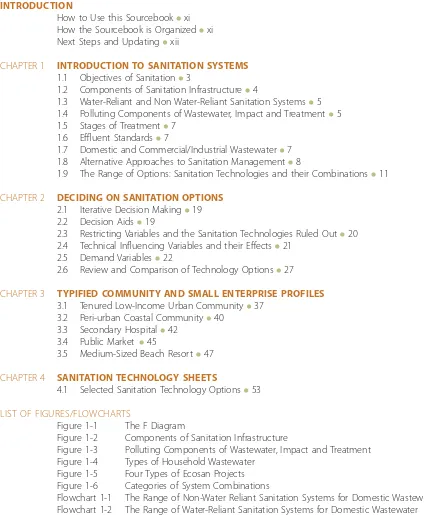
TABLE OF CONTENTS
ABBREVIATIONS iii
FOREWORD iv
ACKNOWLEDGMENT vi
INTRODUCTION
How to Use this Sourcebook xi How the Sourcebook is Organized xi Next Steps and Updating xii
CHAPTER 1 INTRODUCTION TO SANITATION SYSTEMS
1.1 Objectives of Sanitation 3
1.2 Components of Sanitation Infrastructure 4
1.3 Water-Reliant and Non Water-Reliant Sanitation Systems 5 1.4 Polluting Components of Wastewater, Impact and Treatment 5
1.5 Stages of Treatment 7
1.6 Effluent Standards 7
1.7 Domestic and Commercial/Industrial Wastewater 7 1.8 Alternative Approaches to Sanitation Management 8
1.9 The Range of Options: Sanitation Technologies and their Combinations 11
CHAPTER 2 DECIDING ON SANITATION OPTIONS
2.1 Iterative Decision Making 19
2.2 Decision Aids 19
2.3 Restricting Variables and the Sanitation Technologies Ruled Out 20 2.4 Technical Influencing Variables and their Effects 21
2.5 Demand Variables 22
2.6 Review and Comparison of Technology Options 27
CHAPTER 3 TYPIFIED COMMUNITY AND SMALL ENTERPRISE PROFILES
3.1 Tenured Low-Income Urban Community 37
3.2 Peri-urban Coastal Community 40
3.3 Secondary Hospital 42
3.4 Public Market 45
3.5 Medium-Sized Beach Resort 47
CHAPTER 4 SANITATION TECHNOLOGY SHEETS
4.1 Selected Sanitation Technology Options 53
LIST OF FIGURES/FLOWCHARTS
Figure 1-1 The F Diagram
Figure 1-2 Components of Sanitation Infrastructure
Figure 1-3 Polluting Components of Wastewater, Impact and Treatment Figure 1-4 Types of Household Wastewater
Figure 1-5 Four Types of Ecosan Projects Figure 1-6 Categories of System Combinations
Flowchart 1-3 The Range of Ecological Sanitation Systems for Domestic Wastewater Flowchart 1-4 Stages of the Waste Process for Small Enterprise Industry
LIST OF TABLES/MATRICES
Table 1-1 Polluting Components of Wastewater, Impact and Treatment Table 1-2 Effluent Standards (excerpt from DENR DAO#35 Table 2b) Table 2-1 Table of Restricting Variables
Table 2-2 Technical Influencing Variables
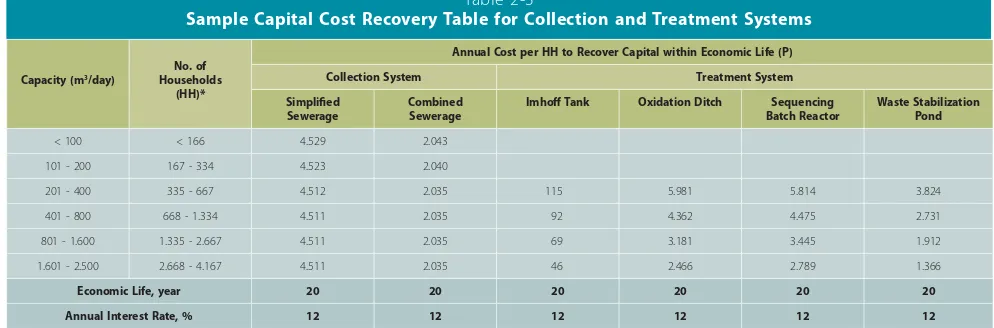
Table 2-3 Sample Cost Recovery Table for Collection and Treatment Systems
Table 2-4 Checklist of Demand Factors
Table 2-5 Technology Performance Rating Scale
Table 3-1 Tenured Low-Income Urban Community
Table 3-2 Peri-Urban Coastal Community
Table 3-3 Types of Hospitals
Table 3-4 Wastewater Streams from Hospitals
Table 3-5 Wastewater Characteristics from Selected Hospitals
Table 3-6 Secondary Hospitals
Table 3-7 Characteristics of Market Wastewater
Table 3-8 Municipal Public Markets
Table 3-9 Medium-Sized Beach Resort
Table 4-1 List of Sanitation Technologies for Systems of Toilet, Collection, Treatment and Disposal/Reuse Matrix 2-1A Effect of Site Specific Conditions and Comparison of Performance of Technologies
for Domestic Wastewater (Non Water-Reliant Systems)
Matrix 2-1B Effect of Site Specific Conditions and Comparison of Performance of Technologies
for Domestic Wastewater (Water-Reliant Systems)
Matrix 2-2A Treatment Technology Options for Public Market
Matrix 2-2B Pre-Treatment / Treatment Technology Options for Hospitals
ANNEXES
Annex 1 Survey Instruments:
Survey Instrument 1a Socio-economic and Demand Investigation
in Residential Communities
Survey Instrument 1b Technical Survey of Residential Communities
Survey Instrument 2 Technical Investigation of Small or Medium Enterprise
or Industry (Hospital, Public Market, Beach Resort)
Annex 2 List of Organizations Providing Information and Assistance on Sanitation Annex 3 List of Selected Web-Based Resources on Sanitation and Hygiene Promotion
Annex 4 List of Credit Funding Facilities for Water Supply and Sanitation Projects in the Philippines
DIC!XBMMXX
DPOD/!TMBC
TUBOEBSEUU UPJMFU!CPXM
This Sourcebook presents basic concepts on sanitation to help project planners, enterprise managers, local executives and other members of the community assess their situation and make a judgment on appropriate sanitation interventions.
It responds to a need identified during a scoping study to present sanitation and wastewater concepts and technology in a comprehensive, yet simple way.
)PXUP6TFUIJT4PVSDFCPPL
This Sourcebook is focused on information about low-cost sanitation technology options. Technology is not the only important aspect of a sanitation project. By focusing on this, the Sourcebook does not intend to downplay the role of hygiene and behavior change, nor the need for institutional frameworks that support sustainable financing, operation and management within sanitation projects. The narrow focus of the Sourcebook only seeks to fill a gap considering that there are excellent toolkits and guidebooks already available on broader topics of strategic sanitation and hygiene planning, programming and promotion. A list of these other resources will be found in Annex 3. We encourage readers to use these resources in conjunction with this Sourcebook.
The objective of this Sourcebook is to identify and discuss the factors that need to be considered when deciding on options for sanitation and wastewater technology. The Sourcebook aims to present a range of solutions and help decision-makers assess the various options based on informed choice. A secondary objective of the Sourcebook is expected to stimulate informed demand for sanitation.
The Sourcebook is mainly written for Philippine project planners, but may be useful to community organizers, service providers, sanitation project financiers, environmental and sanitation regulatory officers, other such practitioners, and to communities and users. During project preparation and implementation, readers are advised to seek advice from experts such as civil and environmental engineers, social scientists and finance specialists.
)PXUIF4PVSDFCPPLJT0SHBOJ[FE
Chapter 1 is an Introduction to Sanitation Systems. It discusses the objectives of sanitation, basic concepts and components of wastewater and different components of sanitation infrastructure. These concepts serve as basis for understanding the operating principles of different technologies. It helps answer the question, for example, of why pre-treatment is necessary in some
cases and not in others. Chapter 1 ends by presenting options spanning the major components of sanitation infrastructure systems and shows their various combinations through a flow chart.
Chapter 2 sets out a decision-making framework to aid project planners assess different options. The chapter starts with a discussion of factors relevant to decision-making. Factors are classified as either restricting or influencing. Restricting variables are conditions that, when present, disallow the use of specific technologies. Influencing variables do not eliminate an option. However, they need to be considered in the design, construction and operation of a system, or they may affect the acceptability of an option to users or project proponents. Thus, influencing factors are distinguished between technical and demand factors. The discussions try to help planners understand why and in what way these factors are relevant and whenever possible, provide for their measure or standard, a description of their usual occurrence or suggest how they can be measured or determined. The factors are given index numbers that relate them to an item in a survey questionnaire or checklist that is proposed to be used as a tool for investigation. The instruments themselves appear in Annex 1.
The chapter then puts forward an iterative approach to decision-making, supported by a series of decision aids. The first step is a process of eliminating technologies that cannot be used because of physical conditions that exist in the project area. A table relates these variables to the technologies and uses the colors green, yellow and red to indicate ‘go,’ ‘proceed with caution,’ and ‘stop.’ This indicates whether the occurrence of a condition rules out an option. The end result of this is a list of potentially feasible options. The second step of the decision process is to compare technologies based on their performance against 13 factors considered to be the most relevant.
The Sourcebook does not put forward a scoring system and makes no final choices for project participants since priorities of stakeholders will vary from case to case.
of wastewater and critical factors observed to influence demand for sanitation services are described in these profiles.
Sanitation situations vary from place to place and it would be impossible to describe all peculiarities. By typifying situations, the Sourcebook does not intend to replace physical and socio-economic investigations that need to underpin project planning. Indeed its intention is to improve investigations by highlighting issues that might escape the consideration of project planners, users and enterprise owners, community leaders and local government staff who may not have working knowledge of sanitation systems and become entirely dependent or captive to the advice of external parties.
Instruments to aid socio-economic and technical investigations are found in Annex 1.
Chapter 4 is a compilation of 23 selected low-cost sanitation options presented in Sanitation Technology Sheets. It presents options under each component of sanitation infrastructure. The sheets feature the components, basic operating principles, application, efficiency, costs and advantages and disadvantages of the options.
There are four Annexes. The survey instruments for technical and socio-economic investigation are in Annex 1. Annex 2 is a list of organizations that provide information or assistance on sanitation. Annex 3 is a list of selected web-based resources on sanitation and hygiene promotion. A list of credit funding utilities for sanitation projects in the Philippines is shown in Annex 4.
The Glossary provides the definition of terms used in the Sourcebook, particularly technical terms.
/FYU4UFQTBOE6QEBUJOH
This Sourcebook is the first attempt to provide basic and simplified information on sanitation. The intention is to test its applicability by dissemination to local governments and through various sanitation and financing institutions operating in the Philippines.
DIC!XBMMXX
DPOD/!TMBC
TUBOEBSEUU UPJMFU!CPXM
CHAPTER 1
Sanitation refers to the hygienic and proper management, collection, disposal or reuse of human excreta (feces and urine) and community liquid wastes to safeguard the health of individuals and communities.
It is concerned with preventing diseases by hindering pathogens, or disease-causing organisms, found in excreta and wastewater from entering the environment and coming into contact with people and communities. This usually involves the construction of adequate collection and disposal or reuse facilities and the promotion of proper hygiene behavior so that facilities are effectively used at all times.
0CKFDUJWFTPG4BOJUBUJPO
1Sanitation (and hygiene promotion) programs have three primary objectives:
Improving health conditions
Promoting dignity of living or enhanced quality of life Protecting the environment
The combined positive effects of these conditions lead to wider economic benefits.
Health
Disease-causing organisms in human excreta may find their way into a host and cause diseases. This usually results in diarrhea. In the Philippines, the Department of Health (DOH) estimates that 93 Filipinos suffer from diarrhea every hour and 25 die from it every day. Diarrhea poses such a significant burden and yet it is easily preventable with proper sanitation and hygiene.
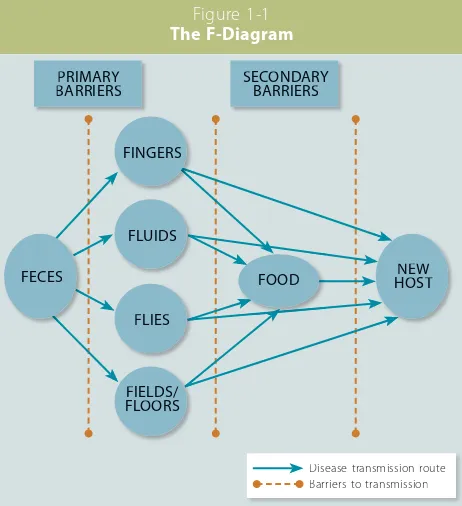
Pathogens are transmitted through a number of routes. These routes can be remembered with the acronym,
WASH:
contamination of Water that we ingest spread byAnthropods or other insects
contact (with our feet) through the Soil or floor contact through ourHands
The first three routes are blocked by constructing sanitation facilities that effectively separate excreta from human and animal (including insects) contact and secure against the contamination of drinking water and soils. The last route is barred by proper hygiene practices such as washing hands with soap after defecation or after cleaning up children post-defecation.
The ‘F-diagram’ shown in the figure below illustrates these same routes as fingers, flies, fields/floor and fluids. The most effective way of reducing transmission of disease is to erect “primary barriers” which prevents pathogens from entering the environment. The “secondary barriers” are practices that prevent the contact or use of the contaminated 4Fs into the food or new host.
Quality of Life
Research has found that people value sanitation facilities, close to or at the home, more for the resulting privacy, convenience and improvement (sights and smell) of their immediate surroundings than for their health benefits. Personal and environmental cleanliness gives a sense of dignity to people, particularly women. School latrines have been proven to be an essential part of keeping teenage girls and young women at school and enabling them to complete their education.
Environmental Protection
The indiscriminate disposal of wastewater into the environment also results in degradation of surface and groundwater resources. About half of the biological pollution unloaded to Philippine waters comes from untreated domestic wastewater. This depletes the waters of oxygen that is necessary to sustain aquatic life. Investment in sanitation and wastewater facilities can improve the quality of water bodies dramatically.
1 While this Sourcebook focuses on sanitation, it is important to note that in order to fully achieve these objectives, attention needs to be paid to hygiene, solid waste and drainage management.
Source: Sanitation and Hygiene Promotion Programming Guidelines (2005), after Wagner and Lanoix
Figure 1-1
FECES FOOD HOSTNEW
FINGERS
FLUIDS
FLIES
$PNQPOFOUTPG
4BOJUBUJPO*OGSBTUSVDUVSF
Sanitation infrastructure systems generally have four components. These are: toilet, collection, treatment and effluent/sludge disposal and reuse.
Each or all components can be located on-site, meaning close to or at the source of waste generation. On-site systems usually serve a single or small group of households or enterprises. Complete on-site systems, where waste is collected, treated and disposed on-site, are called decentralized systems. Components or systems can also be located off-site or away from the source of waste generation. Centralized systems collect and treat large volumes of waste from households and establishments. The residual waste is then moved to areas located away from the communities.
systems, waste from the toilet is usually combined with waste from other parts of the house or establishment and carried away through a sewerage system. In emerging alternative systems, such as ecological sanitation systems, waste streams (urine, feces and kitchen/shower) are isolated and stored or conveyed separately.
The sewerage system consists of a pit/hole, receptacle vessel and pipe network. Pipe networks can be conventional or simplified. A conventional sewer system uses gravity (and sometimes, pumps) to convey wastewater through the network. Pipes must be laid in a continuous incline. The system involves deep trenches and high digging costs.
Simplified sewer (or small bore sewerage) systems operate similarly to their conventional counterpart, but pipe size is significantly reduced and laid in shallower trenches. This is made possible by adding a primary treatment step before conveyance, to separate solids and refine the wastewater that goes into the network. While conventional and simplified sewers transport wastewater only, combined systems transport household wastewater plus storm or rainwater. Storm drainage and canals are commonly used as combined systems.
Condominial sewerage, a variation of simplified sewerage, allows sewer pipes to pass through property lots rather than both sides of a street under conventional systems. The shorter grid of smaller and shallower feeder pipes running through the backyards allow shallower connections to the street sewers, effecting significant reductions in cost. In condominial sewerage, sewer pipes have to cross property lots. Property owners need to allow construction and maintenance of the infrastructure within their properties.
Wastewater can also be collected and transported for disposal by cartage, which consists of safe manual delivery, using pails, spades and carts. Delivery is also done by vacuum trucks or desludging equipment.
Treatment
Treatment is the process of removing liquid and solid waste, or reducing it to stable, non-polluting matter. A treatment plant is a medium, structure or equipment used for this purpose. The characteristics of wastewater will dictate the treatment process that will be required. There are various methods to address the different types of polluting elements present in wastewater. These elements and processes are discussed in Section 1.4.
Disposal or Reuse
The last component of sanitation infrastructure is Figure 1-2
Components of Sanitation Infrastructure
Toilet
The toilet consists of a waste receptacle (bowl) or squatting plate with or without a superstructure. To erect a toilet at home or in a public place is to assign a stationary area for urination and defecation. This prevents the practice of defecating in open areas, which results into a health hazard for the community. Toilets isolate human excreta to prevent direct or indirect transmission of diseases. Toilet bowls that allow the separate collection of urine and feces are called urine diverting toilets.
Collection and Conveyance
POLLUTING COMPONENT TREATMENT ENVIRONTMENTAL IMPACT (if not treated)
PHYSICAL FRACTION
S O L I D S
1. Coarse solids, e.g. sand, gravel and large materials, e.g. sticks
2. Settleable solids
Screening, grit removal, comminution
Sedimentation tanks (septic tanks and clarifiers)
Non-removal of coarse solids may cause damage to pumps, thus impairing the treatment process.
Increase the turbidity of the receiving water body. concerned with returning or releasing treated effluent
and sludge to the environment. Care should be taken that doing so will not pose a hazard to people and the environment. Disposal can mean discharge to a water body (such as a river), application to land or to the soils, or even release to the atmosphere in the form of gas.
In terms of ecological sanitation, residual elements are not ‘disposed’ but reused. Wastewater can be safely reused in agriculture, landscape irrigation, aquaculture, and fire fighting. Sludge can be used in agriculture or dried for use as fertilizer. Before its reuse, the quality and safety of the waste should first be established. Incorrect application can cause harm.
1.3 Water-Reliant and Non-Water
Reliant
Sanitation
Systems
In general, sanitation systems are either water-reliant or non-water reliant. Water-reliant systems employ water to flush and convey waste through the system and therefore, require a continuous supply of water. Non- water reliant systems are those that rely on dry storage and carriage that does not employ water for conveyance. Thus, carriage is usually conducted manually. It does not mean that liquid waste or even, clean water, is not received in the system. A small amount of water may be employed to clean components of a dry system, such as the sitting bowl. A vacuum flush toilet, such as those employed in airplanes, can thus be considered non-water reliant.
1.4 Polluting Components of
Wastewater, Impact and Treatment
Wastewater is composed of different elements, some of which are harmful when discharged untreated, in large volumes or in high concentrations and cannot be processed naturally by the environment. The treatment process will differ according to the polluting element contained in the water.
Table 1-1
Polluting Components of Wastewater, Impact and Treatment
The concentration of different polluting elements will have specific effects on the environment and on humans. The accumulation of solid particles in water results in turbidity or murkiness. Concentration of organic matter in water bodies causes depletion of oxygen and, ultimately, the inability to sustain aquatic life dependent on oxygen. Organic matter also releases foul odors resulting from decay. Nutrients encourage the growth of algae and could lead to eutrophication or excess plant growth, which also reduces the dissolved oxygen in water. Gases in wastewater, such as hydrogen sulfide and ammonia, could be toxic. The same is true for other pollutants such as metals, pesticides, and halogenated compounds. Micro-organisms can cause diseases.
Figure 1-3 illustrates the polluting components of wastewater, their potential impact if discharged untreated, and the applicable treatment process. Table 1-1 discusses this in more detail.
Figure 1-3
POLLUTING COMPONENT TREATMENT ENVIRONTMENTAL IMPACT (if not treated) or non-settleable)
Screening, comminution, grit removal, sedimentation filtration, flotation, chemical polymer addition, coagulation, natural systems (land treatment)
1. Leads to the development of sludge deposits and anaerobic conditions when discharged into the receiving environment, thus impairing water quality. 2. Restricts wastewater use for agricultural irrigation
or aquaculture. Causes decline in growth and yield of most plants.
3. Total Suspended Solids (TSS) increase:
• turbidity which prevents light to pass through and causes fish’s gills to get plugged up • silting which reduces lifetime of lakes
b. Filterable (colloidal or dissolved) Activated sludge, trickling filters, sand filters, rotating biological contactors, oxidation ditch, sequencing batch reactor, lagoon systems
Impairs water quality of receiving water.
CHEMICAL FRACTION
a. Biodegradable organics (protein, carbohydrates, fats)
Activated sludge, trickling filters, rotating biological contactors, lagoon variations, intermittent sand filtration, physical-chemical systems, natural systems
1. Fats increase biochemical oxygen demand. 2. Fat traps trash, plants and other materials,
causing foul odors, at trac ting f lies and mosquitoes and other disease vectors.
3. Fats cause septic conditions in ponds and lakes by preventing oxygen in the atmosphere from reaching the water.
4. Higher concentrations of fats and grease can result in poorer effluent quality thus polluting the receiving water body.
b Refractory organics (surfactants, phenols, agricultural pesticides)
Carbon adsorption, tertiary ozonation, natural systems
-N
a. Dissolved inorganics (calcium, sodium, sulfate)
b. Nutrients (nitrogen, phosphorus)
Chemical precipitation, ion exchange, ultrafiltration, reverse osmosis, electrodialysis.
For nitrogen: nitrification and denitrification, ammonia stripping, ion exchange, chlorination, natural systems For phosphorus: metal-salt addition (alum, FeCI3) lime coagulation/sedimentation, biological phosphorus removal, biological-chemical phosphorus removal, natural systems
Impairs water quality of receiving water
1. In certain proportions and conditions, these nutrients can give rise to harmful algal blooms. 2. Encourages the grow th of algae (eutro
-phication).
(nitrogen, oxygen, carbon dioxide, hydrogen sulfide, ammonia, methane)
Ammonia stripping, acid and base gas scrubbers, biofilters and soil bed
1. Hydrogen sulfide and ammonia can be toxic and pose asphyxiation hazard. Both gases also emit odors, which can be a serious nuisance. 2. Volatile organics can be toxic to humans and
other microorganisms.
3. The formation of nitrogen gas can cause large globs of sludge to overflow, thus polluting the receiving water body. (metals, non-metals, organic compounds, halogenated compounds, pesticides, herbicides, insecticides)
Chemical precipitation, ion exchange, nanofiltration, reverse osmosis and biological degradation in natural systems and reed beds
1. Some metals and compounds cause mutation, cancer and birth defects.
2. Metals accumulate in fish and plant and can be toxic and/or hazardous.
(bacteria, fungi, protozoa, algae)
Application of copper sulfate, sludge wasting and return
1. Algae covers sur face waters since they reproduce rapidly, and affect the quality of water for drinking in terms of taste and odor. 2. Algae affects the value of water for water supply
because they cause taste and odor problems. 3. Bacteria can cause sludge bulking resulting in
higher suspended solids in the effluent and receiving water body.
b. plants
(ferns, mosses, seed plants, liverworts) -
-c. animals
(vertebrates, invertebrates) -
-d. pathogenic organisms (coliforms)
Chlorination, hypochlorination, bromine chloride, ozonation, UV radiation, biological degradation in natural systems
1.5 Stages of Treatment
To be able to address these different polluting elements, wastewater might need to undergo several stages of treatment.
Primary treatment involves the separation of solids through sedimentation or settling. Wastewater might be contained in a tank a number of hours to allow solids to settle at the bottom of the tank. Settled solids, called sludge, are then removed or drawn from the tank and further treated.
Secondary treatment, or biological treatment, breaks down organic matter present after primary treatment with the aid of micro-organisms. Aerobic micro-organisms need oxygen to absorb the organic matter from wastewater. Oxygen, therefore, must be continuously introduced or maintained to prevent the depletion of micro-organisms. On the other hand, anaerobic treatment is applied to wastewater with high organic content such as market wastes.
Tertiary treatment focuses on the removal of micro-organisms, nutrients, priority pollutants, and gases. Chlorination and ultraviolet radiation kill micro-organisms. Nitrification and denitrification remove nutrients. Adsorption takes away toxic elements. Ammonia stripping gets rid of gases.
1.6 Effluent Standards
Treatment aims to reduce the effluent output to a quality that conforms to environmental standards. In the Philippines, effluent standards are applied to the final effluent or discharge of treated/untreated wastewater. Water quality standards are based on the classification of the water body that will be the final point of discharge. Selected pertinent portions of the effluent standards are shown in Table 1-2 on the next page.
If final disposal is into soils, effluent quality is applied to the wastewater discharge, while the disposal process must conform to agricultural regulations that may be issued.
1.7 Domestic and Commercial/
Industrial
Wastewater
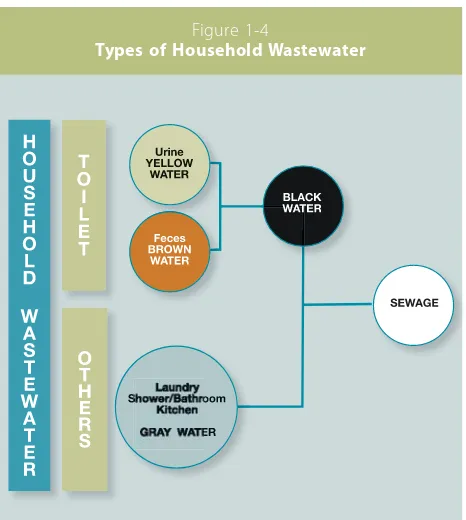
Households produce wastewater from the toilet, bathroom and shower, laundry and kitchen. Wastewater from the toilet includes feces, urine and flushing water.
In this Sourcebook, wastewater streams have been classified using color codes (See Figure 1-4):
Yellow water – urine only, with or without flushing water
Brown water – feces only
Black water – combination of feces and urine,
with or without flushing water
Gray water – wastewater from bathroom, shower,
laundry and kitchen
Yellow water contains metabolic wastes, dissolved salts, and a large amount of nutrients and inorganic materials that are expelled by the body. Approximately 90% of the body’s total nitrogen, 55% of total phosphorus, and a significant portion of potassium is contained in urine. Yellow water can be a significant source of nutrient for plants. Recognition of this resource is one of the important bases of ecological sanitation.
On the other hand, disease-causing organisms are normally found in large quantities in feces. Hygienic handling of brown water or black water is critical.
Gray water comes from all other sources in the home, such as the shower or bathroom, laundry, or kitchen. It comprises the largest fraction of the total wastewater flow. Generally, gray water has very low nutrient content. Phosphorus content becomes high with the continued use of phosphate-containing detergents for washing clothes. High concentration of solids and organic materials (fat, oil, and grease) in gray water comes from cooking, food waste and kitchen drains.
The characteristics of domestic or household
wastewater are similar in most homes. Wastewater from beach resorts are also mainly from the kitchen, laundry and showers. Thus, the characteristics of wastewater from beach resorts do not differ from those produced by households, except in volume
On the other hand, industrial and commercial
PARAMETER UNIT
Temperature °C rise (max rise in deg. Celsius in RBW)
3 3 3
pH (range) 6.0-9.0 6.0-9.0 5.0-9.0
COD mg / L 200 200 200
(excerpt from DENR DAO #35 Table 2B)
(C) Discharge shall not cause abnormal discoloration in the receiving waters outside of the mixing zone. (F) Not more than 30 mg/L increase (dry season)
(H) If effluent is the sole source of supply for irrigation, the maximum limits are 1,500 mg/L and 1,000 mg/L, respectively, for old industries and new industries.
(I) Not present in concentration to affect fish flavor or taste or tainting.
(J) If effluent is used to irrigate vegetable and fruit crops which may be eaten raw, fecal coliforms should be less than 500 MPN/100 mL.
Figure 1-4
Types of Household Wastewater
1.8 Alternative Approaches
to Sanitation Management
In the Philippines, as in many developing countries, very little attention is paid to sanitation. Only 10 of the country’s approximately 1,650 towns and cities have sewerage systems, and these are very limited in scope. The majority of the population relies on on-site treatment through septic tanks that are ill-constructed or poorly maintained.
Among the most significant set-backs for sanitation is the high cost of investment and maintenance required for conventional sanitation systems.
In recent times, a number of approaches have emerged in response to these problems. Each of these approaches can be implemented independently or as part of other approaches. What these approaches have in common is that they all try to move away from centralized sanitation management. They use technology that is cheaper to build, operate and maintain, and easier to manage.
Ecological Sanitation
Ecological sanitation, or “ecosan”, is a new paradigm that aims at the systematic closure of local material flow-cycles. It supposes that rather than being pollutants or waste, local materials can be useful resources. Ecosan is based on an overall view that material flows are part of an ecologically and economically sustainable wastewater management system that can be tailored to the needs of the users and local conditions. The basic principle of ecosan is to close the nutrient loop between sanitation and agriculture.
Ecosan is likewise concerned with the misuse of resources presently dedicated to the collection, conveyance and treatment of wastewater. Under conventional systems, large quantities of clean water, suitable for drinking, are applied for flushing and carriage of dirty water. Significant energy is also used for conveying and treating wastewater in centralized treatment plants that are often electro-mechanized.
Ecosan incorporates the following principles:
1. A conscious effort to conserve resources in the management of sanitation and wastewater
2. Recycling and reuse of waste matter
3. Rendering recyclables from waste (human and animal excreta, gray water) safe for reuse
4. Minimization of the use of energy and water in sanitation and wastewater management
5. Pollution prevention
Ecosan is enhanced by –
2. Non-dilution of waste streams to guarantee high concentration of recyclables
The main objectives of ecosan are:
reducing the health risks related to sanitation, contaminated water and waste
improving the quality of surface and groundwater improving soil fertility
optimizing the management of nutrients and water resources
Closing the loop enables the recovery of organics, nutrients, trace elements and energy contained in household wastewater and organic waste and their subsequent productive reuse. Although the reuse focuses predominantly on agriculture, the options are not limited to this application only.
An essential step in this process is the appropriate hygienization and handling of the materials throughout the entire treatment and reuse process. This is done to ensure a satisfactory sanitization of the excrement. Therefore, unlike conventional sanitation systems, ecosan systems not only control the direct hygienic risks to the population but also protect the natural environment. In practice, the commonly applied ecosan strategy of separately collecting and treating feces, urine and gray water minimizes the consumption of valuable drinking water. At the same time, it enables treatment of the separate wastewater flows at low cost for subsequent
reuse in soil amelioration, as fertilizer, as service or irrigation water or for groundwater recharge. Ecosan systems restore the natural balance between the quantity of nutrients excreted by one person in one year and that required to produce their food. This is particularly urgent with regard to fresh water and mineral resources. For example, current estimates for phosphorus state that economically extractable reserves will be used up within the next 100 years.
Ecosan does not favor a particular technology. It is a philosophy in recycling oriented resource management and offers modern, convenient, gender-friendly and desirable solutions. Nevertheless, appropriate technologies include urine-diversion toilets, compost toilets, biogas plants, wetland treatment plants, rainwater harvesting, and aquaculture.
Introduction of ecosan to communities will need to be supported by intensive education to correct practices of managing excreta and materials. Particularly for communities accustomed to traditional sanitation systems, significant retooling and possibly, retrofitting of existing facilities will be required.
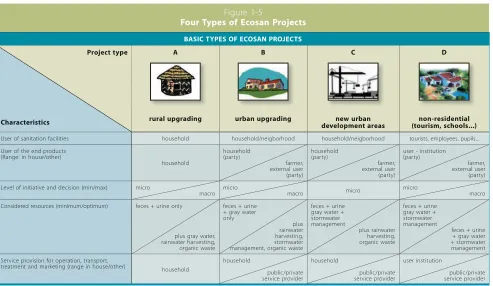
While a majority of ecosan experiences come from a rural context, it would be incorrect to suppose that ecosan is only applicable in this environment. Ecosan projects could be roughly divided into four types and illustrated in Figure 1-5 below.
Source: GTZ Ecosan Sourcebook (2004)
Figure 1-5
Four Types of Ecosan Projects
BASIC TYPES OF ECOSAN PROJECTS Project type
Characteristics
A B C D
rural upgrading urban upgrading new urban
development areas (tourism, schools...)non-residential
User of sanitation facilities household household/neigborhood household/neigborhood tourists, employees, pupils... User of the end products
(Range: in house/other)
Level of initiative and decision (min/max) micro
macro micro macro micro micro macro
Considered resources (minimum/optimum) feces + urine only
plus gray water,
Service provision for operation, transport,
treatment and marketing (range in house/other) household household
Decentralized Wastewater Treatment Systems
Decentralized wastewater treatment systems or
DEWATS, is a client-centered approach to wastewater treatment, rather than simply a technical hardware package. It aims at introducing and designing the most appropriate combination of wastewater treatment technologies based on the needs of clients, considering their objectives, local conditions and financial means.
DEWATS seeks to involve the user in sanitation and wastewater management as much as possible. Therefore, it combines participatory community/client consultation processes together with expert advice. DEWATS recognizes that one shortcoming of centralized systems is that they often leave users without any control over the provision of service.
The approach tries to avoid utilization of mechanical or energy-dependent parts and imported materials. Emphasis is on the utilization of locally available resources. It recognizes that centralized systems are often expensive to construct and difficult to operate and maintain. Thus, while the hardware introduced in DEWATS is based on standard engineering designs, the system includes only such technologies that are considered suitable for decentralized application, requiring only simple operation and maintenance.
It does not promote “ready-to-install prefabricated” technology. Instead, it uses a modular approach to system design in order to cater to particular needs. DEWATS engineers are trained to determine which modules to combine to deliver the best option for clients, depending on the kind of wastewater to be treated and the desired quality of the wastewater outflow.
The technology DEWATS uses is a combination of anaerobic and aerobic wastewater treatment processes. The use of combined processes allows DEWATS to link and enhance the treatment capacity of each independent stage/module. This addresses the limitations of a specific process when implemented as a stand-alone system. DEWATS uses four anaerobic process modules: bio-digester, septic tank, baffle reactor, and anaerobic filter. There are two aerobic process modules: horizontal gravel filter and pond. These are implemented in combination with any or all of the anaerobic parts.
DEWATS is designed so that maintenance and daily management are reduced to a minimum. However, a trained person is needed to perform and record operation and maintenance. Though minimized, maintenance tasks are still necessary. For example, desludging due to the sludge accumulation in the tank
needs to be done at regular intervals (once every two years). Monitoring and removal of scum in the anaerobic chambers, and harvesting of phragmytes plants in the horizontal gravel filter when over-grown are other required maintenance jobs.
DEWATS can be applied to housing settlements, as well as commercial, social and industrial uses, such as hospitals, hotels, universities/schools, slaughter houses, public markets, and food processing facilities.
Septage Management
In the Philippines, a majority of urban dwellings and enterprises rely on septic tanks as the only means of treating their wastewater. Given this, it is important to ensure that septic tanks are operating optimally and that residual waste from septic tanks is managed properly.
Septage management refers to the periodic desludging or removal of septage from septic tanks using vacuum trucks or other desludging equipment, and treatment and disposal of the septage.
Septage is the mix of liquid and solids in a septic tank, which becomes a major source of pollution when it is disposed without effective treatment, either on land or in water bodies.
A septic tank performs primary treatment by separating solids from the wastewater inflow, causing anaerobic decomposition and storage of the accumulated solids. Wastewater is then passed out of the tank as effluent. For effective treatment, the inflowing wastewater needs to be retained in the tank from 24 to 48 hours. With years of usage, solids accumulate and fill the tank such that the retention time of the wastewater becomes shortened. The accumulated solids need to be removed to restore the treatment capability of the septic tank.
Septage has very high BOD (over 10 times that of domestic sewage) and a high solids content. Treatment of septage is required before it is disposed. It can be treated using various methods, including lime stabilization, a mechanized septage treatment facility, or waste stabilization ponds. The supplement to the IRR of Chapter XVII of the Code on Sanitation of the Philippines (P.D. 856) (issued May 2004) states that “it is mandatory that septage and domestic sludge shall be processed and treated prior to disposal.” It cites the following treatment techniques:
The current practice in the Philippines is for individual homeowners to have their septic tanks desludged only when they are completely full and overflowing. They pay a private contractor to perform this service. Most, if not all, of these contractors dispose of the septage without treatment. Therefore, cities and municipalities need to develop septage management programs to ensure that the septic tanks are inspected and desludged on a regular basis, perhaps every 3-5 years depending on the size and number of occupants. The proper treatment of septage before disposal also needs to be enforced.
1.9 The Range of Options:
Sanitation Technologies
and their Combinations
The flowcharts in the following pages present the range of sanitation technology options available and their possible combinations. Sanitation systems, as already discussed, are made up of various components.
Systems vary according to:
their dependence on water for carriage: systems can either be non-water reliant or water-reliant
the size of the potential user group: systems can be individual, cluster- or municipal-wide
their location: systems may be on-site or off-site, or with a combination of on-site and off-site components
their approach: systems could employ traditional or alternative waste management principles
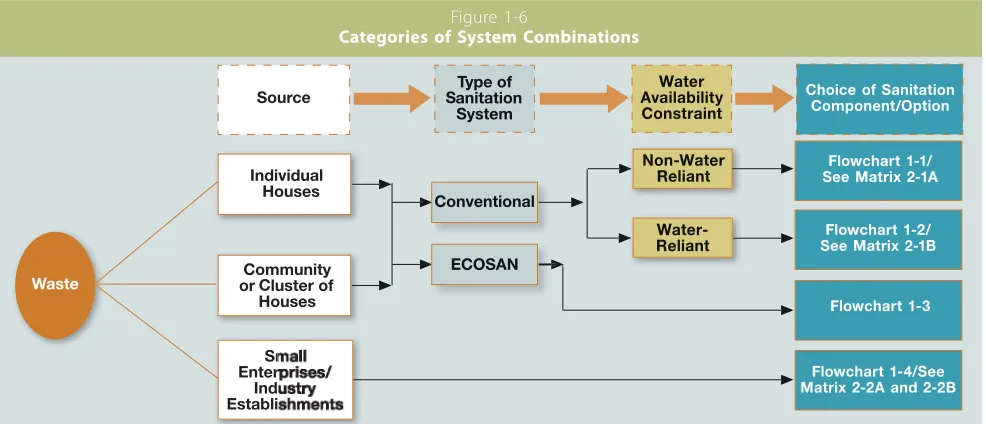
The flowcharts are structured to reflect how options might be combined into the above system classes. To illustrate, each of the flowcharts will reflect these categories of system combinations:
However, to avoid too many permutations, the flowcharts for non-water reliant and water-reliant systems have been separated. Flowchart 1-1 deals with non-water reliant systems and Flowchart 1-2 deals with water-reliant systems.
Flowchart 1-3 shows how wastewater can be managed using an ecological approach. Ecological and traditional sanitation management can be used in combination. Thus, a number of the ecological technologies appearing in Flowchart 1-3 can also be seen in the first two flowcharts. In Flowchart 1-3, the non-water reliant and water-reliant systems appear in a single chart.
Flowcharts 1-1, 1-2 and 1-3 are related to the management of wastewater from homes and beach resorts. Management of industrial or commercial wastewater is illustrated in Flowchart 1-4 to emphasize the need for special treatment processes before a part of the waste stream can be treated as domestic waste.
Figure 1-6
* Not included in technology sheets
** Biological treatment, membrane technology or soak away pit
Waste Type SystemToilet TreatmentOn-Site Disposal/ReuseOn-Site CollectionSystem TreatmentOff-Site Disposal/ReuseOff-Site
Compost Privy Agricultural Use
Bucket Latrine*
or Vault Latrine* Aquaculture
Burying*
Ventilated Improved Privy (VIP) Latrine
Upon filling of pit, open another pit
Anaerobic Digestion
Composting
Biogas
Agricultural Use
Low Volume
Treament** Recycle
Discharge into a Water Body
Constructed
Wetlands Irrigation*
Wastewater
Ponds GroundwaterRecharge*
Direct Use* Black
Water
Sullage or Gray Water
Use the Storm Drain?
No
Yes Pipe/Canal
ther Flow
Wet Weatt
Dry Weather Flow Cartage Cartage
Approval by higher authorities
Flowchart 1-1
Waste Type Toilet
DigesterO AnaerobicBaffled ReactorO
The Range of Water-Reliant Sanitation Systems for Domestic Wastewater
Sullage or
Biogas Reecovered e
No primary treatment
+Septage Desludging by Vacuum Trucks
No primary treatment
Nooo
Yes
Can combine with the blackwater (see combined sewer above)
W
Wet weather flow (separates storm water during rainy days)
W
** Biological treatment, membrane technology or soak away pit
*** Septage treatment can be accomplished by co-treatment with sewage or sludge, composting or anaerobic digestion Black
Toilet System
On-Site
Treatment On-Site
Reuse
Collection System
Off-Site
Treatment Off-Site Reuse
Dehydration Toilet
Composting
Toilet Hygienizationby drying
Applied to Garden/
Plants Storage/Drying
Double Vault Cartage Composting AgriculturalReuse
Heating
Use Storm Drain?
Low Volume
Treatment Reuse
Evapo-Transpirator
Pipe/Canal
Reed Beds
Agricultural Reuse Ponds/Lagoons
Conventional Treatment
Urine Diversion
Toilet Storage
Applied to Garden/
Plants
Drying/
Evaporation AgriculturalReuse
Anaeorobic
Baffled ReactorO Biogas
Anaerobic FilterO
Horizontal
Gravel FilterO AgriculturalReuse
Anaerobic PondO
Low-flush Toilet
Septic Tank Overflow
Reed Beds
Vacuum Toilet Pond/Lagoons
Biogas DigesterO Biogas
Conventional Septage Treatment
Reed Beds
Composting AgriculturalReuse
Storage Applied toGarden/ Plants
Drying/
Evaporation AgriculturalReuse Feces
or Brown Water
Flowchart 1-3
The Range of Ecological Sanitation Systems for Domestic Wastewater
Sullage or Gray Water
Water Reliant?
No
Urine or Yellow
Water
Black Water
Urine or Yellow Water
Septage
No
Yes
WASTEWATER QUALITY SURVEY (hospital, public market, slaughter house, etc.)
FULL TREATMENT
WASTEWATER COLLECTION SYSTEM & PRELIMINARY
TREATMENT
PRE-TREATMENT: REDUCE RAW EFFLUENT TO DOMESTIC SEWAGE
QUALITY (See Matrices 2-2A & 2-2B
in the next chapter)
SEWAGE TREATMENT (Flowchart 1-2)
EFFLUENT & SLUDGE DISPOSAL & REUSE
(Flowchart 1-2)
TREATMENT/ DISPOSAL
Sewage Discharge
to Collection System
Solids
Liquids Raw Wastewater
Solids
Flowchart 1-4
DIC!XBMMXX
DPOD/!TMBC
TUBOEBSEUU UPJMFU!CPXM
CHAPTER 2
In the Philippines, until recently, the decision on how sanitation would be managed was singularly taken by the capital investor, e.g., a family investing in a toilet and septic tank, or a government agency constructing and operating a sewerage system. This practice still exists. Sanitation facilities are almost exclusively toilets and septic tanks on one end of the spectrum and centralized sewerage systems on the other 2.
In the past, population density was low, and the distinction between rural and urban was much more defined. Household sanitation facilities could exist as stand-alone systems, relying on the carrying capacity of the natural environment. This is no longer tenable. Rural areas are rapidly becoming built up, with the country’s rate of urbanization exceeding the regional average. As houses are built closer together, the volume and concentration of waste increases and the capacity of natural systems to process it becomes progressively limited. Thus, sanitation and wastewater planning needs to look more comprehensively across the range of solutions and consider a broader set of views and resources.
Decentralizing responsibility for sanitation to local governments, starting in the 1990s, presents both an opportunity and a challenge for moving towards comprehensive sanitation planning. On the one hand, decisions can be taken at a level where people have the highest degree of interest in, and understanding of, their particular situation. This involves community participation and can result in better decisions about the sanitation service that is feasible and appropriate, given physical, institutional and socio-economic conditions. On the other hand, serious information gaps on sanitation concepts and options exist at this level, even among technical professionals within local government units.
2.1 Iterative Decision-Making
The selection of sanitation options involves the consideration of technical and non-technical issues. An assessment of physical factors that limit potentially feasible options or compel corrective actions in their design, construction or operation is necessary. Decision-making will also need to consider non-technical factors, such as the acceptability of options by users, to better ensure that sanitation systems will operate effectively in the long-run.
As a first step in decision-making, it is easiest to eliminate from the very beginning those options that, on technical grounds, cannot be effectively utilized at all. Some options cannot be used in specific situations given the physical and technical constraints. Factors that exclude certain types of sanitation technology options are referred to as Restricting Variables. The presence of restricting variables will only eliminate some, but not all options, and may continue to be relevant in later stages of decision-making for those options that do not get excluded.
The second step in decision-making is a review of factors that will affect the design, efficiency or acceptability of certain options. These factors are referred to as Influencing Variables.
Influencing variables are further classified into two – technical factors and demand factors. Technical factors
relate to physical parameters, while demand factors
relate to socio-economic considerations, including cultural preferences.
The presence of technical influencing factors will not eliminate options, but need to be considered in the plan, design and implementation of projects. Typically, the responses to technical influencing variables are to:
introduce corrective or mitigating measures in the system so that potential hazards to health and the environment are reduced or eliminated, or
consider them in the design and construction of systems so that standards are met and efficiency of the systems is preserved.
Demand factors also influence the design, efficiency and acceptability of options. They relate to socio-economic issues that affect (increase or decrease) the motivation of investors, users or consumers to invest in a facility, use it and/or to pay for its use. They also relate to cultural preferences in the choice of the appropriate option.
Deciding on the combination of options that is technically feasible and socio-economically viable, therefore, requires judgment based on an investigation of various issues. Usually, this decision is arrived at after a series of discussions and deliberations among project stakeholders.
2.2 Decision Aids
This Chapter identifies Restricting and Influencing factors and how they affect proposed solutions. The Sourcebook organizes information around these issues into quick reference decision-aids:
a. Model Survey Instruments for Community Sanitation and Sanitation for Enterprises - The surveys comprise questionnaires for socio-economic (Survey Instrument 1-a) and technical (Survey Instrument 1-b) investigation. In the discussions of factors, a cross-reference to the relevant item in the questionnaire is made. The survey instruments are in
Annex 1.
b. Tables on Technical Restricting and Influencing Variables – The most common technical factors and their effects are presented in two tables:
5BCMF PO 3FTUSJDUJOH 7BSJBCMFT identifies physical
or technical conditions that render some options inoperable/infeasible.
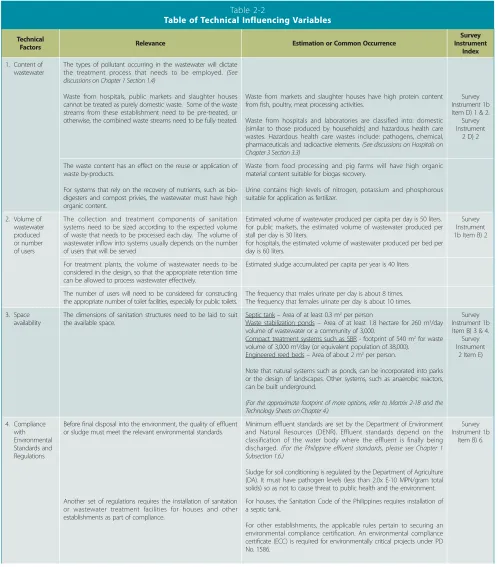
5BCMFPO5FDIOJDBM*OnVFODJOH7BSJBCMFTidentifies
physical or technical variables that need to be considered in the design, construction or operation of some sanitation options.
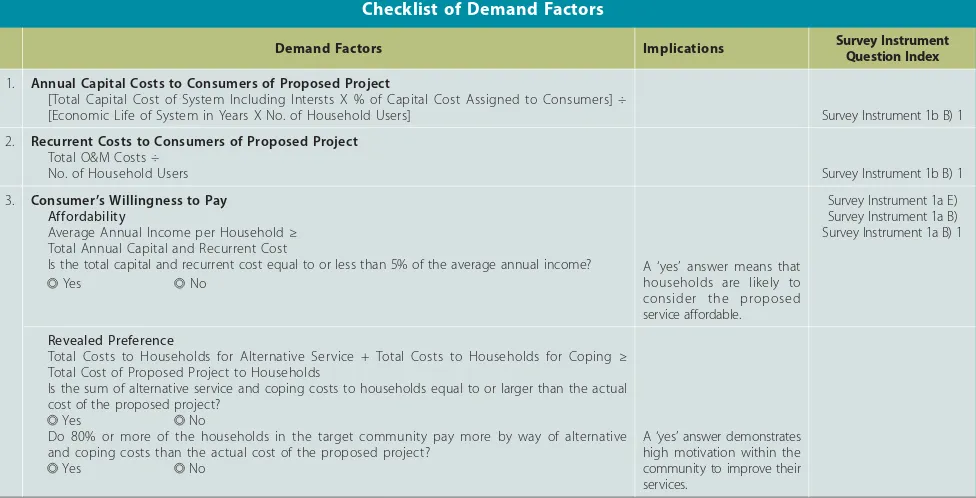
c. Checklist of Demand Factors – A list of considerations relating to demand factors are given in
Subsection 2.5.
This Chapter also puts forward the following three decision-aids that compare the several options under each system component:
a. Matrices 2-1A and 2-1B Effect of Site Specific Conditions to Technology Options for Domestic Wastewater compares domestic sanitation options against a list of site specific conditions. Using the color scheme of a traffic light, the matrix lets the user know, at a glance, the effect of these conditions to certain options and therefore, if one should go ahead
(green grid with vertical lines), stop (red grid with horizontal lines) or proceed with caution (yellow grid with dots).
Comparison of Technology Performance - The lower half of Matrices 2-1A and 2-1B compares the sanitation options according to their performance based on 13 criteria.
b. Preliminary Matrices 2-2A and 2-2B Pre-treatment/ Treatment Technology Options for Public Markets and Hospitals. These are used in conjunction with the above matrices (Effect of Site Specific Conditions to Technology Options for Domestic Wastewater) in the case of public markets and hospitals that will need pre-treatment of non-domestic waste water streams.
These decision aids can assist project planners make informed comparisons of the options and communicate these issues with other project stakeholders.
2.3 Restricting Variables and
Sanitation
Technologies
Ruled Out
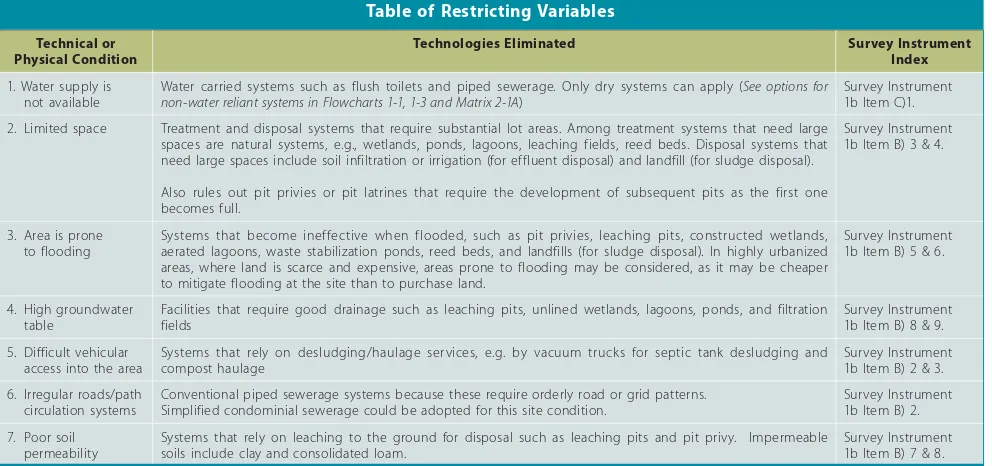
Table 2-1 on Restricting Variables identifies the most common physical or technical conditions that render some options inoperable/infeasible in the first column; the second column lists the sanitation options that are ruled out by their presence; and, the third column provides the cross-reference to the Model Survey Instrument.
Technical or Physical Condition
Technologies Eliminated Survey Instrument
Index
1. Water supply is not available
Water carried systems such as flush toilets and piped sewerage. Only dry systems can apply (See options for non-water reliant systems in Flowcharts 1-1, 1-3 and Matrix 2-1A)
Survey Instrument 1b Item C)1.
2. Limited space Treatment and disposal systems that require substantial lot areas. Among treatment systems that need large spaces are natural systems, e.g., wetlands, ponds, lagoons, leaching fields, reed beds. Disposal systems that need large spaces include soil infiltration or irrigation (for effluent disposal) and landfill (for sludge disposal).
Also rules out pit privies or pit latrines that require the development of subsequent pits as the first one becomes full.
Survey Instrument 1b Item B) 3 & 4.
3. Area is prone to flooding
Systems that become ineffective when flooded, such as pit privies, leaching pits, constructed wetlands, aerated lagoons, waste stabilization ponds, reed beds, and landfills (for sludge disposal). In highly urbanized areas, where land is scarce and expensive, areas prone to flooding may be considered, as it may be cheaper to mitigate flooding at the site than to purchase land.
Survey Instrument 1b Item B) 5 & 6.
4. High groundwater table
Facilities that require good drainage such as leaching pits, unlined wetlands, lagoons, ponds, and filtration fields
Survey Instrument 1b Item B) 8 & 9.
5. Difficult vehicular access into the area
Systems that rely on desludging/haulage services, e.g. by vacuum trucks for septic tank desludging and compost haulage
Survey Instrument 1b Item B) 2 & 3.
6. Irregular roads/path circulation systems
Conventional piped sewerage systems because these require orderly road or grid patterns. Simplified condominial sewerage could be adopted for this site condition.
Survey Instrument 1b Item B) 2.
7. Poor soil permeability
Systems that rely on leaching to the ground for disposal such as leaching pits and pit privy. Impermeable soils include clay and consolidated loam.
Survey Instrument 1b Item B) 7 & 8.
Table 2-1