Recycling of Meat and Bone Meal
Animal Feed by Vacuum Pyrolysis
A . C H A A L A A N D C . R O Y *
De´p artem en t de Ge´n ie Ch im iqu e, Un iversite´ Laval, Sain te-Foy, Qu e´bec, Can ada G1K 7P4
Due to the recent bovine spongiform encephalopathy
(BSE) crisis in the European beef industry, the use of
animal-derived products to feed cattle is now severely restricted.
Large quantities of w aste animal meat and bone meal
(M BM ), also know n as animal flour, have to be safely
disposed of or transformed. One disposal option is pyrolysis.
Vacuum pyrolysis of an animal flour sample has been
performed in a laboratory reactor. The results obtained
revealed that vacuum pyrolysis can be an attractive alternative
to incineration and cement kilns. The process generated
a combustible gas (15.1 w t %), a high calorific value oil (35.1
w t %), a solid residue rich in minerals (39.1 w t %), and
an aqueous phase rich in organics (10.7 w t %). The gas and
the aqueous phase can be used to provide heat to the
vacuum pyrolysis reactor and the M BM drying unit. The
oil can be used alone or mixed w ith petroleum products as
a fuel in boilers or gas turbines. Conversion of animal
w aste by pyrolysis into fuels can contribute to the reduction
of greenhouse gases. It is suggested to use the solid
residue for agricultural soil enrichment in minerals and as
a soil moisturizer.
an d 300000 ton s of fatty p rod u cts. Existin g tech n ologies can treat on ly 350000 ton s of flou r an d th e d erived fatty (Mission in term in iste´rielle p ou r l’e´lim in ation d es farin es an im ales), seven oth er cem en t factories wh ich cou ld con -rad ation p rocesses su ch as p yrolysis in to tran sp ortab le, storab le, an d workab le fu els. Vacu u m p yrolysis h as p rovenAnalysis. Proxim ate an alyses of th e feed stock an d th e solid resid u e ob tain ed were d eterm in ed b y m ean s of a LECO TGA-601 an alyzer, wh ereas th e elem en tal com p osition (carb on , h yd rogen , an d n itrogen ) was d eterm in ed in a LECO CHN-2000 elem en tal an alyzer. Ph ysicoch em ical ch aracter-istics of th e oils were d eterm in ed accord in g to ap p rop riate ASTM m eth od s. Th e gross calorific valu e was d eterm in ed accord in g to ASTM D-240 for solid s an d ASTM D-4809 for liq u id s.
A SSC/ 5200 TG/ DTG (220) m icrob alan ce from Seiko was u sed for th e th erm ogravim etric tests. Sm all p ellet sam p les weigh in g 7-8 m g an d 1-2 m m in d im en sion s were h eated from room tem p eratu re to 550°C, u n d er a n itrogen flow of 150 m L/ m in at a h eatin g rate of 10°C/ m in . Th e con d ition s for th e th erm ogravim etric an alyses were ch osen n ear th e con d ition s u sed in th e p ilot p lan t for th e p yrolysis of sim ilar resid u es su ch as u rb an sewage slu d ge, softwood b ark p ellets, an d b agasse.
Th e m etal con ten t of th e solid m aterials was m easu red by in du ctively cou p led p lasm a atom ic em ission sp ectroscop y (ICP-AES) on a rep resen tative sam p le of ash d issolved in m in eral acid s. Organ ic liq u id s were an alyzed b y gas ch ro-m atograp h y-m ass sp ectrom etry (GC-MS) u sin g an HP-5890 gas ch rom atograp h eq u ip p ed with a 30 m ×0.25 m m i.d . J & W fu sed silica cap illary colu m n DB5 cou p led to an HP-5970 m ass-selective d etector.
a-tion p rocess, a large am ou n t of p owd er left th e reactor with th e vap ors gen erated , cau sin g th e form ation of p lu gs in th e lin es of th e con d en sin g system . To avoid th is p h en om en on , th e feed stock was p elletized .
Figu re 1 illu strates th e p rocess sch em atics. Th e reactor u sed for th e p yrolysis ru n s h as a workin g volu m e of 1 L. Th e stain less steel reactor was in stalled in an electrically h eated tu b u lar fu rn ace. Th e gas an d vap ors p rod u ced d u rin g th e p yrolysis p assed th rou gh a stain less steel trap an d fou r cold trap s con n ected in series. Th e stain less steel trap was m ain tain ed at room tem p eratu re. Th e last fou r trap s m ad e of Pyrex were m ain tain ed at-15,-40,-78, an d-78°C. Th e
n on con d en sab le gas was p u m p ed in to a stain less steel con tain er, p reviou sly set u n d er vacu u m b y m ean s of a vacu u m p u m p .
Th e test tem p eratu re was m easu red u sin g a th erm ocou p le in stalled in th e feed stock b ed in sid e th e reactor. Both th e p ressu re an d th e tem p eratu re were m easu red an d record ed every 30 s, b y m ean s of a d ata acq u isition system .
Wh en th e p ressu re of th e recovered gases rem ain ed con stan t for 30 m in , th e p yrolysis of th e feed stock was con sid ered to b e com p lete. Th e h eatin g of th e reactor was th en term in ated , an d n itrogen was in trod u ced to avoid an y oxid ation reaction s. On ce th e reactor an d th e rest of th e ap p aratu s h ad cooled to room tem p eratu re, th e p yrolysis p rod u cts were recovered an d weigh ed .
Asam p le of 516.5 g of p elletized an im al flou r was p yrolyzed at a tem p eratu re of 500°C, a total p ressu re of ap p roxim ately 4 kPa, an d a h eatin g rate of 15°C/ m in . Th e b atch p yrolysis test lasted 170 m in . Th e en d p yrolysis tem p eratu re was selected on th e b asis of a series of TG tests (Figu re 2).
Results and Discussion
Characterization of the Feedstock.Th e p roxim ate an alysis p resen ted in Tab le 1 sh ows th at th e feed stock con tain s a h igh am ou n t of volatile m atters. Th e h igh ash con ten t (24.8 wt %) is attrib u ted to th e p resen ce of b on es in th e feed stock, an d as a resu lt th is resid u e h as a low calorific valu e (20 MJ/ kg). Th e low fixed carb on (8.0 wt %) an d th e h igh oxygen (17.7 wt %) an d n itrogen (8.9 wt %) con ten ts are also n oticeab le.
Therm ogravim etric Analysis of the Feedstock.Figu re 2 p resen ts th e TG (th erm ogravim etric) an d DTG (d ifferen tial th erm ogravim etric) cu rves of th e an im al flou r sam p le. Th ree sh ou ld ers an d on e p eak are ob served on th e DTG cu rve. Th e m ass loss (3.25 wt %) rep resen ted b y th e first sh ou ld er in th e tem p eratu re ran ge of 50-148°C is attrib u ted to th e d eh
y-d ration of th e an im al flou r sam p le. Th e secon y-d sh ou ly-d er, wh ich is ob served b etween 148 an d 225°C, m ay b e d u e to th e evap oration of low m olecu lar weigh t com p ou n d s con -tain ed in th e an im al flou r or/ an d th e decom p osition reaction s FIGURE 1. Vacuum pyrolysis laboratory-scale installation.
with scission of a C-C b on d . Accord in g to Ch en an d In th is tem p eratu re ran ge, m ajor degradation reaction s occu r, d u rin g wh ich m ost of th e organ ic in term ed iates are totally d estroyed . Th e th ird sh ou ld er, wh ich is ob served in th e tem p eratu re ran ge of 400-500°C, p rob ab ly corresp on d s to th e d egrad ation of th e b on e p ortion of th e feed stock an d th e com p lete decom p osition of th e rem ain in g in term ediates. Th e weigh t loss stab ilizes at a tem p eratu re of ap p roxim ately 500 °C, leavin g beh in d a solid carbon aceou s m in eral-rich residu e, th e feed stock, in sm aller con cen tration s h owever.
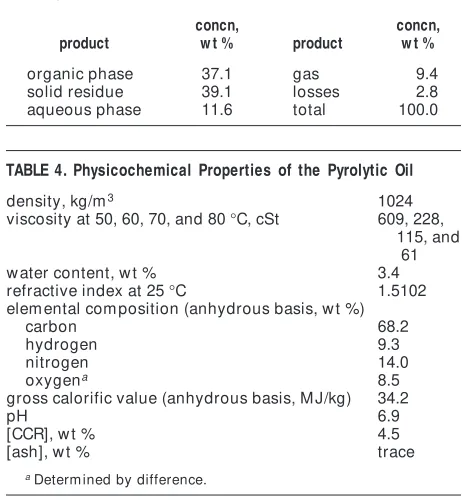
Product Yields. Pyrolysis of th e an im al flou r sam p le yield ed 37.1 wt % of an organ ic p h ase called p yrolytic oil, Characterization of the Pyrolytic Oil. Th e p h ysico-ch em ical p rop erties of th e p yrolytic oil are p resen ted in Tab le 4. Th e p yrolytic oil is a d ark an d h igh ly viscou s liq u id (609 cSt at 50°C). Th is is p rob ab ly d u e to th e p resen ce of h igh m olecu lar weigh t waxy m aterials rich in fatty acid s. Du rin g th e th erm al treatm en t of th e an im al flou r, th e waxy m aterials con tain ed in th e p yrolytic oil ob tain ed from p yrolysis of b iom ass. Ph ysicoch em ical p rop erties su ggest th at p yrolytic oil with its low ash con ten t an d its h igh calorific valu e h as th e p oten tial to b e su b stitu ted for d iesel fu els.
A ch rom atogram of th e wh ole oil an d th e m ain com -p ou n d s d etected is sh own in Figu re 3. Th e oil con tain s a large am ou n t of n itrogen ou s an d oxygen ated com p ou n d s.
TABLE 1. Physicochemical Properties of the Feedstock and the Solid Residue
proxim ate analysis (anhydrous basis, w t %)
volatile m atters 67.2 21.5
ash 24.8 56.2
fixed carbon 8.0 22.3
elem ental analysis (anhydrous basis, w t %)
carbon 42.8 31.8
TABLE 2. Metal Content in the Feedstock and the Solid
Residue (mg/kg)a
TABLE 4. Physicochemical Properties of the Pyrolytic Oil
density, kg/m3 1024 elem ental com position (anhydrous basis, w t %)
carbon 68.2
hydrogen 9.3
nitrogen 14.0
oxygena 8.5
gross calorific value (anhydrous basis, M J/kg) 34.2
pH 6.9
[CCR], w t % 4.5
[ash], w t % trace
Th e m olecu lar weigh t ran ges from arou n d 387 for ch olesterol to 182 for p h en ol. Som e h yd rocarb on s are also d etected in th e oil. Th e com p ou n d s d etected b y GC-MS con fer to th is oil a relatively h igh d en sity, a very h igh viscosity, an d a h igh calorific valu e. Th e h igh n itrogen con ten t of th e oil d eter-m in ed b y eleeter-m en tal an alysis is also con fireter-m ed b y GC-MS an alysis.
For exten sive ch aracterization , th e oil was fraction ated u sin g d ifferen t solven ts an d each fraction was an alyzed b y GC-MS. Th e solven ts u sed were p en tan e, tolu en e, d ich loro-m eth an e, eth yl acetate, an d loro-m eth an ol in ord er of in creasin g solu b ility. Th e fraction ation was p erform ed on a silica gel colu m n at a ratio of 1 g of oil/ 40 g of silica gel.
Th e ch em ical com p osition of th e p en tan e fraction , wh ich rep resen ts 4.0 wt % of th e total oil, is rep orted in Figu re 4a. Th e p en tan e d issolves alm ost all of th e h yd rocarb on s con tain ed in th e oil. Th e lowest m olecu lar weigh t h yd ro-carb on id en tified b y GC-MS is u n d ecan e, wh ile th e h igh est is octad ecan e. Th e ch rom atogram exh ib ited m ajor p eaks sim ilar to th ose of a cracked resid u al p etroleu m fraction . Th e cou p led m ajor p eaks corresp on d ed to u n satu rated an d satu rated h ydrocarbon s with th e sam e carbon n u m ber. Peaks with a relatively weak in ten sity are n ot rep orted in th is p ap er. Peak n o. 9, wh ich rep resen ts 11.2 wt % of th e p en tan e fraction , corresp on d s to ch olestad ien e.
Th e tolu en e fraction rep resen ts 3.2 wt % of th e total oil. Th e m ajor com p ou n d s id en tified are d ifferen t in n atu re from th ose id en tified in th e p en tan e fraction . Nitrile com p ou n d s su ch as in d ole, h exad ecan en itrile, an d h ep tad ecan en itrile are p resen t in th e tolu en e fraction in am ou n ts of 11.5, 13.6, an d 15.7 wt %, resp ectively (Figu re 4b ). Peaks corresp on d in g to th e ch olestad ien e are also ob served (13.1 wt %). Oth er m ajor com p ou n d s cou ld n ot b e p recisely id en tified .
Th e ch em ical com p osition of th e d ich lorom eth an e frac-tion , wh ich rep resen ts 30.7 wt % of th e total oil, is p resen ted in Figu re 4c. Th e ch rom atogram of th is fraction exh ib ited th ree m ajor p eaks wh ich corresp on d to fatty acid s an d rep resen t 80.5 wt % of th e d ich lorom eth an e fraction . A relatively sm all am ou n t of p h en ols (2.0 wt %) is con tain ed in th is fraction . Th e fraction also con tain ed 3.9 wt % ch olesterol.
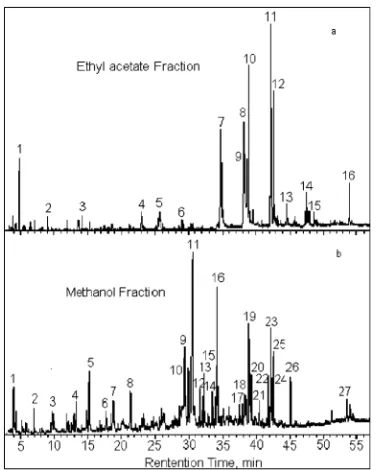
Th e eth yl acetate fraction rep resen ts 19.5 wt % of th e total oil. Th is fraction con tain s a h igh am ou n t of fatty acid s (36.2 wt %) an d th eir corresp on d in g am id es (32.8 wt %) as well as ch olesterol (3.1 wt %) (Figu re 5a).
Th e m eth an ol fraction , wh ich rep resen ts 42.6 wt %, con tain s a large n u m b er of n on id en tified com p ou n d s. Th e m ajor com p ou n d s id en tified are am id es, ald eh yd es, an d keton es (Figu re 5b ).
Characterization of the Aqueous Phase. Th e aq u eou s p h ase ob tain ed d u rin g th e vacu u m p yrolysis was com p osed of 79.5 wt % water an d 20.5 wt % organ ics. Th e p H of th is p h ase is b asic at 9.2, an d its COD (ch em ical oxygen d em an d ) was ab ou t 242700 m g/ L. Th e elem en tal com p osition sh owed th at th e organ ics con tain 40 wt % carb on , 8 wt % h yd rogen , 25.1 wt % n itrogen , an d 26.9 wt % oxygen . Th e oxygen con ten t, wh ich was d eterm in ed b y d ifferen ce, con firm s th e p resen ce of p olar organ ic com p ou n d s in th e aq u eou s p h ase. Th e aq u eou s p h ase is b u rn ab le; it can b e u sed to gen erate en ergy for th e p rocess.
Figu re 6 sh ows th e ch em ical com p osition of th e aq u eou s p h ase as d eterm in ed b y GC-MS. Th e com p ou n d s d etected con tain acid , keton e, ald eh yd e, am id e, an d am in e grou p s. Th e m ain acids iden tified in th e aqu eou s p h ase are p rop an oic (11.3%), b u tan oic (8.9%), an d p en tan oic (2.5%) acid s. Oth er im p ortan t p eaks id en tified are related to p yrrolid in e-d erived com p ou n d s (10%), am id es (12%), am in es (10%), an d p yri-d in e-yri-d eriveyri-d com p ou n yri-d s (7.2%).
Characterization of the Solid Residue.Th e solid resid u e recovered from th e reactor was com p osed of a h ard , easily b reakab le carb on aceou s m ass as well as in d ivid u al p ellets of d ifferen t sizes. Th e form ation of th e h ard m ass is attrib u ted to th e organ ic su b stan ces wh ich m elt p rior to th eir d ecom -p osition d u rin g th e -p yrolysis. Several reaction s occu r d u rin g th e d ecom p osition of th e m elted p rod u cts su ch as crackin g, p olym erization , an d p olycon d en sation , yield in g vap ors,
FIGURE 3. GC-M S chromatogram of the w hole oil: (1) phenol (0.8);
(2) 4-methylphenol (0.6); (3) indole (1.3); (4) 4-methylpiperidine (0.4); (5) pentadecane (0.4); (6) 2-methylpiperidine (0.6); (7) heptadecane (0.8); (9) 4,4-dimethyl-2-imidazoline (4.5); (10) hexadecanenitrile (1.7); (12) hexadecanoic acid (8.1); (13) hexadecenenitrile (1.7); (14) octadecanenitrile (1.5); (15) oleic acid (24.4); (16) octadecanoic acid
(6.4); (17) hexadecanamide (5.6); (18) (Z)-9-octadecenamide (9.7);
(19) octadecanamide (3.4); (20)n-octyl-1-octanamine (1.1); (21) (Z
)-1-(1-oxo-9-octadecenyl)pyrrolidine (0.6);(22) cholesta-3,5-diene (1.8).
FIGURE 4. GC-M S chromatograms of the (a) pentane fraction [(1)
ΣC11 (2.5); (2)ΣC12 (4.9); (3)ΣC13 (8.1); (4)ΣC14 (11.0); (5)ΣC15
(18.0); (6)ΣC16 (7.1); (7)ΣC17 (27); (8)ΣC18 (1.0); (9) cholesterol
benzoate (11.2)], (b) toluene fraction [(1) indole (11.5); (2)
3-methyl-1H-indole (3.1); (3) hexadecanenitrile (13.6); (6) heptadecanenitrile
gases, an d carbon aceou s m aterials. Th e th erm al decom p osi-tion p rocess, wh ich occu rs in th e liqu id p h ase, is called cokin g. Th e p h ysicoch em ical p rop erties of th e solid resid u e are p resen ted in Tab le 1.
Th e solid resid u e con tain s 21.5 wt % volatile m atters an d a large am ou n t of ash (56.2 wt %). Th e gross calorific valu e of th e solid resid u e is con seq u en tly low at 11.5 MJ/ kg. Th e m in eral com p osition of th e solid residu e is p resen ted in Table 2. Th e solid resid u e con tain s th e sam e m etals fou n d in th e
feed stock; h owever, th eir con cen tration h as alm ost d ou b led . Th is is in lin e with th e yield of solid resid u e, wh ich is n early 40 wt %. Th e sp ecific area of th e solid resid u e b efore an d after leach in g is 30 an d 40.1 m2/ g, resp ectively. Th e BET an alysis revealed th at th e solid resid u e h as a m acrop orou s stru ctu re. Th is ch aracteristic is im p ortan t for th e solid residu e if th e latter is u sed as a h u m id ifier (m oistu rizer) m aterial. Leach in g of th e solid resid u e was p erform ed accord in g to ASTM m eth od D 3987-85 (reap p roved 1999). Th e resu lts ob tain ed are p resen ted in Tab le 5. Excep t th e alkalin e an d alkalin e-earth m etals, all th e m etals in vestigated are u n d er th e d etection lim its of th e ICP eq u ip m en t. Th is m ean s th at th e solid resid u e, wh ich was exp osed to leach in g con d ition s, d id n ot release an y h azard ou s h eavy m etals wh ich m igh t p ollu te th e grou n d water or con tam in ate th e soils. On th e con trary, it ap p ears to b e a good fertilizer for soil en rich m en t d u e to its h igh con ten t in NPK (n itrogen , p h osp h oru s, an d p otassiu m ). Th e sp ecific su rface area of th e solid resid u e in creased after leach in g (44 m2/ g versu s 35 m2/ g) d u e to th e red u ction of m in eral com p ou n d s wh ich are m ixed with th e carb on aceou s m atrix.
On th e b asis of th e ch aracteristics p resen ted in Tab les 1, 2, an d 5, th e u se of th is solid resid u e as a sin gle fu el in b oilers is q u estion ab le. However, it is b elieved th at th is resid u e can b e cofired with coal, n atu ral gas, refin ery fu el gas, or oil as a su p p lem en tary fu el in fired kiln s. A m od ern cem en t p lan t con su m es 60-90 ton s of p etroleu m coke p er 1000 ton s of cem en t (14). Use of MBM-d erived solid resid u e in cem en t kiln s cou ld p rovid e an econ om y of coke of ab ou t 20-30 ton s p er 1000 ton s of cem en t. Th e n atu re an d th e levels of con cen tration of th e m etals p resen t in th e solid residu e sh ou ld n ot rep resen t a m ajor p rob lem for th e cem en t q u ality. Th e n itrogen oxid es (NOx) form ed d u rin g th e com b u stion of th e solid resid u e in th e cem en t kiln can b e con verted b y th e m in erals of th e cem en t in to n eu tral m olecu lar n itrogen (15, 16). Altern ative rou tes for th is resid u e are as a fertilizer, a m oistu rizer, an ad sorb en t, or a filler for road b itu m en .
Du rin g a su b seq u en t lab oratory exp erim en t, th e com -b u stion at h igh tem p eratu re (1100-1250°C) of b oth th e solid resid u e an d th e feed stock gen erated rou n d ed an d sm ooth ligh tweigh t aggregates. Th is m aterial exh ib ited a h igh com -p ressive stren gth an d a very low water ab sor-p tion ca-p acity. Th is fin d in g su ggests th at a p oten tial ou tlet for su ch aggregates cou ld b e in th e m an u factu re of a sp ecial con crete. Vyn cke et al. (17) an d Wain wrigh t (18) h ave obtain ed syn th etic ligh tweigh t aggregates b y con version of waste m aterials rich in m in erals, su ch as sewage slu d ge an d p u lp an d p ap er slu d ges.
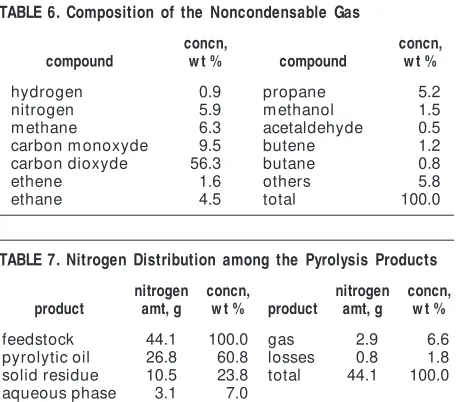
Characterization of the Gas. Th e gas com p osition is p resen ted in Tab le 6. A h igh con ten t of carb on d ioxid e (56.3 wt %) is ob served . Th e average m olecu lar weigh t of th e p yrolytic gas is 30.5, an d its calorific valu e is ap p roxim ately 12.9 MJ/ kg. Th e calorific valu e of th e gas allows it to b e u sed as a m akeu p h eat sou rce for th e p yrolysis p rocess itself or for th e feed stock d ryin g u n it. Th e ch em ical com p osition d eterm in ation of th e p yrolytic gas h as b een p erform ed b y GC-MS. No NH3, NOx, or an y organ ic n itrogen was d etected in th e gas p h ase. Th e n itrogen fou n d in th e gas was in th e m olecu lar form (N2). Th is can b e exp lain ed b y th e oxid ation /
FIGURE 5. GC-M S chromatograms of the (a) ethyl acetate fraction
[(1) acetic acid, butyl ester (2.0); (2) phenol (0.6); (3) 3-methyl-2,5-pyrrolidinedione (0.9); (4) 3-methylcyclohexanone (1.9); (7) hexa-decanoic acid (10.6); (8) oleic acid (18.9); (9) octahexa-decanoic acid
(16.6); (10) octadecanamide (10.0); (11) (Z)-9-octadecenamide (14.3);
(12) dodecanamide (18.5); (14) 9-octadecenoic acid,
2-hydroxy-1-(hydroxymethyl)ethyl ester (3.5); (15) 1-(1-oxo-9-octadecenyl)-(Z
)-pyrrolidine (0.8); (16) cholesterol (31)] and (b) methanol fraction [(1) acetamide (2.1); (3) 3-methylbutanamide (1.7); (5) piperidinone (5.5); (6) 5-methyl-2,4-imidazolidinedione (0.5); (7) methylpyrazine 1-oxide (3.2); (8) quinuclidine (0.6); (10) heptanol (4.3); (12)
2,5,5-trimethyl-1,3-cyclohexanedione (18.4); (19) hexadecanamide (4.4); (23, 24) (Z
)-9-octadecenamide (6.4); (25) dodecanamide (3.1)].
FIGURE 6. GC-M S chromatogram of the aqueous phase: (1)
propanoic acid (11.3); (2) 2-(dimethylamino)ethanol (8.1); (3) 2-me-thylpropanoic acid (3.1); (4) acetamide (7.1); (5) 2-methylpyridine
(5.3); (6) butanoic acid (5.8); (7)N-methylacetamide (1.5); (8)
1,3-propanediol (2.6); (9) 2-furanmethanol (2.6); (10) pentanoic acid (2.5); (11) 2-methylpropanamide (3.3); (12) phenol (1.5); (13) pyridinamine (1.9); (14) 2-pyrrolidinone (1.8); (15) 1-pyrrolidinecarboxaldehyde (8.2); (16) isoimidazolidinedione (5.2); (21) 4,4-dimethyl-2-imidazoline (6.7); (22) 3,5-dimethoxyphenol (1.8).
TABLE 5. Metal Content in the Leachates from the Solid Residue (mg/kg)
K Na P M g Ca Cr M n Fe V Ni
529 194 26 0.13 0.3 <dl <dl <dl <dl <dl
Cu Zn Cd Pb Ti Co As Se M o Al
red u ction m ech an ism s wh ich were p rop osed b y Zh ao et al. (16) for th e NO red u ction over a carb on aceou s solid d op ed with calciu m an d iron catalysts.
Th e n itrogen b alan ce p resen ted in Tab le 7 in d icated th at 84.6 wt % of th e n itrogen con tain ed in th e feed stock was recovered in th e oil an d th e solid resid u e. Th e rem ain in g n itrogen is d istrib u ted in th e aq u eou s p h ase (7.0 wt %) an d th e n on con d en sab le gas (6.6 wt %), losses accou n tin g for th e rem ain in g 1.8 wt %.
Final Rem arks.Th e p resen t stu d y revealed th at vacu u m p yrolysis can b e an in terestin g op tion for th e d isp osal of waste an im al MBM. Th e stu dy revealed th at th e op tion “waste to en ergy” is worth b ein g con sid ered . Th e p rocess gen erated oil, gas, a solid resid u e, an d an aqu eou s p h ase. Th e oil, wh ich exh ib its a h igh h eatin g valu e of 34.2 MJ/ kg, can b e u sed alon e or m ixed with p etroleu m p rod u cts as a fu el in b oilers or gas tu rb in es. However, th e p resen ce of n itrogen ated com p ou n d s m ay cau se som e en viron m en tal p rob lem s if th e oil is u sed alon e. Th e com p lex ch em ical com p osition of th e p yrolysis oil allows it to b e p oten tially u sed for variou s ap p lication s, for exam p le, as a soften er for p olym er p rocess-in g an d as an ad d itive for th e fab rication of well d rillrocess-in g m u d . Th e gas with its calorific valu e of 12.9 MJ/ kg an d th e b u rn ab le aq u eou s p h ase can b e cofired to p rovid e h eat to th e vacu u m p yrolysis reactor. Th e solid resid u e can b e u sed as a fertilizer, a m oistu rizer, an ad sorb en t, a filler for road b itu m en , or a solid fu el in cem en t kiln s.
Acknow ledgments
We th an k Alex Cou tu re In c. (Ch arn y, Qu e´b ec, Can ad a) for p rovid in g th e an im al flou r sam p le. Th an ks are also d u e to Dr. A. Sch werd tfeger for reviewin g th e p ap er an d to Mrs. M. Gin gras an d Mrs. J. Lagace´ for th e lab oratory work.
Literature Cited
(1) Gu illou et, S. Des farin es an im ales b ien en com b ran tes.En viron . Tech.2001,206, 16.
(2) McDon n ell, K.; Desm on d , J.; Leah y, J. J.; Howard -Hild ige, R.; Ward , S.En ergy2001,26, 81.
(3) Betti-Cu sso, M. Le scan d ale d es farin es folles.Figaro Mag.2002, Ju n e 8, 62.
(4) Rizet, D. Elim in ation d es frain es an im ales: Qu in ze p rojets en lice.Figaro Mag.2002, Ju n e 8, 68.
(5) Roy, C.; Ch aala, A.; Darm stad t, H.J. An al. Ap p l. Pyrolysis1999, 51, 201.
(6) Roy, C.; Ch aala, A.Resou r., Con serv. Recycl.2001,32, 1. (7) Roy, C.; Blan ch ette, D.; d e Cau m ia, B.; Du b e´, F.; Pin au lt, J.;
Be´lan ger, E.; Lap rise, P.In du strial Scale Dem on stration of th e Pyrocylin gTMProcess for th e Con version of Biom ass to Biofu els an d Ch em icals; 1st World Con feren ce an d Exh ibition on Biom ass for En ergy an d In d u stry, Sevilla, Sp ain , Ju n e 5-9, 2000; Jam es
& Jam es: Lon d on , 2000; p 1032.
(8) Bou ch er, M. E.; Ch aala, A.; Roy, C.Biom ass Bioen ergy2000,19, 337.
(9) Bou ch er, M. E.; Ch aala, A.; Pakd el, H.; Roy, C.Biom ass Bioen ergy 2000,19, 351.
(10) Roy, C. Treatm en t of Petroleu m -Derived Organ ic Slu d ges an d Oil Resid u es. US Paten t 4,839,021, 1989.
(11) Roy, C. Treatm en t of Au tom ob ile Sh red d er Resid u e b y Vacu u m Pyrolysis. US Paten t 5,451,297, 1995; Eu rop ean Paten t Claim 588,814 B1, 1995; Can ad ian Paten t 2,045,254, 1998.
(12) Ch en , X.; Jeyaseelan , S.J. En viron . En g.2001, 585. (13) Nam 1, C. M.; Gib b s, B. M.Fu el2002,81, 1359.
(14) Howard , M.; Fein tu ch an d Ken n eth , M. Negin . FW. Delayed -Cokin g Process. In Han dbook of Petroleu m Refin in g Process, 2n d ed .; Meyers, R. A., Ed .; McGraw-Hill: New York, 1996; p 63. (15) Tsu b ou ch i, N.; Oh tsu ka, Y.Fu el2001,81, 1423.
(16) Zh ao, Z.; Li, W.; Li, B.Fu el2002,81, 1559.
(17) Vyn cke, J.; Desm yter, J.; De Vos, M.Use of Dredgin g Slu dge as Secon dary Raw Material for th e Man u factu rin g of Ligh tw eigh t Aggregates; Belgian Bu ild in g Research In stitu te (BBRI), Belgiu m In ge Goem aere, SILT n .v.; BBRI: Belgiu m , 1999; p 481. (18) Wain wrigh t, P.In n ovative Rotary Kiln Tech n ology to Recycle
W aste In to Syn th etic Aggregate, BRPR-CT98-5234; Hazel Pex-ton : Stafford sh ire, U.K., 1998.
ES026346M
TABLE 6. Composition of the Noncondensable Gas
compound
concn,
w t % compound
concn, w t %
hydrogen 0.9 propane 5.2
nitrogen 5.9 m ethanol 1.5
m ethane 6.3 acetaldehyde 0.5
carbon m onoxyde 9.5 butene 1.2
carbon dioxyde 56.3 butane 0.8
ethene 1.6 others 5.8
ethane 4.5 total 100.0
TABLE 7. Nitrogen Distribution among the Pyrolysis Products
product
nitrogen amt, g
concn, w t % product
nitrogen amt, g
concn, w t %
feedstock 44.1 100.0 gas 2.9 6.6
pyrolytic oil 26.8 60.8 losses 0.8 1.8 solid residue 10.5 23.8 total 44.1 100.0 aqueous phase 3.1 7.0

![FIGURE 4. GC-(18.0); (6)M S chromatograms of the (a) pentane fraction [(1)ΣC11 (2.5); (2) ΣC12 (4.9); (3) ΣC13 (8.1); (4) ΣC14 (11.0); (5) ΣC15 ΣC16 (7.1); (7) ΣC17 (27); (8) ΣC18 (1.0); (9) cholesterolbenzoate (11.2)], (b) toluene fraction [(1) indole (11.5); (2) 3-methyl-1H-indole (3.1); (3) hexadecanenitrile (13.6); (6) heptadecanenitrile(15.7); (8, 9) cholesta-3,5-diene (13.1)], and (c) dichloromethanefraction [(1) phenol (1.1); (2) 4-methylphenol (0.9); (4) hexadecaneni-trile (1.6); (5) hexadecanoic acid (17.8); (7) oleic acid (47.8); (8)octadecanoic acid (14.9); (10) cholesterol (3.9)].](https://thumb-ap.123doks.com/thumbv2/123dok/3621667.1793677/4.612.93.275.41.183/chromatograms-cholesterolbenzoate-hexadecanenitrile-heptadecanenitrile-dichloromethanefraction-methylphenol-hexadecanoic-octadecanoic.webp)