commit to user
i
A CONTENT ANALYSIS ON ENGLISH FOR VOCATIONAL HIGH
SCHOOL III FOR STUDENTS OF VOCATIONAL HIGH SCHOOL
KURNIASARI
K2209052
THESIS
Submitted to Teacher Training and Education Faculty of Sebelas Maret
University to Fulfill One of the Requirements for Getting the Undergraduate
Degree of Education in English Department
ENGLISH EDUCATION DEPARTMENT
TEACHER TRAINING AND EDUCATION FACULTY
SEBELAS MARET UNIVERSITY
SURAKARTA
commit to user
iii
ABSTRACT
Kurniasari. K2209052. A CONTENT ANALYSIS ON ENGLISH FOR VOCATIONAL HIGH SCHOOL III FOR STUDENTS OF VOCATIONAL
HIGH SCHOOL. Thesis, Surakarta: Teacher Training and Education Faculty of
Sebelas Maret University, 2013.
This research reports an evaluation of the materials and tasks displayed in the textbook entitled English for Vocational High School III designed for the third grade students of vocational high school. The criteria of evaluation is based on the compatibility of the tasks or materials with Kurikulum Tingkat Satuan Pendidikan (KTSP) and the level of communicativeness of the tasks on the textbook based on the types of communicative activities proposed by the experts.
The method used in this study is a descriptive method which refers to the documentary analysis. The study was conducted from January to December 2013. The data of this study is all the tasks in the textbook, English for Vocational High School III, used by the third grade students of vocational high school, which is written by Yiyis Krisnani and published by LP2IP Yogyakarta. The study data were collected by using documentation as the instrument of the collecting data. The techniques of analyzing the data on the textbook involve organizing and familiarizing, coding and reducing, and interpreting and representing as proposed by Ary, et. al (2010: 481).
The result of the study shows that 14 out of 21 (66.67%) indicators demanded by the curriculum are developed in this textbook and 5 out of 16 (41.67%) types of communicative activities are developed. It displays most of all the materials needed for each basic competence, such as business letters, technical documents, report, etc. However, not all of the indicators in each basic competence are developed. Almost all of the tasks in this textbook are classified as pre-communicative activities, among the communicative activities proposed by Littlewood (1981), which focus on the structure of the language. It means that teachers who use this textbook as material source need to add or modify the task so that all the indicators demanded by the curriculum are achieved. Teachers can use this textbook as source of communicative activities in preparatory stage since most of the activities are categorized as pre-communicative activities. Teachers, therefore, should modify or create communicative activities to achieve.
commit to user
vi
MOTTO
“So which of the favors of your Lord would you deny?”
commit to user
vii
DEDICATION
This thesis is dedicated to:
My beloved Mom
My teachers in vocational high school
commit to user
viii
ACKNOWLEDGEMENT
Alhamdulillahirabbil’alamin. In the name of Allah, the Most Gracious and the Most Merciful, all praises and thanks are only for Allah SWT, who gives
His blessing and help so that the writer can accomplish her duty to finish the
thesis as a partial requirement for achieving the Undergraduate Degree of
Education in English of Teacher Training and Education Faculty of Sebelas Maret
University.
The writer realizes that this thesis could not be accomplished without the
help, and support of many people who have been involved in the process of
finishing this writing. Therefore, the writer would like to express her deepest
gratitude and appreciation to the following individuals and institutions:
1. Prof. Dr. M. Furqon Hidayatullah, M. Pd., the Dean of Teacher Training and
Education Faculty; writer’s younger brothers for their support;
7. The writer’s dearest friends for their caring, love, support, and help;
8. The writer’s lovely friends in the English Education Department 2009 for
unforgettable moment and experience during our study;
commit to user
ix
The writer also realizes that this thesis is still far from perfection.
Therefore, she appreciates and accepts any suggestion, criticism, and comments
from those who concern on this thesis. However, she hopes that this thesis will be
able to give contribution and benefit for the readers, especially for those who are
interested in the similar study.
Surakarta, January 2014
The writer
commit to user
APPROVAL OF CONSULTANTS iv
APPROVAL OF THE BOARD OF EXAMINERS v
LIST OF ABBREVIATIONS xiii
LIST OF APPENDICES xiv
commit to user
xi
3. Syllabus of English Subject 12
C. Communicative Activities 13
1. Communicative Competence 13
2. Communicative Language Teaching 17
3. The Role of Materials in Communicative Language
Teaching 17
4. Definition of Communicative Activities 18
5. Criteria of Communicative Activities 19
6. Kinds of Communicative Activities 19
D. Content Analysis 22
1. Definition of Content Analysis 22
2. Function of Content Analysis 22
CHAPTER IV RESEARCH FINDINGS AND DISCUSSION 27
A. The Description of the Textbook 27
B. The Compatibility of the Tasks with the Curriculum 29
C. The Level of Communicativeness of the Tasks 61
D. The Result of the Analysis 71
E. Discussion 73
CHAPTER V CONCLUSION, IMPLICATION, AND SUGGESTIONS 76
A. Conclusion 76
B. Implication 77
C. Suggestion 77
commit to user
xii
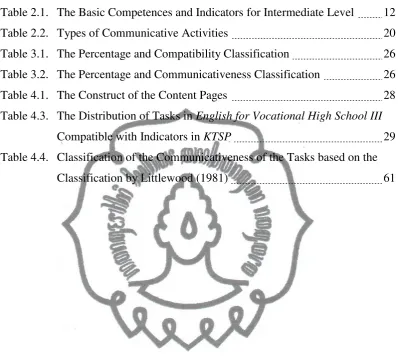
LIST OF TABLES
Table 2.1. The Basic Competences and Indicators for Intermediate Level 12
Table 2.2. Types of Communicative Activities 20
Table 3.1. The Percentage and Compatibility Classification 26
Table 3.2. The Percentage and Communicativeness Classification 26
Table 4.1. The Construct of the Content Pages 28
Table 4.3. The Distribution of Tasks in English for Vocational High School III
Compatible with Indicators in KTSP 29
Table 4.4. Classification of the Communicativeness of the Tasks based on the
commit to user
xiii
LIST OF ABBREVIATIONS
C : Chapter
T : Task
P : Page
SMK : Sekolah Menengah Kejuruan
commit to user
xiv
LIST OF APPENDICES
Appendix 1 The Syllabus of English for SMK 81
Appendix 1 The Content of the Textbook 86
Appendix 2 Coding 87
Appendix 3 Analysis of Compatibility of the Tasks with KTSP 88