A STUDY OF BILINGUAL EDUCATION AND COMMUNICATIVE COMPETENCE AT JUNIOR SECONDARY SCHOOL
Refi Ranto Rozak
Fakultas Bahasa dan Seni (FPBS) Jurusan Pendidikan Bahasa Inggris IKIP PGRI Bojonegoro
E-mail: [email protected]
Abstract:
The concern of the paper is the bilingual education conducted at SMP Negeri I Bojonegoro. The study attempts to investigate and to find out the research problems dealing with the
influence of bilingual education on students’ speaking English competence, communicative
environment motivating students to have awareness to speak in English, bilingual methodology in the classrooms, and the impediments encountered by the teachers and students in employing bilingual learning. The research design of the study is descriptive qualitative using triangulation technique in collecting the required data. The population is seventh and eighth graders students of SMPN 1 Bojonegoro in the academic year of 2013/2014. Meanwhile, the theoretical samples of the study are taken based on the use of bilingual across subject contents (sciences and mathematics) at year VII A and VIII A. The result of the study shows that the program raises the students’ and teachers’ awareness in bilingual education as it is used in specific contents subject. It consequently enhances the motivation for foreign language learning.
Keywords: Bilingual Education, Communicative Competence.
The use of foreign language at school arouses the implication on how to use the target language among the school community, in this instance teachers and students. It means that they attempt to learn a new language, a new culture, a new way of thinking, feeling, and acting (Brown 1994: 1). It has been known that speaking more than one language naturally
has occurred in every human social interaction including at school background. Becoming bilingual or multilingual brings them into a most wanted condition in which they can apply both their first and foreign languages to share the ideas and feelings especially at classroom instruction.
Due to the importance of this issue, English curriculum is outlined nationally. The curriculum covers, for example, how this subject should be taught and what materials should be used. In the curriculum, more teaching hours for this subject are offered in accordance with the level of the schools (e.g. lower secondary and upper secondary) and the grade (e.g., grade one, two, or three). However, some believe that ELT (English Language Teaching) curriculum is too rigid which may lead to predicament in its implementation in the classroom (Jazadi, 1999a).
The curriculum 2006 or KTSP (Kurikulum Tingkat Satuan Pendidikan) is nearly indistinguishable in giving English instruction. This curriculum is intended to construct written and spoken competence
discourse. The recent curriculum based on literacy is more detail and focused on illustrating the competency. It is specifically described by mentioning speech act and selecting kinds of text according to the competency needs to be achieved without obviously mentioning the theme.
culture using English. Hence, the most important function of English learning is a means of communication as a part of gaining the information.
Related to the objective of curriculum based literacy that English instruction at school must be able to enhance students‟ literacy both spoken and written competency by integrating linguistic and socio-cultural competency (Alwasilah, 2005) so that learning foreign language is believed as a strategy of acquiring their target language, so school environment has a significance role to the success of learning foreign language. A school is considered as a system in transforming the sciences including language. Collective efforts taken to prevailing educational goals in the school will be effective if they are mutually aware of the roles they play (Khoironi, 2000).
Many years the learners have got to know the experiences in obtaining knowledge in form of teacher‟s instruction including in learning English but they got nothing holistically. English in Indonesia schools is a ”dead language” for most students since written language has been more emphasized rather than spoken language (Johnson, 1999). In the context of learning language acquisition and understanding, they are driven to learn written English not to involve them to use it as a medium of communication.
Learning English as the foreign language is not easily achieved by doing assessment correctly according to the specified measurement in form of written discourse. But it needs to be developed how the students are able to use it as a means of communication. In line with the argument, Khoironi (2000) has annotated that English learning acquisition can be enhanced by being aware of the nature of language as a means of communication and a tool to pursue knowledge. Failures have found several decades related to the success of mastering English at schools.
They can be the failures of educational system, the school management, teachers‟ competency of pedagogy, the students‟ response in learning, supporting learning linguistic
environment and much more. Meanwhile, the bilingual learning is keeping maintained for years as a solution in teachers‟ classroom instruction.
It has been a trend in Indonesia to find schools with bilingual program, meaning applying the use of two languages in teaching a content subject. Cummins (2000) states from data of four other experts that there is a tendency the bilingual program students obtained better achievements than those in monolingual program. In the context of the Indonesian multilingual society, where English is taught as a foreign language (EFL), such bilingual program has become a significant breakthrough, encouraging the use of English in non–English subjects (known as subjects across curriculum).
In advent of the so-called Kurikulum Tingkat Satuan Pendidikan (KTSP), which was reported in early 2006, it would be judicious to make available more understanding on language learning strategies, one of which is by applying bilingual programs to enhance the understanding of students, who experience barriers to use L2 to convey their ideas in L1, especially in the multilingual society of Indonesia. The KTSP curriculum enables the existence of “subjects across curriculum”, like English across curriculum.
RESEARCH METHODOLOGY
The design of the study report on this article is descriptive qualitative using triangulation technique. It was successfully conducted in March 2014. This study merely attempted to observe and to describe bilingual education and communicative competence conducted at SMP Negeri I Bojonegoro in the academic year of 2013/2014 dealing with: 1) Bilingual education influencing students‟ speaking English competence; 2) Communicative environment motivating students‟ to have awareness to speak in English; 3) Bilingual methodology in the classrooms; and 4) The obstacles encountered by students and teachers at SMP Negeri I Bojonegoro in applying bilingual program.
Subject of the Study
The article accentuated on bilingual program which was applied at classroom context. The content area teachers provided the significant information dealing with the use of bilingual. In teaching and learning, SMPN 1 Bojonegoro classes utilize the bilingual both Indonesian language and English to deliver the crucial subject matter contents namely mathematics and sciences. Content and language integrated learning or English across curriculum is the medium of instruction obliged at SMPN 1 Bojonegoro. The students of SMPN 1 Bojonegoro year VII and VIII were the research population. Year VII divided into three classes, VII A, B, and C. Year VIII has three classes, VIII A, VIII B, and VIII C. Meanwhile, the research focus consisted of VII A and VIII A. Both consisted of 24 students only and it is the standard requirement of students‟ capacity stipulated by the bilingual classrooms.
Data and Data Source
The data are bilingual education on students‟ speaking English competence, communicative environment motivating students‟ to have awareness to speak English, bilingual methodology which was delivered in the classroom, and also the obstacles encountered by students and teachers at SMP Negeri I Bojonegoro in applying bilingual program. Here are the details of the data and the data sources: 1)
The data of bilingual education influencing students‟ speaking English competence were obtained from the interview among the English and content area teachers, English development teacher, and also school management, classroom observation, students‟ questionnaire, and students‟ speaking test; 2) The data of communicative environment motivating students‟ awareness in speaking English were also obtained from the interview among students, school management and teachers of SMPN 1 Bojonegoro, observation of students‟ attitude on bilingual learning, and students‟ questionnaires; 3) The data of bilingual methodology were obtained from classroom observation, interview among research population teachers, and teachers‟ questionnaire; and 4) The data of bilingual learning problems encountered by the teachers and students of SMPN 1 Bojonegoro were obtained from classroom observation, the interview among teachers and students, the questionnaires both teachers and students.
Data Collection Procedure
The advantage of using triangulation is to know the data obtained convergent, inconsistent or contradictory. Hence, using triangulation in data gathering obtained will be more consistent, completed and determined. It is in line with Patton (1990) that through triangulation the writer can build the strengths of each type of data collection while minimizing the weakness in any single approach. If contradictory finding emerge or researcher find negative cases, the investigators most likely will need to study the phenomenon further.
Data Analysis Technique
In analyzing the data obtained, the writer used the following points:
1) The interview among the English and content area teachers, English development teacher, and also school management.
non-test instrument in addition to participant observation. The interview technique was applied to get hold of the data based on the domain of the research. Structured and unstructured interviews were recorded using tape recorder and field notes.
2) Observation of Students‟ attitude on bilingual learning.
Another triangulation instrument that came along the classroom observation was checklist of students‟ attitudes toward the use of bilingual at classroom. The purpose is to know students‟ enthusiasm on bilingual learning that was being conveyed by the teachers of subject content matters– sciences and mathematic in classes. The writer portrayed the evaluation indicators consisting of students‟ attention to the lesson, their participation actively in the class, the students understanding on the lesson conveyed, and soon. The evaluation was based on the criteria given as follows:
(1) Low, meaning that less than 50% students in the class are involved. (2) Average, meaning that 50%-75%
students in the class are involved. (3) High, meaning that more than 75%
students in the class are involved.
FINDINGS
English use at SMP Negeri I Bojonegoro
The use of English at SMP Negeri I Bojonegoro was little bit different to others. English as a subject matter perhaps is commonly taught at schools starting from primary to middle schools around Indonesia as a foreign language but Bilingual program promoted by SMP Negeri I Bojonegoro can not be separated by the efforts taken by the school in developing the school quality. English has been used and considered both as a subject matter and medium instruction at classrooms. It also useful bridges the school community interacting each other in daily activities. So, it is not only restricted at classrooms context but English-speaking milieu within the school and other technological instructions.
Exposure, Support and Engagement to English
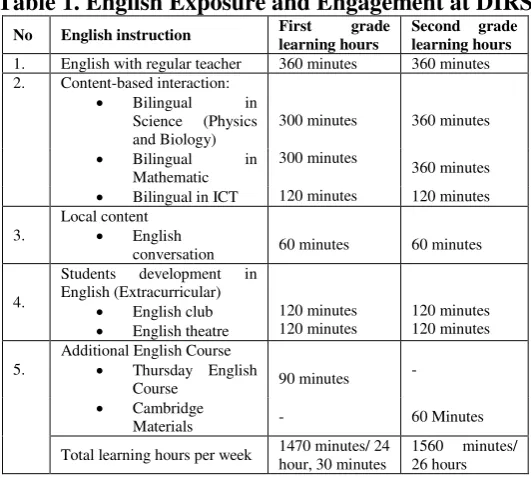
The school community at SMP Negeri I Bojonegoro has language awareness and it is implemented through their willingness to learn it. The school management regulates the academic hours
effectively dealing with language development. Meanwhile, they get additional engagement and exposure through English development to improve their English acquisition. The details are
described in Table 1.
Table 1. English Exposure and Engagement at DIRS No English instruction First grade
learning hours
Second grade learning hours
1. English with regular teacher 360 minutes 360 minutes 2. Content-based interaction:
Bilingual in Science (Physics and Biology)
300 minutes 360 minutes
Bilingual in Mathematic
300 minutes
360 minutes Bilingual in ICT 120 minutes 120 minutes
3.
Local content English
conversation 60 minutes 60 minutes
4.
Students development in English (Extracurricular)
English club English theatre
120 minutes 120 minutes
120 minutes 120 minutes
5.
Additional English Course Thursday English
Course 90 minutes
-
Cambridge
Materials - 60 Minutes Total learning hours per week 1470 minutes/ 24
hour, 30 minutes
Based on the table 1, second year students of SMPN 1 Bojonegoro got more exposure and engagement to English than first year students of DIRS (26 hours and 1560 minutes). The students both year VII and VIII learnt English 6 hours a week and they also took the English conversation as a local content. In the same time students got two optional English development, English club and theatre. They might choose these English curricular outside learning hours as an integral school program in accommodating students‟ talents and hobbies in language development. As the optional programs, these were the English development programs offered by school.
In the meantime, the total English engagement and exposure between year VII and year VIII of SMPN 1 Bojonegoro in the academic year of 2013/2014 indicate the significance differences on additional English course. It was realized that the implementation of the school policy, typically, had several effects for students.
Giving English additional courses except either English as a local content and English development is the English specification emphasized on different SMPN 1 Bojonegoro students. The students of year VII got one and a half hour in English course every Thursday as the student of year VIII got one hour only a week focusing on adapted Cambridge materials in English comprising of speaking, listening, reading, and writing.
The Cambridge preparation class was being prepared at year VIII because they are going to take The Cambridge International Examination (CIE) test in science, mathematic, and English. In the beginning, they are going to take English test which is conducted by Cambridge University to obtain an international certificate. The test will be taken when they will be at year IX.
School Integrated System
Dealing with language development, the school had tried to concentrate the school community in one integrated environment. Based on the research
conducted, it could be concluded that the obstacles encountered by the school in developing linguistic environment at are influenced by some factors such as: 1) The school was not well-integrated yet in an English speaking environment, 2) The social interaction were still influenced by the students of regular classes in Bahasa Indonesia, 3) Punishments and rewards in language policy applied were not obvious, and 4) Exclusivity of students who used bilingual in the classrooms.
Additional Testing Instrument: Students’
Speaking Competence.
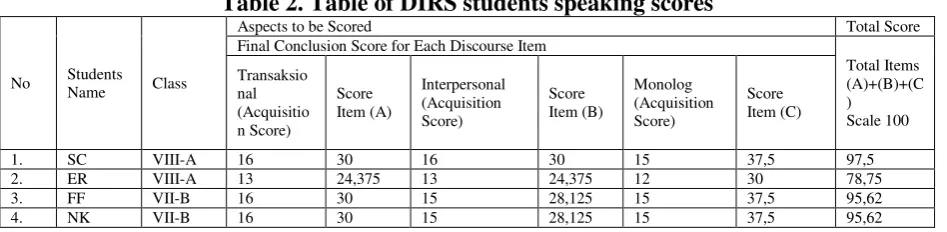
To know the implication of bilingual among year VII A and VIII A students to stimulate their communicative competence, the test of speaking was conducted. The aim of doing this test was to know how far the speaking skill possessed by the students. The communicative competence of the students were expected to be higher than regular ones. Additional learning hours in English content and students‟ development in English outside English learning content in classrooms bring about enhancing students language skill in speaking.
Table 2. Table of DIRS students speaking scores
No Students Name Class
Aspects to be Scored Total Score
Final Conclusion Score for Each Discourse Item
Total Items (A)+(B)+(C )
Scale 100 Transaksio
nal (Acquisitio n Score)
Score Item (A)
Interpersonal (Acquisition Score)
Score Item (B)
Monolog (Acquisition Score)
Score Item (C)
1. SC VIII-A 16 30 16 30 15 37,5 97,5
2. ER VIII-A 13 24,375 13 24,375 12 30 78,75
3. FF VII-B 16 30 15 28,125 15 37,5 95,62
4. NK VII-B 16 30 15 28,125 15 37,5 95,62
Clearly, the speaking test conducted in March 13th and 14th, 2014 indicates that DIRS students‟ communicative competence is satisfying. The test was emphasized on three discourses namely transaksional, interpersonal, and monolog. In transaksional and interpersonal discourses, the students were expected to be able to interact with his or her partner within the social situation given. In this phase, they responded suggestions, giving recommendation, and achieving agreements each other based on the theme or social situation. While the monolog discourse emphasized on students‟ ability in presenting social situation given independently without his or her partner helps. The social situation given in monolog could be students‟ ability in explaining the pictures according to their own words.
Based on the table above, the communicative competence of students year VII A and VIII A were above average. The seven grader students, FF and NK successfully interacted using English with the situation given. Their scores closed to be perfect on scale 100. Their scores were 95, 62. Compared to the other junior high school students, their speaking skill were remarkable. The different speaking test result of second grader students was also shown. SC speaking score was 97, 5 while ER‟s was 78, 75. This contrast speaking test results were based on the different scoring items on each discourse.
Bilingual Methodology
Bilingual methodology in some subject content matters was delivered in various ways. Teachers had their own teaching characteristics including when their lessons must be conveyed using two languages–Bahasa Indonesia and English.
The teachers had to arrange lesson plans as a guideline in teaching learning process before teaching. To be the teachers of bilingual classes they must fulfill several standard criteria and they must teach according to which are being imposed in recent curriculum (KTSP) accordance with National Education Standard–Standar Nasional Pendidikan (SNP)–and also enclose the international characteristics curriculum.
They were qualified and professional teachers. They had got periodical technical guidance from ministry of education and Directorate General of Education. Workshops and education upgrading belong to their professional dedication in cultivating their skills and knowledge in pedagogy world. The urgency of English stipulated as the main foreign language which was taught at VII A and VIII A classes, to become a motivation. 90 % of teachers must be capable in English measurement testing standard in TOEFL > 450 and in term of computer and internet, 90% of them must be literate.
classes and teachers‟ lesson plans that is matched with the nine capabilities in teaching as mentioned in “Petunjuk
Pelaksanaan Praktek Pengalaman
Lapangan (PPL) Keguruan (1998)”.
Bilingual Methodology at Subject
Content Matters (Sciences, Mathematics, and ICT)
The data obtained dominantly was coming from participation observation. Observation checklist of students‟ attitude toward the use of bilingual on each class and checklist for evaluating a teacher‟s lesson was the additional instrument used by the writer when the observation was conducting. Bilingual methodology in physics
In delivering the physics lesson, the teacher started using English in opening. He said, “Assalamualaikum”, then followed by
“how are you today?”, and “any homework?” Later, he used Bahasa Indonesia when he went into the core of the lesson. The observation was occurred at VIII A. The class was conducted indoor and outdoor. Before having outdoor experimental activity, the teacher of physics, Mr. YN explained the theme discussion using Bahasa Indonesia. To the writer he affirmed that his English was „lost‟ and because he could not speak English fluently in discussing the lesson, it would be better if he used Bahasa Indonesia. He was afraid of misunderstanding among students if he drove to use English. He did not want to get rid of the essence of physics. So using
Bahasa Indonesia was considered as the best way in physics class. Sometimes, he added some English sentences.
The students and teachers interaction was generally in Bahasa Indonesia. He could not fluently explain the lesson using English. Bahasa Indonesia was dominant. The students had an experimental activity about kinds of wave. The teacher felt free using Bahasa Indonesia and students easily understood his explanation. Students‟ understanding in physics was teacher‟s consideration in minimizing English in the class. He argued that by using Bahasa Indonesia, they would easier understand the lesson. Some physics terms were difficult to
convey as well because both students and teacher vocabulary in physics were little. But sometime they could express in English instructionally.
Bilingual Methodology in Biology
Biology was one of sciences content taught using bilingual. The observation took place at VII A. The teacher, Mrs. SU was very attractive and talkative. Though she delivered the lesson by herself, she successfully used bilingual to the end of the lesson. The writer observed that she strongly spoke English all the time. Moreover, she repeatedly motivated her students to convey everything in English only. Hence, the students enthusiastically followed her orders in speaking English.
As usual in the first time she opened the class in English and the students greeted her by standing up saying some English greeting. Later, she reminded the students whether there were any homewoks or not in bilingual. The teacher realized that she could not use English well but she tried her best although it was terrible because her English sentences were unstructured and it looked funny. Some students laughed listening to their „indolish‟ English but actually they understood the topic which was being discussed.
The language awareness had come up and it enabled the teacher and students to achieve the target language. Teacher of Biology explained the discussion in bilingual till the time would be up. Finally, she used the remaining time to play a game. In the end, she closed the discussion of the day using bilingual. In bilingual learning at biology class English was often used during the discussion. The teacher as a model of learning influenced whether the class would select English, Bahasa Indonesia, and bilingual as a dominant language which was used during the lesson. If the teacher committed to use English as a dominant language in the teaching learning, the students would do the same thing.
in team teaching. Mrs. TY was the teacher of mathematics and Mrs. AE was the teacher of English. As a subject content teacher, Mrs. TY delivered some mathematics calculation using bilingual. But at first they had to discuss together some material that would be presented with the teacher of English. The English teacher guided the mathematics teacher. She helped her translate some instructional words, mathematic formulas, and arrange the exercises. Uncompleted mathematic paper tests written in English would not be distributed to students unless they truly believed that the structures and the sentences composition were right.
During the observation was happening, the writer concluded that team teaching brought the success of students‟ comprehension in bilingual. The students got an ease being taught with two languages. Moreover they could catch the meaning and the essence of mathematics. In giving assignment the teachers had used bilingual and surprisingly English was very dominant in mathematics class. The teachers always attempted to say everything nearly in English. The data was obtained from participation observation at VIII A.
Bilingual Methodology in ICT (Information and Communication Technology)
The data was obtained from participation observation in ICT laboratory. The observation object was the students of year VII A DIRS. When the writer asked for conducting the observation, the teacher of ICT told that the class would have power point presentation in groups. The use of bilingual in ICT class actually did not appear. Mostly the instruction was in
Bahasa Indonesia. The teacher realized that his English was not quite well. He found difficulties delivering the lesson though using bilingual. Bilingual was only used in opening and closing the discussion.
According to the teacher, the students‟ acquisition in English was better in operating the computer. The language instruction provided by the computer software was dominantly in English so that
they easily understood some English words in computer without translating in Bahasa Indonesia. Generally, the interaction between teacher and students were in
Bahasa Indonesia. English was less emphasized in ICT class because the teacher as a model of bilingual did not effectively commit to use bilingual or English during the discussion.
Additional Bilingual Methodology:
English and Local Content (English Conversation)
Bilingual in English was actually less emphasized. During the classroom observation in English classes (English observation year VII A and year VIII A on March 4th, 2014) and English conversation (EC observation year VII A DIRS on March 24th, 2014) the writer found that mostly teaching and learning English were delivered in English as a medium instruction. Based on the observation in English classes it can be concluded that English was 90% used in the class interaction. Only few students used Bahasa Indonesia in the class. If they got difficulties in conveying some English words or sentence, they hurriedly used bilingual not totally in Bahasa Indonesia.
The students‟ awareness in using English and bilingual was the problem encountered in English class. Sometimes the students were reluctant to precede their friends in speaking English first. They felt ashamed and got bored in the class so that they often began the conversation in Bahasa Indonesia or Javanese.
The role of teacher is very important. In English class–however–the teacher needed to remind or warn whether the students unconsciously use their native, first language, and foreign languages except in English. Reward and punishment were needed to take into account in order that the target language stated could be successfully achieved.
Students’ Attitude Toward the Use of Bilingual at Subject Contents
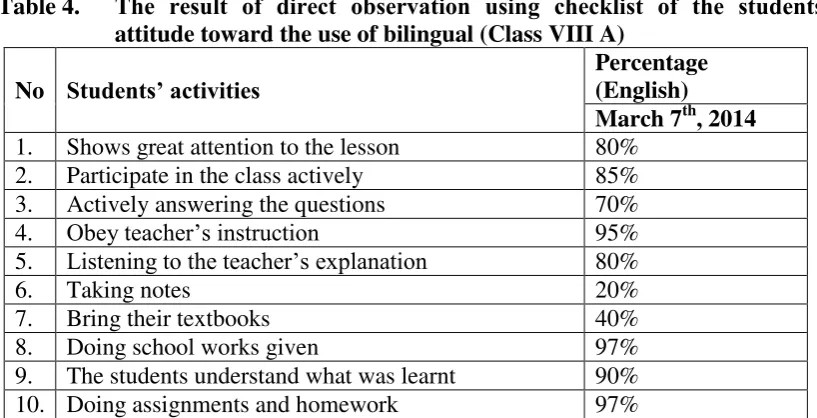
see that the attitudes of the students toward the use of bilingual were high or positive. It
can be seen from the Table 3 and 4 below:
Table 3. The result of direct observation using checklist of the students’ attitude toward the use of bilingual (Class VII A)
No Students’ activities Percentage (ICT)
March 6th, 2014
1. Shows great attention to the lesson 75% 2. Participate in the class actively 50% 3. Actively answering the questions 55%
4. Obey teacher‟s instruction 90%
5. Listening to the teacher‟s explanation 90%
6. Taking notes 20%
7. Bring their textbooks 75%
8. Doing school works given 70%
9. The students understand what was learnt 60% 10. Doing assignments and homework -
Table 4. The result of direct observation using checklist of the students’ attitude toward the use of bilingual (Class VIII A)
No Students’ activities
Percentage (English)
March 7th, 2014
1. Shows great attention to the lesson 80% 2. Participate in the class actively 85% 3. Actively answering the questions 70%
4. Obey teacher‟s instruction 95%
5. Listening to the teacher‟s explanation 80%
6. Taking notes 20%
7. Bring their textbooks 40%
8. Doing school works given 97%
9. The students understand what was learnt 90%
Based on the result of the observation which is presented in the Table 3 and 4, we can see that the students‟ attitude toward the use of bilingual in several subject contents were positive. The appraisal on the basis of researcher‟s point of view as a main instrument toward the use of bilingual in a certain subject content in one class. Generally, the students paid carefully attention on teachers‟ lesson in bilingual. A great attention was shown on each class in which the students were eager to know the lessons.
The Hindrances Encountered in
Bilingual Learning
The foreign language goals (English) stipulated–however–at school platform could not be implemented smoothly. During the research the writer found the obstacles encountered both by students and teachers in applying bilingual across curriculum as follows:
Instructional Materials
According to 46 returned questionnaires distributed to the students of seventh and eight graders, 16 respondents (34, 7%) assumed the instructional materials provided at bilingual classes were difficult. The obstacles encountered in using supportive instructional materials in bilingual could be the terminology used on English subject content books that were difficult to understand. As their English comprehension in scientific terms were poor. On the basis of students comprehension on sciences and mathematics using bilingual as a medium instruction, their availability were not appropriate to standard materials predetermined in international classrooms yet. The school needed to complete the instructional materials especially written English books.
While some others (50% or 23 respondents) argued that instructional materials provided at bilingual classes were not difficult for them. Incompleteness
in instructional materials was not a barrier for them. The had many collection books supporting the directory books provided by the government. After having school mostly students also took additional courses at several Study Center (Lembaga Bimbingan Belajar) across Bojonegoro. The conclusion on students‟ understanding using materials available at bilingual classes was not based on the materials degree of complication but more on the students‟ apprehension on the lesson which was being conveyed using bilingual and materials provided. The teachers‟ credibility and ability in delivering the lessons using bilingual was also considered to influence their understanding on the essence of the lessons using instructional materials.
Mostly the teachers used a directory package comprising of seven books from education department. A little amount of books provided in bilingual classes made the materials used were not longer quite effective. They needed supportive books in sciences and mathematics written in English appropriate to recent curriculum (KTSP) and comparison one (International curriculum in school partnership). Unfortunately, their availability was scarce in books stores. The books for international curriculum mostly written in Bilingual not completely in English. Nevertheless, bilingual books–English and Indonesian language–recently are easily found in the book stores but with respect to scientific English terminology, the teachers–however–preferred to select the teachers‟ science or mathematic directory books written in English or abroad publication not bilingual. Though the English advance level used were quite difficult for students, the teachers believed that it was not a big deal for them.
school structural distribution scheme, news report, and soon were in English. These fasten school efforts in developing foreign language goal as well.
Applied Terminology on Contents
Instructionally, English has been medium instruction and daily communication tool because English contents enrichment which emphasized in communicative competence has been frequently obtained so that teachers and students often speak in English. On the contrary, both the teachers (sciences and mathematic) and students considered that the English terminology used at subject contents were difficult. It could be seen from the questionnaires distributed among VII A and VIII A students (46 respondents) that 32, 6% of samples taken or 15 respondents stated that they did not know what were the teachers saying or explaining related to English used at subject contents (sciences and mathematic). This finding was also supported by the data taken by participation classrooms and questionnaires distributed for teachers. 61, 5% respondents (8 teachers) argued that the students got difficulties in contents terminology.
During the observation the writer revealed some defects in bilingual learning such as the students frequently asked the difficult English terminology in subject contents to the teachers so that it was more time consuming. The essence of learning primary lessons sometimes was ignored because the teachers had to translate them in English or Indonesian language with their teacher partners. Moreover the translation expected results or terminology explanation were not as soon as possible available. They had to look up the dictionaries first. This valuable finding needed to be taken into some consideration by the school to surmount the hindrances in classrooms teaching.
Some further preventive recommendations to make teaching and learning run smoothly at bilingual class
can be 1) Upgrading teachers understanding in specific English terminology used in contents by conducting additional course, 2) Providing related references, such as English dictionaries in sciences and mathematic, English sciences journals, and encyclopedia in contents, 3) Giving additional learning hours in crucial lessons (sciences and mathematic), 4) And good cooperation in team teaching (teacher of contents and English) to solve the problems
Teachers’ Competence in Bilingual
The teachers‟ competence in bilingual influenced the success of bilingual learning. They were as the model of language learning in which the students imitated their teaching style, the language expression used, attitudes, and the most important was knowledge transfer. As the teacher of bilingual classes, they had to be able to use English as a medium instruction at least communicative competence. The teachers of contents (sciences and mathematic) were not obliged learn English in detail. Grammatical mastery was not emphasized for them than their communicative skill in English. It means that speaking skill is highly recommended.
The data obtained from both classroom participation and students‟ questionnaire showed that the ability of teachers teaching using bilingual was quite satisfying and positive. 41, 3% respondents (19 students of VII A and VIII A) revealed that their contents teachers were able to convey the lessons using bilingual. They could understand the contents when the medium instruction was in bilingual. Meanwhile, some others were not quite satisfied and confused on the bilingual learning. 20 respondents (43, 4%) argued that their teachers could not the model of bilingual learning. Their English was poor. This actually determined whether which was more dominant in the classrooms, English or
unbalance bilingual and the dominant language at physics and ICT classes.
In these classes, Bahasa Indonesia
was more dominant than English. Though bilingual was usually stressed on contents not in opening and closing of the discussion but the teachers of ICT and physics were rarely used bilingual in contents. English as instructional medium was also rarely practiced in the classrooms so that the students tended to imitate their Indonesian language spoken teachers. The teachers‟ awareness in using English at communicative level – at least – played an important role on the success of learning English.
CONCLUSION
Bilingual Education at Designated
International Rating School of SMP Negeri I Bojonegoro
The foremost principal of the bilingual education is to develop teaching methodologies that would assist learners to improve their knowledge of and communicative competence in the foreign language and also for preparing them in academic and global challenges. Students and teachers can use a foreign language-English-as a tool in subject contents lessons.
There are two betterment improvements on foreign language paradigm as the bilingual program lead the success of students‟ cognitive acquisition both in English and subject contents matters. Appreciative efforts taken by the school policy in which English was considered as a foreign language obliged to employ on the same level of formal education language-Bahasa Indonesia-in teaching and learning process. One month bilingual research conducted at SMP Negeri I Bojonegoro indicated that the programs raised the students‟ and the teachers‟ awareness of the benefits of a foreign language (English) in bilingual as it was used in subject specific contents. It consequently raised the motivation for foreign language learning.
School‟ support in developing foreign languages was awarding. Being aware that supports in alternative education needed to take into some consideration for the sake of quality education improvement. In developing communicative competence at SMP Negeri I Bojonegoro, the school attempted to promote the foreign language enrichment programs for the school community moreover emphasizing the learning participants, students and teachers. Specifically, the efforts were taken on its school policy as follows. First, there is a strong commitment among the school community on the success of target language goal. Second, the school community willingness and awareness on the commitment goals formulated. Third, the school is promoting innovations to the curriculum design, teaching and learning methods, and evaluations. Fourth, cultivation programs for both teachers and students are quite effective to develop foreign languages capacity. Fifth, the literacy culture covers the school environment so that they are interested in learning and to become it is a need. At last, appreciation, encouragement, reward, and responses as promoted at the school can be perceived as effective support for the development of language education quality.
Bilingual Education Stimulates
Students’ Communicative Competence
both students and teachers communicative competence at subjects contents was not established.
Communicative Environment
Motivating Students’ to Have
Awareness to Speak in English
Generally, English environment at Designated International Rating School has not been created yet. The communicative environment of year VII A and VIIIA students was occurred among their friends in the small scope-classrooms interaction-not totally at school environment. The school readiness in applying English as an academic language at school could not be implemented yet because the students of DIRS were still concentrated with the regular students. The curriculum and management of the school was different to regular class including the policy on language goals taken by the school. The regular students got less emphasis on English development and mostly they rarely used English as a means of communication. Meanwhile, the students of year VII A and VIII A were expected to use English in their social interaction either in the classrooms or in school milieu.
Based on the writer observation, motivation in using English came up among year VII A and VIII A students when they were in the classrooms. The awareness in using English or bilingual (English and Indonesian language) in the classrooms is the reasonable fact because they were encumbered by the prestigious status as the international school students in which at least they had to be able to speak international language (English). This assumption leads the students‟ motivation in learning English and positively ascertains that they were more qualified and talented than their regular friends.
Bilingual Methodology in the
Classrooms
Varied bilingual methodology was clearly described at several subject contents matters classes. The teaching of bilingual gave the experiences both teachers and students in learning English. Therefore, the concern of the bilingual research in the beginning was focused on contents (sciences and mathematic). In English class, bilingual was less emphasized since the students‟ communicative competence had been well-formulated. English has been medium instruction and communication.
It was in contrast to sciences and mathematics. The bilingual was highly stressed and different teaching methodology was applied by the teachers of sciences and mathematics. The teachers of mathematics and biology made use of bilingual methodology in their classes. English and Indonesian language were delivered in balance. Consequently, the students understood the essence of terminology used in the contents. Meanwhile, the physics and ICT teachers‟ ability in delivering subject contents were lack of English exposure. The use of first language was obviously dominant. Still, they considered that the students‟ comprehension in the essence of contents were more important than bilingual learning. They did not force themselves to use bilingual as their English communicative competence were poor.
RECOMMENDATION
the success on language improvement in bilingual education, the writer gives some recommendations as follows:
Educational Department
The government under the education department should include the bilingual education in English curriculum. The teaching of bilingual across subject contents can be started at junior high school level because the students‟ linguistic development has been well-formulated. In year two of junior high school, they can enhance their English using bilingual. But the foreign language goal must be clearly stipulated on school annual programs. In year three they are expected to achieve communicative competence in which dealing with learning English they can speak English fluently in daily interaction. In the meantime, in the classrooms they can maintain the bilingual program as a good program and minimizing the use of first language in bilingual learning.
The school management
The school management plays an important role on the policy of language development. In order to be implemented well, the bilingual program must be kept maintained. The school has to provide special strategies and materials for dealing with problematic encountered. Here are some aspects which need to take into account:
Teacher Training
The teachers who are teaching subject contents using bilingual must obtain specific English terminology course training or workshops gradually to enhance their comprehension on their academic background. It is hoped that in the long term they do not rely on their English teacher partners in team teaching and independently is able to arrange the lesson plans and teaching preparation in English.
Materials
The school has to carefully pay attention on the needs and motivation of the students. They learn more easily and
are more interested if the topics are interest of them. Let them decide the easiest topics discussion freely as long as they are in line with the curriculum. In addition, the students can get the access on the availability of the international scientific journals and references books written in English.
Financial Supports
An innovative program requires additional costs than the traditional one. Improvements of school foreign language proficiency are not cheap and they need a lot of money for operational fee. The school must anticipate this. A well-established and well-funded school commonly allocates their budget to pay some programs dealing with the success of the program such as additional English course, providing the up-date books, comparison study, hiring native teachers and much more to improve its managerial and educational quality.
The Teachers
In teaching bilingual, the teachers are able to combine teaching the language competence and the contents of a subject together. They can use new learning strategies to make the bilingual learning is understandable and also involve the students to actively take part in. They can use self-directing learning and learning by doing. In terms of the interest of the students in order to make them more independent, self-directing learning let the students decide what they want to do or learn. They have the chances to choose from a variety of materials they can discover and explore and so take the responsibility for their learning process themselves. Consequently, teachers are no longer the only centre of knowledge. The focus of the teacher‟s work is here more on preparation, planning, and organization of the learning process.
they can choose in which order they want to do their exercises and sometimes even the topic, they want to work on. So, they find out about their individual learning speed, their difficulties and their strengths. They can learn the theories and their application in daily life. That is meant by CTL (Contextual Teaching and Learning) in which they get together in group discussion and solve the problems in real meaningful activities.
The Learners
Bilingual learning is regarded as a new learning strategy applied in schools. The effort is taken to repair the language education defects that have happening for years in our language curriculum. A language must be considered as a tool to share and express someone‟s ideas, thought, and feeling. It is not only learned as a subject lesson but more than emphasizing for communication. But the policy in developing a foreign language can be success if the learners as the subjects of learning can totally aware their role.
They must have a strong motivation and willingness on the success of the learning. Encouragement and moral support will positively assist them on the importance of language. If they think that it is an urgent need and be a part of their responsibility in determining their better future, they will strongly achieve the language goal.
Bibiografi
Alwasilah, A. Chaedar. 2005. “Kurikulum Berbasis Literasi.” Pikiran-Rakyat
23 June 2005. Accessed on
http://www.pikiranrakyat.com/printe d/2005/0105 /25/0801.html
Brown, H. Douglass. 1994. Principles of Language Learning And Teaching. New York. Prentice Hall, Inc. Cummins, Jim and Merrill Swain. (1986).
Bilingualism in education: Aspects of theory, research and practice.
London: Longman.
Cummins, Jim. (2000a). [Online]
Educational research in bilingual education. Available:
http://www.iteachilearn.com/cummin s/educationalresearch.html. Accessed on March 16, 2009.
Cummins, Jim. (2000b). Language, power and ideology. Cambridge:
Cambridge University Press.
Depdikbud. 1967. Decree of Minister of Education and Culture No. 067/1967 concerning function and objective of English language teaching in educational institutions.
Jazadi, I, 1999a, "Rigid curriculum complicates RI's English teaching",
The Jakarta Post, Wednesday 10 November 1999, p. 4.
Jazadi, I, 1999b, "Complications in English teaching: ideological issues",
The Jakarta Post, Thursday 11 November 1999, p. 4.
Johnson, Ann D. 1999. Culture Bumping for All Round Effective Learning. An article presented in TEFL Seminar,
Malang.
Khoironi, Nugroho. 2000. Developing
language awareness and
communicative competence: An ethnography study at SMU (Plus) Muthahhari. Unpublished Thesis S2. Bandung: Indonesia Education University Bandung.
Susan and William Stainback (1998).