Who patronizes Islamic Banks in Indonesia?
Muhamad Abduh
PhD Student, Department of Business Administration International Islamic University Malaysia
Mohd Azmi Omar
Professor, Department of Business Administration
Dean of International Institute of Islamic Banking and Finance (IIiBF) International Islamic University Malaysia
Abstract
After the fatwa that prohibits bank interest was announced by the Ulama Council of Indonesia (MUI) at the end of year 2003, many Muslim bank’s customers shift their deposits into Islamic banks. However, the number of customers and the amount of money shifted to Islamic banks are not significant compared to those who choose to remain. The purpose of this paper is to investigate the effects of religiosity, perception towards banks and demographic variables of customers on bank selection using the forward stepwise method of binary logistic. The results suggest that individual, who puts shariah issue as his/her first consideration in patronizing a particular bank, recognizes the fatwa announced by MUI on the impermissibility of bank interest, and puts reason of safety of fund during the financial crisis, has greater possibility to patronize Islamic banks in Indonesia. In addition, bank’s marketing and advertisement also highly influences individuals to patronize Islamic banks.
Keywords:
logistic regression analysis, depositors’ behavior, religiosity, Islamic banks
JEL Classification Codes: C35, G31, M31
1. Introduction
Indonesia is a country within the South East Asia region with the largest Muslim population in the world. From a total population of 290 million, thirteen thousand small islands and five main islands (i.e., Sumatera, Jawa, Kalimantan, Sulawesi, and Irian Jaya), with a Muslim population of about 80 percent or equal to 232 million. Although the number and proportion of Muslims is significantly large, however, it does not correspond to the share of Islamic banking assets vis a vis the total banking assets in the country1.
History of Islamic banking in Indonesia began in 1992 when the government introduced Banking Act No 7, which allowed banks to operate on Islamic principles. This led to the establishment of Bank Muamalat Indonesia in the same year. This development is actually ten years behind Malaysia and Turkey, and twenty years behind Dubai which established the first commercial Islamic bank namely, Dubai Islamic bank.
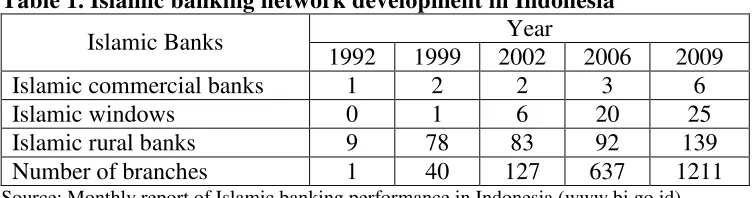
Table 1 shows that currently there are 6 Islamic commercial banks (i.e., Bank Syariah Mandiri, Bank Muamalat Indonesia, Bank Syariah Mega Indonesia, BRI Syariah, BUKOPIN Syariah, and PANIN Syariah) with 701 branches and 25 conventional banks that have Islamic windows with 286 branches. The number of Islamic rural banks also increased significantly from 92 in 2006 to 139 in 2009. Currently there are 1,211 branches of Islamic banks spread around Indonesia to meet the needs of Muslims in the country.
1
Table 1. Islamic banking network development in Indonesia
Year
Islamic Banks
1992
1999
2002
2006
2009
Islamic commercial banks
1
2
2
3
6
Islamic windows
0
1
6
20
25
Islamic rural banks
9
78
83
92
139
Number of branches
1
40
127
637
1211
Source: Monthly report of Islamic banking performance in Indonesia (www.bi.go.id)
However, Islamic banks in Indonesia as well as some other countries like Pakistan seem unable to capitalize their potential market that reaches 232 million and 161 million Muslims respectively. Total assets of Islamic banking in Indonesia is only USD3,267 million, or equivalent to about 10 percent of total assets of Islamic banking in Malaysia and 25 percent of total assets in Turkey (Table 2). It remains a question as to why the asset size developed rather slowly. Could it be due to the ignorance of Indonesian Muslims who cannot differentiate between Islamic banks from its conventional counterpart? Or is it because Islamic banks could not differentiate its potential customers very well in such a way that they cannot formulate a better marketing strategy?
This research tries to find answers to the above-mentioned questions. This article contributes to the literature in a number of ways. First, it provides a quantitative analysis of the Islamic bank-selection criteria whose studies have been limited especially for the case of Indonesia. Secondly, it uses modeling within the microeconomic framework to understand further the performance of Islamic bank so that better policy can be proposed. Thirdly, this study incorporates religiosity as well as psychological factors in bank selection criteria which according to Takemura and Kozu (2009) have not yet been analyzed much in economic and banking field. They argued that most researchers when analyzing bank failures tend to focus on liquidity and credit risk management, and failed to look at the behavior of individuals.
Table 2. Comparison of Islamic banking development in Indonesia and other countries*
Total Assets
Indonesia
3,267
6
232 millions
(80% Muslim)
1.7%
Malaysia
34,543
11
26.6 millions
(60% Muslim)
13%
Pakistan
2,231
6
161 millions
(96% Muslim)
3.2%
Turkey
12,902
4
74.3 millions
(97% Muslim)
3.25%
*Wouters (2007) with some adjustmentsThe paper is organized as follows. Section two discusses previous studies on bank selection criteria covering both conventional and Islamic banks. Next it will present the model and data used in the study. Section four discusses the estimated results and implications derived from it. Finally, section five will present the conclusions and suggested future research.
2. Literature Review
be found but most of them identified the same factors although the degree of importance of these factors might be different.
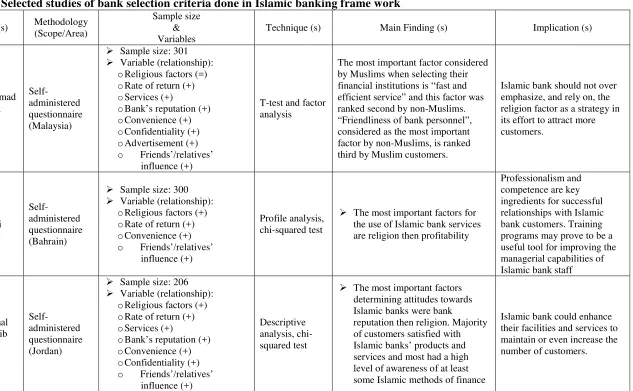
In contrast to the large number of studies in consumers’ perceptions, patronage and satisfaction with conventional bank services that could reach hundreds, Gait and Worthington (2008) found the opposite is true for Islamic banking. Selected studies of banking selection criteria done on Islamic banking is reported in Table 3. Among these, the study done by Erol & El-Bdour (1989) said to be the first study in the area. Erol & El-Bdour (1989) utilize self-administered questionnaire to gather information from 434 Jordanian individual customers about their bank selection criteria. The result conclude that instead of religiosity, other factors like rate of return, facilities and services provided, and the reputation of the bank are the main factors influencing individual customer to patronize particular bank.
Subsequently, Erol et al. (1990) conducted the same survey but this time they collected information from both Islamic bank’s depositors and conventional bank’s depositors. The result shows a lot of similarity in term of the selection criteria; however, they found that the depositors from the two types of bank are significantly different in the viewpoint of bank pricing policies. The findings of this study indicate that bank customers do not differentiate between the services offered by conventional and Islamic banks. Therefore Islamic banks are not distinguishing themselves in terms of services they offer. The implication is that the services offered by Islamic banks should not be a duplication of existing commercial banking activities.
In Malaysia, Haron et al. (1994) studied the selection criteria of Muslim and non-Muslim customers in patronizing a particular bank. They found that the most important factor considered by Muslims when selecting their financial institutions is “fast and efficient service” and this factor was ranked second by non-Muslims. “Friendliness of bank personnel”, considered as the most important factor by non-Muslims, is ranked third by Muslim customers. The implication is that Islamic bank should not over emphasize, and rely on, the religion factor as a strategy in its effort to attract more customers. Later, Hegazy (1995) in Egypt, Naser et al. (1999) in Jordan, Karim and Afiff (2006) and Rohimah (2006) in Indonesia and Dusuki and Abdullah (2007) in Malaysia, all obtained similar conclusion and show that religiosity is not the main reason for customers to patronize Islamic banks.
One exception to the above result is the study by Metwala and Almossawi (1998) who analyzed selection criteria variables such as rate of return, convenience, services and others together with religiosity. Using profile analysis and non-parametric test, they found that the most important factors for the use of Islamic bank services are religion followed by profitability. In addition, Haron and Wan Azmi (2008) investigate the impact of selected economic variables on deposits level in the Islamic and conventional banking systems in Malaysia. The methodology utilized by Haron and Wan Azmi (2008) were co-integration and error correction framework, which are conducted within the vector autoregression framework. They found that customers of conventional banks behave in conformity with the savings behavior theories. In contrast, most of these theories are not applicable to Islamic banking customers. Therefore, there is a possibility that religious belief plays an important role in the banking decisions of Muslim customers.
In Indonesia, Bank Indonesia (BI) together with Bogor Agricultural University (IPB) conducted a series of Islamic bank selection surveys covering West, Central, and East Java as well as West Sumatera and South Kalimantan from 2000 until 2005. The total number of respondents was approximately 7,000. The results indicate that the main factors in customers patronizing Islamic banks are service quality and convenience. Religiosity comes after those two factors. This is not surprising as about 55 percent of the respondents believes that riba is not forbidden in Islam. This study which comes a year after Bank Indonesia released the results of their survey, expects people now to be more educated and able to recognize the differences between Islamic bank and conventional bank.
Based on the previous studies and reasons given above, we therefore formulate our hypotheses as follows:
H1: Religiosity such as consideringshariahcompliant issue and payingshadaqahregularly discriminate between
conventional and Islamic bank customers
H3: Perception towards profit given by Islamic banks discriminate between conventional and Islamic bank
customers
H4: Perception towards safety given by Islamic banks discriminate between conventional and Islamic bank
customers
H5: Perception towards facilities & services offered by Islamic banks discriminate between conventional and
Islamic bank customers
H6: Perception towards conveniences given by Islamic banks discriminate between conventional and Islamic bank
customers
H7: Perception towards advertisements produced by Islamic banks discriminate between conventional and Islamic
Table 3. Selected studies of bank selection criteria done in Islamic banking frame work
Technique (s) Main Finding (s) Implication (s)
Haron, Ahmad
The most important factor considered by Muslims when selecting their financial institutions is “fast and efficient service” and this factor was ranked second by non-Muslims. “Friendliness of bank personnel”, considered as the most important factor by non-Muslims, is ranked third by Muslim customers.
Islamic bank should not over emphasize, and rely on, the religion factor as a strategy in its effort to attract more customers.
The most important factors for the use of Islamic bank services are religion then profitability programs may prove to be a useful tool for improving the managerial capabilities of
The most important factors determining attitudes towards Islamic banks were bank
reputation then religion. Majority of customers satisfied with Islamic banks’ products and services and most had a high level of awareness of at least some Islamic methods of finance
3. Data and Methodology 3.1. Data
Data in this study were collected during the month of June 2006 in the city of Bogor, which has a population of approximately 750 thousands life.2 A total of 300 questionnaires were randomly administered to customers who patronized the branches of two Islamic banks and six conventional banks. Out of the 300 questionnaire, only 260 were usable for analysis.
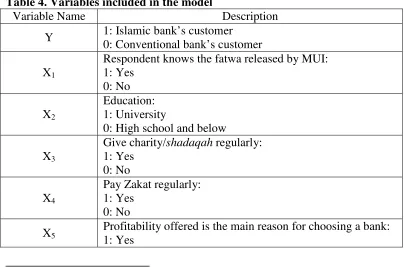
The collected data include 11 main attributes and behaviors such as bank chosen as dependent variable, religiosity, level of education, bank’s advertisement, bank’s facilities and services and some more as the covariates of the model (Table 4).
3.2. Methodology 3.2.1. Model
This paper aims to investigate relationship between individual’s attributes and behavior with their preferences to patronize Islamic banking in Indonesia. The dependent variable is binomial whereby code 1 means he chooses to patronize Islamic banks and code 0 means he chooses not to patronize Islamic banks for the time when they interviewed.
In order to overcome the limitations in the distributions of the dependent variable, binary logistic regression has been widely utilized. Generally, binary logistic regression depicts the relationship between binomially distributed dependent variable with its explanatory variables by taking the logarithm of both sides of equation. The dependent variable is denoted byp, the probability of certain event happens.
The relationship is described in equation (1) and (2).
])
Table 4. Variables included in the model
Variable Name
Description
Y
1: Islamic bank’s customer
0: Conventional bank’s customer
X
1Respondent knows the fatwa released by MUI:
1: Yes
0: No
X
2Education:
1: University
0: High school and below
X
3Profitability offered is the main reason for choosing a bank:
1: Yes
2
0: No
X
6Safety feeling is the main reason for choosing a bank:
1: Yes
0: No
X
7Facilities and services offered by Islamic bank:
1: Facilities & Services offered are enough
0: Facilities & Services offered are not enough
X
8Convenience is the main reason for choosing a bank:
1: Yes
0: No
X
9Shariah
compliant is the main reason for choosing a bank:
1: Yes
0: No
X
10Bank’s advertisement is the main reason for choosing a
bank:
1: Yes
0: No
3.2.2. Statistical Procedures
A logistic regression model is a form of regression whereby the distribution of the dependent variable is dichotomous or binary and the explanatory variables are continuous or categorical or both. It is an estimation technique for equations with dummy dependent variables that avoids the unboundedness problem of the linear probability model by using a variant of the cumulative logistic function (Studenmund, 2006):
]
In estimating a logit, we apply the Maximum Likelihood technique (MLT) to Equation (3). One of the reasons why MLT is used is that MLT has a number of desirable large sample properties; MLT is unbiased and minimum variance for large samples (Studentmund, 2006). However, it is also important to give attention in balancing the responses of the two groups.
The binary logistic regression therefore avoids the problem that the linear probability model encounters in dealing with dummy dependent variables. Since real-world data often described by not-too-linear patterns, this technique is quite satisfying for most researchers. For instance in marketing, Akinci et.al (2007) say that logistic regression can generates more appropriate and correct findings in terms of model fit and correctness of the analysis.
4. Findings and Discussions 4.1. Individual’s choice of bank
The event for the explained variable from equation (1) or (2) is whether the individual is a customer of Islamic banks or not with several criteria observed that embedded to them. Thus, it is defined as follows:
Figure 1. Distribution of individual’s choice of bank
The distribution of the individual’s choice of bank is shown in Figure 1. Respondents who are Islamic banks’ customer total 136 (52%) and for non-Islamic banks’ customer total 124 (48%).
4.2. Explanatory variables
We found that 83.1% of the respondents are aware of the fatwa announced by MUI and that 79.2% and 75.8% respectively pay zakat and shadaqah regularly. Table 5 also shows that respondents’ level of education, their choice of selecting a political party during the general election, perception towards facilities and services offered by Islamic banks are fairly distributed.
Table 5. Descriptive statistics of respondents
Variable
Frequency
Percentage
Knows the fatwa of MUI
216
83.1
X
1Does not know
44
16.9
University
149
57.3
X
2High school and below
111
42.7
Gives charity/
shadaqah
regularly
206
79.2
X
3Does not give charity/
shadaqah
regularly
54
20.8
Pays zakat regularly
197
75.8
X
4Does not pay zakat regularly
63
24.2
Profitability :yes
13
5
X
5Profitability: no
247
95
Safety: yes
181
69.6
X
6Safety: no
79
30.4
F&S offered are enough
140
53.8
X
7F&S offered are not enough
120
46.2
Convenience: yes
71
27.3
X
8Convenience: no
189
72.7
Shariah
compliant: yes
52
20
X
9Shariah
compliant: no
208
80
Bank’s advertisement: yes
181
69.6
X
104.3. Logistic Regression
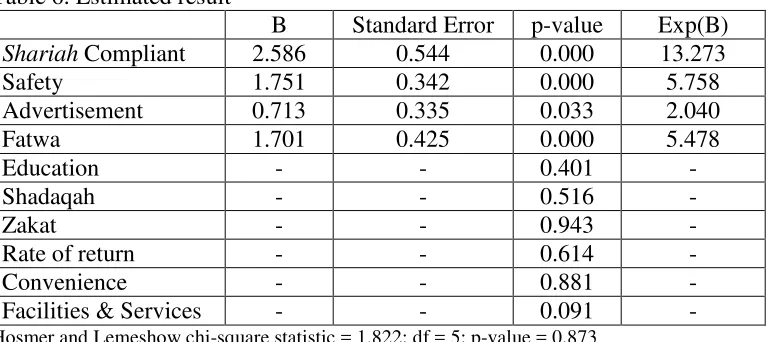
In this part we analyze the data using the model developed in equation (2) by running a forward stepwise method of logistic regression by likelihood ratio (Table 6). The results are that 4 out of 10 explanatory variables survived through this method of examination.
Table 6. Estimated result
B
Standard Error
p-value
Exp(B)
Shariah
Compliant
2.586
0.544
0.000
13.273
Safety
1.751
0.342
0.000
5.758
Advertisement
0.713
0.335
0.033
2.040
Fatwa
1.701
0.425
0.000
5.478
Education
-
-
0.401
-Shadaqah
-
-
0.516
-Zakat
-
-
0.943
-Rate of return
-
-
0.614
-Convenience
-
-
0.881
-Facilities & Services
-
-
0.091
-Hosmer and Lemeshow chi-square statistic = 1.822; df = 5; p-value = 0.873
The estimated coefficient parameter of theshariah compliant (X9), perception about safety of fund deposited (X6),
bank’s advertisement (X10), and knowing fatwa (X1) are statistically significant. On the other hand, those of other
explanatory variables are not statistically significant. Of the question whether the model is fit or not is explained by the Hosmer and Lemeshow test. From the result of Hosmer and Lemeshow test, whereby p-value is much greater than 0.05, we can conclude that goodness of fit test is valid for this model.
This result is very important and particularly useful for Islamic banks which have the intention to expand their market share. Referring to the variables which survived through the stepwise method, an individual who seeks for shariahcompliant deposit account are much more likely to deposit their money at Islamic banks as compared to individuals who are not concern with shariah issues. This can be understood as a religious factor influencing individual’s decision to patronize banks. Muslims patronize Islamic banks due to their conviction that it is a sin to receive and pay bank interest.
The remaining three variables survived are due to Islamic banks’ effort in promoting unique features of depositing money at Islamic banks while keeping people reminded that interest is prohibited in Islam. This could be due to the widespread awareness of the fatwa announced by MUI as can be seen in Table 5 where the ratio of those who knows to those who don’t know is 5 to 1. In addition, the advertisement done by Islamic bank to promote their products seems to be working. This can be seen by Exp(B) value which is equal to 2.040, which means the possibility of people perceive Islamic banks’ advertisement is attractive to deposit their money in is about twice greater than those who perceive otherwise. This implies that in this current modern world, marketing plays an important role regardless of the types of banks.
The results also show bank customers tend to view Islamic banks as more secured meaning that their funds will be in safe hands. The probability of those who believe so is almost six times greater than those who perceive otherwise. We suggest that Islamic banks should capitalize on this issue and promote the bank as a safe and secured institution. The main reason for the emergence of this perception towards safety of fund is due to Bank Muamalat Indonesia (BMI), as the only Islamic bank in Indonesia until 1999, which had performed very well during the 1997/1998 Asian financial crisis which hit Indonesia severely and led to the collapse of many banks.
Although Islamic banking in Indonesia had started almost twenty years ago, their market share is still below three percent. It is below Malaysia, Turkey, and Pakistan. This situation can be explained by a number of reasons. Among them is the inability of Islamic banks to identify factors that can attract customers to their banks. This paper aims to give insight on Islamic bank selection criteria; factors that are considered important to Islamic bank customers.
Out of 10 explanatory variables, 4 are chosen through the forward stepwise method with statistically significant result. These are religiosity as measured byshariahcompliant, awareness of the MUI fatwa, perceptions towards safety of fund and advertisement of Islamic banks. Therefore, as the findings provided in this paper, Islamic banks in Indonesia should by now be able to identify their potential depositors and hence expand their market share. 6. References
Akinci, S., Kaynak, E., Atilgan, E., and Aksoy, Ş. (2007). Where does the logistic regression analysis stand in marketing literature? A comparison of the market positioning of prominent marketing journals. European Journal of Marketing, 41(5/6), 537-567.
Almossawi, M. (2001). Bank selection criteria employed by college students in Bahrain: An empirical analysis. International Journal of Bank Marketing, 19 (3), 115-125.
Bank Indonesia and Bogor Agricultural University. (2005). Pemetaan Hasil Penelitian Potensi, Preferensi, dan Perilaku Masyarakat Terhadap Bank Syariah di Indonesia [Potency, Preference, and People’s Behaviour Toward Islamic Bank in Indonesia: A Compilation]. Jakarta: Author.
Dusuki, Asyraf Wajdi and Abdullah, Nurdianawati Irwani. (2007). Why do Malaysian customers patronize Islamic banks?International Journal of Bank Marketing, 25 (3), 142-160.
Erol, C. and El-Bdour, R. (1989). Attitude, behavior and patronage factors of bank customers towards Islamic banks.International Journal of Bank Marketing, 7 (6), 31-37.
Erol, C., Kaynak, E. and El-Bdour, R. (1990). Conventional and Islamic bank: Patronage behavior of Jordanian customers.International Journal of Bank Marketing, 8 (5), 25-35.
Gait, Alsadek and Worthington, Andrew. (2008). An empirical survey of individual consumer, business firm, and financial institution attitudes towards Islamic methods of finance.International journal of Social Economics, 35 (11), 783-808.
Haron, Sudin and Wan Azmi, Wan Nursofiza. (2008). Determinants of Islamic and conventional deposits in the Malaysian banking system.Managerial Finance, 34 (9), 618-643.
Haron, Sudin., Norafifah Ahmad and Sandra L. Planisek. (1994). Bank Patronage Factors of Muslim and Non-Muslim Customers.International Journal of Bank Marketing, 12 (1), 32-40.
Hegazy, Ibrahim A. (1995). An empirical comparative study between Islamic and commercial banks’ selection criteria in Egypt.International Journal of Bank Marketing, 5 (3), 46-61.
Karim, Adiwarman A. and Affif, Adi Zakaria. (2006). Islamic banking consumer behavior in Indonesia: A qualitative approach. Paper presented at the 7th International Conference on Islamic Economics, 1-3 April 2008, King Abdul Aziz University, Jeddah, Saudi Arabia.
Kaynak, E. and Harcar, T. (2005). American consumers’ attitudes towards commercial banks. International Journal of Bank Marketing, 23 (1), 73-89.
Kennington, C., Hill, J. and Rakowska, A. (1996). Consumer selection criteria for banks in Poland. International Journal of Bank Marketing, 17 (5), 12-21.
Metawa, Saad A. and Almossawi, Mohammed. (1998). Banking behavior of Islamic bank customers: perspectives and implications.International Journal of Bank Marketing, 16 (7), 299-313.
Owusu-Frimpong, N. (1999). Patronage behavior of Ghanaian bank customers. International Journal of Bank Marketing, 17 (7), 335-341.
Rohimah, Nyimas. (2006). Deposit determinants of Islamic banks in Indonesia: an ARDL modeling approach. Master Thesis, KENMS IIUM. Unpublished.
Şafakli, Okan Veli. (2007). A research on the basic motivational factors in consumer bank selection: evidence from Northern Cyprus.Banks and Banks System, 2 (4), 93-100.
Saunders, SG., Bendixen, M. and Abratt, Russel. (2007). Banking patronage motives of the urban informal poor. Journal of Services Marketing, 21 (1), 52-63.
Studenmund, A. H. (2006).Using Econometrics: a practical guide. 5thedition. Pearson Addison-Wesley.
Ta, Huu Phuong. and Har, Kar Yin. (2000). A study of bank selection decisions in Singapore using the analytical hierarchical process.International Journal of Bank Marketing, 18 (4), 170-180.
Takemura, Toshihiko and Kozu, Takashi. (2009). An empirical analysis on individuals deposit withdrawal behaviors using data collected through a web-based survey.Eurasian Journal of Business and Economics, 2 (4), 27-41.